
MADE BY
Udit jain
Himanshu jain
Navneet yadav
CONTENTS
• INTRODUCTION
• HISTORY
*DEVELOPMENT
*TECHNOLOGY
*DECLINE
• ADVANTAGES
• DISADVANTAGES
• PROVIDERS
• COMPARISON
INTRODUCTION
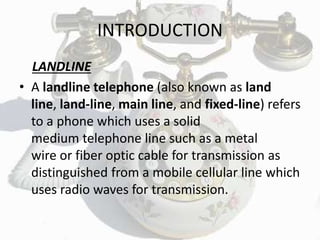
LANDLINE
• A landline telephone (also known as land
line, land-line, main line, and fixed-line) refers
to a phone which uses a solid
medium telephone line such as a metal
wire or fiber optic cable for transmission as
distinguished from a mobile cellular line which
uses radio waves for transmission.
HISTORY
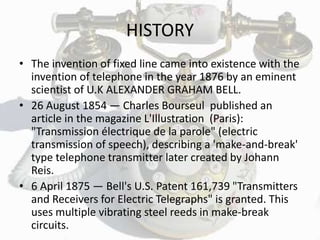
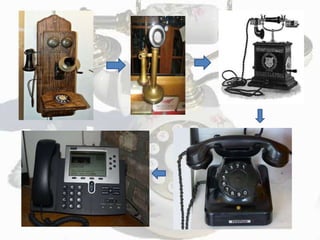
• The invention of fixed line came into existence with the
invention of telephone in the year 1876 by an eminent
scientist of U.K ALEXANDER GRAHAM BELL.
• 26 August 1854 — Charles Bourseul published an
article in the magazine L'Illustration (Paris):
"Transmission électrique de la parole" (electric
transmission of speech), describing a 'make-and-break'
type telephone transmitter later created by Johann
Reis.
• 6 April 1875 — Bell's U.S. Patent 161,739 "Transmitters
and Receivers for Electric Telegraphs" is granted. This
uses multiple vibrating steel reeds in make-break
circuits.
DEVELOPEMENT
• Alexander Graham Bell's invention was based
on the electric telegraph. Several different
telephone designs appeared shortly after
Bell's, but they were all landlines, connected
through transmission wires. Once telephones
became common, central operating
switchboards appeared in which physical
connections were made by operators so that
telephone users could talk to one another.
TECHNOLOGY
• Landline telephones, from Bell's onward,
operated on the principle of electrical resistance.
When a user speaks into a landline phone's
handset, he activates a microphone that sends an
electrical current through a pair of insulated
wires.
• The current follows a physical course, passing
through a telephone exchange, where it is re-
transmitted to the listener on the other end of
the connection and converted to sound. Even
"wireless" phones using landline networks
employ a physical connection, replacing the cord
between the phone and the handset with a radio
signal.
DECLINE
• Digital telephone signals were introduced in the
1960s and began to replace analog signals.
Cellular networks appeared in the 1970s, using a
modem to transmit a telephone signal without
the use of a wired network. Cell phones were
approved by the Federal Communications
Commission and became available to the public
in the 1980s, though quality was generally poor
and usage was expensive.
• In the late 1990s, a new generation of cell
phones made use of new digital network
technology, replacing many private landlines and
bringing telephone service to parts of the world
where landlines never were installed.
ADVANTAGES
• Even with cell-phone use on the rise and landline use
declining, landline telephones do present advantages
over cell phones. The biggest advantage is consistent
fidelity of the telephone signal.
• Landlines don't suffer from the signal problems cell
phones face during bad weather or in remote areas.
Landline telephones do not require an electrical
connection and are operational during power outages--
whereas cell phones rely on relay towers that must be
powered to receive or send a signal.
DISADVANTAGES
• The biggest disadvantage to landline telephones
is their immobility. While cell phones can be
taken and used almost anywhere, landline
phones can be used only in or near the home or
office.
• The landline may represent a redundant service
and an added cost for those with a cell phone,
though most basic landline service packages cost
less than basic cell-phone plans. Landline phones
are quickly losing their quality advantage as cell
phones' audio signals and reliability improve.
FIXED LINE SERVICE PROVIDERS
MAJOR SERVICE PROVIDERS
• B.S.N.L.
• AIRTEL
• TATA COMMUNICATIONS
• RELIANCE COMMUNICATIONS
OTHER SERVICE PROVIDERS
• IDEA
• MTS
COMPARISON BETWEEN MAJOR
OPERATORS
COMPARISON BASES
• TARRIF
• VALUE ADDED SERVICES
• INTERNET SERVICES
• COVERAGE AREAS
TARRIF PLANS
• Tarrif plans are subjected to change according
to the regions
• Within a single region there may be more than
10 different tarrif plans available by a single
service provider
• For the sake of simplicity I have compared
tarrif plans by different service providers in
the delhi-ncr region
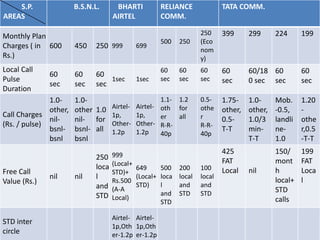
S.P.
AREAS
B.S.N.L. BHARTI
AIRTEL
RELIANCE
COMM.
TATA COMM.
Monthly Plan
Charges ( in
Rs.)
600 450 250 999 699
500 250
250
(Eco
nom
y)
399 299 224 199
Local Call
Pulse
Duration
60
sec
60
sec
60
sec
1sec 1sec
60
sec
60
sec
60
sec
60
sec
60/18
0 sec
60
sec
60
sec
Call Charges
(Rs. / pulse)
1.0-
other,
nil-
bsnl-
bsnl
1.0-
other
nil-
bsnl-
bsnl
1.0
for
all
Airtel-
1p,
Other-
1.2p
Airtel-
1p,
Other-
1.2p
1.1-
oth
er
R-R-
40p
1.2
for
all
0.5-
othe
r
R-R-
40p
1.75-
other,
0.5-
T-T
1.0-
other,
1.0/3
min-
T-T
Mob.
-0.5,
landli
ne-
1.0
1.20
-
othe
r,0.5
-T-T
Free Call
Value (Rs.)
nil nil
250
loca
l
and
STD
999
(Local+
STD)+
Rs.500
(A-A
Local)
649
(Local+
STD)
500
loca
l
and
STD
200
local
and
STD
100
local
and
STD
425
FAT
Local nil
150/
mont
h
local+
STD
calls
199
FAT
Loca
l
STD inter
circle
Airtel-
1p,Oth
er-1.2p
Airtel-
1p,Oth
er-1.2p
TYPES VALUE ADDED SERVICES
• Call forwarding (or call diversion) is a feature on
some telephone networks which let an incoming
call to a called party to be redirected to a third
party. For example, the third party may be
a mobile telephone, voicemail box or
other telephone number where the desired
called party is situated.
• Three Party Conference adds a third party to an
existing call, allowing you and the other two
parties to speak together in a three-way
conference.
• PARALLEL RINGING With parallel ringing you
will never miss a call even when you’re away
from your fixed line. Share your fixed line
number and get incoming calls simultaneously
on two phones - your landline and your
mobile.The ringing stops on the other line as
soon as you pick up any one phone.So never
miss a call now.
• CALL RESTRICTION With Call Restriction you
can manage chargeable calls (calls that are
outside your calling area, 0900 services or
mobile calls) made from your home phone.
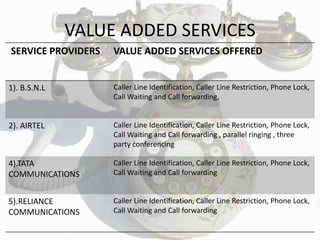
SERVICE PROVIDERS VALUE ADDED SERVICES OFFERED
1). B.S.N.L Caller Line Identification, Caller Line Restriction, Phone Lock,
Call Waiting and Call forwarding,
2). AIRTEL Caller Line Identification, Caller Line Restriction, Phone Lock,
Call Waiting and Call forwarding , parallel ringing , three
party conferencing
4).TATA
COMMUNICATIONS
Caller Line Identification, Caller Line Restriction, Phone Lock,
Call Waiting and Call forwarding
5).RELIANCE
COMMUNICATIONS
Caller Line Identification, Caller Line Restriction, Phone Lock,
Call Waiting and Call forwarding
VALUE ADDED SERVICES
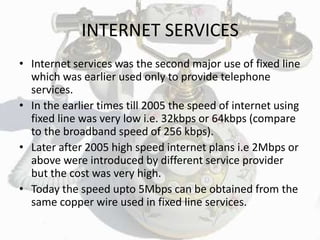
INTERNET SERVICES
• Internet services was the second major use of fixed line
which was earlier used only to provide telephone
services.
• In the earlier times till 2005 the speed of internet using
fixed line was very low i.e. 32kbps or 64kbps (compare
to the broadband speed of 256 kbps).
• Later after 2005 high speed internet plans i.e 2Mbps or
above were introduced by different service provider
but the cost was very high.
• Today the speed upto 5Mbps can be obtained from the
same copper wire used in fixed line services.
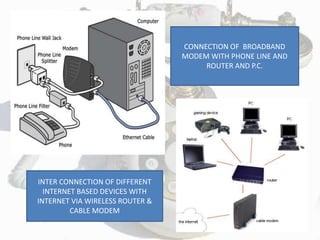
CONNECTION OF BROADBAND
MODEM WITH PHONE LINE AND
ROUTER AND P.C.
INTER CONNECTION OF DIFFERENT
INTERNET BASED DEVICES WITH
INTERNET VIA WIRELESS ROUTER &
CABLE MODEM
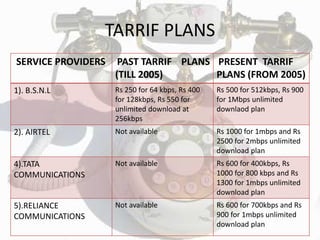
TARRIF PLANS
SERVICE PROVIDERS PAST TARRIF PLANS
(TILL 2005)
PRESENT TARRIF
PLANS (FROM 2005)
1). B.S.N.L Rs 250 for 64 kbps, Rs 400
for 128kbps, Rs 550 for
unlimited download at
256kbps
Rs 500 for 512kbps, Rs 900
for 1Mbps unlimited
downlaod plan
2). AIRTEL Not available Rs 1000 for 1mbps and Rs
2500 for 2mbps unlimited
download plan
4).TATA
COMMUNICATIONS
Not available Rs 600 for 400kbps, Rs
1000 for 800 kbps and Rs
1300 for 1mbps unlimited
download plan
5).RELIANCE
COMMUNICATIONS
Not available Rs 600 for 700kbps and Rs
900 for 1mbps unlimited
download plan
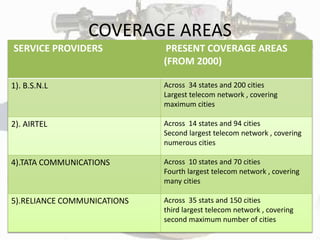
COVERAGE AREAS
SERVICE PROVIDERS PRESENT COVERAGE AREAS
(FROM 2000)
1). B.S.N.L Across 34 states and 200 cities
Largest telecom network , covering
maximum cities
2). AIRTEL Across 14 states and 94 cities
Second largest telecom network , covering
numerous cities
4).TATA COMMUNICATIONS Across 10 states and 70 cities
Fourth largest telecom network , covering
many cities
5).RELIANCE COMMUNICATIONS Across 35 stats and 150 cities
third largest telecom network , covering
second maximum number of cities
COMPARISON OF FIXED LINE SERVICES

COMPARISON OF FIXED LINE SERVICES

  • 1.
    MADE BY Udit jain Himanshujain Navneet yadav
  • 2.
    CONTENTS • INTRODUCTION • HISTORY *DEVELOPMENT *TECHNOLOGY *DECLINE •ADVANTAGES • DISADVANTAGES • PROVIDERS • COMPARISON
  • 3.
    INTRODUCTION LANDLINE • A landlinetelephone (also known as land line, land-line, main line, and fixed-line) refers to a phone which uses a solid medium telephone line such as a metal wire or fiber optic cable for transmission as distinguished from a mobile cellular line which uses radio waves for transmission.
  • 4.
    HISTORY • The inventionof fixed line came into existence with the invention of telephone in the year 1876 by an eminent scientist of U.K ALEXANDER GRAHAM BELL. • 26 August 1854 — Charles Bourseul published an article in the magazine L'Illustration (Paris): "Transmission électrique de la parole" (electric transmission of speech), describing a 'make-and-break' type telephone transmitter later created by Johann Reis. • 6 April 1875 — Bell's U.S. Patent 161,739 "Transmitters and Receivers for Electric Telegraphs" is granted. This uses multiple vibrating steel reeds in make-break circuits.
  • 6.
    DEVELOPEMENT • Alexander GrahamBell's invention was based on the electric telegraph. Several different telephone designs appeared shortly after Bell's, but they were all landlines, connected through transmission wires. Once telephones became common, central operating switchboards appeared in which physical connections were made by operators so that telephone users could talk to one another.
  • 7.
    TECHNOLOGY • Landline telephones,from Bell's onward, operated on the principle of electrical resistance. When a user speaks into a landline phone's handset, he activates a microphone that sends an electrical current through a pair of insulated wires. • The current follows a physical course, passing through a telephone exchange, where it is re- transmitted to the listener on the other end of the connection and converted to sound. Even "wireless" phones using landline networks employ a physical connection, replacing the cord between the phone and the handset with a radio signal.
  • 8.
    DECLINE • Digital telephonesignals were introduced in the 1960s and began to replace analog signals. Cellular networks appeared in the 1970s, using a modem to transmit a telephone signal without the use of a wired network. Cell phones were approved by the Federal Communications Commission and became available to the public in the 1980s, though quality was generally poor and usage was expensive. • In the late 1990s, a new generation of cell phones made use of new digital network technology, replacing many private landlines and bringing telephone service to parts of the world where landlines never were installed.
  • 9.
    ADVANTAGES • Even withcell-phone use on the rise and landline use declining, landline telephones do present advantages over cell phones. The biggest advantage is consistent fidelity of the telephone signal. • Landlines don't suffer from the signal problems cell phones face during bad weather or in remote areas. Landline telephones do not require an electrical connection and are operational during power outages-- whereas cell phones rely on relay towers that must be powered to receive or send a signal.
  • 10.
    DISADVANTAGES • The biggestdisadvantage to landline telephones is their immobility. While cell phones can be taken and used almost anywhere, landline phones can be used only in or near the home or office. • The landline may represent a redundant service and an added cost for those with a cell phone, though most basic landline service packages cost less than basic cell-phone plans. Landline phones are quickly losing their quality advantage as cell phones' audio signals and reliability improve.
  • 11.
    FIXED LINE SERVICEPROVIDERS MAJOR SERVICE PROVIDERS • B.S.N.L. • AIRTEL • TATA COMMUNICATIONS • RELIANCE COMMUNICATIONS OTHER SERVICE PROVIDERS • IDEA • MTS
  • 12.
    COMPARISON BETWEEN MAJOR OPERATORS COMPARISONBASES • TARRIF • VALUE ADDED SERVICES • INTERNET SERVICES • COVERAGE AREAS
  • 13.
    TARRIF PLANS • Tarrifplans are subjected to change according to the regions • Within a single region there may be more than 10 different tarrif plans available by a single service provider • For the sake of simplicity I have compared tarrif plans by different service providers in the delhi-ncr region
  • 14.
    S.P. AREAS B.S.N.L. BHARTI AIRTEL RELIANCE COMM. TATA COMM. MonthlyPlan Charges ( in Rs.) 600 450 250 999 699 500 250 250 (Eco nom y) 399 299 224 199 Local Call Pulse Duration 60 sec 60 sec 60 sec 1sec 1sec 60 sec 60 sec 60 sec 60 sec 60/18 0 sec 60 sec 60 sec Call Charges (Rs. / pulse) 1.0- other, nil- bsnl- bsnl 1.0- other nil- bsnl- bsnl 1.0 for all Airtel- 1p, Other- 1.2p Airtel- 1p, Other- 1.2p 1.1- oth er R-R- 40p 1.2 for all 0.5- othe r R-R- 40p 1.75- other, 0.5- T-T 1.0- other, 1.0/3 min- T-T Mob. -0.5, landli ne- 1.0 1.20 - othe r,0.5 -T-T Free Call Value (Rs.) nil nil 250 loca l and STD 999 (Local+ STD)+ Rs.500 (A-A Local) 649 (Local+ STD) 500 loca l and STD 200 local and STD 100 local and STD 425 FAT Local nil 150/ mont h local+ STD calls 199 FAT Loca l STD inter circle Airtel- 1p,Oth er-1.2p Airtel- 1p,Oth er-1.2p
  • 15.
    TYPES VALUE ADDEDSERVICES • Call forwarding (or call diversion) is a feature on some telephone networks which let an incoming call to a called party to be redirected to a third party. For example, the third party may be a mobile telephone, voicemail box or other telephone number where the desired called party is situated. • Three Party Conference adds a third party to an existing call, allowing you and the other two parties to speak together in a three-way conference.
  • 16.
    • PARALLEL RINGINGWith parallel ringing you will never miss a call even when you’re away from your fixed line. Share your fixed line number and get incoming calls simultaneously on two phones - your landline and your mobile.The ringing stops on the other line as soon as you pick up any one phone.So never miss a call now. • CALL RESTRICTION With Call Restriction you can manage chargeable calls (calls that are outside your calling area, 0900 services or mobile calls) made from your home phone.
  • 17.
    SERVICE PROVIDERS VALUEADDED SERVICES OFFERED 1). B.S.N.L Caller Line Identification, Caller Line Restriction, Phone Lock, Call Waiting and Call forwarding, 2). AIRTEL Caller Line Identification, Caller Line Restriction, Phone Lock, Call Waiting and Call forwarding , parallel ringing , three party conferencing 4).TATA COMMUNICATIONS Caller Line Identification, Caller Line Restriction, Phone Lock, Call Waiting and Call forwarding 5).RELIANCE COMMUNICATIONS Caller Line Identification, Caller Line Restriction, Phone Lock, Call Waiting and Call forwarding VALUE ADDED SERVICES
  • 18.
    INTERNET SERVICES • Internetservices was the second major use of fixed line which was earlier used only to provide telephone services. • In the earlier times till 2005 the speed of internet using fixed line was very low i.e. 32kbps or 64kbps (compare to the broadband speed of 256 kbps). • Later after 2005 high speed internet plans i.e 2Mbps or above were introduced by different service provider but the cost was very high. • Today the speed upto 5Mbps can be obtained from the same copper wire used in fixed line services.
  • 19.
    CONNECTION OF BROADBAND MODEMWITH PHONE LINE AND ROUTER AND P.C. INTER CONNECTION OF DIFFERENT INTERNET BASED DEVICES WITH INTERNET VIA WIRELESS ROUTER & CABLE MODEM
  • 20.
    TARRIF PLANS SERVICE PROVIDERSPAST TARRIF PLANS (TILL 2005) PRESENT TARRIF PLANS (FROM 2005) 1). B.S.N.L Rs 250 for 64 kbps, Rs 400 for 128kbps, Rs 550 for unlimited download at 256kbps Rs 500 for 512kbps, Rs 900 for 1Mbps unlimited downlaod plan 2). AIRTEL Not available Rs 1000 for 1mbps and Rs 2500 for 2mbps unlimited download plan 4).TATA COMMUNICATIONS Not available Rs 600 for 400kbps, Rs 1000 for 800 kbps and Rs 1300 for 1mbps unlimited download plan 5).RELIANCE COMMUNICATIONS Not available Rs 600 for 700kbps and Rs 900 for 1mbps unlimited download plan
  • 21.
    COVERAGE AREAS SERVICE PROVIDERSPRESENT COVERAGE AREAS (FROM 2000) 1). B.S.N.L Across 34 states and 200 cities Largest telecom network , covering maximum cities 2). AIRTEL Across 14 states and 94 cities Second largest telecom network , covering numerous cities 4).TATA COMMUNICATIONS Across 10 states and 70 cities Fourth largest telecom network , covering many cities 5).RELIANCE COMMUNICATIONS Across 35 stats and 150 cities third largest telecom network , covering second maximum number of cities