z
Comparing Immigration
European v Asian
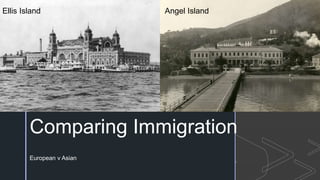
Ellis Island Angel Island
z
Where they came from
Europeans
 Southern & Eastern Europe
(especially Italy, Russia, Greece)
Asians
 China
 Japan
z
Push Factors (Why they left)
European
 Extreme Poverty
 Religious Persecution
 Political Persecution
Asian
 Extreme Poverty
 Political Persecution
 War
z
Pull Factors (Why they came to the US)
European
 Steamships made travel cheaper
 No legal restrictions
 Favorable accounts in
newspapers and letters from
relatives
 Railroads selling land grants
 Promise of factory work
Asian
 Gold rush
 Jobs building the railroads
 Treaty of Burlingame (1868)
allowed “free migration” of
Chinese to America
z
Similar Experiences
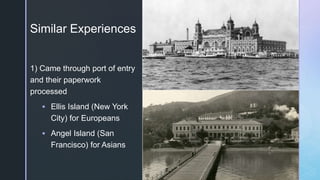
1) Came through port of entry
and their paperwork
processed
 Ellis Island (New York
City) for Europeans
 Angel Island (San
Francisco) for Asians
z
Similar Experiences
2) Were offered only low-paying unskilled jobs
 Americanized: forced to assimilate to American culture
z
Similar Experiences
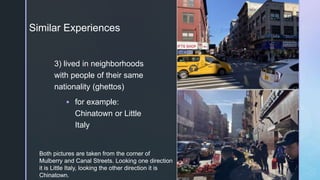
3) lived in neighborhoods
with people of their same
nationality (ghettos)
 for example:
Chinatown or Little
Italy
Both pictures are taken from the corner of
Mulberry and Canal Streets. Looking one direction
it is Little Italy, looking the other direction it is
Chinatown.
z
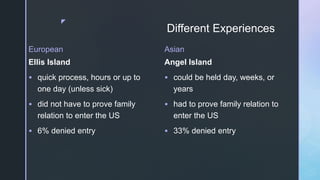
Different Experiences
European
Ellis Island
 quick process, hours or up to
one day (unless sick)
 did not have to prove family
relation to enter the US
 6% denied entry
Asian
Angel Island
 could be held day, weeks, or
years
 had to prove family relation to
enter the US
 33% denied entry
z
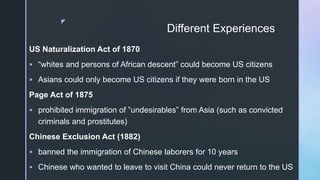
Different Experiences
US Naturalization Act of 1870
 “whites and persons of African descent” could become US citizens
 Asians could only become US citizens if they were born in the US
Page Act of 1875
 prohibited immigration of ”undesirables” from Asia (such as convicted
criminals and prostitutes)
Chinese Exclusion Act (1882)
 banned the immigration of Chinese laborers for 10 years
 Chinese who wanted to leave to visit China could never return to the US
z
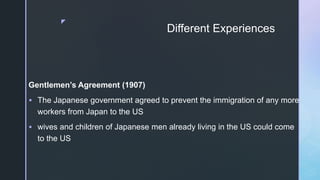
Different Experiences
Gentlemen’s Agreement (1907)
 The Japanese government agreed to prevent the immigration of any more
workers from Japan to the US
 wives and children of Japanese men already living in the US could come
to the US
z
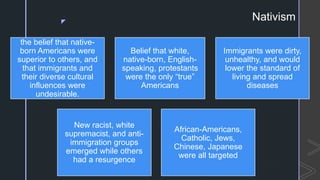
Nativism
the belief that native-
born Americans were
superior to others, and
that immigrants and
their diverse cultural
influences were
undesirable.
Belief that white,
native-born, English-
speaking, protestants
were the only “true”
Americans
Immigrants were dirty,
unhealthy, and would
lower the standard of
living and spread
diseases
New racist, white
supremacist, and anti-
immigration groups
emerged while others
had a resurgence
African-Americans,
Catholic, Jews,
Chinese, Japanese
were all targeted
z
Brainstorm with your Team
Answer the following question in your notes.
 Which group of immigrants do you think faced the
greatest challenges in the United States? Why?
(include information from the notes and this unit to
support your answer)
z
Brainstorm with your Team
Answer the following question in your notes.
 What were the effects of the massive influx of
immigrants to the United States in the late 1800s?
(include information from the notes and this unit to
support your answer)
z
Check-In Questions
Answer the following question in your notes.
 What arguments can you make against nativism and
anti-immigrant feeling? Think About:
 the personal qualities of immigrants
 the reasons for anti-immigrant feeling
 the contributions of immigrants to the United
States
(include information from the notes and this unit to
support your answer)

Comparing Immigration

  • 1.
    z Comparing Immigration European vAsian Ellis Island Angel Island
  • 2.
    z Where they camefrom Europeans  Southern & Eastern Europe (especially Italy, Russia, Greece) Asians  China  Japan
  • 3.
    z Push Factors (Whythey left) European  Extreme Poverty  Religious Persecution  Political Persecution Asian  Extreme Poverty  Political Persecution  War
  • 4.
    z Pull Factors (Whythey came to the US) European  Steamships made travel cheaper  No legal restrictions  Favorable accounts in newspapers and letters from relatives  Railroads selling land grants  Promise of factory work Asian  Gold rush  Jobs building the railroads  Treaty of Burlingame (1868) allowed “free migration” of Chinese to America
  • 5.
    z Similar Experiences 1) Camethrough port of entry and their paperwork processed  Ellis Island (New York City) for Europeans  Angel Island (San Francisco) for Asians
  • 6.
    z Similar Experiences 2) Wereoffered only low-paying unskilled jobs  Americanized: forced to assimilate to American culture
  • 7.
    z Similar Experiences 3) livedin neighborhoods with people of their same nationality (ghettos)  for example: Chinatown or Little Italy Both pictures are taken from the corner of Mulberry and Canal Streets. Looking one direction it is Little Italy, looking the other direction it is Chinatown.
  • 8.
    z Different Experiences European Ellis Island quick process, hours or up to one day (unless sick)  did not have to prove family relation to enter the US  6% denied entry Asian Angel Island  could be held day, weeks, or years  had to prove family relation to enter the US  33% denied entry
  • 9.
    z Different Experiences US NaturalizationAct of 1870  “whites and persons of African descent” could become US citizens  Asians could only become US citizens if they were born in the US Page Act of 1875  prohibited immigration of ”undesirables” from Asia (such as convicted criminals and prostitutes) Chinese Exclusion Act (1882)  banned the immigration of Chinese laborers for 10 years  Chinese who wanted to leave to visit China could never return to the US
  • 10.
    z Different Experiences Gentlemen’s Agreement(1907)  The Japanese government agreed to prevent the immigration of any more workers from Japan to the US  wives and children of Japanese men already living in the US could come to the US
  • 11.
    z Nativism the belief thatnative- born Americans were superior to others, and that immigrants and their diverse cultural influences were undesirable. Belief that white, native-born, English- speaking, protestants were the only “true” Americans Immigrants were dirty, unhealthy, and would lower the standard of living and spread diseases New racist, white supremacist, and anti- immigration groups emerged while others had a resurgence African-Americans, Catholic, Jews, Chinese, Japanese were all targeted
  • 12.
    z Brainstorm with yourTeam Answer the following question in your notes.  Which group of immigrants do you think faced the greatest challenges in the United States? Why? (include information from the notes and this unit to support your answer)
  • 13.
    z Brainstorm with yourTeam Answer the following question in your notes.  What were the effects of the massive influx of immigrants to the United States in the late 1800s? (include information from the notes and this unit to support your answer)
  • 14.
    z Check-In Questions Answer thefollowing question in your notes.  What arguments can you make against nativism and anti-immigrant feeling? Think About:  the personal qualities of immigrants  the reasons for anti-immigrant feeling  the contributions of immigrants to the United States (include information from the notes and this unit to support your answer)

Editor's Notes

  • #13 The Chinese were subjected to interrogation and detention on Angel Island. Nativists pushed for immigration restriction. The Chinese Exclusion Act of 1882 made it extremely difficult for the Chinese to enter the United States.
  • #14 Rapid urban growth; formation of ethnic communities, rise of nativism and anti-immigrant sentiments, competition for jobs
  • #15 Immigrants were brave and willing to work hard; there is value in being exposed to many ways of life; nativists themselves were descendants of immigrants.