Downloaded 58 times
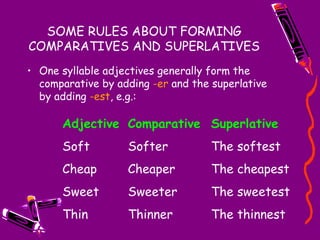

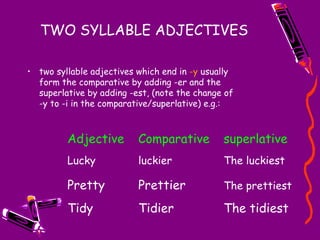
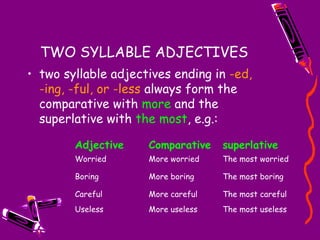

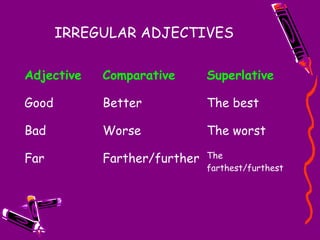


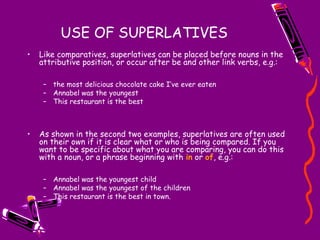



This document provides rules and examples for forming comparative and superlative adjectives in English. It explains that one-syllable adjectives typically form the comparative with -er and superlative with -est. Two-syllable adjectives ending in -y follow the same pattern, while those ending in -ed, -ing, -ful, or -less use 'more' and 'most'. Adjectives with three or more syllables also use 'more' and 'most'. Irregular comparatives like 'good' and 'bad' are also noted. The document discusses using comparatives with 'than' and qualifying them. It also covers using superlatives alone or with prepositional phrases.


