Adjectives:comparative and superlative formsby Pepa Mut
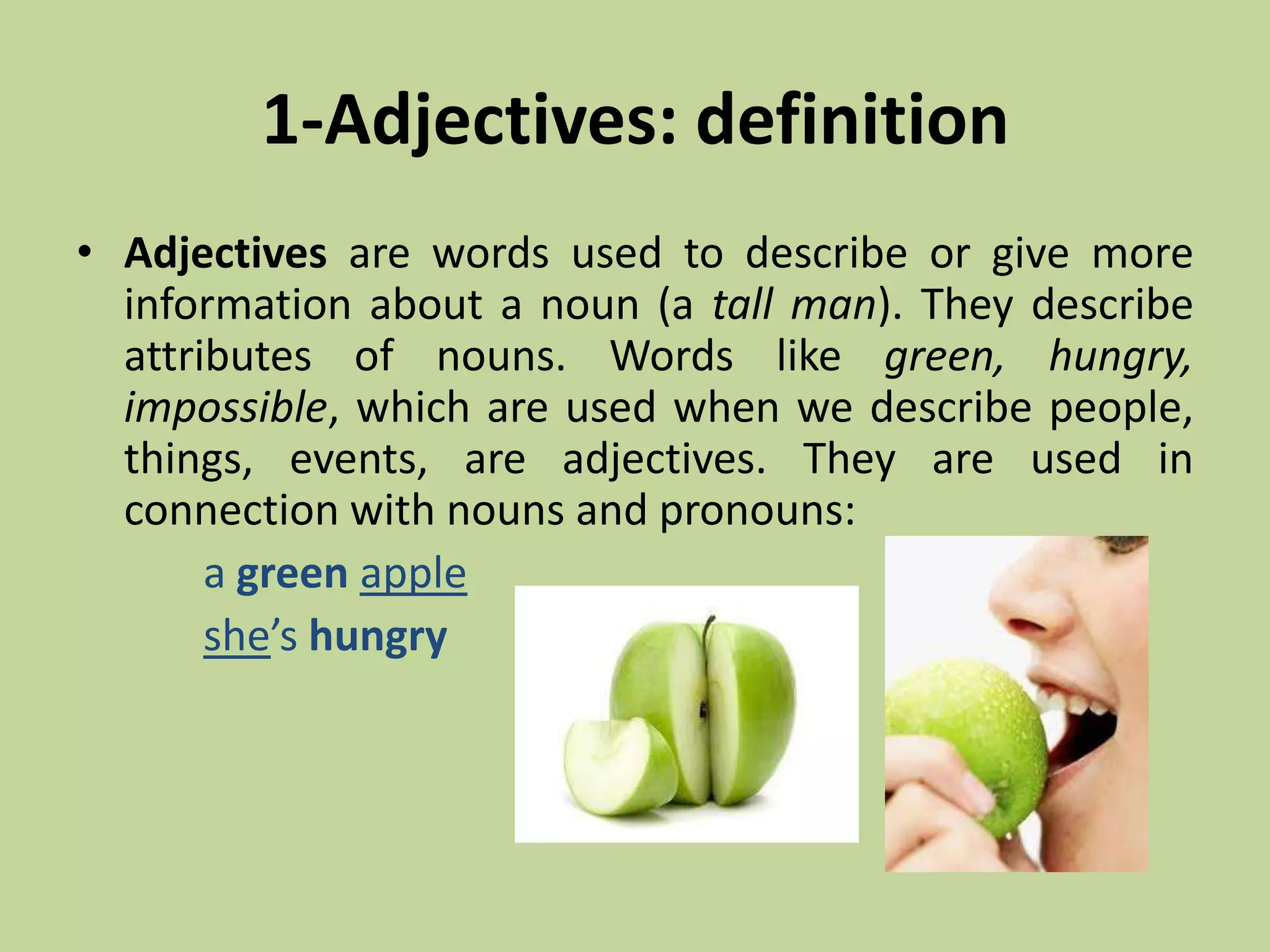
1-Adjectives: definitionAdjectives are words used to describe or give more information about a noun (a tall man). They describe attributes of nouns. Words like green, hungry, impossible, which are used when we describe people, things, events, are adjectives. They are used in connection with nouns and pronouns: a greenappleshe’s hungry
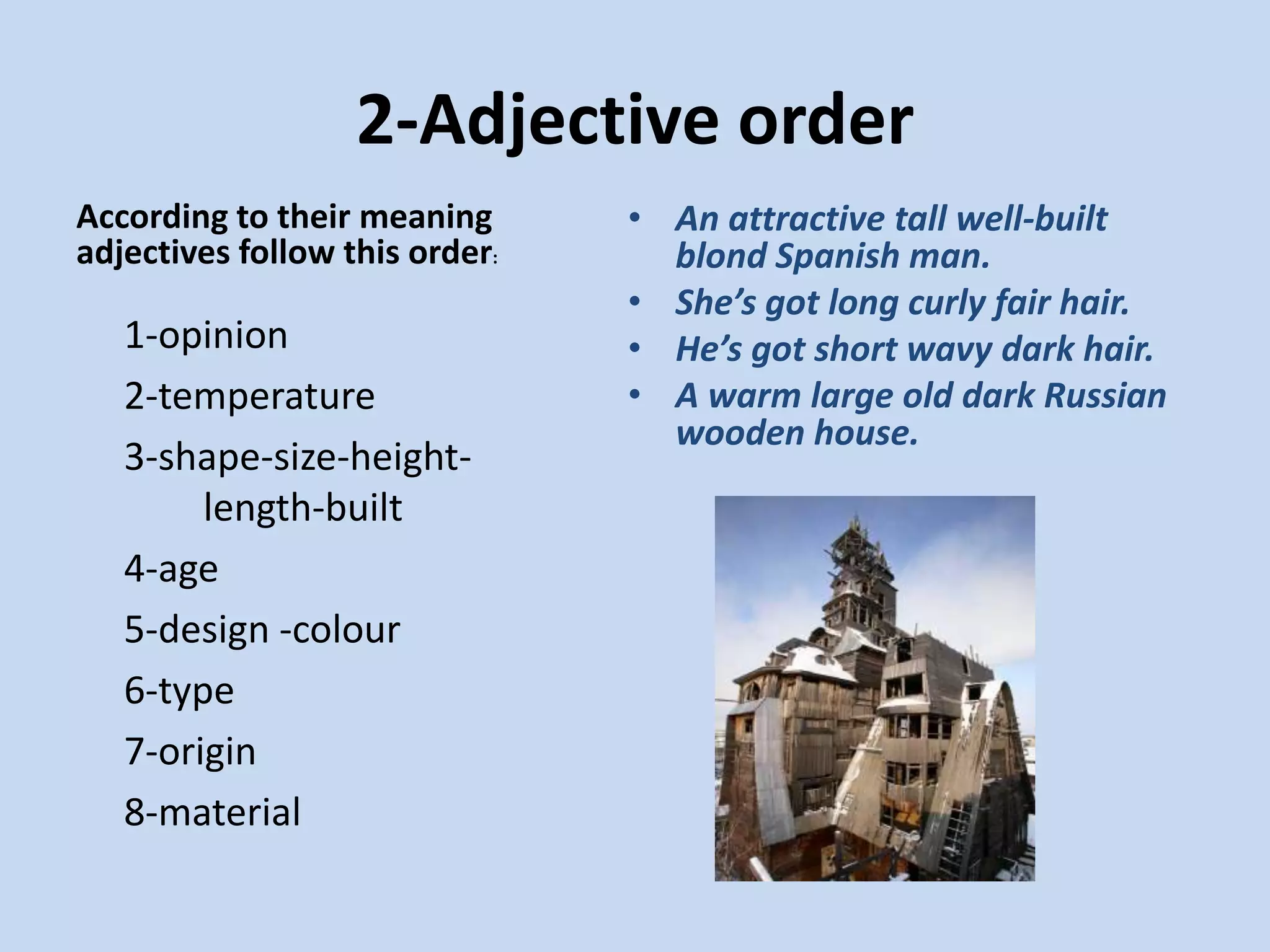
2-Adjective orderAccording to their meaning adjectives follow this order:An attractive tall well-built blond Spanish man.She’s got long curly fair hair.He’s got short wavy dark hair. A warm large old dark Russian wooden house.	1-opinion	2-temperature	3-shape-size-height-	length-built	4-age	5-design -colour	6-type	7-origin	8-material
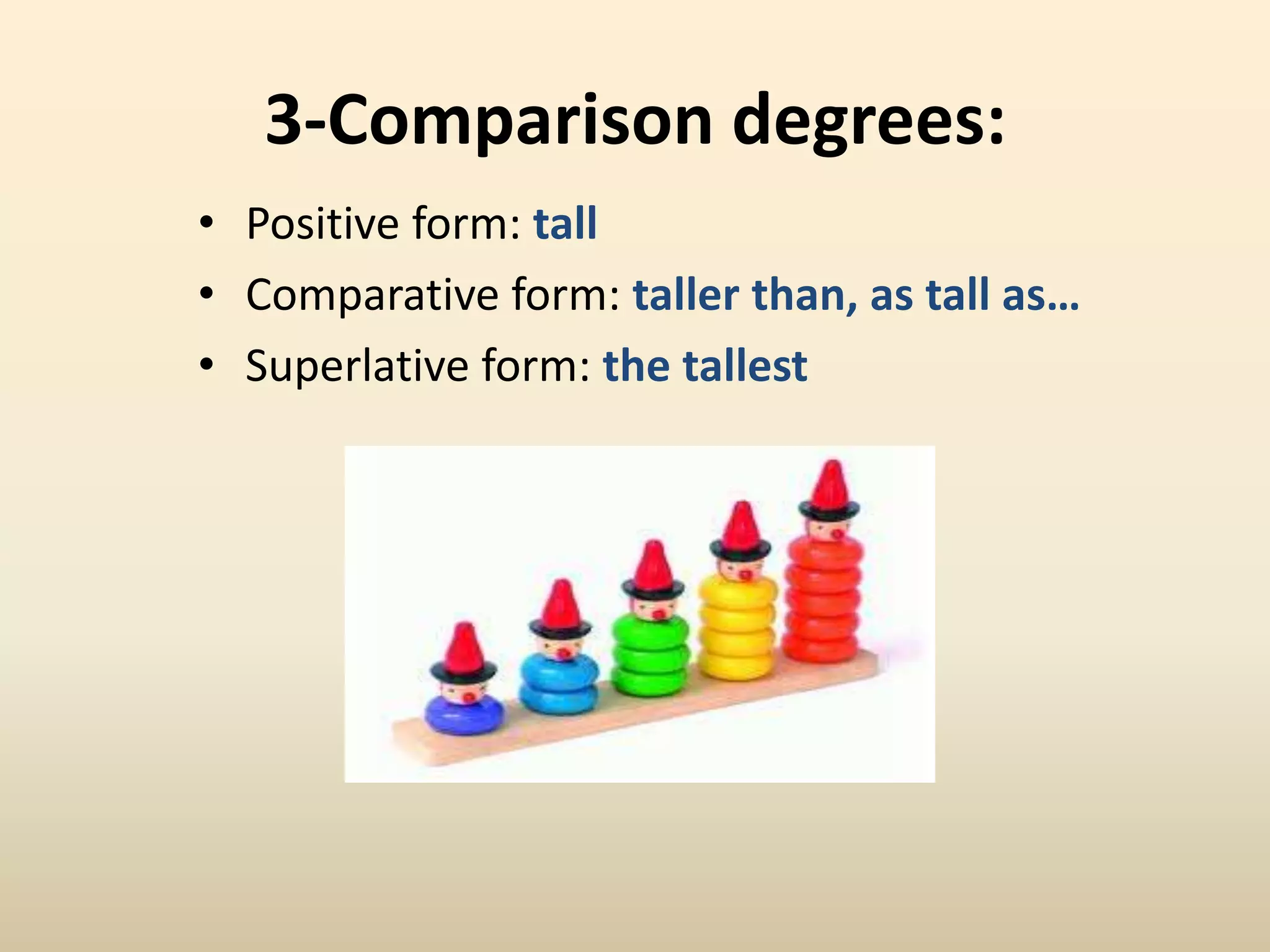
3-Comparison degrees:Positive form: tallComparative form: taller than, as tall as…Superlative form: the tallest
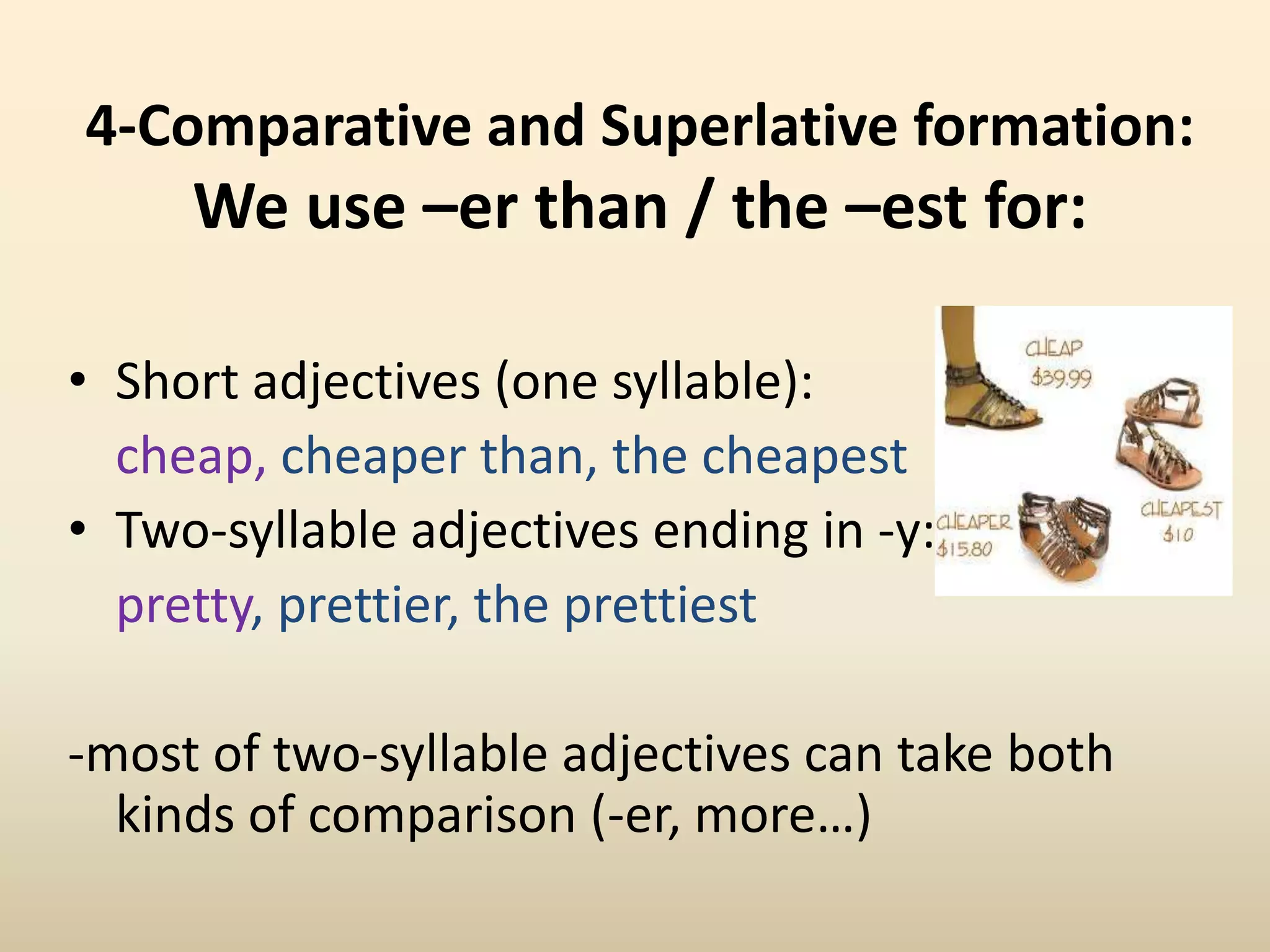
4-Comparative and Superlative formation:We use –er than / the –est for:Short adjectives (one syllable): cheap, cheaper than, the cheapestTwo-syllable adjectives ending in -y:pretty, prettier, the prettiest-most of two-syllable adjectives can take both kinds of comparison (-er, more…)
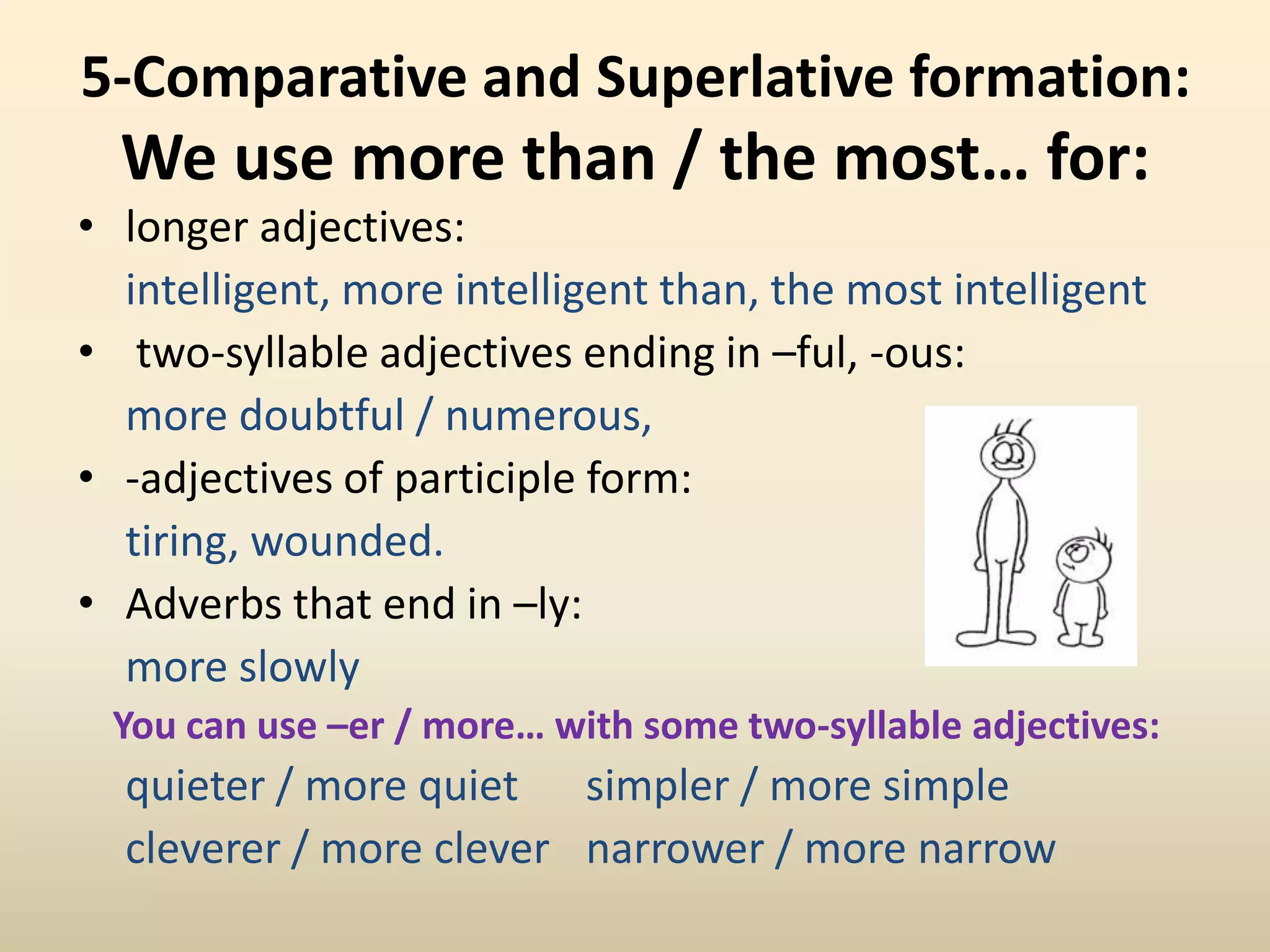
longer adjectives: intelligent, more intelligent than, the most intelligent two-syllable adjectives ending in –ful, -ous: more doubtful / numerous, -adjectives of participle form:tiring, wounded.Adverbs that end in –ly:more slowlyYou can use –er / more… with some two-syllable adjectives: quieter / more quiet	simpler / more simplecleverer / more clever	narrower / more narrow5-Comparative and Superlative formation:We use more than / the most… for:
6-SpellingAdjectives ending in a single short vowel followed by a single consonant double the final consonant:big, biggerAdjectives ending in mute –e drop it:brave, braver2-syllable adjectives ending–y change it to –i:funny, funnier
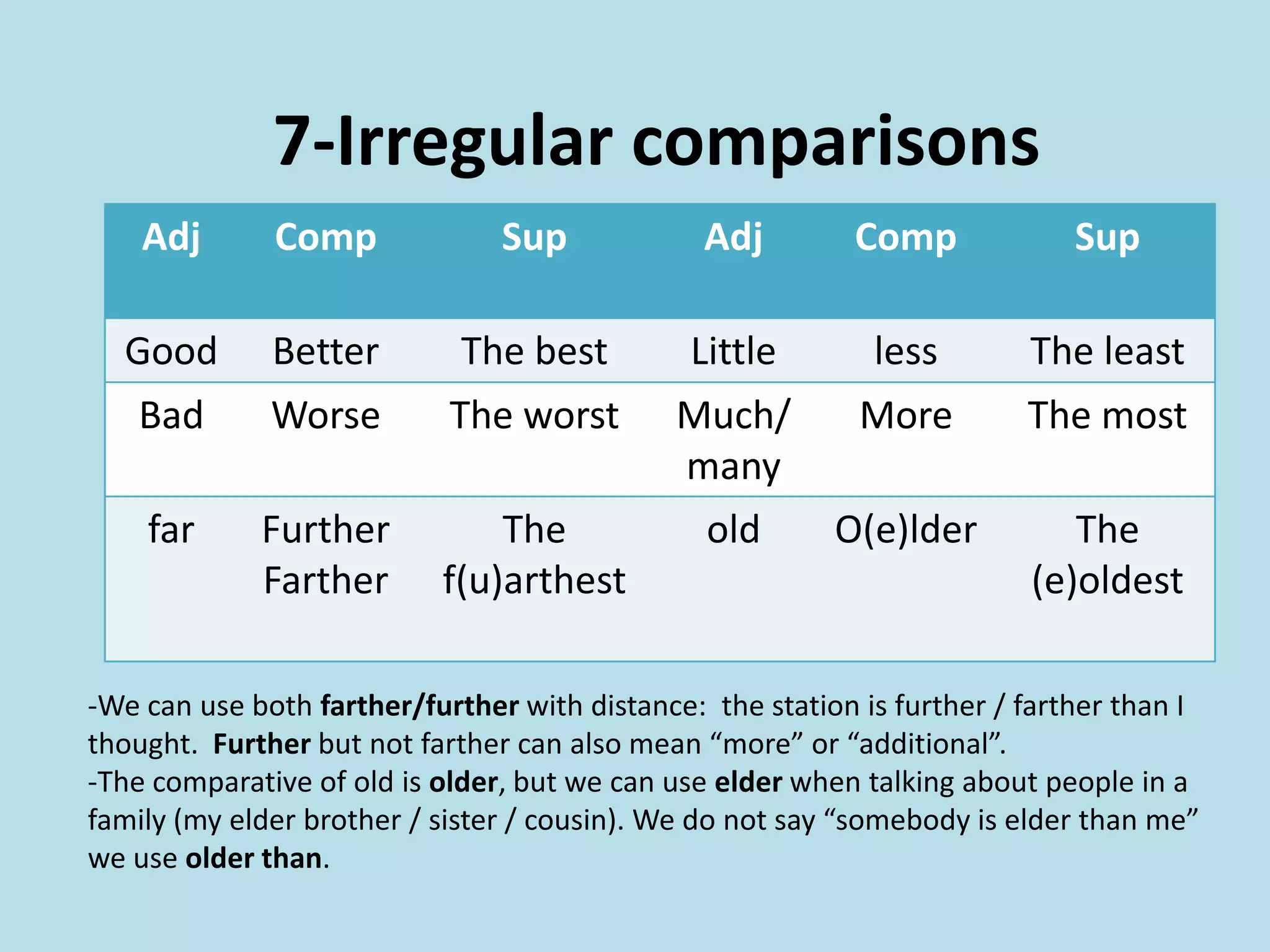
7-Irregular comparisons-We can use both farther/further with distance:  the station is further / farther than I thought.  Further but not farther can also mean “more” or “additional”.-The comparative of old is older, but we can use elder when talking about people in a family (my elder brother / sister / cousin). We do not say “somebody is elder than me” we use older than.
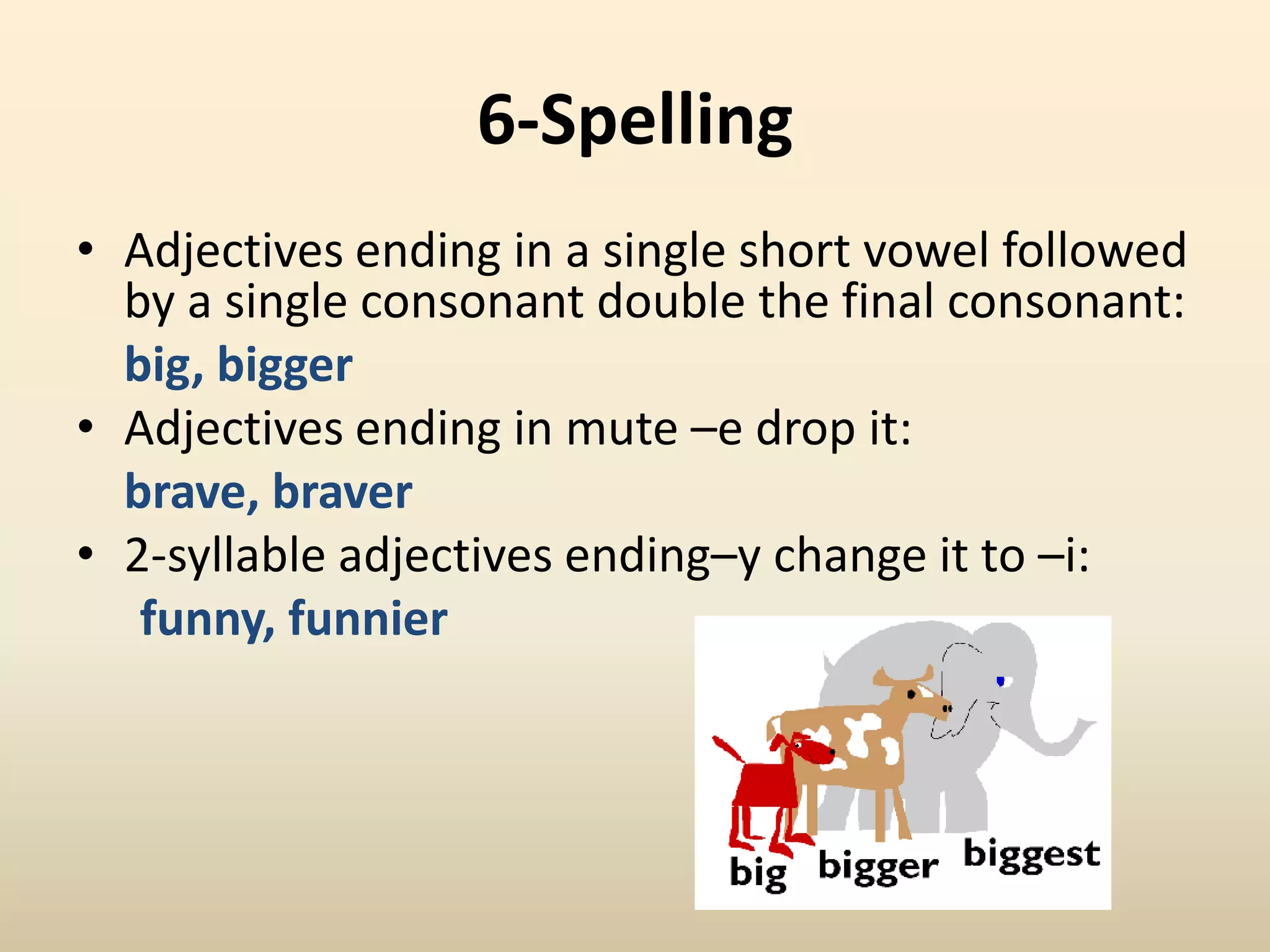
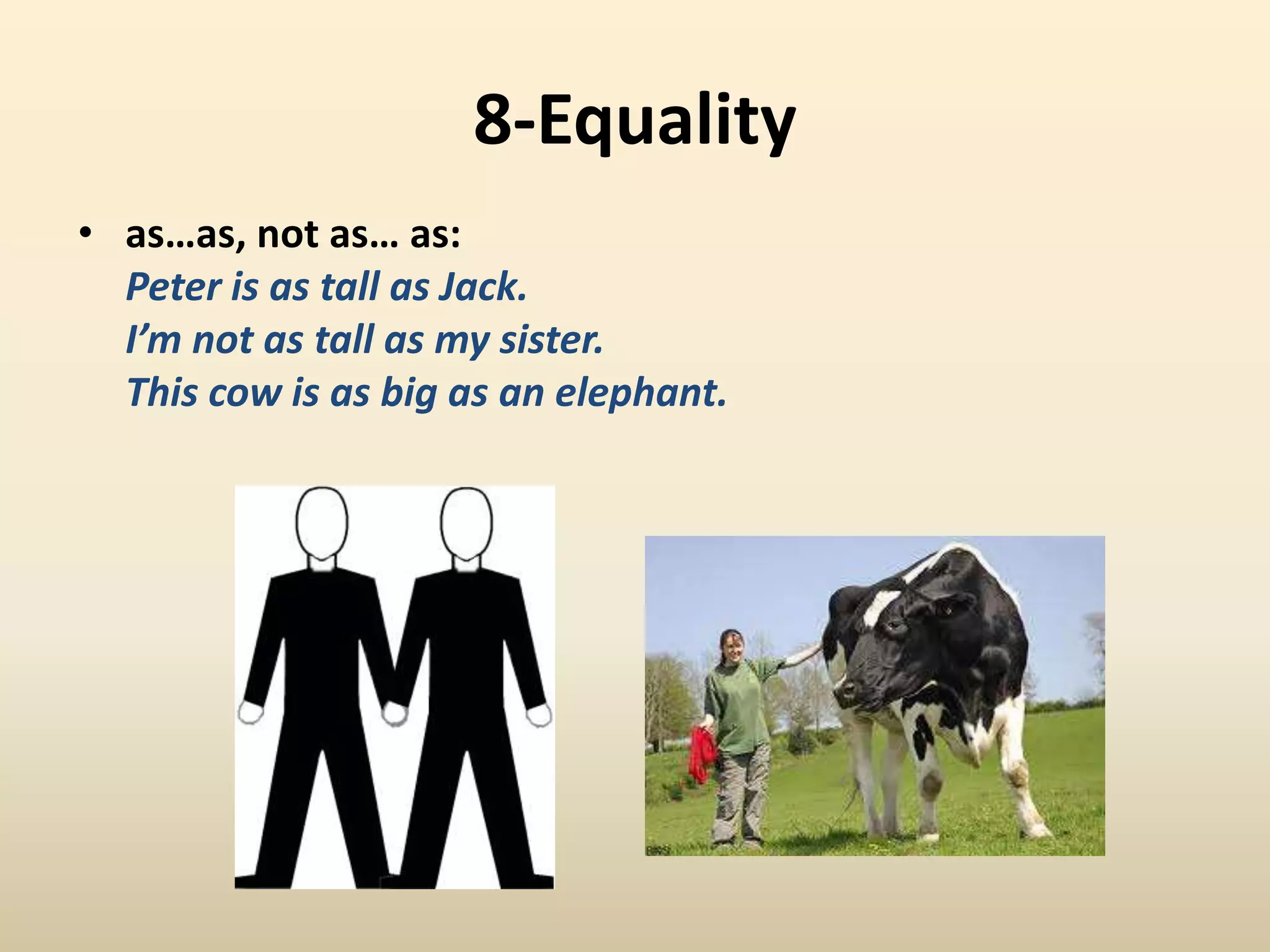
8-Equalityas…as, not as… as: 	Peter is as tall as Jack. I’m not as tall as my sister.This cow is as big as an elephant.
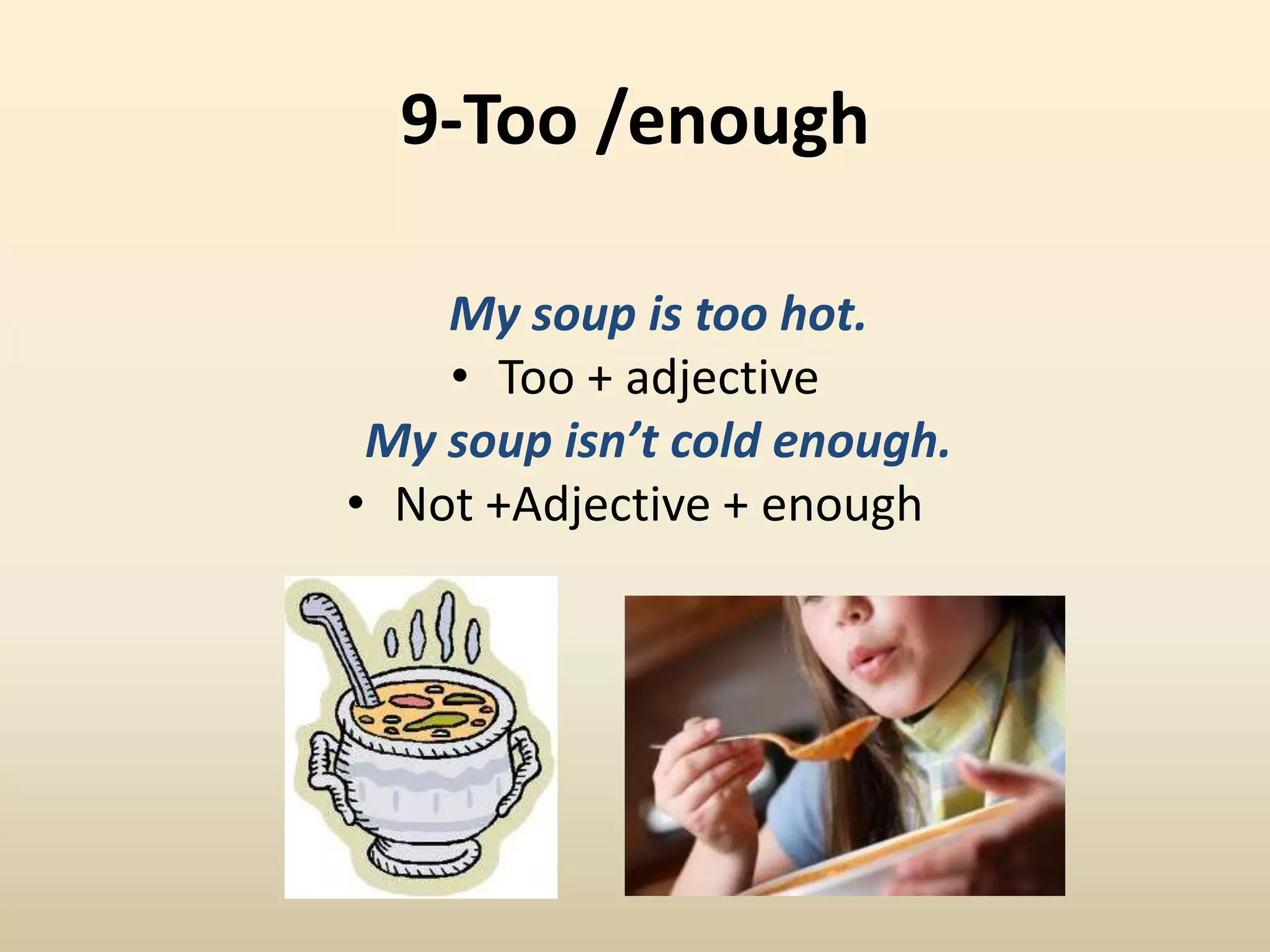
9-Too /enough	My soup is too hot.Too + adjective	My soup isn’t cold enough.Not +Adjective + enough

Adjectives: comparative and superlative forms

  • 1.
  • 2.
    1-Adjectives: definitionAdjectives arewords used to describe or give more information about a noun (a tall man). They describe attributes of nouns. Words like green, hungry, impossible, which are used when we describe people, things, events, are adjectives. They are used in connection with nouns and pronouns: a greenappleshe’s hungry
  • 3.
    2-Adjective orderAccording totheir meaning adjectives follow this order:An attractive tall well-built blond Spanish man.She’s got long curly fair hair.He’s got short wavy dark hair. A warm large old dark Russian wooden house. 1-opinion 2-temperature 3-shape-size-height- length-built 4-age 5-design -colour 6-type 7-origin 8-material
  • 4.
    3-Comparison degrees:Positive form:tallComparative form: taller than, as tall as…Superlative form: the tallest
  • 5.
    4-Comparative and Superlativeformation:We use –er than / the –est for:Short adjectives (one syllable): cheap, cheaper than, the cheapestTwo-syllable adjectives ending in -y:pretty, prettier, the prettiest-most of two-syllable adjectives can take both kinds of comparison (-er, more…)
  • 6.
    longer adjectives: intelligent,more intelligent than, the most intelligent two-syllable adjectives ending in –ful, -ous: more doubtful / numerous, -adjectives of participle form:tiring, wounded.Adverbs that end in –ly:more slowlyYou can use –er / more… with some two-syllable adjectives: quieter / more quiet simpler / more simplecleverer / more clever narrower / more narrow5-Comparative and Superlative formation:We use more than / the most… for:
  • 7.
    6-SpellingAdjectives ending ina single short vowel followed by a single consonant double the final consonant:big, biggerAdjectives ending in mute –e drop it:brave, braver2-syllable adjectives ending–y change it to –i:funny, funnier
  • 8.
    7-Irregular comparisons-We canuse both farther/further with distance: the station is further / farther than I thought. Further but not farther can also mean “more” or “additional”.-The comparative of old is older, but we can use elder when talking about people in a family (my elder brother / sister / cousin). We do not say “somebody is elder than me” we use older than.
  • 9.
    8-Equalityas…as, not as…as: Peter is as tall as Jack. I’m not as tall as my sister.This cow is as big as an elephant.
  • 10.
    9-Too /enough My soupis too hot.Too + adjective My soup isn’t cold enough.Not +Adjective + enough