


Nomination & Remuneration
Committee
COMPOSITION
• As per sub-section (1) of Section 178 of the Act,
Chairman of the Company whether executive or
non-executive can become a member of the
Nomination & Remuneration Committee,
however he cannot hold chair of such
committee.
• As per Clause 49 (IV) (A) of the Circular,
Chairman of the nomination and remuneration
committee shall be an Independent Director.
The circular is applicable to Listed Companies
having Paid-up Equity Share Capital exceeding
Rs. 10 crore and Net Worth exceeding Rs. 25
crore.
ITS ROLE
• to identify persons having the desired qualifications for becoming
directors or for appointment into the senior management level and
to recommend their appointment and/or removal to the Board
• to carry out evaluation of every director’s performance.
• establishing induction programs for new directors and education
programs for existing ones.
• ensuring succession plans are in place to maintain an appropriate
balance of skills.
• formulating the criteria for determining the qualifications, positive
attributes and independence of a director and recommending to the
Board a policy, which is to be disclosed in the Board's report, relating
to the remuneration for the directors, key managerial personnel and
other employees.
• shall also take into account the financial position of the company, the
industrial trend, appointee’s experience, past performance, past
remuneration, etc.
• should also strive to bring about objectivity in
determining the remuneration package while
striking a balance between the interest of the
company and the shareholders
• ensure that-
1. The level and composition of remuneration is
reasonable and sufficient to attract, retain and
motivate directors of the quality required to run the
company successfully;
2. Relationship of remuneration to performance is
clear and meets appropriate performance benchmarks;
3. Remuneration to directors, key managerial
personnel and senior management involves a balance
between fixed and incentive pay reflecting short and
long term performance objectives appropriate to the
working of the company and its goals.
What are the contradictions between Act
and Clause 49 on Listing Agreements on
Nomination and Remuneration
Committee?
• Act here specifically speaks about the
applicability of appointment of Nomination and
Remuneration Committee to Every Listed
Company, however Clause 49 of the Listing
Agreement exempts companies having Paid-up
Equity Share Capital not exceeding Rs. 10 crore
and Net Worth not exceeding Rs. 25 crore.
• It also exempts companies whose equity share
capital is listed exclusively on the Small and
Medium Enterprises (SME) platform.
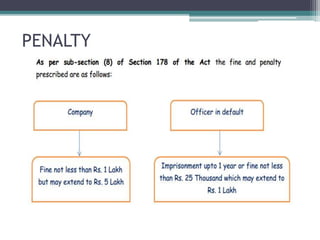
PENALTY
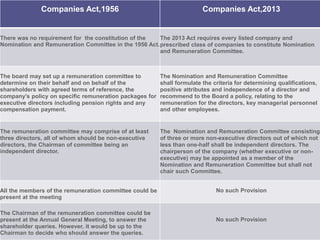
Companies Act,1956 Companies Act,2013
There was no requirement for the constitution of the
Nomination and Remuneration Committee in the 1956 Act.
The 2013 Act requires every listed company and
prescribed class of companies to constitute Nomination
and Remuneration Committee.
The board may set up a remuneration committee to
determine on their behalf and on behalf of the
shareholders with agreed terms of reference, the
company’s policy on specific remuneration packages for
executive directors including pension rights and any
compensation payment.
The Nomination and Remuneration Committee
shall formulate the criteria for determining qualifications,
positive attributes and independence of a director and
recommend to the Board a policy, relating to the
remuneration for the directors, key managerial personnel
and other employees.
The remuneration committee may comprise of at least
three directors, all of whom should be non-executive
directors, the Chairman of committee being an
independent director.
The Nomination and Remuneration Committee consisting
of three or more non-executive directors out of which not
less than one-half shall be independent directors. The
chairperson of the company (whether executive or non-
executive) may be appointed as a member of the
Nomination and Remuneration Committee but shall not
chair such Committee.
All the members of the remuneration committee could be
present at the meeting
No such Provision
The Chairman of the remuneration committee could be
present at the Annual General Meeting, to answer the
shareholder queries. However, it would be up to the
Chairman to decide who should answer the queries.
No such Provision
AMENDED CLAUSE 49
• The company shall setup a nomination &
remuneration committee which shall comprise
of at least three directors all of whom shall be
NON-executive directors and at least half should
be independent.
SHAREHOLDERS’ GRIEVANCE
COMMITTEE
PURPOSE
• It’s a standing committee of the board of
directors which looks into redressal of
shareholders complains related to transfer of
shares, non-receipt of the balance sheet ,
declared dividend, etc.
COMPOSITION
• It consists of 3 or more directors
• The chairman of the committee is an independent
non-executive director
• The Company Secretary acts as the Secretary to
this committee.
ITS ROLE
• Review the mechanism adopted for redressal of investors' and
depositors’ complains.
• Oversees the services of the registrars and transfer agents of the
company.
• Review the complaints and the status of investors’ complaints.
• Review the status of the litigations filed by/against the
shareholders of the company.
• Review the impact of amendments & enactments issued by the
MCA / SEBI and other regulatory authorities on matters
concerning the investors in general.
• Review the status of unclaimed shares and unclaimed dividends.
• Uploading of the data relating to unclaimed deposits/dividends to
the website of Investor Education & Protection Fund (IEPF).
• Other responsibilities given by the board of directors of the
company and/or as required under Clause 49 of the Listing
Agreement.
AMENDED CLAUSE 49
• Makes it mandatory on a listed co. to form this
committee under the chairmanship of a NED to
specifically look into the redressing of
shareholder’s complaints.
Thank you ...
• Shivani Saxena 337
• Aman Verma 368

Nomination & remuneration committee

  • 1.
  • 2.
  • 3.
    • As persub-section (1) of Section 178 of the Act, Chairman of the Company whether executive or non-executive can become a member of the Nomination & Remuneration Committee, however he cannot hold chair of such committee. • As per Clause 49 (IV) (A) of the Circular, Chairman of the nomination and remuneration committee shall be an Independent Director. The circular is applicable to Listed Companies having Paid-up Equity Share Capital exceeding Rs. 10 crore and Net Worth exceeding Rs. 25 crore.
  • 4.
    ITS ROLE • toidentify persons having the desired qualifications for becoming directors or for appointment into the senior management level and to recommend their appointment and/or removal to the Board • to carry out evaluation of every director’s performance. • establishing induction programs for new directors and education programs for existing ones. • ensuring succession plans are in place to maintain an appropriate balance of skills. • formulating the criteria for determining the qualifications, positive attributes and independence of a director and recommending to the Board a policy, which is to be disclosed in the Board's report, relating to the remuneration for the directors, key managerial personnel and other employees. • shall also take into account the financial position of the company, the industrial trend, appointee’s experience, past performance, past remuneration, etc.
  • 5.
    • should alsostrive to bring about objectivity in determining the remuneration package while striking a balance between the interest of the company and the shareholders • ensure that- 1. The level and composition of remuneration is reasonable and sufficient to attract, retain and motivate directors of the quality required to run the company successfully; 2. Relationship of remuneration to performance is clear and meets appropriate performance benchmarks; 3. Remuneration to directors, key managerial personnel and senior management involves a balance between fixed and incentive pay reflecting short and long term performance objectives appropriate to the working of the company and its goals.
  • 6.
    What are thecontradictions between Act and Clause 49 on Listing Agreements on Nomination and Remuneration Committee? • Act here specifically speaks about the applicability of appointment of Nomination and Remuneration Committee to Every Listed Company, however Clause 49 of the Listing Agreement exempts companies having Paid-up Equity Share Capital not exceeding Rs. 10 crore and Net Worth not exceeding Rs. 25 crore. • It also exempts companies whose equity share capital is listed exclusively on the Small and Medium Enterprises (SME) platform.
  • 7.
  • 8.
    Companies Act,1956 CompaniesAct,2013 There was no requirement for the constitution of the Nomination and Remuneration Committee in the 1956 Act. The 2013 Act requires every listed company and prescribed class of companies to constitute Nomination and Remuneration Committee. The board may set up a remuneration committee to determine on their behalf and on behalf of the shareholders with agreed terms of reference, the company’s policy on specific remuneration packages for executive directors including pension rights and any compensation payment. The Nomination and Remuneration Committee shall formulate the criteria for determining qualifications, positive attributes and independence of a director and recommend to the Board a policy, relating to the remuneration for the directors, key managerial personnel and other employees. The remuneration committee may comprise of at least three directors, all of whom should be non-executive directors, the Chairman of committee being an independent director. The Nomination and Remuneration Committee consisting of three or more non-executive directors out of which not less than one-half shall be independent directors. The chairperson of the company (whether executive or non- executive) may be appointed as a member of the Nomination and Remuneration Committee but shall not chair such Committee. All the members of the remuneration committee could be present at the meeting No such Provision The Chairman of the remuneration committee could be present at the Annual General Meeting, to answer the shareholder queries. However, it would be up to the Chairman to decide who should answer the queries. No such Provision
  • 9.
    AMENDED CLAUSE 49 •The company shall setup a nomination & remuneration committee which shall comprise of at least three directors all of whom shall be NON-executive directors and at least half should be independent.
  • 10.
  • 11.
    PURPOSE • It’s astanding committee of the board of directors which looks into redressal of shareholders complains related to transfer of shares, non-receipt of the balance sheet , declared dividend, etc.
  • 12.
    COMPOSITION • It consistsof 3 or more directors • The chairman of the committee is an independent non-executive director • The Company Secretary acts as the Secretary to this committee.
  • 13.
    ITS ROLE • Reviewthe mechanism adopted for redressal of investors' and depositors’ complains. • Oversees the services of the registrars and transfer agents of the company. • Review the complaints and the status of investors’ complaints. • Review the status of the litigations filed by/against the shareholders of the company. • Review the impact of amendments & enactments issued by the MCA / SEBI and other regulatory authorities on matters concerning the investors in general. • Review the status of unclaimed shares and unclaimed dividends. • Uploading of the data relating to unclaimed deposits/dividends to the website of Investor Education & Protection Fund (IEPF). • Other responsibilities given by the board of directors of the company and/or as required under Clause 49 of the Listing Agreement.
  • 14.
    AMENDED CLAUSE 49 •Makes it mandatory on a listed co. to form this committee under the chairmanship of a NED to specifically look into the redressing of shareholder’s complaints.
  • 15.
    Thank you ... •Shivani Saxena 337 • Aman Verma 368