PROSPECTUS
Presented by:
ROLL NO NAME TOPIC
67 ADESH WALAWALKAR CONTENT OF PROSPECTUS
68 VEDIKA ZORE INTRODUCTION OF
PROSPECTUS
TYPES OF PROSPECTUS
69 VIRAJ PATANKAR LEGAL REQUIREMENTS OF
PROSPECTUS
STATEMENT IN LIEU OF
PROSPECTUS
70 RUDRA KHADYE PUBLIC DEPOSITS
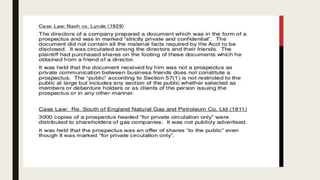
CASE STUDY
71 SWARAJ THAKUR PRIVATE PLACEMENT
RULES AND REGULATIONS
FOR PRIVATE PLACEMENT
INTRODUCTION
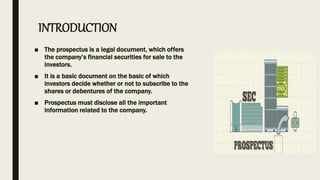
■ The prospectus is a legal document, which offers
the company’s financial securities for sale to the
investors.
■ It is a basic document on the basic of which
investors decide whether or not to subscribe to the
shares or debentures of the company.
■ Prospectus must disclose all the important
information related to the company.
DEFINATION
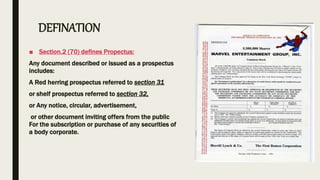
■ Section.2 (70) defines Propectus:
Any document described or issued as a prospectus
includes:
A Red herring prospectus referred to section 31
or shelf prospectus referred to section 32,
or Any notice, circular, advertisement,
or other document inviting offers from the public
For the subscription or purchase of any securities of
a body corporate.
TYPES OF PROSPECTUS
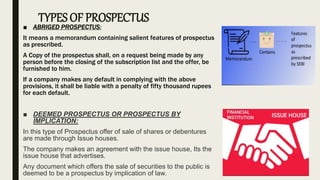
■ ABRIGED PROSPECTUS:
It means a memorandum containing salient features of prospectus
as prescribed.
A Copy of the prospectus shall, on a request being made by any
person before the closing of the subscription list and the offer, be
furnished to him.
If a company makes any default in complying with the above
provisions, it shall be liable with a penalty of fifty thousand rupees
for each default.
■ DEEMED PROSPECTUS OR PROSPECTUS BY
IMPLICATION:
In this type of Prospectus offer of sale of shares or debentures
are made through Issue houses.
The company makes an agreement with the issue house, Its the
issue house that advertises.
Any document which offers the sale of securities to the public is
deemed to be a prospectus by implication of law.
■ RED HERRING PROSPECTUS:
It is a prospectus which does not contain all particulars on the
price and quantam of securitues offered.
This type of prospectus is issued to check the demand for
securities.
It is issued atleast three days prior to the opening of offer.
■ SHELF PROSPECTUS AND INFORMATION MEMORANDUM:
It is issued by any financial instituatio or bank for one or more
issue of securities, in one specified prospectus.
Shelf prospectus shall be valid for 1 year from the date of opening
of the first offering of the prospectus.
The company shall not required to file fresh prospectus with the
registrar at every stage of offer of securities but has to submit
information memorandum
Information Memorandum contains all important information and
the changes made if any.
WHEN PROSPECTUS IS NOT REQUIRED TO BE
ISSUED
■ In case of a Private Company prospectus is not required.
■ When promoters or directors, intend raising fund from
personal contacts and acquaintances without offering the
shares and debentures to the public.
■ When shares are offered to underwriters unders an
underwriting agreement.
■ When the company intends raising funds only from existing
shareholders/ debenture holders.
■ When the shares or debenture issued are uniform in all
respects with shares or debentures previously issued and
dealt in or quoted in a recognised stock exchange.
LEGAL REQUIREMENTS OF PROSPECTUS
■ A document would be considered a prospectus only
if it meet the following legal requirements, viz .
■ It should be in written.
■ It should be issued by or on the behalf of body
corporate.
■ It should be issued to public.
■ It should contain invitation to public for making
deposit or subscription of share or debentures of a
body corporate.
1. It is a statement which is delivered by a company, having
share capital to the Registrar for the registration,at least
three days before the first allotment of shares or
debentures under the following conditions:
■ Where a company does not issue prospectus or ,
■ Where a company has issued a prospectus but has not
proceeded to allot any of its shares offered to the public for
subscription.
2. SILOP is to be signed by every who is named therein as a
director or proposed director of company.
3. Where a company which is required to submit a SILOP
does not comply with the requirement, it can not allot
shares.(sec69(1))
STATEMENT IN LIEUOF PROSPECTUS
DIFFERENCE BETWEEN PROSPECTUS AND SILOP
PROSPECTUS
1. Filed by a public listed company.
2. Has been defined in definations.
3. Submitted to registrar,
commission and share holders.
4. Is a document containing an
advertisement for invitation of
subscription from the public.
STATEMENT IN LIEU OF
PROSPECTUS
1. Filed by a pubic unlisted company.
2. Has not been defined in
definations.
3. Submitted only registrar.
4. Is not an invitation of subscription.
DIFFERENCE BETWEENPROSPECTUS AND
SILOP
■ PROSPECT :
5. Approval of commission must be
obtained within 60 days before the
issue of prospectus.
6. No prescribed form is specified in
this Ordinance.
7. No prospectus shall be issued
unless before the date of its
publication, a copy signed by the
directors or thier agent has been
delivered to the registrar
■ STATEMENT IN LIEU OF
PROSPECTUS:
5. Is not a kind of advertisement for
invitation of subscription.
6. Is filed on prescribed form.
7. It is filed with the registrar
concerned at 3 days before the
allotment of shares.
CONTENT OF PROSPECTUS
■ It shall be dated and signed and shall contain the following things :
(1) Every prospectus issued by or on behalf of a public company either
with reference to its formation or subsequently, or by or on behalf of
any person who is or has been engaged or interested in the
formation of a public company,shall be dated and signed and shall.
(A) State the following information, namely :
(1) Names and addresses of the registered office of the company,
company secretary, Chief Financial Officer, auditors, legal advisers,
bankers, trustees, if any, underwriters and such other persons as may be
prescribed;
(2) Dates of opening and closing of the issue.
(3) A statement by the BOD of separate bank account.
(4) Details about underwriting of the issue.
CONTENT OF PROSPECTUS
(5) Consent of the directors, auditors, bankers to the issue, expert’s
opinion, if any, and of such other persons, as may be prescribed
(6) The authority for the issue and the details of the resolution passed
therefore
(7) Procedure and time schedule for allotment and issue of securities
(8) Capital structure of the company in the prescribed manner
(9) Main objects of public offer, terms of the present issue and such
other particulars as may be prescribed
(10) Main objects and present business of the company and its
location, schedule of implementation of the project.
CONTENT OF PROSPECTUS
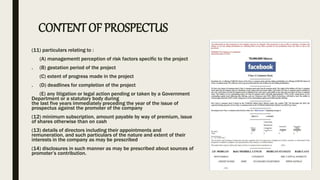
(11) particulars relating to :
(A) managementt perception of risk factors specific to the project
. (B) gestation period of the project
(C) extent of progress made in the project
. (D) deadlines for completion of the project
(E) any litigation or legal action pending or taken by a Government
Department or a statutory body during
the last five years immediately preceding the year of the issue of
prospectus against the promoter of the company
(12) minimum subscription, amount payable by way of premium, issue
of shares otherwise than on cash
(13) details of directors including their appointments and
remuneration, and such particulars of the nature and extent of their
interests in the company as may be prescribed
(14) disclosures in such manner as may be prescribed about sources of
promoter’s contribution.
CONTENT OF PROSPECTUS
(B) REPORTS IN PROSPECTUS:
1. Reports by the auditors of the company.
2. Reports relating to profits and losses of the company.
3. Reports about the business or transaction to which the proceeds of the securities
are to be applied.
(C) DECLARATION: Prospectus shall make a declaration about the compliance of the
provisions of the act and nothing contained in the prospectus is contravening the
provisions of act, Securities Contract regulation act 1956 and Securities and exchange
Board of India Act 1992.
• PRIVATE PLACEMENT (PP) UNDER COMPANIES ACT,
2013
INTRODUCTION:
 WE ALL KNOW COMPANIES
ACT, 2013 PROVIDES VARIOUS OPTIONS
TO ISSUE SECURITIES (SHARES, DEBENTURES
OR ANY OTHER TYPE OF SECURITIES). ONE
OF THESE OPTIONS IS PRIVATE PLACEMENT.
THE DEFINITION OF PRIVATE PLACEMENT
EXPLAINS WHEN THE COMPANIES HAVE
TO FOLLOW THE PROVISIONS. LET’S
LOOK INTO THE DEFINITION AND
THE PROVISIONS
PRIVATE PLACEMENT
DEFINITIONOF PRIVATEPLACEMENTPROCEDURE
UNDERCOMPANIESACT, 2013:
• Explanation -I to Section 42(3) defines the Private
Placement;
 “Private Placement” means any offer or invitation to
subscribe or issue of securities to a select group of persons
by a company (other than by way of public offer) through
private placement offer-cum-application, which satisfies
the conditions specified in this section.
 Let us split the definition and make it easy to understand
 Private Placement is:
 – any offer or invitation by a company
 – to subscribe or issue of securities
 – to a select group of persons,
 – other than by way of public offer,
LIST OF SECTIONS AND RULES APPLICABLE TO PRIVATE
PLACEMENT:
Before go to the Provisions of Private Placement, it is
appropriate to make the list of Sections and Rules
which are applicable while issuing securities under
Private Placement. Below is the list:​
Section 42 of the Companies Act, 2013​
Rule 14 of the Companies (Prospectus and Allotment
of Securities) Rules, 2014
Provisions:
Now we understood what is the definition, but what are the provisions to be followed while
issuing securities under Private placement (PP)?
i. To whom securities can be issued under PP?
The securities under PP can be issued /offered only to
a select group of persons who have been identified by
the Board.
ii. Private Placement offer can be given to how
many persons?
The offer of securities or invitation to subscribe securities,
shall be made to not more than 50 persons in a single offer
or not more than 200 persons in the aggregate in a
financial year (excluding qualified institutional buyers and
employees of the company being offered securities under
ESOP). This restriction would be read for all the securities
combined together in a Financial Year.
3) Is there any prescribed format for Offer Letter?
* The PP offer letter shall be in form of PAS-4 serially numbered and
addressed specifically to the person to whom the offer is made and
shall be sent to him, either in writing or in electronic mode, within
thirty days of recording the name of such person.
4) Is there any minimum Offer size per person?
* Earlier there was a requirement of minimum offer size of Rs.
20,000 face value of the Security. However the same was dispensed
off by Companies (Prospectus and Allotment of Securities) Second
Amendment Rules, 2018 with effect from 7th August, 2018. So there
is no minimum offer size for Private Placement.
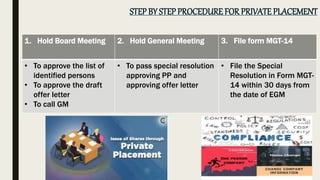
STEP BY STEP PROCEDURE FOR PRIVATE PLACEMENT
1. Hold Board Meeting 2. Hold General Meeting 3. File form MGT-14
• To approve the list of
identified persons
• To approve the draft
offer letter
• To call GM
• To pass special resolution
approving PP and
approving offer letter
• File the Special
Resolution in Form MGT-
14 within 30 days from
the date of EGM
 4. Circulate the Offer Letter (PAS-4)
 PAS-4 to be circulated to the identified
persons
 It can be circulated only after filing MGT-14
 5.Receive the Application money
 The Application money to be
received and kept in a Separate Bank to
be done within 60 days from the date of
receipt of Application Money
 6.Allotment
 Allotment to be done within 60 days
from the date of receipt of Application
Money
7. File Return of Allotment
 The Return of Allotment in Form
PAS-3 to be filed within 15 days
from the date of allotment
8. Utilization of amount
 The amount can be utilize only
after filing PAS-3
9. Other incidental matters
 Issue of Share Certificates within 2
months from the date of allotment
 Updating the Register of Members
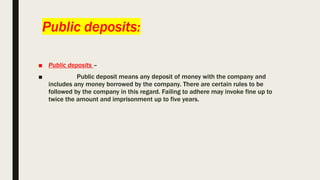
Public deposits:
■ Public deposits –
■ Public deposit means any deposit of money with the company and
includes any money borrowed by the company. There are certain rules to be
followed by the company in this regard. Failing to adhere may invoke fine up to
twice the amount and imprisonment up to five years.
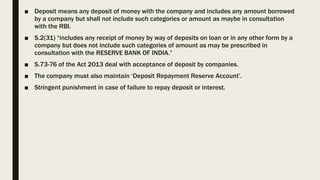
■ Deposit means any deposit of money with the company and includes any amount borrowed
by a company but shall not include such categories or amount as maybe in consultation
with the RBI.
■ S.2(31) “includes any receipt of money by way of deposits on loan or in any other form by a
company but does not include such categories of amount as may be prescribed in
consultation with the RESERVE BANK OF INDIA.”
■ S.73-76 of the Act 2013 deal with acceptance of deposit by companies.
■ The company must also maintain ‘Deposit Repayment Reserve Account’.
■ Stringent punishment in case of failure to repay deposit or interest.
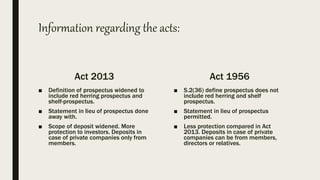
Information regarding the acts:
Act 2013
■ Definition of prospectus widened to
include red herring prospectus and
shelf-prospectus.
■ Statement in lieu of prospectus done
away with.
■ Scope of deposit widened. More
protection to investors. Deposits in
case of private companies only from
members.
Act 1956
■ S.2(36) define prospectus does not
include red herring and shelf
prospectus.
■ Statement in lieu of prospectus
permitted.
■ Less protection compared in Act
2013. Deposits in case of private
companies can be from members,
directors or relatives.
BIBLIOGRAPHY:
■ VIPUL PRAKASHAN
■ https://business-finance.blurtit.com/1432481/what-is-prospectus-and-its-
contents
■ https://tavaga.com/tavagapedia/prospectus/#:~:text=Deemed%20Prospectus%2
0%E2%80%93%20Deemed%20prospectus%20has,offer%20is%20made%20to%2
0investors.
■ https://corporatefinanceinstitute.com/resources/data/public-filings/prospectus/
Thank you!

TYPES OF Prospectus

  • 1.
  • 2.
    Presented by: ROLL NONAME TOPIC 67 ADESH WALAWALKAR CONTENT OF PROSPECTUS 68 VEDIKA ZORE INTRODUCTION OF PROSPECTUS TYPES OF PROSPECTUS 69 VIRAJ PATANKAR LEGAL REQUIREMENTS OF PROSPECTUS STATEMENT IN LIEU OF PROSPECTUS 70 RUDRA KHADYE PUBLIC DEPOSITS CASE STUDY 71 SWARAJ THAKUR PRIVATE PLACEMENT RULES AND REGULATIONS FOR PRIVATE PLACEMENT
  • 3.
    INTRODUCTION ■ The prospectusis a legal document, which offers the company’s financial securities for sale to the investors. ■ It is a basic document on the basic of which investors decide whether or not to subscribe to the shares or debentures of the company. ■ Prospectus must disclose all the important information related to the company.
  • 4.
    DEFINATION ■ Section.2 (70)defines Propectus: Any document described or issued as a prospectus includes: A Red herring prospectus referred to section 31 or shelf prospectus referred to section 32, or Any notice, circular, advertisement, or other document inviting offers from the public For the subscription or purchase of any securities of a body corporate.
  • 5.
    TYPES OF PROSPECTUS ■ABRIGED PROSPECTUS: It means a memorandum containing salient features of prospectus as prescribed. A Copy of the prospectus shall, on a request being made by any person before the closing of the subscription list and the offer, be furnished to him. If a company makes any default in complying with the above provisions, it shall be liable with a penalty of fifty thousand rupees for each default. ■ DEEMED PROSPECTUS OR PROSPECTUS BY IMPLICATION: In this type of Prospectus offer of sale of shares or debentures are made through Issue houses. The company makes an agreement with the issue house, Its the issue house that advertises. Any document which offers the sale of securities to the public is deemed to be a prospectus by implication of law.
  • 6.
    ■ RED HERRINGPROSPECTUS: It is a prospectus which does not contain all particulars on the price and quantam of securitues offered. This type of prospectus is issued to check the demand for securities. It is issued atleast three days prior to the opening of offer. ■ SHELF PROSPECTUS AND INFORMATION MEMORANDUM: It is issued by any financial instituatio or bank for one or more issue of securities, in one specified prospectus. Shelf prospectus shall be valid for 1 year from the date of opening of the first offering of the prospectus. The company shall not required to file fresh prospectus with the registrar at every stage of offer of securities but has to submit information memorandum Information Memorandum contains all important information and the changes made if any.
  • 7.
    WHEN PROSPECTUS ISNOT REQUIRED TO BE ISSUED ■ In case of a Private Company prospectus is not required. ■ When promoters or directors, intend raising fund from personal contacts and acquaintances without offering the shares and debentures to the public. ■ When shares are offered to underwriters unders an underwriting agreement. ■ When the company intends raising funds only from existing shareholders/ debenture holders. ■ When the shares or debenture issued are uniform in all respects with shares or debentures previously issued and dealt in or quoted in a recognised stock exchange.
  • 8.
    LEGAL REQUIREMENTS OFPROSPECTUS ■ A document would be considered a prospectus only if it meet the following legal requirements, viz . ■ It should be in written. ■ It should be issued by or on the behalf of body corporate. ■ It should be issued to public. ■ It should contain invitation to public for making deposit or subscription of share or debentures of a body corporate.
  • 9.
    1. It isa statement which is delivered by a company, having share capital to the Registrar for the registration,at least three days before the first allotment of shares or debentures under the following conditions: ■ Where a company does not issue prospectus or , ■ Where a company has issued a prospectus but has not proceeded to allot any of its shares offered to the public for subscription. 2. SILOP is to be signed by every who is named therein as a director or proposed director of company. 3. Where a company which is required to submit a SILOP does not comply with the requirement, it can not allot shares.(sec69(1)) STATEMENT IN LIEUOF PROSPECTUS
  • 10.
    DIFFERENCE BETWEEN PROSPECTUSAND SILOP PROSPECTUS 1. Filed by a public listed company. 2. Has been defined in definations. 3. Submitted to registrar, commission and share holders. 4. Is a document containing an advertisement for invitation of subscription from the public. STATEMENT IN LIEU OF PROSPECTUS 1. Filed by a pubic unlisted company. 2. Has not been defined in definations. 3. Submitted only registrar. 4. Is not an invitation of subscription.
  • 11.
    DIFFERENCE BETWEENPROSPECTUS AND SILOP ■PROSPECT : 5. Approval of commission must be obtained within 60 days before the issue of prospectus. 6. No prescribed form is specified in this Ordinance. 7. No prospectus shall be issued unless before the date of its publication, a copy signed by the directors or thier agent has been delivered to the registrar ■ STATEMENT IN LIEU OF PROSPECTUS: 5. Is not a kind of advertisement for invitation of subscription. 6. Is filed on prescribed form. 7. It is filed with the registrar concerned at 3 days before the allotment of shares.
  • 12.
    CONTENT OF PROSPECTUS ■It shall be dated and signed and shall contain the following things : (1) Every prospectus issued by or on behalf of a public company either with reference to its formation or subsequently, or by or on behalf of any person who is or has been engaged or interested in the formation of a public company,shall be dated and signed and shall. (A) State the following information, namely : (1) Names and addresses of the registered office of the company, company secretary, Chief Financial Officer, auditors, legal advisers, bankers, trustees, if any, underwriters and such other persons as may be prescribed; (2) Dates of opening and closing of the issue. (3) A statement by the BOD of separate bank account. (4) Details about underwriting of the issue.
  • 13.
    CONTENT OF PROSPECTUS (5)Consent of the directors, auditors, bankers to the issue, expert’s opinion, if any, and of such other persons, as may be prescribed (6) The authority for the issue and the details of the resolution passed therefore (7) Procedure and time schedule for allotment and issue of securities (8) Capital structure of the company in the prescribed manner (9) Main objects of public offer, terms of the present issue and such other particulars as may be prescribed (10) Main objects and present business of the company and its location, schedule of implementation of the project.
  • 14.
    CONTENT OF PROSPECTUS (11)particulars relating to : (A) managementt perception of risk factors specific to the project . (B) gestation period of the project (C) extent of progress made in the project . (D) deadlines for completion of the project (E) any litigation or legal action pending or taken by a Government Department or a statutory body during the last five years immediately preceding the year of the issue of prospectus against the promoter of the company (12) minimum subscription, amount payable by way of premium, issue of shares otherwise than on cash (13) details of directors including their appointments and remuneration, and such particulars of the nature and extent of their interests in the company as may be prescribed (14) disclosures in such manner as may be prescribed about sources of promoter’s contribution.
  • 15.
    CONTENT OF PROSPECTUS (B)REPORTS IN PROSPECTUS: 1. Reports by the auditors of the company. 2. Reports relating to profits and losses of the company. 3. Reports about the business or transaction to which the proceeds of the securities are to be applied. (C) DECLARATION: Prospectus shall make a declaration about the compliance of the provisions of the act and nothing contained in the prospectus is contravening the provisions of act, Securities Contract regulation act 1956 and Securities and exchange Board of India Act 1992.
  • 16.
    • PRIVATE PLACEMENT(PP) UNDER COMPANIES ACT, 2013 INTRODUCTION:  WE ALL KNOW COMPANIES ACT, 2013 PROVIDES VARIOUS OPTIONS TO ISSUE SECURITIES (SHARES, DEBENTURES OR ANY OTHER TYPE OF SECURITIES). ONE OF THESE OPTIONS IS PRIVATE PLACEMENT. THE DEFINITION OF PRIVATE PLACEMENT EXPLAINS WHEN THE COMPANIES HAVE TO FOLLOW THE PROVISIONS. LET’S LOOK INTO THE DEFINITION AND THE PROVISIONS PRIVATE PLACEMENT
  • 17.
    DEFINITIONOF PRIVATEPLACEMENTPROCEDURE UNDERCOMPANIESACT, 2013: •Explanation -I to Section 42(3) defines the Private Placement;  “Private Placement” means any offer or invitation to subscribe or issue of securities to a select group of persons by a company (other than by way of public offer) through private placement offer-cum-application, which satisfies the conditions specified in this section.  Let us split the definition and make it easy to understand  Private Placement is:  – any offer or invitation by a company  – to subscribe or issue of securities  – to a select group of persons,  – other than by way of public offer,
  • 18.
    LIST OF SECTIONSAND RULES APPLICABLE TO PRIVATE PLACEMENT: Before go to the Provisions of Private Placement, it is appropriate to make the list of Sections and Rules which are applicable while issuing securities under Private Placement. Below is the list:​ Section 42 of the Companies Act, 2013​ Rule 14 of the Companies (Prospectus and Allotment of Securities) Rules, 2014
  • 19.
    Provisions: Now we understoodwhat is the definition, but what are the provisions to be followed while issuing securities under Private placement (PP)? i. To whom securities can be issued under PP? The securities under PP can be issued /offered only to a select group of persons who have been identified by the Board. ii. Private Placement offer can be given to how many persons? The offer of securities or invitation to subscribe securities, shall be made to not more than 50 persons in a single offer or not more than 200 persons in the aggregate in a financial year (excluding qualified institutional buyers and employees of the company being offered securities under ESOP). This restriction would be read for all the securities combined together in a Financial Year.
  • 20.
    3) Is thereany prescribed format for Offer Letter? * The PP offer letter shall be in form of PAS-4 serially numbered and addressed specifically to the person to whom the offer is made and shall be sent to him, either in writing or in electronic mode, within thirty days of recording the name of such person. 4) Is there any minimum Offer size per person? * Earlier there was a requirement of minimum offer size of Rs. 20,000 face value of the Security. However the same was dispensed off by Companies (Prospectus and Allotment of Securities) Second Amendment Rules, 2018 with effect from 7th August, 2018. So there is no minimum offer size for Private Placement.
  • 21.
    STEP BY STEPPROCEDURE FOR PRIVATE PLACEMENT 1. Hold Board Meeting 2. Hold General Meeting 3. File form MGT-14 • To approve the list of identified persons • To approve the draft offer letter • To call GM • To pass special resolution approving PP and approving offer letter • File the Special Resolution in Form MGT- 14 within 30 days from the date of EGM
  • 22.
     4. Circulatethe Offer Letter (PAS-4)  PAS-4 to be circulated to the identified persons  It can be circulated only after filing MGT-14  5.Receive the Application money  The Application money to be received and kept in a Separate Bank to be done within 60 days from the date of receipt of Application Money  6.Allotment  Allotment to be done within 60 days from the date of receipt of Application Money
  • 23.
    7. File Returnof Allotment  The Return of Allotment in Form PAS-3 to be filed within 15 days from the date of allotment 8. Utilization of amount  The amount can be utilize only after filing PAS-3 9. Other incidental matters  Issue of Share Certificates within 2 months from the date of allotment  Updating the Register of Members
  • 24.
    Public deposits: ■ Publicdeposits – ■ Public deposit means any deposit of money with the company and includes any money borrowed by the company. There are certain rules to be followed by the company in this regard. Failing to adhere may invoke fine up to twice the amount and imprisonment up to five years.
  • 25.
    ■ Deposit meansany deposit of money with the company and includes any amount borrowed by a company but shall not include such categories or amount as maybe in consultation with the RBI. ■ S.2(31) “includes any receipt of money by way of deposits on loan or in any other form by a company but does not include such categories of amount as may be prescribed in consultation with the RESERVE BANK OF INDIA.” ■ S.73-76 of the Act 2013 deal with acceptance of deposit by companies. ■ The company must also maintain ‘Deposit Repayment Reserve Account’. ■ Stringent punishment in case of failure to repay deposit or interest.
  • 26.
    Information regarding theacts: Act 2013 ■ Definition of prospectus widened to include red herring prospectus and shelf-prospectus. ■ Statement in lieu of prospectus done away with. ■ Scope of deposit widened. More protection to investors. Deposits in case of private companies only from members. Act 1956 ■ S.2(36) define prospectus does not include red herring and shelf prospectus. ■ Statement in lieu of prospectus permitted. ■ Less protection compared in Act 2013. Deposits in case of private companies can be from members, directors or relatives.
  • 29.
    BIBLIOGRAPHY: ■ VIPUL PRAKASHAN ■https://business-finance.blurtit.com/1432481/what-is-prospectus-and-its- contents ■ https://tavaga.com/tavagapedia/prospectus/#:~:text=Deemed%20Prospectus%2 0%E2%80%93%20Deemed%20prospectus%20has,offer%20is%20made%20to%2 0investors. ■ https://corporatefinanceinstitute.com/resources/data/public-filings/prospectus/
  • 30.