DIRECTOR
Director
Definition : A director is a person from a group of managers who leads or
supervises a particular area of a company, program, or project.
Meaning : An appointed or elected member of the board of directors of a
company who, with other directors, has the responsibility for determining and
implementing the company's policy. According to section 2(30), provides that no
body corporate association or a firm can be appointed as director of the company.
Only an individual can be appointed as a director. A company director does not
have to be a stockholder or an employee of the firm
Qualification and disqualification of a
Director
Qualification
A director must hold a share in the company.
Each director must take his qualification share in within 2 months.
Disqualification
An insolvent person can not become a director.
An unsound mind person can not become a director.
A person has not paid any call in respect of shares of the company.
A person who has been convicted an offence or declared by a court.
Power of Director
 Power to buy back its shares
 Power to issue debentures
 Power to borrow money from other company or from RBI
 Power to invest funds for the company
 Power to make loans
 Power to fill the casual vacant seat in the board
 Power to make political contribution
 Power to recommend ant the rate of dividend in the annual general meeting
 Power to appoint any person as Manager or General Manager
 Power to interfere
Duties of director
 Directors owe duties to the corporation, and not to individual
shareholders, employees or creditors outside exceptional circumstances
 Directors' core duty is to remain loyal to the company, and avoid conflicts
of interest
 Directors are expected to display a high standard of care, skill or diligence
 Directors are expected to act in good faith to promote the success of the
corporation
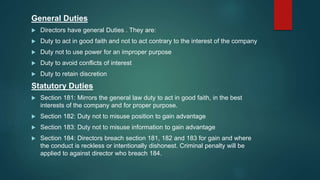
General Duties
 Directors have general Duties . They are:
 Duty to act in good faith and not to act contrary to the interest of the company
 Duty not to use power for an improper purpose
 Duty to avoid conflicts of interest
 Duty to retain discretion
Statutory Duties
 Section 181: Mirrors the general law duty to act in good faith, in the best
interests of the company and for proper purpose.
 Section 182: Duty not to misuse position to gain advantage
 Section 183: Duty not to misuse information to gain advantage
 Section 184: Directors breach section 181, 182 and 183 for gain and where
the conduct is reckless or intentionally dishonest. Criminal penalty will be
applied to against director who breach 184.
Directors Meetings
 1. Frequency of Meeting : within 30 days
 2. Calling of Meeting: within 7 days of calling
 Quorum of Board Meeting: 1/3 of total director
 Participation of Directors in Board Meetings: Participation is must
 Passing of Resolution by Circulation:
Company Directors

Company Directors

  • 1.
  • 2.
    Director Definition : Adirector is a person from a group of managers who leads or supervises a particular area of a company, program, or project. Meaning : An appointed or elected member of the board of directors of a company who, with other directors, has the responsibility for determining and implementing the company's policy. According to section 2(30), provides that no body corporate association or a firm can be appointed as director of the company. Only an individual can be appointed as a director. A company director does not have to be a stockholder or an employee of the firm
  • 3.
    Qualification and disqualificationof a Director Qualification A director must hold a share in the company. Each director must take his qualification share in within 2 months. Disqualification An insolvent person can not become a director. An unsound mind person can not become a director. A person has not paid any call in respect of shares of the company. A person who has been convicted an offence or declared by a court.
  • 4.
    Power of Director Power to buy back its shares  Power to issue debentures  Power to borrow money from other company or from RBI  Power to invest funds for the company  Power to make loans  Power to fill the casual vacant seat in the board  Power to make political contribution  Power to recommend ant the rate of dividend in the annual general meeting  Power to appoint any person as Manager or General Manager  Power to interfere
  • 5.
    Duties of director Directors owe duties to the corporation, and not to individual shareholders, employees or creditors outside exceptional circumstances  Directors' core duty is to remain loyal to the company, and avoid conflicts of interest  Directors are expected to display a high standard of care, skill or diligence  Directors are expected to act in good faith to promote the success of the corporation
  • 6.
    General Duties  Directorshave general Duties . They are:  Duty to act in good faith and not to act contrary to the interest of the company  Duty not to use power for an improper purpose  Duty to avoid conflicts of interest  Duty to retain discretion Statutory Duties  Section 181: Mirrors the general law duty to act in good faith, in the best interests of the company and for proper purpose.  Section 182: Duty not to misuse position to gain advantage  Section 183: Duty not to misuse information to gain advantage  Section 184: Directors breach section 181, 182 and 183 for gain and where the conduct is reckless or intentionally dishonest. Criminal penalty will be applied to against director who breach 184.
  • 7.
    Directors Meetings  1.Frequency of Meeting : within 30 days  2. Calling of Meeting: within 7 days of calling  Quorum of Board Meeting: 1/3 of total director  Participation of Directors in Board Meetings: Participation is must  Passing of Resolution by Circulation: