© 2014 VMware Inc. All rights reserved.
Building your Next Infrastructure
for Cloud Native Apps
PierGiorgio Malusardi – Solution Architect
25/09/2015
Disclaimer
• This presentation may contain product features that are currently under development.
• This overview of new technology represents no commitment from VMware to deliver these
features in any generally available product.
• Features are subject to change, and must not be included in contracts, purchase orders, or
sales agreements of any kind.
• Technical feasibility and market demand will affect final delivery.
• Pricing and packaging for any new technologies or features discussed or presented have not
been determined.
Agenda
1 Overview of Cloud-Native Applications
2 Running Containers on VMware Infrastructure
3 Introducing the VMware Photon Platform
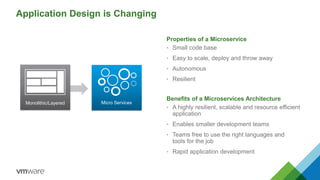
Application Design is Changing
Properties of a Microservice
• Small code base
• Easy to scale, deploy and throw away
• Autonomous
• Resilient
Benefits of a Microservices Architecture
• A highly resilient, scalable and resource efficient
application
• Enables smaller development teams
• Teams free to use the right languages and
tools for the job
• Rapid application development
Monolithic/Layered Micro Services
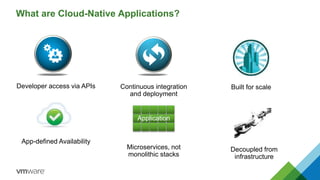
What are Cloud-Native Applications?
Developer access via APIs
Microservices, not
monolithic stacks
Continuous integration
and deployment
App-defined Availability
Built for scale
Decoupled from
infrastructure
Application
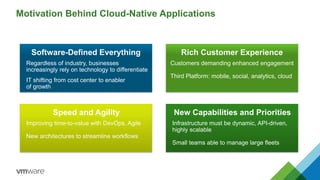
Motivation Behind Cloud-Native Applications
Software-Defined Everything
Regardless of industry, businesses
increasingly rely on technology to differentiate
IT shifting from cost center to enabler
of growth
Rich Customer Experience
Customers demanding enhanced engagement
Third Platform: mobile, social, analytics, cloud
Speed and Agility
Improving time-to-value with DevOps, Agile
New architectures to streamline workflows
New Capabilities and Priorities
Infrastructure must be dynamic, API-driven,
highly scalable
Small teams able to manage large fleets
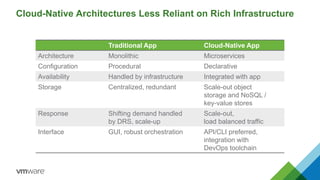
Cloud-Native Architectures Less Reliant on Rich Infrastructure
Traditional App Cloud-Native App
Architecture Monolithic Microservices
Configuration Procedural Declarative
Availability Handled by infrastructure Integrated with app
Storage Centralized, redundant Scale-out object
storage and NoSQL /
key-value stores
Response Shifting demand handled
by DRS, scale-up
Scale-out,
load balanced traffic
Interface GUI, robust orchestration API/CLI preferred,
integration with
DevOps toolchain
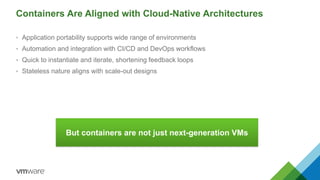
Containers Are Aligned with Cloud-Native Architectures
• Application portability supports wide range of environments
• Automation and integration with CI/CD and DevOps workflows
• Quick to instantiate and iterate, shortening feedback loops
• Stateless nature aligns with scale-out designs
But containers are not just next-generation VMs
Hardware
OS Kernel
OS File system
Userspace
Container
Appprocess
Appprocess
Appprocess
Appprocess
Appprocess
Container
Appprocess
Appprocess
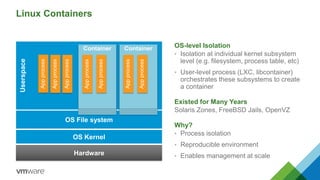
Linux Containers
OS-level Isolation
• Isolation at individual kernel subsystem
level (e.g. filesystem, process table, etc)
• User-level process (LXC, libcontainer)
orchestrates these subsystems to create
a container
Existed for Many Years
Solaris Zones, FreeBSD Jails, OpenVZ
Why?
• Process isolation
• Reproducible environment
• Enables management at scale
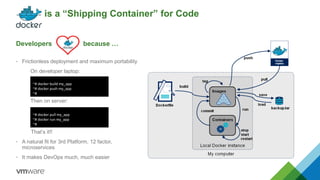
is a “Shipping Container” for Code
Developers because …
• Frictionless deployment and maximum portability
On developer laptop:
Then on server:
That’s it!!
• A natural fit for 3rd Platform, 12 factor,
microservices
• It makes DevOps much, much easier
~# docker build my_app
~# docker push my_app
~#
~# docker pull my_app
~# docker run my_app
~#
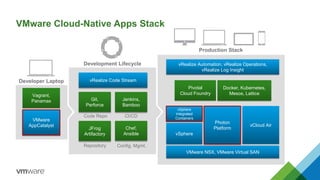
VMware Cloud-Native Apps Stack
vSphere
vSphere
Integrated
Containers
vRealize Automation, vRealize Operations,
vRealize Log Insight
Pivotal
Cloud Foundry
VMware NSX, VMware Virtual SAN
vRealize Code Stream
Chef,
Ansible
JFrog
Artifactory
Repository Config. Mgmt.
Git,
Perforce
Code Repo
Jenkins,
Bamboo
CI/CD
Developer Laptop
Development Lifecycle
Production Stack
Vagrant,
Panamax
VMware
AppCatalyst
Photon
Platform
vCloud Air
Docker, Kubernetes,
Mesos, Lattice
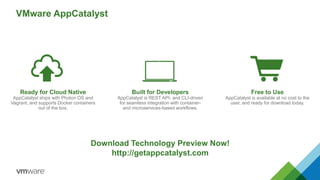
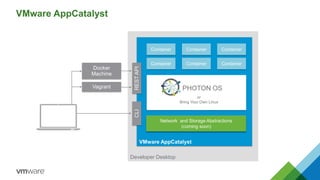
VMware AppCatalyst
Download Technology Preview Now!
http://getappcatalyst.com
Built for Developers
AppCatalyst is REST API- and CLI-driven
for seamless integration with container-
and microservices-based workflows.
Free to Use
AppCatalyst is available at no cost to the
user, and ready for download today.
Ready for Cloud Native
AppCatalyst ships with Photon OS and
Vagrant, and supports Docker containers
out of the box.
VMware AppCatalyst
Developer Desktop
VMware AppCatalyst
CLIRESTAPI
Network and Storage Abstractions
(coming soon)
Docker
Machine
Container Container Container
Vagrant
or
Bring Your Own Linux
PHOTON OS
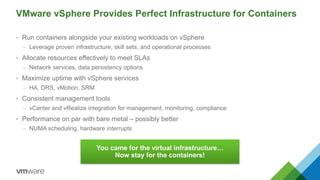
VMware vSphere Provides Perfect Infrastructure for Containers
• Run containers alongside your existing workloads on vSphere
– Leverage proven infrastructure, skill sets, and operational processes
• Allocate resources effectively to meet SLAs
– Network services, data persistency options
• Maximize uptime with vSphere services
– HA, DRS, vMotion, SRM
• Consistent management tools
– vCenter and vRealize integration for management, monitoring, compliance
• Performance on par with bare metal – possibly better
– NUMA scheduling, hardware interrupts
You came for the virtual infrastructure…
Now stay for the containers!
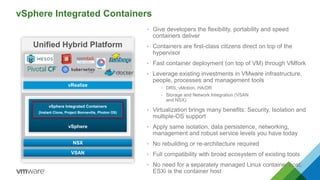
Unified Hybrid Platform
vSphere Integrated Containers
• Give developers the flexibility, portability and speed
containers deliver
• Containers are first-class citizens direct on top of the
hypervisor
• Fast container deployment (on top of VM) through VMfork
• Leverage existing investments in VMware infrastructure,
people, processes and management tools
• DRS, vMotion, HA/DR
• Storage and Network Integration (VSAN
and NSX)
• Virtualization brings many benefits: Security, Isolation and
multiple-OS support
• Apply same isolation, data persistence, networking,
management and robust service levels you have today
• No rebuilding or re-architecture required
• Full compatibility with broad ecosystem of existing tools
• No need for a separately managed Linux container host,
ESXi is the container host
NSX
VSAN
vRealize
vSphere
vSphere Integrated Containers
(Instant Clone, Project Bonneville, Photon OS)
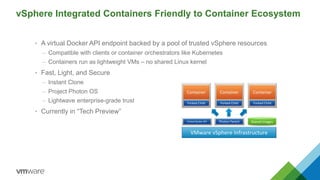
vSphere Integrated Containers Friendly to Container Ecosystem
• A virtual Docker API endpoint backed by a pool of trusted vSphere resources
– Compatible with clients or container orchestrators like Kubernetes
– Containers run as lightweight VMs – no shared Linux kernel
• Fast, Light, and Secure
– Instant Clone
– Project Photon OS
– Lightwave enterprise-grade trust
• Currently in “Tech Preview”
Forked Child
Container
Forked Child
Container
Forked Child
Container
Photon Parent
VMware vSphere Infrastructure
Virtual Docker API Shared Images
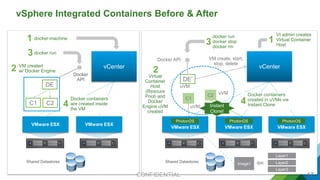
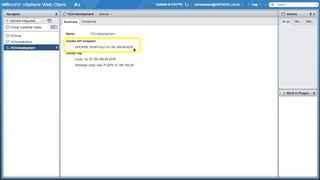
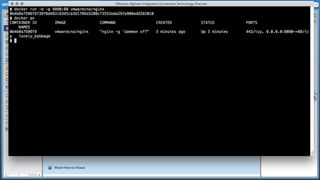
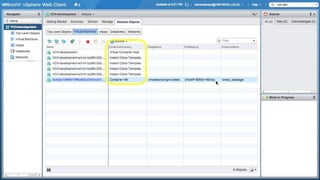
vSphere Integrated Containers Before & After
17
Docker API
VMware ESX
PhotonOS
VMware ESX
PhotonOS
Shared Datastores
C1
Layer1
Layer2
Layer3
Image1
VM create, start,
stop, delete
docker run
docker stop
docker rm
VMware ESXVMware ESX
Shared Datastores
docker-machine1
VM created
w/ Docker Engine2
Docker
API
docker run3
DE
C1 C2
DE’
VI admin creates
Virtual Container
Host
1
C2
3
2
Virtual
Container
Host
(Resoure
Pool) and
Docker
Engine uVM
created
uVM
uVM
uVM
vCenter
Docker containers
are created inside
the VM
4 Instant
Clone!
4
Docker containers
created in uVMs via
Instant Clone
VMware ESX
PhotonOS
vCenter
CONFIDENTIAL
CONFIDENTIAL 19
CONFIDENTIAL 20
Introducing Photon Controller
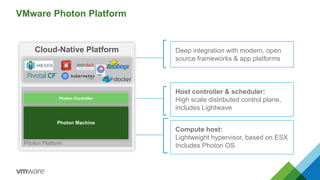
Cloud-Native Platform
VMware Photon Platform
Photon Controller
Photon Machine
Photon Platform
Host controller & scheduler:
High scale distributed control plane,
includes Lightwave
Compute host:
Lightweight hypervisor, based on ESX
Includes Photon OS
Deep integration with modern, open
source frameworks & app platforms
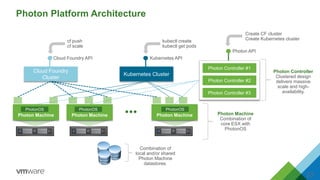
Photon Platform Architecture
23
Photon Machine
PhotonOS
Photon Machine
PhotonOS
Photon Machine
PhotonOS
Photon API
Photon Controller
Clustered design
delivers massive
scale and high-
availability.
Combination of
local and/or shared
Photon Machine
datastores.
Photon Controller #2
Photon Controller #3
Photon Machine
Combination of
core ESX with
PhotonOS
Cloud Foundry API Kubernetes API
Create CF cluster
Create Kubernetes clustercf push
cf scale
kubectl create
kubectl get pods
Photon Controller #1
Cloud Foundry
Cluster
Kubernetes Cluster
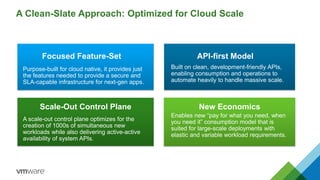
A Clean-Slate Approach: Optimized for Cloud Scale
Focused Feature-Set
Purpose-built for cloud native, it provides just
the features needed to provide a secure and
SLA-capable infrastructure for next-gen apps.
API-first Model
Built on clean, development-friendly APIs,
enabling consumption and operations to
automate heavily to handle massive scale.
Scale-Out Control Plane
A scale-out control plane optimizes for the
creation of 1000s of simultaneous new
workloads while also delivering active-active
availability of system APIs.
New Economics
Enables new “pay for what you need, when
you need it” consumption model that is
suited for large-scale deployments with
elastic and variable workload requirements.
What is Photon Controller NOT? A vCenter Replacement
• They are alternatives, targeting different sets of workloads.
• vCenter will continue to be the right platform for non-cloud
native apps, even once Photon Controller is released.
• Not feature compatible.
– Photon Controller will do far fewer things, at far greater scale.
– No VM Backup, HA, FT, SRM
– No explicit placement, movement of VMs or storage
(*-vMotion, *-DRS).
– Limited VM hardware settings to configure.
• Not Tool or API compatibility: New model for both workload
consumption, and operations (some operational tools will
apply across both, e.g. auto-deploy, OVFtool, etc.)
• No “upgrade path” from vCS.
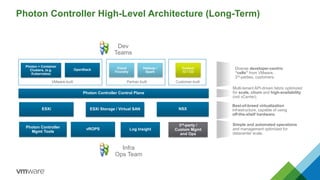
Photon Controller High-Level Architecture (Long-Term)
ESXi ESXi Storage / Virtual SAN NSX
Best-of-breed virtualization
infrastructure, capable of using
off-the-shelf hardware.
Multi-tenant API-driven fabric optimized
for scale, churn and high-availability
(not vCenter).
Photon Controller Control Plane
vROPSPhoton Controller
Mgmt Tools
Simple and automated operations
and management optimized for
datacenter scale.
Log Insight
3rd-party /
Custom Mgmt
and Ops
Diverse developer-centric
“cells” from VMware,
3rd-parties, customers.
OpenStack Cloud
Foundry
Photon + Container
Clusters, (e.g.
Kubernetes)
Hadoop /
Spark
Custom
CI / CD
VMware-built Partner-built Customer-built
Dev
Teams
Infra
Ops Team
Linux OS Optimized for Containers
A lightweight Linux operating system
optimized for cloud-native applications
• Optimized for SDDC
• Addresses guest OS bloat
• Distributed with VMware products
• Standard OS for virtual appliances
Security That Meets the Need of Containers
Identity and access management for cloud-
native applications
• Optimized for services
• Built-in security, identity, authentication
• Open container identity ecosystem
Summary
VMware Infrastructure Provides Flexibility for Cloud-Native Apps
• vSphere Integrated Containers
– On-ramp to cloud-native apps
– Seamless integration with existing vSphere environments
– Fast, lightweight, secure with rich management to meet SLA and compliance requirements
• Photon Platform
– New initiatives with high scale / speed / churn requirements
– Streamlined platform with CLI / API interface
– Extensible consumption surfaces to empower your developers
30
CONFIDENTIAL

Cloud Native Application

  • 1.
    © 2014 VMwareInc. All rights reserved. Building your Next Infrastructure for Cloud Native Apps PierGiorgio Malusardi – Solution Architect 25/09/2015
  • 2.
    Disclaimer • This presentationmay contain product features that are currently under development. • This overview of new technology represents no commitment from VMware to deliver these features in any generally available product. • Features are subject to change, and must not be included in contracts, purchase orders, or sales agreements of any kind. • Technical feasibility and market demand will affect final delivery. • Pricing and packaging for any new technologies or features discussed or presented have not been determined.
  • 3.
    Agenda 1 Overview ofCloud-Native Applications 2 Running Containers on VMware Infrastructure 3 Introducing the VMware Photon Platform
  • 4.
    Application Design isChanging Properties of a Microservice • Small code base • Easy to scale, deploy and throw away • Autonomous • Resilient Benefits of a Microservices Architecture • A highly resilient, scalable and resource efficient application • Enables smaller development teams • Teams free to use the right languages and tools for the job • Rapid application development Monolithic/Layered Micro Services
  • 5.
    What are Cloud-NativeApplications? Developer access via APIs Microservices, not monolithic stacks Continuous integration and deployment App-defined Availability Built for scale Decoupled from infrastructure Application
  • 6.
    Motivation Behind Cloud-NativeApplications Software-Defined Everything Regardless of industry, businesses increasingly rely on technology to differentiate IT shifting from cost center to enabler of growth Rich Customer Experience Customers demanding enhanced engagement Third Platform: mobile, social, analytics, cloud Speed and Agility Improving time-to-value with DevOps, Agile New architectures to streamline workflows New Capabilities and Priorities Infrastructure must be dynamic, API-driven, highly scalable Small teams able to manage large fleets
  • 7.
    Cloud-Native Architectures LessReliant on Rich Infrastructure Traditional App Cloud-Native App Architecture Monolithic Microservices Configuration Procedural Declarative Availability Handled by infrastructure Integrated with app Storage Centralized, redundant Scale-out object storage and NoSQL / key-value stores Response Shifting demand handled by DRS, scale-up Scale-out, load balanced traffic Interface GUI, robust orchestration API/CLI preferred, integration with DevOps toolchain
  • 8.
    Containers Are Alignedwith Cloud-Native Architectures • Application portability supports wide range of environments • Automation and integration with CI/CD and DevOps workflows • Quick to instantiate and iterate, shortening feedback loops • Stateless nature aligns with scale-out designs But containers are not just next-generation VMs
  • 9.
    Hardware OS Kernel OS Filesystem Userspace Container Appprocess Appprocess Appprocess Appprocess Appprocess Container Appprocess Appprocess Linux Containers OS-level Isolation • Isolation at individual kernel subsystem level (e.g. filesystem, process table, etc) • User-level process (LXC, libcontainer) orchestrates these subsystems to create a container Existed for Many Years Solaris Zones, FreeBSD Jails, OpenVZ Why? • Process isolation • Reproducible environment • Enables management at scale
  • 10.
    is a “ShippingContainer” for Code Developers because … • Frictionless deployment and maximum portability On developer laptop: Then on server: That’s it!! • A natural fit for 3rd Platform, 12 factor, microservices • It makes DevOps much, much easier ~# docker build my_app ~# docker push my_app ~# ~# docker pull my_app ~# docker run my_app ~#
  • 11.
    VMware Cloud-Native AppsStack vSphere vSphere Integrated Containers vRealize Automation, vRealize Operations, vRealize Log Insight Pivotal Cloud Foundry VMware NSX, VMware Virtual SAN vRealize Code Stream Chef, Ansible JFrog Artifactory Repository Config. Mgmt. Git, Perforce Code Repo Jenkins, Bamboo CI/CD Developer Laptop Development Lifecycle Production Stack Vagrant, Panamax VMware AppCatalyst Photon Platform vCloud Air Docker, Kubernetes, Mesos, Lattice
  • 12.
    VMware AppCatalyst Download TechnologyPreview Now! http://getappcatalyst.com Built for Developers AppCatalyst is REST API- and CLI-driven for seamless integration with container- and microservices-based workflows. Free to Use AppCatalyst is available at no cost to the user, and ready for download today. Ready for Cloud Native AppCatalyst ships with Photon OS and Vagrant, and supports Docker containers out of the box.
  • 13.
    VMware AppCatalyst Developer Desktop VMwareAppCatalyst CLIRESTAPI Network and Storage Abstractions (coming soon) Docker Machine Container Container Container Container Container Container Vagrant or Bring Your Own Linux PHOTON OS
  • 14.
    VMware vSphere ProvidesPerfect Infrastructure for Containers • Run containers alongside your existing workloads on vSphere – Leverage proven infrastructure, skill sets, and operational processes • Allocate resources effectively to meet SLAs – Network services, data persistency options • Maximize uptime with vSphere services – HA, DRS, vMotion, SRM • Consistent management tools – vCenter and vRealize integration for management, monitoring, compliance • Performance on par with bare metal – possibly better – NUMA scheduling, hardware interrupts You came for the virtual infrastructure… Now stay for the containers!
  • 15.
    Unified Hybrid Platform vSphereIntegrated Containers • Give developers the flexibility, portability and speed containers deliver • Containers are first-class citizens direct on top of the hypervisor • Fast container deployment (on top of VM) through VMfork • Leverage existing investments in VMware infrastructure, people, processes and management tools • DRS, vMotion, HA/DR • Storage and Network Integration (VSAN and NSX) • Virtualization brings many benefits: Security, Isolation and multiple-OS support • Apply same isolation, data persistence, networking, management and robust service levels you have today • No rebuilding or re-architecture required • Full compatibility with broad ecosystem of existing tools • No need for a separately managed Linux container host, ESXi is the container host NSX VSAN vRealize vSphere vSphere Integrated Containers (Instant Clone, Project Bonneville, Photon OS)
  • 16.
    vSphere Integrated ContainersFriendly to Container Ecosystem • A virtual Docker API endpoint backed by a pool of trusted vSphere resources – Compatible with clients or container orchestrators like Kubernetes – Containers run as lightweight VMs – no shared Linux kernel • Fast, Light, and Secure – Instant Clone – Project Photon OS – Lightwave enterprise-grade trust • Currently in “Tech Preview” Forked Child Container Forked Child Container Forked Child Container Photon Parent VMware vSphere Infrastructure Virtual Docker API Shared Images
  • 17.
    vSphere Integrated ContainersBefore & After 17 Docker API VMware ESX PhotonOS VMware ESX PhotonOS Shared Datastores C1 Layer1 Layer2 Layer3 Image1 VM create, start, stop, delete docker run docker stop docker rm VMware ESXVMware ESX Shared Datastores docker-machine1 VM created w/ Docker Engine2 Docker API docker run3 DE C1 C2 DE’ VI admin creates Virtual Container Host 1 C2 3 2 Virtual Container Host (Resoure Pool) and Docker Engine uVM created uVM uVM uVM vCenter Docker containers are created inside the VM 4 Instant Clone! 4 Docker containers created in uVMs via Instant Clone VMware ESX PhotonOS vCenter CONFIDENTIAL
  • 19.
  • 20.
  • 21.
  • 22.
    Cloud-Native Platform VMware PhotonPlatform Photon Controller Photon Machine Photon Platform Host controller & scheduler: High scale distributed control plane, includes Lightwave Compute host: Lightweight hypervisor, based on ESX Includes Photon OS Deep integration with modern, open source frameworks & app platforms
  • 23.
    Photon Platform Architecture 23 PhotonMachine PhotonOS Photon Machine PhotonOS Photon Machine PhotonOS Photon API Photon Controller Clustered design delivers massive scale and high- availability. Combination of local and/or shared Photon Machine datastores. Photon Controller #2 Photon Controller #3 Photon Machine Combination of core ESX with PhotonOS Cloud Foundry API Kubernetes API Create CF cluster Create Kubernetes clustercf push cf scale kubectl create kubectl get pods Photon Controller #1 Cloud Foundry Cluster Kubernetes Cluster
  • 24.
    A Clean-Slate Approach:Optimized for Cloud Scale Focused Feature-Set Purpose-built for cloud native, it provides just the features needed to provide a secure and SLA-capable infrastructure for next-gen apps. API-first Model Built on clean, development-friendly APIs, enabling consumption and operations to automate heavily to handle massive scale. Scale-Out Control Plane A scale-out control plane optimizes for the creation of 1000s of simultaneous new workloads while also delivering active-active availability of system APIs. New Economics Enables new “pay for what you need, when you need it” consumption model that is suited for large-scale deployments with elastic and variable workload requirements.
  • 25.
    What is PhotonController NOT? A vCenter Replacement • They are alternatives, targeting different sets of workloads. • vCenter will continue to be the right platform for non-cloud native apps, even once Photon Controller is released. • Not feature compatible. – Photon Controller will do far fewer things, at far greater scale. – No VM Backup, HA, FT, SRM – No explicit placement, movement of VMs or storage (*-vMotion, *-DRS). – Limited VM hardware settings to configure. • Not Tool or API compatibility: New model for both workload consumption, and operations (some operational tools will apply across both, e.g. auto-deploy, OVFtool, etc.) • No “upgrade path” from vCS.
  • 26.
    Photon Controller High-LevelArchitecture (Long-Term) ESXi ESXi Storage / Virtual SAN NSX Best-of-breed virtualization infrastructure, capable of using off-the-shelf hardware. Multi-tenant API-driven fabric optimized for scale, churn and high-availability (not vCenter). Photon Controller Control Plane vROPSPhoton Controller Mgmt Tools Simple and automated operations and management optimized for datacenter scale. Log Insight 3rd-party / Custom Mgmt and Ops Diverse developer-centric “cells” from VMware, 3rd-parties, customers. OpenStack Cloud Foundry Photon + Container Clusters, (e.g. Kubernetes) Hadoop / Spark Custom CI / CD VMware-built Partner-built Customer-built Dev Teams Infra Ops Team
  • 27.
    Linux OS Optimizedfor Containers A lightweight Linux operating system optimized for cloud-native applications • Optimized for SDDC • Addresses guest OS bloat • Distributed with VMware products • Standard OS for virtual appliances
  • 28.
    Security That Meetsthe Need of Containers Identity and access management for cloud- native applications • Optimized for services • Built-in security, identity, authentication • Open container identity ecosystem
  • 29.
  • 30.
    VMware Infrastructure ProvidesFlexibility for Cloud-Native Apps • vSphere Integrated Containers – On-ramp to cloud-native apps – Seamless integration with existing vSphere environments – Fast, lightweight, secure with rich management to meet SLA and compliance requirements • Photon Platform – New initiatives with high scale / speed / churn requirements – Streamlined platform with CLI / API interface – Extensible consumption surfaces to empower your developers 30 CONFIDENTIAL