1 
Participatory Community development plans 
vs IP - ICARDA experience 
Ali Nefzaoui 
CRP-DS Coordinator of NA&WA Flagship 
a.nefzaoui@cgiar.org
CRP-DS Program Management Office Notice No.3/11 
September 2014 
• An integrated systems approach at all sites that uses innovative 
science and inter-disciplinary teams. 
• Shift from descriptive to systems analysis & modeling 
• Development of innovation platforms 
• Clear linkages of research hypotheses to outputs, outcomes and IDO’s 
• Value chain focus complements on-farm focus 
• Increasing recognition of need for enabling institutions & governance 
• Contested paradigms hard vs soft sciences; researcher vs farmer 
knowledge, what is the balance needed for the research questions 
asked 
• Greater social equity and gender considerations 
• Fit for purpose participatory approaches 
• More emphasis on SRT 1 & 4 (better functioning innovation systems, 
measuring impacts and cross-regional synthesis) 
• Etc……. 
2
CRP-DS ISAC, July 2014 
Systems innovation platforms will be fostered that add 
to value chains by encouraging diversification and local 
income generation by harnessing local and ‘scientific’ 
knowledge that, when combined with responsible 
private sector investment, will result in local clusters of 
economic activity incorporating other livelihood 
options such as renewable energy, ecotourism, 
artisanal goods and biodiversity for pharmaceuticals. 
3
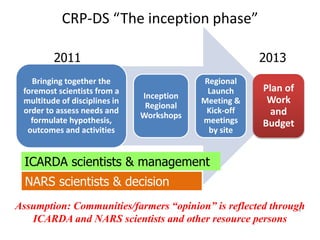
CRP-DS “The inception phase” 
Bringing together the 
foremost scientists from a 
multitude of disciplines in 
order to assess needs and 
formulate hypothesis, 
outcomes and activities 
Inception 
Regional 
Workshops 
Regional 
Launch 
Meeting & 
Kick-off 
meetings 
by site 
Plan of 
Work 
and 
Budget 
4 
2011 2013 
ICARDA scientists & management 
NARS scientists & decision 
makers 
Assumption: Communities/farmers “opinion” is reflected through 
ICARDA and NARS scientists and other resource persons
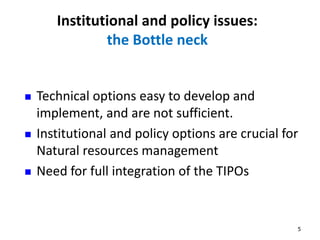
Institutional and policy issues: 
the Bottle neck 
5 
 Technical options easy to develop and 
implement, and are not sufficient. 
 Institutional and policy options are crucial for 
Natural resources management 
 Need for full integration of the TIPOs
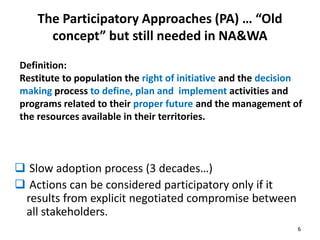
The Participatory Approaches (PA) … “Old 
concept” but still needed in NA&WA 
Definition: 
Restitute to population the right of initiative and the decision 
making process to define, plan and implement activities and 
programs related to their proper future and the management of 
the resources available in their territories. 
 Slow adoption process (3 decades…) 
 Actions can be considered participatory only if it 
results from explicit negotiated compromise between 
all stakeholders. 
6
7 
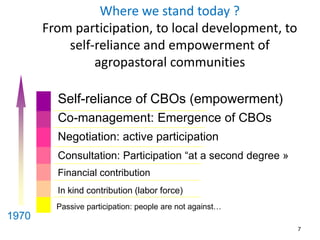
Where we stand today ? 
From participation, to local development, to 
self-reliance and empowerment of 
agropastoral communities 
Self-reliance of CBOs (empowerment) 
Co-management: Emergence of CBOs 
Negotiation: active participation 
Consultation: Participation “at a second degree » 
Financial contribution 
In kind contribution (labor force) 
Passive participation: people are not against… 
1970
8 
ICARDA/M&M – IFAD working together… 
 Develop methodologies and tools for participatory 
management of natural resources in arid agropastoral 
areas 
 Empower agro communities through the creation of 
community-based organizations (CBO) 
 Getting policymakers at the local and national level to 
realize that technical, policy, and institutional options 
(TIPOs) must be strongly linked and integrated for a 
successful and sustainable rural development 
 Enhance on-going research and development initiatives 
using community participatory tools through a sound 
training program targeting all stakeholders.
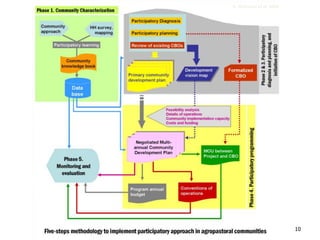
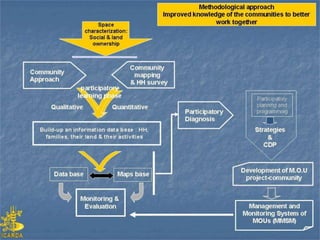
The Methodology: Steps and tools 
• Step 1. Participatory characterization of the 
Community (territory and users): knowledge/learning 
phase 
• Step 2. Participatory diagnosis & planning 
• Step 3. Participatory programming 
• Step 4. Promotion of community-based organizations 
• Step 5. Implementation and Monitoring and Evaluation 
Process based on group animation and multi-disciplinary 
team work
10 
A. Nefzaoui et al. 2006
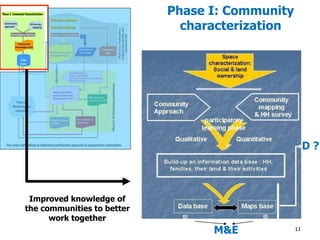
11 
Improved knowledge of 
the communities to better 
work together 
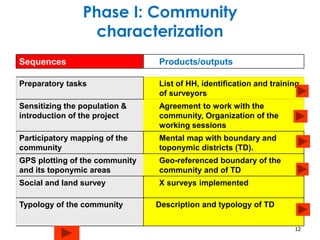
Phase I: Community 
characterization 
D ? 
M&E
Phase I: Community 
characterization 
Sequences Products/outputs 
Preparatory tasks List of HH, identification and training 
of surveyors 
Sensitizing the population & 
introduction of the project 
Agreement to work with the 
community, Organization of the 
working sessions 
Participatory mapping of the 
community 
Mental map with boundary and 
toponymic districts (TD). 
GPS plotting of the community 
and its toponymic areas 
Geo-referenced boundary of the 
community and of TD 
Social and land survey X surveys implemented 
Typology of the community Description and typology of TD 
12
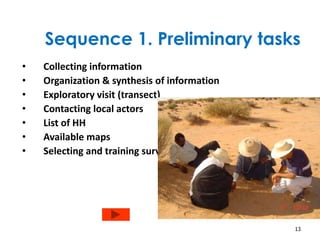
Sequence 1. Preliminary tasks 
• Collecting information 
• Organization & synthesis of information 
• Exploratory visit (transect) 
• Contacting local actors 
• List of HH 
• Available maps 
• Selecting and training surveyors 
13
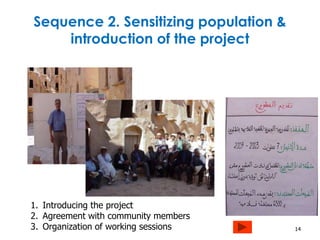
Sequence 2. Sensitizing population & 
introduction of the project 
14 
1. Introducing the project 
2. Agreement with community members 
3. Organization of working sessions
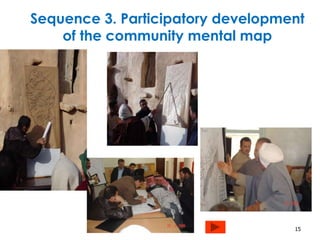
Sequence 3. Participatory development 
of the community mental map 
15
Sequence 3. Participatory development of 
 Common understanding of the territory 
 Create a link between mental map and conventional 
maps and GIS. 
 To have a comprehensive map to negotiate locations of 
activities agreed upon. 
 Define with the population of their history, social 
composition, localization of resources, etc. 
 Toponymic districts (TD) 
 Work to be implemented in small group (elders) 
designated by the population. 
16 
the community mental map
17 
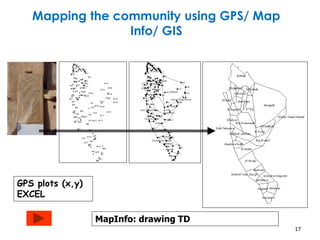
Mapping the community using GPS/ Map 
Info/ GIS 
GPS plots (x,y) 
EXCEL 
MapInfo: drawing TD
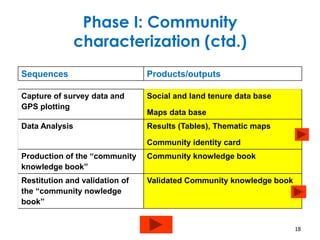
18 
Phase I: Community 
characterization (ctd.) 
Sequences Products/outputs 
Capture of survey data and 
GPS plotting 
Social and land tenure data base 
Maps data base 
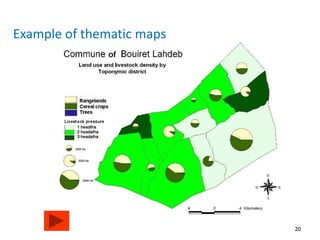
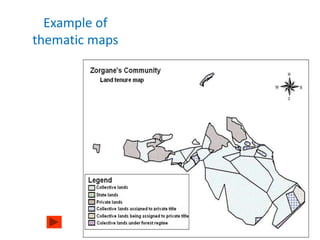
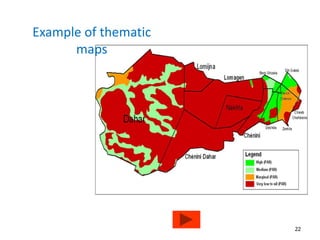
Data Analysis Results (Tables), Thematic maps 
Community identity card 
Production of the “community 
knowledge book” 
Community knowledge book 
Restitution and validation of 
the “community nowledge 
book” 
Validated Community knowledge book
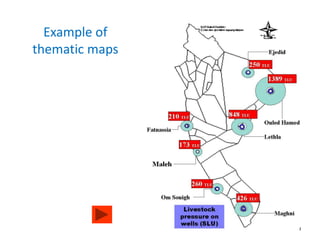
Example of 
thematic maps 
19
20 
Example of thematic maps
21 
Example of 
thematic maps
22 
Example of thematic 
maps
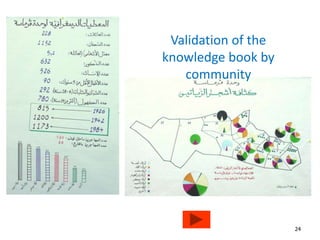
24 
Validation of the 
knowledge book by 
community
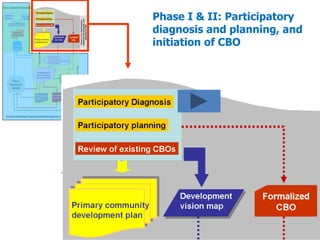
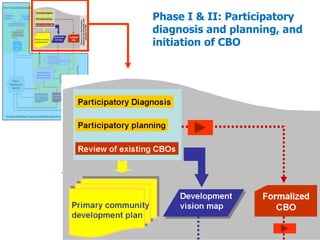
Phase I & II: Participatory 
diagnosis and planning, and 
initiation of CBO 
25
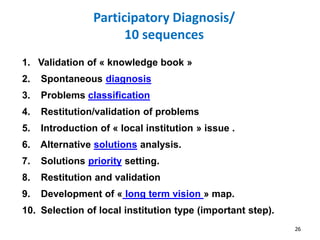
Participatory Diagnosis/ 
10 sequences 
26 
1. Validation of « knowledge book » 
2. Spontaneous diagnosis 
3. Problems classification 
4. Restitution/validation of problems 
5. Introduction of « local institution » issue . 
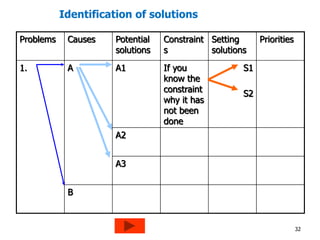
6. Alternative solutions analysis. 
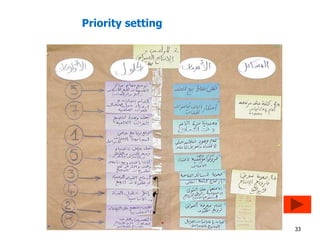
7. Solutions priority setting. 
8. Restitution and validation 
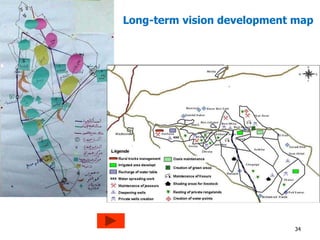
9. Development of « long term vision » map. 
10. Selection of local institution type (important step).
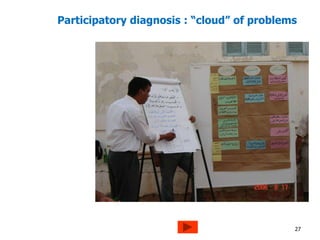
Participatory diagnosis : “cloud” of problems 
27
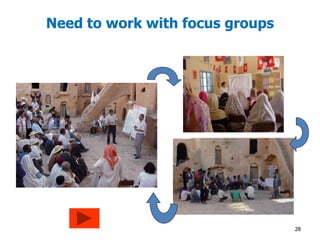
Need to work with focus groups 
28
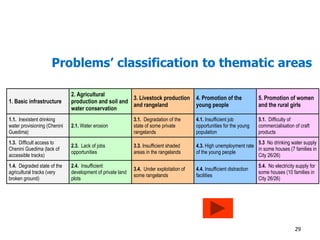
Problems’ classification to thematic areas 
29 
1. Basic infrastructure 
2. Agricultural 
production and soil and 
water conservation 
3. Livestock production 
and rangeland 
4. Promotion of the 
young people 
5. Promotion of women 
and the rural girls 
1.1. Inexistent drinking 
water provisioning (Chenini 
Guedima) 
2.1. Water erosion 
3.1. Degradation of the 
state of some private 
rangelands 
4.1. Insufficient job 
opportunities for the young 
population 
5.1. Difficulty of 
commercialisation of craft 
products 
1.3. Difficult access to 
Chenini Guedima (lack of 
accessible tracks) 
2.3. Lack of jobs 
opportunities 
3.3. Insufficient shaded 
areas in the rangelands 
4.3. High unemployment rate 
of the young people 
5.3 No drinking water supply 
in some houses (7 families in 
City 26/26) 
1.4. Degraded state of the 
agricultural tracks (very 
broken ground) 
2.4. Insufficient 
development of private land 
plots 
3.4. Under exploitation of 
some rangelands 
4.4. Insufficient distraction 
facilities 
5.4. No electricity supply for 
some houses (10 families in 
City 26/26)
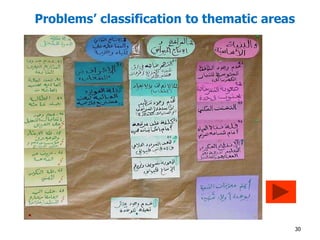
Problems’ classification to thematic areas 
30
31
Problems Causes Potential 
solutions 
Constraint 
s 
Setting 
solutions 
Priorities 
1. A A1 If you 
know the 
constraint 
why it has 
not been 
done 
S1 
S2 
A2 
A3 
B 
32 
Identification of solutions
33 
Priority setting
Long-term vision development map 
34
Phase I & II: Participatory 
diagnosis and planning, and 
initiation of CBO 
35
Step IV. Community-based Organizations 
• Inventory of existing local institutions 
• Analysis of the mandate and roles of each 
institution 
• Analysis of the decision-making process 
• Identification of improvements needed to the 
current decision making process 
• Development of methodologies to formalize local 
institutions 
36
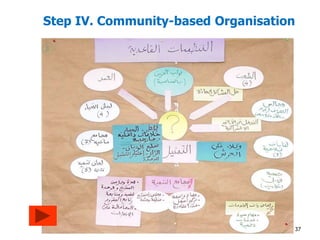
Step IV. Community-based Organisation 
37
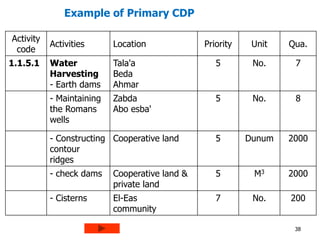
38 
Activity 
code 
Activities Location Priority Unit Qua. 
1.1.5.1 Water 
Harvesting 
- Earth dams 
Tala'a 
Beda 
Ahmar 
5 No. 7 
- Maintaining 
the Romans 
wells 
Zabda 
Abo esba' 
5 No. 8 
- Constructing 
contour 
ridges 
Cooperative land 5 Dunum 2000 
- check dams Cooperative land & 
private land 
5 M3 2000 
- Cisterns El-Eas 
community 
7 No. 200 
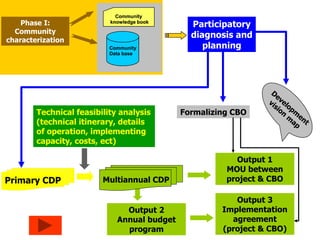
Example of Primary CDP
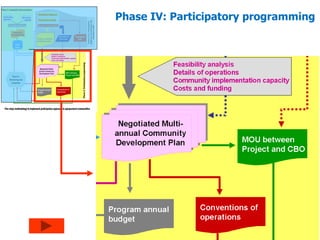
Phase IV: Participatory programming 
39
Community 
knowledge book 
Community 
Data base 
Phase I: 
Community 
characterization 
Participatory 
diagnosis and 
planning 
Formalizing CBO 
Technical feasibility analysis 
(technical itinerary, details 
of operation, implementing 
capacity, costs, ect) 
Primary CDP 
Multiannual CDP 
Output 1 
MOU between 
project & CBO 
Output 3 
Implementation 
agreement 
(project & CBO) 
Output 2 
Annual budget 
program
41
42 
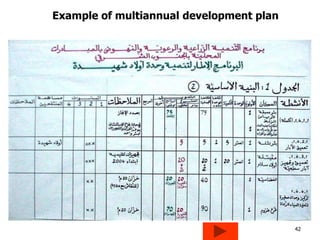
Example of multiannual development plan
43 
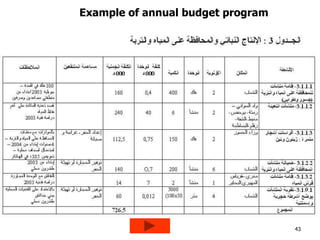
Example of annual budget program
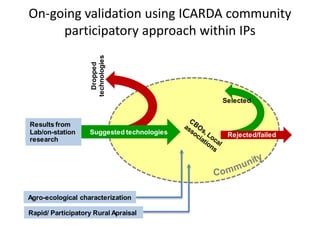
On-going validation using ICARDA community 
participatory approach within IPs 
Dropped 
technologies 
Suggested technologies 
Selected 
Rejected/failed 
Results from 
Lab/on-station 
research 
Agro-ecological characterization 
Rapid/ Participatory Rural Apraisal
Establishing IPs through Community 
development plan 
 Fostering integration between different disciplines, actors, 
etc. 
 Stimulating farmers and communities participation in 
steering their own development process. 
 Facilitating technology transfer through a participatory 
technology development. 
 Promoting collective action on the basis of a shared 
consensus. 
 Sound “open access” mega database
Establishing IPs through Community 
development plan 
– The population through the participatory process determines 
the activities to be implemented, the amount, the location, the 
beneficiaries, and the implementing entity. 
– The population contributes effectively in monitoring and 
endorsement of the work implemented. 
– The power given to the community is a part of the MOU signed 
between the community and the Project management unit. 
– Small businesses are currently emerging from the community 
(soil and water conservation, planting, nurseries, etc.), 
– The President of the CBO is acting equal to equal with the 
project director, and approves and co-sign with him any 
deal/bargain related to their community
Establishing IPs through Community 
development plan 
– The project served as a bridge between communities, 
government services, and NGOs to promote the development 
of the selected communities. 
– National teams worked with their communities to develop 
proposals and get funding for priority actions. 
– The linkages with new partners provided important social 
capital that facilitated the implementation of the negotiated 
action plans and the elaboration of community development 
plans.
Key learning 
• Annual and long-term development plan approved by 
communities is an efficient tool to mobilize resources 
and ease project implementation 
• Do not underestimate the ability of communities to 
identify appropriate technical solutions, to solve internal 
conflicts particularly relating to property rights 
• The success and the sustainability of the process 
depends on the promotion of elected community-based 
organizations that play a key interface role between 
communities and other actors (government agencies and 
decision makers, non government agencies, donors, and 
other communities).
Participatory Community Development Plans

Participatory Community Development Plans

  • 1.
    1 Participatory Communitydevelopment plans vs IP - ICARDA experience Ali Nefzaoui CRP-DS Coordinator of NA&WA Flagship a.nefzaoui@cgiar.org
  • 2.
    CRP-DS Program ManagementOffice Notice No.3/11 September 2014 • An integrated systems approach at all sites that uses innovative science and inter-disciplinary teams. • Shift from descriptive to systems analysis & modeling • Development of innovation platforms • Clear linkages of research hypotheses to outputs, outcomes and IDO’s • Value chain focus complements on-farm focus • Increasing recognition of need for enabling institutions & governance • Contested paradigms hard vs soft sciences; researcher vs farmer knowledge, what is the balance needed for the research questions asked • Greater social equity and gender considerations • Fit for purpose participatory approaches • More emphasis on SRT 1 & 4 (better functioning innovation systems, measuring impacts and cross-regional synthesis) • Etc……. 2
  • 3.
    CRP-DS ISAC, July2014 Systems innovation platforms will be fostered that add to value chains by encouraging diversification and local income generation by harnessing local and ‘scientific’ knowledge that, when combined with responsible private sector investment, will result in local clusters of economic activity incorporating other livelihood options such as renewable energy, ecotourism, artisanal goods and biodiversity for pharmaceuticals. 3
  • 4.
    CRP-DS “The inceptionphase” Bringing together the foremost scientists from a multitude of disciplines in order to assess needs and formulate hypothesis, outcomes and activities Inception Regional Workshops Regional Launch Meeting & Kick-off meetings by site Plan of Work and Budget 4 2011 2013 ICARDA scientists & management NARS scientists & decision makers Assumption: Communities/farmers “opinion” is reflected through ICARDA and NARS scientists and other resource persons
  • 5.
    Institutional and policyissues: the Bottle neck 5  Technical options easy to develop and implement, and are not sufficient.  Institutional and policy options are crucial for Natural resources management  Need for full integration of the TIPOs
  • 6.
    The Participatory Approaches(PA) … “Old concept” but still needed in NA&WA Definition: Restitute to population the right of initiative and the decision making process to define, plan and implement activities and programs related to their proper future and the management of the resources available in their territories.  Slow adoption process (3 decades…)  Actions can be considered participatory only if it results from explicit negotiated compromise between all stakeholders. 6
  • 7.
    7 Where westand today ? From participation, to local development, to self-reliance and empowerment of agropastoral communities Self-reliance of CBOs (empowerment) Co-management: Emergence of CBOs Negotiation: active participation Consultation: Participation “at a second degree » Financial contribution In kind contribution (labor force) Passive participation: people are not against… 1970
  • 8.
    8 ICARDA/M&M –IFAD working together…  Develop methodologies and tools for participatory management of natural resources in arid agropastoral areas  Empower agro communities through the creation of community-based organizations (CBO)  Getting policymakers at the local and national level to realize that technical, policy, and institutional options (TIPOs) must be strongly linked and integrated for a successful and sustainable rural development  Enhance on-going research and development initiatives using community participatory tools through a sound training program targeting all stakeholders.
  • 9.
    The Methodology: Stepsand tools • Step 1. Participatory characterization of the Community (territory and users): knowledge/learning phase • Step 2. Participatory diagnosis & planning • Step 3. Participatory programming • Step 4. Promotion of community-based organizations • Step 5. Implementation and Monitoring and Evaluation Process based on group animation and multi-disciplinary team work
  • 10.
    10 A. Nefzaouiet al. 2006
  • 11.
    11 Improved knowledgeof the communities to better work together Phase I: Community characterization D ? M&E
  • 12.
    Phase I: Community characterization Sequences Products/outputs Preparatory tasks List of HH, identification and training of surveyors Sensitizing the population & introduction of the project Agreement to work with the community, Organization of the working sessions Participatory mapping of the community Mental map with boundary and toponymic districts (TD). GPS plotting of the community and its toponymic areas Geo-referenced boundary of the community and of TD Social and land survey X surveys implemented Typology of the community Description and typology of TD 12
  • 13.
    Sequence 1. Preliminarytasks • Collecting information • Organization & synthesis of information • Exploratory visit (transect) • Contacting local actors • List of HH • Available maps • Selecting and training surveyors 13
  • 14.
    Sequence 2. Sensitizingpopulation & introduction of the project 14 1. Introducing the project 2. Agreement with community members 3. Organization of working sessions
  • 15.
    Sequence 3. Participatorydevelopment of the community mental map 15
  • 16.
    Sequence 3. Participatorydevelopment of  Common understanding of the territory  Create a link between mental map and conventional maps and GIS.  To have a comprehensive map to negotiate locations of activities agreed upon.  Define with the population of their history, social composition, localization of resources, etc.  Toponymic districts (TD)  Work to be implemented in small group (elders) designated by the population. 16 the community mental map
  • 17.
    17 Mapping thecommunity using GPS/ Map Info/ GIS GPS plots (x,y) EXCEL MapInfo: drawing TD
  • 18.
    18 Phase I:Community characterization (ctd.) Sequences Products/outputs Capture of survey data and GPS plotting Social and land tenure data base Maps data base Data Analysis Results (Tables), Thematic maps Community identity card Production of the “community knowledge book” Community knowledge book Restitution and validation of the “community nowledge book” Validated Community knowledge book
  • 19.
  • 20.
    20 Example ofthematic maps
  • 21.
    21 Example of thematic maps
  • 22.
    22 Example ofthematic maps
  • 24.
    24 Validation ofthe knowledge book by community
  • 25.
    Phase I &II: Participatory diagnosis and planning, and initiation of CBO 25
  • 26.
    Participatory Diagnosis/ 10sequences 26 1. Validation of « knowledge book » 2. Spontaneous diagnosis 3. Problems classification 4. Restitution/validation of problems 5. Introduction of « local institution » issue . 6. Alternative solutions analysis. 7. Solutions priority setting. 8. Restitution and validation 9. Development of « long term vision » map. 10. Selection of local institution type (important step).
  • 27.
    Participatory diagnosis :“cloud” of problems 27
  • 28.
    Need to workwith focus groups 28
  • 29.
    Problems’ classification tothematic areas 29 1. Basic infrastructure 2. Agricultural production and soil and water conservation 3. Livestock production and rangeland 4. Promotion of the young people 5. Promotion of women and the rural girls 1.1. Inexistent drinking water provisioning (Chenini Guedima) 2.1. Water erosion 3.1. Degradation of the state of some private rangelands 4.1. Insufficient job opportunities for the young population 5.1. Difficulty of commercialisation of craft products 1.3. Difficult access to Chenini Guedima (lack of accessible tracks) 2.3. Lack of jobs opportunities 3.3. Insufficient shaded areas in the rangelands 4.3. High unemployment rate of the young people 5.3 No drinking water supply in some houses (7 families in City 26/26) 1.4. Degraded state of the agricultural tracks (very broken ground) 2.4. Insufficient development of private land plots 3.4. Under exploitation of some rangelands 4.4. Insufficient distraction facilities 5.4. No electricity supply for some houses (10 families in City 26/26)
  • 30.
  • 31.
  • 32.
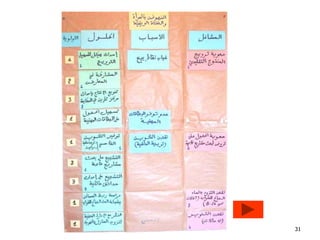
    Problems Causes Potential solutions Constraint s Setting solutions Priorities 1. A A1 If you know the constraint why it has not been done S1 S2 A2 A3 B 32 Identification of solutions
  • 33.
  • 34.
  • 35.
    Phase I &II: Participatory diagnosis and planning, and initiation of CBO 35
  • 36.
    Step IV. Community-basedOrganizations • Inventory of existing local institutions • Analysis of the mandate and roles of each institution • Analysis of the decision-making process • Identification of improvements needed to the current decision making process • Development of methodologies to formalize local institutions 36
  • 37.
    Step IV. Community-basedOrganisation 37
  • 38.
    38 Activity code Activities Location Priority Unit Qua. 1.1.5.1 Water Harvesting - Earth dams Tala'a Beda Ahmar 5 No. 7 - Maintaining the Romans wells Zabda Abo esba' 5 No. 8 - Constructing contour ridges Cooperative land 5 Dunum 2000 - check dams Cooperative land & private land 5 M3 2000 - Cisterns El-Eas community 7 No. 200 Example of Primary CDP
  • 39.
  • 40.
    Community knowledge book Community Data base Phase I: Community characterization Participatory diagnosis and planning Formalizing CBO Technical feasibility analysis (technical itinerary, details of operation, implementing capacity, costs, ect) Primary CDP Multiannual CDP Output 1 MOU between project & CBO Output 3 Implementation agreement (project & CBO) Output 2 Annual budget program
  • 41.
  • 42.
    42 Example ofmultiannual development plan
  • 43.
    43 Example ofannual budget program
  • 44.
    On-going validation usingICARDA community participatory approach within IPs Dropped technologies Suggested technologies Selected Rejected/failed Results from Lab/on-station research Agro-ecological characterization Rapid/ Participatory Rural Apraisal
  • 45.
    Establishing IPs throughCommunity development plan  Fostering integration between different disciplines, actors, etc.  Stimulating farmers and communities participation in steering their own development process.  Facilitating technology transfer through a participatory technology development.  Promoting collective action on the basis of a shared consensus.  Sound “open access” mega database
  • 46.
    Establishing IPs throughCommunity development plan – The population through the participatory process determines the activities to be implemented, the amount, the location, the beneficiaries, and the implementing entity. – The population contributes effectively in monitoring and endorsement of the work implemented. – The power given to the community is a part of the MOU signed between the community and the Project management unit. – Small businesses are currently emerging from the community (soil and water conservation, planting, nurseries, etc.), – The President of the CBO is acting equal to equal with the project director, and approves and co-sign with him any deal/bargain related to their community
  • 47.
    Establishing IPs throughCommunity development plan – The project served as a bridge between communities, government services, and NGOs to promote the development of the selected communities. – National teams worked with their communities to develop proposals and get funding for priority actions. – The linkages with new partners provided important social capital that facilitated the implementation of the negotiated action plans and the elaboration of community development plans.
  • 48.
    Key learning •Annual and long-term development plan approved by communities is an efficient tool to mobilize resources and ease project implementation • Do not underestimate the ability of communities to identify appropriate technical solutions, to solve internal conflicts particularly relating to property rights • The success and the sustainability of the process depends on the promotion of elected community-based organizations that play a key interface role between communities and other actors (government agencies and decision makers, non government agencies, donors, and other communities).