COMMUNICATIVE
ENGLISH
Dr. Sharada H
Assistant Professor
Department of Eye&ENT
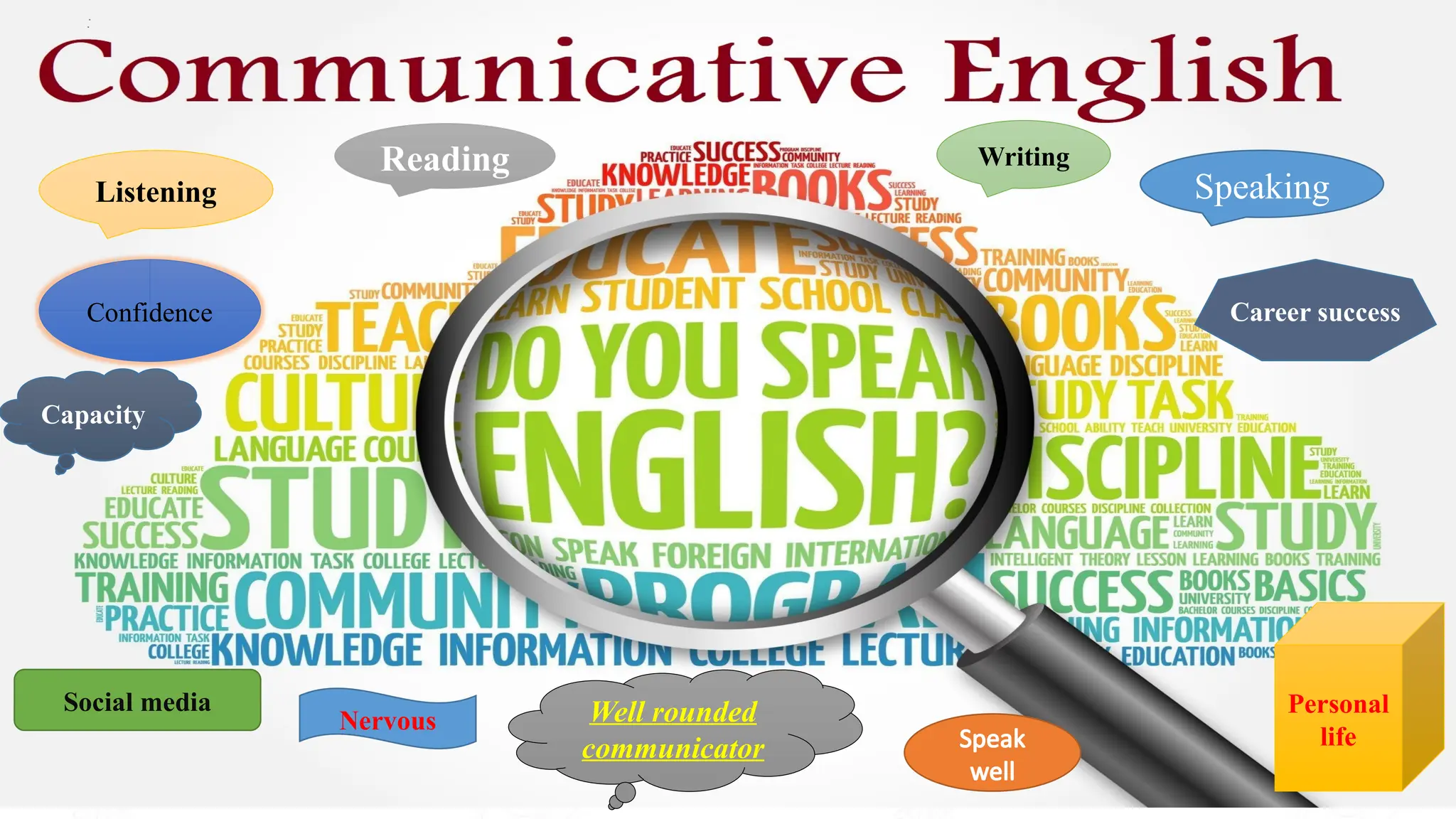
Listening Speaking
Reading Writing
Well rounded
communicator
Confidence Career success
Personal
life
Capacity
Social media
Nervous
Speak
well
INTRODUCTION
• Communicative English is a crucial skill in modern life. It enables one to
communicate with others of various levels and includes social relationships,
discussions with colleagues or business meetings at work.
• Self-improvement becomes critical if you want to raise your chances of
success.
• Language is the vehicle of our thoughts and feelings of our stories ,
Grammar is the machinery by which that vehicle is set in motion.
• Therefore learning English language would help an individual improve
their confidence which influences our perception of competence and
encourages us to be more effective in business and career.
• So basically, Communicative English is the language most suitable for
public speaking internationally.
• Many employable skills are found to be important in day-to-day
communication.
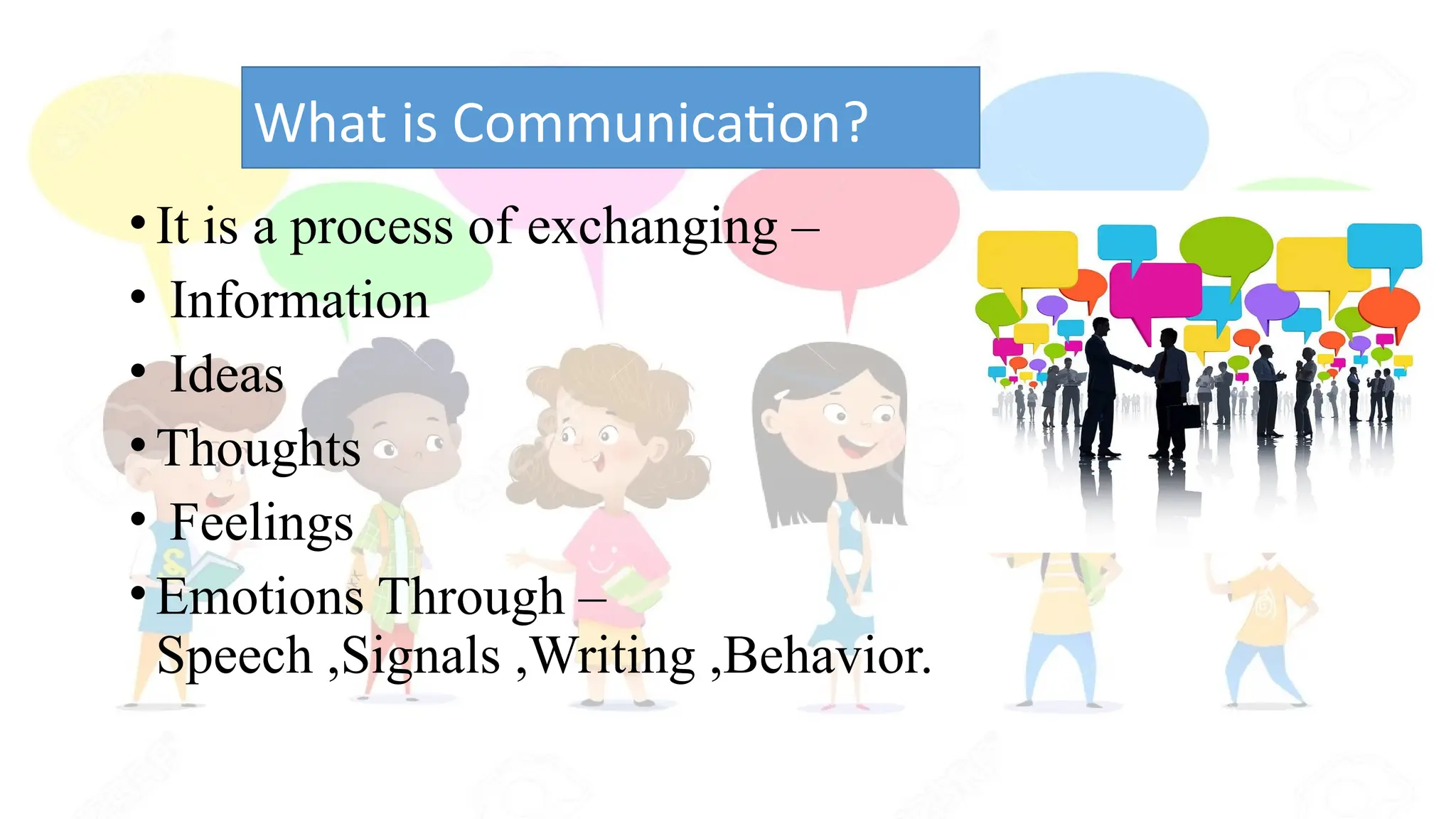
•It is a process of exchanging –
• Information
• Ideas
•Thoughts
• Feelings
•Emotions Through –
Speech ,Signals ,Writing ,Behavior.
What is Communication?
The different categories of communication
include:
• Spoken or Verbal Communication
• Non-Verbal Communication
• Written Communication
• Visualizations
• Spoken or Verbal Communication, which includes face-to-face,
telephone, radio or television and other media.
• Non-Verbal Communication, covering body language, gestures,
how we dress or act, where we stand etc. There are many subtle
ways that we communicate with others.
• For example, the tone of voice can give clues to mood or
emotional state, whilst hand signals or gestures can add to a
spoken message.
• Written Communication: which includes letters, e-mails, social
media, books, magazines, the Internet and other media.
• Until recent times, a relatively small number of writers and
publishers were very powerful when it came to communicating the
written word.
• Today, we can all write and publish our ideas online, which has led
to an explosion of information and communication possibilities.
• Ex: Research work publications
• Visualizations: graphs and charts, maps, logos and other
visualizations can all communicate messages.
The Importance of Communicative English
• The English language as a foreign language is the most used and
important international language.
• When it comes to speaking, reading or writing – meaning
communicating in written form as well – different people will
choose a certain type of grammar if they wish to reach an
understanding with someone else.
How To Improve Your English Communication Skills?
• One of the best ways to learn a language like English is by
learning through communicative-understanding.
• which mainly involves personal experience and everyday use.
• For example, when you are first learning how to develop your
daily conversation skills, do not expect yourself to be talking
elegantly.
• Communicating successfully requires effort and time as it
demands one must be able to afford judgment in the language
which helps them avoid grammatical mistakes despite making
no attempts at communication with the other person.
• Research studies show that when people try to learn a language
through study alone, it may prove difficult for learners.
• Studying the language through conversation is the much possible
easy way.
How To Improve Your English Communication Skills
• There are hundreds of fantastic techniques out there that can help you to
improve your English communication skills.
• Communicative English requires practice, and trying to perfect your
communication skills is no easy task.
• Think Before You Speak – A great first tip for improving your English
Communications Skills would be to think about what you’re going to say
before you speak.
• By thinking about what you are going to say in advance, you reduce the
chances of having to awkwardly wait while you develop an answer to a
question or think about how to push a conversation forward.
• Practice With Others – This is probably one of the most vital
elements when it comes to perfecting your English
Communication Skills and adopting the Communicative
Approach within your studies.
• It is essential for you to practice with others, whether that be
other learners or native speakers.
• By practicing with others, not only will you be getting real life
English Communication experience, but you will also be
developing your natural abilities for learning a language moving
forward.
• Even the most proficient native speakers are naturally learning
from their interactions.
• Don’t Just Learn Words, Learn Your Sentences Too – It’s
important to not only learn your vocabulary, as although this is
useful, it’s not going to benefit you when your conversation
consists of more than a single word.
• Learn your sentences too! By learning your sentences and
practicing these, you will be well prepared for a lot of English
Communication scenarios.
• For example, if you know you are going to be meeting new
people, then practice your sentences explaining who you are,
where you come from, and what you like.
• Focus On Fluency – Another tip for when it comes to
developing your Communicative English skills would be to
practice your fluency.
• Try to speak as if you were a native! You may not get it right at
the beginning, but hopefully the more and more you practice
your fluency, the better your English Communications should
become.
• By practicing your fluency you are on the first track to faultless
English communication skills.
• Don’t Rush When You Speak – You may be a lighting fast speaker when
it comes to your mother tongue.
• But expecting to communicate as fast with a foreign language is not
realistic. Slow down and think.
• More importantly, don’t rush a sentence, because the last thing you want is
a poorly formed sentence. If you spend less time rushing your sentences, it
should give you more breathing space to think about what you’re going to
say.
• By taking your time to speak you will be ensuring that what you are
saying is correct and makes sense.
• Don’t Run Out Of Follow Up Questions – Make sure you don’t run out
of follow up questions or you’ll be left awkwardly thinking about what to
say next.
• Learn different types of open questions that can lead to further discussions,
some examples could be “What are your views on that topic” or “Can you
tell me more about that it seems interesting”.
• For an effective communicative English approach, you need to listen to
what the person you are speaking to is saying, and form an open question
to help further the conversation.
• By following our above tips, you will be able to further improve your
English communication skills, ensuring effortless communication in no
time at all.
Why Is Communicative English Necessary?
• If you have already been exposed to the communicative approach, then it is
likely you already know the benefits this approach can have on your
English language studies, and the value it can provide.
• Communicative English is important as it can help a student to see value in
their studies, in a meaningful way.
• Strengthening your communication skills in English is necessary, and is a
powerful tool that can be used for business, travel or simply to have a
conversation in a different country.
• By improving on your communicative English, you are enabling yourself
to not only hold a conversation in your target language, but you are also
developing the required skills to go forth and develop a natural approach to
language learning and vocabulary acquisition moving forward, on your
own.
• With more than 1.5 billion people speaking English as either their native
or second language, we will leave it up to you to decide whether
communicative English is really necessary.
Why is English important for graduation?
• It is the main language for studying any subject all over the world. English is
important for students as it broadens their minds, develops emotional skills,
improve the quality of life by providing job opportunities.
• English helps you in understanding common business communications
easily.
• Maximum of business contracts, deals, and even product descriptions are
written in the English language. So, to stay updated and understand the
language of business throughout the world, it is important for you to learn
English.
• studying English can help you progress in life both personally and
professionally.
HOW AYURVEDA CONNECTED
WITH ENGLISH LANGUAGE.
• Slokas with English meaning
• Research and statistic paper
• Post graduation
• Publishing the article
• Continuous medical education
BARRIERS OF COMMUNICATION
• Noise
• Inappropriate medium
• Emotions
• Language difference
• Poor listening skills
Few tips towards Active Listening:
• Understand your own communication style.
• Be an active listener.
• Use normal communication.
FEW FACTS
• You have over 630 muscles in your body.
• Eye muscles are the busiest muscles in the body. Scientists estimate
they may move more than 100,000 times a day.
• You have over 30 muscles in your face to help you smile or frown. It
takes 17 muscles to smile and 43 to frown. SO SMILE EVERYTIME
YOU SEE SOMEONE. –
• The strongest muscle in your body is your tongue. USE IT
EFFECTIVELY.
• It takes the interaction of 72 different muscles to produce human speech.
CONCLUSION
•Most journals are written in English.
•To succeed in life , Researches should have new
development and must master their skills of writing
English.
•Non speaking English scientists/ English speaking
scientists.
•Aim higher.
•Change is the only constant thing in life.
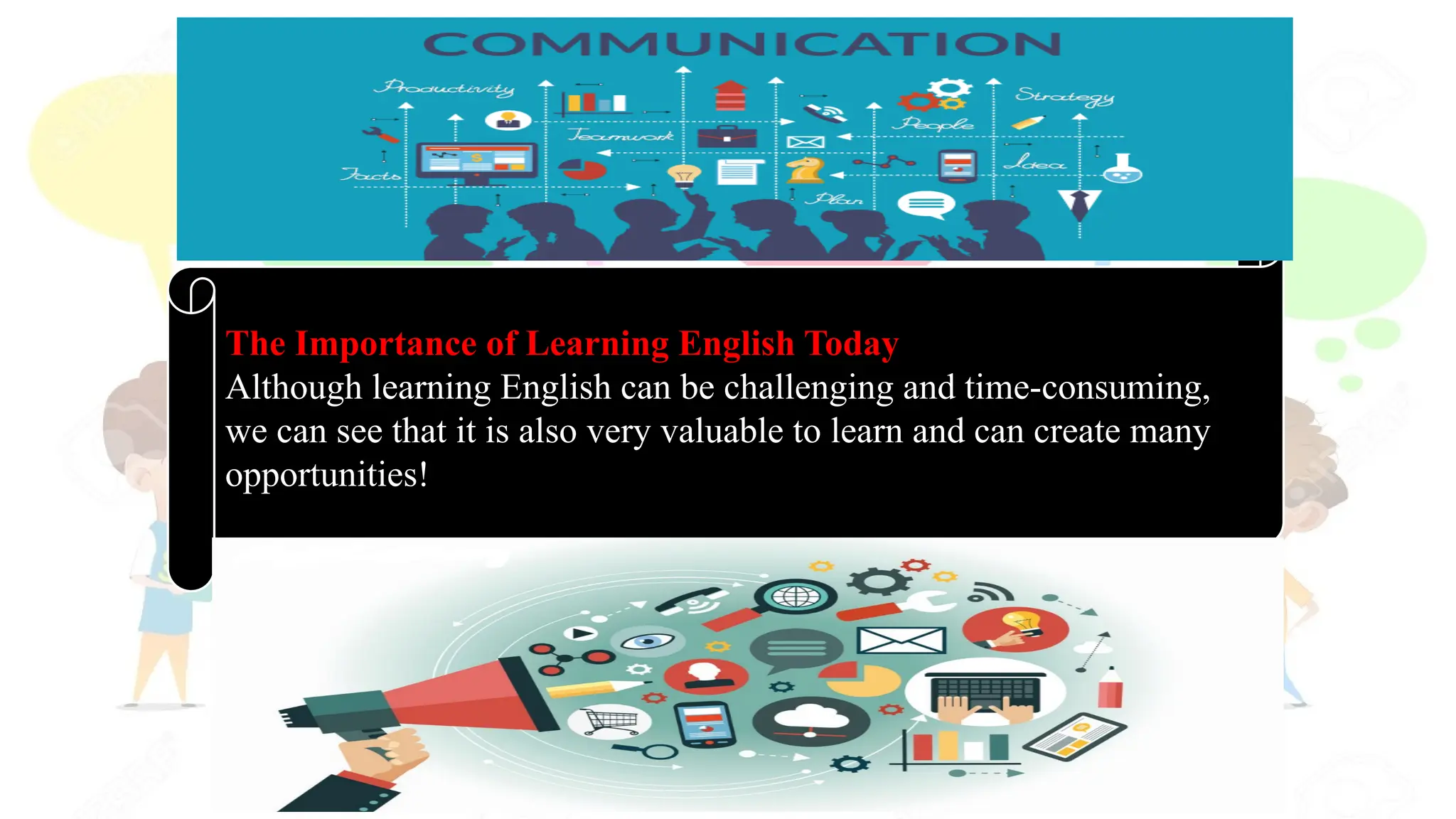
The Importance of Learning English Today
Although learning English can be challenging and time-consuming,
we can see that it is also very valuable to learn and can create many
opportunities!
THANK
YOU!

COMMUNICATIVE ENGLISH.pptx, Tips, & Tricks.

  • 1.
    COMMUNICATIVE ENGLISH Dr. Sharada H AssistantProfessor Department of Eye&ENT
  • 2.
    Listening Speaking Reading Writing Wellrounded communicator Confidence Career success Personal life Capacity Social media Nervous Speak well
  • 3.
    INTRODUCTION • Communicative Englishis a crucial skill in modern life. It enables one to communicate with others of various levels and includes social relationships, discussions with colleagues or business meetings at work. • Self-improvement becomes critical if you want to raise your chances of success. • Language is the vehicle of our thoughts and feelings of our stories , Grammar is the machinery by which that vehicle is set in motion. • Therefore learning English language would help an individual improve their confidence which influences our perception of competence and encourages us to be more effective in business and career.
  • 4.
    • So basically,Communicative English is the language most suitable for public speaking internationally. • Many employable skills are found to be important in day-to-day communication.
  • 5.
    •It is aprocess of exchanging – • Information • Ideas •Thoughts • Feelings •Emotions Through – Speech ,Signals ,Writing ,Behavior. What is Communication?
  • 6.
    The different categoriesof communication include: • Spoken or Verbal Communication • Non-Verbal Communication • Written Communication • Visualizations
  • 7.
    • Spoken orVerbal Communication, which includes face-to-face, telephone, radio or television and other media. • Non-Verbal Communication, covering body language, gestures, how we dress or act, where we stand etc. There are many subtle ways that we communicate with others. • For example, the tone of voice can give clues to mood or emotional state, whilst hand signals or gestures can add to a spoken message.
  • 8.
    • Written Communication:which includes letters, e-mails, social media, books, magazines, the Internet and other media. • Until recent times, a relatively small number of writers and publishers were very powerful when it came to communicating the written word. • Today, we can all write and publish our ideas online, which has led to an explosion of information and communication possibilities. • Ex: Research work publications • Visualizations: graphs and charts, maps, logos and other visualizations can all communicate messages.
  • 9.
    The Importance ofCommunicative English • The English language as a foreign language is the most used and important international language. • When it comes to speaking, reading or writing – meaning communicating in written form as well – different people will choose a certain type of grammar if they wish to reach an understanding with someone else.
  • 10.
    How To ImproveYour English Communication Skills? • One of the best ways to learn a language like English is by learning through communicative-understanding. • which mainly involves personal experience and everyday use. • For example, when you are first learning how to develop your daily conversation skills, do not expect yourself to be talking elegantly.
  • 11.
    • Communicating successfullyrequires effort and time as it demands one must be able to afford judgment in the language which helps them avoid grammatical mistakes despite making no attempts at communication with the other person. • Research studies show that when people try to learn a language through study alone, it may prove difficult for learners. • Studying the language through conversation is the much possible easy way.
  • 12.
    How To ImproveYour English Communication Skills • There are hundreds of fantastic techniques out there that can help you to improve your English communication skills. • Communicative English requires practice, and trying to perfect your communication skills is no easy task. • Think Before You Speak – A great first tip for improving your English Communications Skills would be to think about what you’re going to say before you speak. • By thinking about what you are going to say in advance, you reduce the chances of having to awkwardly wait while you develop an answer to a question or think about how to push a conversation forward.
  • 13.
    • Practice WithOthers – This is probably one of the most vital elements when it comes to perfecting your English Communication Skills and adopting the Communicative Approach within your studies. • It is essential for you to practice with others, whether that be other learners or native speakers. • By practicing with others, not only will you be getting real life English Communication experience, but you will also be developing your natural abilities for learning a language moving forward. • Even the most proficient native speakers are naturally learning from their interactions.
  • 14.
    • Don’t JustLearn Words, Learn Your Sentences Too – It’s important to not only learn your vocabulary, as although this is useful, it’s not going to benefit you when your conversation consists of more than a single word. • Learn your sentences too! By learning your sentences and practicing these, you will be well prepared for a lot of English Communication scenarios. • For example, if you know you are going to be meeting new people, then practice your sentences explaining who you are, where you come from, and what you like.
  • 15.
    • Focus OnFluency – Another tip for when it comes to developing your Communicative English skills would be to practice your fluency. • Try to speak as if you were a native! You may not get it right at the beginning, but hopefully the more and more you practice your fluency, the better your English Communications should become. • By practicing your fluency you are on the first track to faultless English communication skills.
  • 16.
    • Don’t RushWhen You Speak – You may be a lighting fast speaker when it comes to your mother tongue. • But expecting to communicate as fast with a foreign language is not realistic. Slow down and think. • More importantly, don’t rush a sentence, because the last thing you want is a poorly formed sentence. If you spend less time rushing your sentences, it should give you more breathing space to think about what you’re going to say. • By taking your time to speak you will be ensuring that what you are saying is correct and makes sense.
  • 17.
    • Don’t RunOut Of Follow Up Questions – Make sure you don’t run out of follow up questions or you’ll be left awkwardly thinking about what to say next. • Learn different types of open questions that can lead to further discussions, some examples could be “What are your views on that topic” or “Can you tell me more about that it seems interesting”. • For an effective communicative English approach, you need to listen to what the person you are speaking to is saying, and form an open question to help further the conversation. • By following our above tips, you will be able to further improve your English communication skills, ensuring effortless communication in no time at all.
  • 18.
    Why Is CommunicativeEnglish Necessary? • If you have already been exposed to the communicative approach, then it is likely you already know the benefits this approach can have on your English language studies, and the value it can provide. • Communicative English is important as it can help a student to see value in their studies, in a meaningful way. • Strengthening your communication skills in English is necessary, and is a powerful tool that can be used for business, travel or simply to have a conversation in a different country.
  • 19.
    • By improvingon your communicative English, you are enabling yourself to not only hold a conversation in your target language, but you are also developing the required skills to go forth and develop a natural approach to language learning and vocabulary acquisition moving forward, on your own. • With more than 1.5 billion people speaking English as either their native or second language, we will leave it up to you to decide whether communicative English is really necessary.
  • 20.
    Why is Englishimportant for graduation? • It is the main language for studying any subject all over the world. English is important for students as it broadens their minds, develops emotional skills, improve the quality of life by providing job opportunities. • English helps you in understanding common business communications easily. • Maximum of business contracts, deals, and even product descriptions are written in the English language. So, to stay updated and understand the language of business throughout the world, it is important for you to learn English. • studying English can help you progress in life both personally and professionally.
  • 21.
    HOW AYURVEDA CONNECTED WITHENGLISH LANGUAGE. • Slokas with English meaning • Research and statistic paper • Post graduation • Publishing the article • Continuous medical education
  • 22.
    BARRIERS OF COMMUNICATION •Noise • Inappropriate medium • Emotions • Language difference • Poor listening skills
  • 23.
    Few tips towardsActive Listening: • Understand your own communication style. • Be an active listener. • Use normal communication.
  • 24.
    FEW FACTS • Youhave over 630 muscles in your body. • Eye muscles are the busiest muscles in the body. Scientists estimate they may move more than 100,000 times a day. • You have over 30 muscles in your face to help you smile or frown. It takes 17 muscles to smile and 43 to frown. SO SMILE EVERYTIME YOU SEE SOMEONE. – • The strongest muscle in your body is your tongue. USE IT EFFECTIVELY. • It takes the interaction of 72 different muscles to produce human speech.
  • 25.
    CONCLUSION •Most journals arewritten in English. •To succeed in life , Researches should have new development and must master their skills of writing English. •Non speaking English scientists/ English speaking scientists. •Aim higher. •Change is the only constant thing in life.
  • 26.
    The Importance ofLearning English Today Although learning English can be challenging and time-consuming, we can see that it is also very valuable to learn and can create many opportunities!
  • 27.