Writing
Strategies
PAGE 1Copyright © 2021 Talent & Skills HuB
Introduction
 At university you may have multiple
deadlines for your assignments and
course works.
 Hence, finding effective ways to
manage writing at university can be
key to your success. In this lesson, you
will learn some of the strategies for
writing that you may need to consider.
PAGE 2Copyright © 2021 Talent & Skills HuB
Strategies for Writing
 Be prepared for writing: you may need to start your
writing by having a plan, which may include an
outline, visual or diagrammatic representation of what
you want to write, or you may want to start with an
idea for a sentence or paragraph.
 Plan to write regularly: getting into the habit of
writing can help you find ways of managing it.
 Set aside the time space that match your concentration
span and try to gradually build on your ability to
focus.
 Make a realistic time plan for your pieces of writing
and stick to it. Acknowledge that there are many
stages involve in producing a written assignment
which includes reading, writing and editing/revising
before the final submission.
PAGE 3Copyright © 2021 Talent & Skills HuB
Strategies for Writing Cont.
 Write up a section or paragraph as it becomes
ready but remember that you do not have to
write everything in order at first.
 For longer assignments, essays and reports,
you may begin by writing the section that you
are more familiar and comfortable with. For
example, you may begin by writing the
methodology section and end by writing the
introduction before checking if the whole
piece links together smoothly.
 When you are writing but come to a point you
need to stop due to time, breaks or other
factors, make a note about the next point you
will need to write. This can make it easier to
settle back down to writing next time.
PAGE 4Copyright © 2021 Talent & Skills HuB
Strategies for Writing Cont.
 Find out about your peak time; where and when
you are at your best for writing and try to
maximise these benefits.
 Take breaks, a breath of fresh air, a chat with
friends, but make sure you set times and keep to
these for when you plan to re-start writing.
Note: Remember that research and writing are only part
of your work as a student. During each day, some people
may need a variety of tasks to maintain their interest and
motivation.
PAGE 5Copyright © 2021 Talent & Skills HuB
Strategies for Preparing Your Writing
These are some points that are important when approaching writing tasks at university:
 Be clear about the task; what is expected of you and what is needed to answer the question
effectively.
 Identify and use available resources and written advice.
 Listen and respond to guidance offered while producing your work.
 Keep focused on your question or task; keep asking yourself whether any material you plan to
include is really relevant.
 Be clear, concise and to the point in what you write.
 Present your ideas in a clear and logical way.
 Make sure you clearly reference any sources or data that you use as evidence and that your examples
are appropriately justified.
 Take note of feedback on completed tasks.
PAGE 6Copyright © 2021 Talent & Skills HuB
Characteristics of Academic Writing
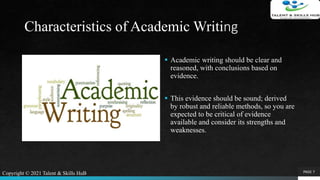
 Academic writing should be clear and
reasoned, with conclusions based on
evidence.
 This evidence should be sound; derived
by robust and reliable methods, so you are
expected to be critical of evidence
available and consider its strengths and
weaknesses.
PAGE 7Copyright © 2021 Talent & Skills HuB
Organising
Materials
No matter what you are writing, an essay, dissertation,
report or thesis, you will need to collect a significant
amount of supporting information that you will need to
refer to while you are writing.
These could be:
 Copies of journal articles.
 Books; both academic and non-academic.
 Notes you make as you read this material.
 Lecture and/or seminar notes.
 Notes you make as you think about the question you
are trying to answer,
 Lab books or journals that you keep during any
research project.
PAGE 8Copyright © 2021 Talent & Skills HuB
Organising
Materials
Continues
 It is important to keep your information gathering,
reading and note-taking proportionate to the task you
are writing, so you will usually gather and refer to far
more materials and read more widely for a long
assignment.
 You will need a filing and retrieval system that works
for you in order to cope with the materials that you
have obtained for your writing, so that you know
where you save/stored them and how they should be
referenced.
 The filing system should allow you to decide which
items you want to find to address any point that is
currently confusing you, and then to quickly locate
those items.
PAGE 9Copyright © 2021 Talent & Skills HuB
Talent &
Skills HuB
T&S-HuB is an enabling environment that supports people
in the development of their talents and skills and in the
actualisation of their personal passions and ambitions.
We help learners and individuals sharpen and exhibit their
talents and skills while exploring relevant and life
changing opportunities that suit their passions.
You can be supported by our instructors, counsellors, and
mentors on employability skills and other personal and
professional development.
Book an appointment for one-to-one or group tutoring
through our website; ts-hub.com
You can also contact us via email: contactus@ts-hub.com
Copyright © 2021 Talent & Skills HuB
Further Reading and References
 Horkoff, T. (2019) Writing for Success 1st Canadian Edition, BC Campus
 University of Nottingham (2020) Studying Effectively [Online] available at:
https://www.nottingham.ac.uk/studyingeffectively/writing/strategies/index.aspx, accessed:
04/08/20
PAGE 11Copyright © 2021 Talent & Skills HuB

Strategies for Developing Writing Skills

  • 1.
    Writing Strategies PAGE 1Copyright ©2021 Talent & Skills HuB
  • 2.
    Introduction  At universityyou may have multiple deadlines for your assignments and course works.  Hence, finding effective ways to manage writing at university can be key to your success. In this lesson, you will learn some of the strategies for writing that you may need to consider. PAGE 2Copyright © 2021 Talent & Skills HuB
  • 3.
    Strategies for Writing Be prepared for writing: you may need to start your writing by having a plan, which may include an outline, visual or diagrammatic representation of what you want to write, or you may want to start with an idea for a sentence or paragraph.  Plan to write regularly: getting into the habit of writing can help you find ways of managing it.  Set aside the time space that match your concentration span and try to gradually build on your ability to focus.  Make a realistic time plan for your pieces of writing and stick to it. Acknowledge that there are many stages involve in producing a written assignment which includes reading, writing and editing/revising before the final submission. PAGE 3Copyright © 2021 Talent & Skills HuB
  • 4.
    Strategies for WritingCont.  Write up a section or paragraph as it becomes ready but remember that you do not have to write everything in order at first.  For longer assignments, essays and reports, you may begin by writing the section that you are more familiar and comfortable with. For example, you may begin by writing the methodology section and end by writing the introduction before checking if the whole piece links together smoothly.  When you are writing but come to a point you need to stop due to time, breaks or other factors, make a note about the next point you will need to write. This can make it easier to settle back down to writing next time. PAGE 4Copyright © 2021 Talent & Skills HuB
  • 5.
    Strategies for WritingCont.  Find out about your peak time; where and when you are at your best for writing and try to maximise these benefits.  Take breaks, a breath of fresh air, a chat with friends, but make sure you set times and keep to these for when you plan to re-start writing. Note: Remember that research and writing are only part of your work as a student. During each day, some people may need a variety of tasks to maintain their interest and motivation. PAGE 5Copyright © 2021 Talent & Skills HuB
  • 6.
    Strategies for PreparingYour Writing These are some points that are important when approaching writing tasks at university:  Be clear about the task; what is expected of you and what is needed to answer the question effectively.  Identify and use available resources and written advice.  Listen and respond to guidance offered while producing your work.  Keep focused on your question or task; keep asking yourself whether any material you plan to include is really relevant.  Be clear, concise and to the point in what you write.  Present your ideas in a clear and logical way.  Make sure you clearly reference any sources or data that you use as evidence and that your examples are appropriately justified.  Take note of feedback on completed tasks. PAGE 6Copyright © 2021 Talent & Skills HuB
  • 7.
    Characteristics of AcademicWriting  Academic writing should be clear and reasoned, with conclusions based on evidence.  This evidence should be sound; derived by robust and reliable methods, so you are expected to be critical of evidence available and consider its strengths and weaknesses. PAGE 7Copyright © 2021 Talent & Skills HuB
  • 8.
    Organising Materials No matter whatyou are writing, an essay, dissertation, report or thesis, you will need to collect a significant amount of supporting information that you will need to refer to while you are writing. These could be:  Copies of journal articles.  Books; both academic and non-academic.  Notes you make as you read this material.  Lecture and/or seminar notes.  Notes you make as you think about the question you are trying to answer,  Lab books or journals that you keep during any research project. PAGE 8Copyright © 2021 Talent & Skills HuB
  • 9.
    Organising Materials Continues  It isimportant to keep your information gathering, reading and note-taking proportionate to the task you are writing, so you will usually gather and refer to far more materials and read more widely for a long assignment.  You will need a filing and retrieval system that works for you in order to cope with the materials that you have obtained for your writing, so that you know where you save/stored them and how they should be referenced.  The filing system should allow you to decide which items you want to find to address any point that is currently confusing you, and then to quickly locate those items. PAGE 9Copyright © 2021 Talent & Skills HuB
  • 10.
    Talent & Skills HuB T&S-HuBis an enabling environment that supports people in the development of their talents and skills and in the actualisation of their personal passions and ambitions. We help learners and individuals sharpen and exhibit their talents and skills while exploring relevant and life changing opportunities that suit their passions. You can be supported by our instructors, counsellors, and mentors on employability skills and other personal and professional development. Book an appointment for one-to-one or group tutoring through our website; ts-hub.com You can also contact us via email: contactus@ts-hub.com Copyright © 2021 Talent & Skills HuB
  • 11.
    Further Reading andReferences  Horkoff, T. (2019) Writing for Success 1st Canadian Edition, BC Campus  University of Nottingham (2020) Studying Effectively [Online] available at: https://www.nottingham.ac.uk/studyingeffectively/writing/strategies/index.aspx, accessed: 04/08/20 PAGE 11Copyright © 2021 Talent & Skills HuB