Mark: __________

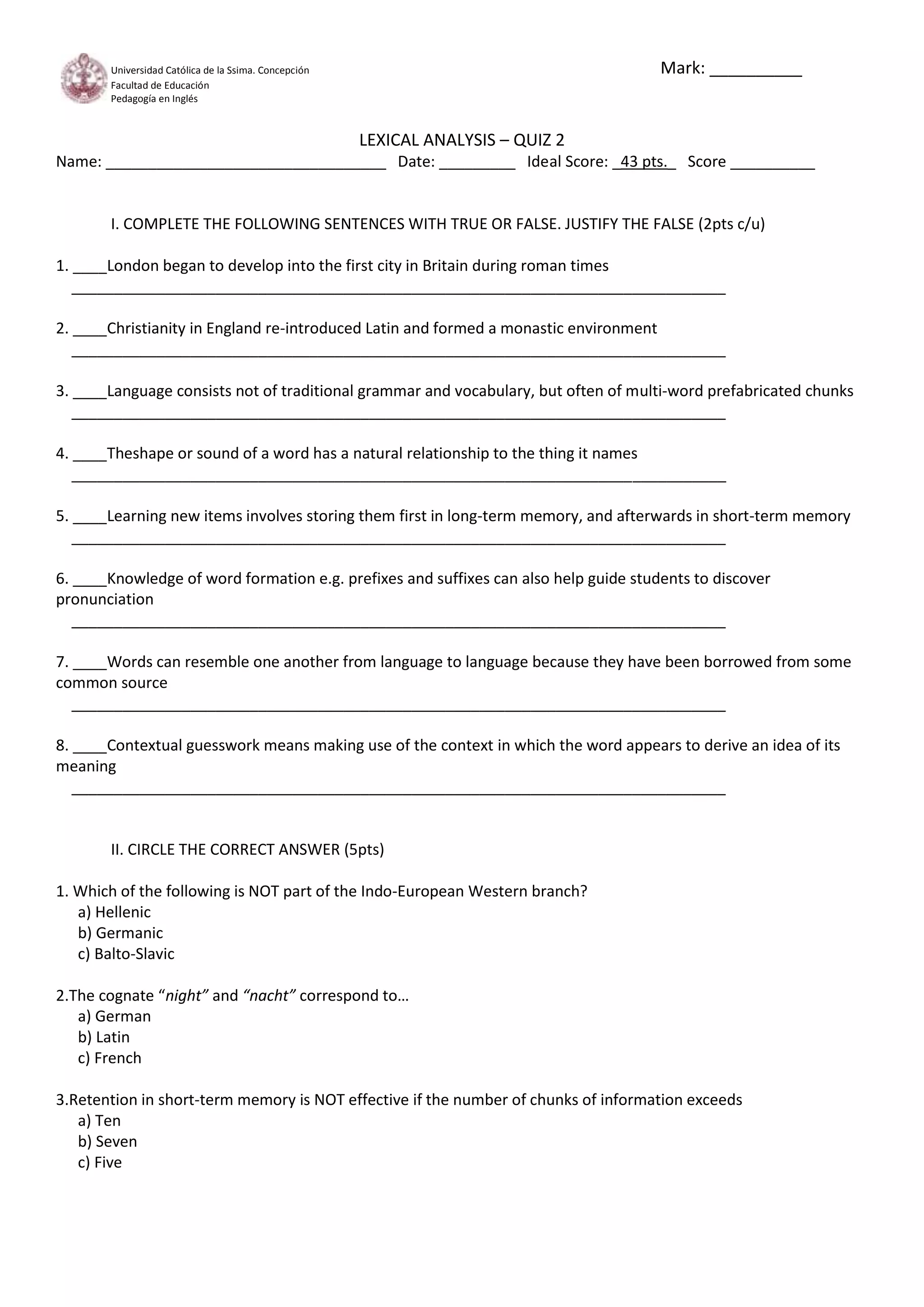
Universidad Católica de la Ssima. Concepción
Facultad de Educación
Pedagogía en Inglés

LEXICAL ANALYSIS – QUIZ 2
Name: _________________________________ Date: _________ Ideal Score: _43 pts._ Score __________

I. COMPLETE THE FOLLOWING SENTENCES WITH TRUE OR FALSE. JUSTIFY THE FALSE (2pts c/u)
1. ____London began to develop into the first city in Britain during roman times
_____________________________________________________________________________
2. ____Christianity in England re-introduced Latin and formed a monastic environment
_____________________________________________________________________________
3. ____Language consists not of traditional grammar and vocabulary, but often of multi-word prefabricated chunks
_____________________________________________________________________________
4. ____Theshape or sound of a word has a natural relationship to the thing it names
_____________________________________________________________________________
5. ____Learning new items involves storing them first in long-term memory, and afterwards in short-term memory
_____________________________________________________________________________
6. ____Knowledge of word formation e.g. prefixes and suffixes can also help guide students to discover
pronunciation
_____________________________________________________________________________
7. ____Words can resemble one another from language to language because they have been borrowed from some
common source
_____________________________________________________________________________
8. ____Contextual guesswork means making use of the context in which the word appears to derive an idea of its
meaning
_____________________________________________________________________________

II. CIRCLE THE CORRECT ANSWER (5pts)
1. Which of the following is NOT part of the Indo-European Western branch?
a) Hellenic
b) Germanic
c) Balto-Slavic
2.The cognate “night” and “nacht” correspond to…
a) German
b) Latin
c) French
3.Retention in short-term memory is NOT effective if the number of chunks of information exceeds
a) Ten
b) Seven
c) Five
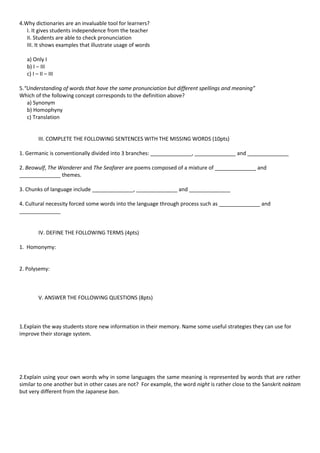
4.Why dictionaries are an invaluable tool for learners?
I. It gives students independence from the teacher
II. Students are able to check pronunciation
III. It shows examples that illustrate usage of words
a) Only I
b) I – III
c) I – II – III
5.“Understanding of words that have the same pronunciation but different spellings and meaning”
Which of the following concept corresponds to the definition above?
a) Synonym
b) Homophyny
c) Translation

III. COMPLETE THE FOLLOWING SENTENCES WITH THE MISSING WORDS (10pts)
1. Germanic is conventionally divided into 3 branches: ______________, ______________ and ______________
2. Beowulf, The Wanderer and The Seafarer are poems composed of a mixture of ______________ and
______________ themes.
3. Chunks of language include ______________, ______________ and ______________
4. Cultural necessity forced some words into the language through process such as ______________ and
______________

IV. DEFINE THE FOLLOWING TERMS (4pts)
1. Homonymy:

2. Polysemy:

V. ANSWER THE FOLLOWING QUESTIONS (8pts)

1.Explain the way students store new information in their memory. Name some useful strategies they can use for
improve their storage system.

2.Explain using your own words why in some languages the same meaning is represented by words that are rather
similar to one another but in other cases are not? For example, the word night is rather close to the Sanskrit naktam
but very different from the Japanese ban.
Mark: __________

Universidad Católica de la Ssima. Concepción
Facultad de Educación
Pedagogía en Inglés

LEXICAL ANALYSIS – QUIZ 2
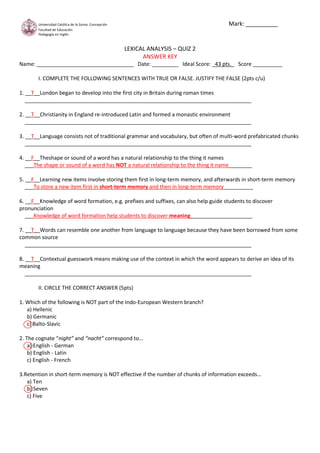
ANSWER KEY
Name: _________________________________ Date: _________ Ideal Score: _43 pts._ Score __________
I. COMPLETE THE FOLLOWING SENTENCES WITH TRUE OR FALSE. JUSTIFY THE FALSE (2pts c/u)
1. __T__London began to develop into the first city in Britain during roman times
_____________________________________________________________________________
2. __T__Christianity in England re-introduced Latin and formed a monastic environment
_____________________________________________________________________________
3. __T__Language consists not of traditional grammar and vocabulary, but often of multi-word prefabricated chunks
_____________________________________________________________________________
4. __F__Theshape or sound of a word has a natural relationship to the thing it names
___The shape or sound of a word has NOT a natural relationship to the thing it name________
5. __F__Learning new items involve storing them first in long-term memory, and afterwards in short-term memory
___To store a new item first in short-term memory and then in long-term memory__________
6. __F__Knowledge of word formation, e.g. prefixes and suffixes, can also help guide students to discover
pronunciation
___Knowledge of word formation help students to discover meaning_____________________
7. __T__Words can resemble one another from language to language because they have been borrowed from some
common source
_____________________________________________________________________________
8. __T__Contextual guesswork means making use of the context in which the word appears to derive an idea of its
meaning
_____________________________________________________________________________
II. CIRCLE THE CORRECT ANSWER (5pts)
1. Which of the following is NOT part of the Indo-European Western branch?
a) Hellenic
b) Germanic
c) Balto-Slavic
2. The cognate “night” and “nacht” correspond to…
a) English - German
b) English - Latin
c) English - French
3.Retention in short-term memory is NOT effective if the number of chunks of information exceeds…
a) Ten
b) Seven
c) Five
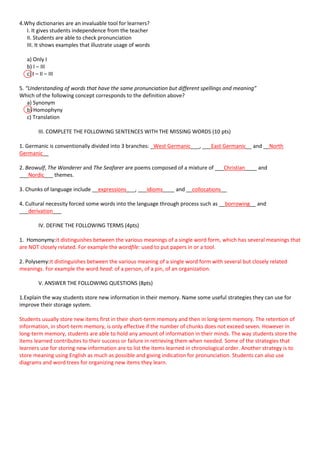
4.Why dictionaries are an invaluable tool for learners?
I. It gives students independence from the teacher
II. Students are able to check pronunciation
III. It shows examples that illustrate usage of words
a) Only I
b) I – III
c) I – II – III
5. “Understanding of words that have the same pronunciation but different spellings and meaning”
Which of the following concept corresponds to the definition above?
a) Synonym
b) Homophyny
c) Translation
III. COMPLETE THE FOLLOWING SENTENCES WITH THE MISSING WORDS (10 pts)
1. Germanic is conventionally divided into 3 branches: _West Germanic___, ___East Germanic__ and __North
Germanic__
2. Beowulf, The Wanderer and The Seafarer are poems composed of a mixture of ___Christian____ and
___Nordic___ themes.
3. Chunks of language include __expressions___, ___idioms____ and __collocations__
4. Cultural necessity forced some words into the language through process such as __borrowing__ and
___derivation___
IV. DEFINE THE FOLLOWING TERMS (4pts)
1. Homonymy:it distinguishes between the various meanings of a single word form, which has several meanings that
are NOT closely related. For example the wordfile: used to put papers in or a tool.
2. Polysemy:it distinguishes between the various meaning of a single word form with several but closely related
meanings. For example the word head: of a person, of a pin, of an organization.
V. ANSWER THE FOLLOWING QUESTIONS (8pts)
1.Explain the way students store new information in their memory. Name some useful strategies they can use for
improve their storage system.
Students usually store new items first in their short-term memory and then in long-term memory. The retention of
information, in short-term memory, is only effective if the number of chunks does not exceed seven. However in
long-term memory, students are able to hold any amount of information in their minds. The way students store the
items learned contributes to their success or failure in retrieving them when needed. Some of the strategies that
learners use for storing new information are to list the items learned in chronological order. Another strategy is to
store meaning using English as much as possible and giving indication for pronunciation. Students can also use
diagrams and word trees for organizing new items they learn.
2.Explain using your own words why in some languages the same meaning is represented by words that are rather
similar to one another but in other cases are not? For example, the word night is rather close to the Sanskrit naktam
but very different from the Japanese ban.
The main reason is because there are words which have a common origin due to geographical features, cultural
similarities and migration process. It means that at least one of these three aspects had influence in the
development of the words night and naktam because its root.
Moreover we have to consider that some words of basic human life which existed within many languages were
passed on from generation to generation and from continents to continents. For example, the culture that spoke
Sanskrit did not have a word for describing the end of the day, but one of them heard the word night and because
the different pronunciations, accents and in general different language, the way of pronouncing the word night was
naktam. Differently, the Japanese culture was influenced in great part by Chinese culture and geographically it was
very difficult and less probably that people from Britain could travel across a continent and the sea only for passing
on the word night.

REFLECTION OF THE TEXTS
By: Camila Muñoz & Bruno Caballero

The texts “Teaching Vocabulary to Advanced Students” and “Words: Native and Borrowed”, were the chosen
documents which we used for making the comprehensive test. Both texts are very linked each other. One of them
(“Teaching Vocabulary to Advanced Students”) gives valuable strategies in order to understand words and it also
explains that advanced learners can communicate well once they learnt the structure of a language. However, they
need to broaden their vocabulary in a way to express them appropriately. On the other hand, the text “Words:
Native and Borrowed” explains briefly the history of the evolution of English language, specifically it express how the
words have been changing since ancient times. Furthermore, the text tells that meaning and vocabulary are the
most sensitive to the external social and historical forces.
Until here, we know that both texts are about the importance of vocabulary and how it has influenced the
development of the language. The evolution of words gives plenty results, which are understood and at the same
time explained through languages phenomenon such as: Polysemy, Homophony, Homonymy, Synonymy, etc. All of
them just mentioned explain distinct changes that words have suffered. The learners have to comprehend these
variations and mainly, they have to understand that the shape or sound of a word has not natural relationship to the
things it names.
Another important aspect that learners have to consider is the existence of “Cognates” which are words that have a
common etymological origin within different languages. Once the students know it, they can use it as a good
strategy of learning vocabulary in order to connect their own language with the words that they want to learn and to
understand. However, there is something that it is called “False Cognates” which are words that are commonly
thought to be related, whereas a linguistic examination reveals they are unrelated and obviously these words have
different meaning, so learners have to be aware of this.
As a conclusion, the chosen texts are useful at the moment of learning new vocabulary, because they explain
strategies for learning it and at the same time they give information on how the words have changed along a
complex process of evolution. We cannot learn new vocabulary if we are not familiarized with the origin of words
and its changes through the time.

Lexical Analysis Test II

  • 1.
    Mark: __________ Universidad Católicade la Ssima. Concepción Facultad de Educación Pedagogía en Inglés LEXICAL ANALYSIS – QUIZ 2 Name: _________________________________ Date: _________ Ideal Score: _43 pts._ Score __________ I. COMPLETE THE FOLLOWING SENTENCES WITH TRUE OR FALSE. JUSTIFY THE FALSE (2pts c/u) 1. ____London began to develop into the first city in Britain during roman times _____________________________________________________________________________ 2. ____Christianity in England re-introduced Latin and formed a monastic environment _____________________________________________________________________________ 3. ____Language consists not of traditional grammar and vocabulary, but often of multi-word prefabricated chunks _____________________________________________________________________________ 4. ____Theshape or sound of a word has a natural relationship to the thing it names _____________________________________________________________________________ 5. ____Learning new items involves storing them first in long-term memory, and afterwards in short-term memory _____________________________________________________________________________ 6. ____Knowledge of word formation e.g. prefixes and suffixes can also help guide students to discover pronunciation _____________________________________________________________________________ 7. ____Words can resemble one another from language to language because they have been borrowed from some common source _____________________________________________________________________________ 8. ____Contextual guesswork means making use of the context in which the word appears to derive an idea of its meaning _____________________________________________________________________________ II. CIRCLE THE CORRECT ANSWER (5pts) 1. Which of the following is NOT part of the Indo-European Western branch? a) Hellenic b) Germanic c) Balto-Slavic 2.The cognate “night” and “nacht” correspond to… a) German b) Latin c) French 3.Retention in short-term memory is NOT effective if the number of chunks of information exceeds a) Ten b) Seven c) Five
  • 2.
    4.Why dictionaries arean invaluable tool for learners? I. It gives students independence from the teacher II. Students are able to check pronunciation III. It shows examples that illustrate usage of words a) Only I b) I – III c) I – II – III 5.“Understanding of words that have the same pronunciation but different spellings and meaning” Which of the following concept corresponds to the definition above? a) Synonym b) Homophyny c) Translation III. COMPLETE THE FOLLOWING SENTENCES WITH THE MISSING WORDS (10pts) 1. Germanic is conventionally divided into 3 branches: ______________, ______________ and ______________ 2. Beowulf, The Wanderer and The Seafarer are poems composed of a mixture of ______________ and ______________ themes. 3. Chunks of language include ______________, ______________ and ______________ 4. Cultural necessity forced some words into the language through process such as ______________ and ______________ IV. DEFINE THE FOLLOWING TERMS (4pts) 1. Homonymy: 2. Polysemy: V. ANSWER THE FOLLOWING QUESTIONS (8pts) 1.Explain the way students store new information in their memory. Name some useful strategies they can use for improve their storage system. 2.Explain using your own words why in some languages the same meaning is represented by words that are rather similar to one another but in other cases are not? For example, the word night is rather close to the Sanskrit naktam but very different from the Japanese ban.
  • 3.
    Mark: __________ Universidad Católicade la Ssima. Concepción Facultad de Educación Pedagogía en Inglés LEXICAL ANALYSIS – QUIZ 2 ANSWER KEY Name: _________________________________ Date: _________ Ideal Score: _43 pts._ Score __________ I. COMPLETE THE FOLLOWING SENTENCES WITH TRUE OR FALSE. JUSTIFY THE FALSE (2pts c/u) 1. __T__London began to develop into the first city in Britain during roman times _____________________________________________________________________________ 2. __T__Christianity in England re-introduced Latin and formed a monastic environment _____________________________________________________________________________ 3. __T__Language consists not of traditional grammar and vocabulary, but often of multi-word prefabricated chunks _____________________________________________________________________________ 4. __F__Theshape or sound of a word has a natural relationship to the thing it names ___The shape or sound of a word has NOT a natural relationship to the thing it name________ 5. __F__Learning new items involve storing them first in long-term memory, and afterwards in short-term memory ___To store a new item first in short-term memory and then in long-term memory__________ 6. __F__Knowledge of word formation, e.g. prefixes and suffixes, can also help guide students to discover pronunciation ___Knowledge of word formation help students to discover meaning_____________________ 7. __T__Words can resemble one another from language to language because they have been borrowed from some common source _____________________________________________________________________________ 8. __T__Contextual guesswork means making use of the context in which the word appears to derive an idea of its meaning _____________________________________________________________________________ II. CIRCLE THE CORRECT ANSWER (5pts) 1. Which of the following is NOT part of the Indo-European Western branch? a) Hellenic b) Germanic c) Balto-Slavic 2. The cognate “night” and “nacht” correspond to… a) English - German b) English - Latin c) English - French 3.Retention in short-term memory is NOT effective if the number of chunks of information exceeds… a) Ten b) Seven c) Five
  • 4.
    4.Why dictionaries arean invaluable tool for learners? I. It gives students independence from the teacher II. Students are able to check pronunciation III. It shows examples that illustrate usage of words a) Only I b) I – III c) I – II – III 5. “Understanding of words that have the same pronunciation but different spellings and meaning” Which of the following concept corresponds to the definition above? a) Synonym b) Homophyny c) Translation III. COMPLETE THE FOLLOWING SENTENCES WITH THE MISSING WORDS (10 pts) 1. Germanic is conventionally divided into 3 branches: _West Germanic___, ___East Germanic__ and __North Germanic__ 2. Beowulf, The Wanderer and The Seafarer are poems composed of a mixture of ___Christian____ and ___Nordic___ themes. 3. Chunks of language include __expressions___, ___idioms____ and __collocations__ 4. Cultural necessity forced some words into the language through process such as __borrowing__ and ___derivation___ IV. DEFINE THE FOLLOWING TERMS (4pts) 1. Homonymy:it distinguishes between the various meanings of a single word form, which has several meanings that are NOT closely related. For example the wordfile: used to put papers in or a tool. 2. Polysemy:it distinguishes between the various meaning of a single word form with several but closely related meanings. For example the word head: of a person, of a pin, of an organization. V. ANSWER THE FOLLOWING QUESTIONS (8pts) 1.Explain the way students store new information in their memory. Name some useful strategies they can use for improve their storage system. Students usually store new items first in their short-term memory and then in long-term memory. The retention of information, in short-term memory, is only effective if the number of chunks does not exceed seven. However in long-term memory, students are able to hold any amount of information in their minds. The way students store the items learned contributes to their success or failure in retrieving them when needed. Some of the strategies that learners use for storing new information are to list the items learned in chronological order. Another strategy is to store meaning using English as much as possible and giving indication for pronunciation. Students can also use diagrams and word trees for organizing new items they learn.
  • 5.
    2.Explain using yourown words why in some languages the same meaning is represented by words that are rather similar to one another but in other cases are not? For example, the word night is rather close to the Sanskrit naktam but very different from the Japanese ban. The main reason is because there are words which have a common origin due to geographical features, cultural similarities and migration process. It means that at least one of these three aspects had influence in the development of the words night and naktam because its root. Moreover we have to consider that some words of basic human life which existed within many languages were passed on from generation to generation and from continents to continents. For example, the culture that spoke Sanskrit did not have a word for describing the end of the day, but one of them heard the word night and because the different pronunciations, accents and in general different language, the way of pronouncing the word night was naktam. Differently, the Japanese culture was influenced in great part by Chinese culture and geographically it was very difficult and less probably that people from Britain could travel across a continent and the sea only for passing on the word night. REFLECTION OF THE TEXTS By: Camila Muñoz & Bruno Caballero The texts “Teaching Vocabulary to Advanced Students” and “Words: Native and Borrowed”, were the chosen documents which we used for making the comprehensive test. Both texts are very linked each other. One of them (“Teaching Vocabulary to Advanced Students”) gives valuable strategies in order to understand words and it also explains that advanced learners can communicate well once they learnt the structure of a language. However, they need to broaden their vocabulary in a way to express them appropriately. On the other hand, the text “Words: Native and Borrowed” explains briefly the history of the evolution of English language, specifically it express how the words have been changing since ancient times. Furthermore, the text tells that meaning and vocabulary are the most sensitive to the external social and historical forces. Until here, we know that both texts are about the importance of vocabulary and how it has influenced the development of the language. The evolution of words gives plenty results, which are understood and at the same time explained through languages phenomenon such as: Polysemy, Homophony, Homonymy, Synonymy, etc. All of them just mentioned explain distinct changes that words have suffered. The learners have to comprehend these variations and mainly, they have to understand that the shape or sound of a word has not natural relationship to the things it names. Another important aspect that learners have to consider is the existence of “Cognates” which are words that have a common etymological origin within different languages. Once the students know it, they can use it as a good strategy of learning vocabulary in order to connect their own language with the words that they want to learn and to understand. However, there is something that it is called “False Cognates” which are words that are commonly thought to be related, whereas a linguistic examination reveals they are unrelated and obviously these words have different meaning, so learners have to be aware of this. As a conclusion, the chosen texts are useful at the moment of learning new vocabulary, because they explain strategies for learning it and at the same time they give information on how the words have changed along a complex process of evolution. We cannot learn new vocabulary if we are not familiarized with the origin of words and its changes through the time.