Universidad Católica de la Santísima Concepción 
Faculty of Education 
English Language Pedagogy 
COURSE BOOK EVALUATION 
Bryan Abos-Padilla V. 
Camila Muñoz F. 
Teacher Astrid Guerra 
Noviembre 11, 2014
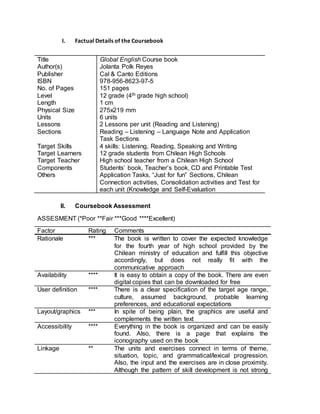
I. Factual Details of the Coursebook 
Title Global English Course book 
Author(s) Jolanta Polk Reyes 
Publisher Cal & Canto Editions 
ISBN 978-956-8623-97-5 
No. of Pages 151 pages 
Level 12 grade (4th grade high school) 
Length 1 cm 
Physical Size 275x219 mm 
Units 6 units 
Lessons 2 Lessons per unit (Reading and Listening) 
Sections Reading – Listening – Language Note and Application 
Task Sections 
Target Skills 4 skills: Listening, Reading, Speaking and Writing 
Target Learners 12 grade students from Chilean High Schools 
Target Teacher High school teacher from a Chilean High School 
Components Students’ book, Teacher’s book, CD and Printable Test 
Others Application Tasks, “Just for fun” Sections, Chilean 
Connection activities, Consolidation activities and Test for 
each unit (Knowledge and Self-Evaluation 
II. Coursebook Assessment 
ASSESMENT (*Poor **Fair ***Good ****Excellent) 
Factor Rating Comments 
Rationale *** The book is written to cover the expected knowledge 
for the fourth year of high school provided by the 
Chilean ministry of education and fulfill this objective 
accordingly, but does not really fit with the 
communicative approach 
Availability **** It is easy to obtain a copy of the book. There are even 
digital copies that can be downloaded for free 
User definition **** There is a clear specification of the target age range, 
culture, assumed background, probable learning 
preferences, and educational expectations 
Layout/graphics *** In spite of being plain, the graphics are useful and 
complements the written text 
Accessibility **** Everything in the book is organized and can be easily 
found. Also, there is a page that explains the 
iconography used on the book 
Linkage ** The units and exercises connect in terms of theme, 
situation, topic, and grammatical/lexical progression. 
Also, the input and the exercises are in close proximity. 
Although the pattern of skill development is not strong
enough in the productive skills 
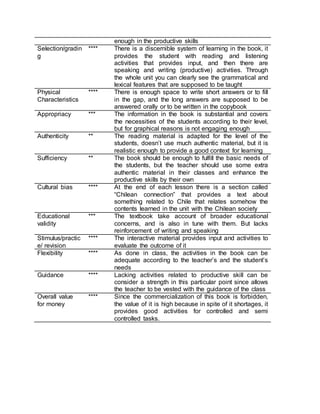
Selection/gradin 
g 
**** There is a discernible system of learning in the book, it 
provides the student with reading and listening 
activities that provides input, and then there are 
speaking and writing (productive) activities. Through 
the whole unit you can clearly see the grammatical and 
lexical features that are supposed to be taught 
Physical 
Characteristics 
**** There is enough space to write short answers or to fill 
in the gap, and the long answers are supposed to be 
answered orally or to be written in the copybook 
Appropriacy *** The information in the book is substantial and covers 
the necessities of the students according to their level, 
but for graphical reasons is not engaging enough 
Authenticity ** The reading material is adapted for the level of the 
students, doesn’t use much authentic material, but it is 
realistic enough to provide a good context for learning 
Sufficiency ** The book should be enough to fulfill the basic needs of 
the students, but the teacher should use some extra 
authentic material in their classes and enhance the 
productive skills by their own 
Cultural bias **** At the end of each lesson there is a section called 
“Chilean connection” that provides a text about 
something related to Chile that relates somehow the 
contents learned in the unit with the Chilean society 
Educational 
validity 
*** The textbook take account of broader educational 
concerns, and is also in tune with them. But lacks 
reinforcement of writing and speaking 
Stimulus/practic 
e/ revision 
**** The interactive material provides input and activities to 
evaluate the outcome of it 
Flexibility **** As done in class, the activities in the book can be 
adequate according to the teacher’s and the student’s 
needs 
Guidance **** Lacking activities related to productive skill can be 
consider a strength in this particular point since allows 
the teacher to be vested with the guidance of the class 
Overall value 
for money 
**** Since the commercialization of this book is forbidden, 
the value of it is high because in spite of it shortages, it 
provides good activities for controlled and semi 
controlled tasks.
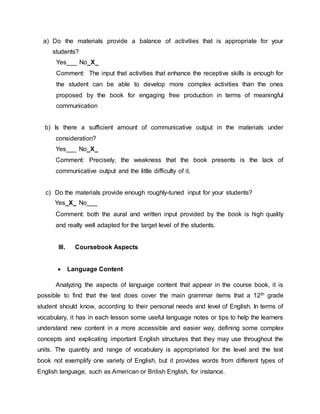
a) Do the materials provide a balance of activities that is appropriate for your 
students? 
Yes___ No_X_ 
Comment: The input that activities that enhance the receptive skills is enough for 
the student can be able to develop more complex activities than the ones 
proposed by the book for engaging free production in terms of meaningful 
communication 
b) Is there a sufficient amount of communicative output in the materials under 
consideration? 
Yes___ No_X_ 
Comment: Precisely, the weakness that the book presents is the lack of 
communicative output and the little difficulty of it. 
c) Do the materials provide enough roughly-tuned input for your students? 
Yes_X_ No___ 
Comment: both the aural and written input provided by the book is high quality 
and really well adapted for the target level of the students. 
III. Coursebook Aspects 
 Language Content 
Analyzing the aspects of language content that appear in the course book, it is 
possible to find that the text does cover the main grammar items that a 12th grade 
student should know, according to their personal needs and level of English. In terms of 
vocabulary, it has in each lesson some useful language notes or tips to help the learners 
understand new content in a more accessible and easier way, defining some complex 
concepts and explicating important English structures that they may use throughout the 
units. The quantity and range of vocabulary is appropriated for the level and the text 
book not exemplify one variety of English, but it provides words from different types of 
English language, such as American or British English, for instance.
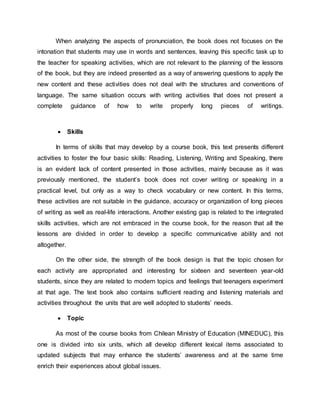
When analyzing the aspects of pronunciation, the book does not focuses on the 
intonation that students may use in words and sentences, leaving this specific task up to 
the teacher for speaking activities, which are not relevant to the planning of the lessons 
of the book, but they are indeed presented as a way of answering questions to apply the 
new content and these activities does not deal with the structures and conventions of 
language. The same situation occurs with writing activities that does not present a 
complete guidance of how to write properly long pieces of writings. 
 Skills 
In terms of skills that may develop by a course book, this text presents different 
activities to foster the four basic skills: Reading, Listening, Writing and Speaking, there 
is an evident lack of content presented in those activities, mainly because as it was 
previously mentioned, the student’s book does not cover writing or speaking in a 
practical level, but only as a way to check vocabulary or new content. In this terms, 
these activities are not suitable in the guidance, accuracy or organization of long pieces 
of writing as well as real-life interactions. Another existing gap is related to the integrated 
skills activities, which are not embraced in the course book, for the reason that all the 
lessons are divided in order to develop a specific communicative ability and not 
altogether. 
On the other side, the strength of the book design is that the topic chosen for 
each activity are appropriated and interesting for sixteen and seventeen year-old 
students, since they are related to modern topics and feelings that teenagers experiment 
at that age. The text book also contains sufficient reading and listening materials and 
activities throughout the units that are well adopted to students’ needs. 
 Topic 
As most of the course books from Chilean Ministry of Education (MINEDUC), this 
one is divided into six units, which all develop different lexical items associated to 
updated subjects that may enhance the students’ awareness and at the same time 
enrich their experiences about global issues.
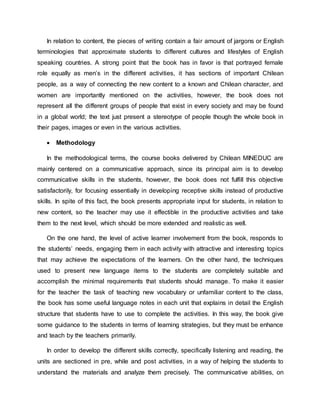
In relation to content, the pieces of writing contain a fair amount of jargons or English 
terminologies that approximate students to different cultures and lifestyles of English 
speaking countries. A strong point that the book has in favor is that portrayed female 
role equally as men’s in the different activities, it has sections of important Chilean 
people, as a way of connecting the new content to a known and Chilean character, and 
women are importantly mentioned on the activities, however, the book does not 
represent all the different groups of people that exist in every society and may be found 
in a global world; the text just present a stereotype of people though the whole book in 
their pages, images or even in the various activities. 
 Methodology 
In the methodological terms, the course books delivered by Chilean MINEDUC are 
mainly centered on a communicative approach, since its principal aim is to develop 
communicative skills in the students, however, the book does not fulfill this objective 
satisfactorily, for focusing essentially in developing receptive skills instead of productive 
skills. In spite of this fact, the book presents appropriate input for students, in relation to 
new content, so the teacher may use it effectible in the productive activities and take 
them to the next level, which should be more extended and realistic as well. 
On the one hand, the level of active learner involvement from the book, responds to 
the students’ needs, engaging them in each activity with attractive and interesting topics 
that may achieve the expectations of the learners. On the other hand, the techniques 
used to present new language items to the students are completely suitable and 
accomplish the minimal requirements that students should manage. To make it easier 
for the teacher the task of teaching new vocabulary or unfamiliar content to the class, 
the book has some useful language notes in each unit that explains in detail the English 
structure that students have to use to complete the activities. In this way, the book give 
some guidance to the students in terms of learning strategies, but they must be enhance 
and teach by the teachers primarily. 
In order to develop the different skills correctly, specifically listening and reading, the 
units are sectioned in pre, while and post activities, in a way of helping the students to 
understand the materials and analyze them precisely. The communicative abilities, on
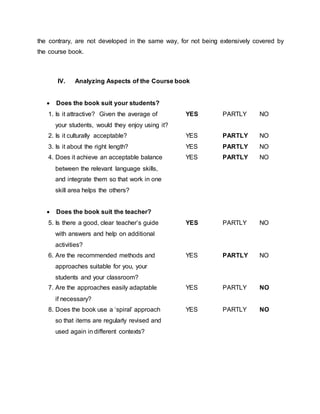
the contrary, are not developed in the same way, for not being extensively covered by 
the course book. 
IV. Analyzing Aspects of the Course book 
 Does the book suit your students? 
1. Is it attractive? Given the average of YES PARTLY NO 
your students, would they enjoy using it? 
2. Is it culturally acceptable? YES PARTLY NO 
3. Is it about the right length? YES PARTLY NO 
4. Does it achieve an acceptable balance YES PARTLY NO 
between the relevant language skills, 
and integrate them so that work in one 
skill area helps the others? 
 Does the book suit the teacher? 
5. Is there a good, clear teacher’s guide YES PARTLY NO 
with answers and help on additional 
activities? 
6. Are the recommended methods and YES PARTLY NO 
approaches suitable for you, your 
students and your classroom? 
7. Are the approaches easily adaptable YES PARTLY NO 
if necessary? 
8. Does the book use a ‘spiral’ approach YES PARTLY NO 
so that items are regularly revised and 
used again in different contexts?
 Does the book suit the syllabus and the examination? 
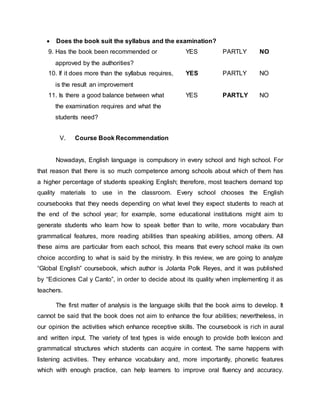
9. Has the book been recommended or YES PARTLY NO 
approved by the authorities? 
10. If it does more than the syllabus requires, YES PARTLY NO 
is the result an improvement 
11. Is there a good balance between what YES PARTLY NO 
the examination requires and what the 
students need? 
V. Course Book Recommendation 
Nowadays, English language is compulsory in every school and high school. For 
that reason that there is so much competence among schools about which of them has 
a higher percentage of students speaking English; therefore, most teachers demand top 
quality materials to use in the classroom. Every school chooses the English 
coursebooks that they needs depending on what level they expect students to reach at 
the end of the school year; for example, some educational institutions might aim to 
generate students who learn how to speak better than to write, more vocabulary than 
grammatical features, more reading abilities than speaking abilities, among others. All 
these aims are particular from each school, this means that every school make its own 
choice according to what is said by the ministry. In this review, we are going to analyze 
“Global English” coursebook, which author is Jolanta Polk Reyes, and it was published 
by “Ediciones Cal y Canto”, in order to decide about its quality when implementing it as 
teachers. 
The first matter of analysis is the language skills that the book aims to develop. It 
cannot be said that the book does not aim to enhance the four abilities; nevertheless, in 
our opinion the activities which enhance receptive skills. The coursebook is rich in aural 
and written input. The variety of text types is wide enough to provide both lexicon and 
grammatical structures which students can acquire in context. The same happens with 
listening activities. They enhance vocabulary and, more importantly, phonetic features 
which with enough practice, can help learners to improve oral fluency and accuracy.
Nonetheless, as we know, while theory says one thing, practice tells us another. As 
previously mentioned, the input provided by the book is wide, but the outcome it 
demands is too basic for the level the students are on. The speaking activities are just 
limited to answering questions and do not gives them a real context to be immersed on. 
Even though Global English coursebook is based on a task base approach, the 
production of the book is fairly minimum and does not require deeper levels of 
understanding such as analysis, so the instructions provided, more than acting as a 
guidance, limits the students’ production process. 
To conclude, we could notice that skills and methodology are very important 
aspects when talking about teaching-learning process, because the sufficient 
development of the four skills can become students into integrated speakers of English 
as a foreign language. In addition, to know the methodology is very helpful for teachers, 
because in this way teachers can implement in a better way the activities presented in 
the book. All the exposed in the previous paragraphs demonstrate that “Global English” 
coursebook is a very useful tool in the area of learning the grammatical system, but it is 
clearly focused on some skills more than in others. This coursebook has its 
weaknesses, but also it has its strengths, therefore the failure or success of the class 
depends ultimately on the way the teacher present the input material and the tasks.

CB ANALYSIS

  • 1.
    Universidad Católica dela Santísima Concepción Faculty of Education English Language Pedagogy COURSE BOOK EVALUATION Bryan Abos-Padilla V. Camila Muñoz F. Teacher Astrid Guerra Noviembre 11, 2014
  • 2.
    I. Factual Detailsof the Coursebook Title Global English Course book Author(s) Jolanta Polk Reyes Publisher Cal & Canto Editions ISBN 978-956-8623-97-5 No. of Pages 151 pages Level 12 grade (4th grade high school) Length 1 cm Physical Size 275x219 mm Units 6 units Lessons 2 Lessons per unit (Reading and Listening) Sections Reading – Listening – Language Note and Application Task Sections Target Skills 4 skills: Listening, Reading, Speaking and Writing Target Learners 12 grade students from Chilean High Schools Target Teacher High school teacher from a Chilean High School Components Students’ book, Teacher’s book, CD and Printable Test Others Application Tasks, “Just for fun” Sections, Chilean Connection activities, Consolidation activities and Test for each unit (Knowledge and Self-Evaluation II. Coursebook Assessment ASSESMENT (*Poor **Fair ***Good ****Excellent) Factor Rating Comments Rationale *** The book is written to cover the expected knowledge for the fourth year of high school provided by the Chilean ministry of education and fulfill this objective accordingly, but does not really fit with the communicative approach Availability **** It is easy to obtain a copy of the book. There are even digital copies that can be downloaded for free User definition **** There is a clear specification of the target age range, culture, assumed background, probable learning preferences, and educational expectations Layout/graphics *** In spite of being plain, the graphics are useful and complements the written text Accessibility **** Everything in the book is organized and can be easily found. Also, there is a page that explains the iconography used on the book Linkage ** The units and exercises connect in terms of theme, situation, topic, and grammatical/lexical progression. Also, the input and the exercises are in close proximity. Although the pattern of skill development is not strong
  • 3.
    enough in theproductive skills Selection/gradin g **** There is a discernible system of learning in the book, it provides the student with reading and listening activities that provides input, and then there are speaking and writing (productive) activities. Through the whole unit you can clearly see the grammatical and lexical features that are supposed to be taught Physical Characteristics **** There is enough space to write short answers or to fill in the gap, and the long answers are supposed to be answered orally or to be written in the copybook Appropriacy *** The information in the book is substantial and covers the necessities of the students according to their level, but for graphical reasons is not engaging enough Authenticity ** The reading material is adapted for the level of the students, doesn’t use much authentic material, but it is realistic enough to provide a good context for learning Sufficiency ** The book should be enough to fulfill the basic needs of the students, but the teacher should use some extra authentic material in their classes and enhance the productive skills by their own Cultural bias **** At the end of each lesson there is a section called “Chilean connection” that provides a text about something related to Chile that relates somehow the contents learned in the unit with the Chilean society Educational validity *** The textbook take account of broader educational concerns, and is also in tune with them. But lacks reinforcement of writing and speaking Stimulus/practic e/ revision **** The interactive material provides input and activities to evaluate the outcome of it Flexibility **** As done in class, the activities in the book can be adequate according to the teacher’s and the student’s needs Guidance **** Lacking activities related to productive skill can be consider a strength in this particular point since allows the teacher to be vested with the guidance of the class Overall value for money **** Since the commercialization of this book is forbidden, the value of it is high because in spite of it shortages, it provides good activities for controlled and semi controlled tasks.
  • 4.
    a) Do thematerials provide a balance of activities that is appropriate for your students? Yes___ No_X_ Comment: The input that activities that enhance the receptive skills is enough for the student can be able to develop more complex activities than the ones proposed by the book for engaging free production in terms of meaningful communication b) Is there a sufficient amount of communicative output in the materials under consideration? Yes___ No_X_ Comment: Precisely, the weakness that the book presents is the lack of communicative output and the little difficulty of it. c) Do the materials provide enough roughly-tuned input for your students? Yes_X_ No___ Comment: both the aural and written input provided by the book is high quality and really well adapted for the target level of the students. III. Coursebook Aspects  Language Content Analyzing the aspects of language content that appear in the course book, it is possible to find that the text does cover the main grammar items that a 12th grade student should know, according to their personal needs and level of English. In terms of vocabulary, it has in each lesson some useful language notes or tips to help the learners understand new content in a more accessible and easier way, defining some complex concepts and explicating important English structures that they may use throughout the units. The quantity and range of vocabulary is appropriated for the level and the text book not exemplify one variety of English, but it provides words from different types of English language, such as American or British English, for instance.
  • 5.
    When analyzing theaspects of pronunciation, the book does not focuses on the intonation that students may use in words and sentences, leaving this specific task up to the teacher for speaking activities, which are not relevant to the planning of the lessons of the book, but they are indeed presented as a way of answering questions to apply the new content and these activities does not deal with the structures and conventions of language. The same situation occurs with writing activities that does not present a complete guidance of how to write properly long pieces of writings.  Skills In terms of skills that may develop by a course book, this text presents different activities to foster the four basic skills: Reading, Listening, Writing and Speaking, there is an evident lack of content presented in those activities, mainly because as it was previously mentioned, the student’s book does not cover writing or speaking in a practical level, but only as a way to check vocabulary or new content. In this terms, these activities are not suitable in the guidance, accuracy or organization of long pieces of writing as well as real-life interactions. Another existing gap is related to the integrated skills activities, which are not embraced in the course book, for the reason that all the lessons are divided in order to develop a specific communicative ability and not altogether. On the other side, the strength of the book design is that the topic chosen for each activity are appropriated and interesting for sixteen and seventeen year-old students, since they are related to modern topics and feelings that teenagers experiment at that age. The text book also contains sufficient reading and listening materials and activities throughout the units that are well adopted to students’ needs.  Topic As most of the course books from Chilean Ministry of Education (MINEDUC), this one is divided into six units, which all develop different lexical items associated to updated subjects that may enhance the students’ awareness and at the same time enrich their experiences about global issues.
  • 6.
    In relation tocontent, the pieces of writing contain a fair amount of jargons or English terminologies that approximate students to different cultures and lifestyles of English speaking countries. A strong point that the book has in favor is that portrayed female role equally as men’s in the different activities, it has sections of important Chilean people, as a way of connecting the new content to a known and Chilean character, and women are importantly mentioned on the activities, however, the book does not represent all the different groups of people that exist in every society and may be found in a global world; the text just present a stereotype of people though the whole book in their pages, images or even in the various activities.  Methodology In the methodological terms, the course books delivered by Chilean MINEDUC are mainly centered on a communicative approach, since its principal aim is to develop communicative skills in the students, however, the book does not fulfill this objective satisfactorily, for focusing essentially in developing receptive skills instead of productive skills. In spite of this fact, the book presents appropriate input for students, in relation to new content, so the teacher may use it effectible in the productive activities and take them to the next level, which should be more extended and realistic as well. On the one hand, the level of active learner involvement from the book, responds to the students’ needs, engaging them in each activity with attractive and interesting topics that may achieve the expectations of the learners. On the other hand, the techniques used to present new language items to the students are completely suitable and accomplish the minimal requirements that students should manage. To make it easier for the teacher the task of teaching new vocabulary or unfamiliar content to the class, the book has some useful language notes in each unit that explains in detail the English structure that students have to use to complete the activities. In this way, the book give some guidance to the students in terms of learning strategies, but they must be enhance and teach by the teachers primarily. In order to develop the different skills correctly, specifically listening and reading, the units are sectioned in pre, while and post activities, in a way of helping the students to understand the materials and analyze them precisely. The communicative abilities, on
  • 7.
    the contrary, arenot developed in the same way, for not being extensively covered by the course book. IV. Analyzing Aspects of the Course book  Does the book suit your students? 1. Is it attractive? Given the average of YES PARTLY NO your students, would they enjoy using it? 2. Is it culturally acceptable? YES PARTLY NO 3. Is it about the right length? YES PARTLY NO 4. Does it achieve an acceptable balance YES PARTLY NO between the relevant language skills, and integrate them so that work in one skill area helps the others?  Does the book suit the teacher? 5. Is there a good, clear teacher’s guide YES PARTLY NO with answers and help on additional activities? 6. Are the recommended methods and YES PARTLY NO approaches suitable for you, your students and your classroom? 7. Are the approaches easily adaptable YES PARTLY NO if necessary? 8. Does the book use a ‘spiral’ approach YES PARTLY NO so that items are regularly revised and used again in different contexts?
  • 8.
     Does thebook suit the syllabus and the examination? 9. Has the book been recommended or YES PARTLY NO approved by the authorities? 10. If it does more than the syllabus requires, YES PARTLY NO is the result an improvement 11. Is there a good balance between what YES PARTLY NO the examination requires and what the students need? V. Course Book Recommendation Nowadays, English language is compulsory in every school and high school. For that reason that there is so much competence among schools about which of them has a higher percentage of students speaking English; therefore, most teachers demand top quality materials to use in the classroom. Every school chooses the English coursebooks that they needs depending on what level they expect students to reach at the end of the school year; for example, some educational institutions might aim to generate students who learn how to speak better than to write, more vocabulary than grammatical features, more reading abilities than speaking abilities, among others. All these aims are particular from each school, this means that every school make its own choice according to what is said by the ministry. In this review, we are going to analyze “Global English” coursebook, which author is Jolanta Polk Reyes, and it was published by “Ediciones Cal y Canto”, in order to decide about its quality when implementing it as teachers. The first matter of analysis is the language skills that the book aims to develop. It cannot be said that the book does not aim to enhance the four abilities; nevertheless, in our opinion the activities which enhance receptive skills. The coursebook is rich in aural and written input. The variety of text types is wide enough to provide both lexicon and grammatical structures which students can acquire in context. The same happens with listening activities. They enhance vocabulary and, more importantly, phonetic features which with enough practice, can help learners to improve oral fluency and accuracy.
  • 9.
    Nonetheless, as weknow, while theory says one thing, practice tells us another. As previously mentioned, the input provided by the book is wide, but the outcome it demands is too basic for the level the students are on. The speaking activities are just limited to answering questions and do not gives them a real context to be immersed on. Even though Global English coursebook is based on a task base approach, the production of the book is fairly minimum and does not require deeper levels of understanding such as analysis, so the instructions provided, more than acting as a guidance, limits the students’ production process. To conclude, we could notice that skills and methodology are very important aspects when talking about teaching-learning process, because the sufficient development of the four skills can become students into integrated speakers of English as a foreign language. In addition, to know the methodology is very helpful for teachers, because in this way teachers can implement in a better way the activities presented in the book. All the exposed in the previous paragraphs demonstrate that “Global English” coursebook is a very useful tool in the area of learning the grammatical system, but it is clearly focused on some skills more than in others. This coursebook has its weaknesses, but also it has its strengths, therefore the failure or success of the class depends ultimately on the way the teacher present the input material and the tasks.