Communication:
Principles
Members:
• Chicaiza Angelica
• Guanoluisa Marco
Teacher:
• Mgs. Amparo Romero
Course:
• Sixth ‘’B’’
Communication
Communication is the basic step for the exchange of
information.
Communication can be defined as the process of
exchange of information through means such as words,
actions, signs, etc., between two or more individuals.
For example
A baby in a cradle, communicates with a cry that she
needs her mother. A cow moos loudly when it is in danger.
A person communicates with the help of a language.
Communication is the bridge to share.
 Must be clearly stated
 There must be no
ambiguity
 It is essential that the
recipient is familiar with
the language.
Principle of
Clarity
01
Principle of
Attention
02
 The receiver's attention
must be directed to the
message.
 They may respond
differently to the
message.
Principle of
Feedback
It is very important for
effective communication
Principles
03
Principle of
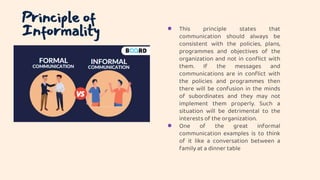
Informality ● This principle states that
communication should always be
consistent with the policies, plans,
programmes and objectives of the
organization and not in conflict with
them. If the messages and
communications are in conflict with
the policies and programmes then
there will be confusion in the minds
of subordinates and they may not
implement them properly. Such a
situation will be detrimental to the
interests of the organization.
● One of the great informal
communication examples is to think
of it like a conversation between a
family at a dinner table
Principle of Consistency
Communication often takes place
through multiple tools/formats
and over a period of time. It is
important that communication is
consistent with and does not
conflict with the organization's
policies, plans, programs and
objectives. If messages and
communications are in conflict
with the policies and programs
For example, a
salesperson’s growth
is usually consistent
with his or her
company’s earnings.
Principle of
Timeliness
● This principle states that
communication should always be
consistent with the policies, plans,
programmes and objectives of the
organization and not in conflict with
them. If the messages and
communications are in conflict with
the policies and programmes then
there will be confusion in the minds
of subordinates and they may not
implement them properly.
Principle of
Adequacy
● The information communicated should be adequate and complete in all respects.
Inadequate information may delay action and create confusion. Inadequate information
also affects efficiency of the receiver. So adequate information is essential for taking
proper decisions and making action plans.
Conclusion!
In conclusion we can say that
communication is the process of
transmitting information from one
person to another. It is also the
process of sending a message in such
a way that the message received is as
close as possible to the intended
message and to achieve this it is
necessary to follow a series of
principles for communication to be
effective.
Bibliographic reference
● https://www.comunicare.es/comunicacion-principios/
● https://www.yourarticlelibrary.com/management/communicati
on/7-principles-of-communication-explained/53333
● https://grupo-pya.com/juegos-mentales-proceso-feed-
back/#:~:text=De%20este%20modo%2C%20la%20retroalimen
taci%C3%B3n,manera%20eficiente%2C%20alimenta%20la%2
0conversaci%C3%B3n.
CREDITS: This presentation template was created by Slidesgo, including icons by Flaticon and infographics & images by Freepik
Thanks!

Communication-Principles-.pptx

  • 1.
    Communication: Principles Members: • Chicaiza Angelica •Guanoluisa Marco Teacher: • Mgs. Amparo Romero Course: • Sixth ‘’B’’
  • 2.
    Communication Communication is thebasic step for the exchange of information. Communication can be defined as the process of exchange of information through means such as words, actions, signs, etc., between two or more individuals. For example A baby in a cradle, communicates with a cry that she needs her mother. A cow moos loudly when it is in danger. A person communicates with the help of a language. Communication is the bridge to share.
  • 3.
     Must beclearly stated  There must be no ambiguity  It is essential that the recipient is familiar with the language. Principle of Clarity 01 Principle of Attention 02  The receiver's attention must be directed to the message.  They may respond differently to the message. Principle of Feedback It is very important for effective communication Principles 03
  • 4.
    Principle of Informality ●This principle states that communication should always be consistent with the policies, plans, programmes and objectives of the organization and not in conflict with them. If the messages and communications are in conflict with the policies and programmes then there will be confusion in the minds of subordinates and they may not implement them properly. Such a situation will be detrimental to the interests of the organization. ● One of the great informal communication examples is to think of it like a conversation between a family at a dinner table
  • 5.
    Principle of Consistency Communicationoften takes place through multiple tools/formats and over a period of time. It is important that communication is consistent with and does not conflict with the organization's policies, plans, programs and objectives. If messages and communications are in conflict with the policies and programs For example, a salesperson’s growth is usually consistent with his or her company’s earnings.
  • 6.
    Principle of Timeliness ● Thisprinciple states that communication should always be consistent with the policies, plans, programmes and objectives of the organization and not in conflict with them. If the messages and communications are in conflict with the policies and programmes then there will be confusion in the minds of subordinates and they may not implement them properly.
  • 7.
    Principle of Adequacy ● Theinformation communicated should be adequate and complete in all respects. Inadequate information may delay action and create confusion. Inadequate information also affects efficiency of the receiver. So adequate information is essential for taking proper decisions and making action plans.
  • 8.
    Conclusion! In conclusion wecan say that communication is the process of transmitting information from one person to another. It is also the process of sending a message in such a way that the message received is as close as possible to the intended message and to achieve this it is necessary to follow a series of principles for communication to be effective.
  • 9.
    Bibliographic reference ● https://www.comunicare.es/comunicacion-principios/ ●https://www.yourarticlelibrary.com/management/communicati on/7-principles-of-communication-explained/53333 ● https://grupo-pya.com/juegos-mentales-proceso-feed- back/#:~:text=De%20este%20modo%2C%20la%20retroalimen taci%C3%B3n,manera%20eficiente%2C%20alimenta%20la%2 0conversaci%C3%B3n.
  • 10.
    CREDITS: This presentationtemplate was created by Slidesgo, including icons by Flaticon and infographics & images by Freepik Thanks!