Copyright © 2015 Mind Commerce - All Rights Reserved Page 1 of 4
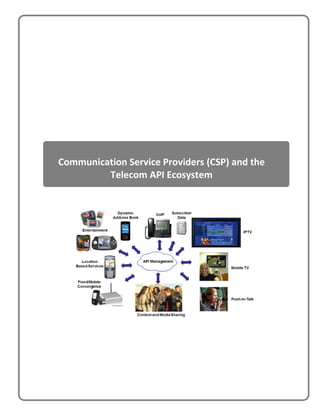
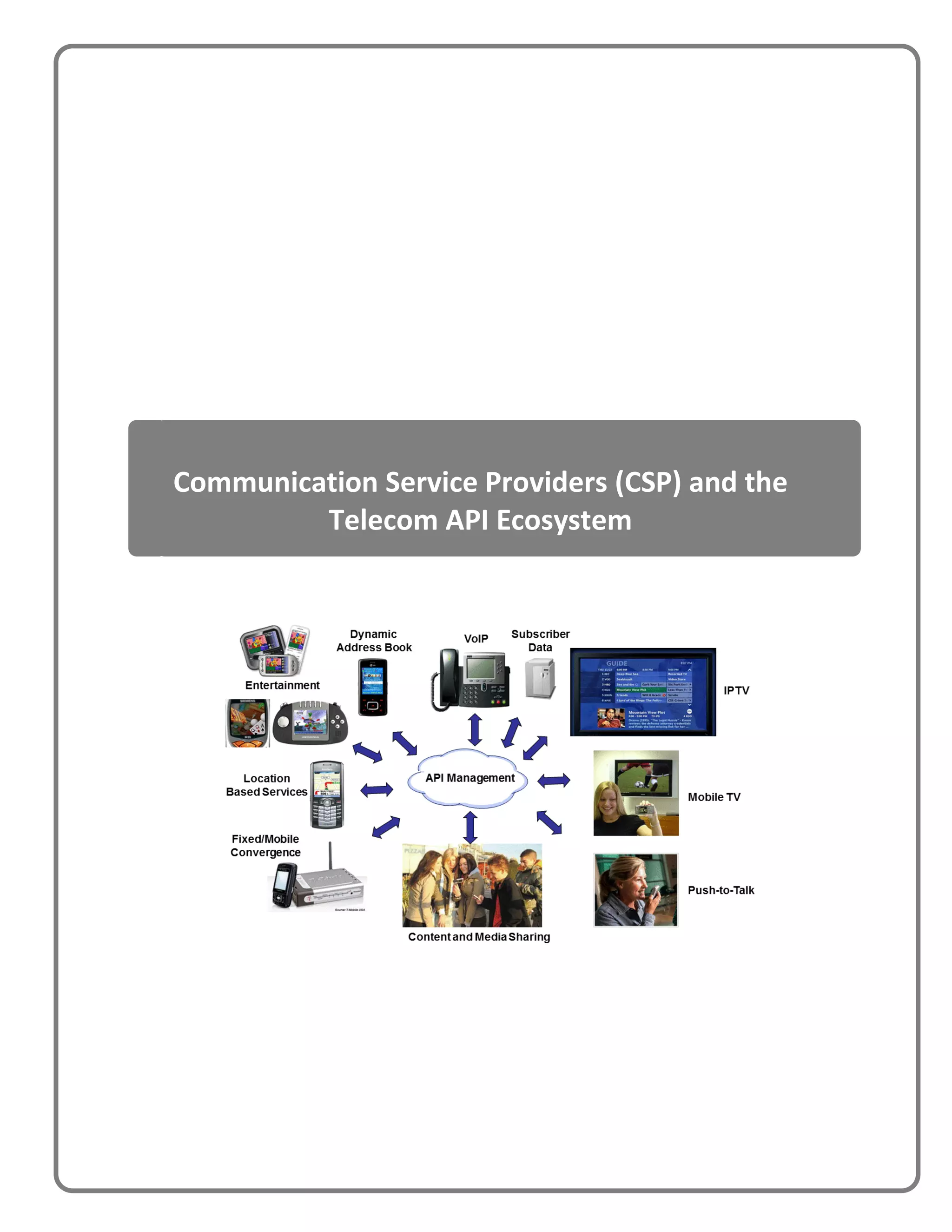
Communication Service Providers (CSP) and the
Telecom API Ecosystem
Copyright © 2015 Mind Commerce - All Rights Reserved Page 2 of 4
CSPs and the Telecom API Ecosystem
Application Programming Interfaces enable network operators to capitalize on existing network
infrastructure to facilitate third-party creation of an array of business opportunities for carriers on a
global basis.
What is an API?
The term API stands for Application Programming Interface. An application programming interface (API)
is a protocol intended to be used as an interface by software components to communicate with each
other. Open API (often referred to as OpenAPI new technology) is a word used to describe sets of
technologies that enable websites to interact with each other by using REST, SOAP, JavaScript and other
web technologies. For example, the YouTube Application Programming Interface, or the YouTube API,
allows developers to access video statistics and YouTube channels' data via two types of calls, REST and
XML-RPC.
Types of Telecom APIs
There are many different types of telephony API’s including:
 Advertising
 Billing for non-digital goods
 Collaboration
 Content delivery
 Directory
 Hosted UC
 ID/SSO and subscriber profile
 IVR/Voice store and voice control
 M2M and IoT
 Number provisioning
 Presence and location
 Quality of Service (QoS)
Telecom APIs allow carriers to disseminate valuable data to third parties, which they monetize on an
asymmetric basis as the network operators typically do not provides services to the end-users. The use
of APIs is also causing an evolution of business models within the ecosystem.
Telecom API Business Models
One of the most common API business models that has been adopted by most carriers at the start of the
API commercialization is the two sided business model, where carrier charges subscribers for access and
third party service providers for APIs. In this model, revenues from traditional core services can be
augmented with revenues derived from the use of their IT assets by partners, for instance by allowing
their billing systems to be used by third-party merchants in return for a transaction fee.
Copyright © 2015 Mind Commerce - All Rights Reserved Page 3 of 4
The second business model is exposing APIs to attract individual developers, who are presented with a
pre-defined route to market for their applications and access to APIs based on billing, SMS, messaging
etc. Many notable Tier 1 Carriers have created application stores that utilize APIs to deliver rich
downloadable applications that can be delivered through the operator portal, potentially reaching
millions of subscribers.
Developers are now starting to embrace carrier initiatives, as the latter are starting to become
developer friendly – contrary to earlier schemes that required developers to familiarize with
complicated telecoms-grade protocols.
Another major business model is based on web “mash-ups”, where web developers can combine web
services with telecoms functionality to embed voice, SMS or LBS to existing applications, including
enabling communications for social networks. In present circumstances, although monetizing mash-ups
may not be a major driver, the additional traffic generated by mash-ups may incrementally add to
existing voice and data revenues.
Telecom API Marketplace
The use of APIs by companies who do not make their use widely known is also increasing. Many
companies are reinventing the way applications are built within their own enterprises by exposing their
existing assets as APIs, enabling their internal developers to build innovative new mobile, social, and
cloud apps. Many of the "traditional enterprises" are employing APIs to increase their overall agility in
delivering applications and to open up new opportunities for dealing with partners.
Telecom API Aggregators
Telecom network API models are evolving. For instance, aggregators are now considering a model in
which they pay the carrier for access to the SMS network, and then sell on, on a revenue share basis,
that network capability to large brands and enterprises. Because the aggregators may operate and
manage the platform, they can apply intelligence, priority, full analytics and assurance to the brand or
enterprise it is selling access to. It's a change of business model both for the carrier, who usually sells
bundles of messages to aggregators and service providers, and for the aggregators themselves.
Example Telecom API Aggregation: Location Data
Like other forms of API aggregation, LBS aggregator solutions sit at the intersection of two big needs:
 Allow carriers to unlock the utility and value of the location information inherent in their
networks and in which they have invested hundreds of millions of dollars
 Provide developers ability to obtain that information quickly and easily, in a way that promotes
innovation for the total pool of wireless subscribers
Part of the business model for location API management/aggregation is location brokering. Location
brokering can be defined purchasing location data from one party (the carriers most prevalently) and
selling to others (content and application providers).
Copyright © 2015 Mind Commerce - All Rights Reserved Page 4 of 4
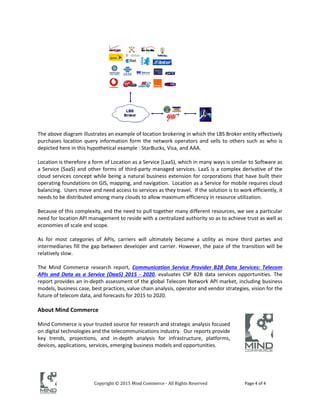
The above diagram illustrates an example of location brokering in which the LBS Broker entity effectively
purchases location query information form the network operators and sells to others such as who is
depicted here in this hypothetical example : StarBucks, Visa, and AAA.
Location is therefore a form of Location as a Service (LaaS), which in many ways is similar to Software as
a Service (SaaS) and other forms of third-party managed services. LaaS is a complex derivative of the
cloud services concept while being a natural business extension for corporations that have built their
operating foundations on GIS, mapping, and navigation. Location as a Service for mobile requires cloud
balancing. Users move and need access to services as they travel. If the solution is to work efficiently, it
needs to be distributed among many clouds to allow maximum efficiency in resource utilization.
Because of this complexity, and the need to pull together many different resources, we see a particular
need for location API management to reside with a centralized authority so as to achieve trust as well as
economies of scale and scope.
As for most categories of APIs, carriers will ultimately become a utility as more third parties and
intermediaries fill the gap between developer and carrier. However, the pace of the transition will be
relatively slow.
The Mind Commerce research report, Communication Service Provider B2B Data Services: Telecom
APIs and Data as a Service (DaaS) 2015 - 2020, evaluates CSP B2B data services opportunities. The
report provides an in-depth assessment of the global Telecom Network API market, including business
models, business case, best practices, value chain analysis, operator and vendor strategies, vision for the
future of telecom data, and forecasts for 2015 to 2020.
About Mind Commerce
Mind Commerce is your trusted source for research and strategic analysis focused
on digital technologies and the telecommunications industry. Our reports provide
key trends, projections, and in-depth analysis for infrastructure, platforms,
devices, applications, services, emerging business models and opportunities.

Communication Service Providers (CSP) and the Telecom API Ecosystem

  • 1.
    Copyright © 2015Mind Commerce - All Rights Reserved Page 1 of 4 Communication Service Providers (CSP) and the Telecom API Ecosystem
  • 2.
    Copyright © 2015Mind Commerce - All Rights Reserved Page 2 of 4 CSPs and the Telecom API Ecosystem Application Programming Interfaces enable network operators to capitalize on existing network infrastructure to facilitate third-party creation of an array of business opportunities for carriers on a global basis. What is an API? The term API stands for Application Programming Interface. An application programming interface (API) is a protocol intended to be used as an interface by software components to communicate with each other. Open API (often referred to as OpenAPI new technology) is a word used to describe sets of technologies that enable websites to interact with each other by using REST, SOAP, JavaScript and other web technologies. For example, the YouTube Application Programming Interface, or the YouTube API, allows developers to access video statistics and YouTube channels' data via two types of calls, REST and XML-RPC. Types of Telecom APIs There are many different types of telephony API’s including:  Advertising  Billing for non-digital goods  Collaboration  Content delivery  Directory  Hosted UC  ID/SSO and subscriber profile  IVR/Voice store and voice control  M2M and IoT  Number provisioning  Presence and location  Quality of Service (QoS) Telecom APIs allow carriers to disseminate valuable data to third parties, which they monetize on an asymmetric basis as the network operators typically do not provides services to the end-users. The use of APIs is also causing an evolution of business models within the ecosystem. Telecom API Business Models One of the most common API business models that has been adopted by most carriers at the start of the API commercialization is the two sided business model, where carrier charges subscribers for access and third party service providers for APIs. In this model, revenues from traditional core services can be augmented with revenues derived from the use of their IT assets by partners, for instance by allowing their billing systems to be used by third-party merchants in return for a transaction fee.
  • 3.
    Copyright © 2015Mind Commerce - All Rights Reserved Page 3 of 4 The second business model is exposing APIs to attract individual developers, who are presented with a pre-defined route to market for their applications and access to APIs based on billing, SMS, messaging etc. Many notable Tier 1 Carriers have created application stores that utilize APIs to deliver rich downloadable applications that can be delivered through the operator portal, potentially reaching millions of subscribers. Developers are now starting to embrace carrier initiatives, as the latter are starting to become developer friendly – contrary to earlier schemes that required developers to familiarize with complicated telecoms-grade protocols. Another major business model is based on web “mash-ups”, where web developers can combine web services with telecoms functionality to embed voice, SMS or LBS to existing applications, including enabling communications for social networks. In present circumstances, although monetizing mash-ups may not be a major driver, the additional traffic generated by mash-ups may incrementally add to existing voice and data revenues. Telecom API Marketplace The use of APIs by companies who do not make their use widely known is also increasing. Many companies are reinventing the way applications are built within their own enterprises by exposing their existing assets as APIs, enabling their internal developers to build innovative new mobile, social, and cloud apps. Many of the "traditional enterprises" are employing APIs to increase their overall agility in delivering applications and to open up new opportunities for dealing with partners. Telecom API Aggregators Telecom network API models are evolving. For instance, aggregators are now considering a model in which they pay the carrier for access to the SMS network, and then sell on, on a revenue share basis, that network capability to large brands and enterprises. Because the aggregators may operate and manage the platform, they can apply intelligence, priority, full analytics and assurance to the brand or enterprise it is selling access to. It's a change of business model both for the carrier, who usually sells bundles of messages to aggregators and service providers, and for the aggregators themselves. Example Telecom API Aggregation: Location Data Like other forms of API aggregation, LBS aggregator solutions sit at the intersection of two big needs:  Allow carriers to unlock the utility and value of the location information inherent in their networks and in which they have invested hundreds of millions of dollars  Provide developers ability to obtain that information quickly and easily, in a way that promotes innovation for the total pool of wireless subscribers Part of the business model for location API management/aggregation is location brokering. Location brokering can be defined purchasing location data from one party (the carriers most prevalently) and selling to others (content and application providers).
  • 4.
    Copyright © 2015Mind Commerce - All Rights Reserved Page 4 of 4 The above diagram illustrates an example of location brokering in which the LBS Broker entity effectively purchases location query information form the network operators and sells to others such as who is depicted here in this hypothetical example : StarBucks, Visa, and AAA. Location is therefore a form of Location as a Service (LaaS), which in many ways is similar to Software as a Service (SaaS) and other forms of third-party managed services. LaaS is a complex derivative of the cloud services concept while being a natural business extension for corporations that have built their operating foundations on GIS, mapping, and navigation. Location as a Service for mobile requires cloud balancing. Users move and need access to services as they travel. If the solution is to work efficiently, it needs to be distributed among many clouds to allow maximum efficiency in resource utilization. Because of this complexity, and the need to pull together many different resources, we see a particular need for location API management to reside with a centralized authority so as to achieve trust as well as economies of scale and scope. As for most categories of APIs, carriers will ultimately become a utility as more third parties and intermediaries fill the gap between developer and carrier. However, the pace of the transition will be relatively slow. The Mind Commerce research report, Communication Service Provider B2B Data Services: Telecom APIs and Data as a Service (DaaS) 2015 - 2020, evaluates CSP B2B data services opportunities. The report provides an in-depth assessment of the global Telecom Network API market, including business models, business case, best practices, value chain analysis, operator and vendor strategies, vision for the future of telecom data, and forecasts for 2015 to 2020. About Mind Commerce Mind Commerce is your trusted source for research and strategic analysis focused on digital technologies and the telecommunications industry. Our reports provide key trends, projections, and in-depth analysis for infrastructure, platforms, devices, applications, services, emerging business models and opportunities.