Independent Review of Telecom APIs

Nov 11th 2013
Structure: Alan’s Bit
•
•
•
•
•
•
•
•
•

2

The Painful Facts!

Why do telcos need APIs?
Why all the big numbers?
Beware the Bait and Switch!
Where are the Telco API successes?
Dos and Don’ts of Telco API success

Mapping the API landscape!
Where are Telecom API going?
What needs to change?

© 2010 Alan Quayle Business and Service Development
Structure: Luis’s bit
•

APIDAZE: facts & figures

•

Presentation of the APIDAZE REST API

•

Customer case: How a leading European affiliate network increased
its revenue by 15% using APIDAZE

•

APIDAZE & WebRTC

•

WebRTC integration using APIDAZE

3

© 2010 Alan Quayle Business and Service Development
Structure: Jean’s Bit
•

TeleStax introduction

•

What is RestComm?

•

HealthSense Case Study: using Telecom APIs to help baby boomers
age safely

•

4

RestComm demo

© 2010 Alan Quayle Business and Service Development
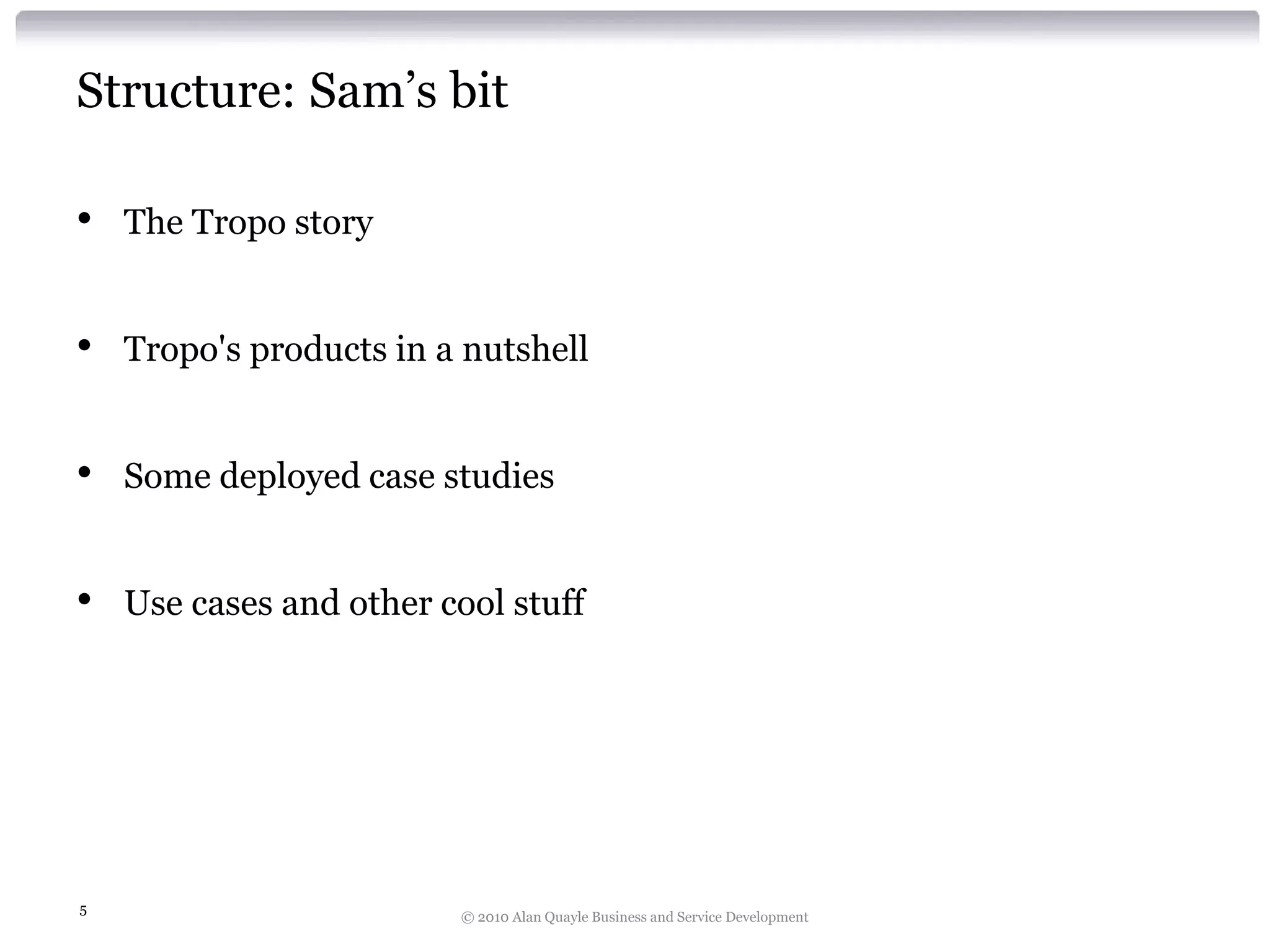
Structure: Sam’s bit
•

The Tropo story

•

Tropo's products in a nutshell

•

Some deployed case studies

•

Use cases and other cool stuff

5

© 2010 Alan Quayle Business and Service Development
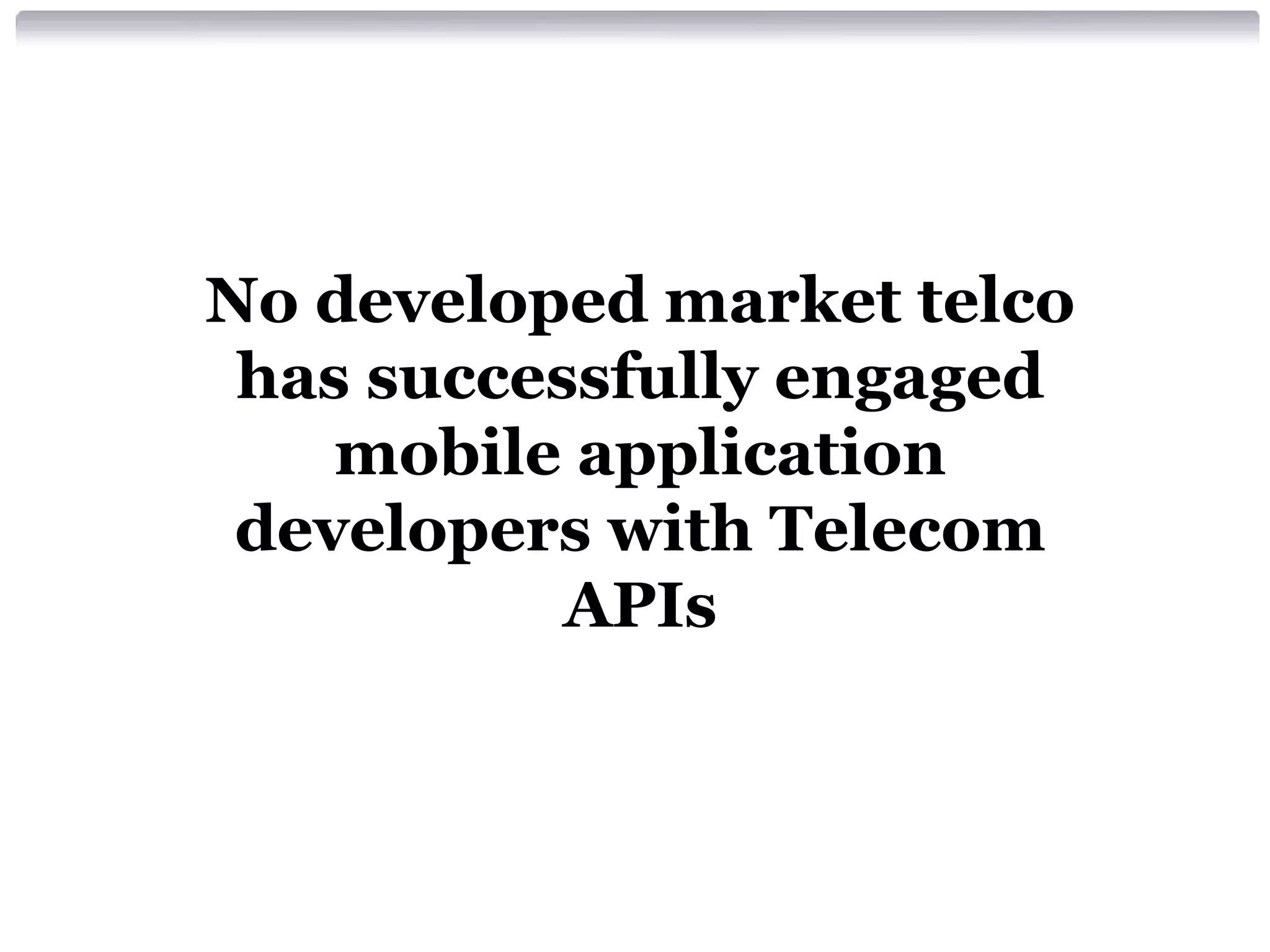
No developed market telco
has successfully engaged
mobile application
developers with Telecom
APIs
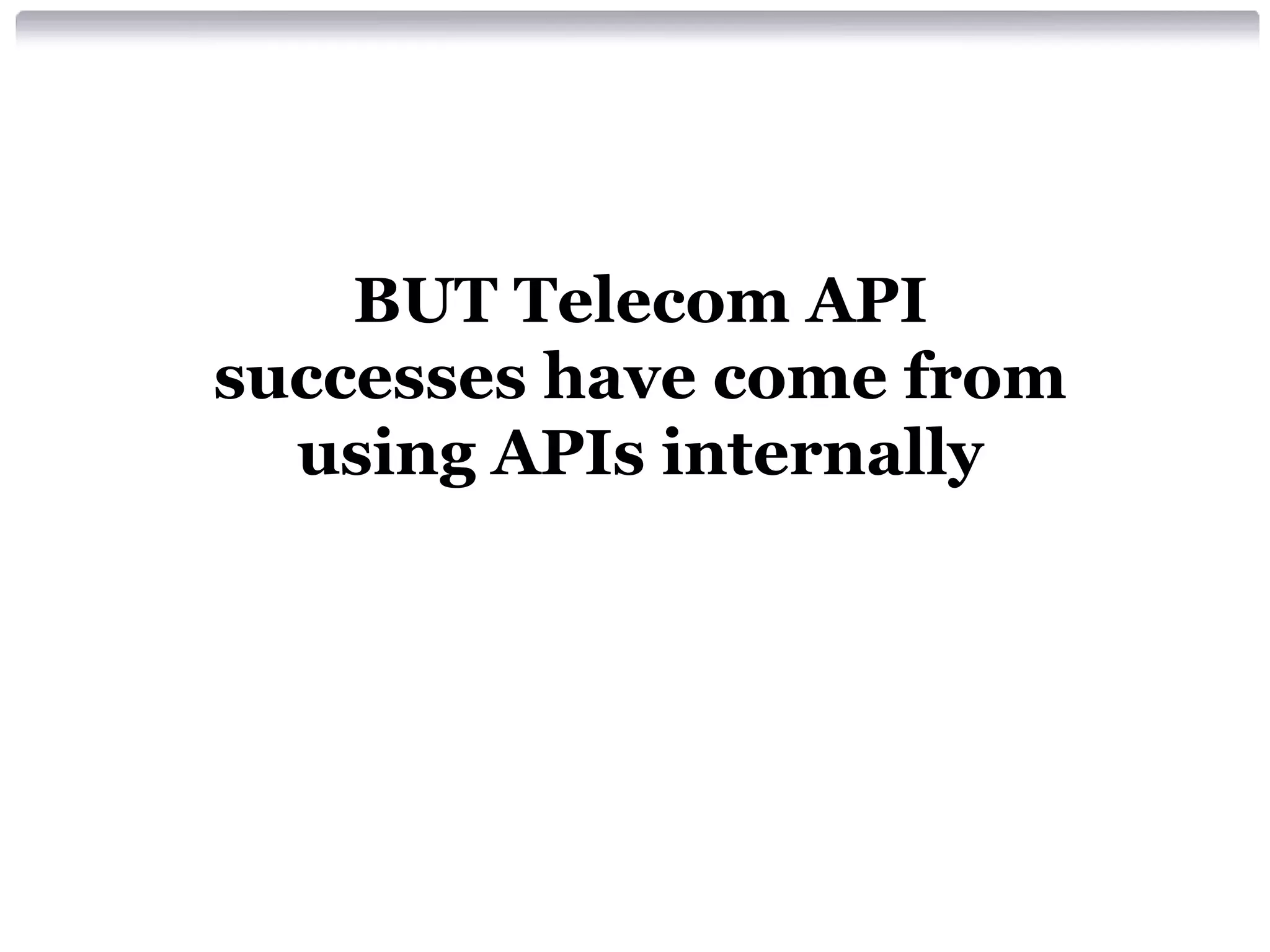
BUT Telecom API
successes have come from
using APIs internally
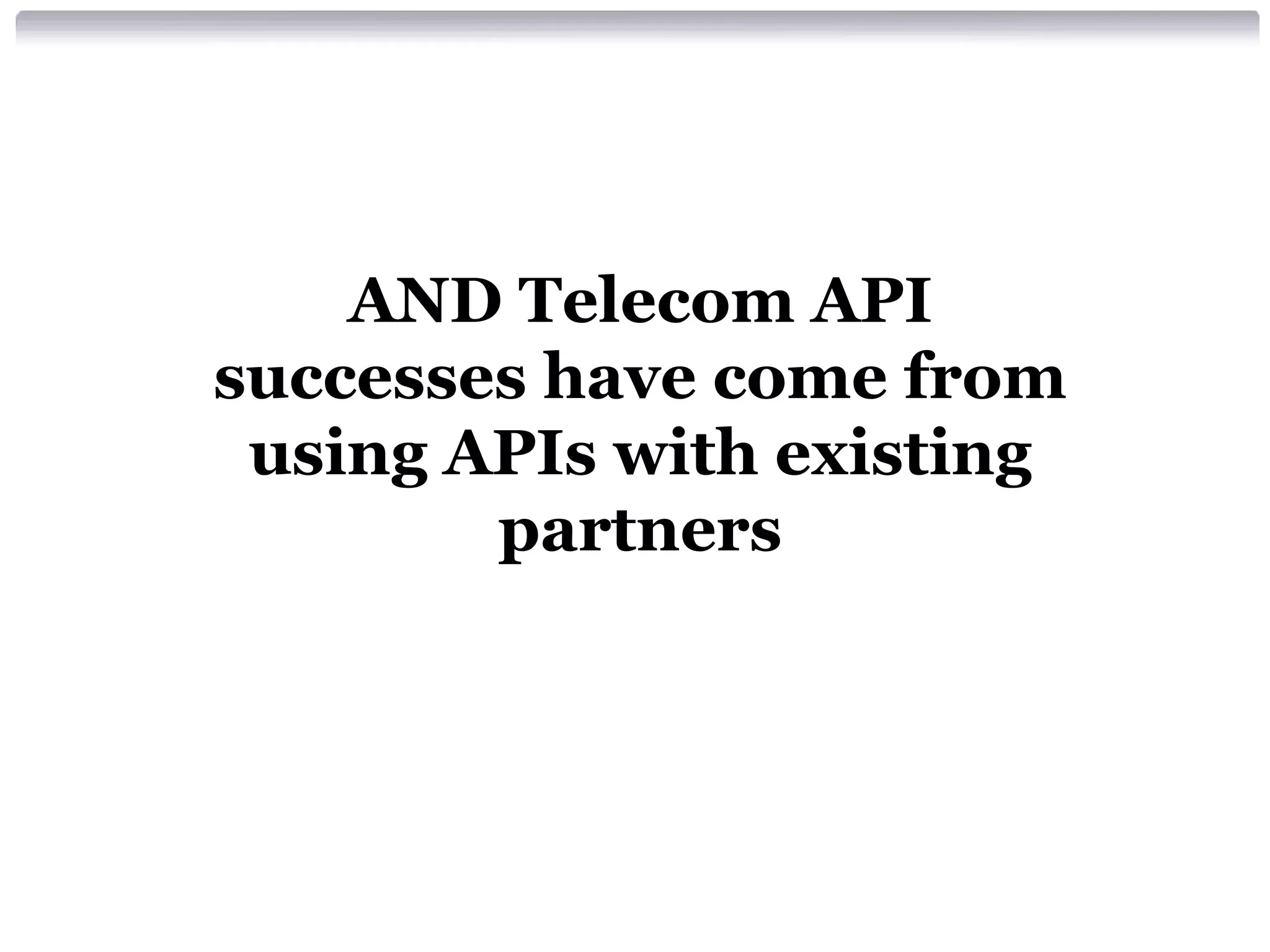
AND Telecom API
successes have come from
using APIs with existing
partners
APIs reduce business
friction. This means the
value is not ‘in the API’ it’s
in the service or data
delivered through the API.
Mobile Application Developers
ONLY care about direct access to
a large engaged customer base
that is prepared to pay. Apple
and Android fulfill this need,
Telcos are IRRELEVANT
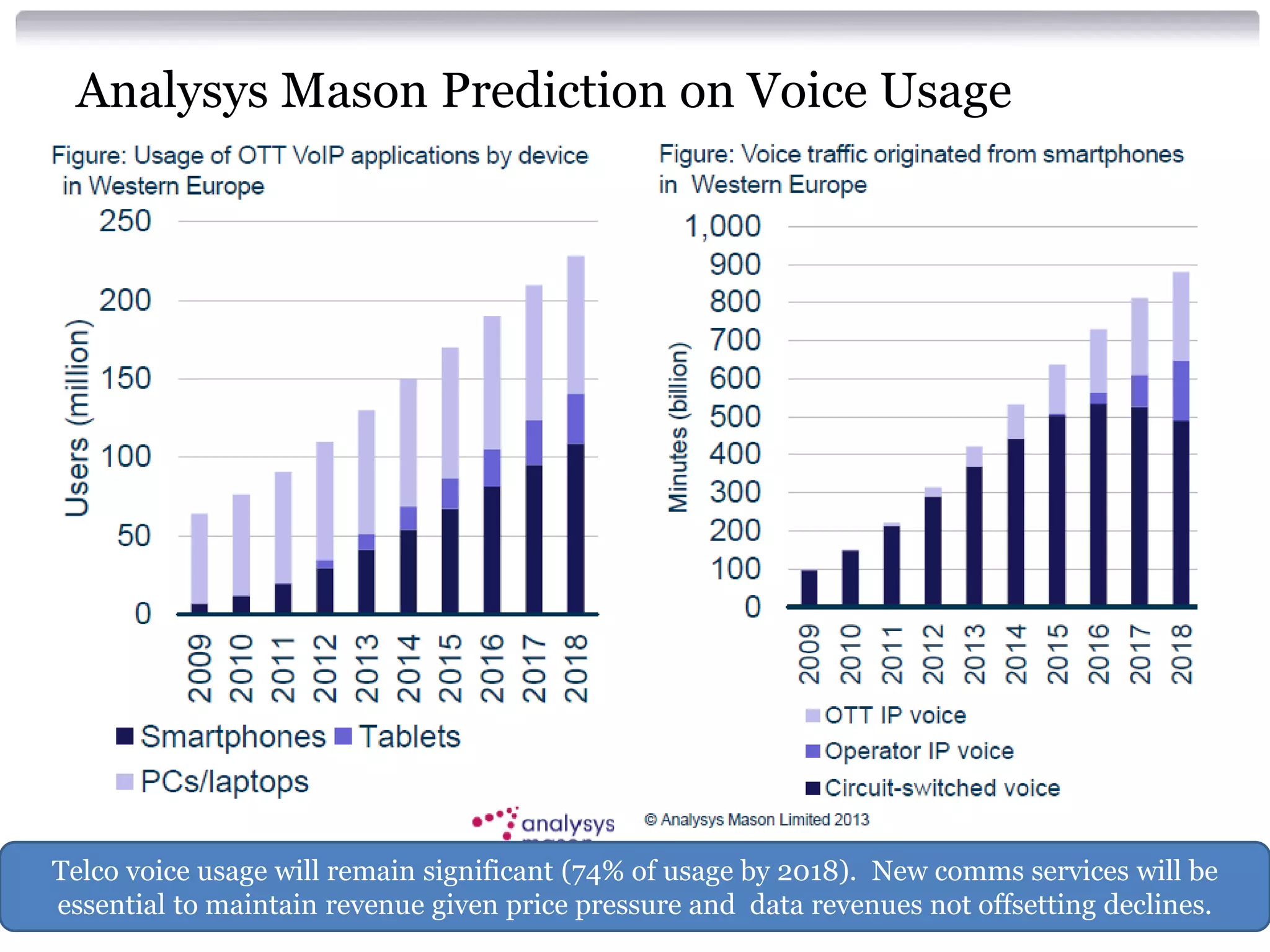
Analysys Mason Prediction on Voice Usage

Telco voice usage will remain significant (74% of usage by 2018). New comms services will be
essential to maintain revenue given price pressure and data revenues not offsetting declines.
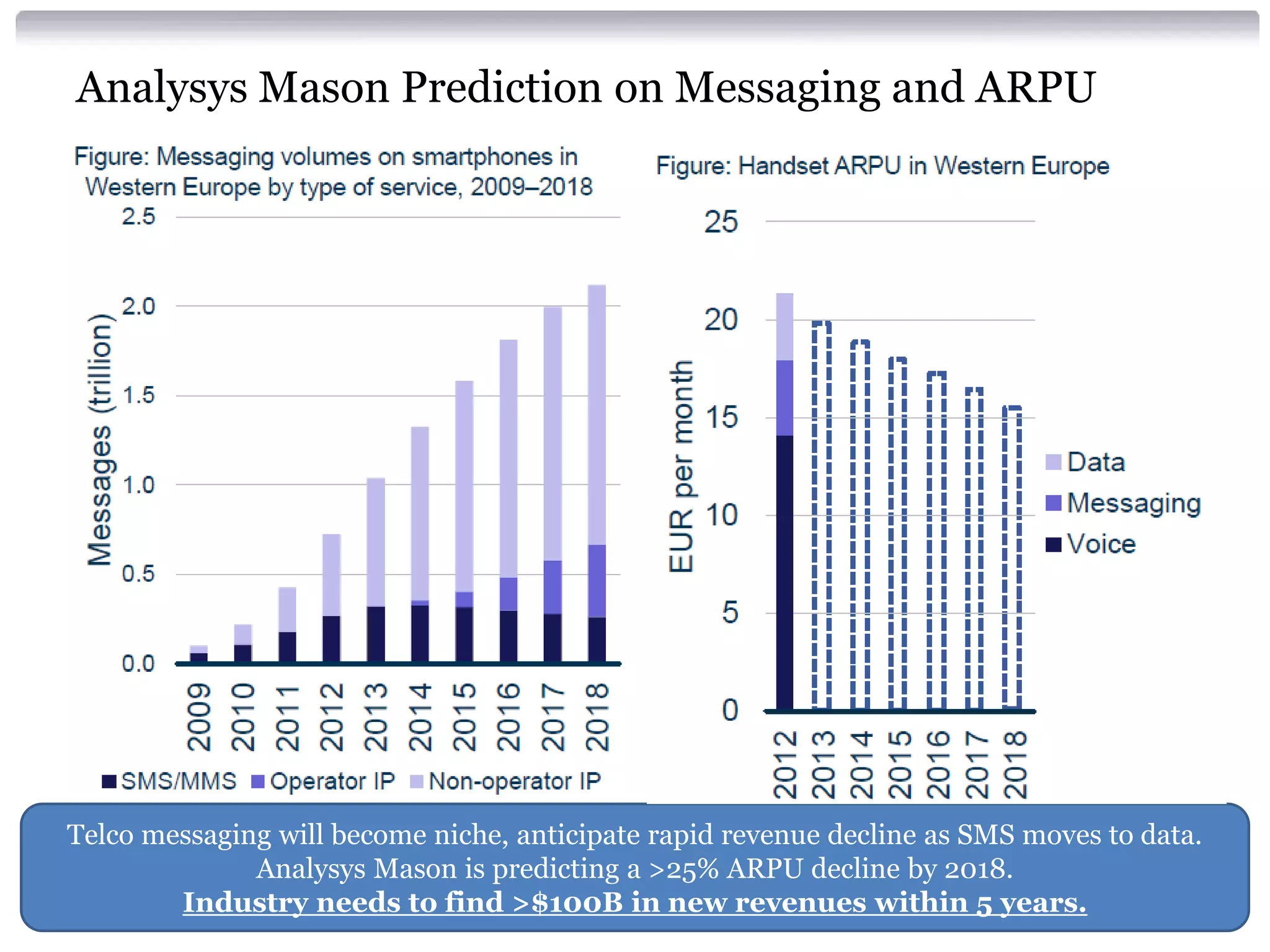
Analysys Mason Prediction on Messaging and ARPU

Telco messaging will become niche, anticipate rapid revenue decline as SMS moves to data.
Analysys Mason is predicting a >25% ARPU decline by 2018.
Industry needs to find >$100B in new revenues within 5 years.
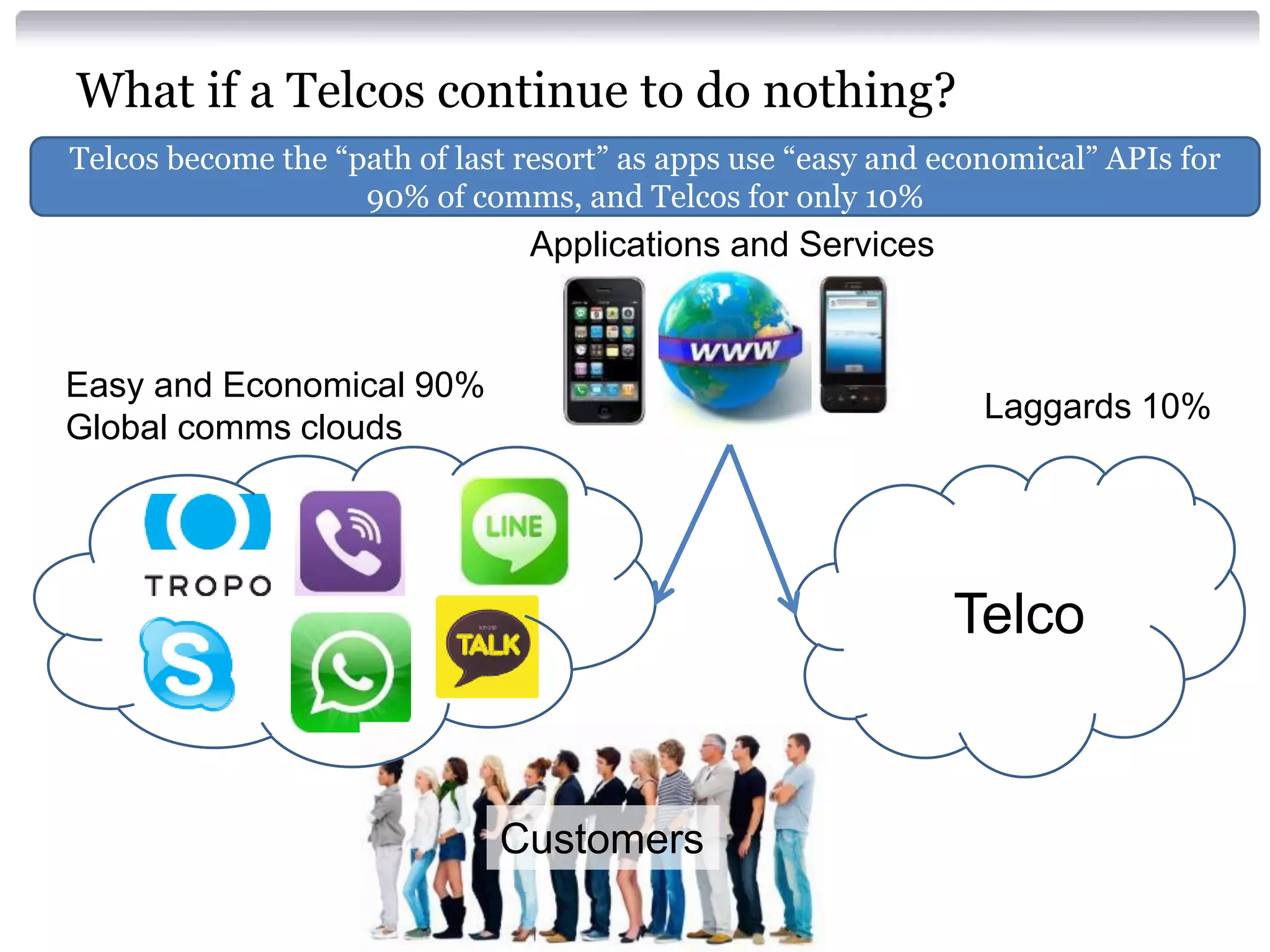
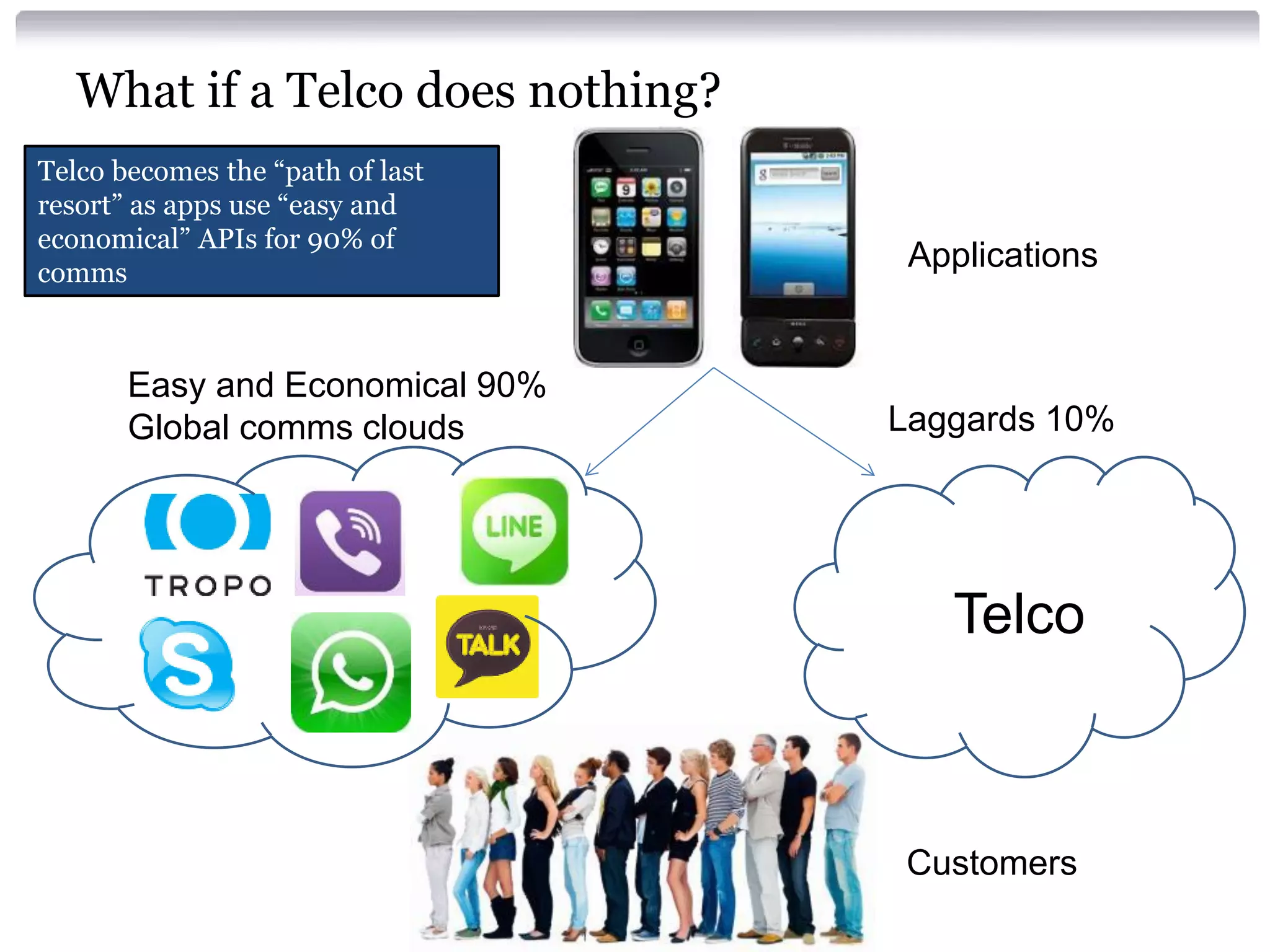
What if a Telcos continue to do nothing?
Telcos become the “path of last resort” as apps use “easy and economical” APIs for
90% of comms, and Telcos for only 10%

Applications and Services

Easy and Economical 90%
Global comms clouds

Laggards 10%

Telco

Customers
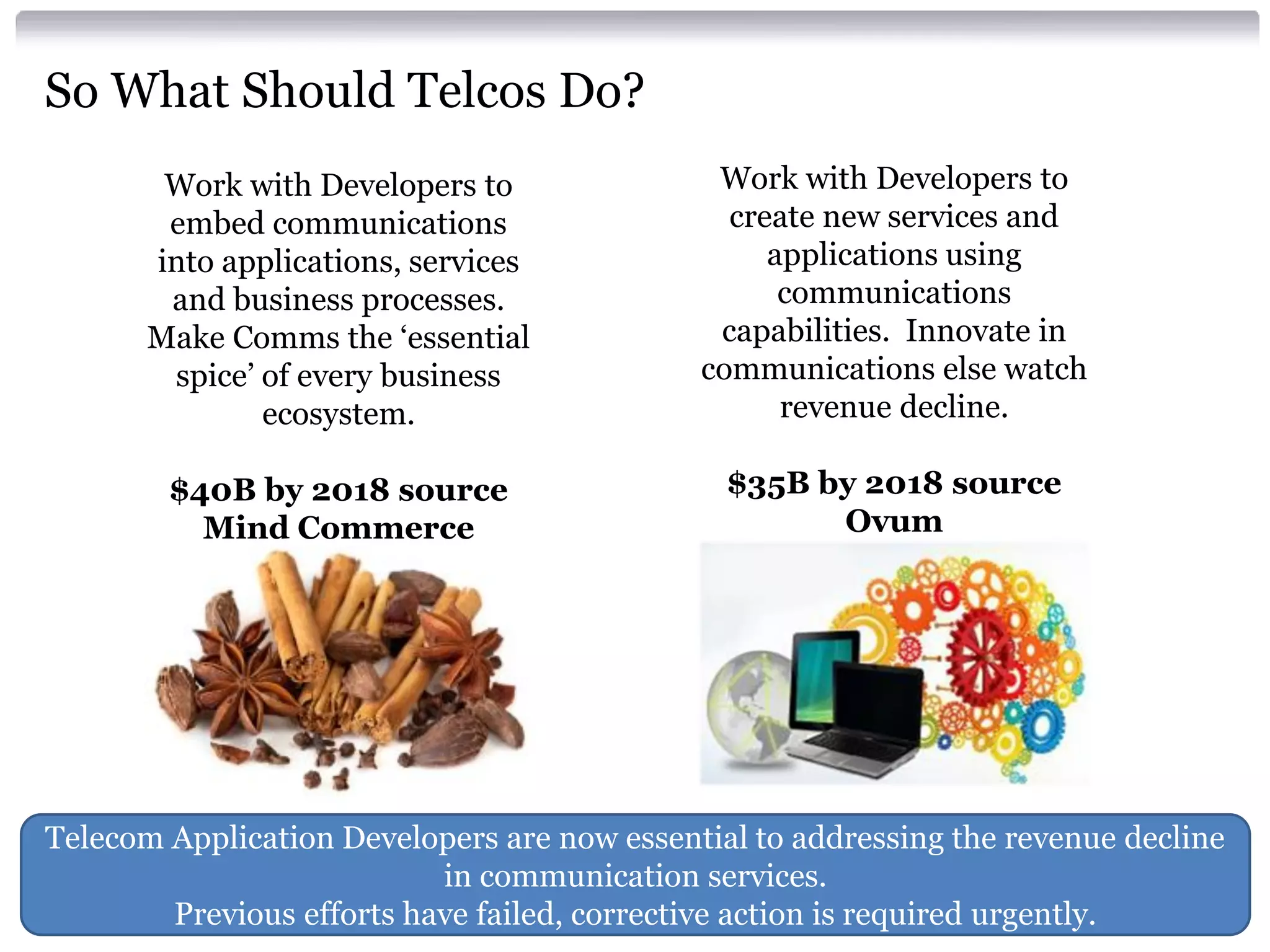
So What Should Telcos Do?
Work with Developers to
embed communications
into applications, services
and business processes.
Make Comms the ‘essential
spice’ of every business
ecosystem.

Work with Developers to
create new services and
applications using
communications
capabilities. Innovate in
communications else watch
revenue decline.

$40B by 2018 source
Mind Commerce

$35B by 2018 source
Ovum

Telecom Application Developers are now essential to addressing the revenue decline
in communication services.
Previous efforts have failed, corrective action is required urgently.
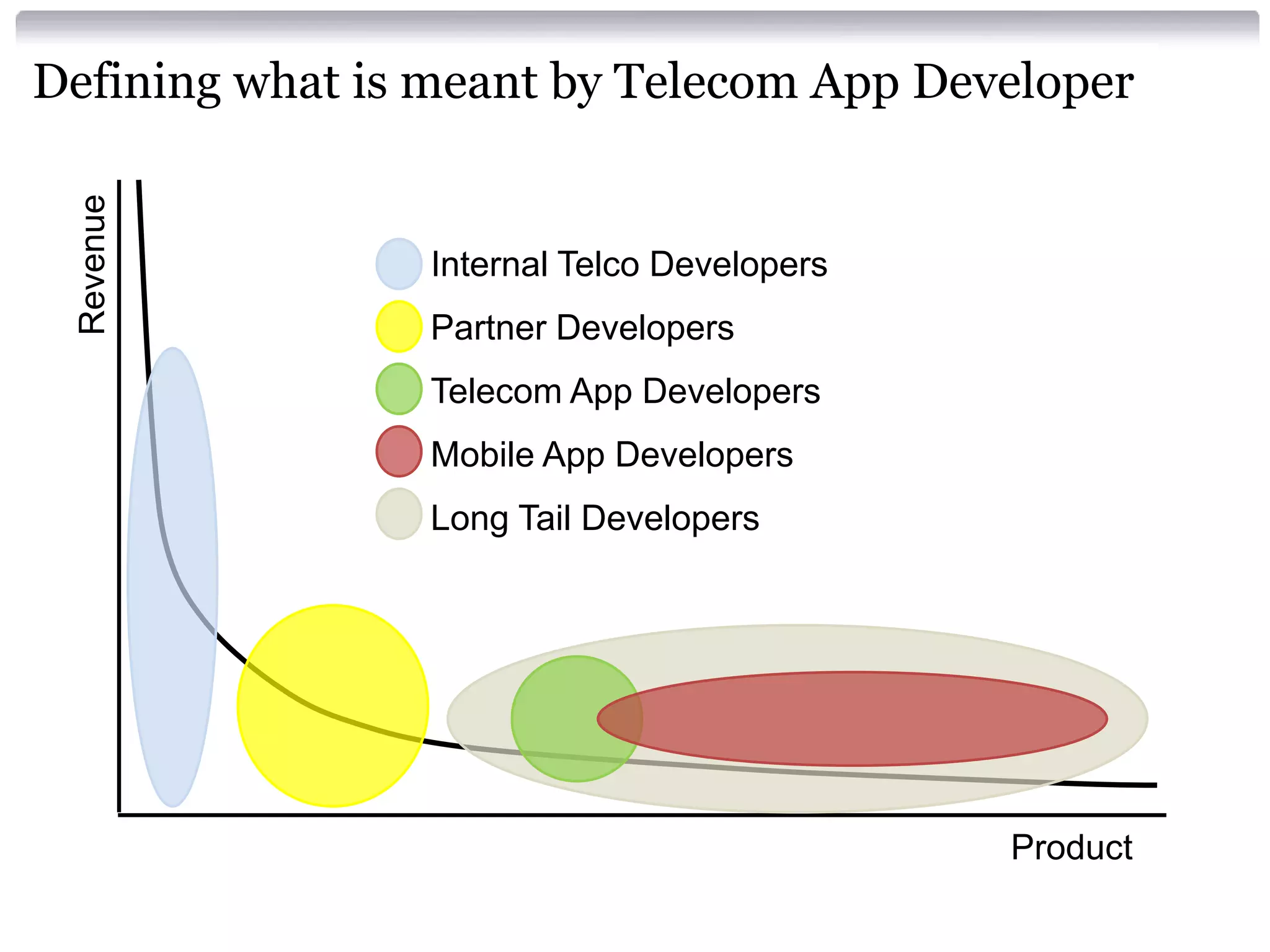
Revenue

Defining what is meant by Telecom App Developer

Internal Telco Developers
Partner Developers
Telecom App Developers
Mobile App Developers

Long Tail Developers

Product
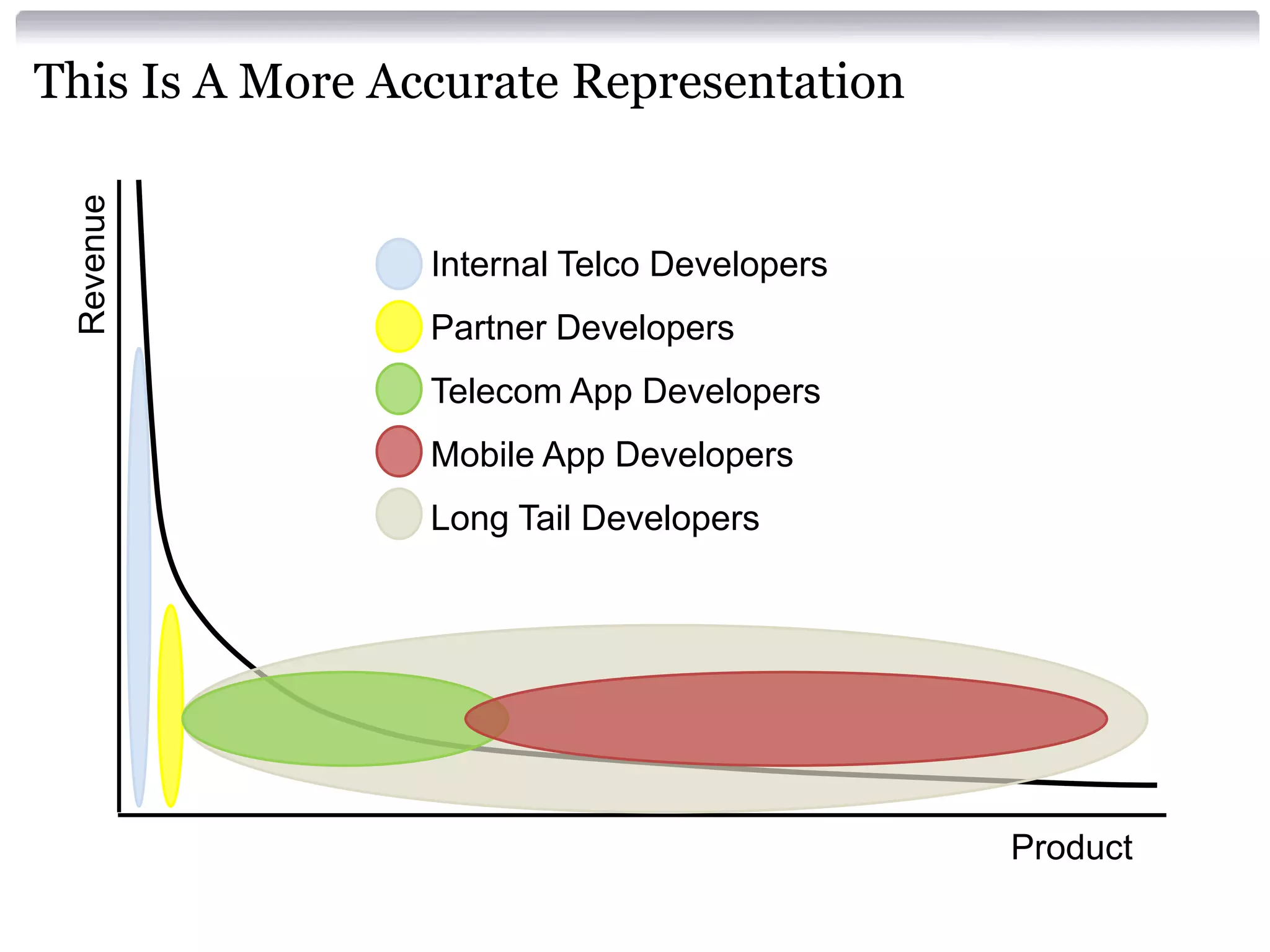
Revenue

This Is A More Accurate Representation

Internal Telco Developers
Partner Developers
Telecom App Developers
Mobile App Developers

Long Tail Developers

Product
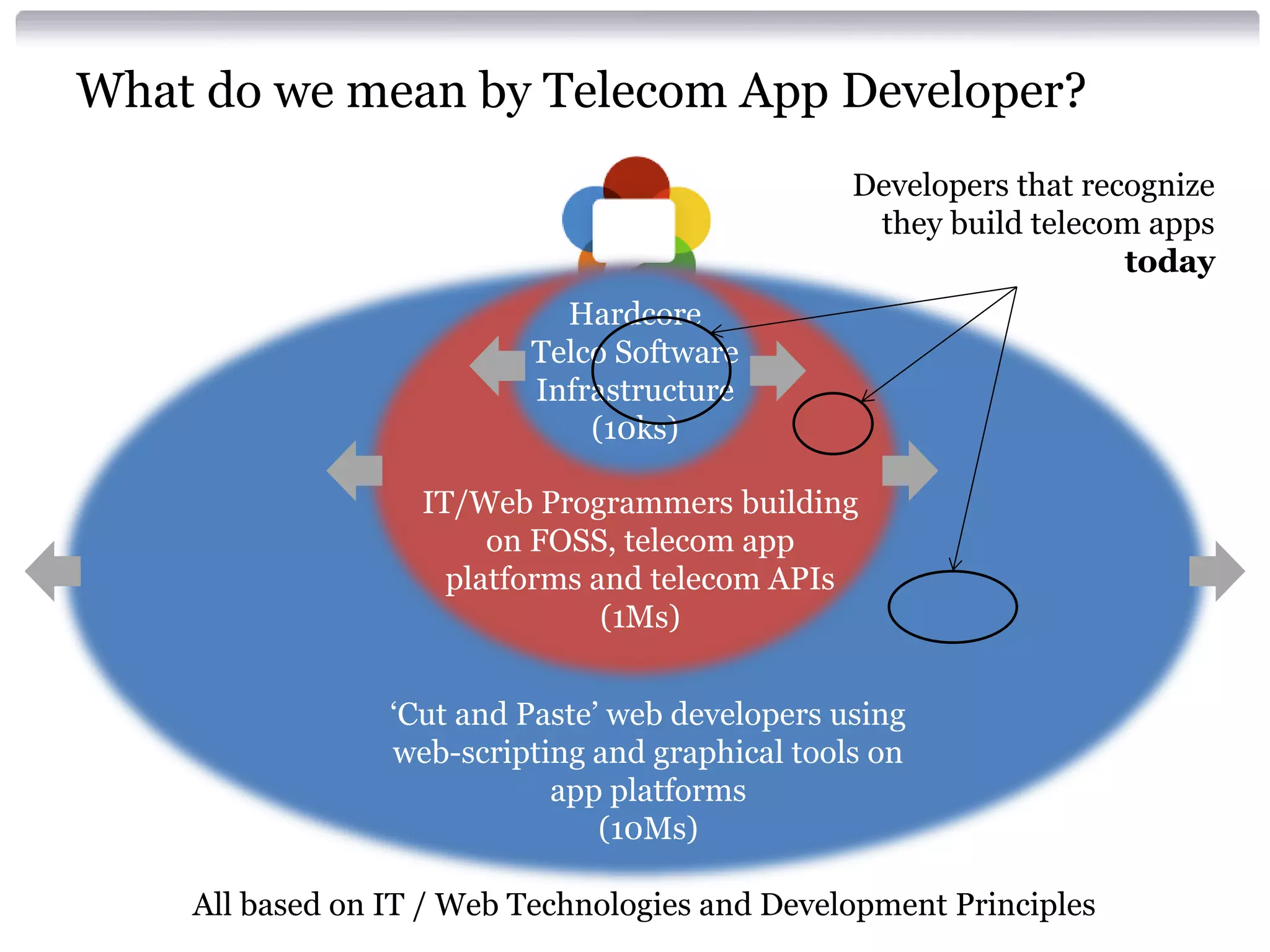
What do we mean by Telecom App Developer?
Developers that recognize
they build telecom apps
today
Hardcore
Telco Software
Infrastructure
(10ks)
IT/Web Programmers building
on FOSS, telecom app
platforms and telecom APIs
(1Ms)
‘Cut and Paste’ web developers using
web-scripting and graphical tools on
app platforms
(10Ms)
All based on IT / Web Technologies and Development Principles
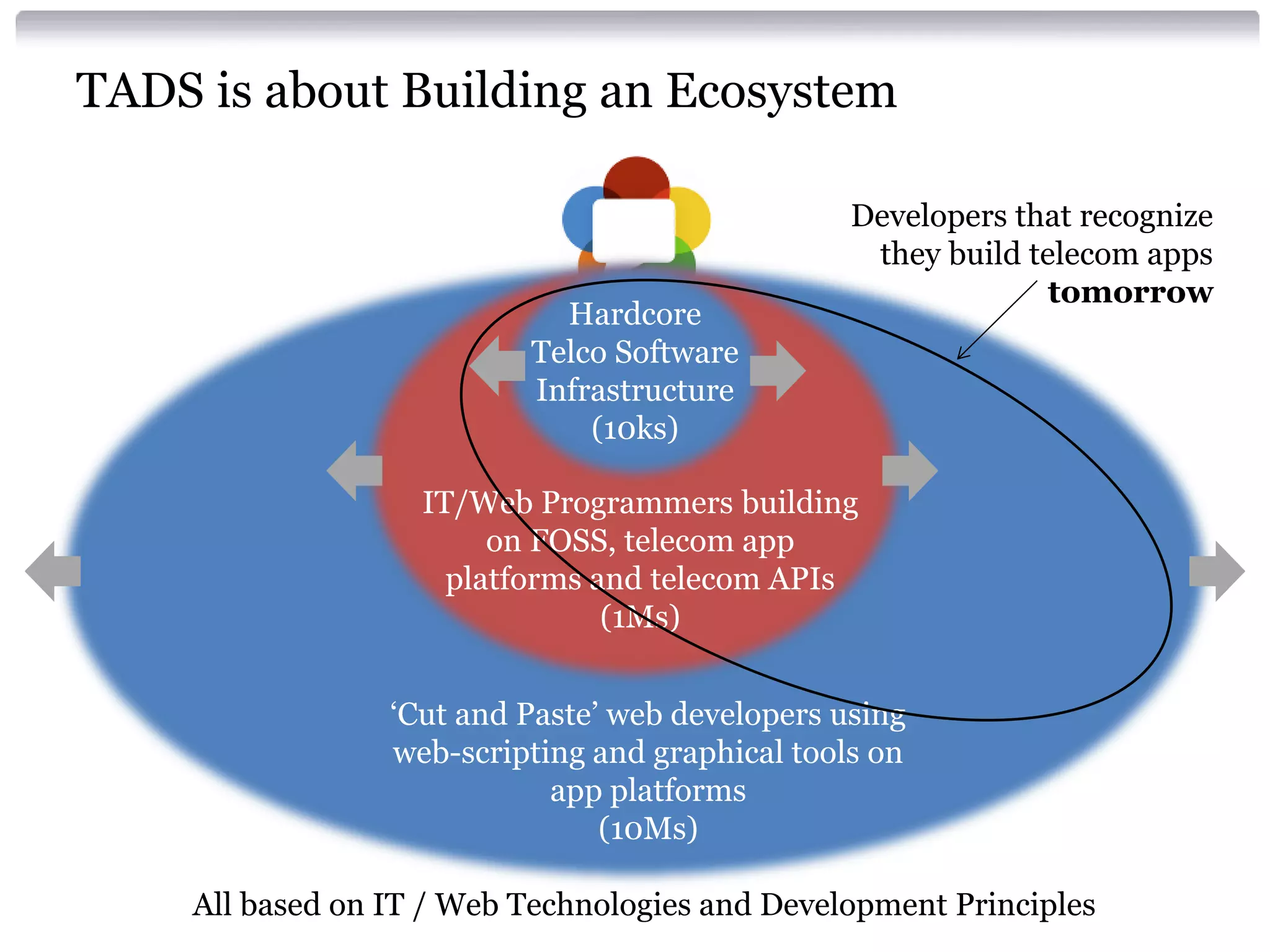
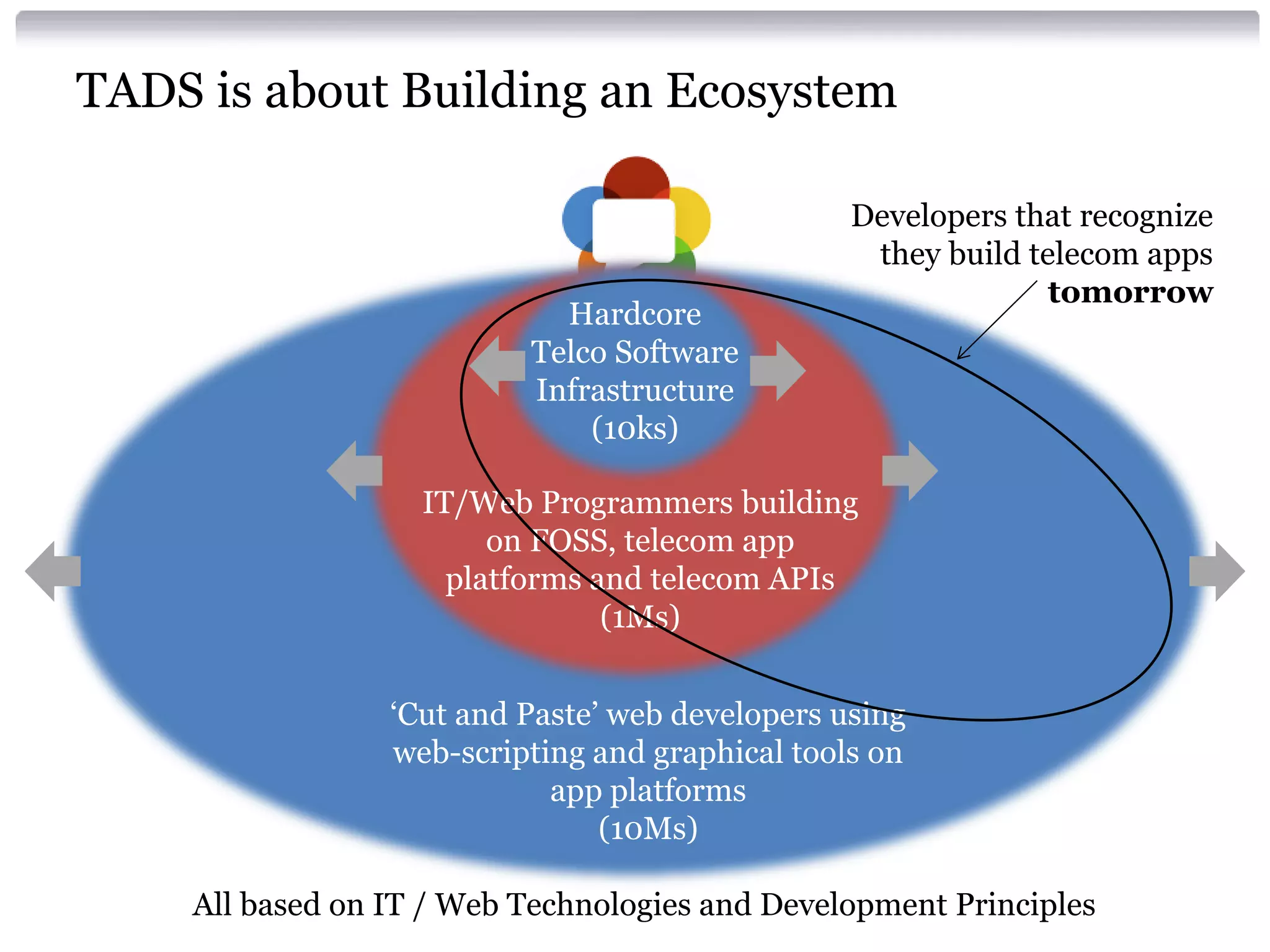
TADS is about Building an Ecosystem

Hardcore
Telco Software
Infrastructure
(10ks)

Developers that recognize
they build telecom apps
tomorrow

IT/Web Programmers building
on FOSS, telecom app
platforms and telecom APIs
(1Ms)
‘Cut and Paste’ web developers using
web-scripting and graphical tools on
app platforms
(10Ms)
All based on IT / Web Technologies and Development Principles
www.tadsummit.com
No Gatekeeper
Focus
Motivation
Why? graphic
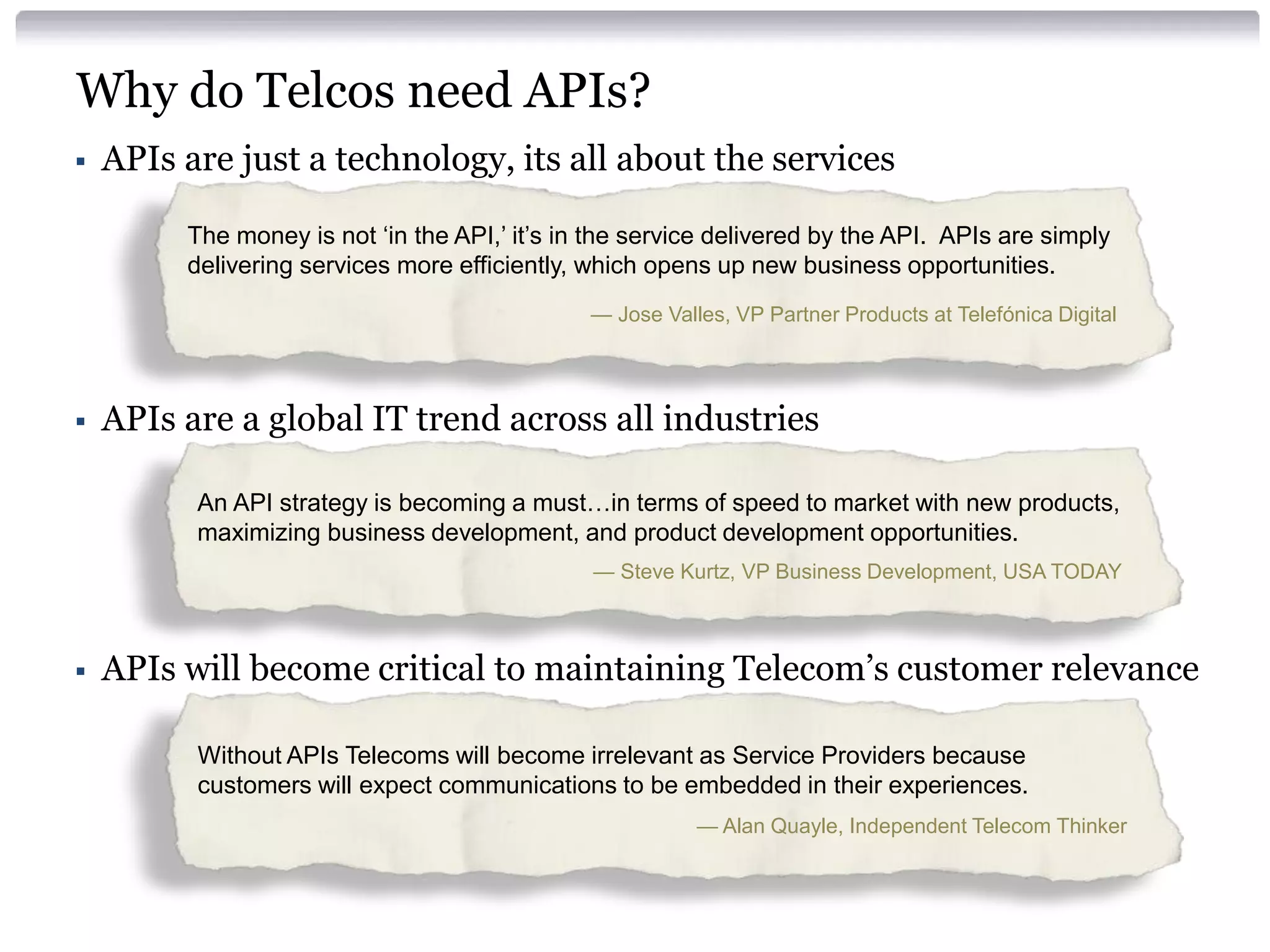
Why do Telcos need APIs?


APIs are just a technology, its all about the services
The money is not ‘in the API,’ it’s in the service delivered by the API. APIs are simply
delivering services more efficiently, which opens up new business opportunities.
— Jose Valles, VP Partner Products at Telefónica Digital



APIs are a global IT trend across all industries
An API strategy is becoming a must…in terms of speed to market with new products,
maximizing business development, and product development opportunities.
— Steve Kurtz, VP Business Development, USA TODAY



APIs will become critical to maintaining Telecom’s customer relevance
Without APIs Telecoms will become irrelevant as Service Providers because
customers will expect communications to be embedded in their experiences.
— Alan Quayle, Independent Telecom Thinker
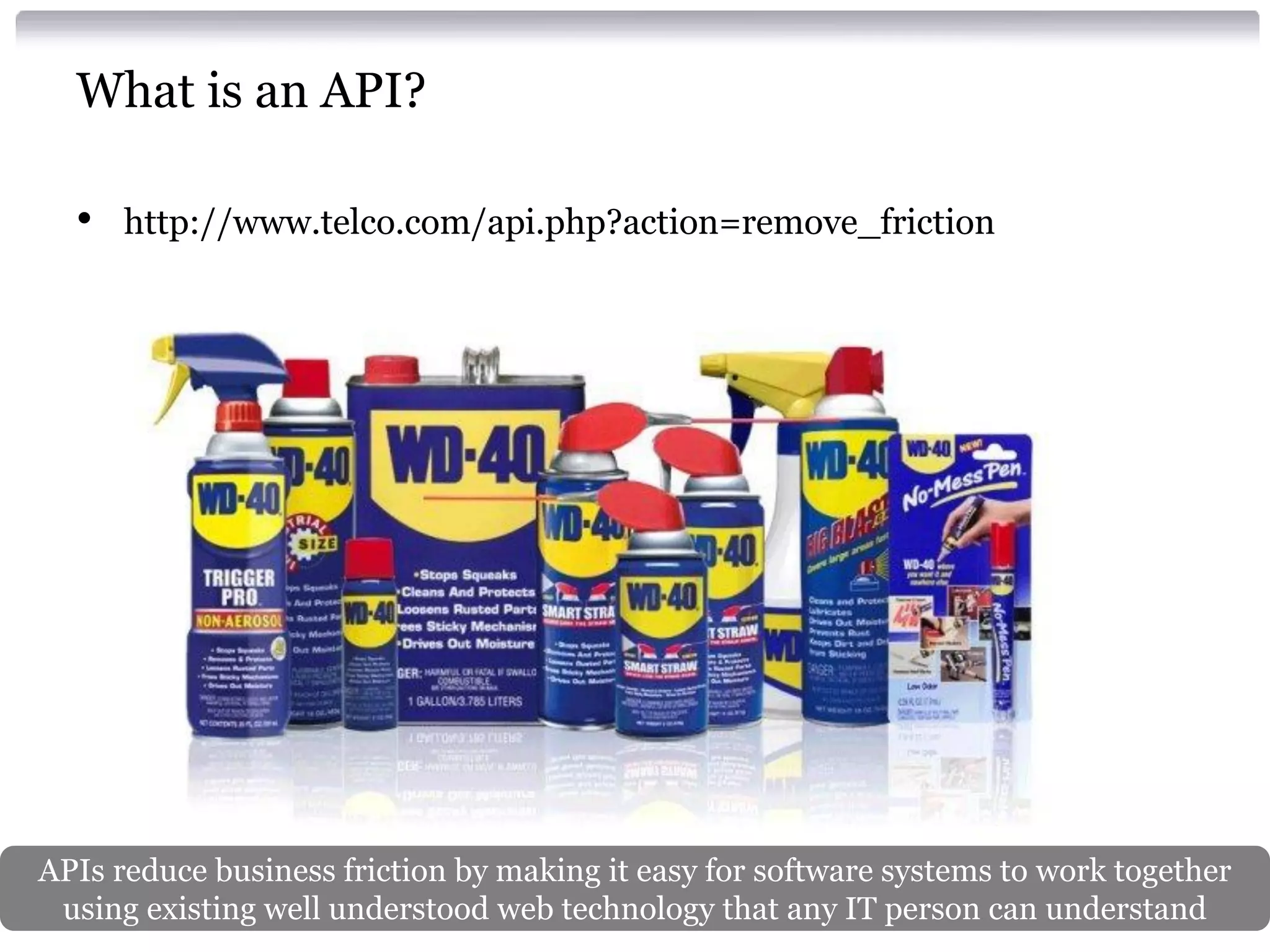
What is an API?
•

http://www.telco.com/api.php?action=remove_friction

APIs reduce business friction by making it easy for software systems to work together
using existing well understood web technology that any IT person can understand
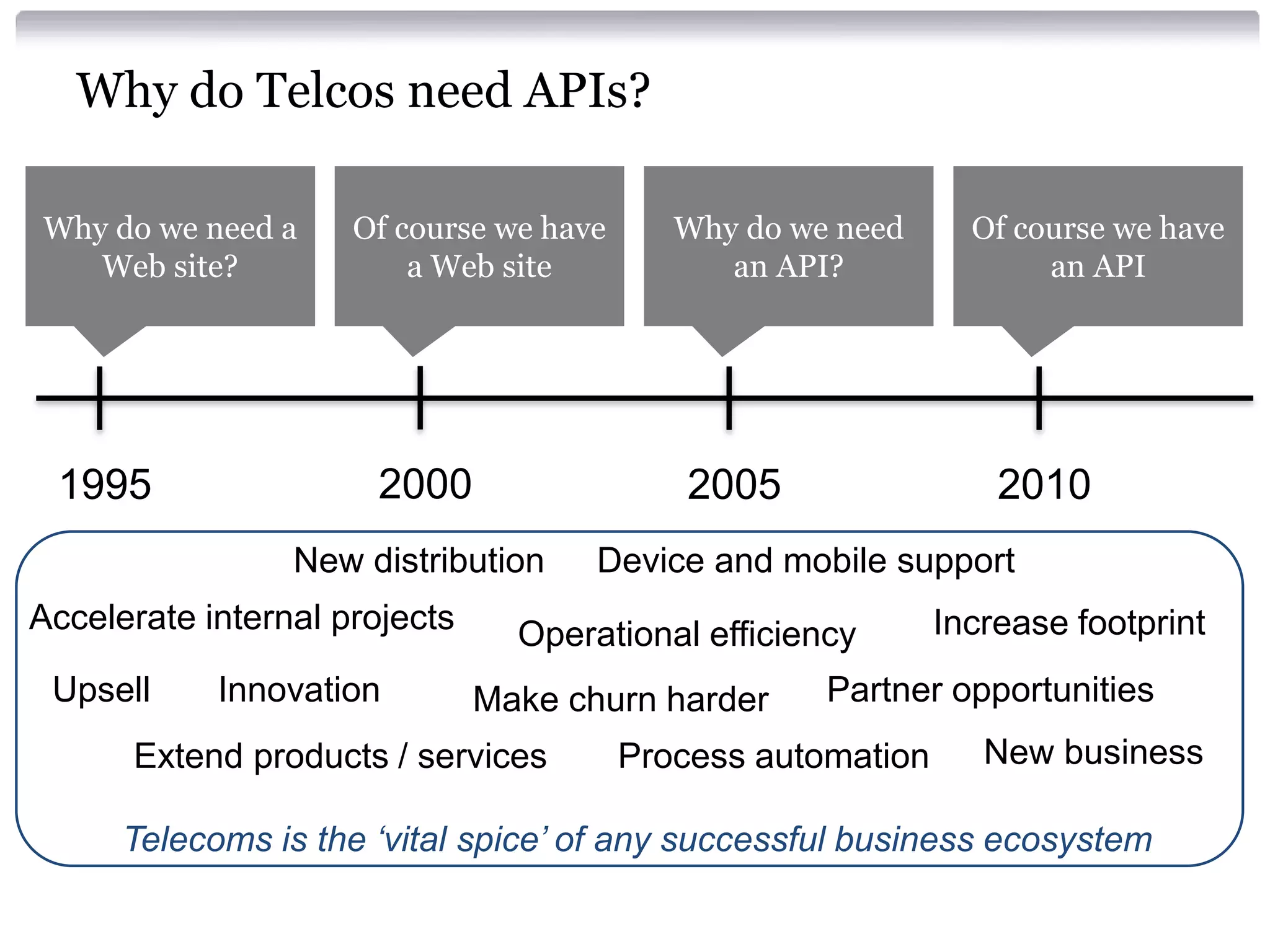
Why do Telcos need APIs?
Why do we need a
Web site?

1995

Of course we have
a Web site

2000

2005

New distribution
Accelerate internal projects

Upsell

Innovation

Why do we need
an API?

2010

Device and mobile support

Operational efficiency
Make churn harder

Extend products / services

Of course we have
an API

Increase footprint

Partner opportunities

Process automation

New business

Telecoms is the ‘vital spice’ of any successful business ecosystem
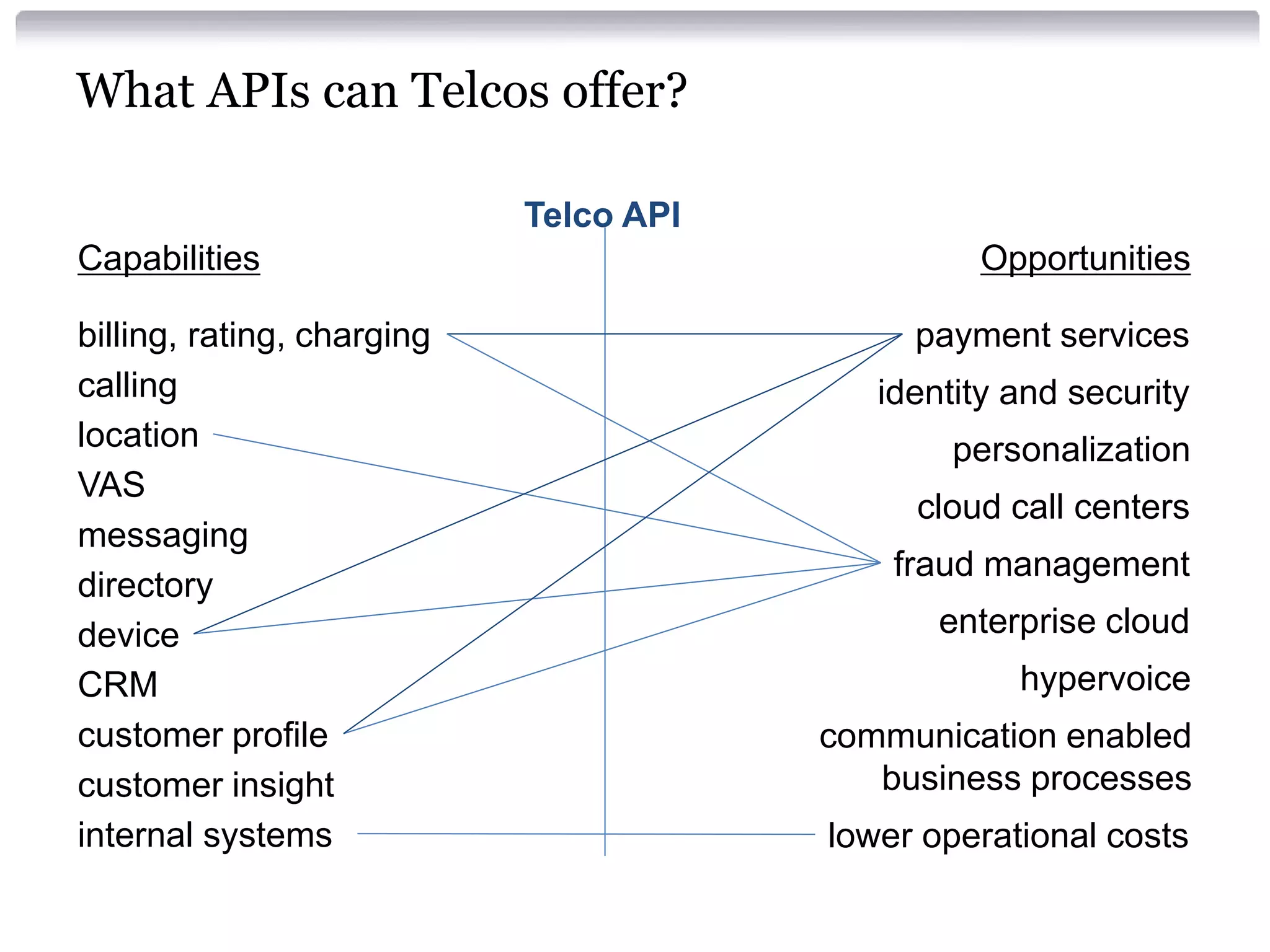
What APIs can Telcos offer?
Telco API
Capabilities
billing, rating, charging
calling
location
VAS
messaging
directory
device
CRM
customer profile
customer insight
internal systems

Opportunities
payment services
identity and security
personalization
cloud call centers
fraud management
enterprise cloud
hypervoice
communication enabled
business processes
lower operational costs
Show me the money? graphic
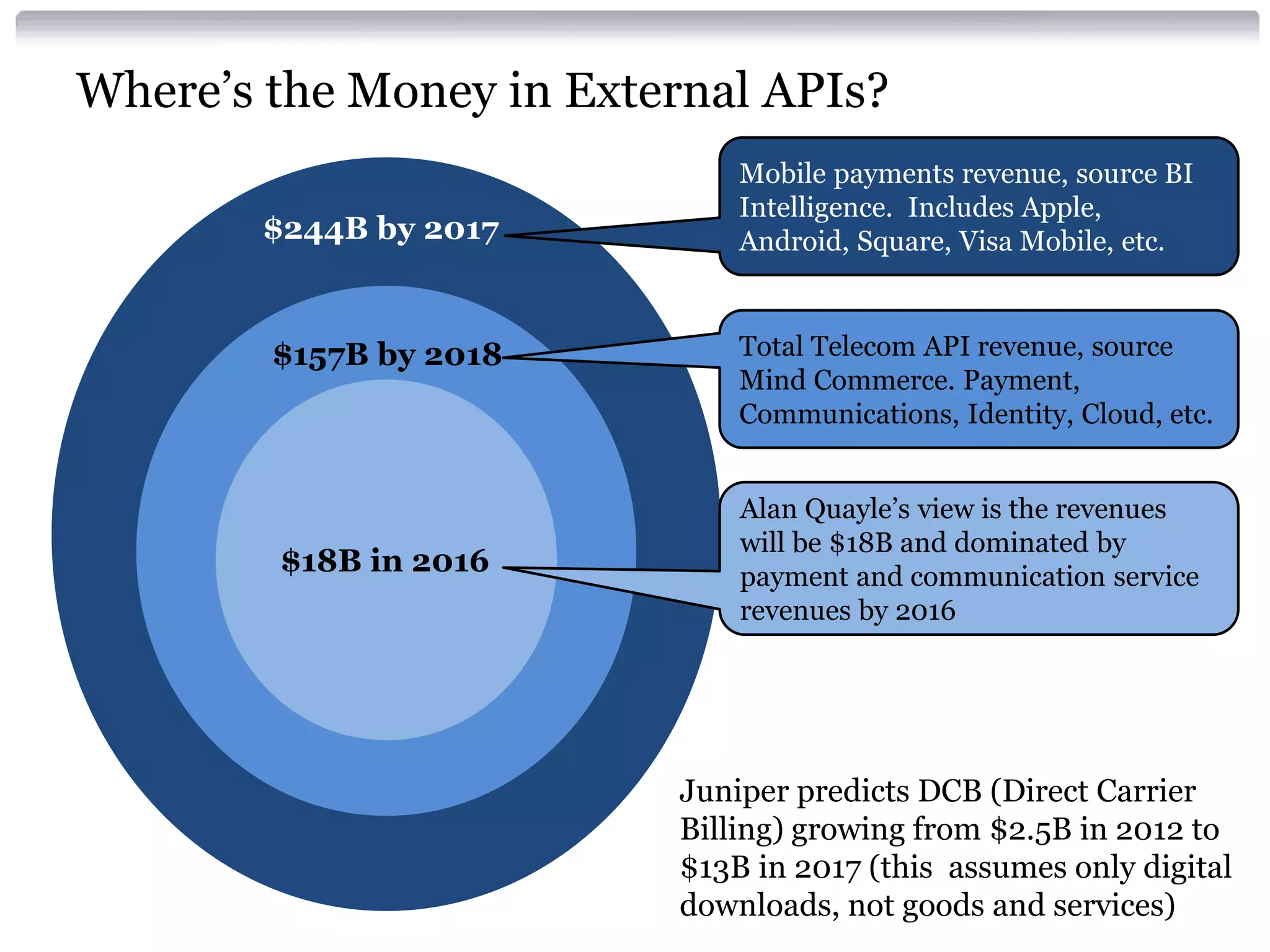
Where’s the Money in External APIs?
$244B by 2017

$157B by 2018

$18B in 2016

Mobile payments revenue, source BI
Intelligence. Includes Apple,
Android, Square, Visa Mobile, etc.

Total Telecom API revenue, source
Mind Commerce. Payment,
Communications, Identity, Cloud, etc.
Alan Quayle’s view is the revenues
will be $18B and dominated by
payment and communication service
revenues by 2016

Juniper predicts DCB (Direct Carrier
Billing) growing from $2.5B in 2012 to
$13B in 2017 (this assumes only digital
downloads, not goods and services)
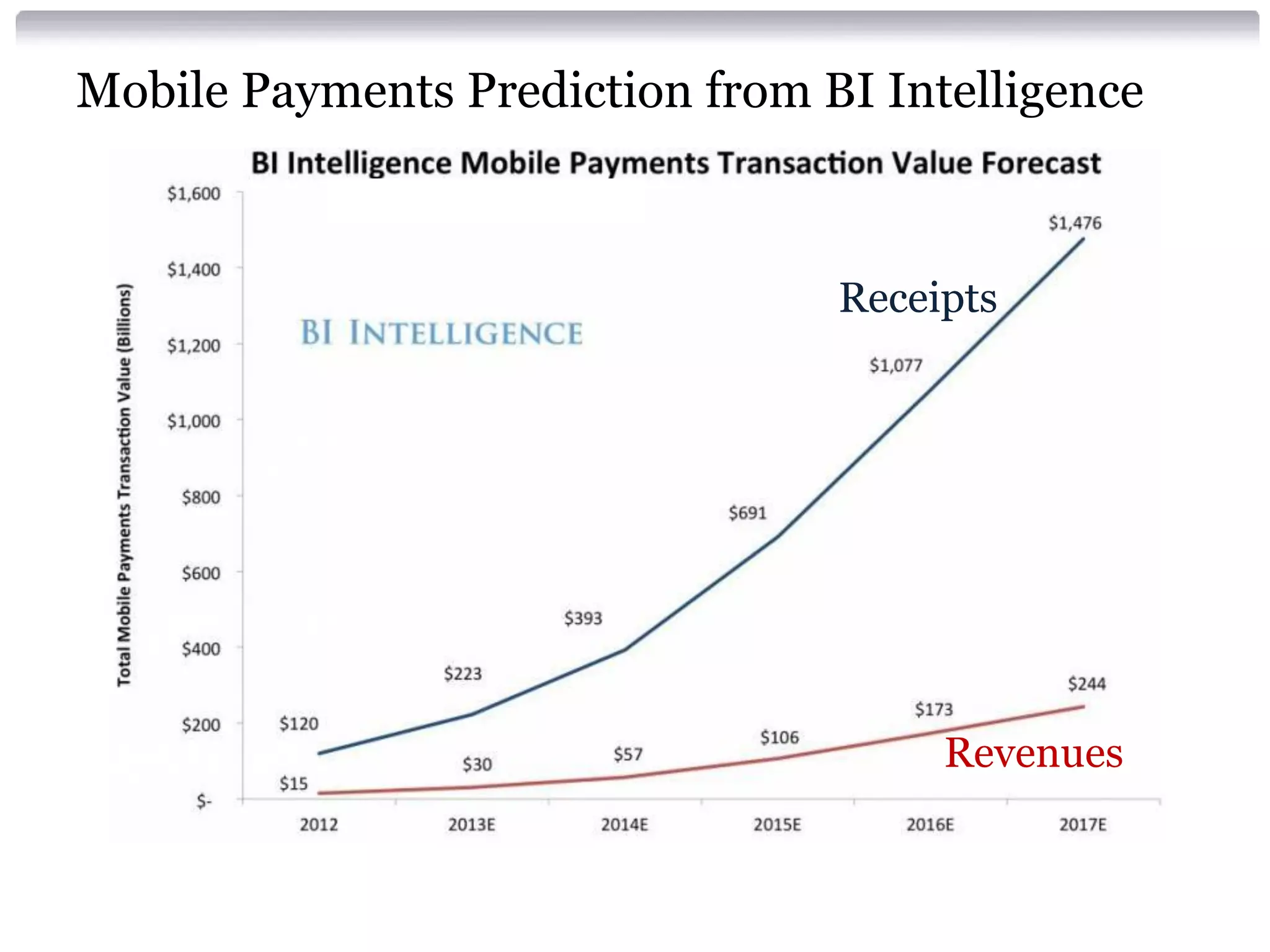
Mobile Payments Prediction from BI Intelligence

Receipts

Revenues
What if a Telco does nothing?
Telco becomes the “path of last
resort” as apps use “easy and
economical” APIs for 90% of
comms

Easy and Economical 90%
Global comms clouds

Applications

Laggards 10%

Telco

Customers
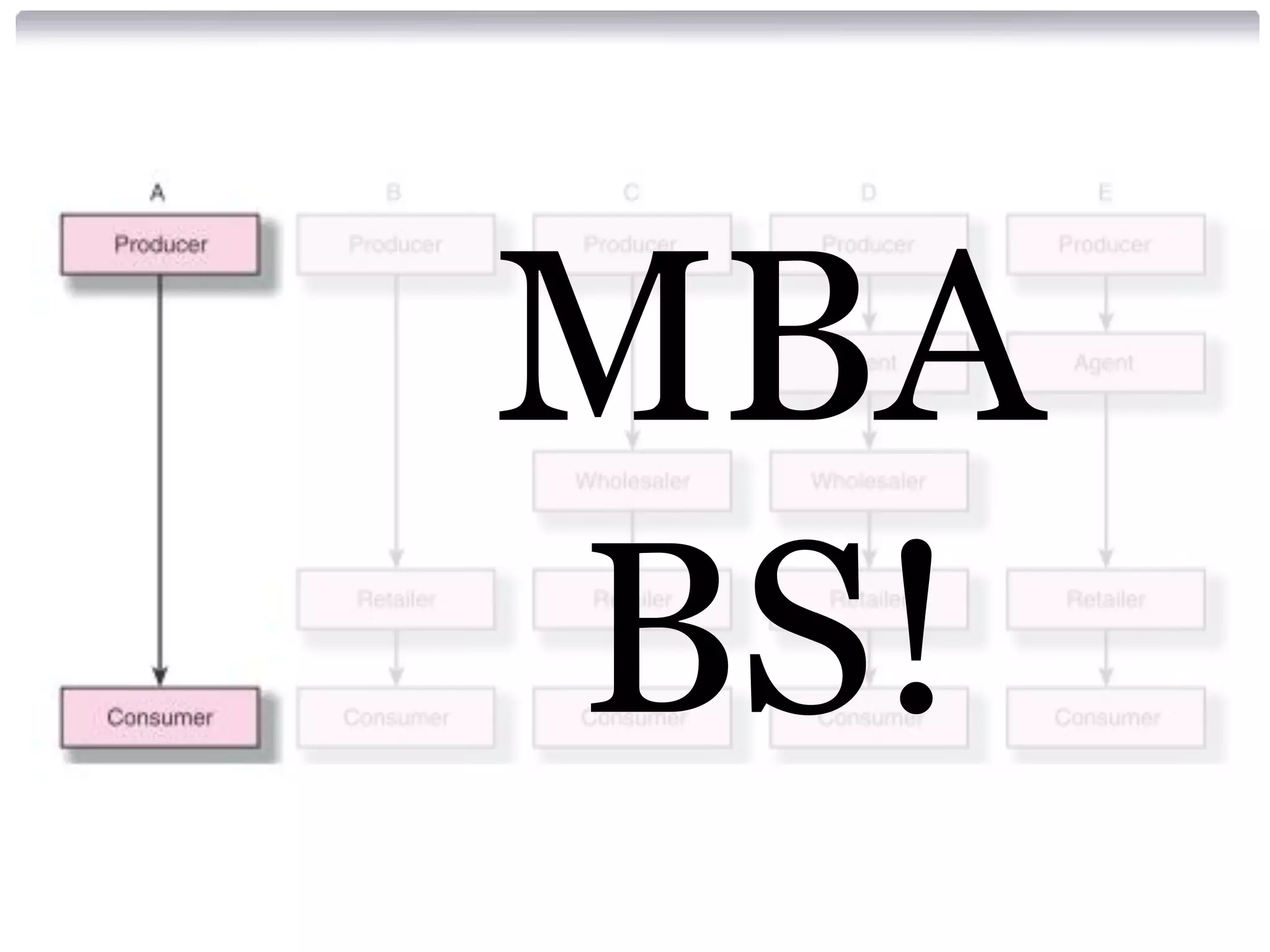
MBA
BS!
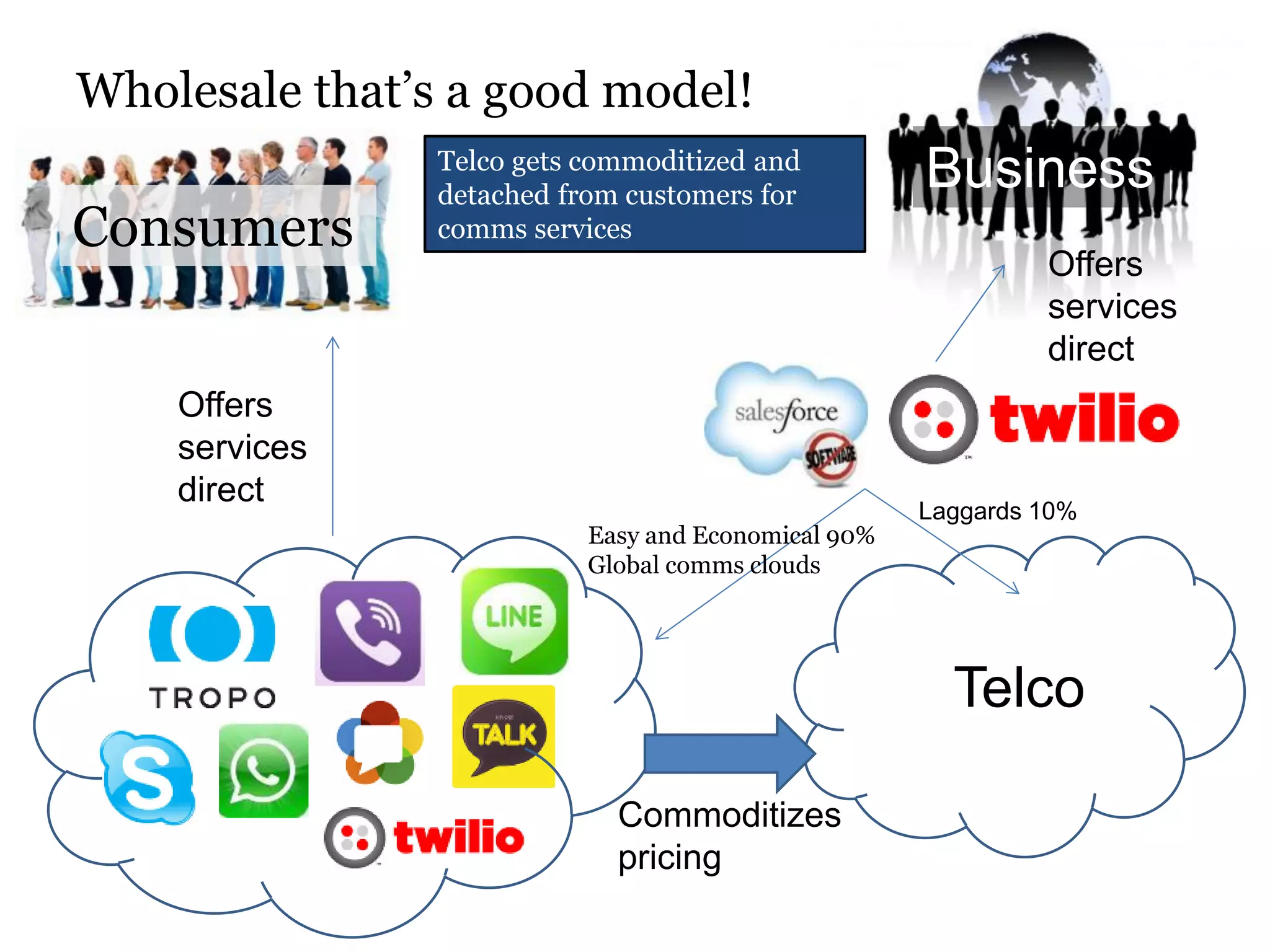
Wholesale that’s a good model!

Consumers

Telco gets commoditized and
detached from customers for
comms services

Business
Offers
services
direct

Offers
services
direct
Easy and Economical 90%
Global comms clouds

Laggards 10%

Telco
Commoditizes
pricing
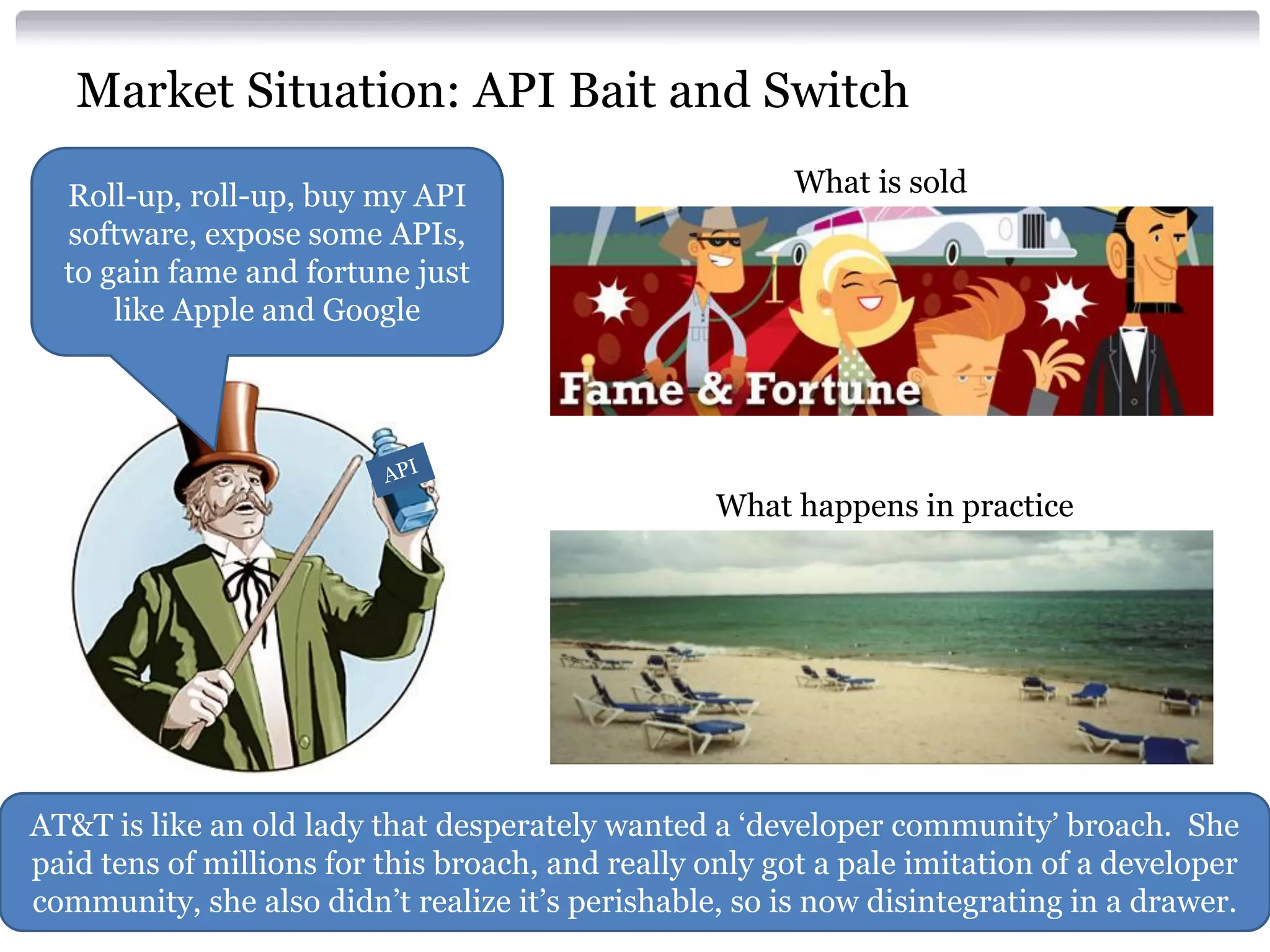
Bait and Switch graphic
Market Situation: API Bait and Switch
Roll-up, roll-up, buy my API
software, expose some APIs,
to gain fame and fortune just
like Apple and Google

What is sold

What happens in practice

AT&T is like an old lady that desperately wanted a ‘developer community’ broach. She
paid tens of millions for this broach, and really only got a pale imitation of a developer
community, she also didn’t realize it’s perishable, so is now disintegrating in a drawer.
Reality graphic
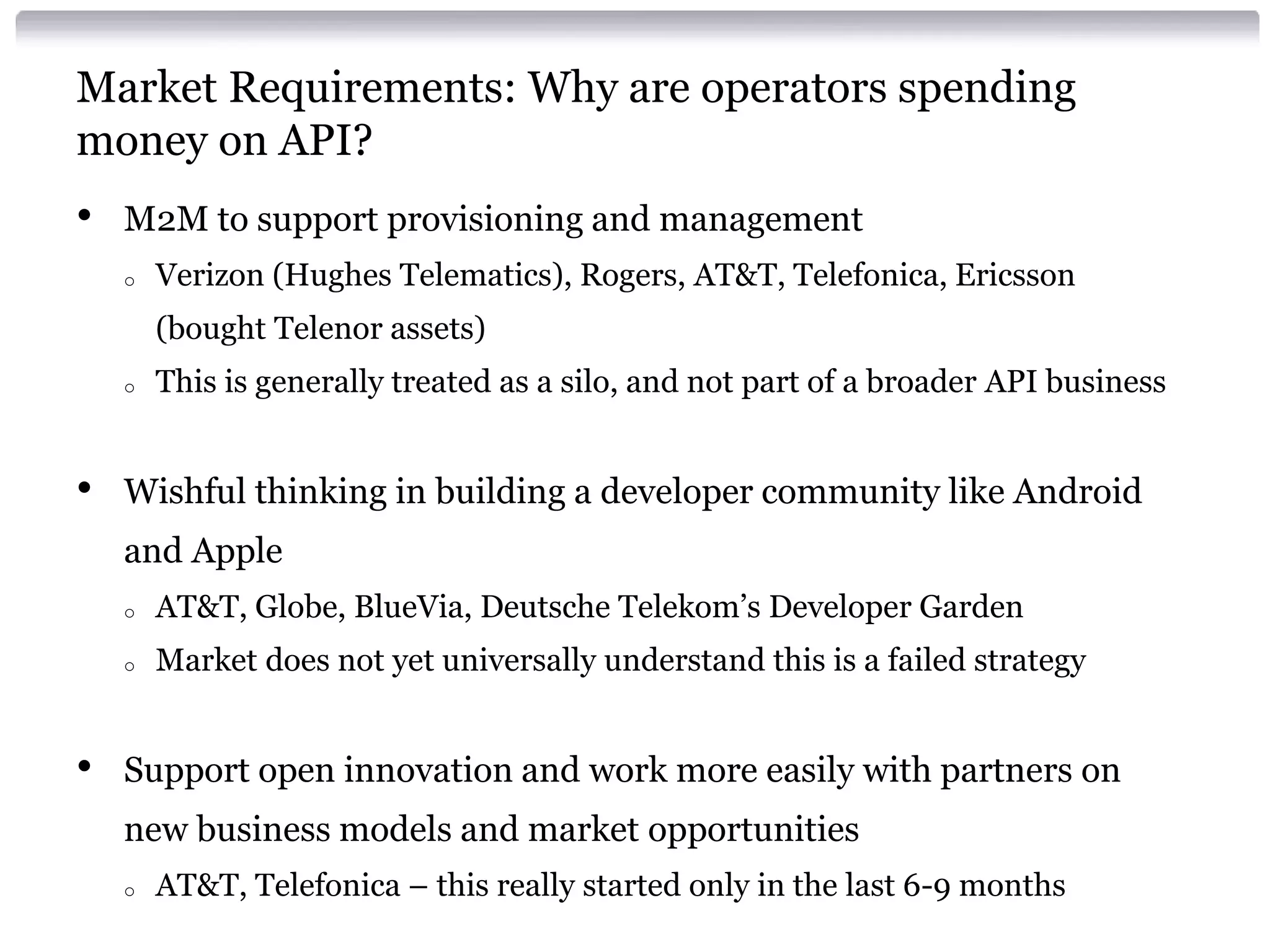
Market Requirements: Why are operators spending
money on API?

•

M2M to support provisioning and management
o

Verizon (Hughes Telematics), Rogers, AT&T, Telefonica, Ericsson
(bought Telenor assets)

o

•

This is generally treated as a silo, and not part of a broader API business

Wishful thinking in building a developer community like Android
and Apple
o
o

•

AT&T, Globe, BlueVia, Deutsche Telekom’s Developer Garden
Market does not yet universally understand this is a failed strategy

Support open innovation and work more easily with partners on
new business models and market opportunities
o

AT&T, Telefonica – this really started only in the last 6-9 months
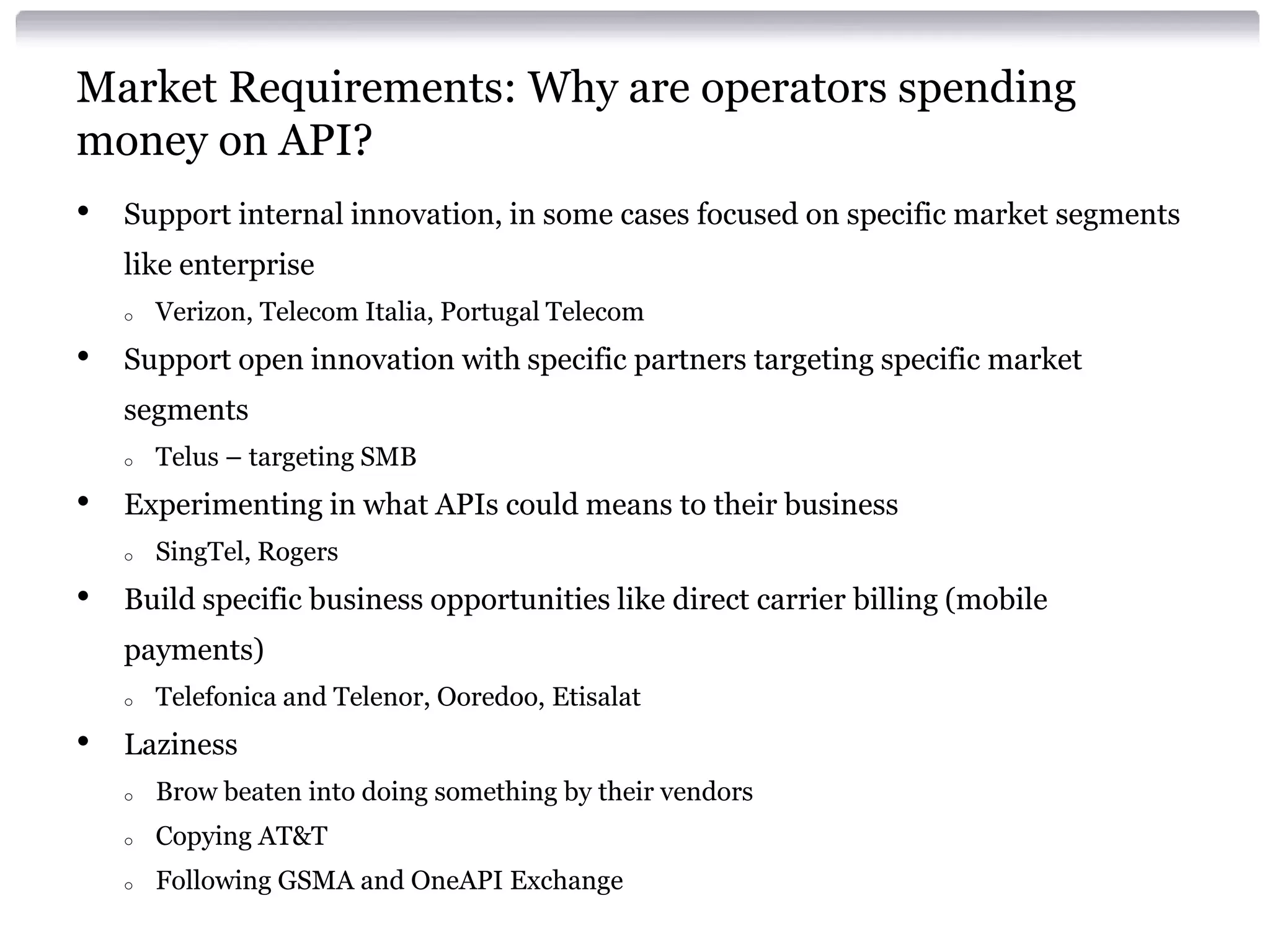
Market Requirements: Why are operators spending
money on API?
•

Support internal innovation, in some cases focused on specific market segments

like enterprise
o

•

Verizon, Telecom Italia, Portugal Telecom

Support open innovation with specific partners targeting specific market
segments
o

•

Experimenting in what APIs could means to their business
o

•

Telus – targeting SMB
SingTel, Rogers

Build specific business opportunities like direct carrier billing (mobile
payments)
o

•

Telefonica and Telenor, Ooredoo, Etisalat

Laziness
o

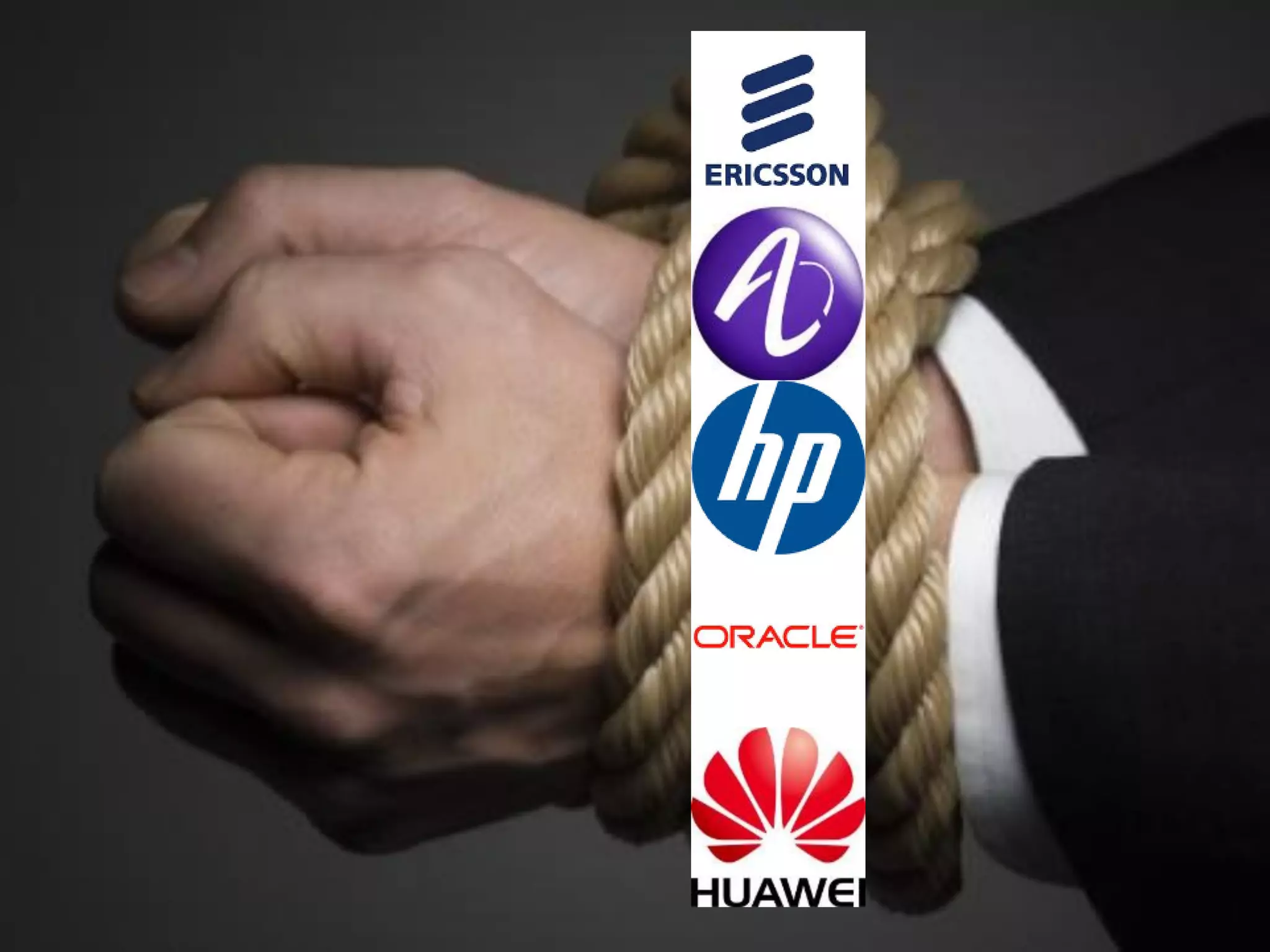
Brow beaten into doing something by their vendors

o

Copying AT&T

o

Following GSMA and OneAPI Exchange
AT&T Graphic
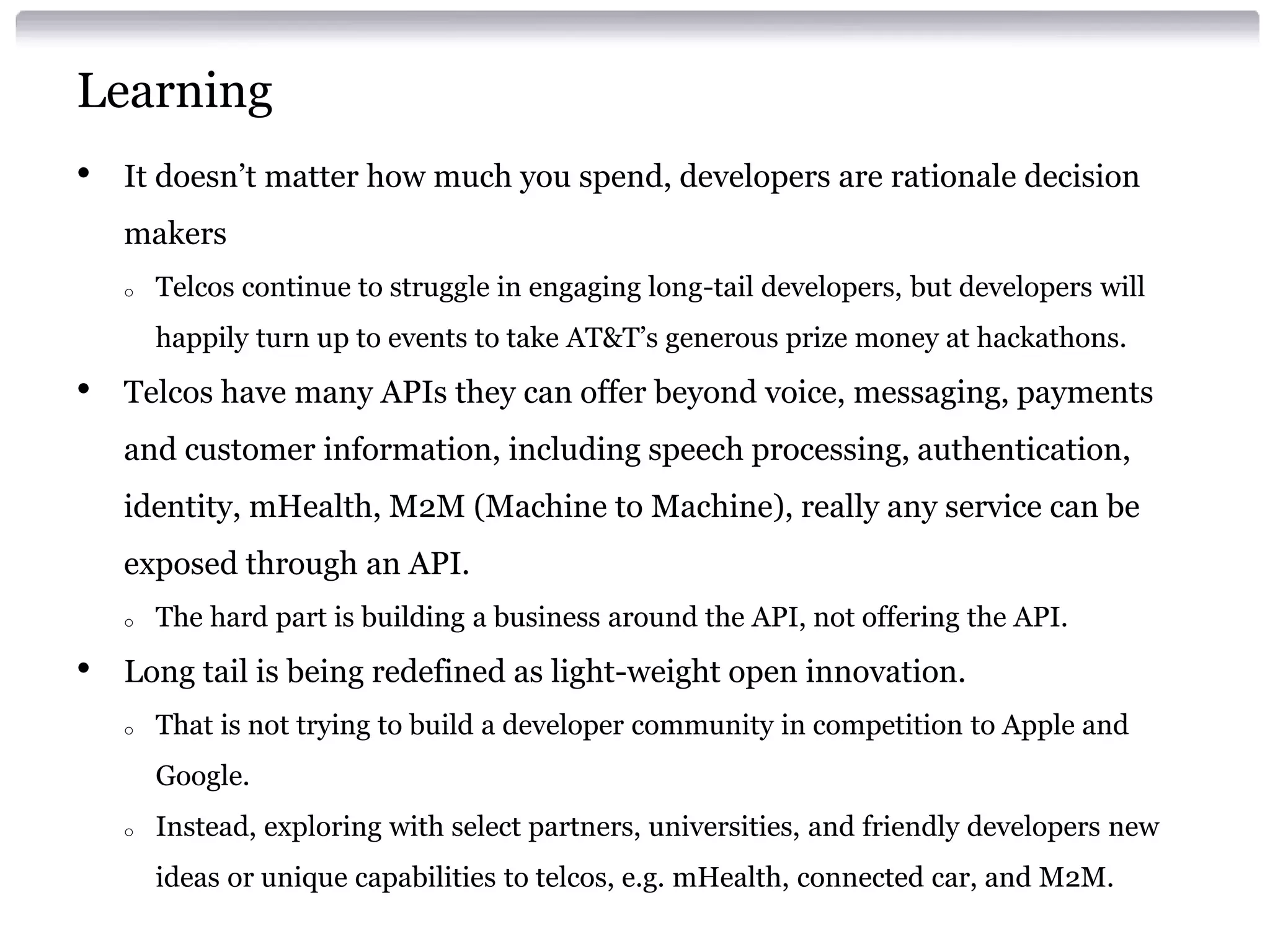
Learning
•

It doesn’t matter how much you spend, developers are rationale decision
makers
o

Telcos continue to struggle in engaging long-tail developers, but developers will
happily turn up to events to take AT&T’s generous prize money at hackathons.

•

Telcos have many APIs they can offer beyond voice, messaging, payments

and customer information, including speech processing, authentication,
identity, mHealth, M2M (Machine to Machine), really any service can be
exposed through an API.
o

•

The hard part is building a business around the API, not offering the API.

Long tail is being redefined as light-weight open innovation.
o

That is not trying to build a developer community in competition to Apple and
Google.

o

Instead, exploring with select partners, universities, and friendly developers new
ideas or unique capabilities to telcos, e.g. mHealth, connected car, and M2M.
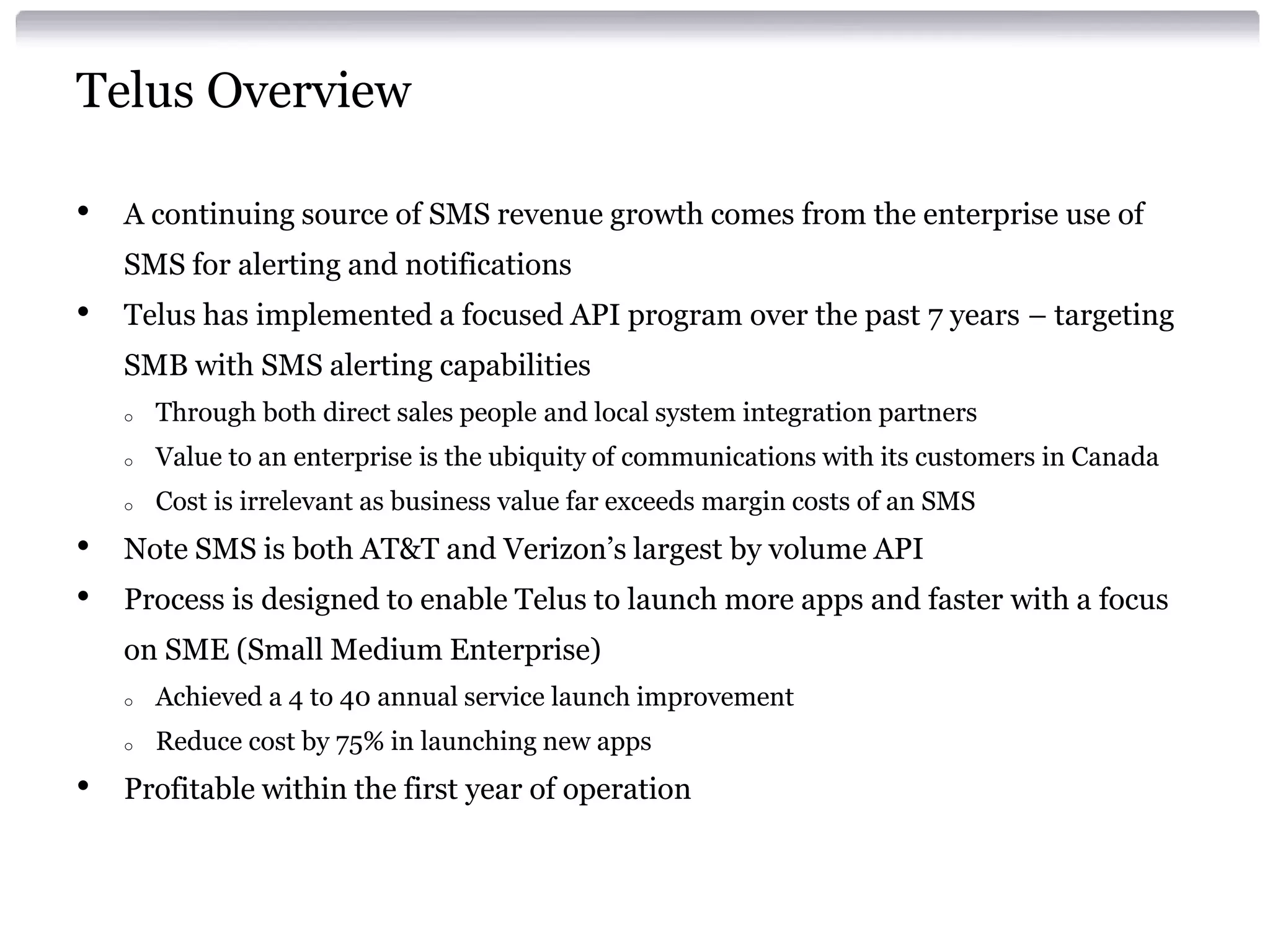
Telus Overview
•

A continuing source of SMS revenue growth comes from the enterprise use of

SMS for alerting and notifications

•

Telus has implemented a focused API program over the past 7 years – targeting
SMB with SMS alerting capabilities
o
o

Value to an enterprise is the ubiquity of communications with its customers in Canada

o

•
•

Through both direct sales people and local system integration partners
Cost is irrelevant as business value far exceeds margin costs of an SMS

Note SMS is both AT&T and Verizon’s largest by volume API
Process is designed to enable Telus to launch more apps and faster with a focus
on SME (Small Medium Enterprise)
o
o

•

Achieved a 4 to 40 annual service launch improvement
Reduce cost by 75% in launching new apps

Profitable within the first year of operation
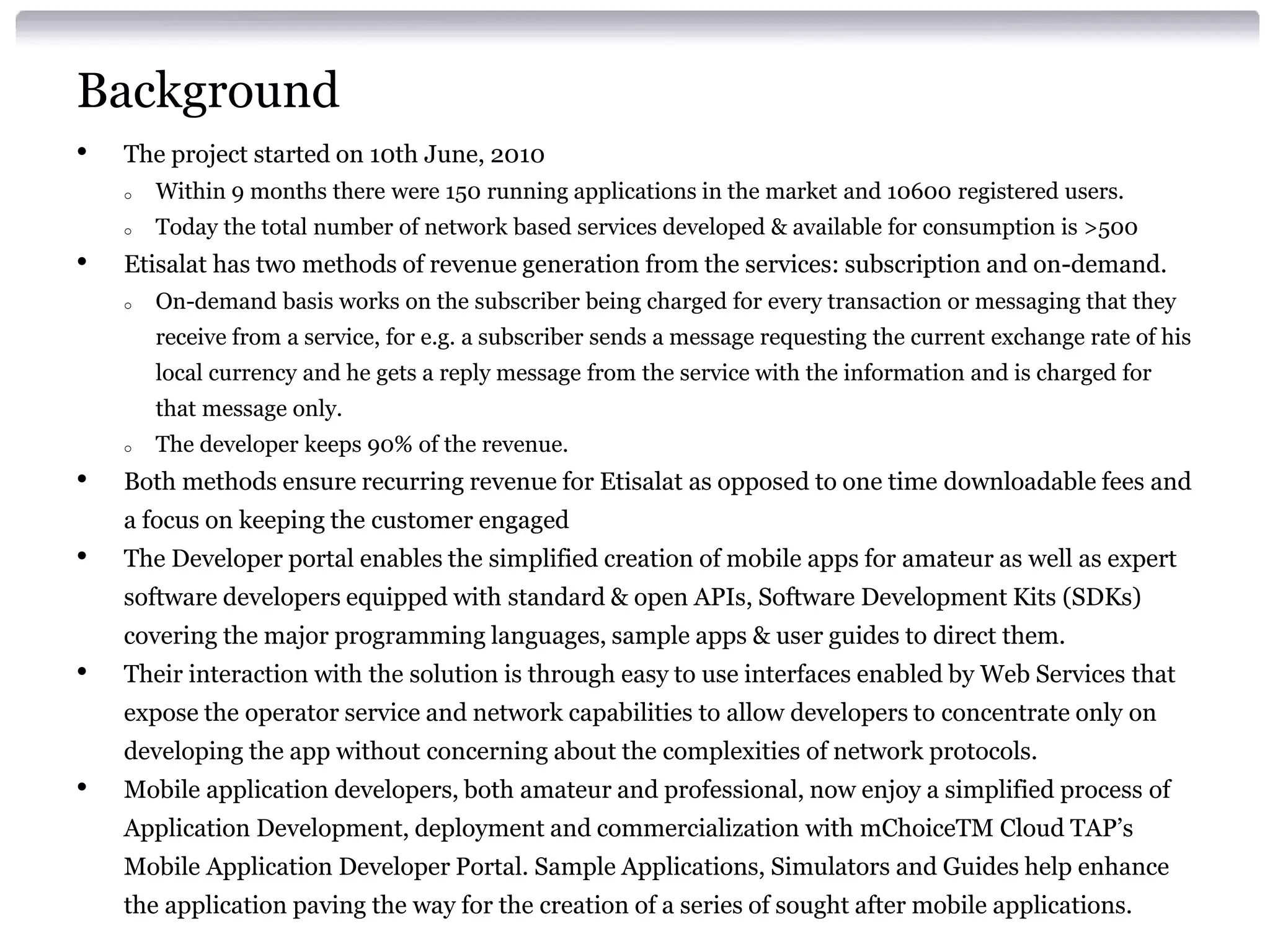
Background
•

The project started on 10th June, 2010
o
o

•

Within 9 months there were 150 running applications in the market and 10600 registered users.
Today the total number of network based services developed & available for consumption is >500

Etisalat has two methods of revenue generation from the services: subscription and on-demand.
o

On-demand basis works on the subscriber being charged for every transaction or messaging that they
receive from a service, for e.g. a subscriber sends a message requesting the current exchange rate of his
local currency and he gets a reply message from the service with the information and is charged for
that message only.

o

•

The developer keeps 90% of the revenue.

Both methods ensure recurring revenue for Etisalat as opposed to one time downloadable fees and
a focus on keeping the customer engaged

•

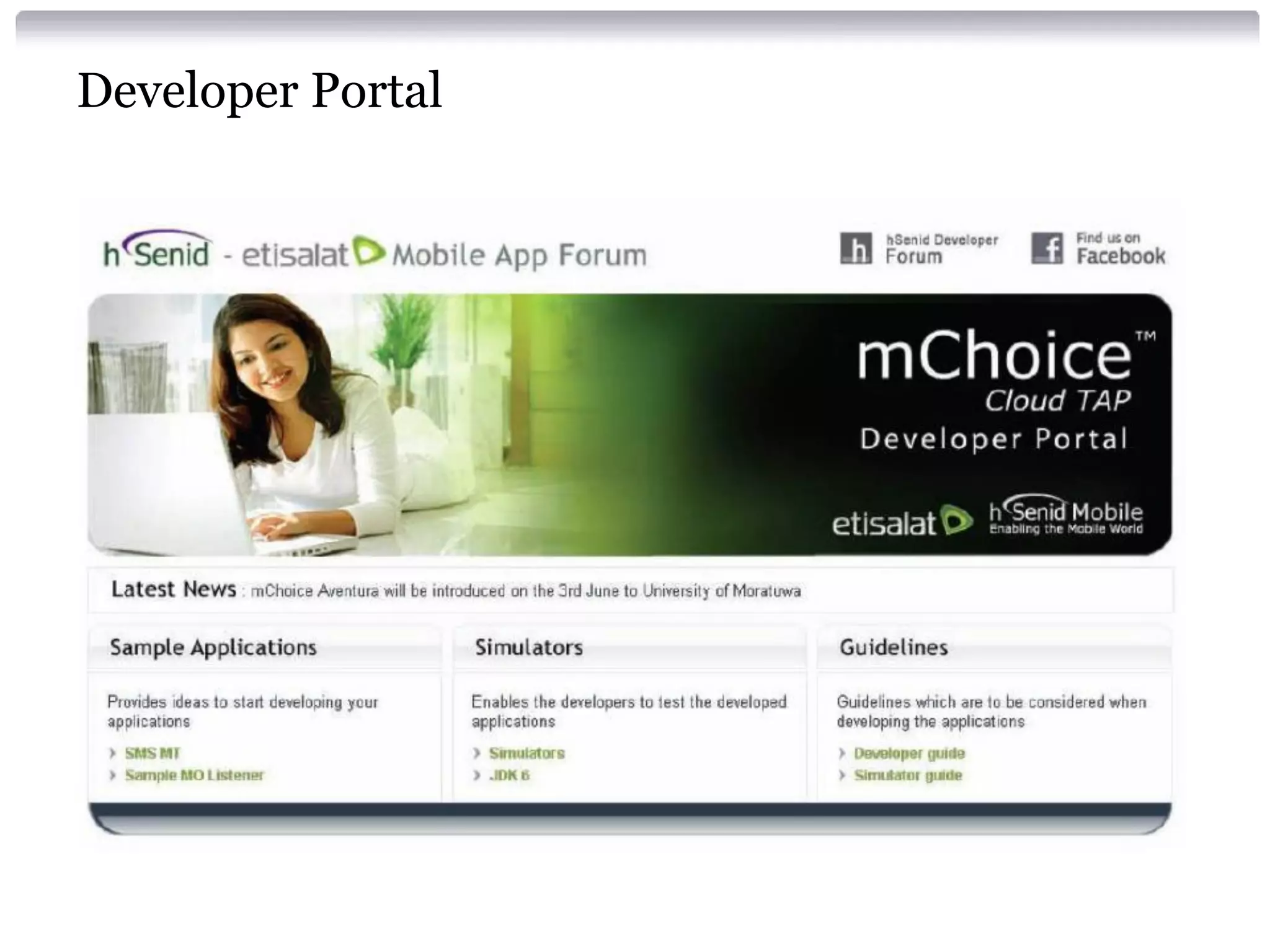
The Developer portal enables the simplified creation of mobile apps for amateur as well as expert

software developers equipped with standard & open APIs, Software Development Kits (SDKs)
covering the major programming languages, sample apps & user guides to direct them.

•

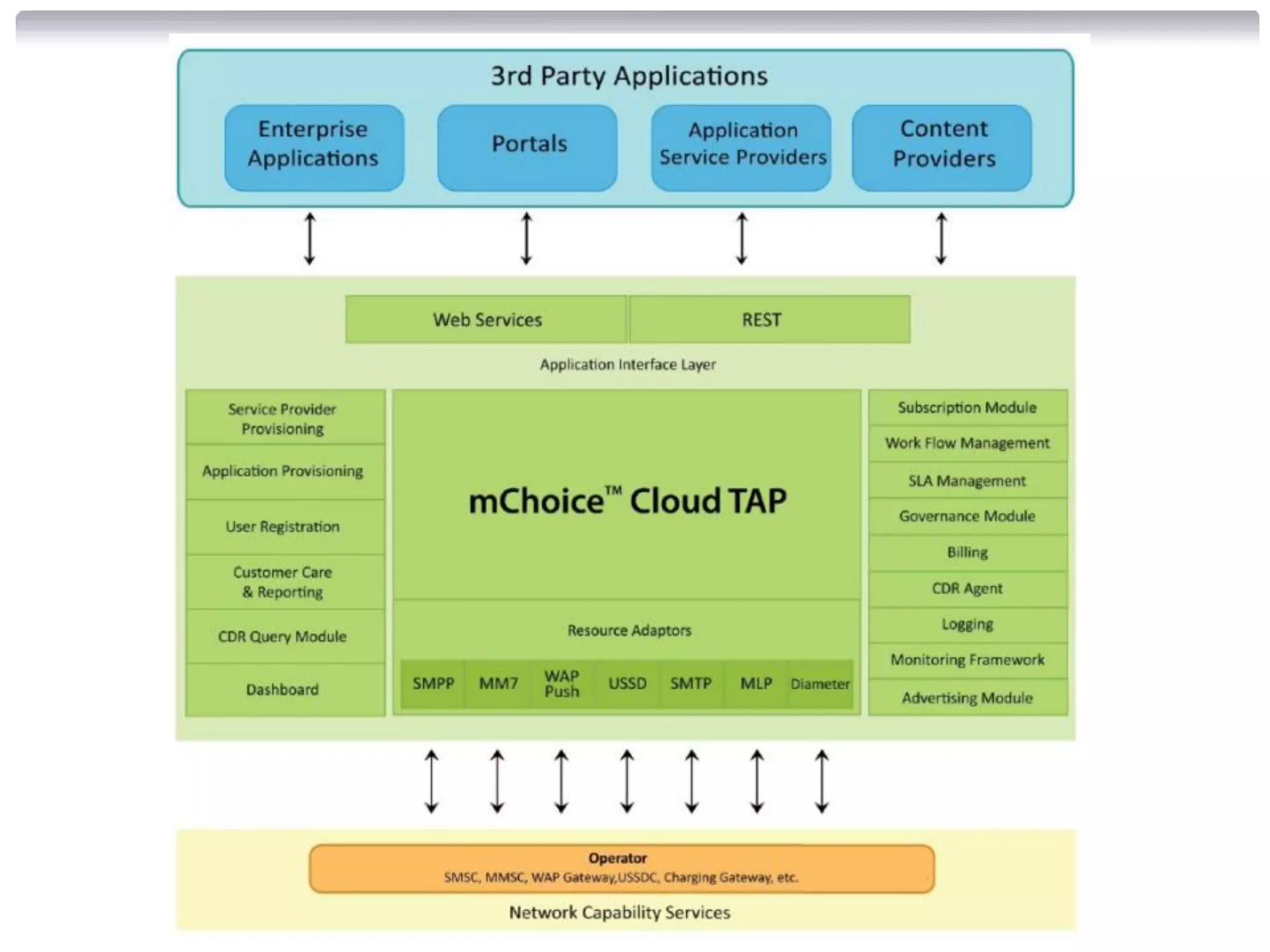
Their interaction with the solution is through easy to use interfaces enabled by Web Services that
expose the operator service and network capabilities to allow developers to concentrate only on
developing the app without concerning about the complexities of network protocols.

•

Mobile application developers, both amateur and professional, now enjoy a simplified process of
Application Development, deployment and commercialization with mChoiceTM Cloud TAP’s
Mobile Application Developer Portal. Sample Applications, Simulators and Guides help enhance
the application paving the way for the creation of a series of sought after mobile applications.
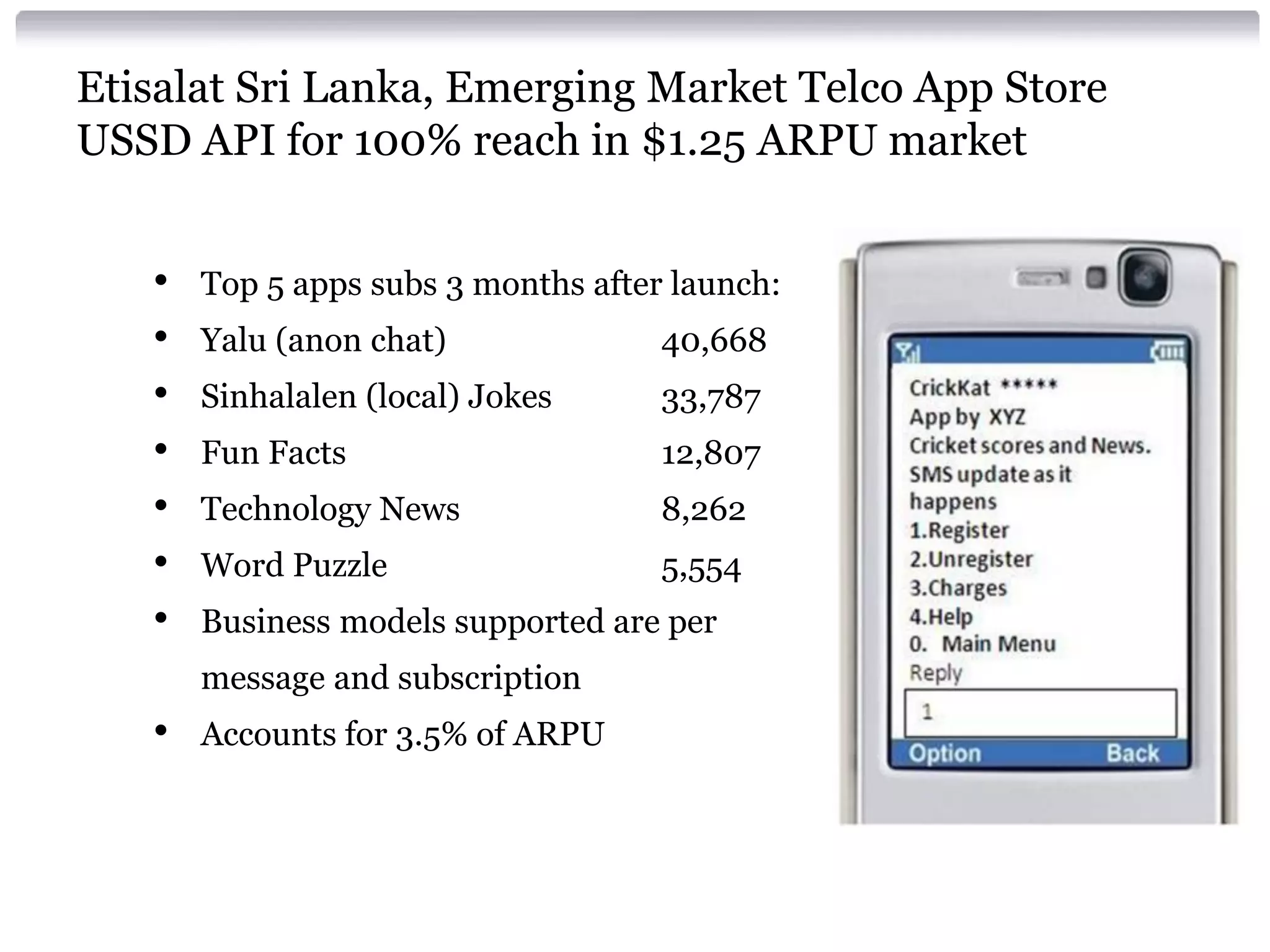
Etisalat Sri Lanka, Emerging Market Telco App Store
USSD API for 100% reach in $1.25 ARPU market
•
•
•
•
•
•
•

Top 5 apps subs 3 months after launch:
Yalu (anon chat)

40,668

Sinhalalen (local) Jokes

33,787

Fun Facts

12,807

Technology News

8,262

Word Puzzle

5,554

Business models supported are per
message and subscription

•

Accounts for 3.5% of ARPU
Developer Portal
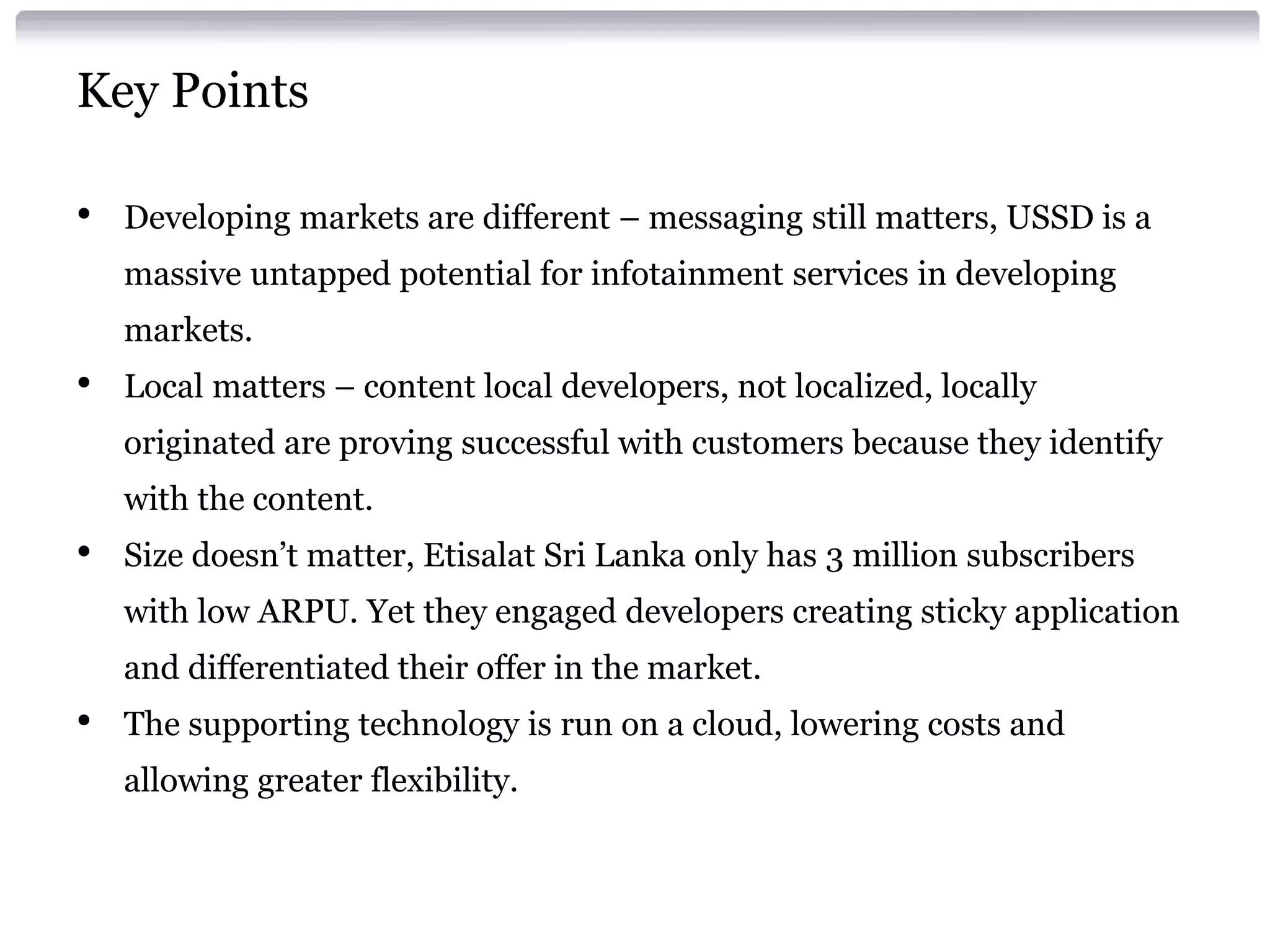
Key Points
•

Developing markets are different – messaging still matters, USSD is a

massive untapped potential for infotainment services in developing
markets.

•

Local matters – content local developers, not localized, locally

originated are proving successful with customers because they identify
with the content.

•

Size doesn’t matter, Etisalat Sri Lanka only has 3 million subscribers

with low ARPU. Yet they engaged developers creating sticky application
and differentiated their offer in the market.

•

The supporting technology is run on a cloud, lowering costs and

allowing greater flexibility.
Telecom Italia Graphic
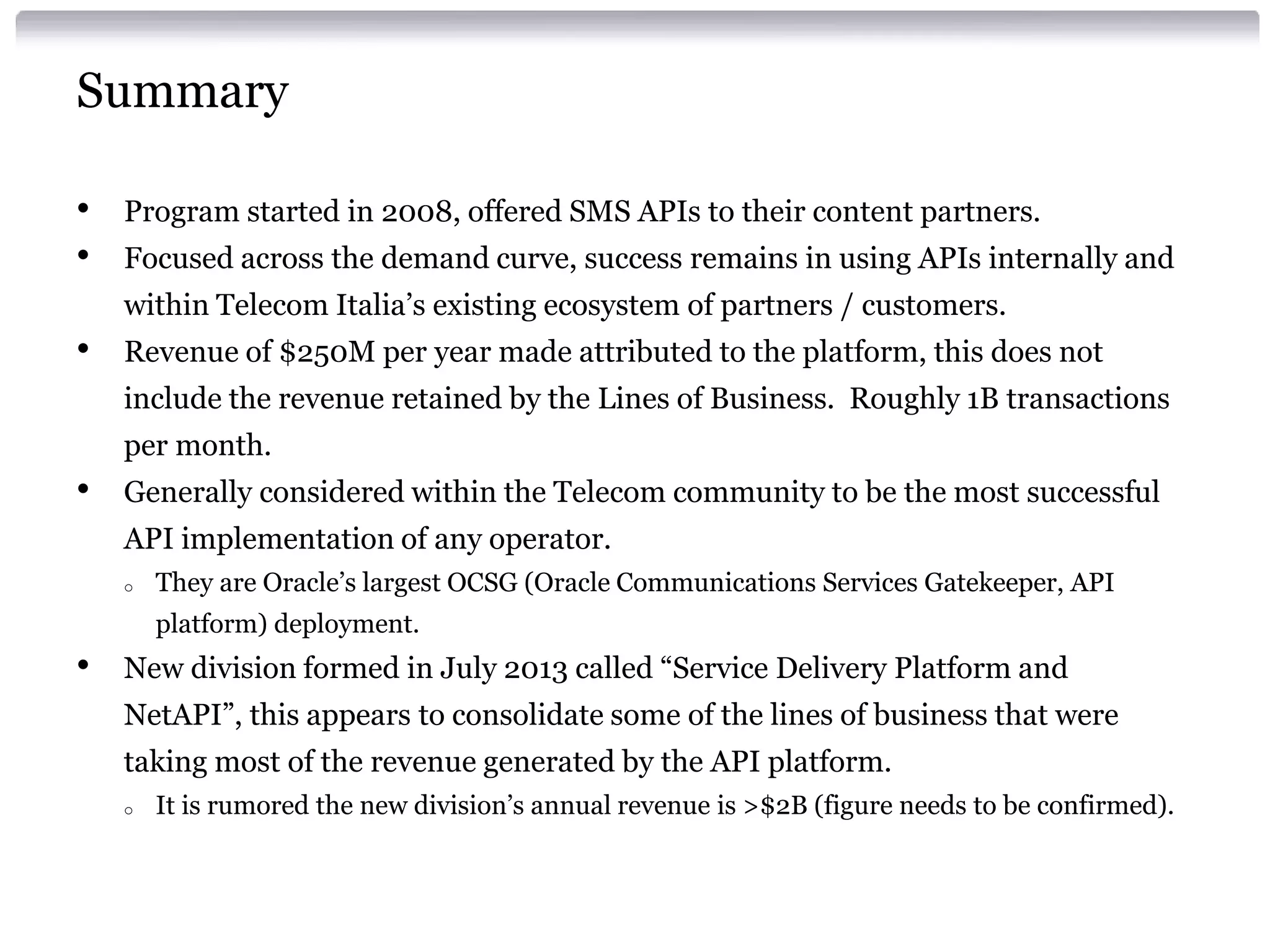
Summary
•
•

Program started in 2008, offered SMS APIs to their content partners.

Focused across the demand curve, success remains in using APIs internally and
within Telecom Italia’s existing ecosystem of partners / customers.

•

Revenue of $250M per year made attributed to the platform, this does not
include the revenue retained by the Lines of Business. Roughly 1B transactions

per month.

•

Generally considered within the Telecom community to be the most successful
API implementation of any operator.
o

They are Oracle’s largest OCSG (Oracle Communications Services Gatekeeper, API
platform) deployment.

•

New division formed in July 2013 called “Service Delivery Platform and
NetAPI”, this appears to consolidate some of the lines of business that were
taking most of the revenue generated by the API platform.
o

It is rumored the new division’s annual revenue is >$2B (figure needs to be confirmed).
Learning
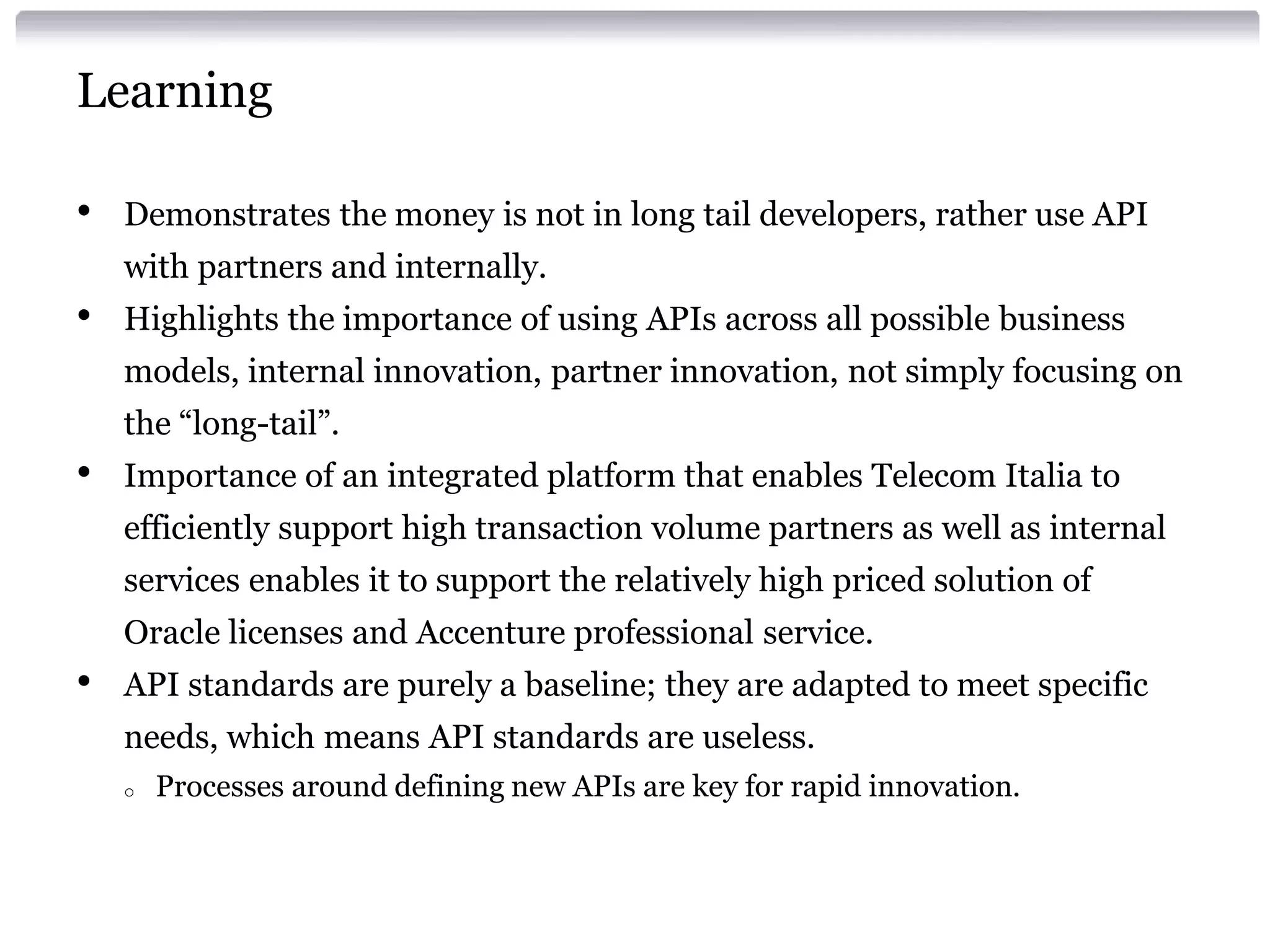
•

Demonstrates the money is not in long tail developers, rather use API

with partners and internally.

•

Highlights the importance of using APIs across all possible business
models, internal innovation, partner innovation, not simply focusing on

the “long-tail”.

•

Importance of an integrated platform that enables Telecom Italia to
efficiently support high transaction volume partners as well as internal
services enables it to support the relatively high priced solution of
Oracle licenses and Accenture professional service.

•

API standards are purely a baseline; they are adapted to meet specific
needs, which means API standards are useless.
o

Processes around defining new APIs are key for rapid innovation.
Telefonica Logo
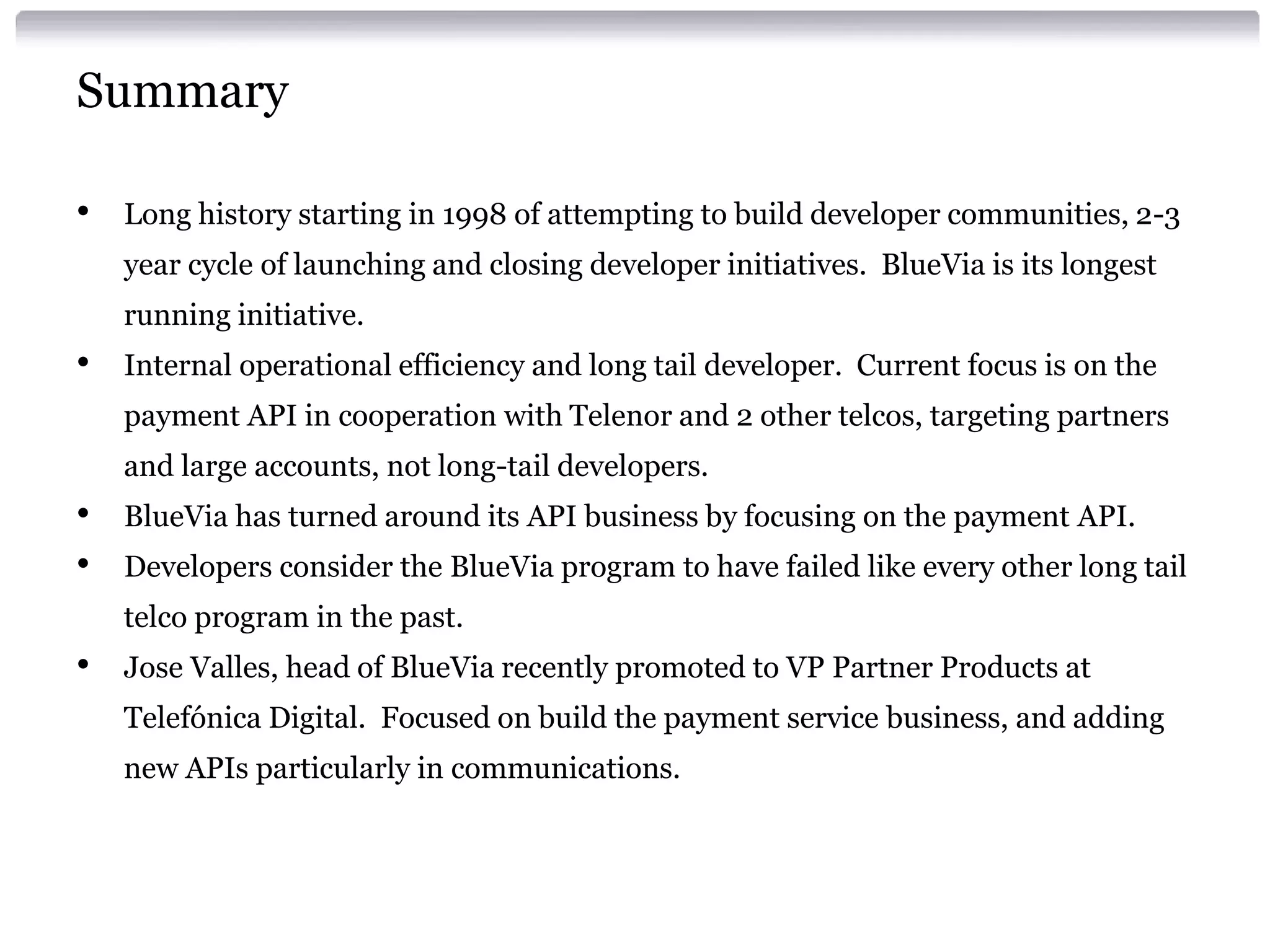
Summary
•

Long history starting in 1998 of attempting to build developer communities, 2-3

year cycle of launching and closing developer initiatives. BlueVia is its longest
running initiative.

•

Internal operational efficiency and long tail developer. Current focus is on the
payment API in cooperation with Telenor and 2 other telcos, targeting partners
and large accounts, not long-tail developers.

•
•

BlueVia has turned around its API business by focusing on the payment API.
Developers consider the BlueVia program to have failed like every other long tail

telco program in the past.

•

Jose Valles, head of BlueVia recently promoted to VP Partner Products at
Telefónica Digital. Focused on build the payment service business, and adding
new APIs particularly in communications.
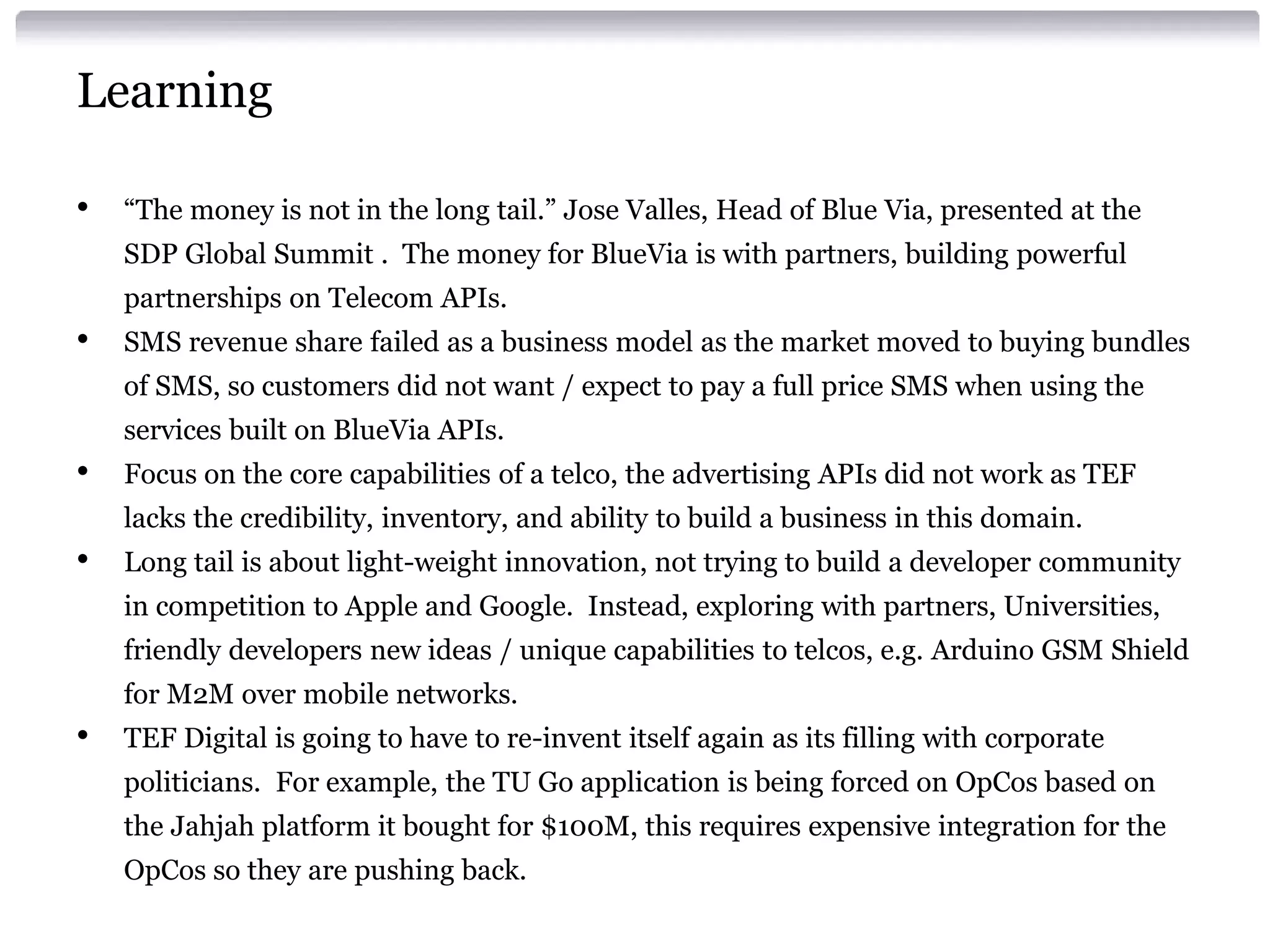
Learning
•

“The money is not in the long tail.” Jose Valles, Head of Blue Via, presented at the
SDP Global Summit . The money for BlueVia is with partners, building powerful
partnerships on Telecom APIs.

•

SMS revenue share failed as a business model as the market moved to buying bundles
of SMS, so customers did not want / expect to pay a full price SMS when using the

services built on BlueVia APIs.

•

Focus on the core capabilities of a telco, the advertising APIs did not work as TEF
lacks the credibility, inventory, and ability to build a business in this domain.

•

Long tail is about light-weight innovation, not trying to build a developer community

in competition to Apple and Google. Instead, exploring with partners, Universities,
friendly developers new ideas / unique capabilities to telcos, e.g. Arduino GSM Shield
for M2M over mobile networks.

•

TEF Digital is going to have to re-invent itself again as its filling with corporate

politicians. For example, the TU Go application is being forced on OpCos based on
the Jahjah platform it bought for $100M, this requires expensive integration for the
OpCos so they are pushing back.
Verizon Logo
Learning
•
•

Copy Tropo or Twilio if you want to compete in the US in communications APIs.

Don’t chase long tail developers in the back yard of Apple and Google
o

Focus on businesses that need to run on Telecom APIs, or using APIs within your
existing ecosystem (Internally and with partners)

•

Operators cannot credibly engage the long-tail, need to focus of specific
technologies or domains, e.g. in M2M with relevant M2M companies, it’s a more
a focused open innovation model.

•

OneAPI is not relevant to long-tail developers, and looks archaic compared to

modern well-written APIs.

•

Money is not in the APIs, 1c per location dip required 100 million dips a month
to make $1M and no developer will pay 1c location these days.
o

The money is in the services and solutions enabled by APIs.
Mapping graphic
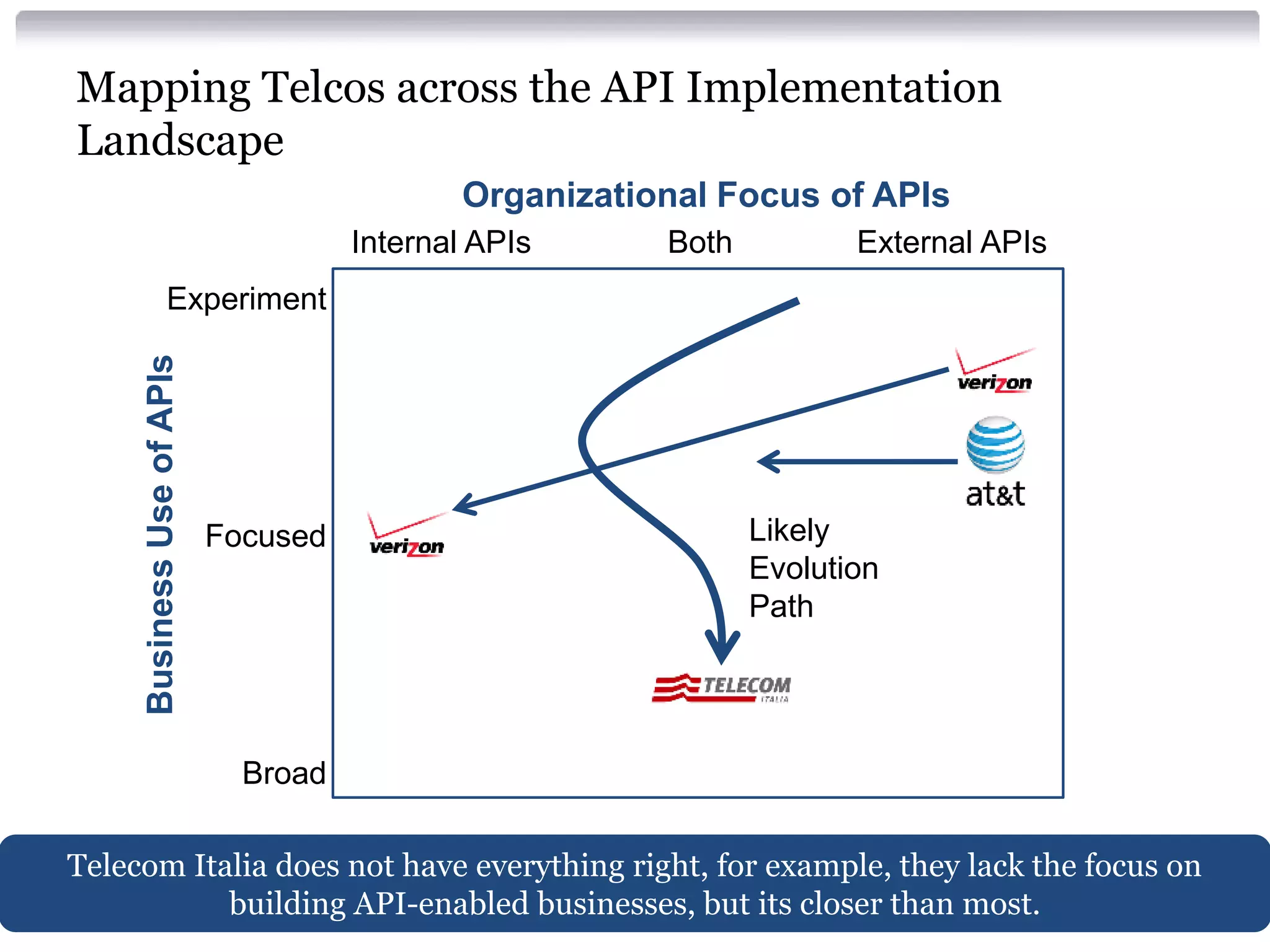
Mapping Telcos across the API Implementation
Landscape
Organizational Focus of APIs
Internal APIs

Both

External APIs

Business Use of APIs

Experiment

Focused

Likely
Evolution
Path

Broad
Telecom Italia does not have everything right, for example, they lack the focus on
building API-enabled businesses, but its closer than most.
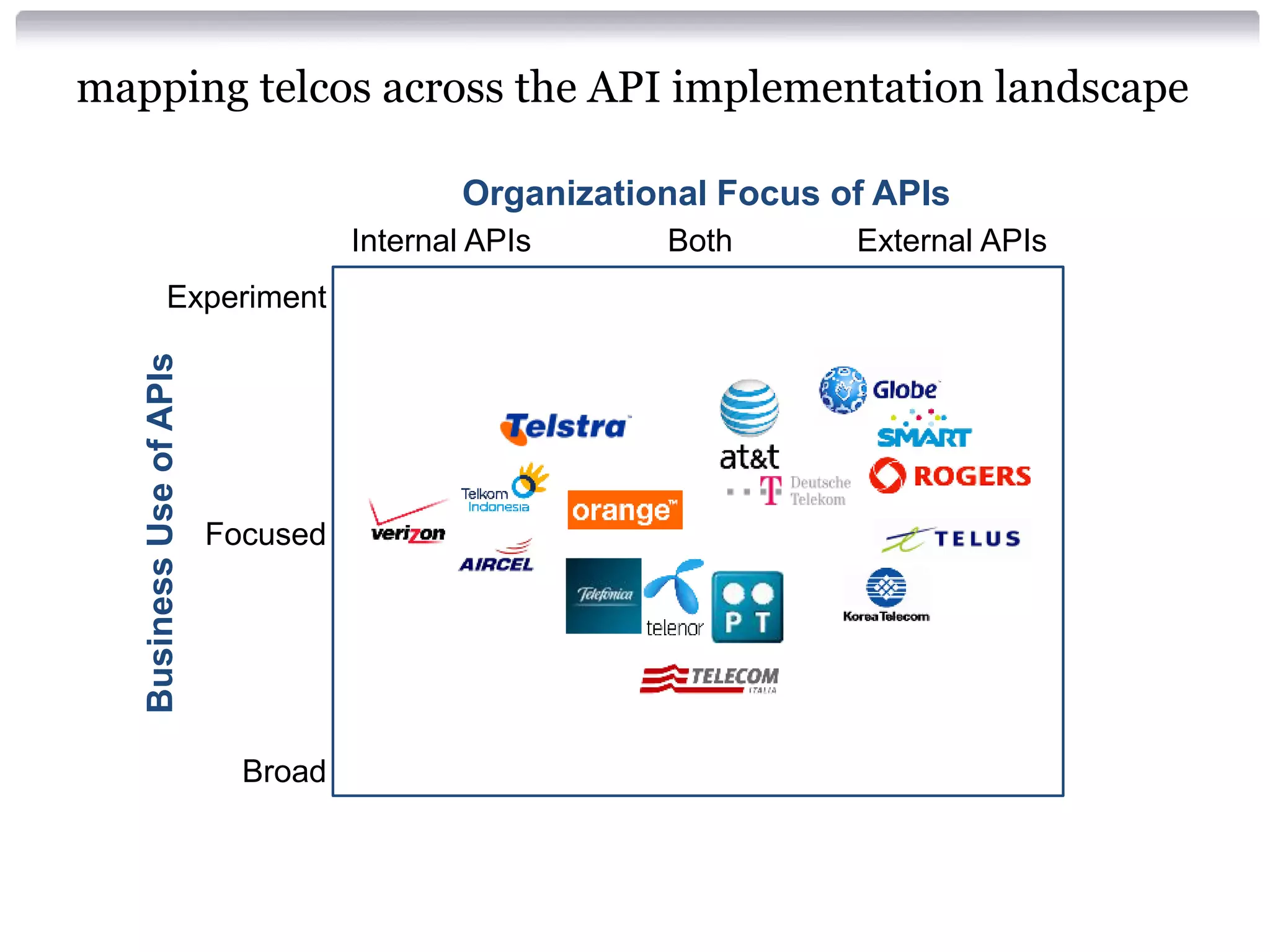
mapping telcos across the API implementation landscape
Organizational Focus of APIs
Internal APIs

Business Use of APIs

Experiment

Focused

Broad

Both

External APIs
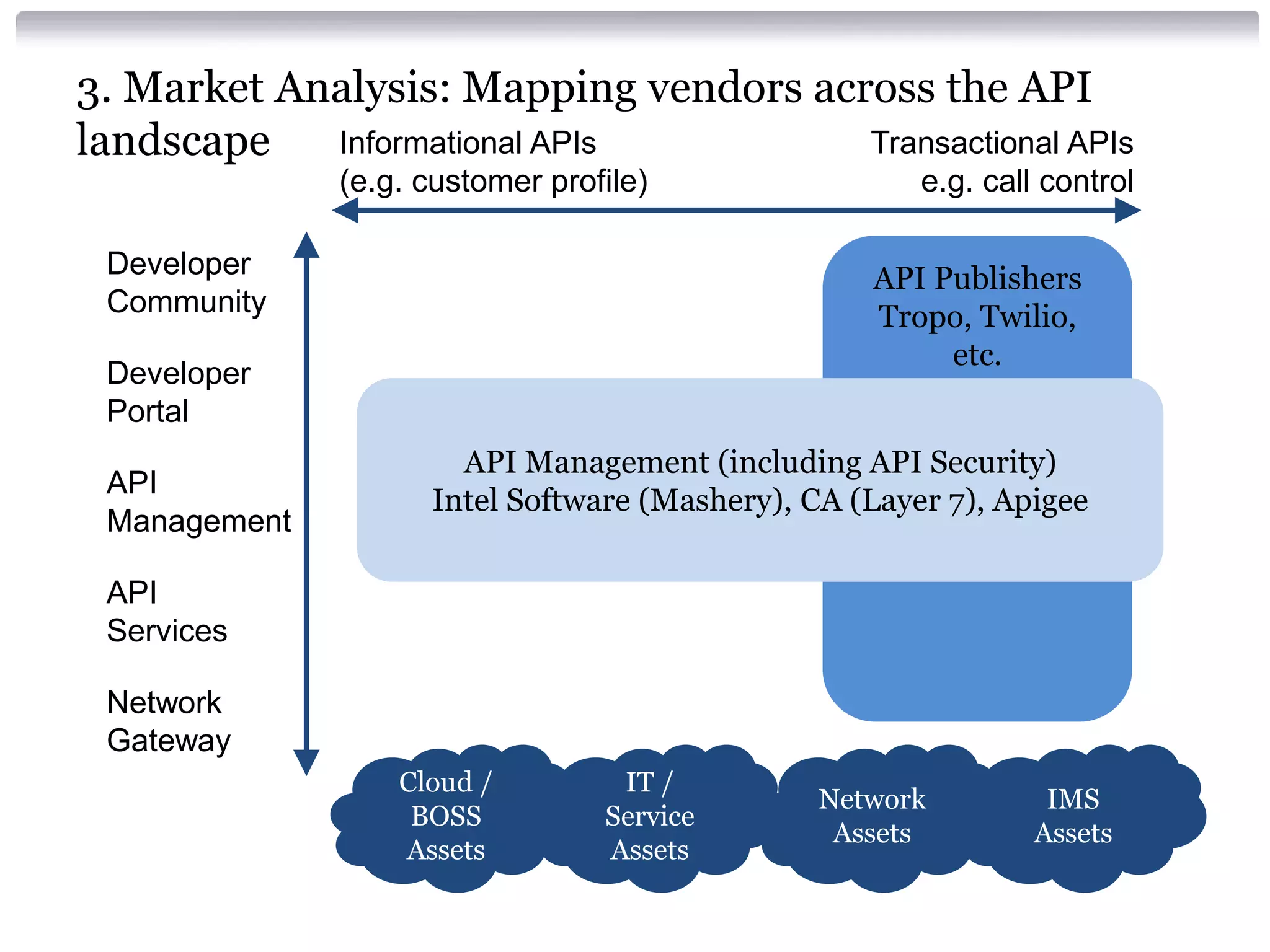
3. Market Analysis: Mapping vendors across the API
Informational APIs
Transactional APIs
landscape
(e.g. customer profile)

Developer
Community

API Publishers
Tropo, Twilio,
etc.

Developer
Portal
API
Management

e.g. call control

API Management (including API Security)
Intel Software (Mashery), CA (Layer 7), Apigee

API
Services
Network
Gateway
Cloud /
BOSS
Assets

IT /
Service
Assets

Network
Assets

IMS
Assets
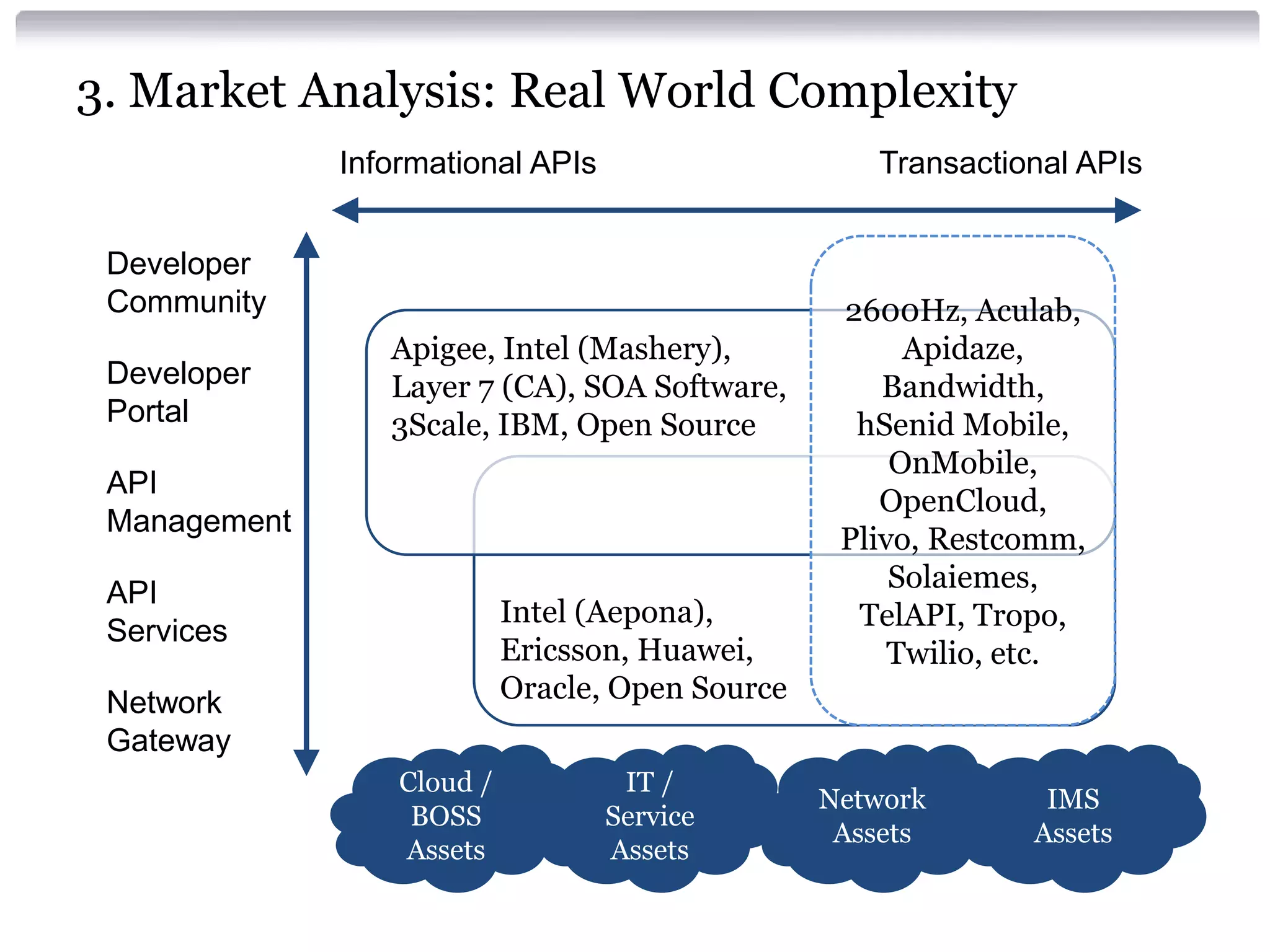
3. Market Analysis: Real World Complexity
Informational APIs

Transactional APIs

Developer
Community
Developer
Portal

Apigee, Intel (Mashery),
Layer 7 (CA), SOA Software,
3Scale, IBM, Open Source

API
Management
API
Services

Intel (Aepona),
Ericsson, Huawei,
Oracle, Open Source

Network
Gateway
Cloud /
BOSS
Assets

IT /
Service
Assets

2600Hz, Aculab,
Apidaze,
Bandwidth,
hSenid Mobile,
OnMobile,
OpenCloud,
Plivo, Restcomm,
Solaiemes,
TelAPI, Tropo,
Twilio, etc.

Network
Assets

IMS
Assets
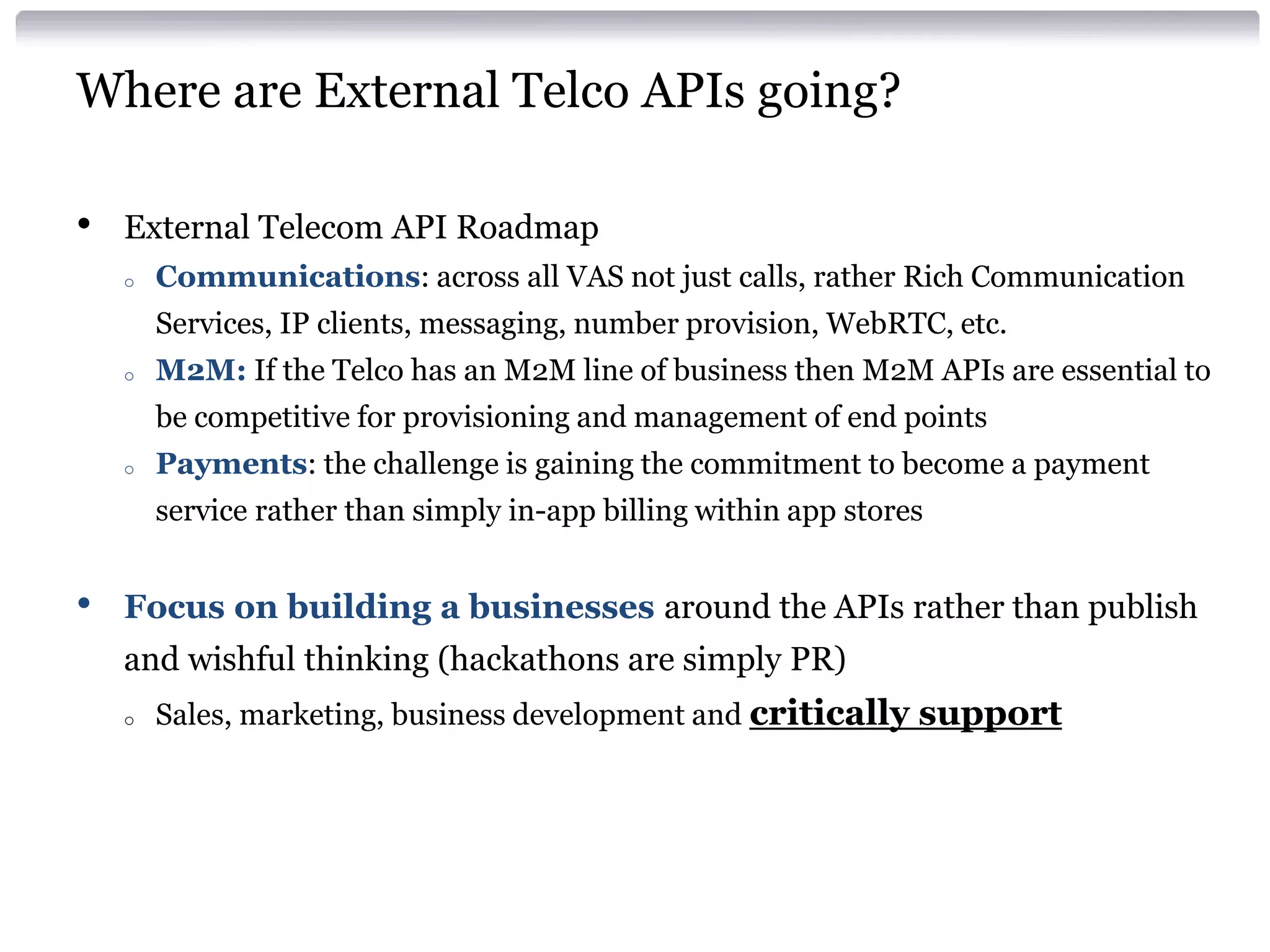
Where are External Telco APIs going?
•

External Telecom API Roadmap
o

Communications: across all VAS not just calls, rather Rich Communication
Services, IP clients, messaging, number provision, WebRTC, etc.

o

M2M: If the Telco has an M2M line of business then M2M APIs are essential to
be competitive for provisioning and management of end points

o

Payments: the challenge is gaining the commitment to become a payment
service rather than simply in-app billing within app stores

•

Focus on building a businesses around the APIs rather than publish
and wishful thinking (hackathons are simply PR)
o

Sales, marketing, business development and critically support
Brown-Nosed
Middle Manager!
Market Chatter
is Monopolized
Mobile
Everything,
WebRTC
Customers

Services
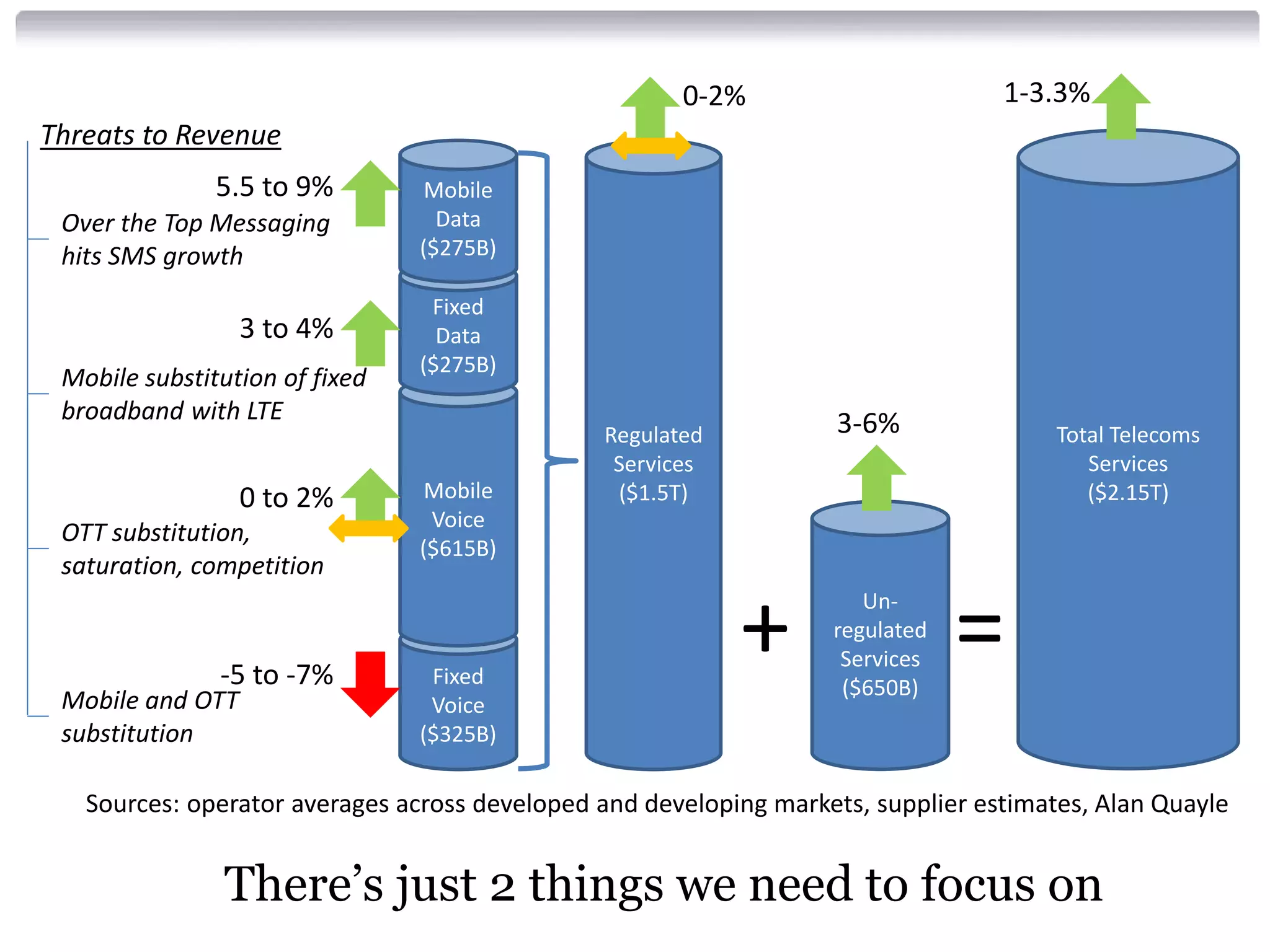
1-3.3%

0-2%
Threats to Revenue
5.5 to 9%
Over the Top Messaging
hits SMS growth

3 to 4%
Mobile substitution of fixed
broadband with LTE

0 to 2%
OTT substitution,
saturation, competition

-5 to -7%

Mobile and OTT
substitution

Mobile
Data
($275B)
Fixed
Data
($275B)

Mobile
Voice
($615B)

Fixed
Voice
($325B)

3-6%

Regulated
Services
($1.5T)

+

Unregulated
Services
($650B)

Total Telecoms
Services
($2.15T)

=

Sources: operator averages across developed and developing markets, supplier estimates, Alan Quayle

There’s just 2 things we need to focus on
Make Telecoms an Essential Spice for every Business Recipe
Do more VAS!
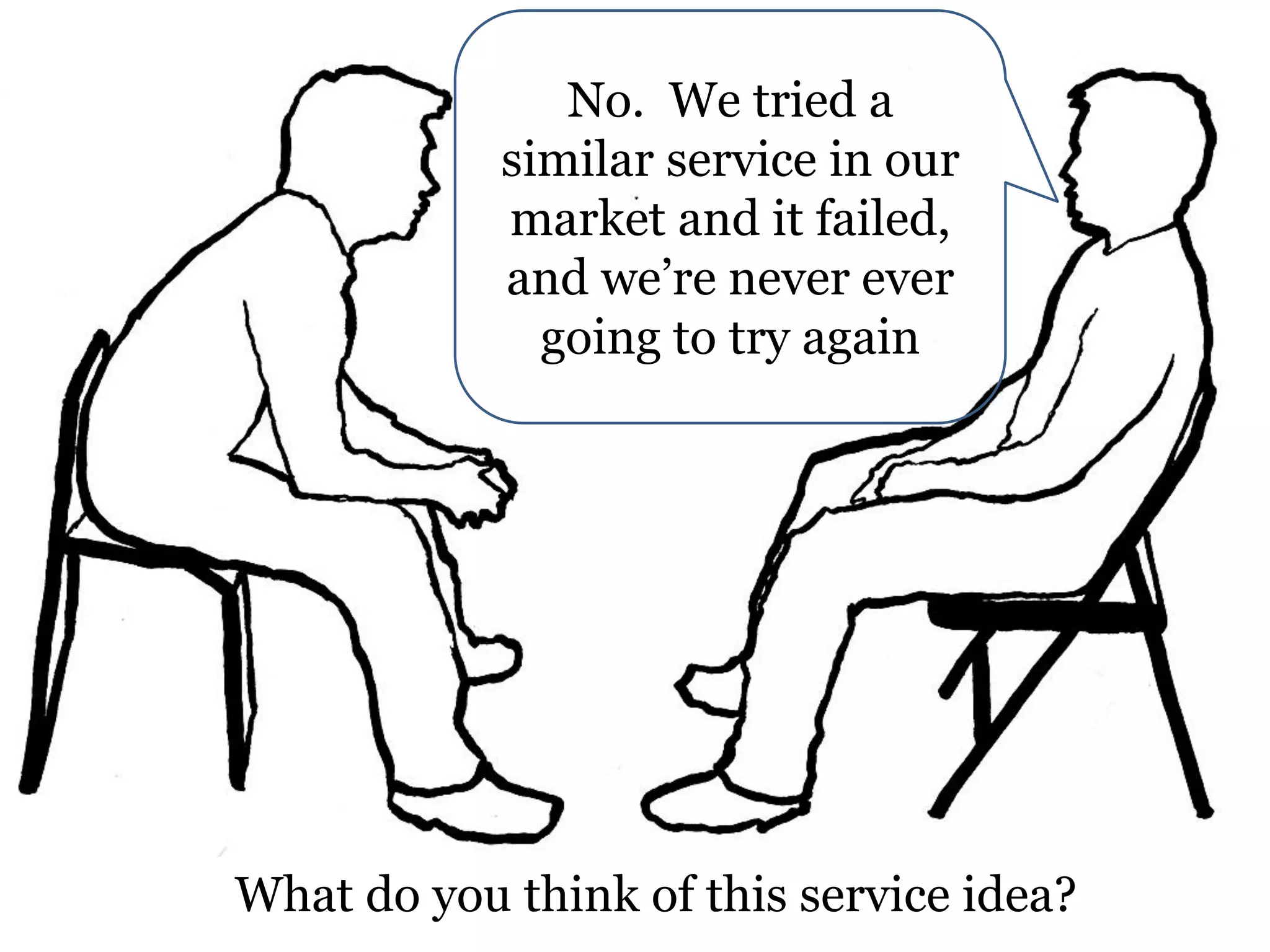
No. We tried a
similar service in our
market and it failed,
and we’re never ever
going to try again

What do you think of this service idea?
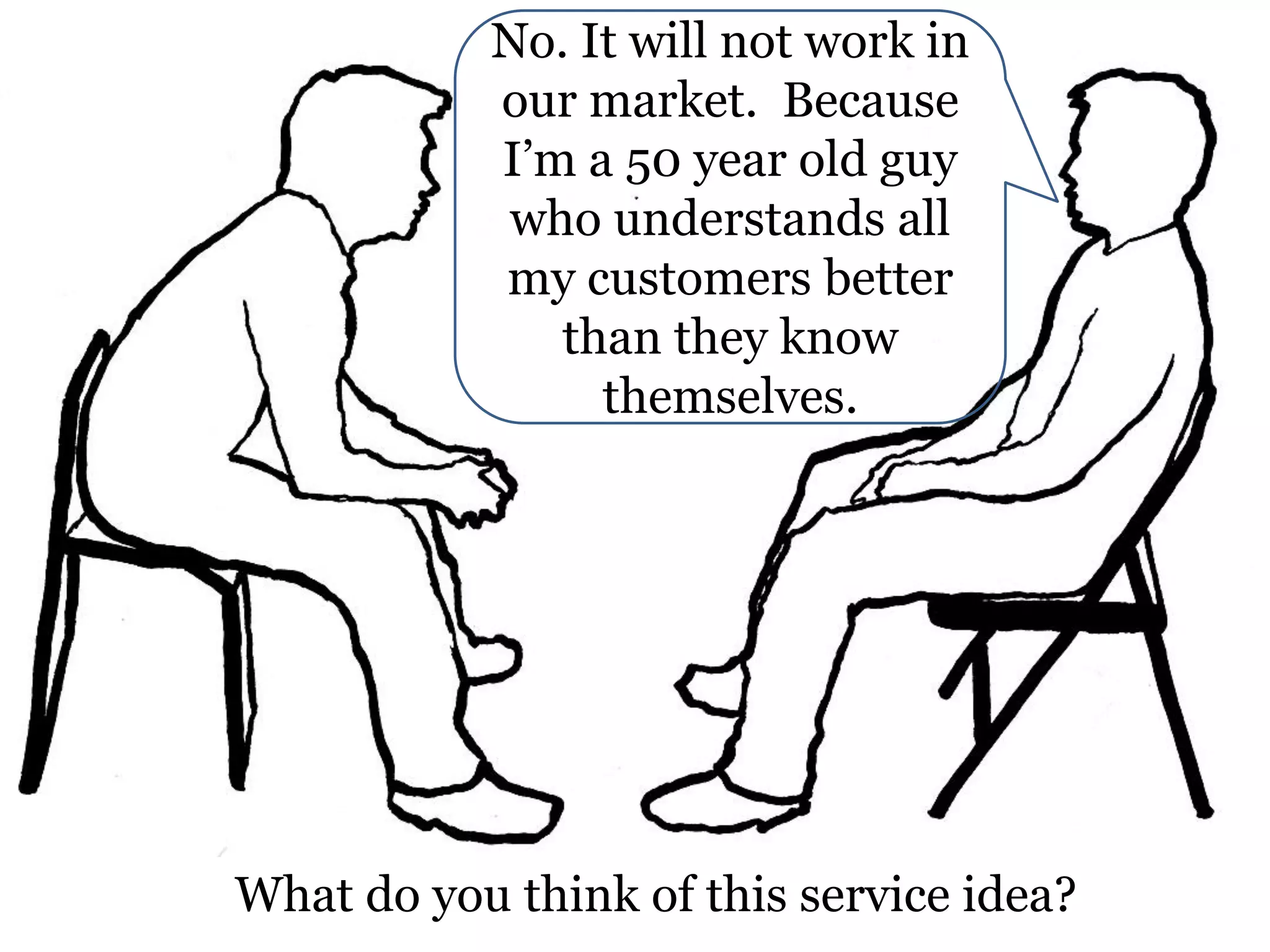
No. It will not work in
our market. Because
I’m a 50 year old guy
who understands all
my customers better
than they know
themselves.

What do you think of this service idea?
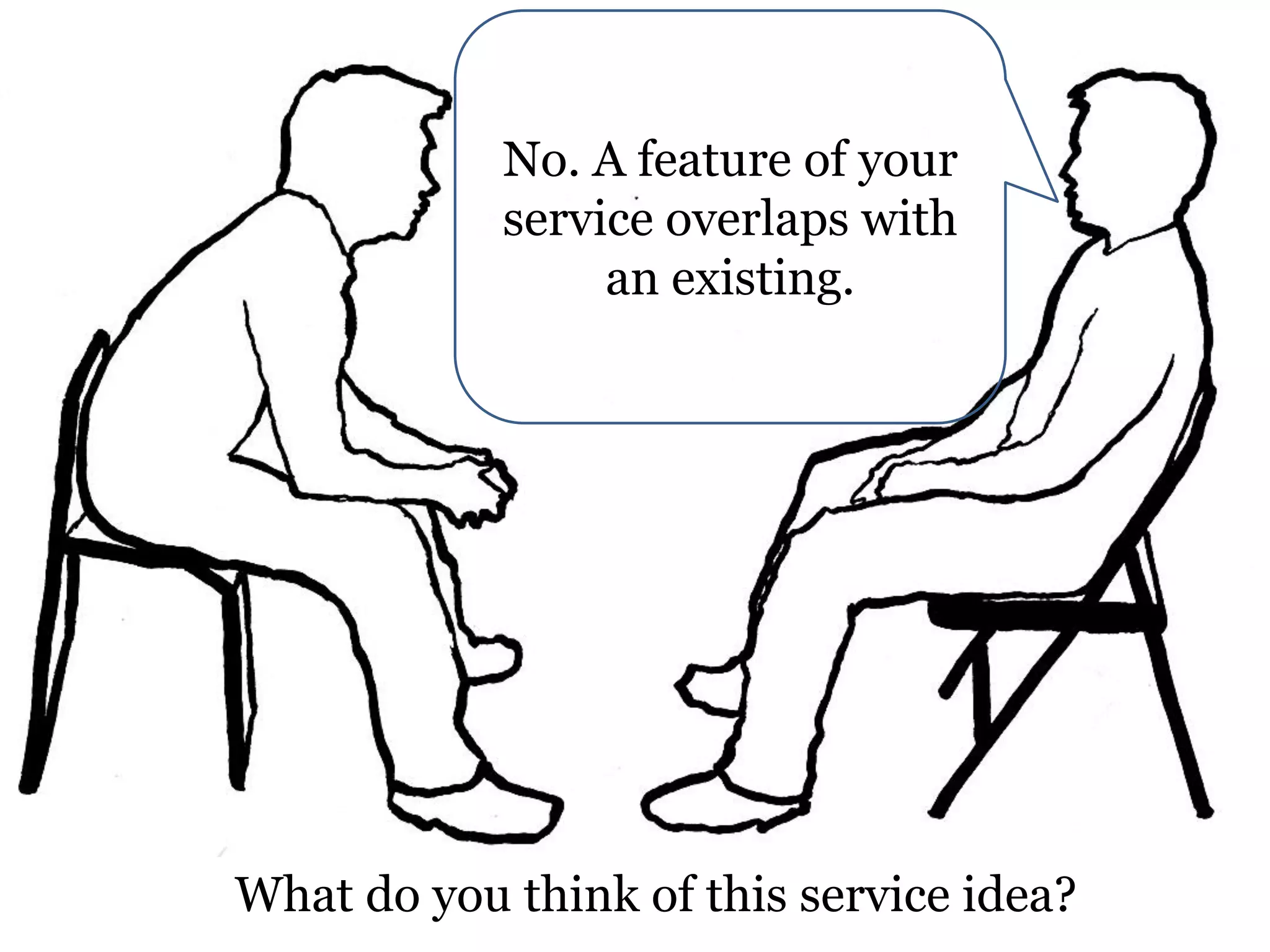
No. A feature of your
service overlaps with
an existing.

What do you think of this service idea?
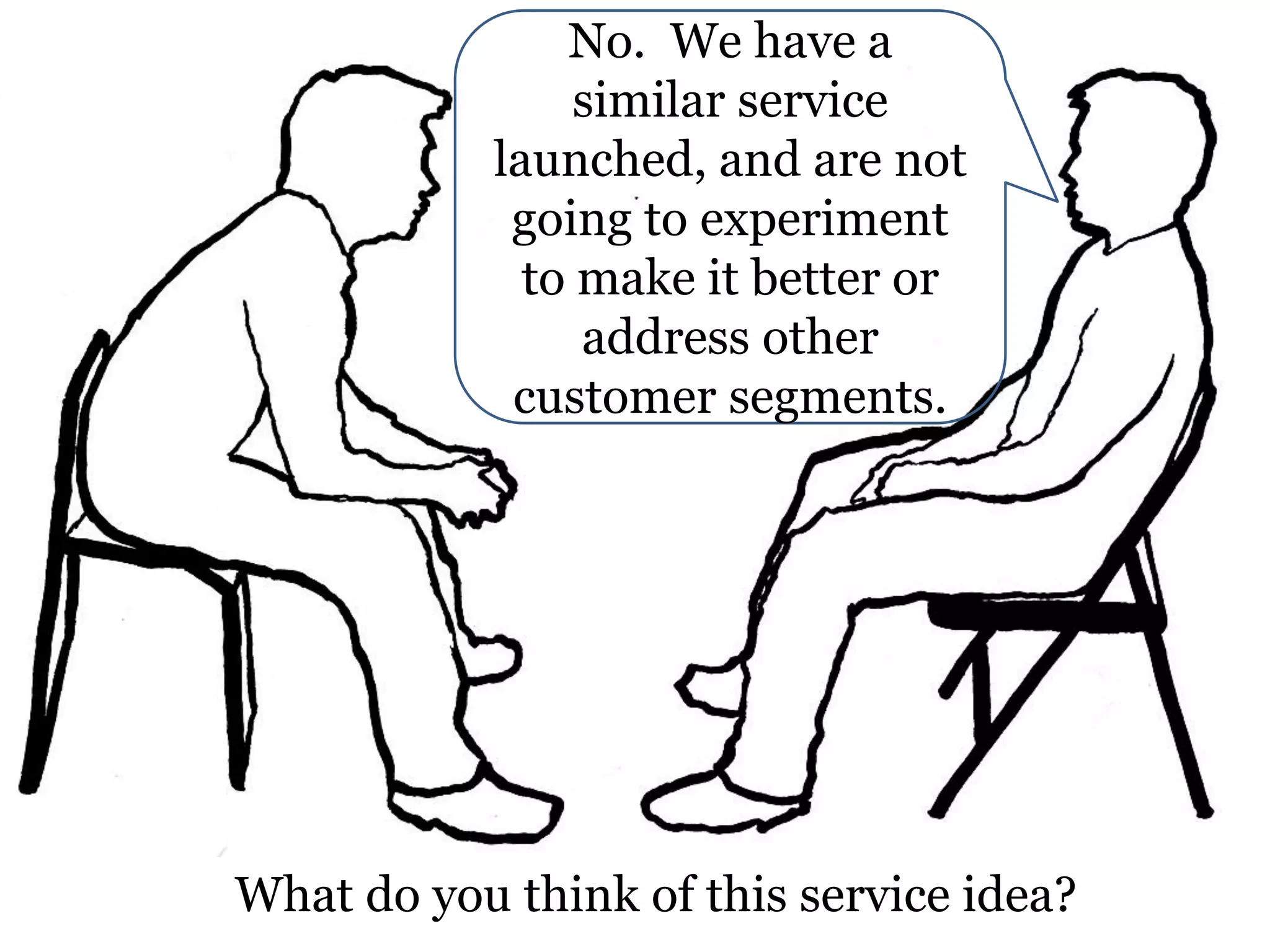
No. We have a
similar service
launched, and are not
going to experiment
to make it better or
address other
customer segments.

What do you think of this service idea?
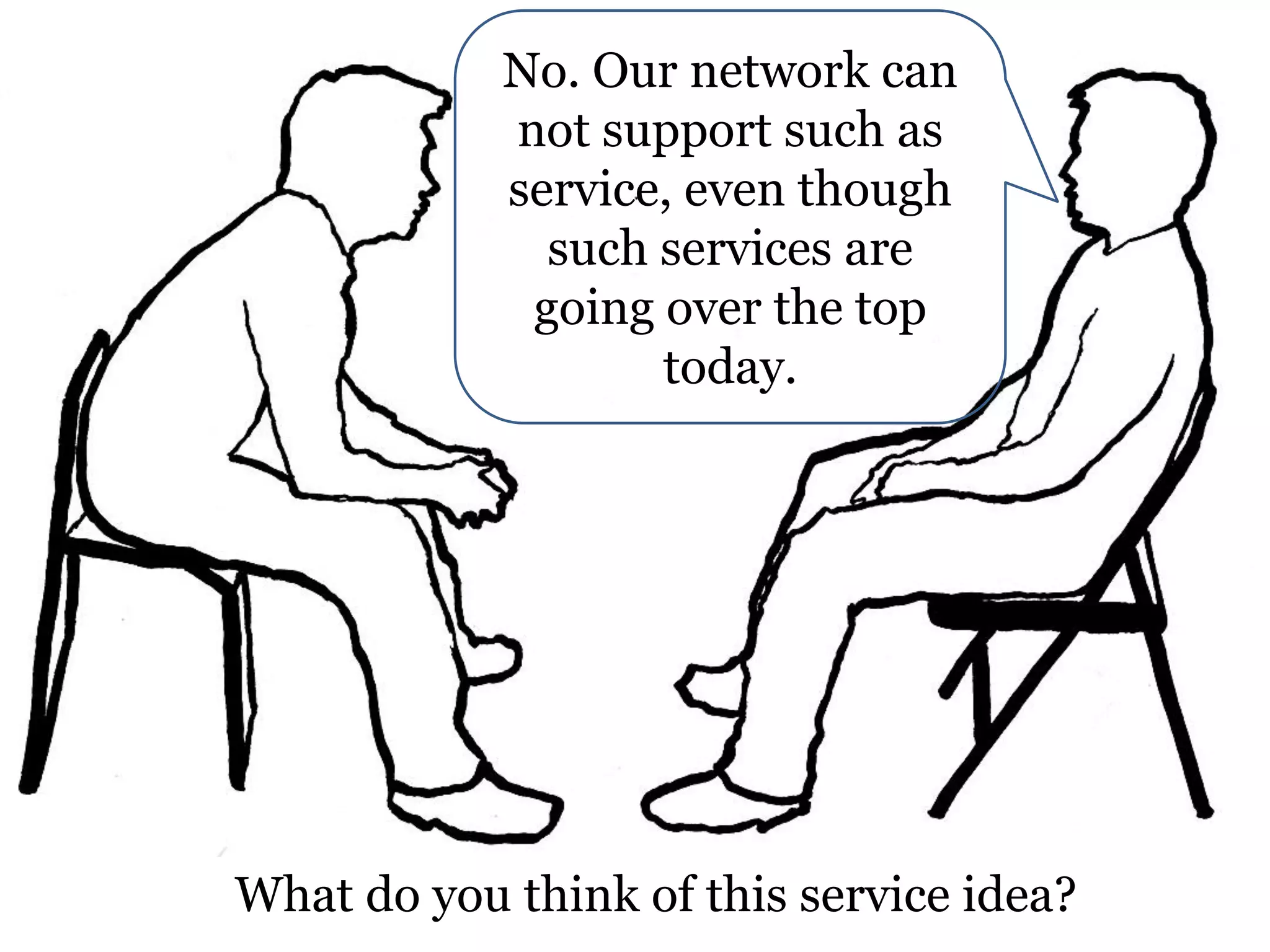
No. Our network can
not support such as
service, even though
such services are
going over the top
today.

What do you think of this service idea?
No. It looks a bit like
Joyn, we’re not sure
about it, but because
it looks a bit like
something we may do
in the future we’re not
going to do it.

What do you think of this service idea?
No. It must work
across all devices,
even though most
devices will never use
it.

What do you think of this service idea?
No. We need
additional (random)
features included
before we could
consider it.

What do you think of this service idea?
No. It must work on
IMS (even though it
doesn’t need to).

What do you think of this service idea?
No. It must work
across all our
customers from day
one, even though
most will never use it.

What do you think of this service idea?
No. It must conform
to our process and
design norms. But
we’re not going to tell
you what they are.

What do you think of this service idea?
No. It must integrate
with all our existing
platforms, even
though it can work
fine in the current
configuration.

What do you think of this service idea?
No. It must be
delivered through our
preferred SI or NEP,
who will copy / kill
the service
immediately.

What do you think of this service idea?
No. You must work
through our app store
/ portal, which we’re
in the process of
closing.

What do you think of this service idea?
No. We can only focus on
4 service launches per
year. We only back major
successes like Video
Telephony, Mobile TV,
Push To Talk, See What I
See…

What do you think of this service idea?
No. We just don’t
have the bandwidth,
to do our job.

What do you think of this service idea?
No. We have a
network lock-down as
we launch LTE so
cannot do anything
for the next 6-9
month.

What do you think of this service idea?
No. Bob has left the
business and we’re
waiting on his
replacement, who
never comes.

What do you think of this service idea?
No. We’re waiting on
annual budgets to be
confirmed, sometime
in the next 6-12
months.

What do you think of this service idea?
No. We’re reorganizing again this
year.

What do you think of this service idea?
No. Someone in the
organization doesn’t
like such services.

What do you think of this service idea?
No. That cannot be
implemented without
changing our IN /
product catalog /
CRM / billing /
network.

What do you think of this service idea?
No. We cannot bill /
sell services under $5
per month.

What do you think of this service idea?
No. We have a
backlog of 24 months
on billing updates,
even though the
service doesn’t need
to be in that pipeline.

What do you think of this service idea?
No. You must work
through our
innovation group who
we all hate and ignore
as they’re parasites on
our business.

What do you think of this service idea?
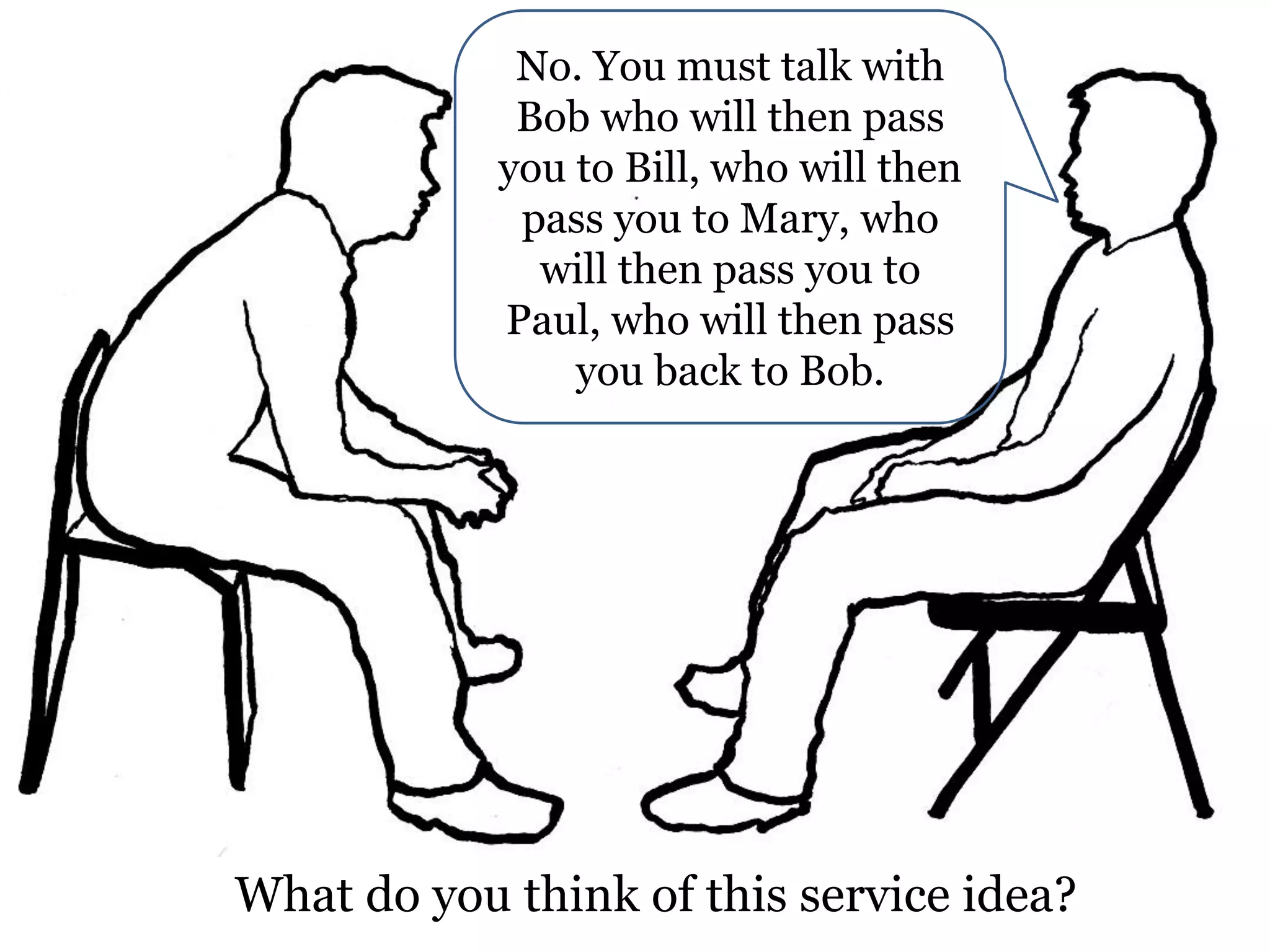
No. You must talk with
Bob who will then pass
you to Bill, who will then
pass you to Mary, who
will then pass you to
Paul, who will then pass
you back to Bob.

What do you think of this service idea?
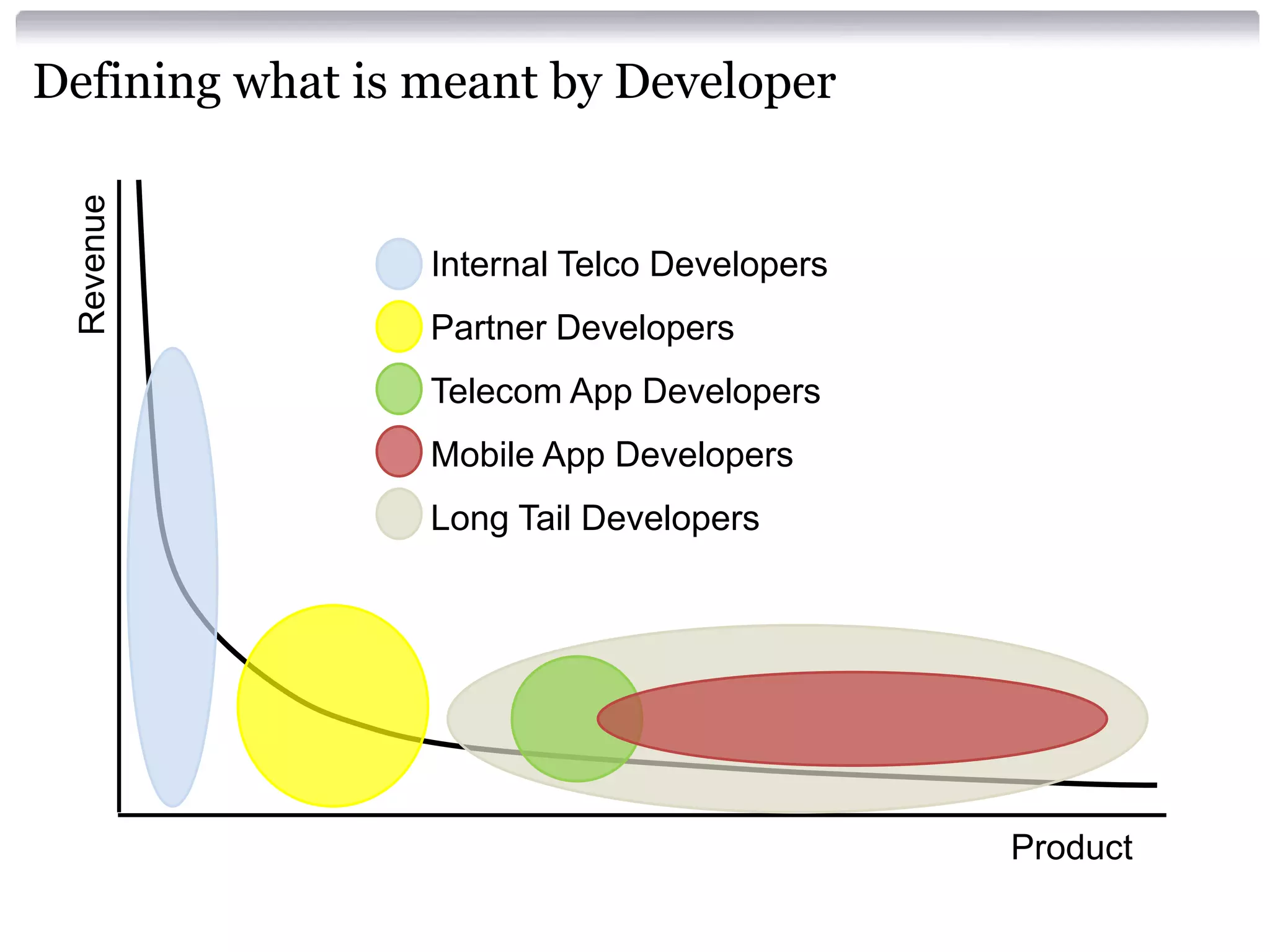
Revenue

Defining what is meant by Developer

Internal Telco Developers
Partner Developers
Telecom App Developers
Mobile App Developers

Long Tail Developers

Product
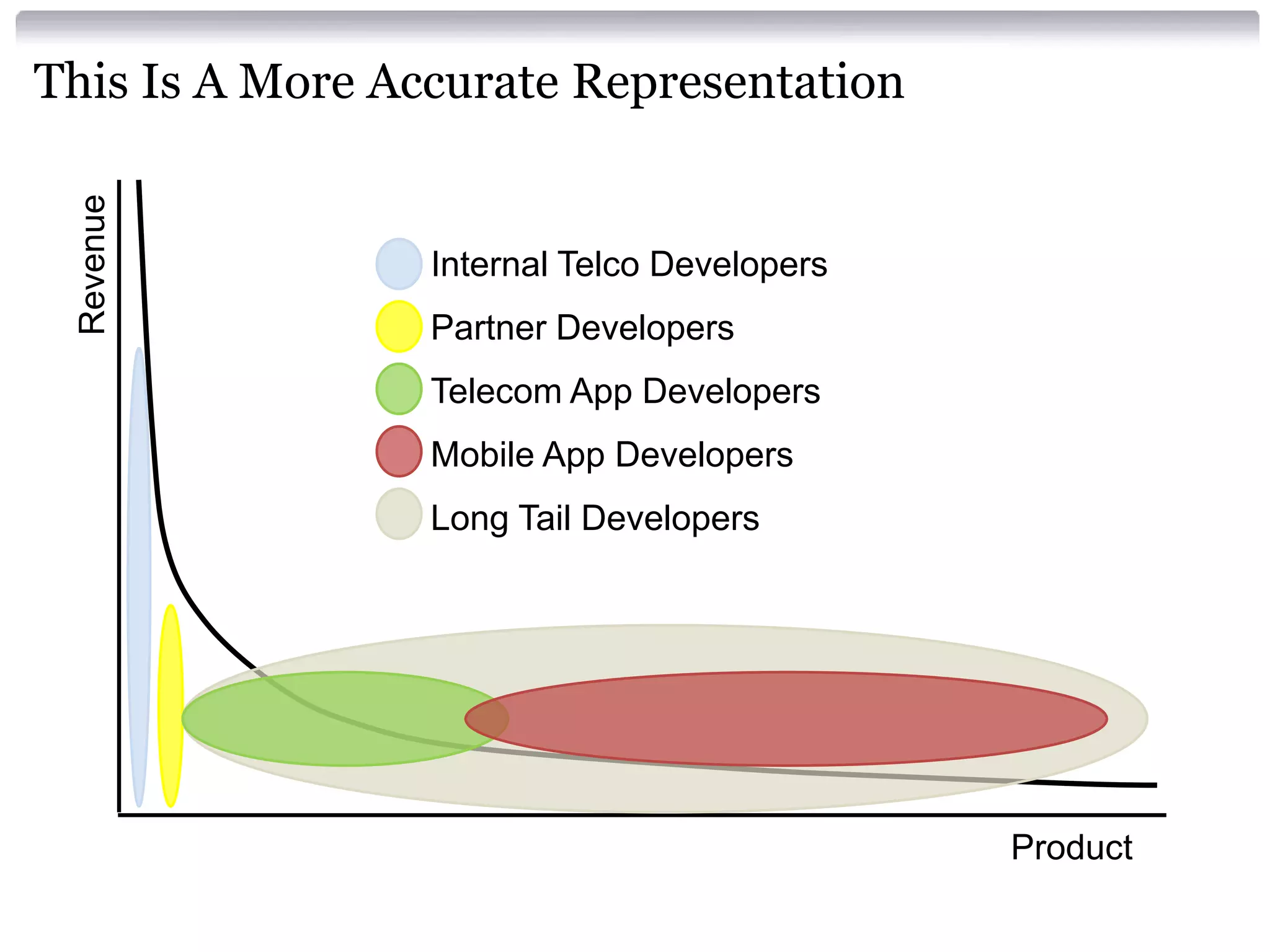
Revenue

This Is A More Accurate Representation

Internal Telco Developers
Partner Developers
Telecom App Developers
Mobile App Developers

Long Tail Developers

Product
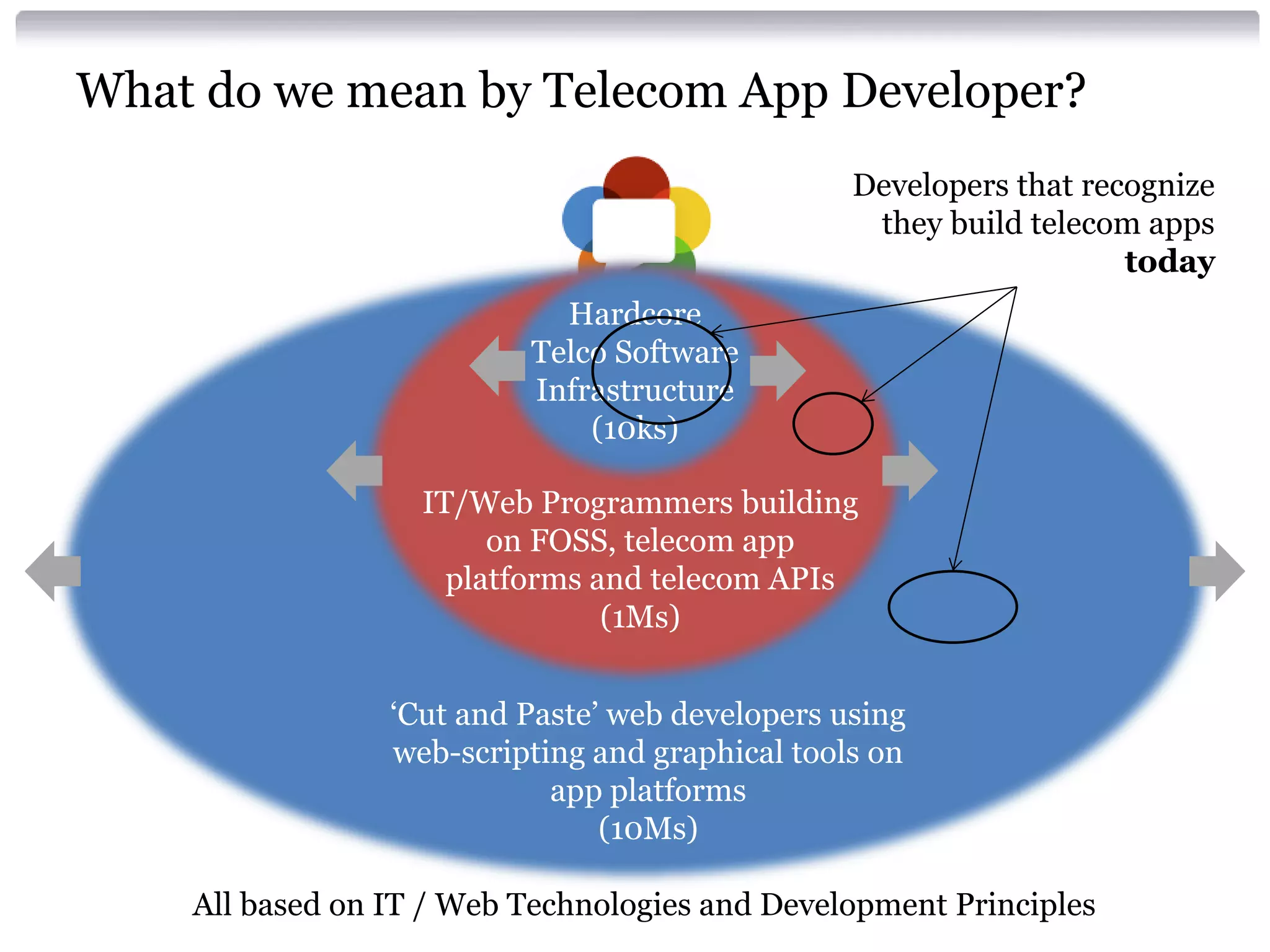
What do we mean by Telecom App Developer?
Developers that recognize
they build telecom apps
today
Hardcore
Telco Software
Infrastructure
(10ks)
IT/Web Programmers building
on FOSS, telecom app
platforms and telecom APIs
(1Ms)
‘Cut and Paste’ web developers using
web-scripting and graphical tools on
app platforms
(10Ms)
All based on IT / Web Technologies and Development Principles
TADS is about Building an Ecosystem

Hardcore
Telco Software
Infrastructure
(10ks)

Developers that recognize
they build telecom apps
tomorrow

IT/Web Programmers building
on FOSS, telecom app
platforms and telecom APIs
(1Ms)
‘Cut and Paste’ web developers using
web-scripting and graphical tools on
app platforms
(10Ms)
All based on IT / Web Technologies and Development Principles
www.tadsummit.com

Independent review of telecom ap is pre conference workshop

  • 1.
    Independent Review ofTelecom APIs Nov 11th 2013
  • 2.
    Structure: Alan’s Bit • • • • • • • • • 2 ThePainful Facts! Why do telcos need APIs? Why all the big numbers? Beware the Bait and Switch! Where are the Telco API successes? Dos and Don’ts of Telco API success Mapping the API landscape! Where are Telecom API going? What needs to change? © 2010 Alan Quayle Business and Service Development
  • 3.
    Structure: Luis’s bit • APIDAZE:facts & figures • Presentation of the APIDAZE REST API • Customer case: How a leading European affiliate network increased its revenue by 15% using APIDAZE • APIDAZE & WebRTC • WebRTC integration using APIDAZE 3 © 2010 Alan Quayle Business and Service Development
  • 4.
    Structure: Jean’s Bit • TeleStaxintroduction • What is RestComm? • HealthSense Case Study: using Telecom APIs to help baby boomers age safely • 4 RestComm demo © 2010 Alan Quayle Business and Service Development
  • 5.
    Structure: Sam’s bit • TheTropo story • Tropo's products in a nutshell • Some deployed case studies • Use cases and other cool stuff 5 © 2010 Alan Quayle Business and Service Development
  • 6.
    No developed markettelco has successfully engaged mobile application developers with Telecom APIs
  • 7.
    BUT Telecom API successeshave come from using APIs internally
  • 8.
    AND Telecom API successeshave come from using APIs with existing partners
  • 9.
    APIs reduce business friction.This means the value is not ‘in the API’ it’s in the service or data delivered through the API.
  • 10.
    Mobile Application Developers ONLYcare about direct access to a large engaged customer base that is prepared to pay. Apple and Android fulfill this need, Telcos are IRRELEVANT
  • 11.
    Analysys Mason Predictionon Voice Usage Telco voice usage will remain significant (74% of usage by 2018). New comms services will be essential to maintain revenue given price pressure and data revenues not offsetting declines.
  • 12.
    Analysys Mason Predictionon Messaging and ARPU Telco messaging will become niche, anticipate rapid revenue decline as SMS moves to data. Analysys Mason is predicting a >25% ARPU decline by 2018. Industry needs to find >$100B in new revenues within 5 years.
  • 13.
    What if aTelcos continue to do nothing? Telcos become the “path of last resort” as apps use “easy and economical” APIs for 90% of comms, and Telcos for only 10% Applications and Services Easy and Economical 90% Global comms clouds Laggards 10% Telco Customers
  • 14.
    So What ShouldTelcos Do? Work with Developers to embed communications into applications, services and business processes. Make Comms the ‘essential spice’ of every business ecosystem. Work with Developers to create new services and applications using communications capabilities. Innovate in communications else watch revenue decline. $40B by 2018 source Mind Commerce $35B by 2018 source Ovum Telecom Application Developers are now essential to addressing the revenue decline in communication services. Previous efforts have failed, corrective action is required urgently.
  • 15.
    Revenue Defining what ismeant by Telecom App Developer Internal Telco Developers Partner Developers Telecom App Developers Mobile App Developers Long Tail Developers Product
  • 16.
    Revenue This Is AMore Accurate Representation Internal Telco Developers Partner Developers Telecom App Developers Mobile App Developers Long Tail Developers Product
  • 17.
    What do wemean by Telecom App Developer? Developers that recognize they build telecom apps today Hardcore Telco Software Infrastructure (10ks) IT/Web Programmers building on FOSS, telecom app platforms and telecom APIs (1Ms) ‘Cut and Paste’ web developers using web-scripting and graphical tools on app platforms (10Ms) All based on IT / Web Technologies and Development Principles
  • 18.
    TADS is aboutBuilding an Ecosystem Hardcore Telco Software Infrastructure (10ks) Developers that recognize they build telecom apps tomorrow IT/Web Programmers building on FOSS, telecom app platforms and telecom APIs (1Ms) ‘Cut and Paste’ web developers using web-scripting and graphical tools on app platforms (10Ms) All based on IT / Web Technologies and Development Principles
  • 19.
  • 20.
  • 21.
  • 22.
    Why do Telcosneed APIs?  APIs are just a technology, its all about the services The money is not ‘in the API,’ it’s in the service delivered by the API. APIs are simply delivering services more efficiently, which opens up new business opportunities. — Jose Valles, VP Partner Products at Telefónica Digital  APIs are a global IT trend across all industries An API strategy is becoming a must…in terms of speed to market with new products, maximizing business development, and product development opportunities. — Steve Kurtz, VP Business Development, USA TODAY  APIs will become critical to maintaining Telecom’s customer relevance Without APIs Telecoms will become irrelevant as Service Providers because customers will expect communications to be embedded in their experiences. — Alan Quayle, Independent Telecom Thinker
  • 23.
    What is anAPI? • http://www.telco.com/api.php?action=remove_friction APIs reduce business friction by making it easy for software systems to work together using existing well understood web technology that any IT person can understand
  • 24.
    Why do Telcosneed APIs? Why do we need a Web site? 1995 Of course we have a Web site 2000 2005 New distribution Accelerate internal projects Upsell Innovation Why do we need an API? 2010 Device and mobile support Operational efficiency Make churn harder Extend products / services Of course we have an API Increase footprint Partner opportunities Process automation New business Telecoms is the ‘vital spice’ of any successful business ecosystem
  • 25.
    What APIs canTelcos offer? Telco API Capabilities billing, rating, charging calling location VAS messaging directory device CRM customer profile customer insight internal systems Opportunities payment services identity and security personalization cloud call centers fraud management enterprise cloud hypervoice communication enabled business processes lower operational costs
  • 26.
    Show me themoney? graphic
  • 27.
    Where’s the Moneyin External APIs? $244B by 2017 $157B by 2018 $18B in 2016 Mobile payments revenue, source BI Intelligence. Includes Apple, Android, Square, Visa Mobile, etc. Total Telecom API revenue, source Mind Commerce. Payment, Communications, Identity, Cloud, etc. Alan Quayle’s view is the revenues will be $18B and dominated by payment and communication service revenues by 2016 Juniper predicts DCB (Direct Carrier Billing) growing from $2.5B in 2012 to $13B in 2017 (this assumes only digital downloads, not goods and services)
  • 28.
    Mobile Payments Predictionfrom BI Intelligence Receipts Revenues
  • 29.
    What if aTelco does nothing? Telco becomes the “path of last resort” as apps use “easy and economical” APIs for 90% of comms Easy and Economical 90% Global comms clouds Applications Laggards 10% Telco Customers
  • 30.
  • 31.
    Wholesale that’s agood model! Consumers Telco gets commoditized and detached from customers for comms services Business Offers services direct Offers services direct Easy and Economical 90% Global comms clouds Laggards 10% Telco Commoditizes pricing
  • 32.
  • 33.
    Market Situation: APIBait and Switch Roll-up, roll-up, buy my API software, expose some APIs, to gain fame and fortune just like Apple and Google What is sold What happens in practice AT&T is like an old lady that desperately wanted a ‘developer community’ broach. She paid tens of millions for this broach, and really only got a pale imitation of a developer community, she also didn’t realize it’s perishable, so is now disintegrating in a drawer.
  • 34.
  • 35.
    Market Requirements: Whyare operators spending money on API? • M2M to support provisioning and management o Verizon (Hughes Telematics), Rogers, AT&T, Telefonica, Ericsson (bought Telenor assets) o • This is generally treated as a silo, and not part of a broader API business Wishful thinking in building a developer community like Android and Apple o o • AT&T, Globe, BlueVia, Deutsche Telekom’s Developer Garden Market does not yet universally understand this is a failed strategy Support open innovation and work more easily with partners on new business models and market opportunities o AT&T, Telefonica – this really started only in the last 6-9 months
  • 36.
    Market Requirements: Whyare operators spending money on API? • Support internal innovation, in some cases focused on specific market segments like enterprise o • Verizon, Telecom Italia, Portugal Telecom Support open innovation with specific partners targeting specific market segments o • Experimenting in what APIs could means to their business o • Telus – targeting SMB SingTel, Rogers Build specific business opportunities like direct carrier billing (mobile payments) o • Telefonica and Telenor, Ooredoo, Etisalat Laziness o Brow beaten into doing something by their vendors o Copying AT&T o Following GSMA and OneAPI Exchange
  • 37.
  • 38.
    Learning • It doesn’t matterhow much you spend, developers are rationale decision makers o Telcos continue to struggle in engaging long-tail developers, but developers will happily turn up to events to take AT&T’s generous prize money at hackathons. • Telcos have many APIs they can offer beyond voice, messaging, payments and customer information, including speech processing, authentication, identity, mHealth, M2M (Machine to Machine), really any service can be exposed through an API. o • The hard part is building a business around the API, not offering the API. Long tail is being redefined as light-weight open innovation. o That is not trying to build a developer community in competition to Apple and Google. o Instead, exploring with select partners, universities, and friendly developers new ideas or unique capabilities to telcos, e.g. mHealth, connected car, and M2M.
  • 40.
    Telus Overview • A continuingsource of SMS revenue growth comes from the enterprise use of SMS for alerting and notifications • Telus has implemented a focused API program over the past 7 years – targeting SMB with SMS alerting capabilities o o Value to an enterprise is the ubiquity of communications with its customers in Canada o • • Through both direct sales people and local system integration partners Cost is irrelevant as business value far exceeds margin costs of an SMS Note SMS is both AT&T and Verizon’s largest by volume API Process is designed to enable Telus to launch more apps and faster with a focus on SME (Small Medium Enterprise) o o • Achieved a 4 to 40 annual service launch improvement Reduce cost by 75% in launching new apps Profitable within the first year of operation
  • 42.
    Background • The project startedon 10th June, 2010 o o • Within 9 months there were 150 running applications in the market and 10600 registered users. Today the total number of network based services developed & available for consumption is >500 Etisalat has two methods of revenue generation from the services: subscription and on-demand. o On-demand basis works on the subscriber being charged for every transaction or messaging that they receive from a service, for e.g. a subscriber sends a message requesting the current exchange rate of his local currency and he gets a reply message from the service with the information and is charged for that message only. o • The developer keeps 90% of the revenue. Both methods ensure recurring revenue for Etisalat as opposed to one time downloadable fees and a focus on keeping the customer engaged • The Developer portal enables the simplified creation of mobile apps for amateur as well as expert software developers equipped with standard & open APIs, Software Development Kits (SDKs) covering the major programming languages, sample apps & user guides to direct them. • Their interaction with the solution is through easy to use interfaces enabled by Web Services that expose the operator service and network capabilities to allow developers to concentrate only on developing the app without concerning about the complexities of network protocols. • Mobile application developers, both amateur and professional, now enjoy a simplified process of Application Development, deployment and commercialization with mChoiceTM Cloud TAP’s Mobile Application Developer Portal. Sample Applications, Simulators and Guides help enhance the application paving the way for the creation of a series of sought after mobile applications.
  • 43.
    Etisalat Sri Lanka,Emerging Market Telco App Store USSD API for 100% reach in $1.25 ARPU market • • • • • • • Top 5 apps subs 3 months after launch: Yalu (anon chat) 40,668 Sinhalalen (local) Jokes 33,787 Fun Facts 12,807 Technology News 8,262 Word Puzzle 5,554 Business models supported are per message and subscription • Accounts for 3.5% of ARPU
  • 44.
  • 46.
    Key Points • Developing marketsare different – messaging still matters, USSD is a massive untapped potential for infotainment services in developing markets. • Local matters – content local developers, not localized, locally originated are proving successful with customers because they identify with the content. • Size doesn’t matter, Etisalat Sri Lanka only has 3 million subscribers with low ARPU. Yet they engaged developers creating sticky application and differentiated their offer in the market. • The supporting technology is run on a cloud, lowering costs and allowing greater flexibility.
  • 47.
  • 48.
    Summary • • Program started in2008, offered SMS APIs to their content partners. Focused across the demand curve, success remains in using APIs internally and within Telecom Italia’s existing ecosystem of partners / customers. • Revenue of $250M per year made attributed to the platform, this does not include the revenue retained by the Lines of Business. Roughly 1B transactions per month. • Generally considered within the Telecom community to be the most successful API implementation of any operator. o They are Oracle’s largest OCSG (Oracle Communications Services Gatekeeper, API platform) deployment. • New division formed in July 2013 called “Service Delivery Platform and NetAPI”, this appears to consolidate some of the lines of business that were taking most of the revenue generated by the API platform. o It is rumored the new division’s annual revenue is >$2B (figure needs to be confirmed).
  • 50.
    Learning • Demonstrates the moneyis not in long tail developers, rather use API with partners and internally. • Highlights the importance of using APIs across all possible business models, internal innovation, partner innovation, not simply focusing on the “long-tail”. • Importance of an integrated platform that enables Telecom Italia to efficiently support high transaction volume partners as well as internal services enables it to support the relatively high priced solution of Oracle licenses and Accenture professional service. • API standards are purely a baseline; they are adapted to meet specific needs, which means API standards are useless. o Processes around defining new APIs are key for rapid innovation.
  • 51.
  • 52.
    Summary • Long history startingin 1998 of attempting to build developer communities, 2-3 year cycle of launching and closing developer initiatives. BlueVia is its longest running initiative. • Internal operational efficiency and long tail developer. Current focus is on the payment API in cooperation with Telenor and 2 other telcos, targeting partners and large accounts, not long-tail developers. • • BlueVia has turned around its API business by focusing on the payment API. Developers consider the BlueVia program to have failed like every other long tail telco program in the past. • Jose Valles, head of BlueVia recently promoted to VP Partner Products at Telefónica Digital. Focused on build the payment service business, and adding new APIs particularly in communications.
  • 53.
    Learning • “The money isnot in the long tail.” Jose Valles, Head of Blue Via, presented at the SDP Global Summit . The money for BlueVia is with partners, building powerful partnerships on Telecom APIs. • SMS revenue share failed as a business model as the market moved to buying bundles of SMS, so customers did not want / expect to pay a full price SMS when using the services built on BlueVia APIs. • Focus on the core capabilities of a telco, the advertising APIs did not work as TEF lacks the credibility, inventory, and ability to build a business in this domain. • Long tail is about light-weight innovation, not trying to build a developer community in competition to Apple and Google. Instead, exploring with partners, Universities, friendly developers new ideas / unique capabilities to telcos, e.g. Arduino GSM Shield for M2M over mobile networks. • TEF Digital is going to have to re-invent itself again as its filling with corporate politicians. For example, the TU Go application is being forced on OpCos based on the Jahjah platform it bought for $100M, this requires expensive integration for the OpCos so they are pushing back.
  • 54.
  • 55.
    Learning • • Copy Tropo orTwilio if you want to compete in the US in communications APIs. Don’t chase long tail developers in the back yard of Apple and Google o Focus on businesses that need to run on Telecom APIs, or using APIs within your existing ecosystem (Internally and with partners) • Operators cannot credibly engage the long-tail, need to focus of specific technologies or domains, e.g. in M2M with relevant M2M companies, it’s a more a focused open innovation model. • OneAPI is not relevant to long-tail developers, and looks archaic compared to modern well-written APIs. • Money is not in the APIs, 1c per location dip required 100 million dips a month to make $1M and no developer will pay 1c location these days. o The money is in the services and solutions enabled by APIs.
  • 56.
  • 57.
    Mapping Telcos acrossthe API Implementation Landscape Organizational Focus of APIs Internal APIs Both External APIs Business Use of APIs Experiment Focused Likely Evolution Path Broad Telecom Italia does not have everything right, for example, they lack the focus on building API-enabled businesses, but its closer than most.
  • 58.
    mapping telcos acrossthe API implementation landscape Organizational Focus of APIs Internal APIs Business Use of APIs Experiment Focused Broad Both External APIs
  • 59.
    3. Market Analysis:Mapping vendors across the API Informational APIs Transactional APIs landscape (e.g. customer profile) Developer Community API Publishers Tropo, Twilio, etc. Developer Portal API Management e.g. call control API Management (including API Security) Intel Software (Mashery), CA (Layer 7), Apigee API Services Network Gateway Cloud / BOSS Assets IT / Service Assets Network Assets IMS Assets
  • 60.
    3. Market Analysis:Real World Complexity Informational APIs Transactional APIs Developer Community Developer Portal Apigee, Intel (Mashery), Layer 7 (CA), SOA Software, 3Scale, IBM, Open Source API Management API Services Intel (Aepona), Ericsson, Huawei, Oracle, Open Source Network Gateway Cloud / BOSS Assets IT / Service Assets 2600Hz, Aculab, Apidaze, Bandwidth, hSenid Mobile, OnMobile, OpenCloud, Plivo, Restcomm, Solaiemes, TelAPI, Tropo, Twilio, etc. Network Assets IMS Assets
  • 61.
    Where are ExternalTelco APIs going? • External Telecom API Roadmap o Communications: across all VAS not just calls, rather Rich Communication Services, IP clients, messaging, number provision, WebRTC, etc. o M2M: If the Telco has an M2M line of business then M2M APIs are essential to be competitive for provisioning and management of end points o Payments: the challenge is gaining the commitment to become a payment service rather than simply in-app billing within app stores • Focus on building a businesses around the APIs rather than publish and wishful thinking (hackathons are simply PR) o Sales, marketing, business development and critically support
  • 64.
  • 65.
  • 66.
  • 67.
  • 68.
    1-3.3% 0-2% Threats to Revenue 5.5to 9% Over the Top Messaging hits SMS growth 3 to 4% Mobile substitution of fixed broadband with LTE 0 to 2% OTT substitution, saturation, competition -5 to -7% Mobile and OTT substitution Mobile Data ($275B) Fixed Data ($275B) Mobile Voice ($615B) Fixed Voice ($325B) 3-6% Regulated Services ($1.5T) + Unregulated Services ($650B) Total Telecoms Services ($2.15T) = Sources: operator averages across developed and developing markets, supplier estimates, Alan Quayle There’s just 2 things we need to focus on
  • 69.
    Make Telecoms anEssential Spice for every Business Recipe
  • 70.
  • 71.
    No. We trieda similar service in our market and it failed, and we’re never ever going to try again What do you think of this service idea?
  • 72.
    No. It willnot work in our market. Because I’m a 50 year old guy who understands all my customers better than they know themselves. What do you think of this service idea?
  • 73.
    No. A featureof your service overlaps with an existing. What do you think of this service idea?
  • 74.
    No. We havea similar service launched, and are not going to experiment to make it better or address other customer segments. What do you think of this service idea?
  • 75.
    No. Our networkcan not support such as service, even though such services are going over the top today. What do you think of this service idea?
  • 76.
    No. It looksa bit like Joyn, we’re not sure about it, but because it looks a bit like something we may do in the future we’re not going to do it. What do you think of this service idea?
  • 77.
    No. It mustwork across all devices, even though most devices will never use it. What do you think of this service idea?
  • 78.
    No. We need additional(random) features included before we could consider it. What do you think of this service idea?
  • 79.
    No. It mustwork on IMS (even though it doesn’t need to). What do you think of this service idea?
  • 80.
    No. It mustwork across all our customers from day one, even though most will never use it. What do you think of this service idea?
  • 81.
    No. It mustconform to our process and design norms. But we’re not going to tell you what they are. What do you think of this service idea?
  • 82.
    No. It mustintegrate with all our existing platforms, even though it can work fine in the current configuration. What do you think of this service idea?
  • 83.
    No. It mustbe delivered through our preferred SI or NEP, who will copy / kill the service immediately. What do you think of this service idea?
  • 84.
    No. You mustwork through our app store / portal, which we’re in the process of closing. What do you think of this service idea?
  • 85.
    No. We canonly focus on 4 service launches per year. We only back major successes like Video Telephony, Mobile TV, Push To Talk, See What I See… What do you think of this service idea?
  • 86.
    No. We justdon’t have the bandwidth, to do our job. What do you think of this service idea?
  • 87.
    No. We havea network lock-down as we launch LTE so cannot do anything for the next 6-9 month. What do you think of this service idea?
  • 88.
    No. Bob hasleft the business and we’re waiting on his replacement, who never comes. What do you think of this service idea?
  • 89.
    No. We’re waitingon annual budgets to be confirmed, sometime in the next 6-12 months. What do you think of this service idea?
  • 90.
    No. We’re reorganizingagain this year. What do you think of this service idea?
  • 91.
    No. Someone inthe organization doesn’t like such services. What do you think of this service idea?
  • 92.
    No. That cannotbe implemented without changing our IN / product catalog / CRM / billing / network. What do you think of this service idea?
  • 93.
    No. We cannotbill / sell services under $5 per month. What do you think of this service idea?
  • 94.
    No. We havea backlog of 24 months on billing updates, even though the service doesn’t need to be in that pipeline. What do you think of this service idea?
  • 95.
    No. You mustwork through our innovation group who we all hate and ignore as they’re parasites on our business. What do you think of this service idea?
  • 96.
    No. You musttalk with Bob who will then pass you to Bill, who will then pass you to Mary, who will then pass you to Paul, who will then pass you back to Bob. What do you think of this service idea?
  • 100.
    Revenue Defining what ismeant by Developer Internal Telco Developers Partner Developers Telecom App Developers Mobile App Developers Long Tail Developers Product
  • 101.
    Revenue This Is AMore Accurate Representation Internal Telco Developers Partner Developers Telecom App Developers Mobile App Developers Long Tail Developers Product
  • 102.
    What do wemean by Telecom App Developer? Developers that recognize they build telecom apps today Hardcore Telco Software Infrastructure (10ks) IT/Web Programmers building on FOSS, telecom app platforms and telecom APIs (1Ms) ‘Cut and Paste’ web developers using web-scripting and graphical tools on app platforms (10Ms) All based on IT / Web Technologies and Development Principles
  • 103.
    TADS is aboutBuilding an Ecosystem Hardcore Telco Software Infrastructure (10ks) Developers that recognize they build telecom apps tomorrow IT/Web Programmers building on FOSS, telecom app platforms and telecom APIs (1Ms) ‘Cut and Paste’ web developers using web-scripting and graphical tools on app platforms (10Ms) All based on IT / Web Technologies and Development Principles
  • 104.