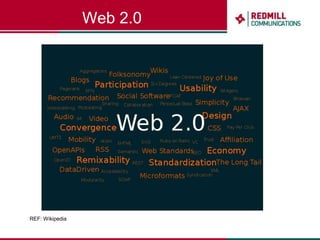
Web 2.0REF: Wikipedia
What is Web 2.0?Collaboration, interactivity, shared informationClient / serverApp stores vs applications that leverage telco capabilitiesCommunications enablersWhere is the money?http://tinyurl.com/157appstats
App Stores?How much money does 1 billion app downloads generate?Not That Much! Ratio of free to paid apps: 1:15 and 1:40, The mean price for paid apps $2.65. Apple’s 30%, puts their share at $20-45 million per billion downloadsREF: Moriana / RCL
Communications: Mobile voiceIn 2009, Voice together with SMS, 85% of the world's $800 billion per year mobile services marketWhere is the money for telcos?Services that leverage voice and telco resources are much more interesting than free games Or railway timetablesREF: Moriana / RCL
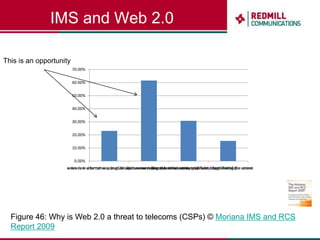
IMS and Web 2.0This is an opportunityFigure 46: Why is Web 2.0 a threat to telecoms (CSPs) © Moriana IMS and RCS Report 2009
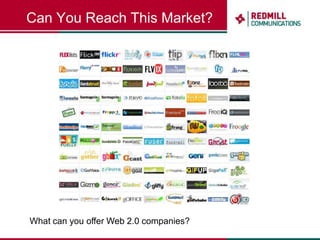
Can You Reach This Market?What can you offer Web 2.0 companies?
What is a Mashup?Blended serviceMixes capabilities to create a new applicationOr complement / enhance existingPOI on mapsClick to call in a websiteSMS notification from directory enquiriesNew forms of communication and collaboration represent an opportunity
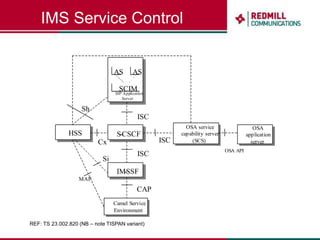
IMS Service ControlREF: TS 23.002.820 (NB – note TISPAN variant)
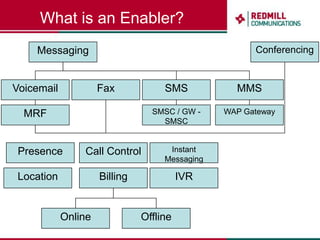
What is an Enabler?MessagingConferencingVoicemailSMSMMSFaxMRFSMSC / GW - SMSCWAP GatewayPresenceCall ControlInstant MessagingLocationBillingIVROnlineOffline
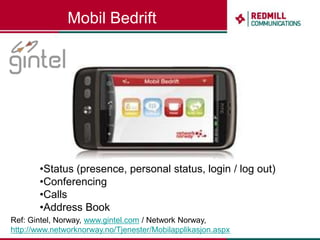
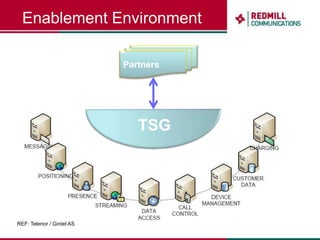
Enablement EnvironmentPartnersTSGREF: Telenor / Gintel AS
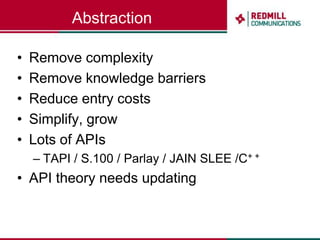
AbstractionRemove complexityRemove knowledge barriersReduce entry costsSimplify, growLots of APIsTAPI / S.100 / Parlay / JAIN SLEE /C+ +API theory needs updating
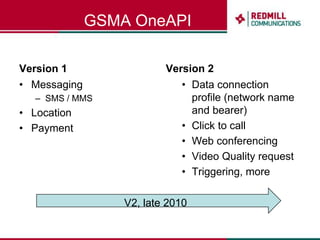
GSMA OneAPIVersion 1MessagingSMS / MMSLocationPaymentVersion 2Data connection profile (network name and bearer)
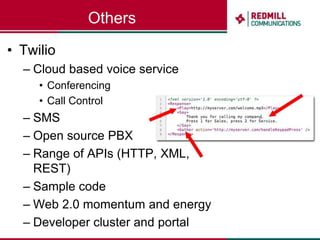
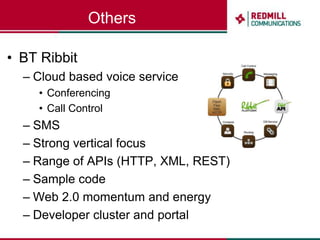
Click to call
Web conferencing
Video Quality request
Triggering, moreV2, late 2010
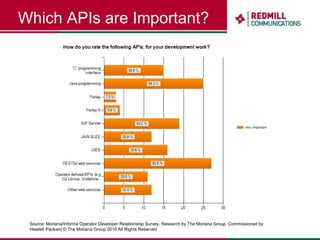
Which APIs are Important?Source: Moriana/Informa Operator Developer Relationship Survey. Research by The Moriana Group. Commissioned by Hewlett Packard © The Moriana Group 2010 All Rights Reserved
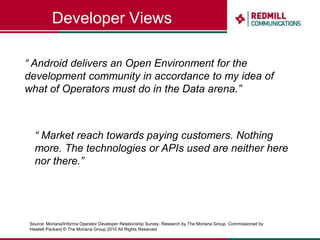
Developer Views“ Android delivers an Open Environment for the development community in accordance to my idea of what of Operators must do in the Data arena.” “ Market reach towards paying customers. Nothing more. The technologies or APIs used are neither here nor there.” Source: Moriana/Informa Operator Developer Relationship Survey. Research by The Moriana Group. Commissioned by Hewlett Packard © The Moriana Group 2010 All Rights Reserved
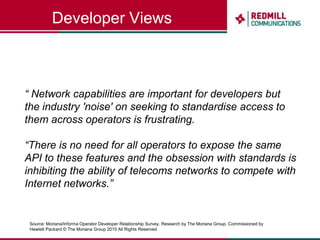
Developer Views“ Network capabilities are important for developers but the industry 'noise' on seeking to standardise access to them across operators is frustrating. “There is no need for all operators to expose the same API to these features and the obsession with standards is inhibiting the ability of telecoms networks to compete with Internet networks.” Source: Moriana/Informa Operator Developer Relationship Survey. Research by The Moriana Group. Commissioned by Hewlett Packard © The Moriana Group 2010 All Rights Reserved
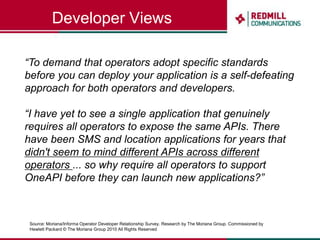
Developer Views“To demand that operators adopt specific standards before you can deploy your application is a self-defeating approach for both operators and developers. “I have yet to see a single application that genuinely requires all operators to expose the same APIs. There have been SMS and location applications for years that didn't seem to mind different APIs across different operators ... so why require all operators to support OneAPI before they can launch new applications?” Source: Moriana/Informa Operator Developer Relationship Survey. Research by The Moriana Group. Commissioned by Hewlett Packard © The Moriana Group 2010 All Rights Reserved
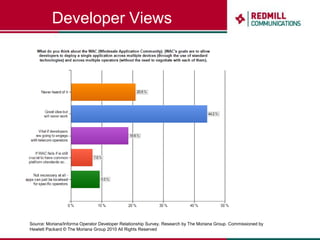
Developer ViewsSource: Moriana/Informa Operator Developer Relationship Survey. Research by The Moriana Group. Commissioned by Hewlett Packard © The Moriana Group 2010 All Rights Reserved
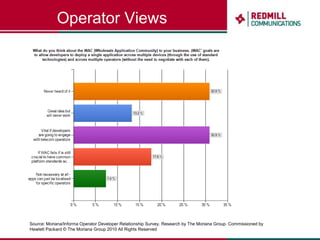
Operator ViewsSource: Moriana/Informa Operator Developer Relationship Survey. Research by The Moriana Group. Commissioned by Hewlett Packard © The Moriana Group 2010 All Rights Reserved
One APINice, but may be irrelevantOpportunity cost in delaying provision of APIs to (the right) developers One API is in its infancyDevelopers will use anything if it can generate a returnIt’s not the specific API per se, but the model...
RESTfulRepresentational State Transfer (REST)Client / serverRequest from client (stateless)Processed by server (stateful)Response returnedBased on transfer for representations of resourcesResources are independent of their representations
Third Party AccessTPA requires:InterfacesWeb ServicesCapabilitiesVoIP, (X)MS, Call Control, VideoDataLocation, Profile, Traffic, BillingManagementDo CSPs want to do this?Can they make money from it?Do they understand key assets that can be leveraged?
Third Party Access“Integration to third parties is a key differentiation from our competition and creates stickiness with customers”“For residential customers, it is important to offer web services [for TPA] as soon as possible in order to address end user demands”“As operators, we lack flexibility to create new services. By offering APIs to third parties, we can leverage on their creativity and flexibility. If successful, we are still in a position to buy their company.”CSPs recognise that they have to extend boundaries to accommodate innovationRef: RCL / Moriana RCS Research, 2010, to be published
Third Party Access80% of operators surveyed support TPAMixed focusSmall devs for the long tail; larger for enterprises50% have processes in place to do thisMultiple APIsMay be different for each enablerNot clear which will be popularChallenge in enabling across multiple OpCosRef: RCL / Moriana RCS Research, 2010, to be published
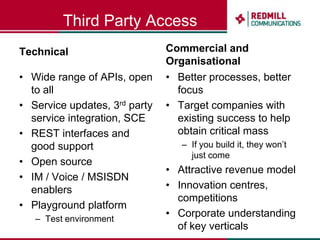
Third Party AccessTechnicalCommercial and OrganisationalWide range of APIs, open to allService updates, 3rd party service integration, SCEREST interfaces and good supportOpen sourceIM / Voice / MSISDN enablersPlayground platformTest environmentBetter processes, better focusTarget companies with existing success to help obtain critical massIf you build it, they won’t just comeAttractive revenue modelInnovation centres, competitionsCorporate understanding of key verticals
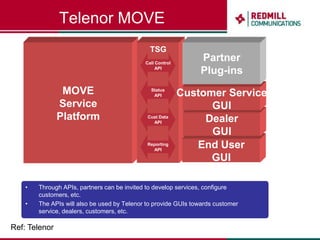
Telenor MOVETSGPartnerPlug-insMOVEServicePlatformCall ControlAPIStatusAPICustomer ServiceGUICust DataAPIDealerGUIReportingAPIEnd UserGUIThrough APIs, partners can be invited to develop services, configure customers, etc.
The APIs will also be used by Telenor to provide GUIs towards customer service, dealers, customers, etc.Ref: Telenor
CIE MashupMashupsWeb 2.0CIE 2.0 ConferencingRef: NetDev Ltd, UK www.netdev.co.uk

What does web2.0 mean for operators?

  • 2.
  • 3.
    What is Web2.0?Collaboration, interactivity, shared informationClient / serverApp stores vs applications that leverage telco capabilitiesCommunications enablersWhere is the money?http://tinyurl.com/157appstats
  • 4.
    App Stores?How muchmoney does 1 billion app downloads generate?Not That Much! Ratio of free to paid apps: 1:15 and 1:40, The mean price for paid apps $2.65. Apple’s 30%, puts their share at $20-45 million per billion downloadsREF: Moriana / RCL
  • 5.
    Communications: Mobile voiceIn2009, Voice together with SMS, 85% of the world's $800 billion per year mobile services marketWhere is the money for telcos?Services that leverage voice and telco resources are much more interesting than free games Or railway timetablesREF: Moriana / RCL
  • 6.
    IMS and Web2.0This is an opportunityFigure 46: Why is Web 2.0 a threat to telecoms (CSPs) © Moriana IMS and RCS Report 2009
  • 7.
    Can You ReachThis Market?What can you offer Web 2.0 companies?
  • 8.
    What is aMashup?Blended serviceMixes capabilities to create a new applicationOr complement / enhance existingPOI on mapsClick to call in a websiteSMS notification from directory enquiriesNew forms of communication and collaboration represent an opportunity
  • 9.
    IMS Service ControlREF:TS 23.002.820 (NB – note TISPAN variant)
  • 10.
    What is anEnabler?MessagingConferencingVoicemailSMSMMSFaxMRFSMSC / GW - SMSCWAP GatewayPresenceCall ControlInstant MessagingLocationBillingIVROnlineOffline
  • 11.
  • 12.
    AbstractionRemove complexityRemove knowledgebarriersReduce entry costsSimplify, growLots of APIsTAPI / S.100 / Parlay / JAIN SLEE /C+ +API theory needs updating
  • 13.
    GSMA OneAPIVersion 1MessagingSMS/ MMSLocationPaymentVersion 2Data connection profile (network name and bearer)
  • 14.
  • 15.
  • 16.
  • 17.
  • 18.
    Which APIs areImportant?Source: Moriana/Informa Operator Developer Relationship Survey. Research by The Moriana Group. Commissioned by Hewlett Packard © The Moriana Group 2010 All Rights Reserved
  • 19.
    Developer Views“ Androiddelivers an Open Environment for the development community in accordance to my idea of what of Operators must do in the Data arena.” “ Market reach towards paying customers. Nothing more. The technologies or APIs used are neither here nor there.” Source: Moriana/Informa Operator Developer Relationship Survey. Research by The Moriana Group. Commissioned by Hewlett Packard © The Moriana Group 2010 All Rights Reserved
  • 20.
    Developer Views“ Networkcapabilities are important for developers but the industry 'noise' on seeking to standardise access to them across operators is frustrating. “There is no need for all operators to expose the same API to these features and the obsession with standards is inhibiting the ability of telecoms networks to compete with Internet networks.” Source: Moriana/Informa Operator Developer Relationship Survey. Research by The Moriana Group. Commissioned by Hewlett Packard © The Moriana Group 2010 All Rights Reserved
  • 21.
    Developer Views“To demandthat operators adopt specific standards before you can deploy your application is a self-defeating approach for both operators and developers. “I have yet to see a single application that genuinely requires all operators to expose the same APIs. There have been SMS and location applications for years that didn't seem to mind different APIs across different operators ... so why require all operators to support OneAPI before they can launch new applications?” Source: Moriana/Informa Operator Developer Relationship Survey. Research by The Moriana Group. Commissioned by Hewlett Packard © The Moriana Group 2010 All Rights Reserved
  • 22.
    Developer ViewsSource: Moriana/InformaOperator Developer Relationship Survey. Research by The Moriana Group. Commissioned by Hewlett Packard © The Moriana Group 2010 All Rights Reserved
  • 23.
    Operator ViewsSource: Moriana/InformaOperator Developer Relationship Survey. Research by The Moriana Group. Commissioned by Hewlett Packard © The Moriana Group 2010 All Rights Reserved
  • 24.
    One APINice, butmay be irrelevantOpportunity cost in delaying provision of APIs to (the right) developers One API is in its infancyDevelopers will use anything if it can generate a returnIt’s not the specific API per se, but the model...
  • 25.
    RESTfulRepresentational State Transfer(REST)Client / serverRequest from client (stateless)Processed by server (stateful)Response returnedBased on transfer for representations of resourcesResources are independent of their representations
  • 26.
    Third Party AccessTPArequires:InterfacesWeb ServicesCapabilitiesVoIP, (X)MS, Call Control, VideoDataLocation, Profile, Traffic, BillingManagementDo CSPs want to do this?Can they make money from it?Do they understand key assets that can be leveraged?
  • 27.
    Third Party Access“Integrationto third parties is a key differentiation from our competition and creates stickiness with customers”“For residential customers, it is important to offer web services [for TPA] as soon as possible in order to address end user demands”“As operators, we lack flexibility to create new services. By offering APIs to third parties, we can leverage on their creativity and flexibility. If successful, we are still in a position to buy their company.”CSPs recognise that they have to extend boundaries to accommodate innovationRef: RCL / Moriana RCS Research, 2010, to be published
  • 28.
    Third Party Access80%of operators surveyed support TPAMixed focusSmall devs for the long tail; larger for enterprises50% have processes in place to do thisMultiple APIsMay be different for each enablerNot clear which will be popularChallenge in enabling across multiple OpCosRef: RCL / Moriana RCS Research, 2010, to be published
  • 29.
    Third Party AccessTechnicalCommercialand OrganisationalWide range of APIs, open to allService updates, 3rd party service integration, SCEREST interfaces and good supportOpen sourceIM / Voice / MSISDN enablersPlayground platformTest environmentBetter processes, better focusTarget companies with existing success to help obtain critical massIf you build it, they won’t just comeAttractive revenue modelInnovation centres, competitionsCorporate understanding of key verticals
  • 30.
    Telenor MOVETSGPartnerPlug-insMOVEServicePlatformCall ControlAPIStatusAPICustomerServiceGUICust DataAPIDealerGUIReportingAPIEnd UserGUIThrough APIs, partners can be invited to develop services, configure customers, etc.
  • 31.
    The APIs willalso be used by Telenor to provide GUIs towards customer service, dealers, customers, etc.Ref: Telenor
  • 32.
    CIE MashupMashupsWeb 2.0CIE2.0 ConferencingRef: NetDev Ltd, UK www.netdev.co.uk

Editor's Notes

  • #5 Popularity enhanced by developers commitment to platform; Apple gets to sell lots of phones. Defensive ploy to protect against market entry. Even if you supply the most popular applications, you don’t make a huge amount of money.
  • #6 Huge, huge market
  • #8 Can these companies benefit from integration of telco capabilities? If so, what do they want?
  • #9 In other words, they include collaboration between different applications -
  • #11 Services use capabilitiesConferencing requires media resources, mixing, etcMessaging requires voicemail, SMS, fax, etcBuilding blocks of more complex servicesRCS requires presence, messaging, etc, etcCan other (external) applications benefit from telco enablers?