COMMUNICATION
COMMUNICATION
• Definition: Communication is the process of exchanging information, thoughts, and ideas through
speech, writing, or non-verbal methods.
• Components of Communication:Sender
• Message
• Channel
• Receiver
• Feedback
• Noise (barriers to communication)
TYPES OF COMMUNICATION
• Communication can be classified into
various types based on mode, context,
and direction. Understanding these
classifications is crucial for teachers to
effectively interact with students, colleagues,
and the community.
TYPES OF COMMUNICATION
•Based on Mode
•Verbal CommunicationInvolves the use of spoken or written
words.
•Examples: Lectures, discussions, conversations, emails, letters.
•Advantages:
•Clear and direct.
•Immediate feedback.
•Limitations:
•Misunderstandings due to tone, vocabulary, or context
TYPES OF COMMUNICATION
Non-Verbal Communication
Involves the use of body language, facial expressions, gestures, posture,
eye contact, and tone of voice.
Examples: Smiling to show approval, maintaining eye contact for attention.
Advantages:
Enhances verbal communication.
Universally understood in many cases.
Limitations:
TYPES OF COMMUNICATION
•Based on Direction
• One-Way Communication
• Information flows only from the sender to the receiver without feedback.
• Examples:Announcements, instructions,TV or radio broadcasts.
• Advantages:
• Fast and efficient.
• Suitable for large audiences.
• Limitations:
• No interaction or feedback.
• Misunderstandings cannot be clarified.
TYPES OF COMMUNICATION
Two-Way Communication
Involves interaction with feedback from the receiver.
Examples: Classroom discussions, interviews.
Advantages:
Promotes understanding and clarity.
Encourages engagement.
Limitations:
• Time-consuming.
TYPES OF COMMUNICATION
Based on Context
Formal Communication
Structured and follows predefined rules or protocols.
Examples: Staff meetings, official letters, classroom teaching.
Advantages:
Professional and clear.
Maintains authority and respect.
Limitations:
• May lack personal touch
TYPES OF COMMUNICATION
Informal Communication
Casual and spontaneous, often without any
specific rules.
Examples: Conversations with colleagues, friendly
chats with students.
Advantages:
Builds rapport and trust.
Encourages openness.
Limitations:
• May lead to misunderstandings if not handled
TYPES OF COMMUNICATION
Based on the Purpose
Instructional Communication
Used to give directions, explain concepts, or provide guidance.
Examples: Classroom lectures, demonstrations.
Persuasive Communication
Aimed at influencing opinions or motivating actions.
Examples: Motivational talks, debates.
Expressive Communication
Focuses on sharing feelings, emotions, or thoughts.
TYPES OF COMMUNICATION
Based on Channel
Face-to-Face Communication
Involves direct interaction in person.
Examples: Classroom teaching, parent-teacher meetings.
Advantages: Rich in verbal and non-verbal cues, immediate
feedback.
Mediated Communication
Requires a medium or technology to convey the
message.
Examples: Phone calls, emails, video conferences.
TYPES OF COMMUNICATION
Based on the Number of Participants
Intrapersonal Communication
Communication with oneself, such as self-reflection,
thoughts, or internal dialogues.
Examples: Planning lessons, self-assessment.
Interpersonal Communication
Direct communication between two or more
individuals.
•
TYPES OF COMMUNICATION
• Based onTiming
• Synchronous Communication
• Real-time communication.
• Examples: Live classroom teaching, phone calls, video conferences.
• Advantages: Immediate interaction and feedback.
• Asynchronous Communication
• Communication where feedback is delayed.
• Examples: Emails, recorded lectures, letters.
TYPES OF COMMUNICATION
Cultural Communication
Communication that considers cultural norms, traditions, and values.
• Examples: Respecting cultural gestures and language during lessons.
• Importance of UnderstandingTypes of Communication in Education:
• Enhances Teaching: Helps in delivering lessons effectively.
• Builds Relationships: Strengthens teacher-student rapport.
• Encourages Participation: Facilitates inclusive and interactive learning.
• Manages Conflicts: Resolves misunderstandings efficiently.
COMPONENTS OF
COMMUNICATION
• The communication process involves several
essential components that work together to
ensure effective transmission and understanding
of a message. Understanding these components
is critical for teachers to communicate
effectively in educational settings.
COMPONENTS OF COMMUNICATION
Sender (Source/Encoder)
The person or entity initiating the
communication.
Role: Formulates and encodes the message.
•Example:A teacher delivering a lecture
COMPONENTS OF COMMUNICATION
Message
The information, idea, or thought conveyed
by the sender.
Types:
Verbal (spoken or written words).
Non-verbal (gestures, body language, tone).
• Example:A teacher explaining a math concept or giving homework
instructions.
COMPONENTS OF COMMUNICATION
Encoding
The process of converting the message into
a form (language, symbols, gestures) that
can be transmitted and understood.
Importance: Ensures the message is clear and meaningful.
•Example:A teacher using a diagram to explain a concept.
COMPONENTS OF COMMUNICATION
Channel
The medium or method used to transmit the
message from the sender to the receiver.
Types:
Oral (speech, phone calls).
Written (letters, emails, text messages).
Visual (charts, videos, images).
•Example:A teacher using a projector or a textbook.
COMPONENTS OF COMMUNICATION
Receiver (Decoder)
The person or audience for whom
the message is intended.
Role: Decodes the message and attempts to
understand its meaning.
•Example: Students listening to the teacher.
COMPONENTS OF COMMUNICATION
Decoding
The process by which the receiver interprets
and makes sense of the message.
Importance:The effectiveness of communication depends
on how well the receiver understands the message.
•Example: Students interpreting instructions given by the
teacher.
COMPONENTS OF COMMUNICATION
Feedback
The response or reaction from the receiver, indicating
whether the message was understood.
Forms:
Verbal (questions, comments).
Non-verbal (nods, expressions).
Importance: Helps the sender adjust or clarify the message if
necessary.
•Example:A student asking a question about a lesson.
COMPONENTS OF COMMUNICATION
Noise (Interference)
Any factor that disrupts or distorts the communication
process.
Types:
Physical Noise: Background sounds, poor lighting.
Psychological Noise: Prejudices, emotions, stress.
Semantic Noise: Misunderstanding due to language or jargon.
• Example:A noisy classroom making it hard for students to hear the
teacher
COMPONENTS OF COMMUNICATION
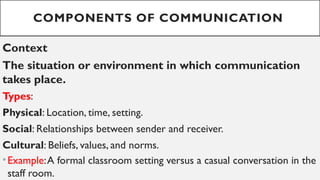
Context
The situation or environment in which communication
takes place.
Types:
Physical: Location, time, setting.
Social: Relationships between sender and receiver.
Cultural: Beliefs, values, and norms.
•Example:A formal classroom setting versus a casual conversation in the
staff room.
COMPONENTS OF COMMUNICATION
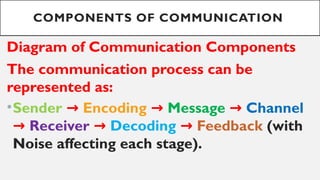
Diagram of Communication Components
The communication process can be
represented as:
•Sender → Encoding → Message → Channel
→ Receiver → Decoding → Feedback (with
Noise affecting each stage).
IMPORTANCE OF UNDERSTANDING
COMMUNICATION COMPONENTS IN
EDUCATION
EffectiveTeaching: Helps teachers convey
ideas clearly and receive feedback.
Engagement: Encourages interactive learning
and participation.
Conflict Resolution:Assists in managing
misunderstandings.

communication,types and components1.pptx

  • 1.
  • 2.
    COMMUNICATION • Definition: Communicationis the process of exchanging information, thoughts, and ideas through speech, writing, or non-verbal methods. • Components of Communication:Sender • Message • Channel • Receiver • Feedback • Noise (barriers to communication)
  • 3.
    TYPES OF COMMUNICATION •Communication can be classified into various types based on mode, context, and direction. Understanding these classifications is crucial for teachers to effectively interact with students, colleagues, and the community.
  • 4.
    TYPES OF COMMUNICATION •Basedon Mode •Verbal CommunicationInvolves the use of spoken or written words. •Examples: Lectures, discussions, conversations, emails, letters. •Advantages: •Clear and direct. •Immediate feedback. •Limitations: •Misunderstandings due to tone, vocabulary, or context
  • 5.
    TYPES OF COMMUNICATION Non-VerbalCommunication Involves the use of body language, facial expressions, gestures, posture, eye contact, and tone of voice. Examples: Smiling to show approval, maintaining eye contact for attention. Advantages: Enhances verbal communication. Universally understood in many cases. Limitations:
  • 6.
    TYPES OF COMMUNICATION •Basedon Direction • One-Way Communication • Information flows only from the sender to the receiver without feedback. • Examples:Announcements, instructions,TV or radio broadcasts. • Advantages: • Fast and efficient. • Suitable for large audiences. • Limitations: • No interaction or feedback. • Misunderstandings cannot be clarified.
  • 7.
    TYPES OF COMMUNICATION Two-WayCommunication Involves interaction with feedback from the receiver. Examples: Classroom discussions, interviews. Advantages: Promotes understanding and clarity. Encourages engagement. Limitations: • Time-consuming.
  • 8.
    TYPES OF COMMUNICATION Basedon Context Formal Communication Structured and follows predefined rules or protocols. Examples: Staff meetings, official letters, classroom teaching. Advantages: Professional and clear. Maintains authority and respect. Limitations: • May lack personal touch
  • 9.
    TYPES OF COMMUNICATION InformalCommunication Casual and spontaneous, often without any specific rules. Examples: Conversations with colleagues, friendly chats with students. Advantages: Builds rapport and trust. Encourages openness. Limitations: • May lead to misunderstandings if not handled
  • 10.
    TYPES OF COMMUNICATION Basedon the Purpose Instructional Communication Used to give directions, explain concepts, or provide guidance. Examples: Classroom lectures, demonstrations. Persuasive Communication Aimed at influencing opinions or motivating actions. Examples: Motivational talks, debates. Expressive Communication Focuses on sharing feelings, emotions, or thoughts.
  • 11.
    TYPES OF COMMUNICATION Basedon Channel Face-to-Face Communication Involves direct interaction in person. Examples: Classroom teaching, parent-teacher meetings. Advantages: Rich in verbal and non-verbal cues, immediate feedback. Mediated Communication Requires a medium or technology to convey the message. Examples: Phone calls, emails, video conferences.
  • 12.
    TYPES OF COMMUNICATION Basedon the Number of Participants Intrapersonal Communication Communication with oneself, such as self-reflection, thoughts, or internal dialogues. Examples: Planning lessons, self-assessment. Interpersonal Communication Direct communication between two or more individuals. •
  • 13.
    TYPES OF COMMUNICATION •Based onTiming • Synchronous Communication • Real-time communication. • Examples: Live classroom teaching, phone calls, video conferences. • Advantages: Immediate interaction and feedback. • Asynchronous Communication • Communication where feedback is delayed. • Examples: Emails, recorded lectures, letters.
  • 14.
    TYPES OF COMMUNICATION CulturalCommunication Communication that considers cultural norms, traditions, and values. • Examples: Respecting cultural gestures and language during lessons. • Importance of UnderstandingTypes of Communication in Education: • Enhances Teaching: Helps in delivering lessons effectively. • Builds Relationships: Strengthens teacher-student rapport. • Encourages Participation: Facilitates inclusive and interactive learning. • Manages Conflicts: Resolves misunderstandings efficiently.
  • 15.
    COMPONENTS OF COMMUNICATION • Thecommunication process involves several essential components that work together to ensure effective transmission and understanding of a message. Understanding these components is critical for teachers to communicate effectively in educational settings.
  • 16.
    COMPONENTS OF COMMUNICATION Sender(Source/Encoder) The person or entity initiating the communication. Role: Formulates and encodes the message. •Example:A teacher delivering a lecture
  • 17.
    COMPONENTS OF COMMUNICATION Message Theinformation, idea, or thought conveyed by the sender. Types: Verbal (spoken or written words). Non-verbal (gestures, body language, tone). • Example:A teacher explaining a math concept or giving homework instructions.
  • 18.
    COMPONENTS OF COMMUNICATION Encoding Theprocess of converting the message into a form (language, symbols, gestures) that can be transmitted and understood. Importance: Ensures the message is clear and meaningful. •Example:A teacher using a diagram to explain a concept.
  • 19.
    COMPONENTS OF COMMUNICATION Channel Themedium or method used to transmit the message from the sender to the receiver. Types: Oral (speech, phone calls). Written (letters, emails, text messages). Visual (charts, videos, images). •Example:A teacher using a projector or a textbook.
  • 20.
    COMPONENTS OF COMMUNICATION Receiver(Decoder) The person or audience for whom the message is intended. Role: Decodes the message and attempts to understand its meaning. •Example: Students listening to the teacher.
  • 21.
    COMPONENTS OF COMMUNICATION Decoding Theprocess by which the receiver interprets and makes sense of the message. Importance:The effectiveness of communication depends on how well the receiver understands the message. •Example: Students interpreting instructions given by the teacher.
  • 22.
    COMPONENTS OF COMMUNICATION Feedback Theresponse or reaction from the receiver, indicating whether the message was understood. Forms: Verbal (questions, comments). Non-verbal (nods, expressions). Importance: Helps the sender adjust or clarify the message if necessary. •Example:A student asking a question about a lesson.
  • 23.
    COMPONENTS OF COMMUNICATION Noise(Interference) Any factor that disrupts or distorts the communication process. Types: Physical Noise: Background sounds, poor lighting. Psychological Noise: Prejudices, emotions, stress. Semantic Noise: Misunderstanding due to language or jargon. • Example:A noisy classroom making it hard for students to hear the teacher
  • 24.
    COMPONENTS OF COMMUNICATION Context Thesituation or environment in which communication takes place. Types: Physical: Location, time, setting. Social: Relationships between sender and receiver. Cultural: Beliefs, values, and norms. •Example:A formal classroom setting versus a casual conversation in the staff room.
  • 25.
    COMPONENTS OF COMMUNICATION Diagramof Communication Components The communication process can be represented as: •Sender → Encoding → Message → Channel → Receiver → Decoding → Feedback (with Noise affecting each stage).
  • 26.
    IMPORTANCE OF UNDERSTANDING COMMUNICATIONCOMPONENTS IN EDUCATION EffectiveTeaching: Helps teachers convey ideas clearly and receive feedback. Engagement: Encourages interactive learning and participation. Conflict Resolution:Assists in managing misunderstandings.