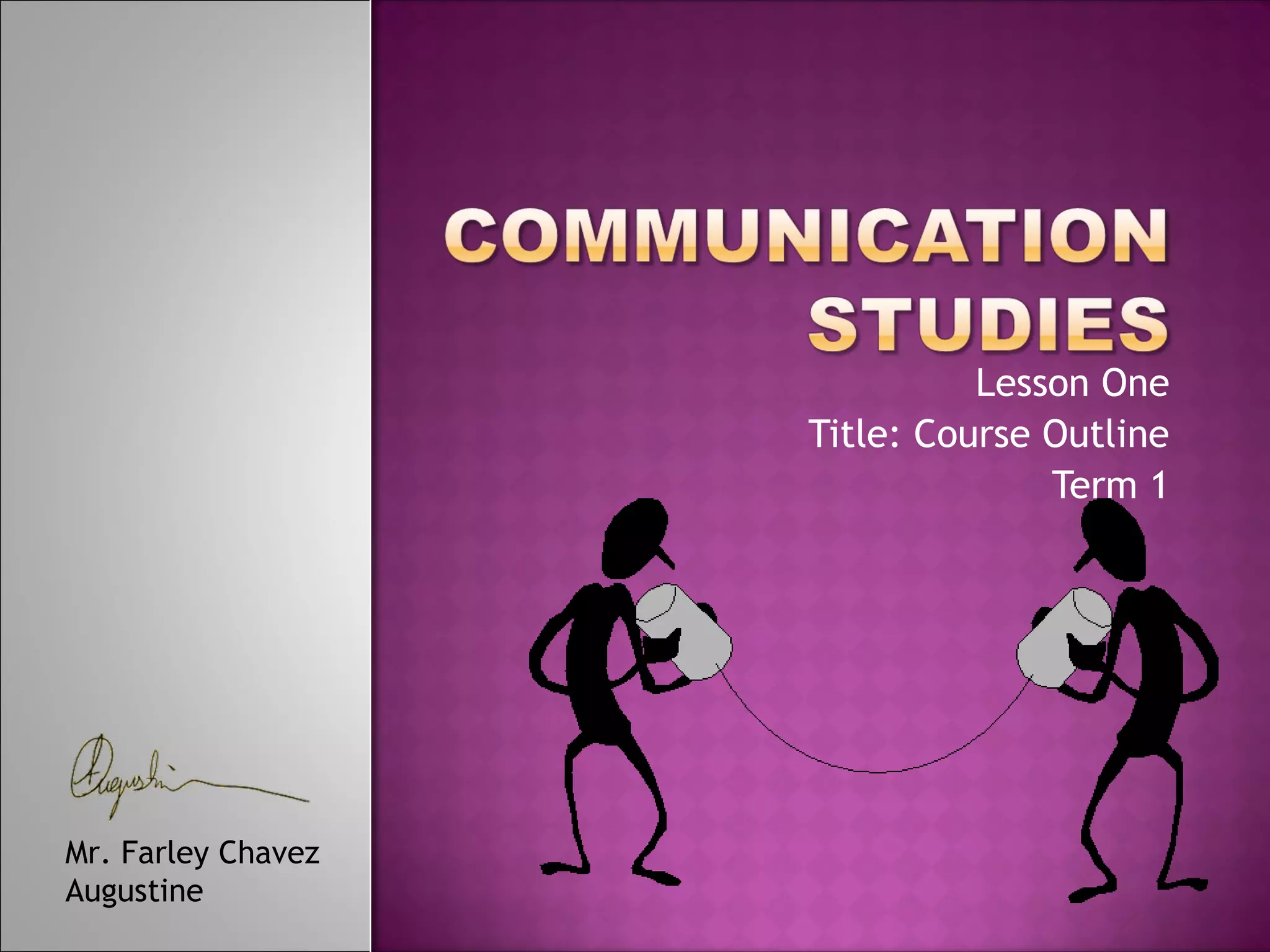
Lesson One Title: Course Outline Term 1 Mr. Farley Chavez Augustine
Communication Studies  is aimed at building one’s awareness of the  centrality of language  to the normal functioning of human beings and facilitates their ability to operate in the  Caribbean linguistic environment  and beyond.
The Syllabus consists of three modules: Module 1- Gathering and Processing Information Module 2- Language and Community Module 3- Speaking and Writing
Expression (oral & written) grammar, usage, word choice, spelling, punctuation, pronunciation,  enunciation, revising and editing drafts Comprehension Levels: literal, interpretive, analytical, application. Modes: efferent, aesthetic, critical. Genres: narrative/descriptive, expository, argumentative/persuasive Summary Skills Note taking, distinguishing main and subsidiary ideas, understanding logical linkages between ideas, formulating topic sentences and linking them to subsidiary ideas, sequencing, condensing, writing outlines, writing continuous prose summaries, editing drafts (peer  and self-evaluation)
Current Issues: Evaluating Sources Defining key concepts (authority, reliability, validity, bias,  fact, opinion); identifying a significant issue; sourcing  information: locating primary and secondary sources;  choosing from among sources; determining the  appropriateness of data collection methods; summarizing the  content of sources; evaluating the reliability and validity of  sources Organizing Skills (oral & written) Introductions and conclusions; focus and emphasis; logical  linkages, formatting, revising and editing drafts
Expression (oral & written) Same content areas as Module 1 Defining Language Characteristics of language- (Language as: human; verbal; symbolic; systematic <non-arbitrary>;  maturational; non-instinctive <naturally acquired>;  dynamic); differentiation between ‘language’  (generic) and ‘a language’ (individual); purposes of  language
Characteristics of English Creole Languages Language in the Society Influence of social, political and other cultural  factors on language and communication; the role  of languages; the influence of historical factors on  language in the region; attitudes to Caribbean  language; language in international situations;  language in interactive situations Technology, Culture and Communication Print, electronic; enhancing and facilitating  communication; the effects of technology
Expression (oral & written) Same content areas as Module 1 & 2 Process of Communication Elements of the process (sender, message,  channel/medium, receiver, feedback); mass media  and technology Forms of Communication Verbal, non-verbal, body language, use of space,  use of objects, dress, graphics
Contexts of Communication Intrapersonal, interpersonal, small group,  organizational, academic, public, intercultural Organizing Skills (oral & written) Same as Module 1 Types of Speaking and Writing Speaking: conversation; short expository, persuasive and argumentative speeches Writing: reflective (journals and diaries), academic  essays
Paper 01A (1 ½ hrs) Ten compulsory short-response questions >>25% (2 questions on module 1, 4 on module 2, 4 on module 3) Paper 01B (30min) Four compulsory questions from module 1 requiring short-responses >>5% Paper 02 (2 ½ hrs) Three compulsory questions, one on each module>>50%
Internal Assessment 20% Written Portfolios & Oral Examination *(Internal Assessments are to be completed in the second term)

Communication studies lecture 1

  • 1.
    Lesson One Title:Course Outline Term 1 Mr. Farley Chavez Augustine
  • 2.
    Communication Studies is aimed at building one’s awareness of the centrality of language to the normal functioning of human beings and facilitates their ability to operate in the Caribbean linguistic environment and beyond.
  • 3.
    The Syllabus consistsof three modules: Module 1- Gathering and Processing Information Module 2- Language and Community Module 3- Speaking and Writing
  • 4.
    Expression (oral &written) grammar, usage, word choice, spelling, punctuation, pronunciation, enunciation, revising and editing drafts Comprehension Levels: literal, interpretive, analytical, application. Modes: efferent, aesthetic, critical. Genres: narrative/descriptive, expository, argumentative/persuasive Summary Skills Note taking, distinguishing main and subsidiary ideas, understanding logical linkages between ideas, formulating topic sentences and linking them to subsidiary ideas, sequencing, condensing, writing outlines, writing continuous prose summaries, editing drafts (peer and self-evaluation)
  • 5.
    Current Issues: EvaluatingSources Defining key concepts (authority, reliability, validity, bias, fact, opinion); identifying a significant issue; sourcing information: locating primary and secondary sources; choosing from among sources; determining the appropriateness of data collection methods; summarizing the content of sources; evaluating the reliability and validity of sources Organizing Skills (oral & written) Introductions and conclusions; focus and emphasis; logical linkages, formatting, revising and editing drafts
  • 6.
    Expression (oral &written) Same content areas as Module 1 Defining Language Characteristics of language- (Language as: human; verbal; symbolic; systematic <non-arbitrary>; maturational; non-instinctive <naturally acquired>; dynamic); differentiation between ‘language’ (generic) and ‘a language’ (individual); purposes of language
  • 7.
    Characteristics of EnglishCreole Languages Language in the Society Influence of social, political and other cultural factors on language and communication; the role of languages; the influence of historical factors on language in the region; attitudes to Caribbean language; language in international situations; language in interactive situations Technology, Culture and Communication Print, electronic; enhancing and facilitating communication; the effects of technology
  • 8.
    Expression (oral &written) Same content areas as Module 1 & 2 Process of Communication Elements of the process (sender, message, channel/medium, receiver, feedback); mass media and technology Forms of Communication Verbal, non-verbal, body language, use of space, use of objects, dress, graphics
  • 9.
    Contexts of CommunicationIntrapersonal, interpersonal, small group, organizational, academic, public, intercultural Organizing Skills (oral & written) Same as Module 1 Types of Speaking and Writing Speaking: conversation; short expository, persuasive and argumentative speeches Writing: reflective (journals and diaries), academic essays
  • 10.
    Paper 01A (1½ hrs) Ten compulsory short-response questions >>25% (2 questions on module 1, 4 on module 2, 4 on module 3) Paper 01B (30min) Four compulsory questions from module 1 requiring short-responses >>5% Paper 02 (2 ½ hrs) Three compulsory questions, one on each module>>50%
  • 11.
    Internal Assessment 20%Written Portfolios & Oral Examination *(Internal Assessments are to be completed in the second term)

Editor's Notes

  • #2 Welcome all Students to 6 th form and the new term. Explain that this lesson is
  • #3 “ Centrality of the language” speaks to the fact that language is a universal function of every human beings. Every human being needs language (Speech or symbols or gestures). The Caribbean Linguistic Environment- Creoles, and inherited European languages.