MODULE - 2
Prepared By : Ms. Arti K. Gore-Sabale
Transmission Media
Transmission Media and Physical Layer
Classes of Transmission Media
Cabling
• Network cabling is the medium through which information
usually moves from one network device to another.
• There are several different types of cable commonly used in
LANS.
• Some networks use a variety of cable types within the one
network.
Twisted Pair Cable
Transmission Characteristics
 Analog - needs amplifiers every 5km to 6km
 Digital - can use either analog or digital signals
needs a repeater every 2-3km
 Limited distance & Limited bandwidth (1MHz)
 Limited data rate (100MHz)
 Susceptible to interference and noise
Unshielded Twisted Pair (UTP) Cable
• Twisted pair cables come in two varieties: shielded
and unshielded. Unshielded (UTP) is the most
popular.
• Shielded twisted pair is used only in environments
where there may be electrical interference.
UTP (continued)
• UTP has four pairs of wires inside the jacket
• Each pair is twisted with a different number of
twists per inch to help eliminate interference
from adjacent pairs.
UTP (continued)
UTP Connector
• The standard connector for UTP cabling is an RJ-45. It looks like
a telephone style connection.
 Applications:
 Telephone lines connecting subscribers to
the central office
 DSL lines
 LAN – 10Base-T &
100Base-T
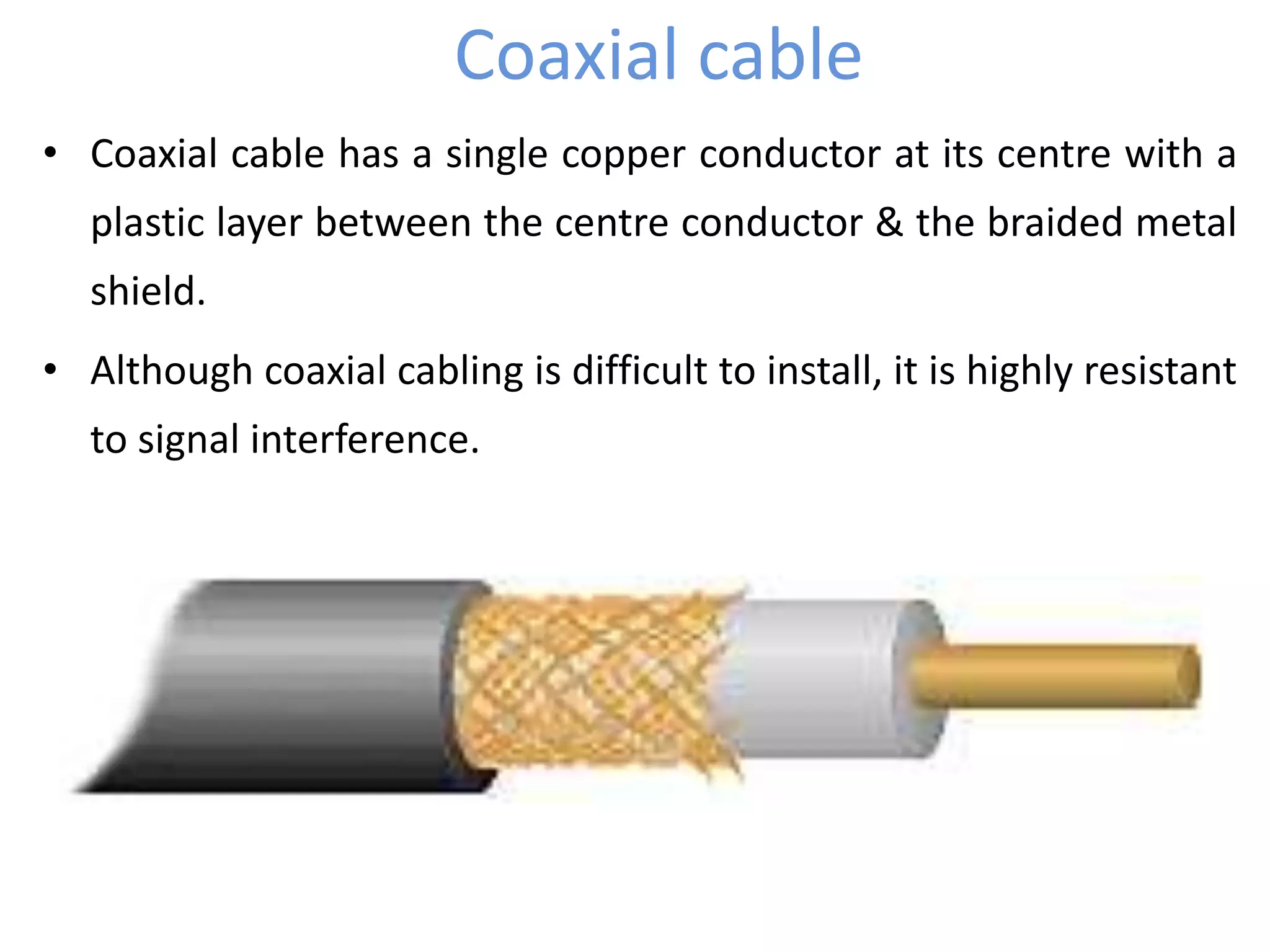
Coaxial cable
• Coaxial cable has a single copper conductor at its centre with a
plastic layer between the centre conductor & the braided metal
shield.
• Although coaxial cabling is difficult to install, it is highly resistant
to signal interference.
Coaxial cable connectors
• The most common type of connector used
with coaxial cables is the BNC connector.
• Superior frequency characteristics to TP.
• Performance limited by attenuation & noise
• Analog signals
- amplifiers every few km
- closer if higher frequency
- up to 500MHz
• Digital signals
- repeater every 1km
- closer for higher data rates
Coaxial Cable
Transmission Characteristics
Coaxial Cable Applications
• Most versatile medium
• Television distribution
• Long distance telephone transmission
• Can carry 10,000 voice calls simultaneously
• Short distance computer systems links
• Local area networks
Differences Between Coaxial Cable and
Twisted Pair
• Coaxial cables are generally used for cable
television and internet connections.
• Twisted pair cables are usually used for telephone
connections.
• Coaxial cables support greater cable lengths.
• Twisted pair cables are thinner and less expensive.
• Coaxial cables are better shielded from crosstalk.
• Twisted pair cables provide high transmission rates.
Fiber Optic Cable
• Fiber optic cabling consists of a center glass core surrounded by
several layers of protective materials
• It transmits light rather than electronic signals.
• It is the standard for connecting networks between buildings,
due to its immunity to the effects of moisture and light.
Fiber Optic (continued)
• Fiber optic cable has the ability to transmit signals over
much longer distances than coaxial or twisted pair.
• It can also carry information at vastly greater speeds.
• Fiber optic cable is more difficult to install than other
cabling.
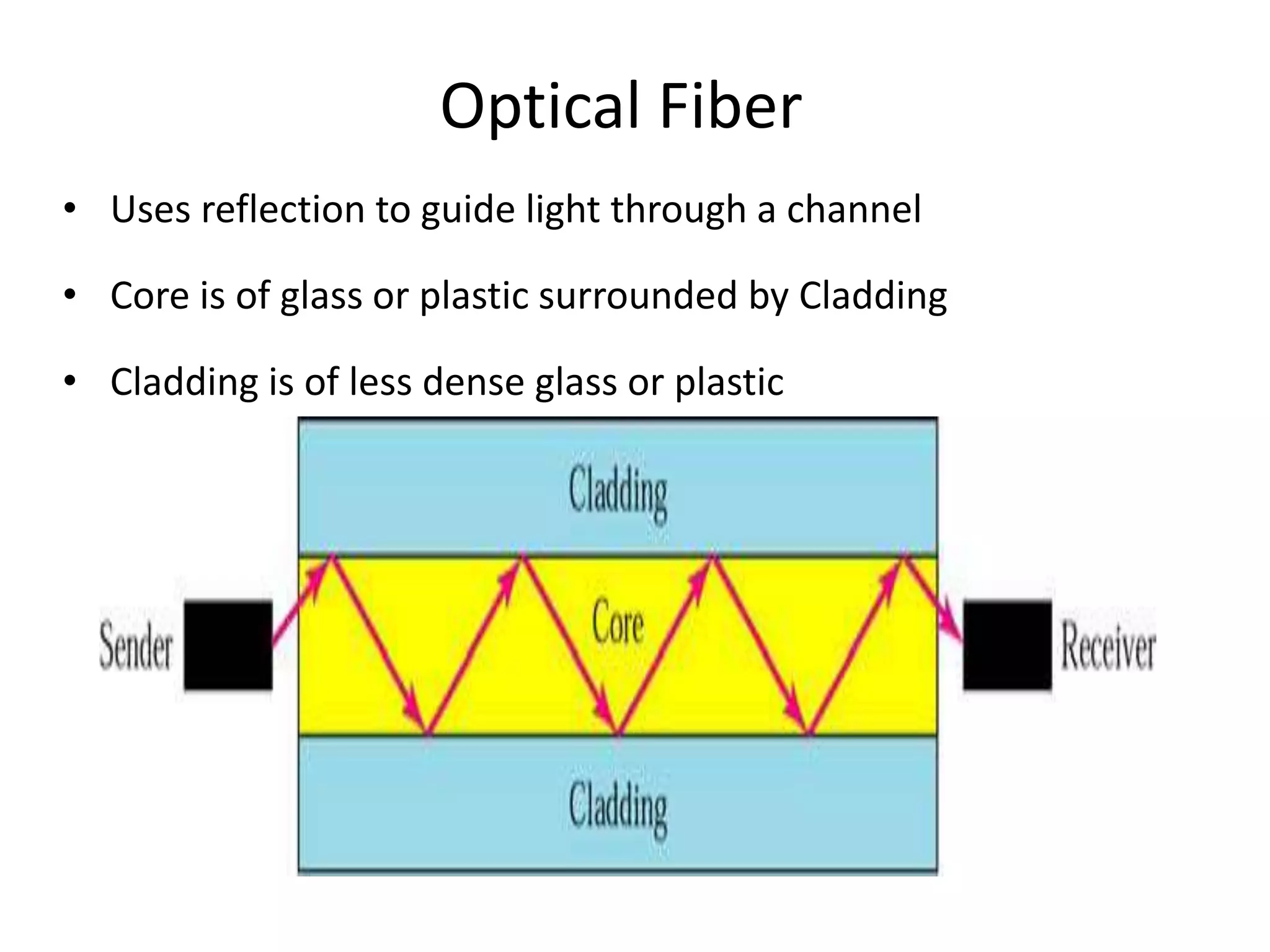
Optical Fiber
• Uses reflection to guide light through a channel
• Core is of glass or plastic surrounded by Cladding
• Cladding is of less dense glass or plastic
Optical Fiber Connector
Optical Fiber
Transmission Characteristics
• Uses total internal reflection to transmit light
– effectively acts as wave guide for 1014 to 1015 Hz
• Can use several different light sources
– Light Emitting Diode (LED)
• cheaper, wider operating temp range, lasts longer
– Injection Laser Diode (ILD)
• more efficient, has greater data rate
Optical Fiber Cable
 Applications:
 Backbone networks – SONET
 Cable TV – backbone
 LAN
 100Base-FX network (Fast Ethernet)
 100Base-X
Wireless Transmission Frequencies
• 2GHz to 40GHz
– Microwave , Highly directional , Point to point
– Satellite
• 30MHz to 1GHz
– Omnidirectional , Broadcast radio
• 3 x 10¹¹ to 2 x 10¹⁴
– Infrared , local
Unguided Media
Electromagnetic spectrum for wireless
communication
Bands
Unguided Media
Wireless transmission waves
Radio Waves
Omnidirectional Antenna
 Frequencies between 3 KHz & 1 GHz.
 Sending or receiving in all directions
Are used for multicasts
communications, such as radio &
television, and paging system.
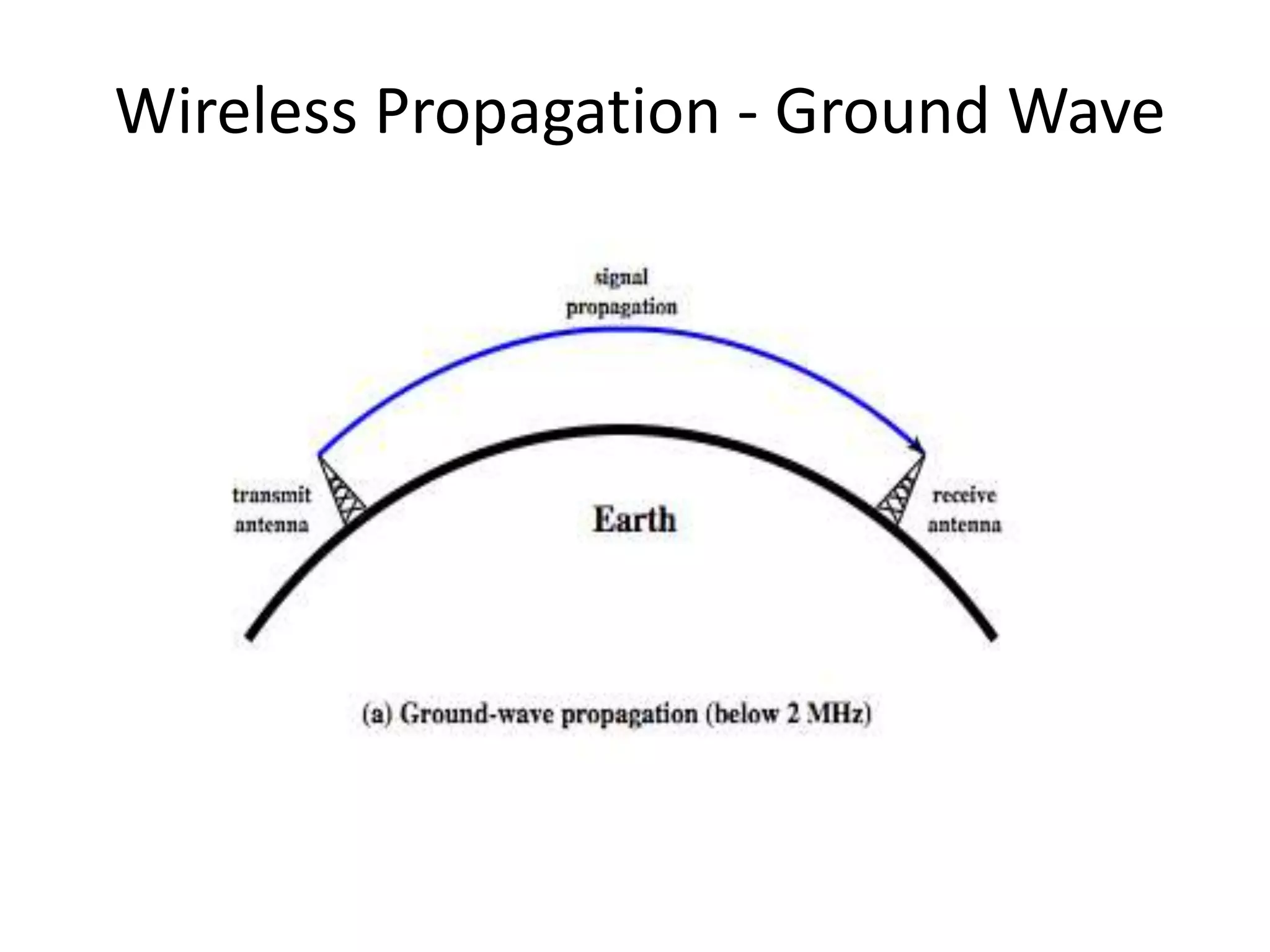
Wireless Propagation - Ground Wave
Wireless Propagation
Line of Sight
Terrestrial Microwave
• used for long haul (inter state / international)
telecommunications, short point-to-point links
• requires fewer repeaters but line of sight (unobstructed
vision)
• use a parabolic dish to focus a narrow beam onto a
receiver antenna
• 1-40 GHz frequencies
• higher frequencies give higher data rates
• Interference
Unguided Media – Microwaves
 Frequencies between 1 and 300 GHz.
 Used for unicast communication such as cellular phones,
satellite networks and wireless LANs.
Unidirectional Antenna
Satellite Microwave
• Satellite receives on one frequency, amplifies or
repeats signal and transmits on another
frequency e.g. uplink 5.925-6.425 GHz & downlink 3.7-4.2
GHz
• Typically requires geo-stationary orbit
– height of 35,784km
• Typical uses - television, long distance phone
private business networks, global positioning.
Satellite Point to Point Link
Satellite Broadcast Link
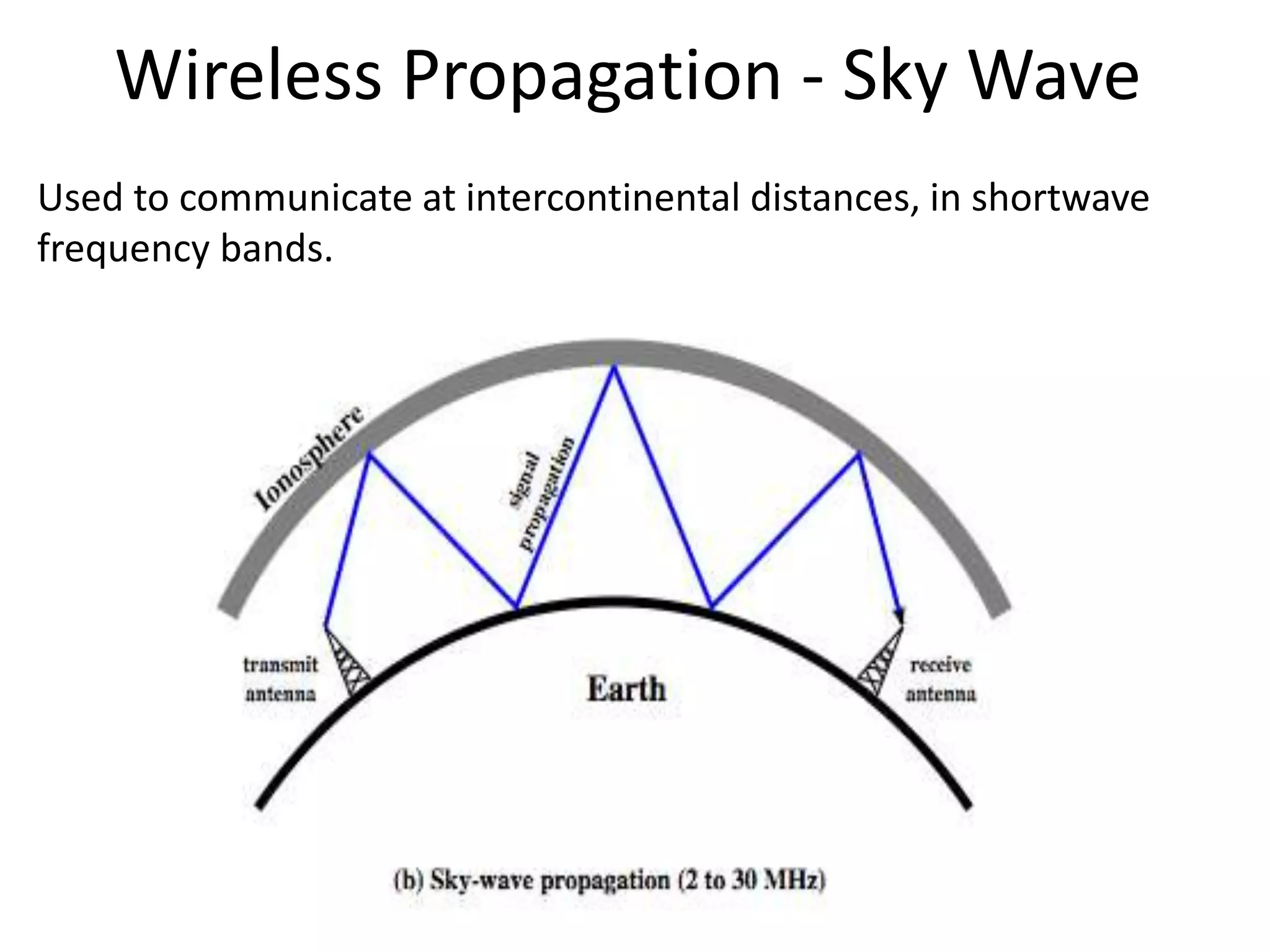
Wireless Propagation - Sky Wave
Used to communicate at intercontinental distances, in shortwave
frequency bands.
Infrared
 Frequencies between 300 GHz to 400 THz.
 Can not penetrate walls.
 Used for short-range communication in a closed area using line-
of-sight propagation.
 Modulate non-coherent infrared light
 End line of sight (or reflection)
 Are blocked by walls
 No licenses required
 Typical uses : TV remote control, IRD port
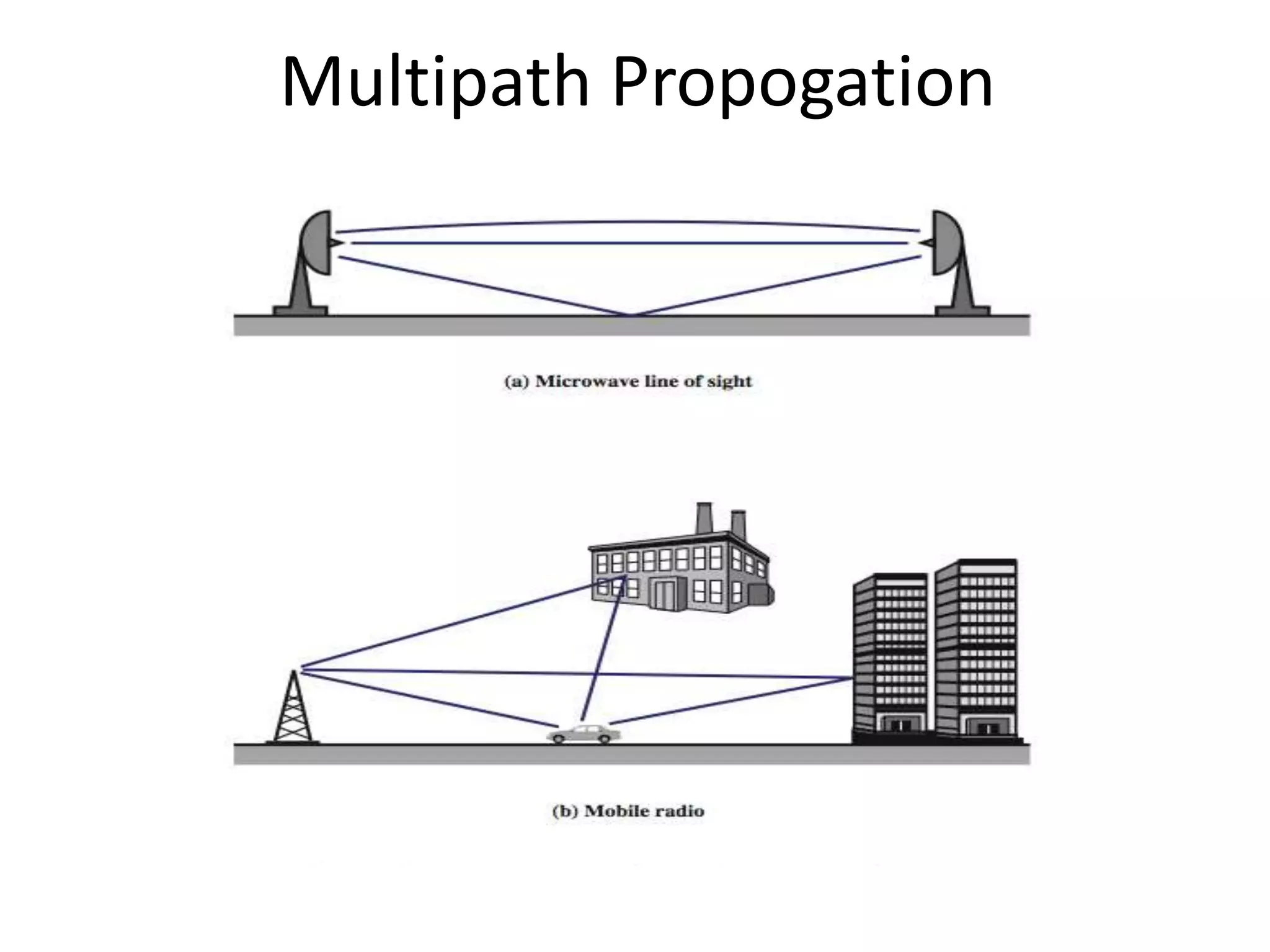
Multipath Propogation
Antennas
• Electrical conductor used to radiate electromagnetic energy
• Transmission antenna
– radio frequency energy from transmitter
– converted to electromagnetic energy by antenna
– radiated into surrounding environment
• Reception antenna
– electromagnetic energy impinging on antenna
– converted to radio frequency electrical energy
– fed to receiver
• Same antenna is often used for both purposes
Comparison of Media
• Medium Cost Speed Atten Interfere Security
• UTP Low 1-100M High High Low
• STP Medium 1-150M High Medium Low
• Coax Medium 1M–1G Medium Medium Low
• Fibre High 10M–2G Low Low High
• Radio Medium 1-10M Varies High Low
• Microwv High 1M–10G Varies High Medium
• Satellite High 1 M–10G Varies High Medium
• Cellular High 9.6–19.2K Low Medium Low
BLUETOOTH
BLUETOOTH
BLUETOOTH
BLUETOOTH
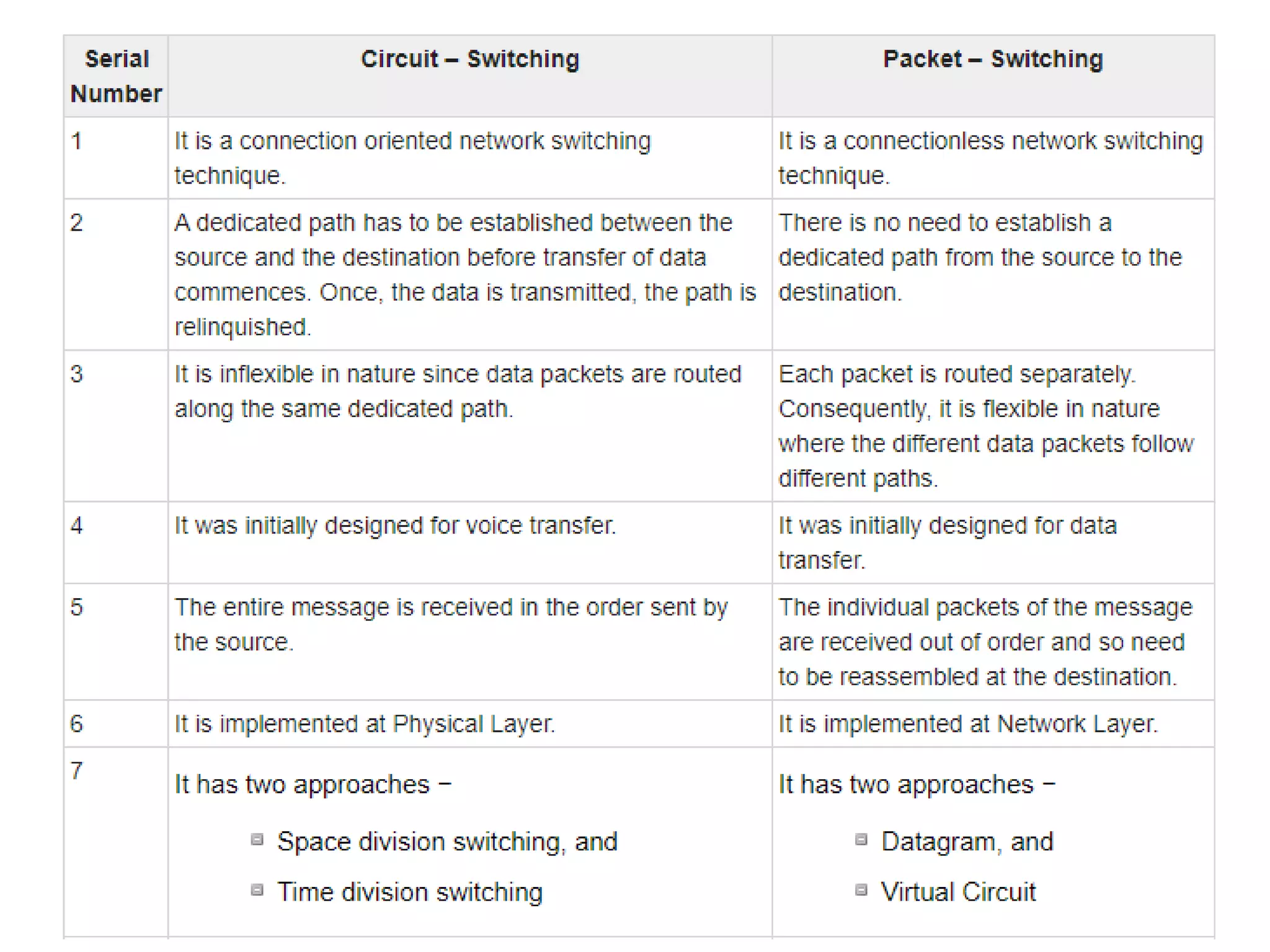
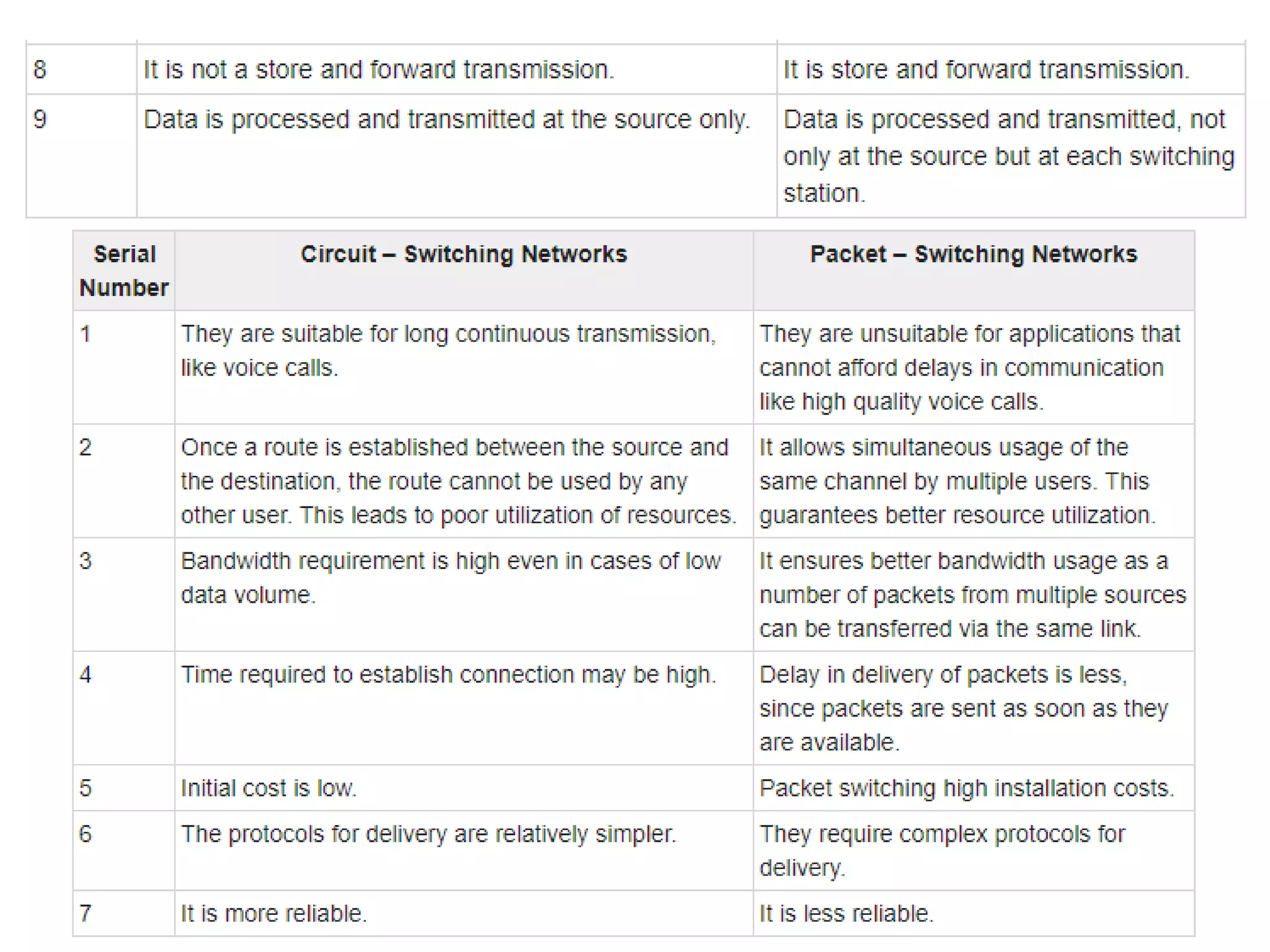
Circuit Switched & Packet Switched
Networks
• Circuit switched networks are connection-
oriented networks. Here, a dedicated route is
established between the source and the
destination and the entire message is
transferred through it.
• Packet switched networks are
connectionless networks.
END

Physical layer

  • 1.
    MODULE - 2 PreparedBy : Ms. Arti K. Gore-Sabale
  • 2.
  • 3.
  • 4.
    Cabling • Network cablingis the medium through which information usually moves from one network device to another. • There are several different types of cable commonly used in LANS. • Some networks use a variety of cable types within the one network.
  • 5.
    Twisted Pair Cable TransmissionCharacteristics  Analog - needs amplifiers every 5km to 6km  Digital - can use either analog or digital signals needs a repeater every 2-3km  Limited distance & Limited bandwidth (1MHz)  Limited data rate (100MHz)  Susceptible to interference and noise
  • 6.
    Unshielded Twisted Pair(UTP) Cable • Twisted pair cables come in two varieties: shielded and unshielded. Unshielded (UTP) is the most popular. • Shielded twisted pair is used only in environments where there may be electrical interference.
  • 7.
    UTP (continued) • UTPhas four pairs of wires inside the jacket • Each pair is twisted with a different number of twists per inch to help eliminate interference from adjacent pairs.
  • 8.
  • 9.
    UTP Connector • Thestandard connector for UTP cabling is an RJ-45. It looks like a telephone style connection.  Applications:  Telephone lines connecting subscribers to the central office  DSL lines  LAN – 10Base-T & 100Base-T
  • 10.
    Coaxial cable • Coaxialcable has a single copper conductor at its centre with a plastic layer between the centre conductor & the braided metal shield. • Although coaxial cabling is difficult to install, it is highly resistant to signal interference.
  • 11.
    Coaxial cable connectors •The most common type of connector used with coaxial cables is the BNC connector.
  • 12.
    • Superior frequencycharacteristics to TP. • Performance limited by attenuation & noise • Analog signals - amplifiers every few km - closer if higher frequency - up to 500MHz • Digital signals - repeater every 1km - closer for higher data rates Coaxial Cable Transmission Characteristics
  • 13.
    Coaxial Cable Applications •Most versatile medium • Television distribution • Long distance telephone transmission • Can carry 10,000 voice calls simultaneously • Short distance computer systems links • Local area networks
  • 14.
    Differences Between CoaxialCable and Twisted Pair • Coaxial cables are generally used for cable television and internet connections. • Twisted pair cables are usually used for telephone connections. • Coaxial cables support greater cable lengths. • Twisted pair cables are thinner and less expensive. • Coaxial cables are better shielded from crosstalk. • Twisted pair cables provide high transmission rates.
  • 15.
    Fiber Optic Cable •Fiber optic cabling consists of a center glass core surrounded by several layers of protective materials • It transmits light rather than electronic signals. • It is the standard for connecting networks between buildings, due to its immunity to the effects of moisture and light.
  • 16.
    Fiber Optic (continued) •Fiber optic cable has the ability to transmit signals over much longer distances than coaxial or twisted pair. • It can also carry information at vastly greater speeds. • Fiber optic cable is more difficult to install than other cabling.
  • 17.
    Optical Fiber • Usesreflection to guide light through a channel • Core is of glass or plastic surrounded by Cladding • Cladding is of less dense glass or plastic
  • 18.
  • 19.
    Optical Fiber Transmission Characteristics •Uses total internal reflection to transmit light – effectively acts as wave guide for 1014 to 1015 Hz • Can use several different light sources – Light Emitting Diode (LED) • cheaper, wider operating temp range, lasts longer – Injection Laser Diode (ILD) • more efficient, has greater data rate
  • 20.
    Optical Fiber Cable Applications:  Backbone networks – SONET  Cable TV – backbone  LAN  100Base-FX network (Fast Ethernet)  100Base-X
  • 21.
    Wireless Transmission Frequencies •2GHz to 40GHz – Microwave , Highly directional , Point to point – Satellite • 30MHz to 1GHz – Omnidirectional , Broadcast radio • 3 x 10¹¹ to 2 x 10¹⁴ – Infrared , local
  • 22.
    Unguided Media Electromagnetic spectrumfor wireless communication
  • 23.
  • 24.
  • 25.
    Radio Waves Omnidirectional Antenna Frequencies between 3 KHz & 1 GHz.  Sending or receiving in all directions Are used for multicasts communications, such as radio & television, and paging system.
  • 26.
  • 27.
  • 28.
    Terrestrial Microwave • usedfor long haul (inter state / international) telecommunications, short point-to-point links • requires fewer repeaters but line of sight (unobstructed vision) • use a parabolic dish to focus a narrow beam onto a receiver antenna • 1-40 GHz frequencies • higher frequencies give higher data rates • Interference
  • 29.
    Unguided Media –Microwaves  Frequencies between 1 and 300 GHz.  Used for unicast communication such as cellular phones, satellite networks and wireless LANs. Unidirectional Antenna
  • 30.
    Satellite Microwave • Satellitereceives on one frequency, amplifies or repeats signal and transmits on another frequency e.g. uplink 5.925-6.425 GHz & downlink 3.7-4.2 GHz • Typically requires geo-stationary orbit – height of 35,784km • Typical uses - television, long distance phone private business networks, global positioning.
  • 31.
  • 32.
  • 33.
    Wireless Propagation -Sky Wave Used to communicate at intercontinental distances, in shortwave frequency bands.
  • 34.
    Infrared  Frequencies between300 GHz to 400 THz.  Can not penetrate walls.  Used for short-range communication in a closed area using line- of-sight propagation.  Modulate non-coherent infrared light  End line of sight (or reflection)  Are blocked by walls  No licenses required  Typical uses : TV remote control, IRD port
  • 35.
  • 36.
    Antennas • Electrical conductorused to radiate electromagnetic energy • Transmission antenna – radio frequency energy from transmitter – converted to electromagnetic energy by antenna – radiated into surrounding environment • Reception antenna – electromagnetic energy impinging on antenna – converted to radio frequency electrical energy – fed to receiver • Same antenna is often used for both purposes
  • 37.
    Comparison of Media •Medium Cost Speed Atten Interfere Security • UTP Low 1-100M High High Low • STP Medium 1-150M High Medium Low • Coax Medium 1M–1G Medium Medium Low • Fibre High 10M–2G Low Low High • Radio Medium 1-10M Varies High Low • Microwv High 1M–10G Varies High Medium • Satellite High 1 M–10G Varies High Medium • Cellular High 9.6–19.2K Low Medium Low
  • 38.
  • 39.
  • 41.
  • 42.
  • 49.
    Circuit Switched &Packet Switched Networks • Circuit switched networks are connection- oriented networks. Here, a dedicated route is established between the source and the destination and the entire message is transferred through it. • Packet switched networks are connectionless networks.
  • 52.