Communication channels in
Organizations
• Organizations
Communication Networks
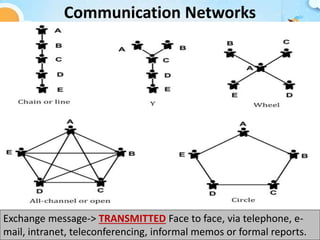
Exchange message-> TRANSMITTED Face to face, via telephone, e-
mail, intranet, teleconferencing, informal memos or formal reports.
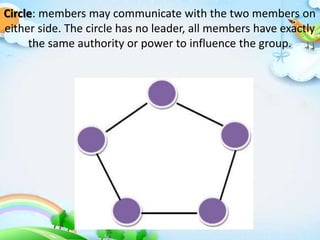
Circle: members may communicate with the two members on
either side. The circle has no leader, all members have exactly
the same authority or power to influence the group.
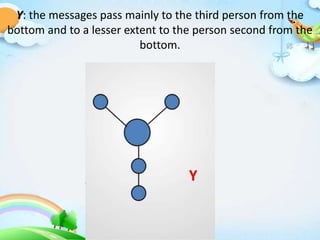
Y: the messages pass mainly to the third person from the
bottom and to a lesser extent to the person second from the
bottom.
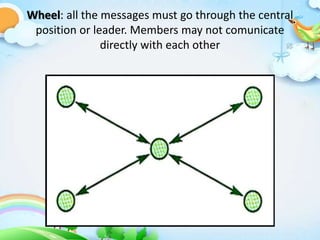
Wheel: all the messages must go through the central
position or leader. Members may not comunicate
directly with each other
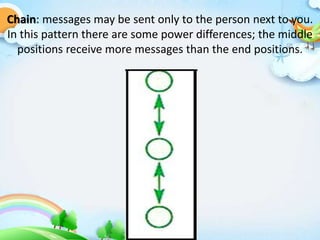
Chain: messages may be sent only to the person next to you.
In this pattern there are some power differences; the middle
positions receive more messages than the end positions.
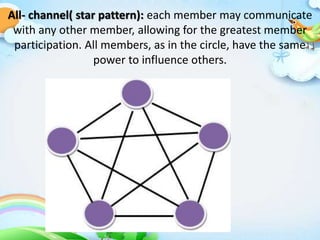
All- channel( star pattern): each member may communicate
with any other member, allowing for the greatest member
participation. All members, as in the circle, have the same
power to influence others.
Information Overload
 Is a condition in which a worker has to deal with an
excessive amount of information.
 Is created not only by the vast number of messages
that a worker receives, but also by the ambiguity and
complexity that often characterize such messages.
Problems:
- Absorb an enormous amount of time
- Make errors
- Cause the risk
- Seek to escape the overload by not accessing
information
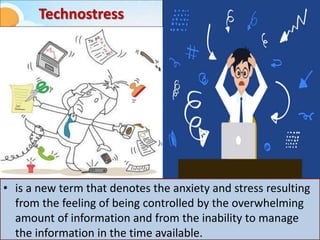
Technostress
• is a new term that denotes the anxiety and stress resulting
from the feeling of being controlled by the overwhelming
amount of information and from the inability to manage
the information in the time available.
Suggestions
 Think before passing on messages. Not all messages must
be passed on; not everyone needs to know everything.
 Use the messages as they come to you. Record the
relevent information and then throw them out or delete them.
Similarly, throw out or delete materials that contain information
that you can easily find elsewhere.
 Organize your messages. Create folders to help you store and
retrieve the information you need quickly.
 Get rid of extra copies. When you receive multiple copies that
you need. And back it up on your computer.
 Take inventory. Periodically take inventory of the messages you
receive regularly and, where appropriate, eliminate one or more
source of unnecessary messages.
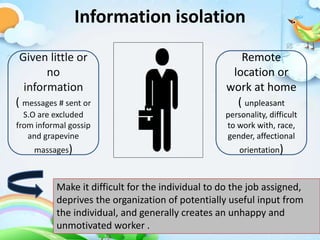
Information isolation
Given little or
no
information
( messages # sent or
S.O are excluded
from informal gossip
and grapevine
massages)
Remote
location or
work at home
( unpleasant
personality, difficult
to work with, race,
gender, affectional
orientation)
Make it difficult for the individual to do the job assigned,
deprives the organization of potentially useful input from
the individual, and generally creates an unhappy and
unmotivated worker .
Organizational Message Competence
1. Listen actively, empathically, critically, and in depth.
2. Apologize when you make an error.
3. Avoid contributing to iinformatin ooverloaf or information
isolation.
4. Use the grapevine appropriately.
5. Demonstrate the communication skills of leadership.
6. Avoid the variousism discussed: racist, heterosexist,
ageist, sexist.
7. Help manage conflict; don’t aggravate it, as some do, to
stir up excitement.
8. Use power effectively.
9. Understand the communication flow.
10. Prepare all messages as if they are going to be graded by
your instructor.

Communication channel in Organization

  • 1.
  • 3.
    Communication Networks Exchange message->TRANSMITTED Face to face, via telephone, e- mail, intranet, teleconferencing, informal memos or formal reports.
  • 4.
    Circle: members maycommunicate with the two members on either side. The circle has no leader, all members have exactly the same authority or power to influence the group.
  • 5.
    Y: the messagespass mainly to the third person from the bottom and to a lesser extent to the person second from the bottom.
  • 6.
    Wheel: all themessages must go through the central position or leader. Members may not comunicate directly with each other
  • 7.
    Chain: messages maybe sent only to the person next to you. In this pattern there are some power differences; the middle positions receive more messages than the end positions.
  • 8.
    All- channel( starpattern): each member may communicate with any other member, allowing for the greatest member participation. All members, as in the circle, have the same power to influence others.
  • 9.
    Information Overload  Isa condition in which a worker has to deal with an excessive amount of information.  Is created not only by the vast number of messages that a worker receives, but also by the ambiguity and complexity that often characterize such messages. Problems: - Absorb an enormous amount of time - Make errors - Cause the risk - Seek to escape the overload by not accessing information
  • 10.
    Technostress • is anew term that denotes the anxiety and stress resulting from the feeling of being controlled by the overwhelming amount of information and from the inability to manage the information in the time available.
  • 11.
    Suggestions  Think beforepassing on messages. Not all messages must be passed on; not everyone needs to know everything.  Use the messages as they come to you. Record the relevent information and then throw them out or delete them. Similarly, throw out or delete materials that contain information that you can easily find elsewhere.  Organize your messages. Create folders to help you store and retrieve the information you need quickly.  Get rid of extra copies. When you receive multiple copies that you need. And back it up on your computer.  Take inventory. Periodically take inventory of the messages you receive regularly and, where appropriate, eliminate one or more source of unnecessary messages.
  • 12.
    Information isolation Given littleor no information ( messages # sent or S.O are excluded from informal gossip and grapevine massages) Remote location or work at home ( unpleasant personality, difficult to work with, race, gender, affectional orientation) Make it difficult for the individual to do the job assigned, deprives the organization of potentially useful input from the individual, and generally creates an unhappy and unmotivated worker .
  • 13.
    Organizational Message Competence 1.Listen actively, empathically, critically, and in depth. 2. Apologize when you make an error. 3. Avoid contributing to iinformatin ooverloaf or information isolation. 4. Use the grapevine appropriately. 5. Demonstrate the communication skills of leadership. 6. Avoid the variousism discussed: racist, heterosexist, ageist, sexist. 7. Help manage conflict; don’t aggravate it, as some do, to stir up excitement. 8. Use power effectively. 9. Understand the communication flow. 10. Prepare all messages as if they are going to be graded by your instructor.