Abid Zafar
Spring 2015
Organizational Communication
International Islamic University Islamabad
 Any type of electronic equipment which is utilized for
communicating a message
 Electronic equipment can be smartphones, tablets, cell phones,
laptops and desktops, etc.
1. http://study.com/academy/lesson/computer-mediated-communication-in-organizations-definition-types-advantages.html
 Technologically-mediated communication (TMC) is a process
in which human data interaction occurs through one or more
networked telecommunication systems.
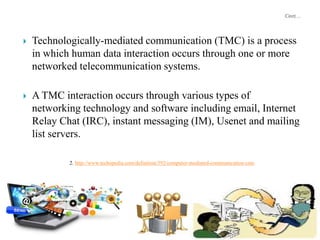
 A TMC interaction occurs through various types of
networking technology and software including email, Internet
Relay Chat (IRC), instant messaging (IM), Usenet and mailing
list servers.
2. http://www.techopedia.com/definition/392/computer-mediated-communication-cmc
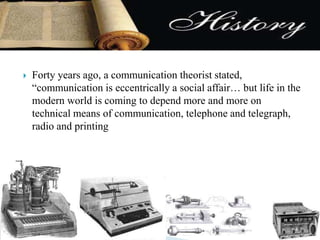
 Forty years ago, a communication theorist stated,
“communication is eccentrically a social affair… but life in the
modern world is coming to depend more and more on
technical means of communication, telephone and telegraph,
radio and printing
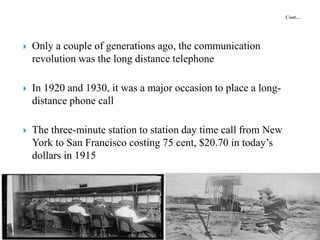
 Only a couple of generations ago, the communication
revolution was the long distance telephone
 In 1920 and 1930, it was a major occasion to place a long-
distance phone call
 The three-minute station to station day time call from New
York to San Francisco costing 75 cent, $20.70 in today’s
dollars in 1915
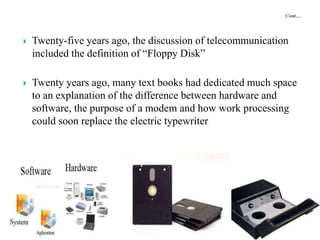
 Twenty-five years ago, the discussion of telecommunication
included the definition of “Floppy Disk”
 Twenty years ago, many text books had dedicated much space
to an explanation of the difference between hardware and
software, the purpose of a modem and how work processing
could soon replace the electric typewriter
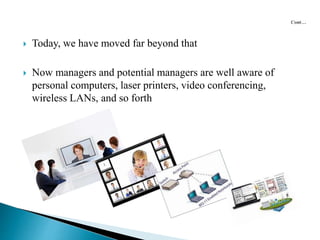
 Today, we have moved far beyond that
 Now managers and potential managers are well aware of
personal computers, laser printers, video conferencing,
wireless LANs, and so forth
 An organization can not exist without communication,
especially the type of communication to keep the employees
well-informed about the organization's business vision and
strategy as well as to help every individual in the organization
work together with a common purpose.
 Communication is central to organizations because it helps
create shared meanings, norms and culture of the organization
(Gumus, 2007)
 Many companies have begun to treat new communication
technologies as an important investment for creating a new
paradigm for workplace communication
 The major developments in technology have found
communication being mediated in a number of revolutionary
new ways…communication was transformed (Thurlow et al.,
2004: 26)
 The range of technologies introduced into the workplace in
recent years such as electronic mail, instant messaging, voice
mail, audio and video conferencing, computer conferencing,
World Wide Web and wireless networks usage have been
increased (Miller, 2009)
3. http://search.taylors.edu.my/journalonline/Vol%203/Catherine%28edSP%2901-12.pdf
 Communication channels are the means through which people
in an organization communicate
 Thought must be given to what channels are used to complete
various tasks, because using an inappropriate channel for a
task or interaction can lead to negative consequences
 Complex messages require richer channels of communication
that facilitate interaction to ensure clarity
4. http://smallbusiness.chron.com/communication-channels-within-organization-61447.html
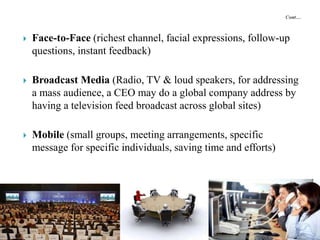
 Face-to-Face (richest channel, facial expressions, follow-up
questions, instant feedback)
 Broadcast Media (Radio, TV & loud speakers, for addressing
a mass audience, a CEO may do a global company address by
having a television feed broadcast across global sites)
 Mobile (small groups, meeting arrangements, specific
message for specific individuals, saving time and efforts)
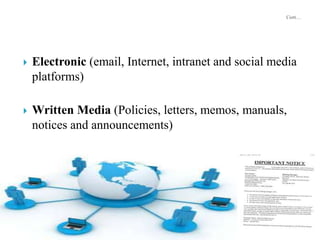
 Electronic (email, Internet, intranet and social media
platforms)
 Written Media (Policies, letters, memos, manuals,
notices and announcements)
 The development and use of the Internet has changed the way
we communicate with each other
 This change extends to personal and business communications
 The instantaneous nature of electronic communication has
expanded our reach and created a world without boundaries
 Much business Communication now occurs electronically and
this trend in now to increase
 For better and worse, a manager can leave the office early,
goes to home, put on dinner and then compose a report or
instructions that will be on the boss’ or subordinates’s
electronic desks at the next morning
5. http://www.ehow.com/list_7417103_electronic-communication-tools.html
a) Telephoning
b) Faxes
c) Telecommunicating & Satellite Video Conferencing
d) Cellular Phones and Beepers
e) Websites
f) E-mail
g) Voice mail
h) Instant Messaging
i) Blogs
j) Social Networking Websites etc.
6. http://www.geekhowtos.com/different-types-of-electronic-communications/
 The ability to work anywhere at any time
 Employees also have the ability to multi-task
 Constant flow of ideas
 Timely sharing of ideas
 Supports open discussion and exploration
 Provides the capability to store, process and transmit messages
 Relationship Building
 Collaboration
 Documentation
 Instant Feedback
7. http://www.uky.edu/~drlane/techno/cmcasset.htm
8. http://smallbusiness.chron.com/advantages-technologybased-communication-24971.html
 Technology overload (constant influx of work and information
through technology)
 Too much information
 Changes group interaction
 Security Issues
 Equipment Expense
 Confidentiality & trust issues
 Frustration and stress due to sensory and data overload
 Informal Learning
 Miscommunication
http://denvertechnology.blogspot.com/2012/11/advantages-and-disadvantages-of.html
http://smallbusiness.chron.com/disadvantages-business-communication-technology-1799.html
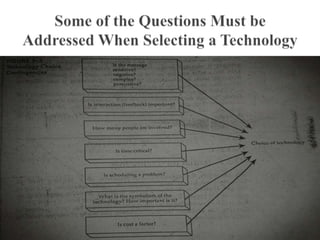
 All technologies are not suitable for all types of message
 Technologies are selected according to the types of messages
 The main challenge is to consider the message and how it fits
in to the various categories, and then to match it with the
appropriate technology
 In this way, messages are categorized along these continuums
1. Message Sensitivity
2. Message Negativity
3. Message Complexity
4. Message Persuasiveness
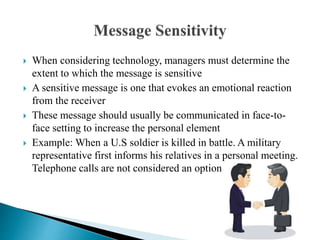
 When considering technology, managers must determine the
extent to which the message is sensitive
 A sensitive message is one that evokes an emotional reaction
from the receiver
 These message should usually be communicated in face-to-
face setting to increase the personal element
 Example: When a U.S soldier is killed in battle. A military
representative first informs his relatives in a personal meeting.
Telephone calls are not considered an option
 Sending negative message in organizations, managers
should generally be sensitive to the receiver.
 Consequently, the extent to which a message is
negative and the extent to which it is sensitive are
highly related
 Another important consideration exists when
communicating negative messages via technology.
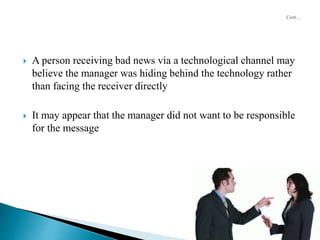
 A person receiving bad news via a technological channel may
believe the manager was hiding behind the technology rather
than facing the receiver directly
 It may appear that the manager did not want to be responsible
for the message
 As a result, every one has complained to a company about
poor service
 Contemporary organizations are making efforts to balance
“high tech” and “high touch”
 Addressing employees and customers by name in mass
mailing
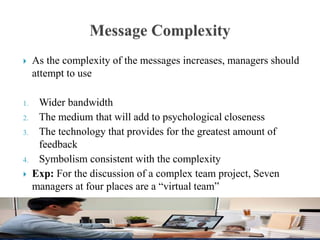
 As the complexity of the messages increases, managers should
attempt to use
1. Wider bandwidth
2. The medium that will add to psychological closeness
3. The technology that provides for the greatest amount of
feedback
4. Symbolism consistent with the complexity
 Exp: For the discussion of a complex team project, Seven
managers at four places are a “virtual team”
 A number of viable solutions exist for communicating
complex messages, without getting everyone together face-to-
face
 Fax, e-mail attachments, shared databases and conference calls
are the norms for electronic communication
 Persuasive messages involve an effort to induce a receiver to
take a particular action
 It is not an effort to fool, seduce or manipulate the receiver.
Rather, it is an attempt to get employees to comply with
behaviors that will meet the goals of the organization
 When thinking of persuasion, salespeople probably come to
mind
 However, manager frequently use persuasion, influence tactics
to effect employees to perform particular action
 According to a popular Book “Influence”: The New
Psychology of Modern Persuasion, managers can easily
persuade those
a) Who like them
b) Those who perceive the persuader an authority
c) Those who are more closer to the managers
 If one were to speculate about what developments would
affect managerial communication in the future, any number of
possibilities would exist. However, several safe projections
can be made
1. Technology will simply be used more
2. Decision making will be affected
3. Job and organizational design will be altered
4. Mediated collaborative writing will be common
 An estimated 11 billion e-mails are sent each day worldwide,
triple the level of 1999
 Nearly one in ten workers say that they would need two or
more days to catch up on e-mails if they went on a two week
vacation
 56% of workers surveyed by USA Today believe that e-mail
increase their productivity
 One-third of chief information officers say “losing e-mail
system for a week would be more traumatic than getting
divorced
 According to a survey by computer storage company Veritas,
the risk of sensory overload, rather than motivating managers
to ignore technological media or use an assistant to sort and
redirect the crush of message
 John Scully, the former CEO of Apple Computers was
infamous for not allowing employees to send him e-mail
messages
 The president of Southwest Airlines, Colleen Barrett doesn’t
have an e-mail address and only recently acquired a cell
phone. She thinks, email is very impersonal
 Decision making requires that managers scan for
pertinent information
 Most decisions on the topic generally contain two major
stages
1. Problem identification stage
2. Solution Identification stage
 In both stages, the more information available, the greater
the possibility that effective decision will be made
 More and more information is available with increased in
technologies
 Increasing communication technology will allow managers to
monitor more closely the standard expected from a job
performance
 A subordinate can get to a manager at any time and managers
can communicate with their subordinates regardless of
distance and time and time barriers
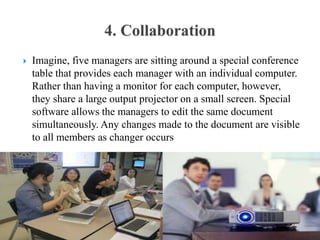
 Imagine, five managers are sitting around a special conference
table that provides each manager with an individual computer.
Rather than having a monitor for each computer, however,
they share a large output projector on a small screen. Special
software allows the managers to edit the same document
simultaneously. Any changes made to the document are visible
to all members as changer occurs
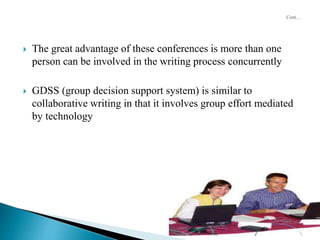
 The great advantage of these conferences is more than one
person can be involved in the writing process concurrently
 GDSS (group decision support system) is similar to
collaborative writing in that it involves group effort mediated
by technology
 It means that they must become sensitive to select the correct
type of communication channel to use in different situations
 It means, managers must learn to use these new technologies
 It means another dimension has been added to managerial
communication
 A whole new dimension has been added to the manager’s job:
understanding and selecting the correct communication
technology
 Now, new alternative are available requiring strategic
decisions
 If managers don’t learn how to make these strategic decisions,
their jobs could be in jeopardy
 In America, a trillion dollars a year is spent on IT. When
compared to our GDP of about $9 trillion, it’s clear, how
committed U.S. business is to IT
Technologically/Computer Mediated Communication

Technologically/Computer Mediated Communication

  • 2.
    Abid Zafar Spring 2015 OrganizationalCommunication International Islamic University Islamabad
  • 3.
     Any typeof electronic equipment which is utilized for communicating a message  Electronic equipment can be smartphones, tablets, cell phones, laptops and desktops, etc. 1. http://study.com/academy/lesson/computer-mediated-communication-in-organizations-definition-types-advantages.html
  • 4.
     Technologically-mediated communication(TMC) is a process in which human data interaction occurs through one or more networked telecommunication systems.  A TMC interaction occurs through various types of networking technology and software including email, Internet Relay Chat (IRC), instant messaging (IM), Usenet and mailing list servers. 2. http://www.techopedia.com/definition/392/computer-mediated-communication-cmc
  • 5.
     Forty yearsago, a communication theorist stated, “communication is eccentrically a social affair… but life in the modern world is coming to depend more and more on technical means of communication, telephone and telegraph, radio and printing
  • 6.
     Only acouple of generations ago, the communication revolution was the long distance telephone  In 1920 and 1930, it was a major occasion to place a long- distance phone call  The three-minute station to station day time call from New York to San Francisco costing 75 cent, $20.70 in today’s dollars in 1915
  • 7.
     Twenty-five yearsago, the discussion of telecommunication included the definition of “Floppy Disk”  Twenty years ago, many text books had dedicated much space to an explanation of the difference between hardware and software, the purpose of a modem and how work processing could soon replace the electric typewriter
  • 8.
     Today, wehave moved far beyond that  Now managers and potential managers are well aware of personal computers, laser printers, video conferencing, wireless LANs, and so forth
  • 9.
     An organizationcan not exist without communication, especially the type of communication to keep the employees well-informed about the organization's business vision and strategy as well as to help every individual in the organization work together with a common purpose.  Communication is central to organizations because it helps create shared meanings, norms and culture of the organization (Gumus, 2007)
  • 10.
     Many companieshave begun to treat new communication technologies as an important investment for creating a new paradigm for workplace communication  The major developments in technology have found communication being mediated in a number of revolutionary new ways…communication was transformed (Thurlow et al., 2004: 26)
  • 11.
     The rangeof technologies introduced into the workplace in recent years such as electronic mail, instant messaging, voice mail, audio and video conferencing, computer conferencing, World Wide Web and wireless networks usage have been increased (Miller, 2009) 3. http://search.taylors.edu.my/journalonline/Vol%203/Catherine%28edSP%2901-12.pdf
  • 12.
     Communication channelsare the means through which people in an organization communicate  Thought must be given to what channels are used to complete various tasks, because using an inappropriate channel for a task or interaction can lead to negative consequences  Complex messages require richer channels of communication that facilitate interaction to ensure clarity 4. http://smallbusiness.chron.com/communication-channels-within-organization-61447.html
  • 13.
     Face-to-Face (richestchannel, facial expressions, follow-up questions, instant feedback)  Broadcast Media (Radio, TV & loud speakers, for addressing a mass audience, a CEO may do a global company address by having a television feed broadcast across global sites)  Mobile (small groups, meeting arrangements, specific message for specific individuals, saving time and efforts)
  • 14.
     Electronic (email,Internet, intranet and social media platforms)  Written Media (Policies, letters, memos, manuals, notices and announcements)
  • 15.
     The developmentand use of the Internet has changed the way we communicate with each other  This change extends to personal and business communications  The instantaneous nature of electronic communication has expanded our reach and created a world without boundaries
  • 16.
     Much businessCommunication now occurs electronically and this trend in now to increase  For better and worse, a manager can leave the office early, goes to home, put on dinner and then compose a report or instructions that will be on the boss’ or subordinates’s electronic desks at the next morning 5. http://www.ehow.com/list_7417103_electronic-communication-tools.html
  • 17.
    a) Telephoning b) Faxes c)Telecommunicating & Satellite Video Conferencing d) Cellular Phones and Beepers e) Websites f) E-mail g) Voice mail h) Instant Messaging i) Blogs j) Social Networking Websites etc. 6. http://www.geekhowtos.com/different-types-of-electronic-communications/
  • 18.
     The abilityto work anywhere at any time  Employees also have the ability to multi-task  Constant flow of ideas  Timely sharing of ideas  Supports open discussion and exploration  Provides the capability to store, process and transmit messages  Relationship Building  Collaboration  Documentation  Instant Feedback 7. http://www.uky.edu/~drlane/techno/cmcasset.htm 8. http://smallbusiness.chron.com/advantages-technologybased-communication-24971.html
  • 19.
     Technology overload(constant influx of work and information through technology)  Too much information  Changes group interaction  Security Issues  Equipment Expense  Confidentiality & trust issues  Frustration and stress due to sensory and data overload  Informal Learning  Miscommunication http://denvertechnology.blogspot.com/2012/11/advantages-and-disadvantages-of.html http://smallbusiness.chron.com/disadvantages-business-communication-technology-1799.html
  • 20.
     All technologiesare not suitable for all types of message  Technologies are selected according to the types of messages  The main challenge is to consider the message and how it fits in to the various categories, and then to match it with the appropriate technology
  • 21.
     In thisway, messages are categorized along these continuums 1. Message Sensitivity 2. Message Negativity 3. Message Complexity 4. Message Persuasiveness
  • 22.
     When consideringtechnology, managers must determine the extent to which the message is sensitive  A sensitive message is one that evokes an emotional reaction from the receiver  These message should usually be communicated in face-to- face setting to increase the personal element  Example: When a U.S soldier is killed in battle. A military representative first informs his relatives in a personal meeting. Telephone calls are not considered an option
  • 23.
     Sending negativemessage in organizations, managers should generally be sensitive to the receiver.  Consequently, the extent to which a message is negative and the extent to which it is sensitive are highly related  Another important consideration exists when communicating negative messages via technology.
  • 24.
     A personreceiving bad news via a technological channel may believe the manager was hiding behind the technology rather than facing the receiver directly  It may appear that the manager did not want to be responsible for the message
  • 25.
     As aresult, every one has complained to a company about poor service  Contemporary organizations are making efforts to balance “high tech” and “high touch”  Addressing employees and customers by name in mass mailing
  • 26.
     As thecomplexity of the messages increases, managers should attempt to use 1. Wider bandwidth 2. The medium that will add to psychological closeness 3. The technology that provides for the greatest amount of feedback 4. Symbolism consistent with the complexity  Exp: For the discussion of a complex team project, Seven managers at four places are a “virtual team”
  • 27.
     A numberof viable solutions exist for communicating complex messages, without getting everyone together face-to- face  Fax, e-mail attachments, shared databases and conference calls are the norms for electronic communication
  • 28.
     Persuasive messagesinvolve an effort to induce a receiver to take a particular action  It is not an effort to fool, seduce or manipulate the receiver. Rather, it is an attempt to get employees to comply with behaviors that will meet the goals of the organization  When thinking of persuasion, salespeople probably come to mind  However, manager frequently use persuasion, influence tactics to effect employees to perform particular action
  • 29.
     According toa popular Book “Influence”: The New Psychology of Modern Persuasion, managers can easily persuade those a) Who like them b) Those who perceive the persuader an authority c) Those who are more closer to the managers
  • 30.
     If onewere to speculate about what developments would affect managerial communication in the future, any number of possibilities would exist. However, several safe projections can be made 1. Technology will simply be used more 2. Decision making will be affected 3. Job and organizational design will be altered 4. Mediated collaborative writing will be common
  • 31.
     An estimated11 billion e-mails are sent each day worldwide, triple the level of 1999  Nearly one in ten workers say that they would need two or more days to catch up on e-mails if they went on a two week vacation  56% of workers surveyed by USA Today believe that e-mail increase their productivity  One-third of chief information officers say “losing e-mail system for a week would be more traumatic than getting divorced
  • 32.
     According toa survey by computer storage company Veritas, the risk of sensory overload, rather than motivating managers to ignore technological media or use an assistant to sort and redirect the crush of message  John Scully, the former CEO of Apple Computers was infamous for not allowing employees to send him e-mail messages  The president of Southwest Airlines, Colleen Barrett doesn’t have an e-mail address and only recently acquired a cell phone. She thinks, email is very impersonal
  • 33.
     Decision makingrequires that managers scan for pertinent information  Most decisions on the topic generally contain two major stages 1. Problem identification stage 2. Solution Identification stage  In both stages, the more information available, the greater the possibility that effective decision will be made  More and more information is available with increased in technologies
  • 34.
     Increasing communicationtechnology will allow managers to monitor more closely the standard expected from a job performance  A subordinate can get to a manager at any time and managers can communicate with their subordinates regardless of distance and time and time barriers
  • 35.
     Imagine, fivemanagers are sitting around a special conference table that provides each manager with an individual computer. Rather than having a monitor for each computer, however, they share a large output projector on a small screen. Special software allows the managers to edit the same document simultaneously. Any changes made to the document are visible to all members as changer occurs
  • 36.
     The greatadvantage of these conferences is more than one person can be involved in the writing process concurrently  GDSS (group decision support system) is similar to collaborative writing in that it involves group effort mediated by technology
  • 37.
     It meansthat they must become sensitive to select the correct type of communication channel to use in different situations  It means, managers must learn to use these new technologies  It means another dimension has been added to managerial communication  A whole new dimension has been added to the manager’s job: understanding and selecting the correct communication technology
  • 38.
     Now, newalternative are available requiring strategic decisions  If managers don’t learn how to make these strategic decisions, their jobs could be in jeopardy  In America, a trillion dollars a year is spent on IT. When compared to our GDP of about $9 trillion, it’s clear, how committed U.S. business is to IT