Tarun solanki, S K College Of Business Management,
What is a Network? Wikipedia definition - A  social network  is a social structure made of individuals (or organizations) called "nodes," which are tied (connected) by one or more specific types of interdependency, such as friendship, kinship, financial exchange, dislike or relationships of beliefs, knowledge or prestige Social networking is the grouping of individuals into specific groups, like small rural communities or a neighborhood subdivision,
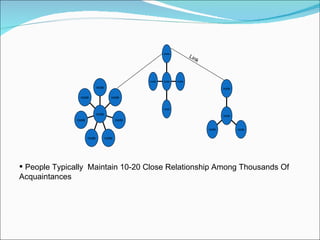
Link People Typically  Maintain 10-20 Close Relationship Among Thousands Of Acquaintances  node node node node node node node node node node node node node node node node node
Social Networks Why are we studying Social Networks ?
Social Network Analysis Social network analysis [SNA] is the mapping and measuring of relationships and flows between people, groups, organizations, computers or other information/knowledge processing entities. The nodes in the network are the people and groups while the links show relationships or flows between the nodes.
Social Network Analysis We measure Social Network in terms of: 1. Betweenness Centrality: A node with high betweenness has great influence over what flows in the network indicating important links and single point of failure.  2.  Closeness Centrality: The measure of closeness of a node which are close to everyone else.  The pattern of the direct and indirect ties allows the nodes any other node in the network more quickly than anyone else. They have the shortest paths to all others.  3. Reach The degree any member of network can reach other members network.
Criteria It is accessible over the web with a web browser. User must explicitly state their relationship with other people qua stating a relationship. Relationship must be visible & browsable by other users in the system. The website or other web based frame work must have explicit built-in support for a users making these connections to other people.
Technology : LinkedIn What is Your Network? When your connections invite  their  connections, your Network starts to grow. Your Network is your connections, their connections, and so on out from you at the center. How do you classify users? Your Network contains professionals out to “three degrees” — that is, friends-of-friends-of-friends. If each person had 10 connections (and some have many more) then your network would contain 10,000 professionals.
Technology Various technologies that help in creating Social Networks are: Email Blogs Social Networking Software like Orkut, LinkedIn etc.
Why internet is popular mean for social networking? The Internet is powerful because it bridges distance at a low cost When people first meet online they tend to “like” each other more Less stressful than face-to-face meeting Superficialities aside people focus on communicating their “selves”
Popular social networking sites Personal sites-Myspace, Orkut, Cyworld Professional/work related-LinkedIn Romantic relationship initiation-friendster Micro logging-Twitter Music-last.fm Movies-flickster Photos/pictures-flickr
TOP FIVE POPULER SITE (1) Facebook (2) Myspace (3) Bebo (4) Friendster (5) Hi5
Mark zuckerberg
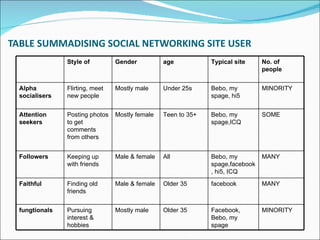
TABLE SUMMADISING SOCIAL NETWORKING SITE USER Style of  Gender age Typical site No. of people Alpha socialisers Flirting, meet new people Mostly male Under 25s Bebo, my spage, hi5 MINORITY Attention seekers Posting photos to get comments from others Mostly female Teen to 35+ Bebo, my spage,ICQ SOME Followers Keeping up with friends Male & female All Bebo, my spage,facebook, hi5, ICQ MANY Faithful Finding old friends Male & female Older 35 facebook MANY fungtionals Pursuing interest & hobbies Mostly male Older 35 Facebook, Bebo, my spage MINORITY
Privacy concerns Social networking sites provide privacy options but users are generally unaware or tend to ignore such concerns Stalkers, terrorists, ill-doers, con-artists could benefit from such issues Facebook’s controversial decision to make visible relationship actions to entire social group
Questions time??
 

Social networking

  • 1.
    Tarun solanki, SK College Of Business Management,
  • 2.
    What is aNetwork? Wikipedia definition - A social network is a social structure made of individuals (or organizations) called "nodes," which are tied (connected) by one or more specific types of interdependency, such as friendship, kinship, financial exchange, dislike or relationships of beliefs, knowledge or prestige Social networking is the grouping of individuals into specific groups, like small rural communities or a neighborhood subdivision,
  • 3.
    Link People Typically Maintain 10-20 Close Relationship Among Thousands Of Acquaintances node node node node node node node node node node node node node node node node node
  • 4.
    Social Networks Whyare we studying Social Networks ?
  • 5.
    Social Network AnalysisSocial network analysis [SNA] is the mapping and measuring of relationships and flows between people, groups, organizations, computers or other information/knowledge processing entities. The nodes in the network are the people and groups while the links show relationships or flows between the nodes.
  • 6.
    Social Network AnalysisWe measure Social Network in terms of: 1. Betweenness Centrality: A node with high betweenness has great influence over what flows in the network indicating important links and single point of failure. 2. Closeness Centrality: The measure of closeness of a node which are close to everyone else. The pattern of the direct and indirect ties allows the nodes any other node in the network more quickly than anyone else. They have the shortest paths to all others. 3. Reach The degree any member of network can reach other members network.
  • 7.
    Criteria It isaccessible over the web with a web browser. User must explicitly state their relationship with other people qua stating a relationship. Relationship must be visible & browsable by other users in the system. The website or other web based frame work must have explicit built-in support for a users making these connections to other people.
  • 8.
    Technology : LinkedInWhat is Your Network? When your connections invite their connections, your Network starts to grow. Your Network is your connections, their connections, and so on out from you at the center. How do you classify users? Your Network contains professionals out to “three degrees” — that is, friends-of-friends-of-friends. If each person had 10 connections (and some have many more) then your network would contain 10,000 professionals.
  • 9.
    Technology Various technologiesthat help in creating Social Networks are: Email Blogs Social Networking Software like Orkut, LinkedIn etc.
  • 10.
    Why internet ispopular mean for social networking? The Internet is powerful because it bridges distance at a low cost When people first meet online they tend to “like” each other more Less stressful than face-to-face meeting Superficialities aside people focus on communicating their “selves”
  • 11.
    Popular social networkingsites Personal sites-Myspace, Orkut, Cyworld Professional/work related-LinkedIn Romantic relationship initiation-friendster Micro logging-Twitter Music-last.fm Movies-flickster Photos/pictures-flickr
  • 12.
    TOP FIVE POPULERSITE (1) Facebook (2) Myspace (3) Bebo (4) Friendster (5) Hi5
  • 13.
  • 14.
    TABLE SUMMADISING SOCIALNETWORKING SITE USER Style of Gender age Typical site No. of people Alpha socialisers Flirting, meet new people Mostly male Under 25s Bebo, my spage, hi5 MINORITY Attention seekers Posting photos to get comments from others Mostly female Teen to 35+ Bebo, my spage,ICQ SOME Followers Keeping up with friends Male & female All Bebo, my spage,facebook, hi5, ICQ MANY Faithful Finding old friends Male & female Older 35 facebook MANY fungtionals Pursuing interest & hobbies Mostly male Older 35 Facebook, Bebo, my spage MINORITY
  • 15.
    Privacy concerns Socialnetworking sites provide privacy options but users are generally unaware or tend to ignore such concerns Stalkers, terrorists, ill-doers, con-artists could benefit from such issues Facebook’s controversial decision to make visible relationship actions to entire social group
  • 16.
  • 17.