•Verbal communications consists of words arranged in
meaningful patterns.
•To create a thought with these words we arrange them
according to the rules of grammar.
•We then transmit the message in spoken or written
form, anticipating that someone will hear or read what
we have to say.
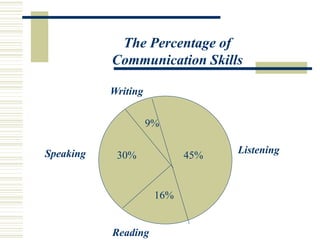
9%
45%
16%
30%
Speaking
Writing
Listening
Reading
The Percentage of
Communication Skills
Speaking and Writing:
•Business people tend to prefer oral communication
channels to written ones.
•Oral is generally quicker and more convenient to talk to
somebody rather than to write a memo, or a letter.
•You can also pick up added meaning from nonverbal
cues and benefit from immediate feedback.
•They often put important messages in writing.
•For maximum impact, use both written and spoken
channels.
Listening and Reading:
•Effective business communication depends on skill in
receiving messages as well as skill in sending.
•Listening and reading are every bit as important as
speaking and writing.
•Unfortunately most of us are not good listeners.
•Developing better listening abilities is crucial if want
to foster the understanding and cooperation so
necessary for an increasing diverse work force.
•Our reading skills often leave a good deal to be
desired.
•Even those who read adequately do not often know how to
read effectively.
•They have trouble extracting the important points from a
document.
•Although listening and reading obviously differ, both require
a similar approach.
•The first step is to register the information which means you
must focus your attention.
•You must then interpret and evaluate the information and
respond accordingly.
•The most important part of this process is interpretation and
evaluation .
•While absorbing the material you must decide
what is important and what is not.
•To absorb information, you must concentrate,
evaluate and retain what you read or hear.
Questions for Discussion:
1. How can nonverbal communication help you run a
meeting? How can it help your call the meeting or
order, emphasize important topics, show approval?
2. Which communication channels are more
susceptible to noise, written or spoken? Why?
3. How can you as a receiver help a sender successfully
communicate a message?
Exercises:
1. Write a short description of your class room’s
communication potential. What furniture is in the
room? Are the students seated in rows? In a circle?
Where is the instructor’s space? In the front or not?
Are there any windows in the room? Are there any
chalk boards or other visual aids that might affect
communication? Is the temperature comfortable? Are
heaters or air conditioners noisy? Conclude your
description with a statement what kind of
communication your classroom encourages? Like
open communication or lecture forum.
2. Describe the kinds of vocal signals and body
movements you can use to highlight the key points of
your speech.
Without intruding, observe and analyze three face to
face interactions ( perhaps between a customer and a
cashier at a super market check stand, between students
in your college cafeteria, between your room mates or
member of the family). Describe how the nonverbal
behaviors you observe give the participants clues about
what’s being said.

Communication and Presentation skills .ppt

  • 1.
    •Verbal communications consistsof words arranged in meaningful patterns. •To create a thought with these words we arrange them according to the rules of grammar. •We then transmit the message in spoken or written form, anticipating that someone will hear or read what we have to say.
  • 2.
  • 3.
    Speaking and Writing: •Businesspeople tend to prefer oral communication channels to written ones. •Oral is generally quicker and more convenient to talk to somebody rather than to write a memo, or a letter. •You can also pick up added meaning from nonverbal cues and benefit from immediate feedback. •They often put important messages in writing. •For maximum impact, use both written and spoken channels.
  • 4.
    Listening and Reading: •Effectivebusiness communication depends on skill in receiving messages as well as skill in sending. •Listening and reading are every bit as important as speaking and writing. •Unfortunately most of us are not good listeners. •Developing better listening abilities is crucial if want to foster the understanding and cooperation so necessary for an increasing diverse work force. •Our reading skills often leave a good deal to be desired.
  • 5.
    •Even those whoread adequately do not often know how to read effectively. •They have trouble extracting the important points from a document. •Although listening and reading obviously differ, both require a similar approach. •The first step is to register the information which means you must focus your attention. •You must then interpret and evaluate the information and respond accordingly. •The most important part of this process is interpretation and evaluation .
  • 6.
    •While absorbing thematerial you must decide what is important and what is not. •To absorb information, you must concentrate, evaluate and retain what you read or hear.
  • 7.
    Questions for Discussion: 1.How can nonverbal communication help you run a meeting? How can it help your call the meeting or order, emphasize important topics, show approval? 2. Which communication channels are more susceptible to noise, written or spoken? Why? 3. How can you as a receiver help a sender successfully communicate a message?
  • 8.
    Exercises: 1. Write ashort description of your class room’s communication potential. What furniture is in the room? Are the students seated in rows? In a circle? Where is the instructor’s space? In the front or not? Are there any windows in the room? Are there any chalk boards or other visual aids that might affect communication? Is the temperature comfortable? Are heaters or air conditioners noisy? Conclude your description with a statement what kind of communication your classroom encourages? Like open communication or lecture forum. 2. Describe the kinds of vocal signals and body movements you can use to highlight the key points of your speech.
  • 9.
    Without intruding, observeand analyze three face to face interactions ( perhaps between a customer and a cashier at a super market check stand, between students in your college cafeteria, between your room mates or member of the family). Describe how the nonverbal behaviors you observe give the participants clues about what’s being said.