Professional
Communication
Contents
• Introduction to Professional Communication – Concept of Communication, Process
and Importance in Corporate World.
• Spoken Communication to build Relationship – Identify and Understand the
Purpose and Audience.
• Written communication for career success – Guidelines for effective business
correspondence.
• Digital and Virtual Communication – Need and Future of Technological platforms -
Benefits and Threats.
• Ethics and Etiquettes in Professional Communication – Communication as a
weapon to win or fail.
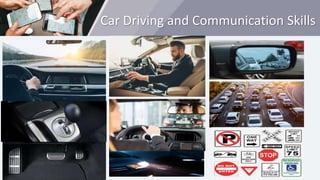
Car Driving and Communication Skills
Conceptualize........
• “Communication is the sum of all the things one
person does when he wants to create understanding
in the mind of another.” - Louis A. Allen
• The term Professional Communication refers to the
various forms of speaking, listening, writing, reading
and responding carried out both in and beyond the
workplace, whether in person or electronically.
Importance of Communication
• Communication helps in all aspects of our life, from personal life to professional life
to social gatherings, official meetings and everything in between.
• Communication can win/lose a battle – Mahabharat and Ramayana.
• No matter what job you have in life, your success will be determined 5% by your
academic credentials, 15% by professional experiences and 80% by your
communication skills - Linkedin Survey
• Perfection is Communication takes more than a lifetime as there is always a scope
of improvement and betterment.
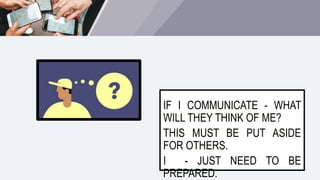
IF I COMMUNICATE - WHAT
WILL THEY THINK OF ME?
THIS MUST BE PUT ASIDE
FOR OTHERS.
I - JUST NEED TO BE
PREPARED.
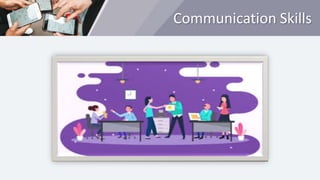
Communication Skills
• Reading Skills - Reading is a process of the brain where you look at symbols on a page,
and the mind sees the patterns of characters and understands the meaning in them.
• Writing Skills – Writing is very important because our human world is a world of words
and meanings. We use words to express and give meaning to our identities, relationships,
and activities.
• Speaking Skills - Speech is a critical skill which helps to get across the ideas and
thoughts to the listener. Effective Speaking includes development of voice, tone, and
speech delivery.
• Listening Skills - Listening is the process of receiving sounds through our ears. It requires
attention and focus.
• Body Language - body language is the unspoken part of communication that we use to
reveal our true feelings and emotions. When we are able to "read" these signs, we can use
it to our advantage.
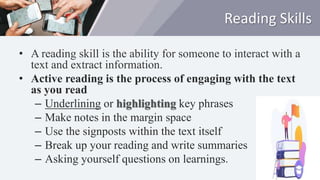
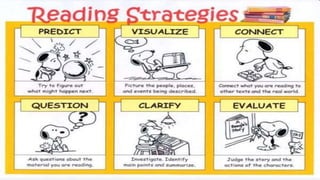
Reading Skills
• A reading skill is the ability for someone to interact with a
text and extract information.
• Active reading is the process of engaging with the text
as you read
– Underlining or highlighting key phrases
– Make notes in the margin space
– Use the signposts within the text itself
– Break up your reading and write summaries
– Asking yourself questions on learnings.
Sharing Insights
1. https://timesofindia.indiatimes.com/blogs/toi-edit-page/are-you-putting-your-time-to-good-use/
2. https://timesofindia.indiatimes.com/blogs/toi-edit-page/open-the-door-the-key-is-in-your-pocket/
3. https://timesofindia.indiatimes.com/blogs/toi-edit-page/let-go-of-all-that-is-causing-negative-
emotions/
4. https://timesofindia.indiatimes.com/blogs/toi-edit-page/in-nature-there-is-no-such-thing-as-
waste/
5. https://timesofindia.indiatimes.com/blogs/toi-edit-page/gratitude-can-do-wonders-for-your-
temperament/
6. https://timesofindia.indiatimes.com/blogs/toi-edit-page/life-lessons-from-the-ongoing-pandemic/
7. https://timesofindia.indiatimes.com/blogs/toi-edit-page/bridge-the-gap-between-knowing-and-
doing/
8. https://timesofindia.indiatimes.com/blogs/toi-edit-page/lets-face-our-problems-fair-and-square/
9. https://timesofindia.indiatimes.com/blogs/toi-edit-page/know-your-true-self-to-guard-against-
fear/
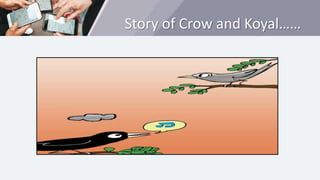
Story of Crow and Koyal……
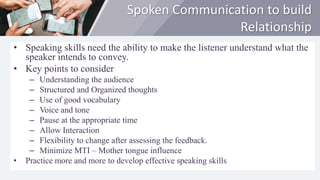
Spoken Communication to build
Relationship
• Speaking skills need the ability to make the listener understand what the
speaker intends to convey.
• Key points to consider
– Understanding the audience
– Structured and Organized thoughts
– Use of good vocabulary
– Voice and tone
– Pause at the appropriate time
– Allow Interaction
– Flexibility to change after assessing the feedback.
– Minimize MTI – Mother tongue influence
• Practice more and more to develop effective speaking skills
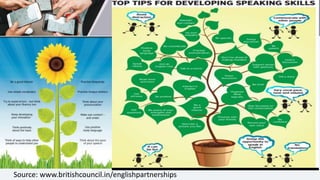
Source: www.britishcouncil.in/englishpartnerships
Written Communication for Success
Writing Skills - The right word in the right form at the right place.
• Vocabulary and Grammar - the two pillars of Effective Written communication.
• The structure of a sentence is created using different parts of speech
• Different forms of Business Writing – Business Correspondence
• Effective writing
– Identify the audience
– Simple and short sentences
– Give clarity and complete information
– Avoid repetition and jargons
– Avoid spelling mistakes and grammatical errors
• Use of maximum of 20-22 words in a sentence.
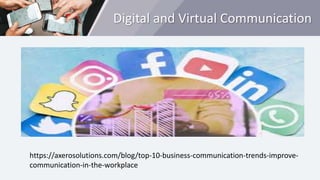
Digital and Virtual Communication
https://axerosolutions.com/blog/top-10-business-communication-trends-improve-
communication-in-the-workplace
Listening Skills
A good listener LISTENS, by way these qualities:
L - Looks at the speaker and maintain eye contact.
I - Initiates dialogue; demonstrates and enhances listening
by asking questions.
S - Stays on the subject and ensures focus.
T - Temper is controlled by managing emotions well.
E - Engages with mind and body to ensure full understanding
and concentration.
N - Never interrupts and lets the speaker finish his/her line of
thought.
S - Signals listening through positive body language.
Body Language
• Body language - use of physical behavior,
expressions, and mannerisms to communicate
nonverbally, often done instinctively rather than
consciously.
• The nonverbal behaviors—the gestures, posture,
tone of voice, eye contact —send strong
messages.
• Even when we’re silent, we’re still communicating
nonverbally.
• If we want to become a better communicator, it’s
important to become more sensitive not only to
the body language and nonverbal cues of others,
but also to our own.
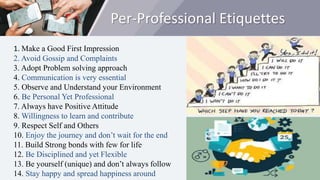
Per-Professional Etiquettes
1. Make a Good First Impression
2. Avoid Gossip and Complaints
3. Adopt Problem solving approach
4. Communication is very essential
5. Observe and Understand your Environment
6. Be Personal Yet Professional
7. Always have Positive Attitude
8. Willingness to learn and contribute
9. Respect Self and Others
10. Enjoy the journey and don’t wait for the end
11. Build Strong bonds with few for life
12. Be Disciplined and yet Flexible
13. Be yourself (unique) and don’t always follow
14. Stay happy and spread happiness around
Thank You !!!!!!
I will be really happy to contribute to your learning journey and success in life…

Professional Communication 2022 (1).pptx

  • 1.
  • 2.
    Contents • Introduction toProfessional Communication – Concept of Communication, Process and Importance in Corporate World. • Spoken Communication to build Relationship – Identify and Understand the Purpose and Audience. • Written communication for career success – Guidelines for effective business correspondence. • Digital and Virtual Communication – Need and Future of Technological platforms - Benefits and Threats. • Ethics and Etiquettes in Professional Communication – Communication as a weapon to win or fail.
  • 3.
    Car Driving andCommunication Skills
  • 4.
  • 5.
    • “Communication isthe sum of all the things one person does when he wants to create understanding in the mind of another.” - Louis A. Allen • The term Professional Communication refers to the various forms of speaking, listening, writing, reading and responding carried out both in and beyond the workplace, whether in person or electronically.
  • 6.
    Importance of Communication •Communication helps in all aspects of our life, from personal life to professional life to social gatherings, official meetings and everything in between. • Communication can win/lose a battle – Mahabharat and Ramayana. • No matter what job you have in life, your success will be determined 5% by your academic credentials, 15% by professional experiences and 80% by your communication skills - Linkedin Survey • Perfection is Communication takes more than a lifetime as there is always a scope of improvement and betterment.
  • 7.
    IF I COMMUNICATE- WHAT WILL THEY THINK OF ME? THIS MUST BE PUT ASIDE FOR OTHERS. I - JUST NEED TO BE PREPARED.
  • 8.
  • 9.
    Communication Skills • ReadingSkills - Reading is a process of the brain where you look at symbols on a page, and the mind sees the patterns of characters and understands the meaning in them. • Writing Skills – Writing is very important because our human world is a world of words and meanings. We use words to express and give meaning to our identities, relationships, and activities. • Speaking Skills - Speech is a critical skill which helps to get across the ideas and thoughts to the listener. Effective Speaking includes development of voice, tone, and speech delivery. • Listening Skills - Listening is the process of receiving sounds through our ears. It requires attention and focus. • Body Language - body language is the unspoken part of communication that we use to reveal our true feelings and emotions. When we are able to "read" these signs, we can use it to our advantage.
  • 10.
    Reading Skills • Areading skill is the ability for someone to interact with a text and extract information. • Active reading is the process of engaging with the text as you read – Underlining or highlighting key phrases – Make notes in the margin space – Use the signposts within the text itself – Break up your reading and write summaries – Asking yourself questions on learnings.
  • 11.
    Sharing Insights 1. https://timesofindia.indiatimes.com/blogs/toi-edit-page/are-you-putting-your-time-to-good-use/ 2.https://timesofindia.indiatimes.com/blogs/toi-edit-page/open-the-door-the-key-is-in-your-pocket/ 3. https://timesofindia.indiatimes.com/blogs/toi-edit-page/let-go-of-all-that-is-causing-negative- emotions/ 4. https://timesofindia.indiatimes.com/blogs/toi-edit-page/in-nature-there-is-no-such-thing-as- waste/ 5. https://timesofindia.indiatimes.com/blogs/toi-edit-page/gratitude-can-do-wonders-for-your- temperament/ 6. https://timesofindia.indiatimes.com/blogs/toi-edit-page/life-lessons-from-the-ongoing-pandemic/ 7. https://timesofindia.indiatimes.com/blogs/toi-edit-page/bridge-the-gap-between-knowing-and- doing/ 8. https://timesofindia.indiatimes.com/blogs/toi-edit-page/lets-face-our-problems-fair-and-square/ 9. https://timesofindia.indiatimes.com/blogs/toi-edit-page/know-your-true-self-to-guard-against- fear/
  • 13.
    Story of Crowand Koyal……
  • 14.
    Spoken Communication tobuild Relationship • Speaking skills need the ability to make the listener understand what the speaker intends to convey. • Key points to consider – Understanding the audience – Structured and Organized thoughts – Use of good vocabulary – Voice and tone – Pause at the appropriate time – Allow Interaction – Flexibility to change after assessing the feedback. – Minimize MTI – Mother tongue influence • Practice more and more to develop effective speaking skills
  • 15.
  • 16.
    Written Communication forSuccess Writing Skills - The right word in the right form at the right place. • Vocabulary and Grammar - the two pillars of Effective Written communication. • The structure of a sentence is created using different parts of speech • Different forms of Business Writing – Business Correspondence • Effective writing – Identify the audience – Simple and short sentences – Give clarity and complete information – Avoid repetition and jargons – Avoid spelling mistakes and grammatical errors • Use of maximum of 20-22 words in a sentence.
  • 18.
    Digital and VirtualCommunication https://axerosolutions.com/blog/top-10-business-communication-trends-improve- communication-in-the-workplace
  • 19.
    Listening Skills A goodlistener LISTENS, by way these qualities: L - Looks at the speaker and maintain eye contact. I - Initiates dialogue; demonstrates and enhances listening by asking questions. S - Stays on the subject and ensures focus. T - Temper is controlled by managing emotions well. E - Engages with mind and body to ensure full understanding and concentration. N - Never interrupts and lets the speaker finish his/her line of thought. S - Signals listening through positive body language.
  • 20.
    Body Language • Bodylanguage - use of physical behavior, expressions, and mannerisms to communicate nonverbally, often done instinctively rather than consciously. • The nonverbal behaviors—the gestures, posture, tone of voice, eye contact —send strong messages. • Even when we’re silent, we’re still communicating nonverbally. • If we want to become a better communicator, it’s important to become more sensitive not only to the body language and nonverbal cues of others, but also to our own.
  • 21.
    Per-Professional Etiquettes 1. Makea Good First Impression 2. Avoid Gossip and Complaints 3. Adopt Problem solving approach 4. Communication is very essential 5. Observe and Understand your Environment 6. Be Personal Yet Professional 7. Always have Positive Attitude 8. Willingness to learn and contribute 9. Respect Self and Others 10. Enjoy the journey and don’t wait for the end 11. Build Strong bonds with few for life 12. Be Disciplined and yet Flexible 13. Be yourself (unique) and don’t always follow 14. Stay happy and spread happiness around
  • 22.
    Thank You !!!!!! Iwill be really happy to contribute to your learning journey and success in life…

Editor's Notes

  • #4 If you sit in the car , even without any knowledge, you will apply common sense and try to make it function but that will be risky same with communication. Have knowledge of all the essential tools available and its usage, that will give you command. Responding and not reacting to others Rules and regulations applicable Many factors are responsible
  • #12 Divide the students in groups, select different target audience like school students, College competition, Government authority, Corporate professionals etc