Ethical Hacking and Defence
Introduction to Hacking/
Penetration Testing (Pen Test)
Remember: You are as secure as your weakest link
Er. Jay Nagar (Cyber Security Researcher)
Intern At CyberCell
What is Hacking
•Making use of a system in a way which was not intended
•Examples:
•Accessing a system without a required password
•Opening a lock without the key
•Gaining control of software through the use of an exploit
•Leveraging a flaw in a system to make it do something unexpected
Clarifications
•Hacking isn’t always illegal
•Hacking isn’t always harmful
•Hacking isn’t always wrong (unethical)
•We are learning to use hacking in a legal and ethical way
•Legitimate purposes of hacking – pen-testing, security auditing
Some Terminologies – Understand the Difference
•Vulnerability Assessment – enumerates all the vulnerabilities found
in an application or on a system and document them
•Penetration Test - an activity in which an ethical hacker attempts to
break into a company’s network or applications to find weak links and
exploits them
•Security Test – more than an attempt to break in; analyses a
company’s security policy, procedures, and report any vulnerabilities
to management
Some Terminologies – Understand the Difference
•A security test takes penetration testing to a higher level
•If we have to sequence all these terms, what would be the correct
order?
Some Terminologies – Understand the Difference
•A security tester does not has the ability to make a network
impenetrable
•The only way – unplug the network cable 
•Security tester suggest possible remediations to the weaknesses
found (such as updating an Operating System or installing the latest
security patch of an application/firmware)
Some Terminologies – Understand the Difference
•As a penetration tester:
• You simple report your findings to the company
• It is then upto the company to make the final decision on how to use the
information you have supplied
•Security tester may be required to offer solutions for securing or
protecting the network
•In reality, the two activities often crossover
Some Terminologies – Understand the Difference
•The term ‘hacker’ and ‘cracker’ diluted
• In olden days, hacker was considered as a good guy and cracker to be the
bad guy (criminal hacker)
• Another understanding:
• Hacker accesses a computer system or network without the authorization of
the system’s owner – breaking the law and can be prosecuted
• Cracker – breaks into the system and steal/destroy the information or
system
Some Terminologies – Understand the Difference
•The US Department of Justice labelled all illegal access to computer
or network systems a hacking
•Hacker (or hacking) is an abused term often confused with cyber
criminal
•Ended up using the terms ‘hacker’ (bad guy) and an ‘ethical hacker’
(good guy)
•A cyber criminal (hacker) - an individual who maliciously breaks into a
computer system
Some Terminologies – Understand the Difference
•An ethical hacker:
• Performs most of the same activities a hacker does but with the
company’s permission and help them in securing the infrastructure
• Having a permission decides whether the entity conducting the test can
be charged or otherwise
• Contracted to perform to perform penetration tests or security tests
• Help identify flaws in the network design
Some Terminologies – Understand the Difference
•An ethical hacker:
• Identify issues in software/applications
• Advise on potential fixes to the security issues – fixing is not the job
•The aim is to deny intruders access to a network or computer systems
by finding the weak points that can be leveraged
Some Terminologies – Understand the Difference
•Generally, an ethical hacker should be able to:
• Perform vulnerability, attack, and penetration assessments in Internet,
Intranet, and wireless environments
• Discover and scan for open ports and services
• Apply appropriate exploits to gain access and expand access
• Produce reports documenting discoveries during the engagement
• Have good understanding of current country, state cyber laws
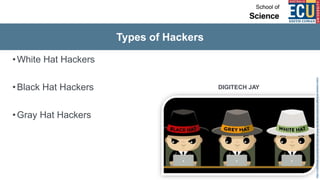
Types of Hackers
•White Hat Hackers
•Black Hat Hackers
•Gray Hat Hackers
https://cryptomode.com/white-hat-black-hat-gray-hat-hackers-whats-the-difference-between-them/
DIGITECH JAY
Types of Hackers
•White Hat Hackers
• Are the ethical hackers
• Secure companies and organisations IT systems
• Examine the network in the same manner as a criminal hacker to better
understand its vulnerabilities to help improve its defence posture
• Contracted by the company or internal employees
• Have legal permissions
Types of Hackers
•Black Hat Hackers
• Perform illegal activities
• Are crackers/cyber-criminals
• Cause harm to the infrastructure
• Backed by organized crime or nation states
Types of Hackers
•Gray Hat Hackers
• Sits between the good guys and the bad guys
• Follow the law but sometimes go beyond their mandate and gain
access to a system without permission (out of their curiosity)
• E.g. installing backdoor for later use or selling confidential
information
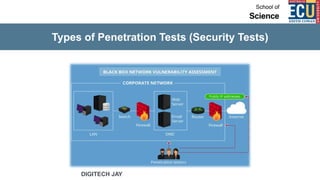
Types of Penetration Tests (Security Tests)
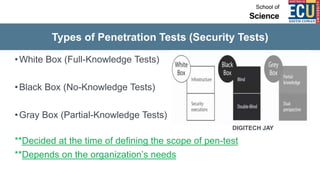
•White Box (Full-Knowledge Tests)
•Black Box (No-Knowledge Tests)
•Gray Box (Partial-Knowledge Tests)
**Decided at the time of defining the scope of pen-test
**Depends on the organization’s needs
DIGITECH JAY
Types of Penetration Tests (Security Tests)
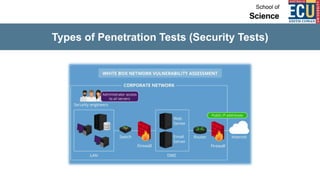
•White Box (Full-Knowledge Tests)
• All information about the target is provided (system, network, etc.)
• Common in internal/onsite penetration tests
• Allows the tester to follow more structured approach
• Spend less time in information gathering
• More time to probe for the vulnerabilities
Types of Penetration Tests (Security Tests)
•Black Box (No-Knowledge Tests)
• Tester has no knowledge of the target network or its systems
• Simulates an outside attack or as if an external attacker has launched the
attack
• Spend more time in information gathering (profile its strengths and
weaknesses)
• Unbiased (can only see public IPs, firewall’s external interface, systems in
DMZ)
Types of Penetration Tests (Security Tests)
•Black Box (No-Knowledge Tests) (cont..)
• Takes more time to perform security tests
• More expensive
• Focus is on external attackers (does not take into consideration attacks
launched by internal attackers)
Types of Penetration Tests (Security Tests)
DIGITECH JAY
Types of Penetration Tests (Security Tests)
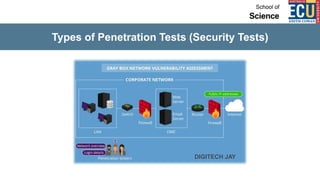
•Gray Box (Partial-Knowledge Tests)
• Internal test
• Some information is provided and some hidden
• Goal is to determine what insiders can access
• E.g. names of applications running are provided but their exact version
isn’t provided
Types of Penetration Tests (Security Tests)
DIGITECH JAY
Penetration Tests
•Network Penetration Test
•Web Application Penetration Test
•Mobile Application Penetration Test
•Social Engineering Penetration Test
•Physical Penetration Test
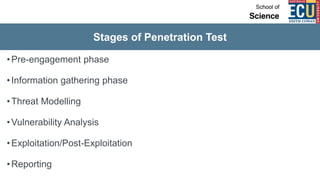
Stages of Penetration Test
•Pre-engagement phase
•Information gathering phase
•Threat Modelling
•Vulnerability Analysis
•Exploitation/Post-Exploitation
•Reporting
Stages of Penetration Test
•Pre-engagement phase
• Map out the scope to ensure everyone is on the same page
• Always clarify to your client the difference between a vulnerability and pen-
test
• Understand client’s business goals for the activity
• Understand about the fragile devices you need to be careful with when
testing
Stages of Penetration Test
•Pre-engagement phase
• Essential to understand client’s business
• Scope
• IP addresses (which one to scan)
• Actions that you as a pen tester can take (use of exploit to bring down a
service
• Social engineering attack are allowed or not
• Type of test
• What systems to probe
Stages of Penetration Test
•Pre-engagement phase
• When can you perform the test (hours/days), start and stop dates
• How to communicate critical findings (use of encrypted email, etc.)
• A “get out of jail” card
• Everything in writing – nothing verbal
• If the target is not owned by the company, do they have the approval
• Understand the person you are communicating with has right knowledge
Stages of Penetration Test
•Pre-engagement phase
• Discuss about confidentiality/non-disclosure agreement – keeping the
findings confidential
• Include it in the written contract
• Know the relevant local, state, and federal laws
Stages of Penetration Test
•Information Gathering
• Begins after pre-engagement phase
• No direct interaction with the network/system being examined
• Use freely available sources to gather information about the target
(OSINT)
• Also known as passive scanning (company’s website, source code, social
networking sites, dumpster diving, etc.)
Stages of Penetration Test
•Threat Modelling
• Based on the OSINT methods, a pen-tester undertakes threat modelling
• Think like attackers and develop plans based on the information gathered
Stages of Penetration Test
•Vulnerability Analysis
• Discover vulnerabilities in the system (active scanning)
• Run vulnerability scanners
•Exploitation/Post-Exploitation
• Take advantage of the vulnerabilities using exploits
• How a successful exploit might lead to a post-exploitation (further
leveraging the weakness, escalate privileges)
Stages of Penetration Test
•Reporting
• Present the findings for executives and technical team
• Debrief/Deliver presentation and highlight key findings
Stages of Penetration Test
•There exist different ways to represent pen-testing stages. Another way
of defining the stages are:
• Gain Permission
• Enumerate and Discover
• Gain Access
• Move Laterally
• Elevate Privileges
• Control Network
• Report and Debrief
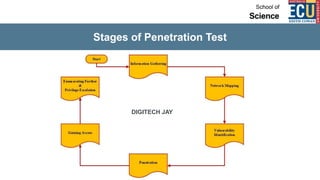
Stages of Penetration Test
DIGITECH JAY
Tutorial Activity
•Building a Penetration Testing Lab
•You would not be able to proceed, if you don’t set-up your lab now
Ethical Hacking and Defense
Thank You
&
Questions
Er. Jay Nagar (Cyber Security Researcher)
Intern At CyberCell
+91-9601957620

Ethical Hacking and Defense Penetration

  • 1.
    Ethical Hacking andDefence Introduction to Hacking/ Penetration Testing (Pen Test) Remember: You are as secure as your weakest link Er. Jay Nagar (Cyber Security Researcher) Intern At CyberCell
  • 2.
    What is Hacking •Makinguse of a system in a way which was not intended •Examples: •Accessing a system without a required password •Opening a lock without the key •Gaining control of software through the use of an exploit •Leveraging a flaw in a system to make it do something unexpected
  • 3.
    Clarifications •Hacking isn’t alwaysillegal •Hacking isn’t always harmful •Hacking isn’t always wrong (unethical) •We are learning to use hacking in a legal and ethical way •Legitimate purposes of hacking – pen-testing, security auditing
  • 4.
    Some Terminologies –Understand the Difference •Vulnerability Assessment – enumerates all the vulnerabilities found in an application or on a system and document them •Penetration Test - an activity in which an ethical hacker attempts to break into a company’s network or applications to find weak links and exploits them •Security Test – more than an attempt to break in; analyses a company’s security policy, procedures, and report any vulnerabilities to management
  • 5.
    Some Terminologies –Understand the Difference •A security test takes penetration testing to a higher level •If we have to sequence all these terms, what would be the correct order?
  • 6.
    Some Terminologies –Understand the Difference •A security tester does not has the ability to make a network impenetrable •The only way – unplug the network cable  •Security tester suggest possible remediations to the weaknesses found (such as updating an Operating System or installing the latest security patch of an application/firmware)
  • 7.
    Some Terminologies –Understand the Difference •As a penetration tester: • You simple report your findings to the company • It is then upto the company to make the final decision on how to use the information you have supplied •Security tester may be required to offer solutions for securing or protecting the network •In reality, the two activities often crossover
  • 8.
    Some Terminologies –Understand the Difference •The term ‘hacker’ and ‘cracker’ diluted • In olden days, hacker was considered as a good guy and cracker to be the bad guy (criminal hacker) • Another understanding: • Hacker accesses a computer system or network without the authorization of the system’s owner – breaking the law and can be prosecuted • Cracker – breaks into the system and steal/destroy the information or system
  • 9.
    Some Terminologies –Understand the Difference •The US Department of Justice labelled all illegal access to computer or network systems a hacking •Hacker (or hacking) is an abused term often confused with cyber criminal •Ended up using the terms ‘hacker’ (bad guy) and an ‘ethical hacker’ (good guy) •A cyber criminal (hacker) - an individual who maliciously breaks into a computer system
  • 10.
    Some Terminologies –Understand the Difference •An ethical hacker: • Performs most of the same activities a hacker does but with the company’s permission and help them in securing the infrastructure • Having a permission decides whether the entity conducting the test can be charged or otherwise • Contracted to perform to perform penetration tests or security tests • Help identify flaws in the network design
  • 11.
    Some Terminologies –Understand the Difference •An ethical hacker: • Identify issues in software/applications • Advise on potential fixes to the security issues – fixing is not the job •The aim is to deny intruders access to a network or computer systems by finding the weak points that can be leveraged
  • 12.
    Some Terminologies –Understand the Difference •Generally, an ethical hacker should be able to: • Perform vulnerability, attack, and penetration assessments in Internet, Intranet, and wireless environments • Discover and scan for open ports and services • Apply appropriate exploits to gain access and expand access • Produce reports documenting discoveries during the engagement • Have good understanding of current country, state cyber laws
  • 13.
    Types of Hackers •WhiteHat Hackers •Black Hat Hackers •Gray Hat Hackers https://cryptomode.com/white-hat-black-hat-gray-hat-hackers-whats-the-difference-between-them/ DIGITECH JAY
  • 14.
    Types of Hackers •WhiteHat Hackers • Are the ethical hackers • Secure companies and organisations IT systems • Examine the network in the same manner as a criminal hacker to better understand its vulnerabilities to help improve its defence posture • Contracted by the company or internal employees • Have legal permissions
  • 15.
    Types of Hackers •BlackHat Hackers • Perform illegal activities • Are crackers/cyber-criminals • Cause harm to the infrastructure • Backed by organized crime or nation states
  • 16.
    Types of Hackers •GrayHat Hackers • Sits between the good guys and the bad guys • Follow the law but sometimes go beyond their mandate and gain access to a system without permission (out of their curiosity) • E.g. installing backdoor for later use or selling confidential information
  • 17.
    Types of PenetrationTests (Security Tests) •White Box (Full-Knowledge Tests) •Black Box (No-Knowledge Tests) •Gray Box (Partial-Knowledge Tests) **Decided at the time of defining the scope of pen-test **Depends on the organization’s needs DIGITECH JAY
  • 18.
    Types of PenetrationTests (Security Tests) •White Box (Full-Knowledge Tests) • All information about the target is provided (system, network, etc.) • Common in internal/onsite penetration tests • Allows the tester to follow more structured approach • Spend less time in information gathering • More time to probe for the vulnerabilities
  • 19.
    Types of PenetrationTests (Security Tests)
  • 20.
    Types of PenetrationTests (Security Tests) •Black Box (No-Knowledge Tests) • Tester has no knowledge of the target network or its systems • Simulates an outside attack or as if an external attacker has launched the attack • Spend more time in information gathering (profile its strengths and weaknesses) • Unbiased (can only see public IPs, firewall’s external interface, systems in DMZ)
  • 21.
    Types of PenetrationTests (Security Tests) •Black Box (No-Knowledge Tests) (cont..) • Takes more time to perform security tests • More expensive • Focus is on external attackers (does not take into consideration attacks launched by internal attackers)
  • 22.
    Types of PenetrationTests (Security Tests) DIGITECH JAY
  • 23.
    Types of PenetrationTests (Security Tests) •Gray Box (Partial-Knowledge Tests) • Internal test • Some information is provided and some hidden • Goal is to determine what insiders can access • E.g. names of applications running are provided but their exact version isn’t provided
  • 24.
    Types of PenetrationTests (Security Tests) DIGITECH JAY
  • 25.
    Penetration Tests •Network PenetrationTest •Web Application Penetration Test •Mobile Application Penetration Test •Social Engineering Penetration Test •Physical Penetration Test
  • 26.
    Stages of PenetrationTest •Pre-engagement phase •Information gathering phase •Threat Modelling •Vulnerability Analysis •Exploitation/Post-Exploitation •Reporting
  • 27.
    Stages of PenetrationTest •Pre-engagement phase • Map out the scope to ensure everyone is on the same page • Always clarify to your client the difference between a vulnerability and pen- test • Understand client’s business goals for the activity • Understand about the fragile devices you need to be careful with when testing
  • 28.
    Stages of PenetrationTest •Pre-engagement phase • Essential to understand client’s business • Scope • IP addresses (which one to scan) • Actions that you as a pen tester can take (use of exploit to bring down a service • Social engineering attack are allowed or not • Type of test • What systems to probe
  • 29.
    Stages of PenetrationTest •Pre-engagement phase • When can you perform the test (hours/days), start and stop dates • How to communicate critical findings (use of encrypted email, etc.) • A “get out of jail” card • Everything in writing – nothing verbal • If the target is not owned by the company, do they have the approval • Understand the person you are communicating with has right knowledge
  • 30.
    Stages of PenetrationTest •Pre-engagement phase • Discuss about confidentiality/non-disclosure agreement – keeping the findings confidential • Include it in the written contract • Know the relevant local, state, and federal laws
  • 31.
    Stages of PenetrationTest •Information Gathering • Begins after pre-engagement phase • No direct interaction with the network/system being examined • Use freely available sources to gather information about the target (OSINT) • Also known as passive scanning (company’s website, source code, social networking sites, dumpster diving, etc.)
  • 32.
    Stages of PenetrationTest •Threat Modelling • Based on the OSINT methods, a pen-tester undertakes threat modelling • Think like attackers and develop plans based on the information gathered
  • 33.
    Stages of PenetrationTest •Vulnerability Analysis • Discover vulnerabilities in the system (active scanning) • Run vulnerability scanners •Exploitation/Post-Exploitation • Take advantage of the vulnerabilities using exploits • How a successful exploit might lead to a post-exploitation (further leveraging the weakness, escalate privileges)
  • 34.
    Stages of PenetrationTest •Reporting • Present the findings for executives and technical team • Debrief/Deliver presentation and highlight key findings
  • 35.
    Stages of PenetrationTest •There exist different ways to represent pen-testing stages. Another way of defining the stages are: • Gain Permission • Enumerate and Discover • Gain Access • Move Laterally • Elevate Privileges • Control Network • Report and Debrief
  • 36.
    Stages of PenetrationTest DIGITECH JAY
  • 37.
    Tutorial Activity •Building aPenetration Testing Lab •You would not be able to proceed, if you don’t set-up your lab now
  • 38.
    Ethical Hacking andDefense Thank You & Questions Er. Jay Nagar (Cyber Security Researcher) Intern At CyberCell +91-9601957620

Editor's Notes

  • #4 You
  • #13 This by no means is an exhaustive list
  • #18 Image taken from https://www.youtube.com/watch?v=HD80AJPJ6s0
  • #20 https://www.scnsoft.com/blog/network-vulnerability-assessment-guide
  • #23 https://www.scnsoft.com/blog/network-vulnerability-assessment-guide
  • #25 https://www.scnsoft.com/blog/network-vulnerability-assessment-guide