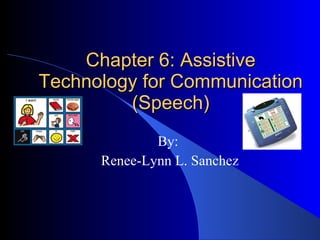
Chapter 6: Assistive Technology for Communication (Speech) By: Renee-Lynn L. Sanchez
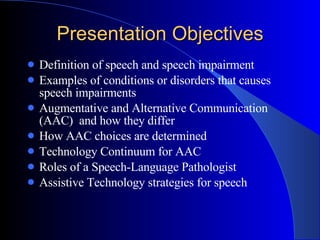
Presentation Objectives Definition of speech and speech impairment  Examples of conditions or disorders that causes speech impairments Augmentative and Alternative Communication  (AAC)  and how they differ How AAC choices are determined Technology Continuum for AAC Roles of a Speech-Language Pathologist Assistive Technology strategies for speech
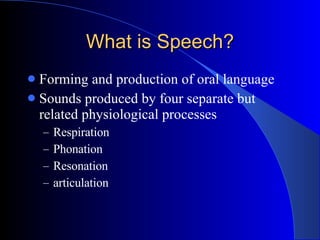
What is Speech? Forming and production of oral language Sounds produced by four separate but related physiological processes Respiration Phonation Resonation articulation
What is a Speech Impairment? Disorder that affects  the articulation of speech sounds Fluency in speech  voice
Examples of disorders or conditions that cause speech impairment Cerebral Palsy (CP Cleft lip or  Cleft palate Stuttering Significant hearing loss
Augmentative and Alternative Communication (AAC) Combination of different forms of communication  Supplements, enhances or replaces conventional communication methods
Augmentative vs. Alternative Augmentative Communication System Helps students utilize the communication system the student already has Alternative Communication System  Bypasses oral system altogether
Choosing an Augmentative and Alternative Communication System.. Depend on student’s physical, cognitive, sensory and receptive communication skills Depend on how well others understand student Must be evaluated by many professionals Must address indications Scanning Encoding Direct selection
Technology Continuum for Augmentative and Alternative Communication (AAC) No Tech Light Tech High Tech
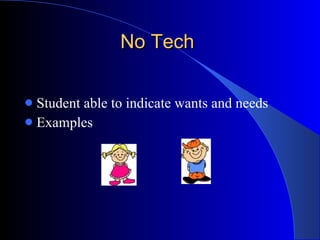
No Tech  Student able to indicate wants and needs Examples
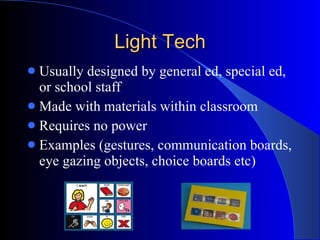
Light Tech Usually designed by general ed, special ed, or school staff Made with materials within classroom Requires no power Examples (gestures, communication boards, eye gazing objects, choice boards etc)
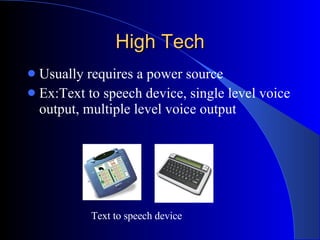
High Tech Usually requires a power source Ex:Text to speech device, single level voice output, multiple level voice output Text to speech device
Role of the Speech Language Pathologist Provide speech language therapy to the student (small or large group) Be a part of IEP team (which chooses at device) Help assist students in accessing the general curriculum Serve as consultants
Assistive Technology Strategies for Speech Samples Picture Exchange Communication System (PECS) Picture Communication System (PCS) Expression Cards Communication Rings Schedule Boards
References http://www.asha.org/public/speech/disorders/AAC.htm http://www.asha.org/public/speech/disorders/accPrimer.htm http://www.superduperinc.com/handouts/PDFs/95_AugmentativeAlternative.pdf
Questions or Comments

Chapter 6

  • 1.
    Chapter 6: AssistiveTechnology for Communication (Speech) By: Renee-Lynn L. Sanchez
  • 2.
    Presentation Objectives Definitionof speech and speech impairment Examples of conditions or disorders that causes speech impairments Augmentative and Alternative Communication (AAC) and how they differ How AAC choices are determined Technology Continuum for AAC Roles of a Speech-Language Pathologist Assistive Technology strategies for speech
  • 3.
    What is Speech?Forming and production of oral language Sounds produced by four separate but related physiological processes Respiration Phonation Resonation articulation
  • 4.
    What is aSpeech Impairment? Disorder that affects the articulation of speech sounds Fluency in speech voice
  • 5.
    Examples of disordersor conditions that cause speech impairment Cerebral Palsy (CP Cleft lip or Cleft palate Stuttering Significant hearing loss
  • 6.
    Augmentative and AlternativeCommunication (AAC) Combination of different forms of communication Supplements, enhances or replaces conventional communication methods
  • 7.
    Augmentative vs. AlternativeAugmentative Communication System Helps students utilize the communication system the student already has Alternative Communication System Bypasses oral system altogether
  • 8.
    Choosing an Augmentativeand Alternative Communication System.. Depend on student’s physical, cognitive, sensory and receptive communication skills Depend on how well others understand student Must be evaluated by many professionals Must address indications Scanning Encoding Direct selection
  • 9.
    Technology Continuum forAugmentative and Alternative Communication (AAC) No Tech Light Tech High Tech
  • 10.
    No Tech Student able to indicate wants and needs Examples
  • 11.
    Light Tech Usuallydesigned by general ed, special ed, or school staff Made with materials within classroom Requires no power Examples (gestures, communication boards, eye gazing objects, choice boards etc)
  • 12.
    High Tech Usuallyrequires a power source Ex:Text to speech device, single level voice output, multiple level voice output Text to speech device
  • 13.
    Role of theSpeech Language Pathologist Provide speech language therapy to the student (small or large group) Be a part of IEP team (which chooses at device) Help assist students in accessing the general curriculum Serve as consultants
  • 14.
    Assistive Technology Strategiesfor Speech Samples Picture Exchange Communication System (PECS) Picture Communication System (PCS) Expression Cards Communication Rings Schedule Boards
  • 15.
  • 16.