PORUKARA COLLEGE OF
EDUCATION, CHAMPAKKULAM
Submitted to,
Ms. Jeffey Mary Joseph
Teacher in charge
Submitted by,
Reshma Thaj
B.Ed Social science
Roll no:32
WELCOME
COMMUNICATION
INTRODUCTION
The word communication originates from
‘communis’ Greek word meaning ‘to make
common’.
It is having a common experience with other
people.
It is the ability to transmit thoughts and ideas
to others.
DEFINITION
• National society for the study of communication
defines it as a mutual exchange of facts ,thoughts
opinion or emotions.
• According to Edgar Dale, “communication is
the sharing of ideas and feelings in a mode of
mutuality”.
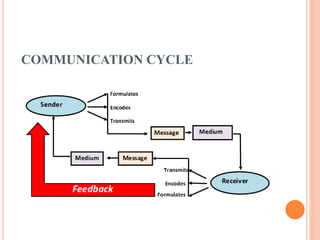
COMMUNICATION CYCLE
COMPONENTS OF COMMUNICATION
a) Sender/encoder : The person or event which provide verbal or
non verbal cues.
b) Message/signal : It is the set of verbal; or non verbal cues sent
by the source. It may be figures,words,movements etc.
c) Medium/channel : Channels are the means used to convey the
message.
d) Receiver : The person who receives the message or interprets
the message.
e) Feed back : It is the information fed back from the receiver to
the source
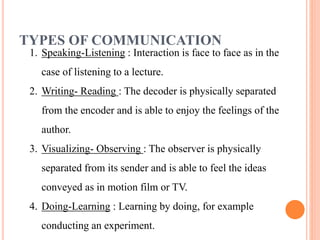
TYPES OF COMMUNICATION
1. Speaking-Listening : Interaction is face to face as in the
case of listening to a lecture.
2. Writing- Reading : The decoder is physically separated
from the encoder and is able to enjoy the feelings of the
author.
3. Visualizing- Observing : The observer is physically
separated from its sender and is able to feel the ideas
conveyed as in motion film or TV.
4. Doing-Learning : Learning by doing, for example
conducting an experiment.
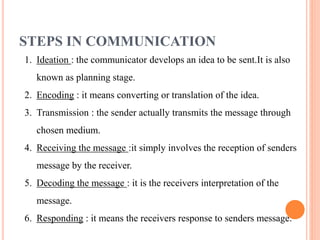
STEPS IN COMMUNICATION
1. Ideation : the communicator develops an idea to be sent.It is also
known as planning stage.
2. Encoding : it means converting or translation of the idea.
3. Transmission : the sender actually transmits the message through
chosen medium.
4. Receiving the message :it simply involves the reception of senders
message by the receiver.
5. Decoding the message : it is the receivers interpretation of the
message.
6. Responding : it means the receivers response to senders message.
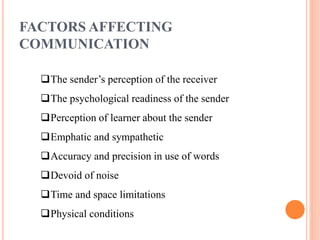
FACTORS AFFECTING
COMMUNICATION
The sender’s perception of the receiver
The psychological readiness of the sender
Perception of learner about the sender
Emphatic and sympathetic
Accuracy and precision in use of words
Devoid of noise
Time and space limitations
Physical conditions
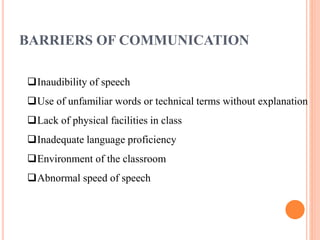
BARRIERS OF COMMUNICATION
Inaudibility of speech
Use of unfamiliar words or technical terms without explanation
Lack of physical facilities in class
Inadequate language proficiency
Environment of the classroom
Abnormal speed of speech
CONCLUSION
Communication is always made with some purpose.
It means getting across an idea and information to another person.
The purpose of communication is encoded in the message and
transmitted to its destination where it is decoded and response made.
It is a process of interaction of ideas between the communicator
and receiver to arrive at a common understanding for mutual benefit.
THANK YOU

Technologyreshma

  • 1.
    PORUKARA COLLEGE OF EDUCATION,CHAMPAKKULAM Submitted to, Ms. Jeffey Mary Joseph Teacher in charge Submitted by, Reshma Thaj B.Ed Social science Roll no:32
  • 2.
  • 3.
  • 4.
    INTRODUCTION The word communicationoriginates from ‘communis’ Greek word meaning ‘to make common’. It is having a common experience with other people. It is the ability to transmit thoughts and ideas to others.
  • 5.
    DEFINITION • National societyfor the study of communication defines it as a mutual exchange of facts ,thoughts opinion or emotions. • According to Edgar Dale, “communication is the sharing of ideas and feelings in a mode of mutuality”.
  • 6.
  • 7.
    COMPONENTS OF COMMUNICATION a)Sender/encoder : The person or event which provide verbal or non verbal cues. b) Message/signal : It is the set of verbal; or non verbal cues sent by the source. It may be figures,words,movements etc. c) Medium/channel : Channels are the means used to convey the message. d) Receiver : The person who receives the message or interprets the message. e) Feed back : It is the information fed back from the receiver to the source
  • 8.
    TYPES OF COMMUNICATION 1.Speaking-Listening : Interaction is face to face as in the case of listening to a lecture. 2. Writing- Reading : The decoder is physically separated from the encoder and is able to enjoy the feelings of the author. 3. Visualizing- Observing : The observer is physically separated from its sender and is able to feel the ideas conveyed as in motion film or TV. 4. Doing-Learning : Learning by doing, for example conducting an experiment.
  • 9.
    STEPS IN COMMUNICATION 1.Ideation : the communicator develops an idea to be sent.It is also known as planning stage. 2. Encoding : it means converting or translation of the idea. 3. Transmission : the sender actually transmits the message through chosen medium. 4. Receiving the message :it simply involves the reception of senders message by the receiver. 5. Decoding the message : it is the receivers interpretation of the message. 6. Responding : it means the receivers response to senders message.
  • 10.
    FACTORS AFFECTING COMMUNICATION The sender’sperception of the receiver The psychological readiness of the sender Perception of learner about the sender Emphatic and sympathetic Accuracy and precision in use of words Devoid of noise Time and space limitations Physical conditions
  • 11.
    BARRIERS OF COMMUNICATION Inaudibilityof speech Use of unfamiliar words or technical terms without explanation Lack of physical facilities in class Inadequate language proficiency Environment of the classroom Abnormal speed of speech
  • 12.
    CONCLUSION Communication is alwaysmade with some purpose. It means getting across an idea and information to another person. The purpose of communication is encoded in the message and transmitted to its destination where it is decoded and response made. It is a process of interaction of ideas between the communicator and receiver to arrive at a common understanding for mutual benefit.
  • 13.