COMMUNICATION SKILLCOMMUNICATION SKILL
Communication is a skill that you can learn. It’s
like riding a bicycle or typing. If you’re willing to
work at it, you can rapidly improve the quality of
every part of your life.
-BRIAN TRACY
COMMUNICATIONCOMMUNICATION
• INTRODUCTIONINTRODUCTION
Communication pervades all human activities. In an
organization, communication plays an important role.
Therefore, effective communication is regarded as the
most crucial ingredient of business success.
• DEFINITIONDEFINITION
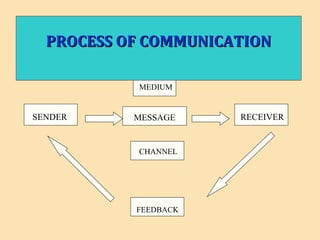
Communication is a process wherein a message sent by a
sender to a receiver through a medium/channel elicits a
feedback.
SENDER MESSAGE
FEEDBACK
MEDIUM
CHANNEL
RECEIVER
PROCESS OF COMMUNICATIONPROCESS OF COMMUNICATION
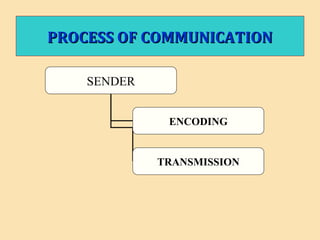
SENDER
ENCODING
TRANSMISSION
PROCESS OF COMMUNICATIONPROCESS OF COMMUNICATION
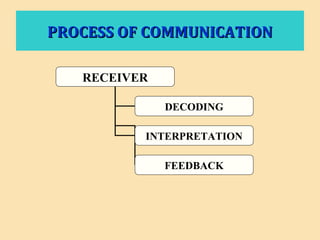
RECEIVER
DECODING
INTERPRETATION
FEEDBACK
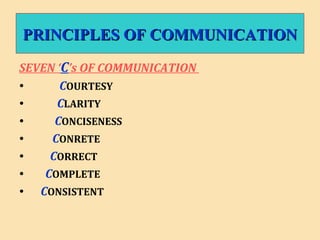
PRINCIPLES OF COMMUNICATIONPRINCIPLES OF COMMUNICATION
SEVEN ‘C’s OF COMMUNICATION
• COURTESY
• CLARITY
• CONCISENESS
• CONRETE
• CORRECT
• COMPLETE
• CONSISTENT
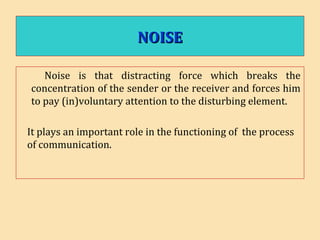
NOISENOISE
Noise is that distracting force which breaks the
concentration of the sender or the receiver and forces him
to pay (in)voluntary attention to the disturbing element.
It plays an important role in the functioning of the process
of communication.
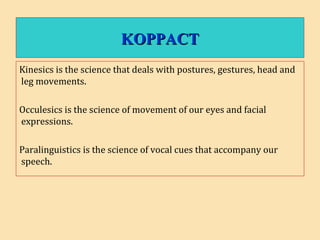
KOPPACTKOPPACT
Kinesics is the science that deals with postures, gestures, head and
leg movements.
Occulesics is the science of movement of our eyes and facial
expressions.
Paralinguistics is the science of vocal cues that accompany our
speech.
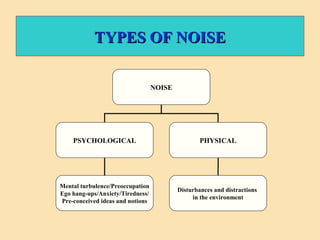
TYPES OF NOISETYPES OF NOISE
NOISE
PSYCHOLOGICAL PHYSICAL
Mental turbulence/Preoccupation
Ego hang-ups/Anxiety/Tiredness/
Pre-conceived ideas and notions
Disturbances and distractions
in the environment
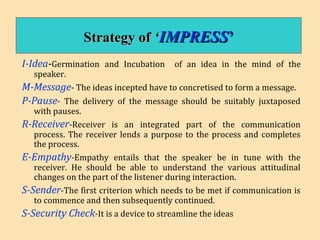
Strategy ofStrategy of ‘‘IMPRESSIMPRESS’’
I-Idea-Germination and Incubation of an idea in the mind of the
speaker.
M-Message- The ideas incepted have to concretised to form a message.
P-Pause- The delivery of the message should be suitably juxtaposed
with pauses.
R-Receiver-Receiver is an integrated part of the communication
process. The receiver lends a purpose to the process and completes
the process.
E-Empathy-Empathy entails that the speaker be in tune with the
receiver. He should be able to understand the various attitudinal
changes on the part of the listener during interaction.
S-Sender-The first criterion which needs to be met if communication is
to commence and then subsequently continued.
S-Security Check-It is a device to streamline the ideas
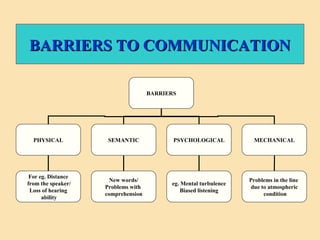
BARRIERS TO COMMUNICATIONBARRIERS TO COMMUNICATION
BARRIERS
PHYSICAL SEMANTIC PSYCHOLOGICAL MECHANICAL
eg. Mental turbulence
Biased listening
New words/
Problems with
comprehension
For eg. Distance
from the speaker/
Loss of hearing
ability
Problems in the line
due to atmospheric
condition
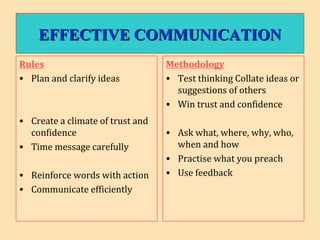
EFFECTIVE COMMUNICATIONEFFECTIVE COMMUNICATION
Rules
• Plan and clarify ideas
• Create a climate of trust and
confidence
• Time message carefully
• Reinforce words with action
• Communicate efficiently
Methodology
• Test thinking Collate ideas or
suggestions of others
• Win trust and confidence
• Ask what, where, why, who,
when and how
• Practise what you preach
• Use feedback
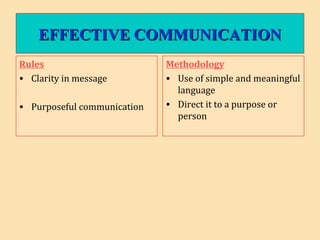
EFFECTIVE COMMUNICATIONEFFECTIVE COMMUNICATION
Rules
• Clarity in message
• Purposeful communication
Methodology
• Use of simple and meaningful
language
• Direct it to a purpose or
person
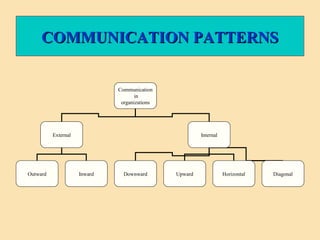
COMMUNICATION PATTERNSCOMMUNICATION PATTERNS
Communication
in
organizations
External Internal
Outward Inward Downward Upward Horizontal Diagonal
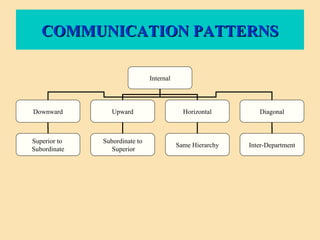
COMMUNICATION PATTERNSCOMMUNICATION PATTERNS
Internal
Downward Upward Horizontal Diagonal
Inter-DepartmentSame Hierarchy
Subordinate to
Superior
Superior to
Subordinate
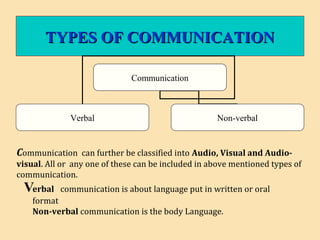
TYPES OF COMMUNICATIONTYPES OF COMMUNICATION
Communication
Verbal Non-verbal
Communication can further be classified into Audio, Visual and Audio-
visual. All or any one of these can be included in above mentioned types of
communication.
erbal communication is about language put in written or oral
format
Non-verbal communication is the body Language.
V
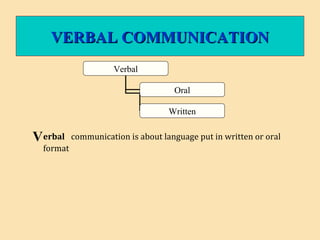
VERBAL COMMUNICATIONVERBAL COMMUNICATION
Verbal
Oral
Written
Verbal communication is about language put in written or oral
format
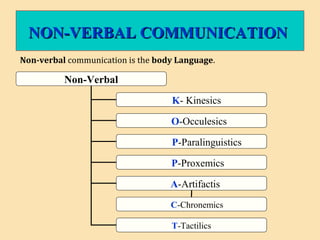
NON-VERBAL COMMUNICATIONNON-VERBAL COMMUNICATION
Non-Verbal
K- Kinesics
O-Occulesics
P-Paralinguistics
P-Proxemics
A-Artifactis
C-Chronemics
T-Tactilics
Non-verbal communication is the body Language.
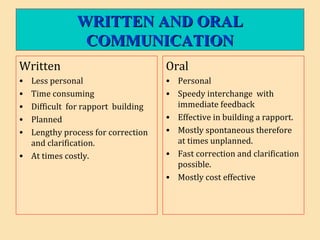
WRITTEN AND ORALWRITTEN AND ORAL
COMMUNICATIONCOMMUNICATION
Written
• Less personal
• Time consuming
• Difficult for rapport building
• Planned
• Lengthy process for correction
and clarification.
• At times costly.
Oral
• Personal
• Speedy interchange with
immediate feedback
• Effective in building a rapport.
• Mostly spontaneous therefore
at times unplanned.
• Fast correction and clarification
possible.
• Mostly cost effective

Communication

  • 1.
  • 2.
    Communication is askill that you can learn. It’s like riding a bicycle or typing. If you’re willing to work at it, you can rapidly improve the quality of every part of your life. -BRIAN TRACY
  • 3.
    COMMUNICATIONCOMMUNICATION • INTRODUCTIONINTRODUCTION Communication pervadesall human activities. In an organization, communication plays an important role. Therefore, effective communication is regarded as the most crucial ingredient of business success. • DEFINITIONDEFINITION Communication is a process wherein a message sent by a sender to a receiver through a medium/channel elicits a feedback.
  • 4.
  • 5.
    PROCESS OF COMMUNICATIONPROCESSOF COMMUNICATION SENDER ENCODING TRANSMISSION
  • 6.
    PROCESS OF COMMUNICATIONPROCESSOF COMMUNICATION RECEIVER DECODING INTERPRETATION FEEDBACK
  • 7.
    PRINCIPLES OF COMMUNICATIONPRINCIPLESOF COMMUNICATION SEVEN ‘C’s OF COMMUNICATION • COURTESY • CLARITY • CONCISENESS • CONRETE • CORRECT • COMPLETE • CONSISTENT
  • 8.
    NOISENOISE Noise is thatdistracting force which breaks the concentration of the sender or the receiver and forces him to pay (in)voluntary attention to the disturbing element. It plays an important role in the functioning of the process of communication.
  • 9.
    KOPPACTKOPPACT Kinesics is thescience that deals with postures, gestures, head and leg movements. Occulesics is the science of movement of our eyes and facial expressions. Paralinguistics is the science of vocal cues that accompany our speech.
  • 10.
    TYPES OF NOISETYPESOF NOISE NOISE PSYCHOLOGICAL PHYSICAL Mental turbulence/Preoccupation Ego hang-ups/Anxiety/Tiredness/ Pre-conceived ideas and notions Disturbances and distractions in the environment
  • 11.
    Strategy ofStrategy of‘‘IMPRESSIMPRESS’’ I-Idea-Germination and Incubation of an idea in the mind of the speaker. M-Message- The ideas incepted have to concretised to form a message. P-Pause- The delivery of the message should be suitably juxtaposed with pauses. R-Receiver-Receiver is an integrated part of the communication process. The receiver lends a purpose to the process and completes the process. E-Empathy-Empathy entails that the speaker be in tune with the receiver. He should be able to understand the various attitudinal changes on the part of the listener during interaction. S-Sender-The first criterion which needs to be met if communication is to commence and then subsequently continued. S-Security Check-It is a device to streamline the ideas
  • 12.
    BARRIERS TO COMMUNICATIONBARRIERSTO COMMUNICATION BARRIERS PHYSICAL SEMANTIC PSYCHOLOGICAL MECHANICAL eg. Mental turbulence Biased listening New words/ Problems with comprehension For eg. Distance from the speaker/ Loss of hearing ability Problems in the line due to atmospheric condition
  • 13.
    EFFECTIVE COMMUNICATIONEFFECTIVE COMMUNICATION Rules •Plan and clarify ideas • Create a climate of trust and confidence • Time message carefully • Reinforce words with action • Communicate efficiently Methodology • Test thinking Collate ideas or suggestions of others • Win trust and confidence • Ask what, where, why, who, when and how • Practise what you preach • Use feedback
  • 14.
    EFFECTIVE COMMUNICATIONEFFECTIVE COMMUNICATION Rules •Clarity in message • Purposeful communication Methodology • Use of simple and meaningful language • Direct it to a purpose or person
  • 15.
    COMMUNICATION PATTERNSCOMMUNICATION PATTERNS Communication in organizations ExternalInternal Outward Inward Downward Upward Horizontal Diagonal
  • 16.
    COMMUNICATION PATTERNSCOMMUNICATION PATTERNS Internal DownwardUpward Horizontal Diagonal Inter-DepartmentSame Hierarchy Subordinate to Superior Superior to Subordinate
  • 17.
    TYPES OF COMMUNICATIONTYPESOF COMMUNICATION Communication Verbal Non-verbal Communication can further be classified into Audio, Visual and Audio- visual. All or any one of these can be included in above mentioned types of communication. erbal communication is about language put in written or oral format Non-verbal communication is the body Language. V
  • 18.
    VERBAL COMMUNICATIONVERBAL COMMUNICATION Verbal Oral Written Verbalcommunication is about language put in written or oral format
  • 19.
    NON-VERBAL COMMUNICATIONNON-VERBAL COMMUNICATION Non-Verbal K-Kinesics O-Occulesics P-Paralinguistics P-Proxemics A-Artifactis C-Chronemics T-Tactilics Non-verbal communication is the body Language.
  • 20.
    WRITTEN AND ORALWRITTENAND ORAL COMMUNICATIONCOMMUNICATION Written • Less personal • Time consuming • Difficult for rapport building • Planned • Lengthy process for correction and clarification. • At times costly. Oral • Personal • Speedy interchange with immediate feedback • Effective in building a rapport. • Mostly spontaneous therefore at times unplanned. • Fast correction and clarification possible. • Mostly cost effective