Presented by-
Ramchandra Verma
Nurse Gr-1st
SMS Hospital, Jaipur
IGNOU PB B.Sc. Nursing
IIIrd Year
PSC- GCON Jaipur
Contents
What is communication.
Purpose of Communication
Importance of Communication
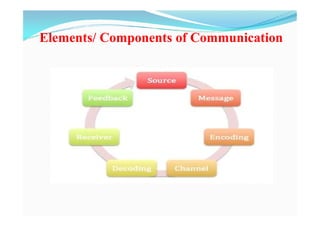
Elements/ Components of Communication
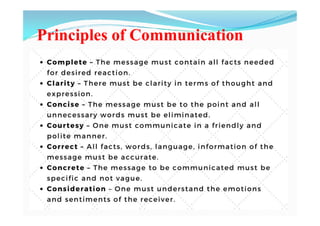
Principles of CommunicationPrinciples of Communication
Types of Communication
Levels of Communication
Barriers in Communication
What is communication?
It is a process of exchanging-
Information
Ideas
Thoughts
Feelings
Emotions
Through-Through-
Speech
Signal
Writing
Behaviour
What is communication?- contd.
Meaning-
Communication is a Latin word which means ‘to share’. It
is the sharing of information between different individuals. It
includes the sharing of ideas, concepts, imaginations, behaviours
and written content.and written content.
Definition-
“Communication is the process of passing information from
one person to another.” In simple words it is a process of
transmitting and sharing ideas, opinions, facts, values etc. from one
person to another or one organization to another .
Purpose of Communication
Flow of information
Coordination
Learning management skills
Preparing people to accept changePreparing people to accept change
Developing good human relations
Ideas of subordinates encouraged
Importance of Communication
Base for action
Planning becomes easy
Means of coordination
Aids in decision-making
Provides effective leadership
Boosts morale and motivation
Elements/ Components of Communication
Principles of Communication
Types of Communication
Types of communication based on the communication channels used
are-
1. Verbal Communication- It is the form of communication in
which message is transmitted verbally by spoken words and a piece of
writing.
Oral Communication- face-to-face conversations, speech, telephonic
conversation, video, radio, television, voice over internet.conversation, video, radio, television, voice over internet.
Written Communication- email, letter, report, memorandum etc.
2. Nonverbal Communication- Nonverbal communication is the
sending or receiving of wordless messages. Such as gesture, body
language, posture, tone of voice or facial expressions. It is all about the
body language of speaker.
Types of communication based on the style and purpose are-
1. Formal Communication- It is the exchange of official
information that flows among the different levels of the organizational
hierarchy and conforms to the prescribed professional rules, policy,
standards, processes and regulations of the organization.
Downward communication: people working at higher levels have the
authority to communicate to the people working at lower levels.authority to communicate to the people working at lower levels.
Upward communication: to send information, suggestions, complaints
and grievances of the lower level to the higher level.
Lateral or horizontal communication: communication between
persons operating at the same level .
Diagonal or crosswise communication: interaction with those working
at a higher or lower-level of organisational hierarchy.
2. Informal Communication- A casual form of information
sharing typically used in personal conversations with friends or family
members.
Example: Sharing of feelings, casual discussion, gossips, etc.
Levels of Communication
Intrapersonal Communication
Communication that occurs in your own mind.
It is the basis of your feelings, biases, prejudices,
and beliefs. Examples are when you make any
kind of decision what to eat or wear.
Interpersonal CommunicationInterpersonal Communication
Communication between two people but can
involve more in informal conversations.
Examples are when you are talking to your
friends. A patient and a doctor discussing a
treatment.
Small Group Communication
Communication within formal or informal
groups or teams. It is group interaction that
results in decision making, problem solving
and discussion within an organization.
Examples would be a group planning a
surprise birthday party for someone.surprise birthday party for someone.
Public Communication
It involves a speaker who seeks to inform,
persuade or motivate an audience. Examples
are a teacher and a class of students. A speaker
and an assembly of people in the auditorium.
Mass Communication
It is the electronic or print transmission
of messages to the general public. Mass
media includes things like radio,
television, film, and printed materials
designed to reach large audiences. Example
a television commercial. A magazine article.a television commercial. A magazine article.
Hearing a song on the radio. The key is that you are reaching a large
amount of people without it being face to face. Feedback is generally
delayed with mass communication
Barriers in Communication
 Language Barriers- The use of jargon, over-complicated or
unfamiliar terms.
 Psychological Barriers- Some people have stage fear, speech
disorders, phobia, depression etc.
 Emotional Barriers- Emotions like anger, frustration, humour, can
blur the decision-making capacities of a person and thus limit theblur the decision-making capacities of a person and thus limit the
effectiveness of their communication.
 Physical Barriers- They include barriers like noise, closed doors,
faulty equipment used for communication, closed cabins, etc
 Cultural Barriers- The norms of social interaction vary greatly in
different cultures.
 Organisational Structure Barriers- misinformation or lack of
appropriate transparency available to the employees.
 Attitude Barriers- attitude issues, like huge ego and inconsiderate
behaviours.
 Perception Barriers- Different people perceive the same things
differently.
 Physiological Barrier-The shrillness of voice, dyslexia, hearing
disability or speech difficulties.
 Technological Barriers- Most of the organizations will not be able Technological Barriers- Most of the organizations will not be able
to afford a decent technology for the purpose of communication.
Hence, this becomes a very crucial barrier.
 Socio-religious Barriers- In a patriarchal society, a woman or a
transgender may face many difficulties and barriers while
communicating.
Communication

Communication

  • 1.
    Presented by- Ramchandra Verma NurseGr-1st SMS Hospital, Jaipur IGNOU PB B.Sc. Nursing IIIrd Year PSC- GCON Jaipur
  • 2.
    Contents What is communication. Purposeof Communication Importance of Communication Elements/ Components of Communication Principles of CommunicationPrinciples of Communication Types of Communication Levels of Communication Barriers in Communication
  • 3.
    What is communication? Itis a process of exchanging- Information Ideas Thoughts Feelings Emotions Through-Through- Speech Signal Writing Behaviour
  • 4.
    What is communication?-contd. Meaning- Communication is a Latin word which means ‘to share’. It is the sharing of information between different individuals. It includes the sharing of ideas, concepts, imaginations, behaviours and written content.and written content. Definition- “Communication is the process of passing information from one person to another.” In simple words it is a process of transmitting and sharing ideas, opinions, facts, values etc. from one person to another or one organization to another .
  • 5.
    Purpose of Communication Flowof information Coordination Learning management skills Preparing people to accept changePreparing people to accept change Developing good human relations Ideas of subordinates encouraged
  • 6.
    Importance of Communication Basefor action Planning becomes easy Means of coordination Aids in decision-making Provides effective leadership Boosts morale and motivation
  • 7.
  • 8.
  • 9.
  • 10.
    Types of communicationbased on the communication channels used are- 1. Verbal Communication- It is the form of communication in which message is transmitted verbally by spoken words and a piece of writing. Oral Communication- face-to-face conversations, speech, telephonic conversation, video, radio, television, voice over internet.conversation, video, radio, television, voice over internet. Written Communication- email, letter, report, memorandum etc. 2. Nonverbal Communication- Nonverbal communication is the sending or receiving of wordless messages. Such as gesture, body language, posture, tone of voice or facial expressions. It is all about the body language of speaker.
  • 11.
    Types of communicationbased on the style and purpose are- 1. Formal Communication- It is the exchange of official information that flows among the different levels of the organizational hierarchy and conforms to the prescribed professional rules, policy, standards, processes and regulations of the organization. Downward communication: people working at higher levels have the authority to communicate to the people working at lower levels.authority to communicate to the people working at lower levels. Upward communication: to send information, suggestions, complaints and grievances of the lower level to the higher level. Lateral or horizontal communication: communication between persons operating at the same level . Diagonal or crosswise communication: interaction with those working at a higher or lower-level of organisational hierarchy.
  • 12.
    2. Informal Communication-A casual form of information sharing typically used in personal conversations with friends or family members. Example: Sharing of feelings, casual discussion, gossips, etc.
  • 13.
    Levels of Communication IntrapersonalCommunication Communication that occurs in your own mind. It is the basis of your feelings, biases, prejudices, and beliefs. Examples are when you make any kind of decision what to eat or wear. Interpersonal CommunicationInterpersonal Communication Communication between two people but can involve more in informal conversations. Examples are when you are talking to your friends. A patient and a doctor discussing a treatment.
  • 14.
    Small Group Communication Communicationwithin formal or informal groups or teams. It is group interaction that results in decision making, problem solving and discussion within an organization. Examples would be a group planning a surprise birthday party for someone.surprise birthday party for someone. Public Communication It involves a speaker who seeks to inform, persuade or motivate an audience. Examples are a teacher and a class of students. A speaker and an assembly of people in the auditorium.
  • 15.
    Mass Communication It isthe electronic or print transmission of messages to the general public. Mass media includes things like radio, television, film, and printed materials designed to reach large audiences. Example a television commercial. A magazine article.a television commercial. A magazine article. Hearing a song on the radio. The key is that you are reaching a large amount of people without it being face to face. Feedback is generally delayed with mass communication
  • 16.
    Barriers in Communication Language Barriers- The use of jargon, over-complicated or unfamiliar terms.  Psychological Barriers- Some people have stage fear, speech disorders, phobia, depression etc.  Emotional Barriers- Emotions like anger, frustration, humour, can blur the decision-making capacities of a person and thus limit theblur the decision-making capacities of a person and thus limit the effectiveness of their communication.  Physical Barriers- They include barriers like noise, closed doors, faulty equipment used for communication, closed cabins, etc  Cultural Barriers- The norms of social interaction vary greatly in different cultures.  Organisational Structure Barriers- misinformation or lack of appropriate transparency available to the employees.
  • 17.
     Attitude Barriers-attitude issues, like huge ego and inconsiderate behaviours.  Perception Barriers- Different people perceive the same things differently.  Physiological Barrier-The shrillness of voice, dyslexia, hearing disability or speech difficulties.  Technological Barriers- Most of the organizations will not be able Technological Barriers- Most of the organizations will not be able to afford a decent technology for the purpose of communication. Hence, this becomes a very crucial barrier.  Socio-religious Barriers- In a patriarchal society, a woman or a transgender may face many difficulties and barriers while communicating.