PRESENTED TO: MADE BY:
Dr. ASHISH CHOPRA 52010031- MITANSHI
JAIN
52010033- TUSHAR JAIN
 Communication is the process of
sharing our Ideas, thoughts, and
feelings with other people and having
those ideas, thoughts, and feelings
understood by the people we are
talking with.
 without COMMUNICATION, we would
be unable to share knowledge or
experience with anything outside of
ourselves.
 Common forms of communication
include speaking, writing, gestures,
touch and broadcasting.
Communication is the process of sending and receiving information
among people…
SENDER
CHANNEL
RECEIVE
R
ENCODING DECODING
NOISE
MESSAGE
FEEDBACK
Effective communication is the
communication which produces intended or
desired result.
Effective Communication is a two way process –
sending the right message and to the right person. It is
important to know the psychology of the people you
are interacting with for communication to be effective.
Effective communication includes all the aspects of
visual, auditory and kinesthetic language to appeal the
listener.
Effective communication helps to understand a
person or situation in a better way.
It enables us to solve the differences, build trust and
respect in the organization.
Sometimes our message is misunderstood or we
misunderstand the received message, effective
communication helps us to resolve problems with
both‟s point of view.
Effective communication helps us to connect well
with kids, spouse, boss, colleagues, etc.
It helps us in decision making.
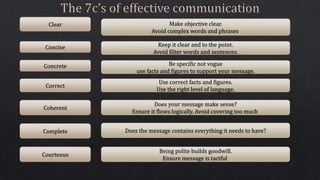
Courteous
Clear
Concise
Concrete
Correct
Coherent
Complete
Make objective clear.
Avoid complex words and phrases.
Keep it clear and to the point.
Avoid filter words and sentences.
Be specific not vogue
use facts and figures to support your message.
Use correct facts and figures.
Use the right level of language.
Does your message make sense?
Ensure it flows logically. Avoid covering too much.
Does the message contains everything it needs to have?
Being polite builds goodwill.
Ensure message is tactful.
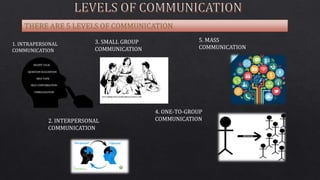
1. INTRAPERSONAL
COMMUNICATION
2. INTERPERSONAL
COMMUNICATION
3. SMALL GROUP
COMMUNICATION
4. ONE-TO-GROUP
COMMUNICATION
5. MASS
COMMUNICATION
Intrapersonal Communication is communication that occurs in your own
mind. It is the basis of your feelings, biases, prejudices, and beliefs. – Examples
are when you make any kind of decision – what to eat or wear. When you
think about something – what you want to do on the weekend or when you
think about another person.
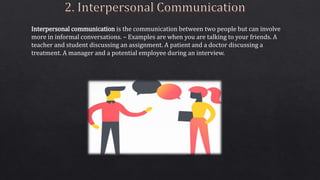
Interpersonal communication is the communication between two people but can involve
more in informal conversations. – Examples are when you are talking to your friends. A
teacher and student discussing an assignment. A patient and a doctor discussing a
treatment. A manager and a potential employee during an interview.
Small Group communication is communication within formal or informal groups
or teams. It is group interaction that results in decision making, problem solving
and discussion within an organization. – Examples would be a group planning a
surprise birthday party for someone. A team working together on a project.
One-to-group communication involves a speaker who seeks to inform, persuade or
motivate an audience. – Examples are a teacher and a class of students. A preacher and a
congregation. A speaker and an assembly of people in the auditorium.
Mass communication is the electronic or print transmission of messages to the general
public. Outlets called mass media include things like radio, television, film, and printed
materials designed to reach large audiences. – A television commercial. A magazine article.
Hearing a song on the radio. Books, Newspapers, Billboards. The key is that you are
reaching a large amount of people without it being face to face. Feedback is generally
delayed with mass communication.
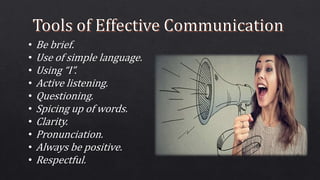
• Be brief.
• Use of simple language.
• Using “I”.
• Active listening.
• Questioning.
• Spicing up of words.
• Clarity.
• Pronunciation.
• Always be positive.
• Respectful.
Communication skills

Communication skills

  • 1.
    PRESENTED TO: MADEBY: Dr. ASHISH CHOPRA 52010031- MITANSHI JAIN 52010033- TUSHAR JAIN
  • 3.
     Communication isthe process of sharing our Ideas, thoughts, and feelings with other people and having those ideas, thoughts, and feelings understood by the people we are talking with.  without COMMUNICATION, we would be unable to share knowledge or experience with anything outside of ourselves.  Common forms of communication include speaking, writing, gestures, touch and broadcasting.
  • 4.
    Communication is theprocess of sending and receiving information among people… SENDER CHANNEL RECEIVE R ENCODING DECODING NOISE MESSAGE FEEDBACK
  • 5.
    Effective communication isthe communication which produces intended or desired result. Effective Communication is a two way process – sending the right message and to the right person. It is important to know the psychology of the people you are interacting with for communication to be effective. Effective communication includes all the aspects of visual, auditory and kinesthetic language to appeal the listener.
  • 6.
    Effective communication helpsto understand a person or situation in a better way. It enables us to solve the differences, build trust and respect in the organization. Sometimes our message is misunderstood or we misunderstand the received message, effective communication helps us to resolve problems with both‟s point of view. Effective communication helps us to connect well with kids, spouse, boss, colleagues, etc. It helps us in decision making.
  • 7.
    Courteous Clear Concise Concrete Correct Coherent Complete Make objective clear. Avoidcomplex words and phrases. Keep it clear and to the point. Avoid filter words and sentences. Be specific not vogue use facts and figures to support your message. Use correct facts and figures. Use the right level of language. Does your message make sense? Ensure it flows logically. Avoid covering too much. Does the message contains everything it needs to have? Being polite builds goodwill. Ensure message is tactful.
  • 8.
    1. INTRAPERSONAL COMMUNICATION 2. INTERPERSONAL COMMUNICATION 3.SMALL GROUP COMMUNICATION 4. ONE-TO-GROUP COMMUNICATION 5. MASS COMMUNICATION
  • 9.
    Intrapersonal Communication iscommunication that occurs in your own mind. It is the basis of your feelings, biases, prejudices, and beliefs. – Examples are when you make any kind of decision – what to eat or wear. When you think about something – what you want to do on the weekend or when you think about another person.
  • 10.
    Interpersonal communication isthe communication between two people but can involve more in informal conversations. – Examples are when you are talking to your friends. A teacher and student discussing an assignment. A patient and a doctor discussing a treatment. A manager and a potential employee during an interview.
  • 11.
    Small Group communicationis communication within formal or informal groups or teams. It is group interaction that results in decision making, problem solving and discussion within an organization. – Examples would be a group planning a surprise birthday party for someone. A team working together on a project.
  • 12.
    One-to-group communication involvesa speaker who seeks to inform, persuade or motivate an audience. – Examples are a teacher and a class of students. A preacher and a congregation. A speaker and an assembly of people in the auditorium.
  • 13.
    Mass communication isthe electronic or print transmission of messages to the general public. Outlets called mass media include things like radio, television, film, and printed materials designed to reach large audiences. – A television commercial. A magazine article. Hearing a song on the radio. Books, Newspapers, Billboards. The key is that you are reaching a large amount of people without it being face to face. Feedback is generally delayed with mass communication.
  • 23.
    • Be brief. •Use of simple language. • Using “I”. • Active listening. • Questioning. • Spicing up of words. • Clarity. • Pronunciation. • Always be positive. • Respectful.