Introduction To Communicable Diseases
Lecturer: Mr. Osman H. Ali
2
Learning Objectives:
• Definition of terminology related with communicable diseases.
• Classifications of communicable diseases.
• Surveillance and its types.
• Mechanism of disease transmission.
• Prevention and control of communicable diseases.
Communicable Disease
It may be defined as an:-
 “illness due to a specific infectious agent as its toxic products &
effects capable of being directly or indirectly transmitted from man to
man, animal to animal or from the environment” i.e.(from
air,dust,soil,water,food etc)
3
DISEASE:
o It is a physiological/psychological dysfunction. It is a condition in which
body health is impaired. This is an objective pathology of the body, such as an
infection.
ILLNESS:
oA condition in which the equilibrium of the body is distrubed.The subjective
sense; the individual does not feel well & can not function as usual.
4
• Important Definitions
5
FOLK ILLNESS:
o Syndromes from which members of a particular group claim to suffer;& for
which their culture provide their etiology, a diagnosis, preventive measures,&
regimens of healing.
SICKNESS:
oIt is a state of social dysfuntion.It is the condition of those who are socially
recognized as unwell.
• Important Definitions
INFECTION:
oThe process of introduction of microorganisms into human host followed by
their multiplication within the body at the expense of the host is called
infection.
INFESTATION:
oIt is a state of having a parasite in or on the body which includes arthropods or
animal parasites.
6
7
Important Definitions
SUSCEPTIBLE:
oA person in whom the defensive power against infections is less is called
susceptible.
IMMUNE:
oA person who possess power to resist infection.
IMPORTANT Definitions(cont…)
EPIDEMIC: (epi=upon ,demos=people)
o Any disease injury or other health related events occurring suddenly in members clearly in
excess of normal expectancy
• E.g. cholera.
ENDEMIC:(en=in, demos=people).
o It refers to the constant presence of a disease or infectious agent within a geographic
area or population group without importation from outside.
• E.g. common cold
8
IMPORTANT Definitions(cont…)
SPORADIC: (means scattered about).
o The cases occur irregurally,haphazardly from time to time & generally infrequently showing
little or no connection with each other nor a recognizable common source of infection.
• e.g.polio,tatnus,herpes zooster & meningococcal meningitis etc.
PANDEMIC:
o An epidemic usually affecting a large proportion of the population & occurring over a wide
geographic area such as a section of a nation, the entire nation, a continent or the world.
9
IMPORTANT Definitions(cont..)
EXOTIC:
• Diseases which are imported into a country in which they do not otherwise
occur.
• E.g. Rabies in UK.
ZOONOSIS:
• An infection or infectious disease transmissible under natural condition from
vertebrate animals to man.
• E.g. Rabies,Plague,Hydatid diseases,Anthrax etc.
10
11
Conti….
Anthropozoonosois:
• Infections transmitted to man from vertebrate animals.
• (Rabies,Plague,Hydatid disease, Anthrax etc).
Zooanthroponoses:
• Infections transmitted from man to vertebrate animals.
• (Human TB in cattle).
IMPORTANT Definitions(cont..)
HOST:
• A person or other animal including birds & arthropods, that affords logement to an infectious agent
under natural condition is called Host.
Primary (or) Definitive Host:
• Host in which parasite attains maturity or passes its sexual stage.
• E.g. mosquito in malaria, man in Filariasis.
Secondary(or)Intermediate Host:
• Host in which parasite is in a larval or asexual state.
• E.g. man in malaria, mosquito in Filariasis.
12
13
Obligate Host:
• It means the only host.
• E.g. man in measles & Typhoid fever.
Dead End Host:
• The host is infected, but does not become functionally infectious,& thus does
not transmit on the infection.
• E.g. Rabies, Bubonic Plague, Tetanus.
IMPORTANT Definitions(cont..)
Important Definitions(cont..)
Incubation Period:
• The time interval b/w invasion by an infectious agent & appearance of the first
sign or symptom of the disease.
Infective Period:
• The time interval during which an infectious agent can be transmitted from a
reservoir (patient) to the susceptible host.
14
15
Window Period:
• The time b/w initial infection & the development of detectable antibodies
against the infection.
Latency Period:
• The time from receiving the infection to the onset of infectiousness,i.e.the
ability to transmit infection.
Important Definitions(cont..)
IMPORTANT Definitions(cont..)
Exposure Period:
• The time during which an individual or a group is exposed to a source of
infection.
Generation Time:
• The interval of time b/w receipt of infection by a host & maximal
infectivity/communicability of that host.
16
17
Infectivity:
• Capacity of organisms to multiply in or around the host.
Pathogenicity:
• Capacity to cause disease in an infected host.
Virulence:
• The ability of a microorganism to produce disease in a shorter period of time
with a very low dose even.
Important Definitions(cont..)
Communicable Disease(cont…)
 Infectious Disease:
• A clinically manifest disease of man or animals resulting from an infection
• E.g.cholera,measles,T.B,chickenpox etc.
 Contagious Disease:
• A disease that is transmitted through contact.
• E.g. Scabies,Leprosy,STDs,Trachoma.
18
Communicable Disease(Cont…)
 Iatrogenic Disease:
Any untoward or adverse consequence of a preventive, diagnostic or
therapeutic regimen or procedure, that comes imairment,handicap,disability or
death resulting from a physician’s professional activity or from the activity of
other health professionals.
• E.g.
I. Reactions to penicillin & immunizing agents.
II. Hepatitis B following blood transfusion.
III. Childhood leukemia due to prenatal X-Rays.
19
Communicable DISEASE(Cont…)
 Nosocomial Infection:
• It is a hospital acquired infection originating in a pt. while in a
hospital denoting a new disorder (unrelated to the pt’s primary
condition).
• E.g.=Infection of surgical wounds,Hep:B & UTI .
20
21
Cross Infection:
• When pts suffering from a particular disease are admitted in
hospital, they may acquire fresh infection from their neighbors who
may suffering from other disease.
Communicable Disease(cont…)
22
Opportunistic Infection:
 This is infection by an organism(s) that takes the opportunity
provided by low resistance in host defense(e.g AIDS) to infect the
host &hence cause disease.
• E.g. Herpes simplex,CMV,Toxoplasma,TB.etc
Communicable Disease(cont…)
23
Classification Of C.D
CLASSIFICATION:1
• Arthropod-born infections{insects}.
• Respiratory infections.
• Intestinal infections.
• Zoonosis.
• Surface infections.
CLASSIFICATION:2
• Water washed Diseases.
• Feco-oral diseases.
• Soil mediated infections.
• Water contact diseases.
• Skin infections
• Respiratory Infections.
• Diseases via body fluids.
• Insect-Born Diseases.
• Ectoparasite Zoonosis.
• Domestic Zoonosis.
Classification Of C.D
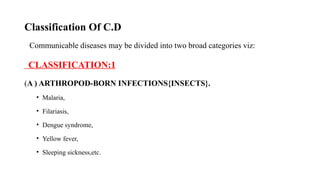
Communicable diseases may be divided into two broad categories viz:
CLASSIFICATION:1
(A ) ARTHROPOD-BORN INFECTIONS{INSECTS}.
• Malaria,
• Filariasis,
• Dengue syndrome,
• Yellow fever,
• Sleeping sickness,etc.
24
25
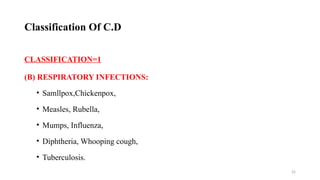
CLASSIFICATION=1
(B) RESPIRATORY INFECTIONS:
• Samllpox,Chickenpox,
• Measles, Rubella,
• Mumps, Influenza,
• Diphtheria, Whooping cough,
• Tuberculosis.
Classification Of C.D
26
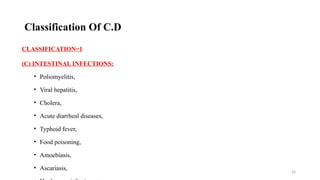
CLASSIFICATION=1
(C) INTESTINAL INFECTIONS:
• Poliomyelitis,
• Viral hepatitis,
• Cholera,
• Acute diarrheal diseases,
• Typhoid fever,
• Food poisoning,
• Amoebiasis,
• Ascariasis,
Classification Of C.D
Classification OF C.D(cont…)
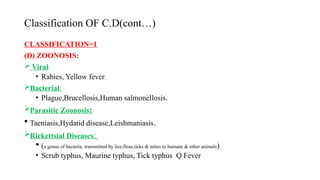
CLASSIFICATION=1
(D) ZOONOSIS:
 Viral:
• Rabies, Yellow fever.
Bacterial:
• Plague,Brucellosis,Human salmonellosis.
Parasitic Zoonosis:
 Taeniasis,Hydatid disease,Leishmaniasis.
Rickettsial Diseases:
 (a genus of bacteria, transmitted by lice,fleas,ticks & mites to humans & other animals)
• Scrub typhus, Maurine typhus, Tick typhus Q Fever
27
28
CLASSIFICATION=1
(E) SURFACE INFECTIONS:
oTrachoma,
oLeprosy,
oSTD,AIDS,
oTetanus.
Classification Of C.D
Classification (Cont…)
CLASSIFICATION=2
I. Water washed Diseases.
II. Feco-oral diseases.
III. Soil mediated infections.
IV. Water contact diseases.
V. Skin infections
VI. Respiratory Infections.
VII.Diseases via body fluids.
VIII.Insect-Born Diseases.
IX. Ectoparasite Zoonosis.
X. Domestic Zoonosis.
29
30
CLASSIFICATION=2
1.Warer washed Diseases:
• Scabies,
• Trachoma,
• Ophthalmia neonatorum,
• Lice(louse),
• Dermatomycosis.
Classification (Cont…)
31
CLASSIFICATION=2
2.Feco-oral diseases:
• Gastroenteritis,
• Amoebiasis,
• Giardiasis,
• Bacillary Dysentery,
• Cholera,
• Typhoid,
• Hep:A &E,Poliomylitis,
Classification (Cont…)
32
CLASSIFICATION=2
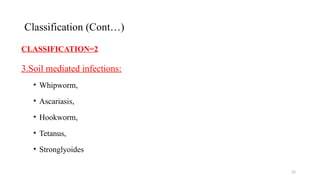
3.Soil mediated infections:
• Whipworm,
• Ascariasis,
• Hookworm,
• Tetanus,
• Stronglyoides
Classification (Cont…)
33
CLASSIFICATION=2
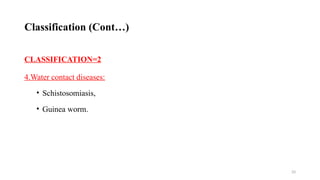
4.Water contact diseases:
• Schistosomiasis,
• Guinea worm.
Classification (Cont…)
34
CLASSIFICATION=2
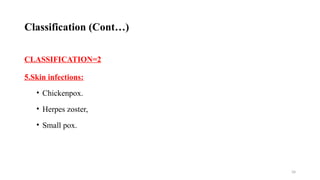
5.Skin infections:
• Chickenpox.
• Herpes zoster,
• Small pox.
Classification (Cont…)
35
CLASSIFICATION=2
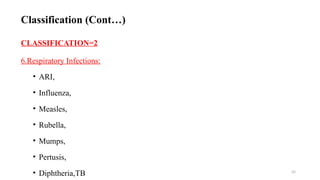
6.Respiratory Infections:
• ARI,
• Influenza,
• Measles,
• Rubella,
• Mumps,
• Pertusis,
• Diphtheria,TB
Classification (Cont…)
36
CLASSIFICATION=2
7.Diseases via body fluids:
• Gonorrhea,
• Venereal Syphilis,
• HIV/AIDS,
• Chancroid,
• Hep:B,C,D.
Classification (Cont…)
37
CLASSIFICATION=2
8.Insect-Born Diseases:
• Malaria,
• Filariasis,
• Yellow fever,
• Dengue fever(DHF),
• Sleeping sickness,
• Leishmaniosis.
Classification (Cont…)
38
CLASSIFICATION=2
9.Ectoparasite Zoonosis:
• Plague,
• Typhus
• Relapsing fever.
Classification (Cont…)
39
CLASSIFICATION=2
10.Domestic Zoonosis:
• Hydatid Disease,
• Toxoplasmosis,
• Rabies,
• Leptospirosis,
• Brucellosis,
• Anthrax.
Classification (Cont…)
Surveillance
SURVELLANCE:
• “It is the continuous & systemic collection, analysis & interpretation of health data”
• “The continuous scrutiny of the factors that determine the occurrence & distribution of
the disease & other conditions of ill-health “
• It may be:
1.ACTIVE SURVEILLANCE:
• A reporter is contacted at regular intervals to specifically ask about the occurrence of
diseases under surveillance. 40
41
Conti….
2.Sentinel Surveillance:
• The reporting is from the sources(doctors ,hospitals ,etc) that are likely to see the
cases of disease under surveillance.
3.Passive Surveillance:
• This is routine reporting in which the reporter initiates the case reports.
Mechanism of transmission
42
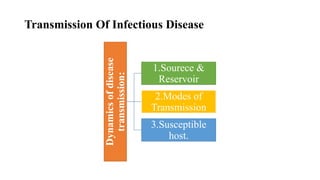
Transmission Of Infectious Disease
Dynamics
of
disease
transmission:
1.Sourece &
Reservoir
2.Modes of
Transmission
3.Susceptible
host.
43
Transmission Of Infectious Disease
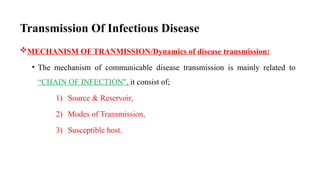
MECHANISM OF TRANMISSION/Dynamics of disease transmission:
• The mechanism of communicable disease transmission is mainly related to
“CHAIN OF INFECTION", it consist of;
1) Source & Reservoir,
2) Modes of Transmission,
3) Susceptible host.
44
45
1.SOURCE AND RESERVOIR
Transmission Of Infectious Disease(cont..)
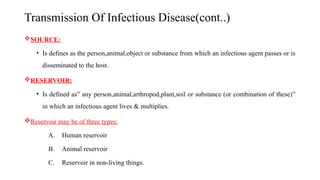
SOURCE:
• Is defines as the person,animal,object or substance from which an infectious agent passes or is
disseminated to the host.
RESERVOIR:
• Is defined as” any person,animal,arthropod,plant,soil or substance (or combination of these)”
in which an infectious agent lives & multiplies.
Reservoir may be of three types:
A. Human reservoir
B. Animal reservoir
C. Reservoir in non-living things.
46
Transmission Of Infectious Disease(cont..)
HUMAN RESERVOIR:
• The important source or reservoir of infection for humans is a man himself.
• In human reservoir 2 things should be noted:-
I. CASES:
 May be defined as a person in the population or study group identified as having the particular disease, health
disorder or condition.
II. CARRIERS:
 A carrier is defined as an infected person or animal that harbors a specific infectious agent in the absence of
discrbile clinical disease & serve as a potential source of infection for others.
47
Classification Of Carriers
A. By TYPE:
I. Incubatory Carriers: are those who shed the infectious agent during the incubation
period of disease E.g,measles, mumps, polio.
II. Convalescent Carriers:-are those who continue to shed the disease agent during the
convalescent period. E.g. typhoid fever, dysentery, cholera, whooping cough, diphtheria.
III. Healthy Carriers:-are those who emerges from subclinical cases .The are victims of
subclinical infection who have developed carriers state without suffering from overt
disease. E.g. poliomyelitis, meningitis, cholera, diphtheria & salmonellosis.
48
Classification Of Carriers (Cont…)
B. By Duration:
1.Temporary Carriers:
 Those who shed the infectious agent for short periods of time.
 It includes the incubatory, convalescent & healthy carriers.
2.Chronic Carriers:
 One who excretes the infectious agent for indefinite periods.
• E.g. typhoid fever, hepatitis B, gonorrhea, dysentery.
49
Classification Of Carriers (Cont…)
C. By PORTAL OF EXIT:
 They Are Also Classified As Urinary, Intestinal, Respiratory, Nasal Carriers Etc.
 Skin Eruptions Open Wounds And Blood Are Also Portals Of Exit.
i. Urinary: Typhoid, Gonorrhea.
ii. Intestinal: Cholera, Typhoid.
iii. Respiratory: Staphylococcal Infection.
50
Reservoir (Cont..)
2. Animal Reservoir:
 The source of infection may some times be animals and birds.
 The diseases & infections which are transmissible to men from
vertebrates is called Zoonosis.
51
52
Reservoir (Cont..)
3. Reservoir In Non-living Things:
 Soils & inanimate matter can also act as a reservoirs of infection
 E.g. soil may harbors agents that cause tetanus, anthrax.
53
2.MODES OF TRANSMISSION
Modes Of Transmission
• Communicable Diseases May Be Transmitted From The Reservoir Or
Source Of Infection To A Susceptible Individual In Many Different Ways.
• The Mode Of Transmission On Infectious Diseases May Be Classified
As :
A. Direct Transmission.
B. Indirect Transmission.
54
Modes of transmission (cont…)
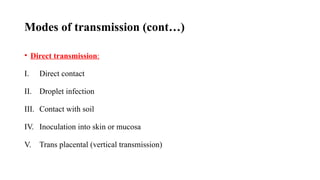
• Direct transmission:
I. Direct contact
II. Droplet infection
III. Contact with soil
IV. Inoculation into skin or mucosa
V. Trans placental (vertical transmission)
55
Modes of transmission (cont…)
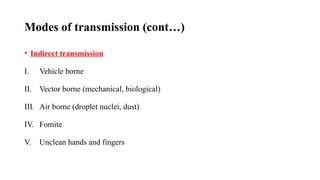
• Indirect transmission
I. Vehicle borne
II. Vector borne (mechanical, biological)
III. Air borne (droplet nuclei, dust)
IV. Fomite
V. Unclean hands and fingers
56
Direct transmission
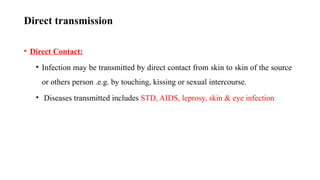
• Direct Contact:
• Infection may be transmitted by direct contact from skin to skin of the source
or others person .e.g. by touching, kissing or sexual intercourse.
• Diseases transmitted includes STD, AIDS, leprosy, skin & eye infection.
57
58
Direct transmission
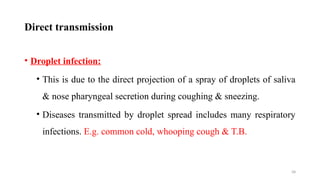
• Droplet infection:
• This is due to the direct projection of a spray of droplets of saliva
& nose pharyngeal secretion during coughing & sneezing.
• Diseases transmitted by droplet spread includes many respiratory
infections. E.g. common cold, whooping cough & T.B.
59
Direct transmission
• Contact With Soil:
• The disease agent may be in soil, compost or decaying vegetable matter.
• Examples of diseases, hook worm, tetanus, mycosis.
Direct transmission
• IN OCCULATION INTO SKIN AND MUCOSA:
• The disease agent may be inoculated directly into the skin or mucosa.
• E.g. rabies virus by dog bite, hepatitis B & C virus through contaminated
needles and syringes.
60
61
Conti….
• TRANSPLACENTAL OR VERTICAL TRANSMISSION:
• In this case the disease agents can be transmitted transplacentally & is another form of
direct transmission.
• Examples are (TORCH)
• To= toxoplasma gondii
• R=rubella virus
• C= cytomegalo virus
• H=herpes virus
Indirect transmission
This transmission includes the traditional 5F’s “ Flies, Fingers, Fomites, Food & Fluid’’.
• VEHICLE BORNE
• It implies the transmission of the infectious agent through the agency of water, food
(including raw vegetables, fruits, milk & milk products)
• E.g. acute diarrhea, typhoid fever, cholera, polio, hep: A.
• VECTOR BORNE
• Vector is defined as an arthropod or any living carrier that transports an infectious
agent.
• Transmission by a vector may be mechanical or biological.
62
63
• Air Borne:
• Droplet Nuclei:
• Are a type of particles implicated in the spread of air borne infections.
• They may be formed by:
• Evaporation of droplets of coughed or sneezed into the air, diseases include
T.B, Influenza, chicken pox, measles.
Indirect Transmission
64
Conti…
• DUST:
• Some of larger droplets which are expelled during talking, coughing &
sneezing settles down by their sheer weights on the floor , carpets, furniture,
cloths etc
• A Variety of pathogenic bacteria, virus and fungal spores have been found
in the dust of hospital wards.
• Examples of diseases are pneumonia, T.B etc.
65
• Fomite borne, unclean hands &fingers:
• FOMITES includes:
• syringes, surgical dressings, towels, drinking glasses, spoons, soiled
clothes, books, cups, pencils, instruments etc.
• Diseases transmitted = diphtheria, hepatitis A, skin infections.
Indirect transmission
66
Conti…
• UNCLEAN HANDS:
• Hands are the most common medium by which pathogen agents are transferred to
food from the bowl etc as well as from other foods.
• Examples are :
• -Staphylococcal infection
• -Typhoid & Para typhoid fever
• -Gastroenteritis
• -Dysentery
• -Hepatitis A
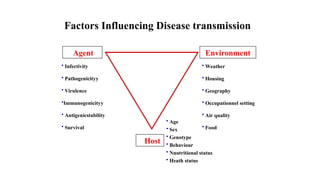
• Infectivity
• Pathogenicityy
• Virulence
•Immunogenicityy
• Antigenicstability
• Survival
• Weather
• Housing
• Geography
• Occupationnel setting
• Air quality
• Food
Environment
• Age
• Sex
• Genotype
• Behaviour
• Nnutritional status
• Heath status
Host
Agent
Factors Influencing Disease transmission
68
3.SUSCEPTIBLE HOST.
69
3.Susceptible Host.
• Susceptibility means a likelihood of a person getting a disease, for successful transmission,
the Infectious agent must have following stages:
i. The infectious agent must find a portal of entry.
ii. The organism must reach the appropriate tissues for its multiplication & survival.
iii. The disease agent must find a way out of the body to reach a new host(if there is no portal of
exit, the infection becomes a dead-end infection as in Rabies, Bubonic plague & Tetanus).
iv. The organism must survive in the external environment for sufficient period till a new host is
found.
70
Preventation And Control Of The Communicable Diseases
Preventation and Control of the Communicable Diseases
• The principle of prevention & control of diseases comes under following
headings:-
1. Notification:-
• The immediate notice of this infection by the health officer as an authority. So
that they take measures for preventing the further spread of diseases.
2. early diagnosis:-
• The physician must take a tentative diagnosis & advises isolation measures.
71
Preventation and Control of the Communicable Diseases (Cont
3. ISOLATION:
 It is meant the separation of person suffering from communicable disease from the
rest of the family to prevent the transmission from the sick to the healthy.
• QUARANTINE:-
• Isolation of healthy travelers (who do not possess any certificate of having been
immunized) from an infected area for at least the longest incubation period of disease.
• DISEASE PERIOD OF QUARANTINE
• Cholera, plague, yellow fever 5days,6days,6day
72
Preventation and Control of The Communicable Diseases (Cont..)
4.Destruction of Infecting Agents:-
• The destruction of pathogenic micro-organisms called disinfection & those
substances which destroy pathogenic material are called disinfectants, germicides &
bactericides.
5. Increasing the resistance of the susceptible by Immunization:-
• It is very powerful measure for the control of communicable diseases & the infection.
73
Preventation and control of the communicable diseases (cont..)
6. Behavioral Change:- (Health Education)
• Its purpose is to inform the community, about the principle of preventive
medicine & public health.
7. Investigation of an Attack Of Illness:-
Responsibility of an health officer .
• To learn exact date of illness.
• To search the source of infection
• To search the history of any recent illness in the family or neighbors.
74
THANK YOU
75

Introduction To Communicable Diseases.pptx

  • 1.
    Introduction To CommunicableDiseases Lecturer: Mr. Osman H. Ali
  • 2.
    2 Learning Objectives: • Definitionof terminology related with communicable diseases. • Classifications of communicable diseases. • Surveillance and its types. • Mechanism of disease transmission. • Prevention and control of communicable diseases.
  • 3.
    Communicable Disease It maybe defined as an:-  “illness due to a specific infectious agent as its toxic products & effects capable of being directly or indirectly transmitted from man to man, animal to animal or from the environment” i.e.(from air,dust,soil,water,food etc) 3
  • 4.
    DISEASE: o It isa physiological/psychological dysfunction. It is a condition in which body health is impaired. This is an objective pathology of the body, such as an infection. ILLNESS: oA condition in which the equilibrium of the body is distrubed.The subjective sense; the individual does not feel well & can not function as usual. 4 • Important Definitions
  • 5.
    5 FOLK ILLNESS: o Syndromesfrom which members of a particular group claim to suffer;& for which their culture provide their etiology, a diagnosis, preventive measures,& regimens of healing. SICKNESS: oIt is a state of social dysfuntion.It is the condition of those who are socially recognized as unwell. • Important Definitions
  • 6.
    • Important Definitions INFECTION: oTheprocess of introduction of microorganisms into human host followed by their multiplication within the body at the expense of the host is called infection. INFESTATION: oIt is a state of having a parasite in or on the body which includes arthropods or animal parasites. 6
  • 7.
    7 Important Definitions SUSCEPTIBLE: oA personin whom the defensive power against infections is less is called susceptible. IMMUNE: oA person who possess power to resist infection.
  • 8.
    IMPORTANT Definitions(cont…) EPIDEMIC: (epi=upon,demos=people) o Any disease injury or other health related events occurring suddenly in members clearly in excess of normal expectancy • E.g. cholera. ENDEMIC:(en=in, demos=people). o It refers to the constant presence of a disease or infectious agent within a geographic area or population group without importation from outside. • E.g. common cold 8
  • 9.
    IMPORTANT Definitions(cont…) SPORADIC: (meansscattered about). o The cases occur irregurally,haphazardly from time to time & generally infrequently showing little or no connection with each other nor a recognizable common source of infection. • e.g.polio,tatnus,herpes zooster & meningococcal meningitis etc. PANDEMIC: o An epidemic usually affecting a large proportion of the population & occurring over a wide geographic area such as a section of a nation, the entire nation, a continent or the world. 9
  • 10.
    IMPORTANT Definitions(cont..) EXOTIC: • Diseaseswhich are imported into a country in which they do not otherwise occur. • E.g. Rabies in UK. ZOONOSIS: • An infection or infectious disease transmissible under natural condition from vertebrate animals to man. • E.g. Rabies,Plague,Hydatid diseases,Anthrax etc. 10
  • 11.
    11 Conti…. Anthropozoonosois: • Infections transmittedto man from vertebrate animals. • (Rabies,Plague,Hydatid disease, Anthrax etc). Zooanthroponoses: • Infections transmitted from man to vertebrate animals. • (Human TB in cattle).
  • 12.
    IMPORTANT Definitions(cont..) HOST: • Aperson or other animal including birds & arthropods, that affords logement to an infectious agent under natural condition is called Host. Primary (or) Definitive Host: • Host in which parasite attains maturity or passes its sexual stage. • E.g. mosquito in malaria, man in Filariasis. Secondary(or)Intermediate Host: • Host in which parasite is in a larval or asexual state. • E.g. man in malaria, mosquito in Filariasis. 12
  • 13.
    13 Obligate Host: • Itmeans the only host. • E.g. man in measles & Typhoid fever. Dead End Host: • The host is infected, but does not become functionally infectious,& thus does not transmit on the infection. • E.g. Rabies, Bubonic Plague, Tetanus. IMPORTANT Definitions(cont..)
  • 14.
    Important Definitions(cont..) Incubation Period: •The time interval b/w invasion by an infectious agent & appearance of the first sign or symptom of the disease. Infective Period: • The time interval during which an infectious agent can be transmitted from a reservoir (patient) to the susceptible host. 14
  • 15.
    15 Window Period: • Thetime b/w initial infection & the development of detectable antibodies against the infection. Latency Period: • The time from receiving the infection to the onset of infectiousness,i.e.the ability to transmit infection. Important Definitions(cont..)
  • 16.
    IMPORTANT Definitions(cont..) Exposure Period: •The time during which an individual or a group is exposed to a source of infection. Generation Time: • The interval of time b/w receipt of infection by a host & maximal infectivity/communicability of that host. 16
  • 17.
    17 Infectivity: • Capacity oforganisms to multiply in or around the host. Pathogenicity: • Capacity to cause disease in an infected host. Virulence: • The ability of a microorganism to produce disease in a shorter period of time with a very low dose even. Important Definitions(cont..)
  • 18.
    Communicable Disease(cont…)  InfectiousDisease: • A clinically manifest disease of man or animals resulting from an infection • E.g.cholera,measles,T.B,chickenpox etc.  Contagious Disease: • A disease that is transmitted through contact. • E.g. Scabies,Leprosy,STDs,Trachoma. 18
  • 19.
    Communicable Disease(Cont…)  IatrogenicDisease: Any untoward or adverse consequence of a preventive, diagnostic or therapeutic regimen or procedure, that comes imairment,handicap,disability or death resulting from a physician’s professional activity or from the activity of other health professionals. • E.g. I. Reactions to penicillin & immunizing agents. II. Hepatitis B following blood transfusion. III. Childhood leukemia due to prenatal X-Rays. 19
  • 20.
    Communicable DISEASE(Cont…)  NosocomialInfection: • It is a hospital acquired infection originating in a pt. while in a hospital denoting a new disorder (unrelated to the pt’s primary condition). • E.g.=Infection of surgical wounds,Hep:B & UTI . 20
  • 21.
    21 Cross Infection: • Whenpts suffering from a particular disease are admitted in hospital, they may acquire fresh infection from their neighbors who may suffering from other disease. Communicable Disease(cont…)
  • 22.
    22 Opportunistic Infection:  Thisis infection by an organism(s) that takes the opportunity provided by low resistance in host defense(e.g AIDS) to infect the host &hence cause disease. • E.g. Herpes simplex,CMV,Toxoplasma,TB.etc Communicable Disease(cont…)
  • 23.
    23 Classification Of C.D CLASSIFICATION:1 •Arthropod-born infections{insects}. • Respiratory infections. • Intestinal infections. • Zoonosis. • Surface infections. CLASSIFICATION:2 • Water washed Diseases. • Feco-oral diseases. • Soil mediated infections. • Water contact diseases. • Skin infections • Respiratory Infections. • Diseases via body fluids. • Insect-Born Diseases. • Ectoparasite Zoonosis. • Domestic Zoonosis.
  • 24.
    Classification Of C.D Communicablediseases may be divided into two broad categories viz: CLASSIFICATION:1 (A ) ARTHROPOD-BORN INFECTIONS{INSECTS}. • Malaria, • Filariasis, • Dengue syndrome, • Yellow fever, • Sleeping sickness,etc. 24
  • 25.
    25 CLASSIFICATION=1 (B) RESPIRATORY INFECTIONS: •Samllpox,Chickenpox, • Measles, Rubella, • Mumps, Influenza, • Diphtheria, Whooping cough, • Tuberculosis. Classification Of C.D
  • 26.
    26 CLASSIFICATION=1 (C) INTESTINAL INFECTIONS: •Poliomyelitis, • Viral hepatitis, • Cholera, • Acute diarrheal diseases, • Typhoid fever, • Food poisoning, • Amoebiasis, • Ascariasis, Classification Of C.D
  • 27.
    Classification OF C.D(cont…) CLASSIFICATION=1 (D)ZOONOSIS:  Viral: • Rabies, Yellow fever. Bacterial: • Plague,Brucellosis,Human salmonellosis. Parasitic Zoonosis:  Taeniasis,Hydatid disease,Leishmaniasis. Rickettsial Diseases:  (a genus of bacteria, transmitted by lice,fleas,ticks & mites to humans & other animals) • Scrub typhus, Maurine typhus, Tick typhus Q Fever 27
  • 28.
  • 29.
    Classification (Cont…) CLASSIFICATION=2 I. Waterwashed Diseases. II. Feco-oral diseases. III. Soil mediated infections. IV. Water contact diseases. V. Skin infections VI. Respiratory Infections. VII.Diseases via body fluids. VIII.Insect-Born Diseases. IX. Ectoparasite Zoonosis. X. Domestic Zoonosis. 29
  • 30.
    30 CLASSIFICATION=2 1.Warer washed Diseases: •Scabies, • Trachoma, • Ophthalmia neonatorum, • Lice(louse), • Dermatomycosis. Classification (Cont…)
  • 31.
    31 CLASSIFICATION=2 2.Feco-oral diseases: • Gastroenteritis, •Amoebiasis, • Giardiasis, • Bacillary Dysentery, • Cholera, • Typhoid, • Hep:A &E,Poliomylitis, Classification (Cont…)
  • 32.
    32 CLASSIFICATION=2 3.Soil mediated infections: •Whipworm, • Ascariasis, • Hookworm, • Tetanus, • Stronglyoides Classification (Cont…)
  • 33.
    33 CLASSIFICATION=2 4.Water contact diseases: •Schistosomiasis, • Guinea worm. Classification (Cont…)
  • 34.
    34 CLASSIFICATION=2 5.Skin infections: • Chickenpox. •Herpes zoster, • Small pox. Classification (Cont…)
  • 35.
    35 CLASSIFICATION=2 6.Respiratory Infections: • ARI, •Influenza, • Measles, • Rubella, • Mumps, • Pertusis, • Diphtheria,TB Classification (Cont…)
  • 36.
    36 CLASSIFICATION=2 7.Diseases via bodyfluids: • Gonorrhea, • Venereal Syphilis, • HIV/AIDS, • Chancroid, • Hep:B,C,D. Classification (Cont…)
  • 37.
    37 CLASSIFICATION=2 8.Insect-Born Diseases: • Malaria, •Filariasis, • Yellow fever, • Dengue fever(DHF), • Sleeping sickness, • Leishmaniosis. Classification (Cont…)
  • 38.
    38 CLASSIFICATION=2 9.Ectoparasite Zoonosis: • Plague, •Typhus • Relapsing fever. Classification (Cont…)
  • 39.
    39 CLASSIFICATION=2 10.Domestic Zoonosis: • HydatidDisease, • Toxoplasmosis, • Rabies, • Leptospirosis, • Brucellosis, • Anthrax. Classification (Cont…)
  • 40.
    Surveillance SURVELLANCE: • “It isthe continuous & systemic collection, analysis & interpretation of health data” • “The continuous scrutiny of the factors that determine the occurrence & distribution of the disease & other conditions of ill-health “ • It may be: 1.ACTIVE SURVEILLANCE: • A reporter is contacted at regular intervals to specifically ask about the occurrence of diseases under surveillance. 40
  • 41.
    41 Conti…. 2.Sentinel Surveillance: • Thereporting is from the sources(doctors ,hospitals ,etc) that are likely to see the cases of disease under surveillance. 3.Passive Surveillance: • This is routine reporting in which the reporter initiates the case reports.
  • 42.
  • 43.
    Transmission Of InfectiousDisease Dynamics of disease transmission: 1.Sourece & Reservoir 2.Modes of Transmission 3.Susceptible host. 43
  • 44.
    Transmission Of InfectiousDisease MECHANISM OF TRANMISSION/Dynamics of disease transmission: • The mechanism of communicable disease transmission is mainly related to “CHAIN OF INFECTION", it consist of; 1) Source & Reservoir, 2) Modes of Transmission, 3) Susceptible host. 44
  • 45.
  • 46.
    Transmission Of InfectiousDisease(cont..) SOURCE: • Is defines as the person,animal,object or substance from which an infectious agent passes or is disseminated to the host. RESERVOIR: • Is defined as” any person,animal,arthropod,plant,soil or substance (or combination of these)” in which an infectious agent lives & multiplies. Reservoir may be of three types: A. Human reservoir B. Animal reservoir C. Reservoir in non-living things. 46
  • 47.
    Transmission Of InfectiousDisease(cont..) HUMAN RESERVOIR: • The important source or reservoir of infection for humans is a man himself. • In human reservoir 2 things should be noted:- I. CASES:  May be defined as a person in the population or study group identified as having the particular disease, health disorder or condition. II. CARRIERS:  A carrier is defined as an infected person or animal that harbors a specific infectious agent in the absence of discrbile clinical disease & serve as a potential source of infection for others. 47
  • 48.
    Classification Of Carriers A.By TYPE: I. Incubatory Carriers: are those who shed the infectious agent during the incubation period of disease E.g,measles, mumps, polio. II. Convalescent Carriers:-are those who continue to shed the disease agent during the convalescent period. E.g. typhoid fever, dysentery, cholera, whooping cough, diphtheria. III. Healthy Carriers:-are those who emerges from subclinical cases .The are victims of subclinical infection who have developed carriers state without suffering from overt disease. E.g. poliomyelitis, meningitis, cholera, diphtheria & salmonellosis. 48
  • 49.
    Classification Of Carriers(Cont…) B. By Duration: 1.Temporary Carriers:  Those who shed the infectious agent for short periods of time.  It includes the incubatory, convalescent & healthy carriers. 2.Chronic Carriers:  One who excretes the infectious agent for indefinite periods. • E.g. typhoid fever, hepatitis B, gonorrhea, dysentery. 49
  • 50.
    Classification Of Carriers(Cont…) C. By PORTAL OF EXIT:  They Are Also Classified As Urinary, Intestinal, Respiratory, Nasal Carriers Etc.  Skin Eruptions Open Wounds And Blood Are Also Portals Of Exit. i. Urinary: Typhoid, Gonorrhea. ii. Intestinal: Cholera, Typhoid. iii. Respiratory: Staphylococcal Infection. 50
  • 51.
    Reservoir (Cont..) 2. AnimalReservoir:  The source of infection may some times be animals and birds.  The diseases & infections which are transmissible to men from vertebrates is called Zoonosis. 51
  • 52.
    52 Reservoir (Cont..) 3. ReservoirIn Non-living Things:  Soils & inanimate matter can also act as a reservoirs of infection  E.g. soil may harbors agents that cause tetanus, anthrax.
  • 53.
  • 54.
    Modes Of Transmission •Communicable Diseases May Be Transmitted From The Reservoir Or Source Of Infection To A Susceptible Individual In Many Different Ways. • The Mode Of Transmission On Infectious Diseases May Be Classified As : A. Direct Transmission. B. Indirect Transmission. 54
  • 55.
    Modes of transmission(cont…) • Direct transmission: I. Direct contact II. Droplet infection III. Contact with soil IV. Inoculation into skin or mucosa V. Trans placental (vertical transmission) 55
  • 56.
    Modes of transmission(cont…) • Indirect transmission I. Vehicle borne II. Vector borne (mechanical, biological) III. Air borne (droplet nuclei, dust) IV. Fomite V. Unclean hands and fingers 56
  • 57.
    Direct transmission • DirectContact: • Infection may be transmitted by direct contact from skin to skin of the source or others person .e.g. by touching, kissing or sexual intercourse. • Diseases transmitted includes STD, AIDS, leprosy, skin & eye infection. 57
  • 58.
    58 Direct transmission • Dropletinfection: • This is due to the direct projection of a spray of droplets of saliva & nose pharyngeal secretion during coughing & sneezing. • Diseases transmitted by droplet spread includes many respiratory infections. E.g. common cold, whooping cough & T.B.
  • 59.
    59 Direct transmission • ContactWith Soil: • The disease agent may be in soil, compost or decaying vegetable matter. • Examples of diseases, hook worm, tetanus, mycosis.
  • 60.
    Direct transmission • INOCCULATION INTO SKIN AND MUCOSA: • The disease agent may be inoculated directly into the skin or mucosa. • E.g. rabies virus by dog bite, hepatitis B & C virus through contaminated needles and syringes. 60
  • 61.
    61 Conti…. • TRANSPLACENTAL ORVERTICAL TRANSMISSION: • In this case the disease agents can be transmitted transplacentally & is another form of direct transmission. • Examples are (TORCH) • To= toxoplasma gondii • R=rubella virus • C= cytomegalo virus • H=herpes virus
  • 62.
    Indirect transmission This transmissionincludes the traditional 5F’s “ Flies, Fingers, Fomites, Food & Fluid’’. • VEHICLE BORNE • It implies the transmission of the infectious agent through the agency of water, food (including raw vegetables, fruits, milk & milk products) • E.g. acute diarrhea, typhoid fever, cholera, polio, hep: A. • VECTOR BORNE • Vector is defined as an arthropod or any living carrier that transports an infectious agent. • Transmission by a vector may be mechanical or biological. 62
  • 63.
    63 • Air Borne: •Droplet Nuclei: • Are a type of particles implicated in the spread of air borne infections. • They may be formed by: • Evaporation of droplets of coughed or sneezed into the air, diseases include T.B, Influenza, chicken pox, measles. Indirect Transmission
  • 64.
    64 Conti… • DUST: • Someof larger droplets which are expelled during talking, coughing & sneezing settles down by their sheer weights on the floor , carpets, furniture, cloths etc • A Variety of pathogenic bacteria, virus and fungal spores have been found in the dust of hospital wards. • Examples of diseases are pneumonia, T.B etc.
  • 65.
    65 • Fomite borne,unclean hands &fingers: • FOMITES includes: • syringes, surgical dressings, towels, drinking glasses, spoons, soiled clothes, books, cups, pencils, instruments etc. • Diseases transmitted = diphtheria, hepatitis A, skin infections. Indirect transmission
  • 66.
    66 Conti… • UNCLEAN HANDS: •Hands are the most common medium by which pathogen agents are transferred to food from the bowl etc as well as from other foods. • Examples are : • -Staphylococcal infection • -Typhoid & Para typhoid fever • -Gastroenteritis • -Dysentery • -Hepatitis A
  • 67.
    • Infectivity • Pathogenicityy •Virulence •Immunogenicityy • Antigenicstability • Survival • Weather • Housing • Geography • Occupationnel setting • Air quality • Food Environment • Age • Sex • Genotype • Behaviour • Nnutritional status • Heath status Host Agent Factors Influencing Disease transmission
  • 68.
  • 69.
    69 3.Susceptible Host. • Susceptibilitymeans a likelihood of a person getting a disease, for successful transmission, the Infectious agent must have following stages: i. The infectious agent must find a portal of entry. ii. The organism must reach the appropriate tissues for its multiplication & survival. iii. The disease agent must find a way out of the body to reach a new host(if there is no portal of exit, the infection becomes a dead-end infection as in Rabies, Bubonic plague & Tetanus). iv. The organism must survive in the external environment for sufficient period till a new host is found.
  • 70.
    70 Preventation And ControlOf The Communicable Diseases
  • 71.
    Preventation and Controlof the Communicable Diseases • The principle of prevention & control of diseases comes under following headings:- 1. Notification:- • The immediate notice of this infection by the health officer as an authority. So that they take measures for preventing the further spread of diseases. 2. early diagnosis:- • The physician must take a tentative diagnosis & advises isolation measures. 71
  • 72.
    Preventation and Controlof the Communicable Diseases (Cont 3. ISOLATION:  It is meant the separation of person suffering from communicable disease from the rest of the family to prevent the transmission from the sick to the healthy. • QUARANTINE:- • Isolation of healthy travelers (who do not possess any certificate of having been immunized) from an infected area for at least the longest incubation period of disease. • DISEASE PERIOD OF QUARANTINE • Cholera, plague, yellow fever 5days,6days,6day 72
  • 73.
    Preventation and Controlof The Communicable Diseases (Cont..) 4.Destruction of Infecting Agents:- • The destruction of pathogenic micro-organisms called disinfection & those substances which destroy pathogenic material are called disinfectants, germicides & bactericides. 5. Increasing the resistance of the susceptible by Immunization:- • It is very powerful measure for the control of communicable diseases & the infection. 73
  • 74.
    Preventation and controlof the communicable diseases (cont..) 6. Behavioral Change:- (Health Education) • Its purpose is to inform the community, about the principle of preventive medicine & public health. 7. Investigation of an Attack Of Illness:- Responsibility of an health officer . • To learn exact date of illness. • To search the source of infection • To search the history of any recent illness in the family or neighbors. 74
  • 75.