COMMON ORIGIN All things have a common origin Atomic models and the behavior of the atom Atomic structure and the correlation of element’s physical and chemical properties .
WHY  STUDY CHEMISTRY? Chemistry is how the world works! ?   What are some ways chemistry effects our lives ? 1- Health Care 2- Conservation of natural resources 3- environmental protection 5- everyday needs
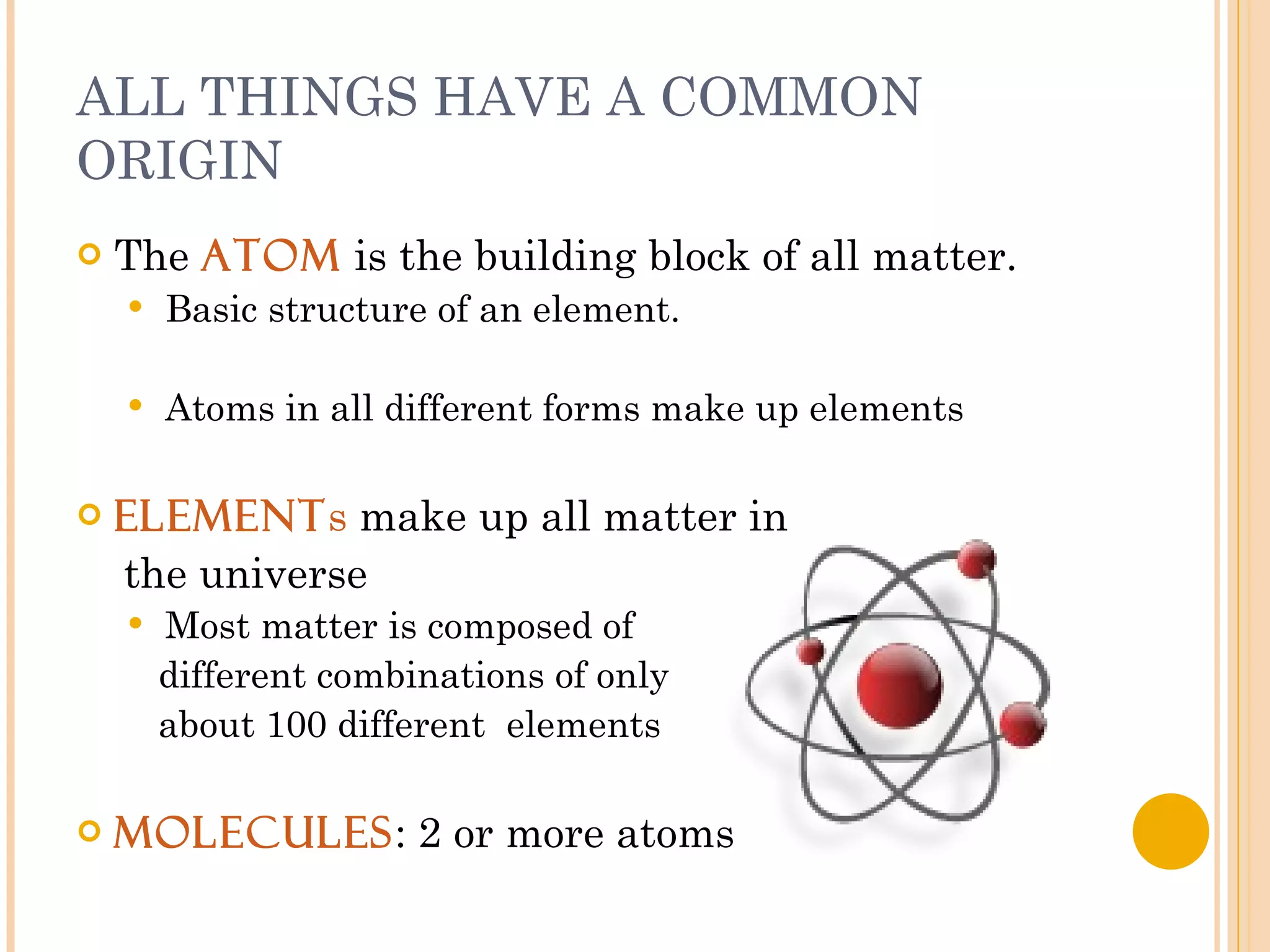
ALL THINGS HAVE A COMMON ORIGIN The  atom  is the building block of all matter. Basic structure of an element. Atoms in all different forms make up elements Element s  make up all matter in  the universe Most matter is composed of  different combinations of only  about 100 different  elements Molecules : 2 or more atoms
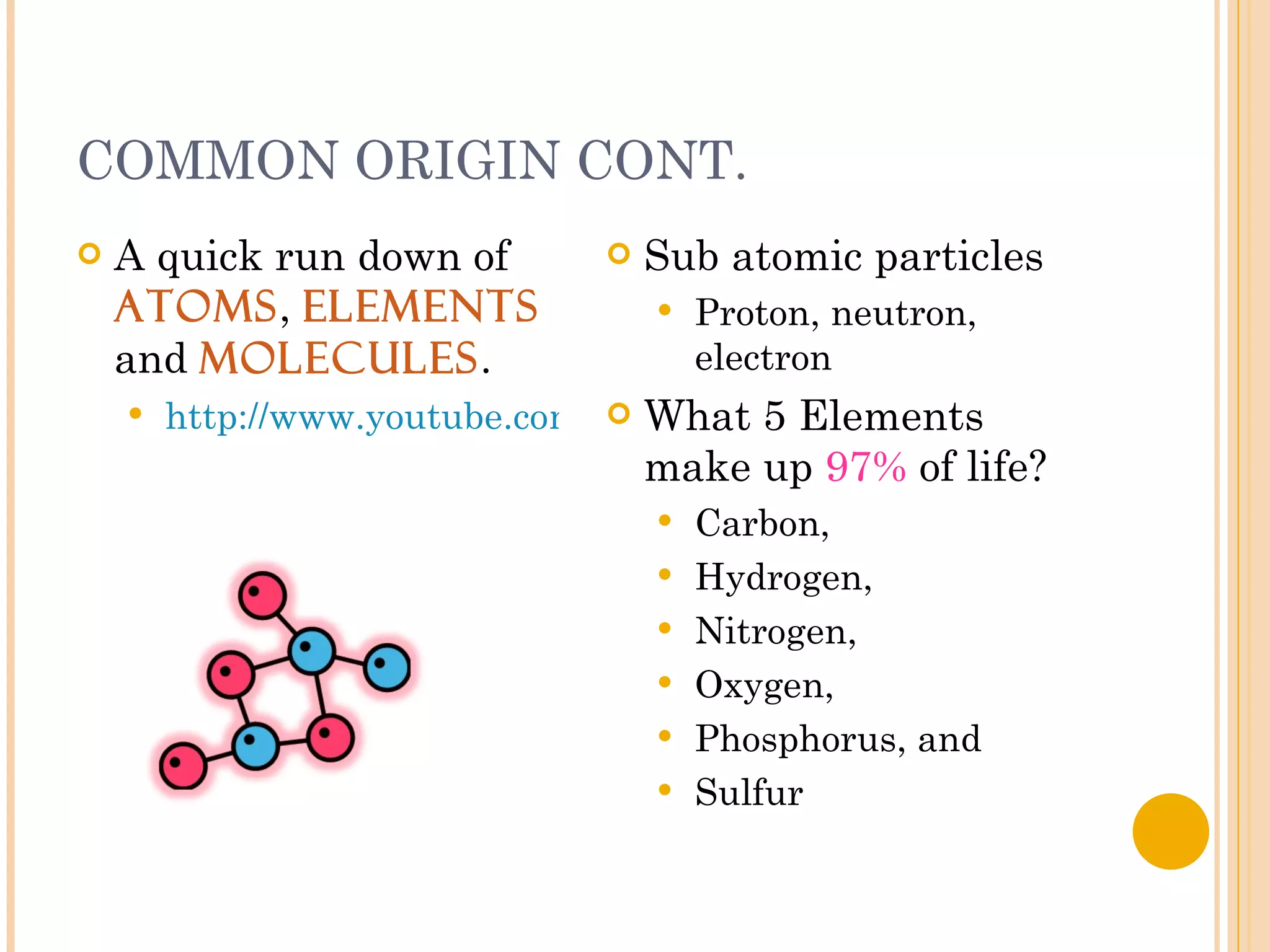
COMMON ORIGIN CONT. A quick run down of  Atoms ,  Elements  and  Molecules . http://www.youtube.com/watch?v=fND0ps4EtBg   Sub atomic particles Proton, neutron, electron What 5 Elements make up  97%  of life? Carbon,  Hydrogen,  Nitrogen,  Oxygen,  Phosphorus, and Sulfur
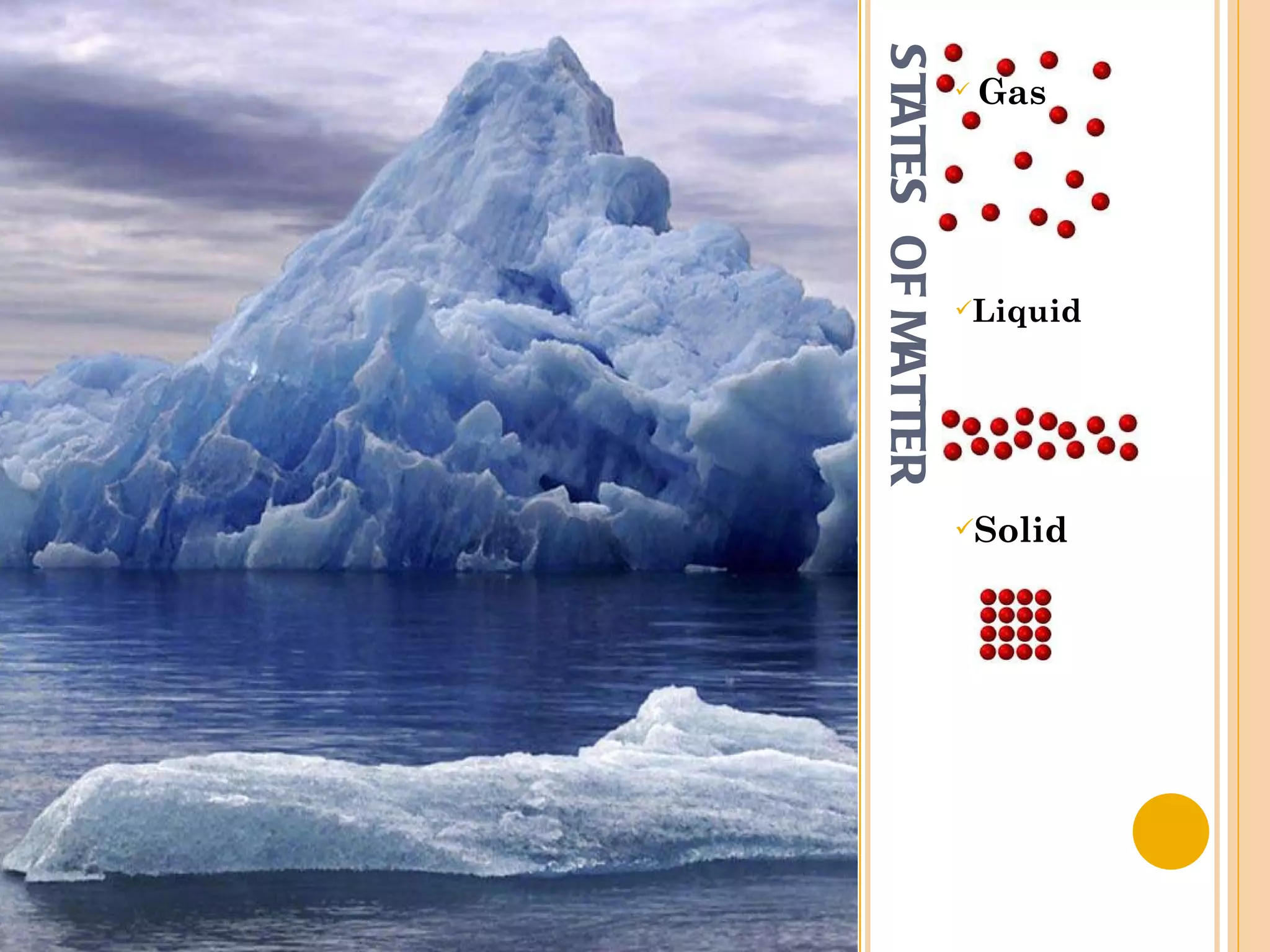
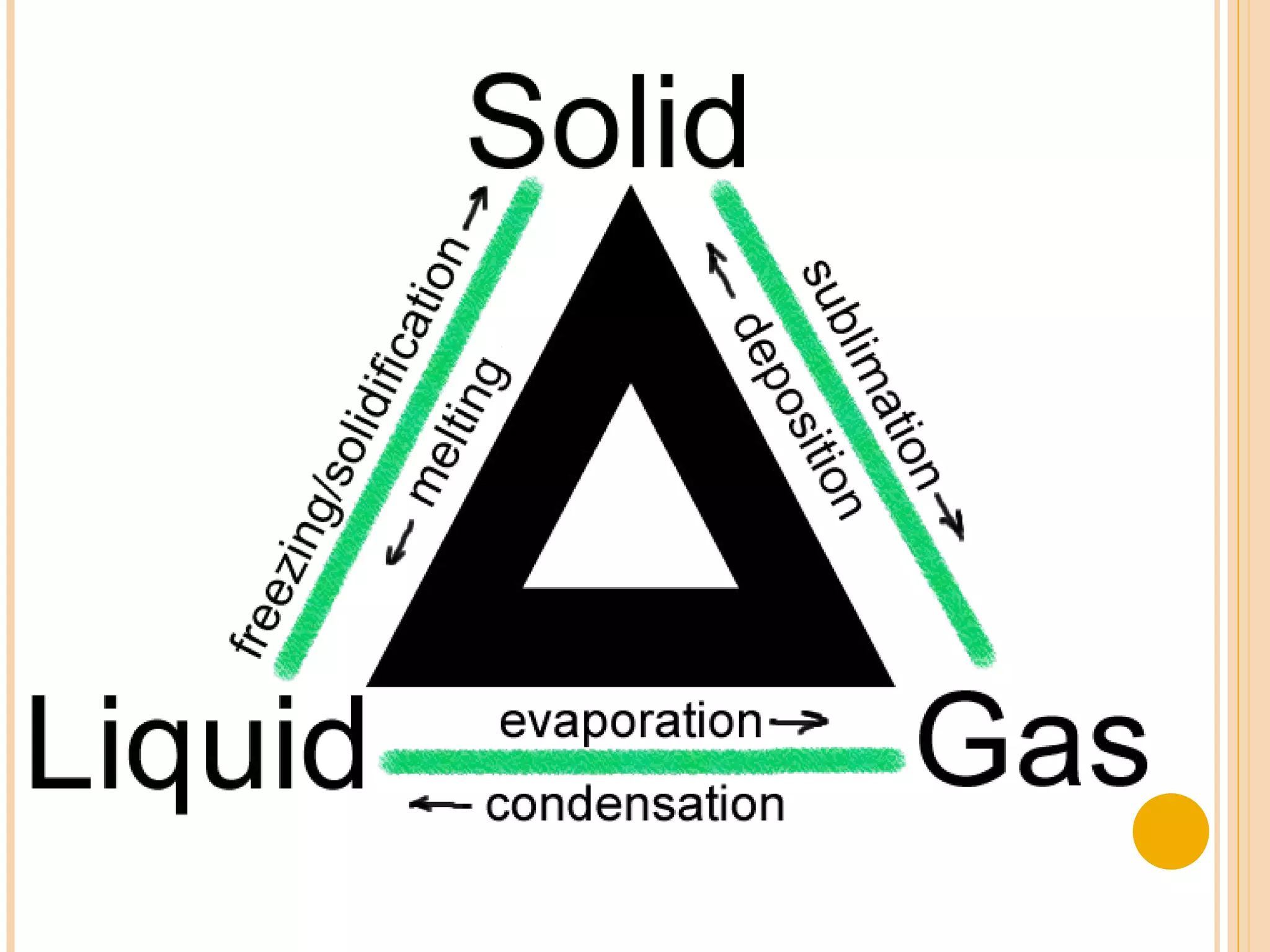
STATES  OF MATTER Gas Liquid   Solid
 
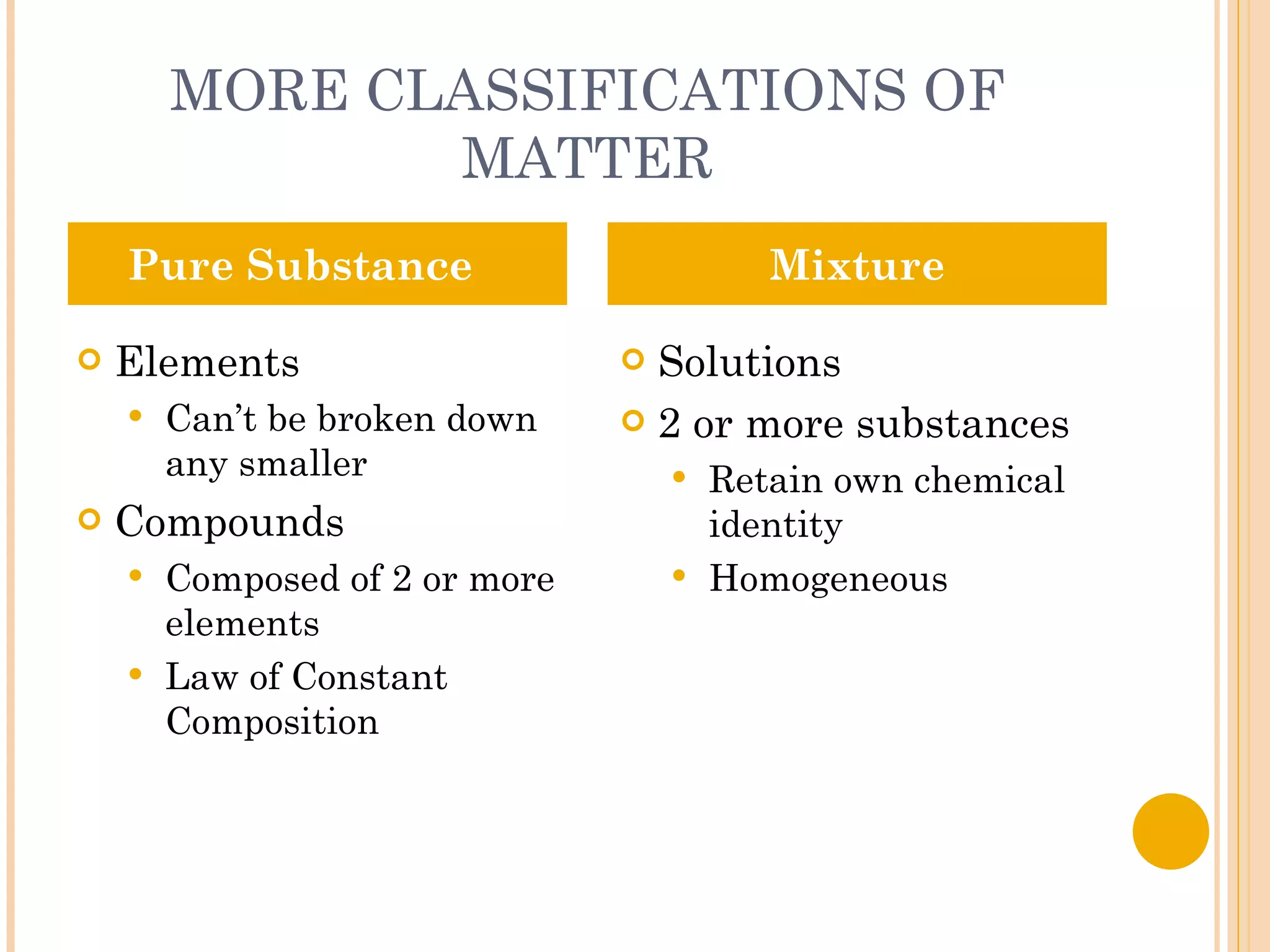
MORE CLASSIFICATIONS OF MATTER Elements Can’t be broken down any smaller Compounds Composed of 2 or more elements Law of Constant Composition Solutions 2 or more substances  Retain own chemical identity Homogeneous Pure Substance Mixture
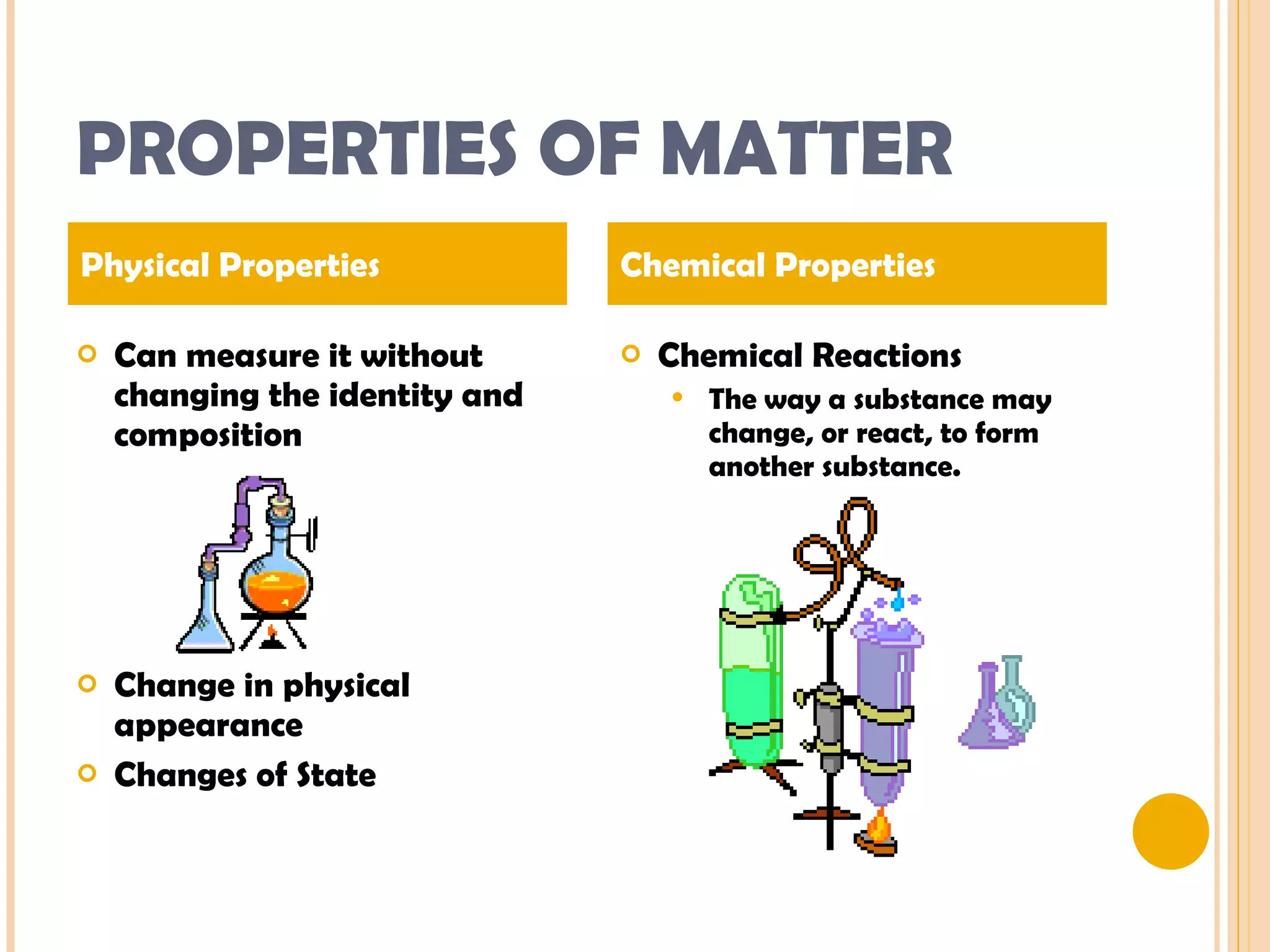
PROPERTIES OF MATTER Can measure it without changing the identity and composition Change in physical appearance  Changes of State Chemical Reactions The way a substance may change, or react, to form another substance. Physical Properties Chemical Properties
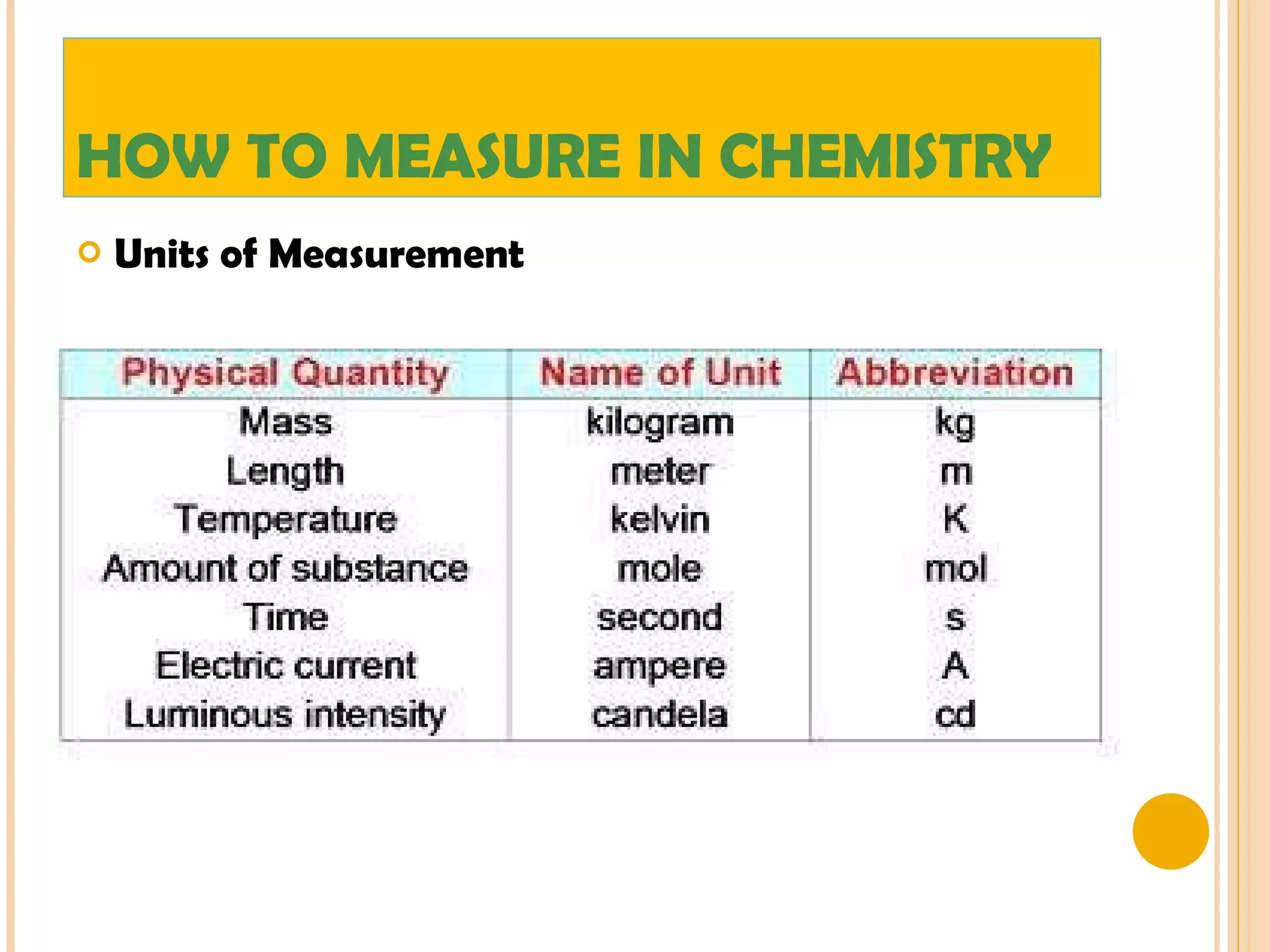
HOW TO MEASURE IN CHEMISTRY Units of Measurement
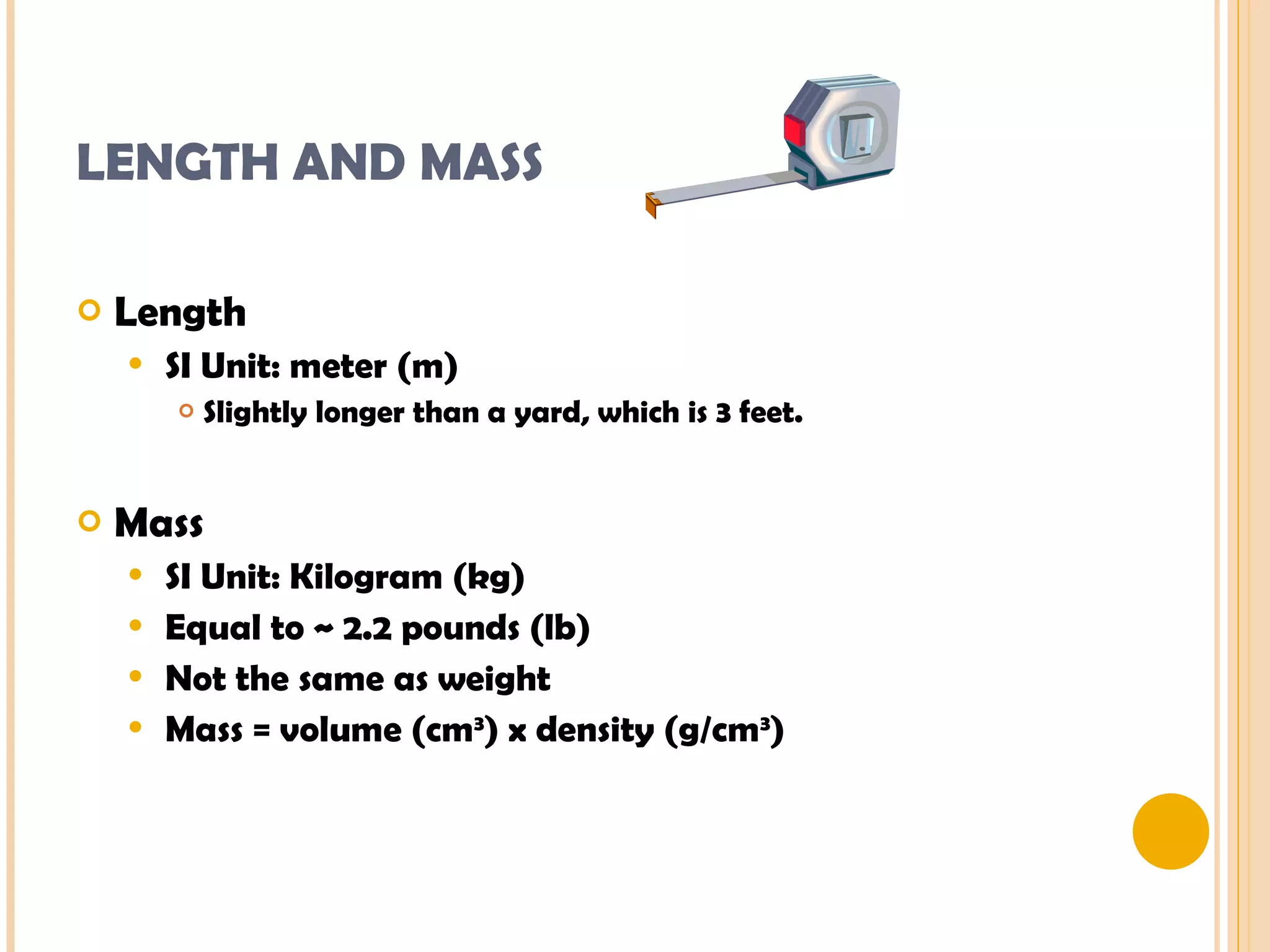
LENGTH AND MASS  Length SI Unit: meter (m) Slightly longer than a yard, which is 3 feet. Mass SI Unit: Kilogram (kg) Equal to ~ 2.2 pounds (lb) Not the same as weight Mass = volume (cm 3 ) x density (g/cm 3 )
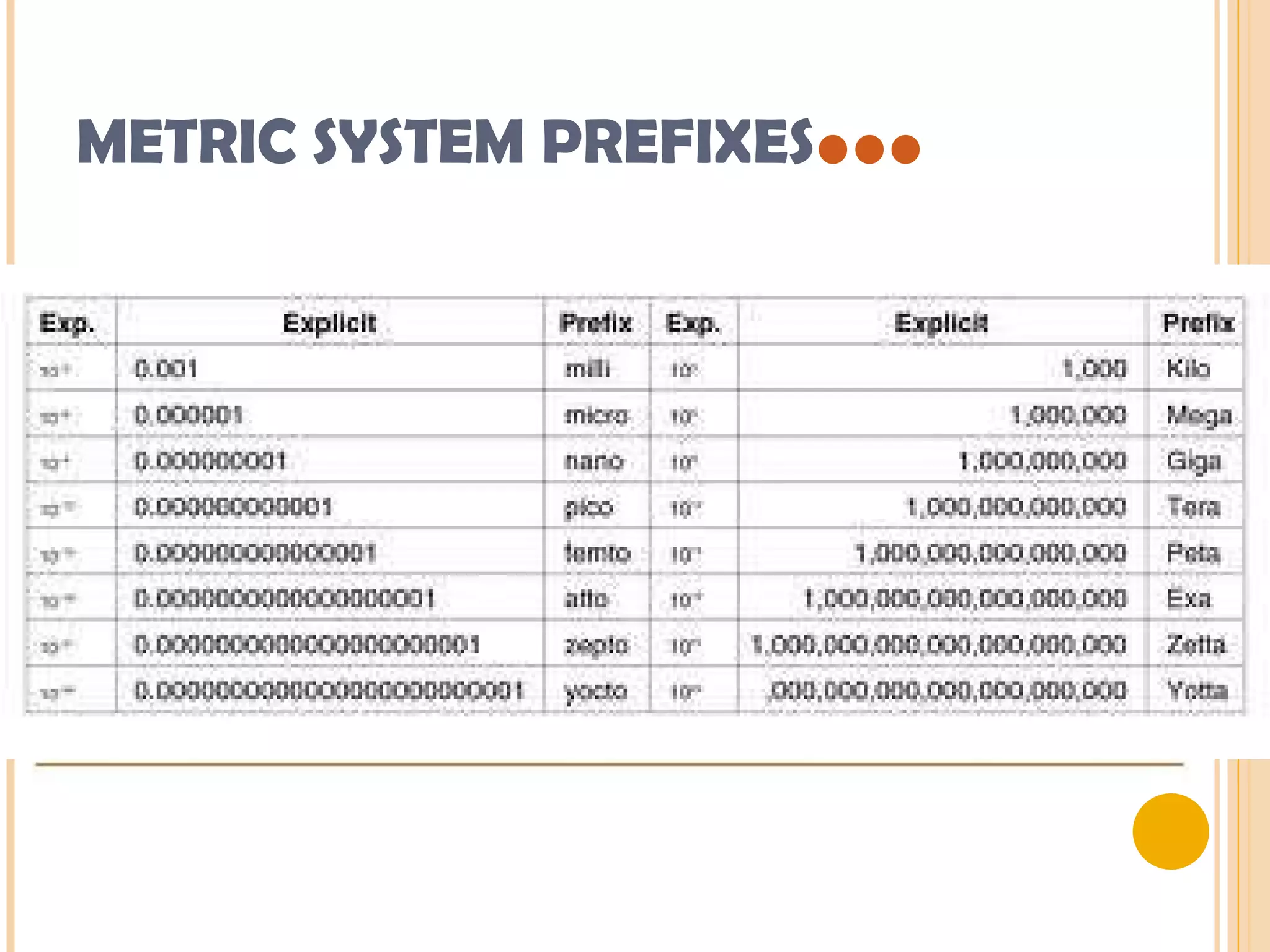
METRIC SYSTEM PREFIXES …
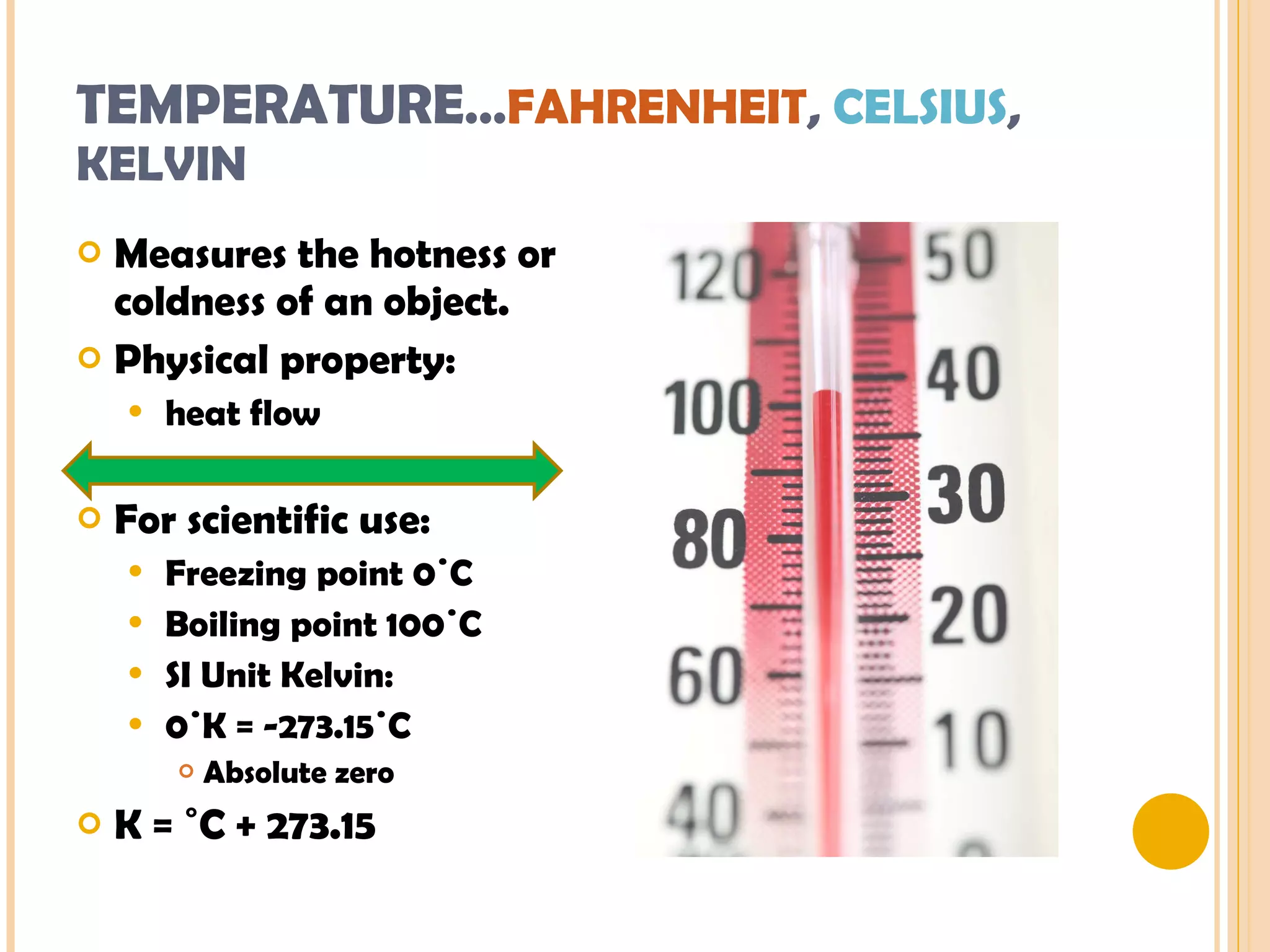
TEMPERATURE … FAHRENHEIT ,  CELSIUS , KELVIN Measures the hotness or coldness of an object. Physical property: heat flow For scientific use: Freezing point 0˙C Boiling point 100˙C SI Unit Kelvin:  0˙K = -273.15˙C Absolute zero K = ˚C + 273.15
DERIVED SI UNITS Volume Cubic Centimeters  (cm 3 ) (length cubed) Calculate the volume of 65.0 g of the liquid methanol (wood alcohol) if its density is 0.791 g/mL Density Density = mass/volume g/cm 3  or g/mL 1 mL = 1 cm 3 Calculate the density of mercury if 1.00 X 10 2  g occupies a volume of 7.36 cm 3 What is the mass in grams of cube of goal (density = 19.32 g/cm 3 ) if the length of the cube is 2.00 cm?
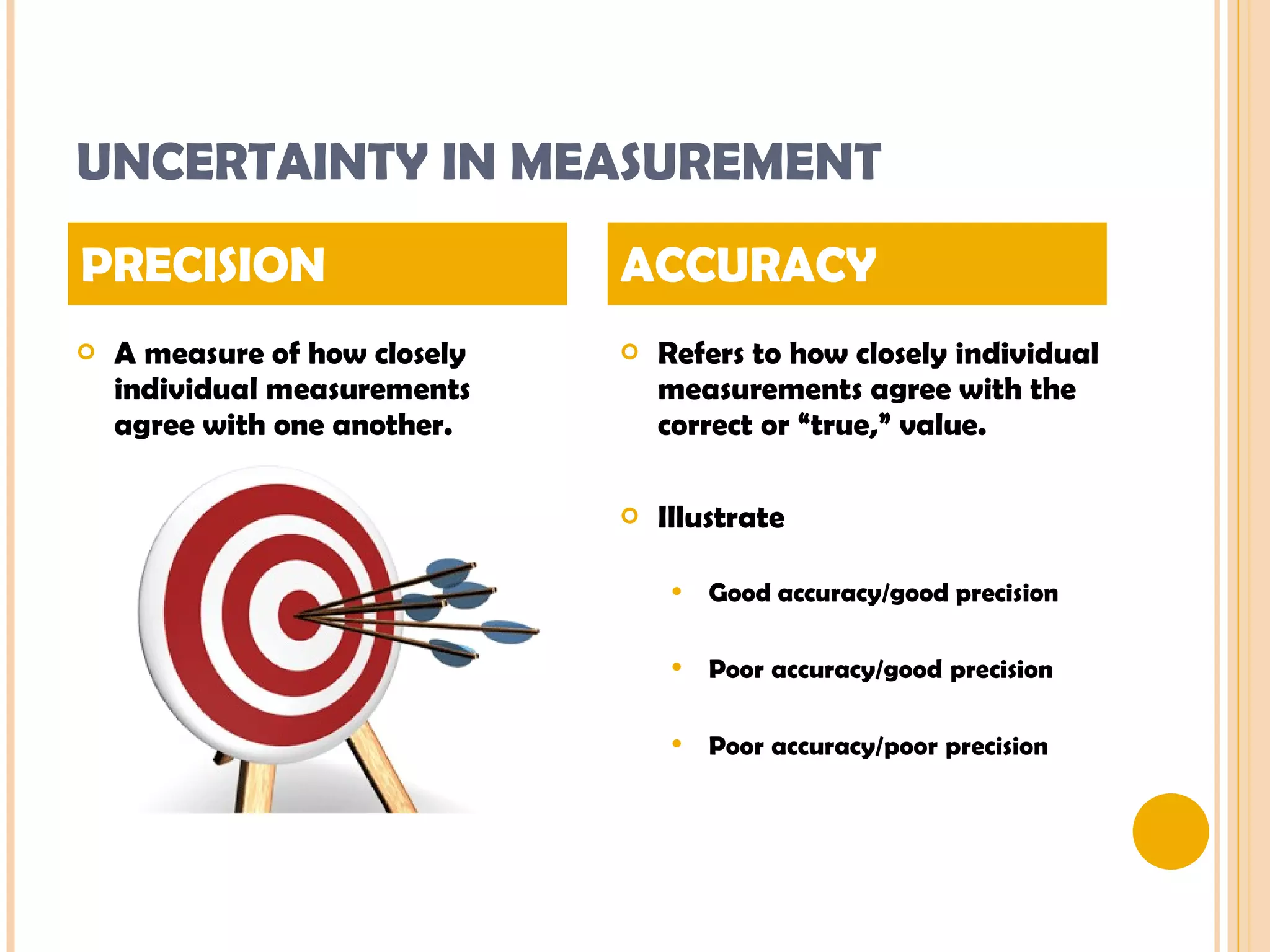
UNCERTAINTY IN MEASUREMENT A measure of how closely individual measurements agree with one another. Refers to how closely individual measurements agree with the correct or “true,” value. Illustrate  Good accuracy/good precision Poor   accuracy/good   precision Poor   accuracy/poor   precision PRECISION ACCURACY
SIGNIFICANT FIGURES Definition:  all digits of a measured quantity, including the uncertain one (± 0.0001 g) How many  Significant   Figures …? 2.2 g ??? 2.2405 g ??? What is the difference…? 4.0 g ??? 4.00 g To read  significant figures  you read the number from left to right, counting the digits starting with  the first digit that is not zero!
ZER000000’S IN SIGNIFICANT FIGURES Zer0s between nonzero digits are always significant 1005 kg 1.03 kg Zer0s at the beginning of a number are never significant; they merely indicate the position of a decimal point 0.02 g 0.0026 g Zer0s at the end of a number are significant if the number contains a decimal point 0.0200 g 3.0 cm

Common origin

  • 1.
    COMMON ORIGIN Allthings have a common origin Atomic models and the behavior of the atom Atomic structure and the correlation of element’s physical and chemical properties .
  • 2.
    WHY STUDYCHEMISTRY? Chemistry is how the world works! ? What are some ways chemistry effects our lives ? 1- Health Care 2- Conservation of natural resources 3- environmental protection 5- everyday needs
  • 3.
    ALL THINGS HAVEA COMMON ORIGIN The atom is the building block of all matter. Basic structure of an element. Atoms in all different forms make up elements Element s make up all matter in the universe Most matter is composed of different combinations of only about 100 different elements Molecules : 2 or more atoms
  • 4.
    COMMON ORIGIN CONT.A quick run down of Atoms , Elements and Molecules . http://www.youtube.com/watch?v=fND0ps4EtBg Sub atomic particles Proton, neutron, electron What 5 Elements make up 97% of life? Carbon, Hydrogen, Nitrogen, Oxygen, Phosphorus, and Sulfur
  • 5.
    STATES OFMATTER Gas Liquid Solid
  • 6.
  • 7.
    MORE CLASSIFICATIONS OFMATTER Elements Can’t be broken down any smaller Compounds Composed of 2 or more elements Law of Constant Composition Solutions 2 or more substances Retain own chemical identity Homogeneous Pure Substance Mixture
  • 8.
    PROPERTIES OF MATTERCan measure it without changing the identity and composition Change in physical appearance Changes of State Chemical Reactions The way a substance may change, or react, to form another substance. Physical Properties Chemical Properties
  • 9.
    HOW TO MEASUREIN CHEMISTRY Units of Measurement
  • 10.
    LENGTH AND MASS Length SI Unit: meter (m) Slightly longer than a yard, which is 3 feet. Mass SI Unit: Kilogram (kg) Equal to ~ 2.2 pounds (lb) Not the same as weight Mass = volume (cm 3 ) x density (g/cm 3 )
  • 11.
  • 12.
    TEMPERATURE … FAHRENHEIT, CELSIUS , KELVIN Measures the hotness or coldness of an object. Physical property: heat flow For scientific use: Freezing point 0˙C Boiling point 100˙C SI Unit Kelvin: 0˙K = -273.15˙C Absolute zero K = ˚C + 273.15
  • 13.
    DERIVED SI UNITSVolume Cubic Centimeters (cm 3 ) (length cubed) Calculate the volume of 65.0 g of the liquid methanol (wood alcohol) if its density is 0.791 g/mL Density Density = mass/volume g/cm 3 or g/mL 1 mL = 1 cm 3 Calculate the density of mercury if 1.00 X 10 2 g occupies a volume of 7.36 cm 3 What is the mass in grams of cube of goal (density = 19.32 g/cm 3 ) if the length of the cube is 2.00 cm?
  • 14.
    UNCERTAINTY IN MEASUREMENTA measure of how closely individual measurements agree with one another. Refers to how closely individual measurements agree with the correct or “true,” value. Illustrate Good accuracy/good precision Poor accuracy/good precision Poor accuracy/poor precision PRECISION ACCURACY
  • 15.
    SIGNIFICANT FIGURES Definition: all digits of a measured quantity, including the uncertain one (± 0.0001 g) How many Significant Figures …? 2.2 g ??? 2.2405 g ??? What is the difference…? 4.0 g ??? 4.00 g To read significant figures you read the number from left to right, counting the digits starting with the first digit that is not zero!
  • 16.
    ZER000000’S IN SIGNIFICANTFIGURES Zer0s between nonzero digits are always significant 1005 kg 1.03 kg Zer0s at the beginning of a number are never significant; they merely indicate the position of a decimal point 0.02 g 0.0026 g Zer0s at the end of a number are significant if the number contains a decimal point 0.0200 g 3.0 cm