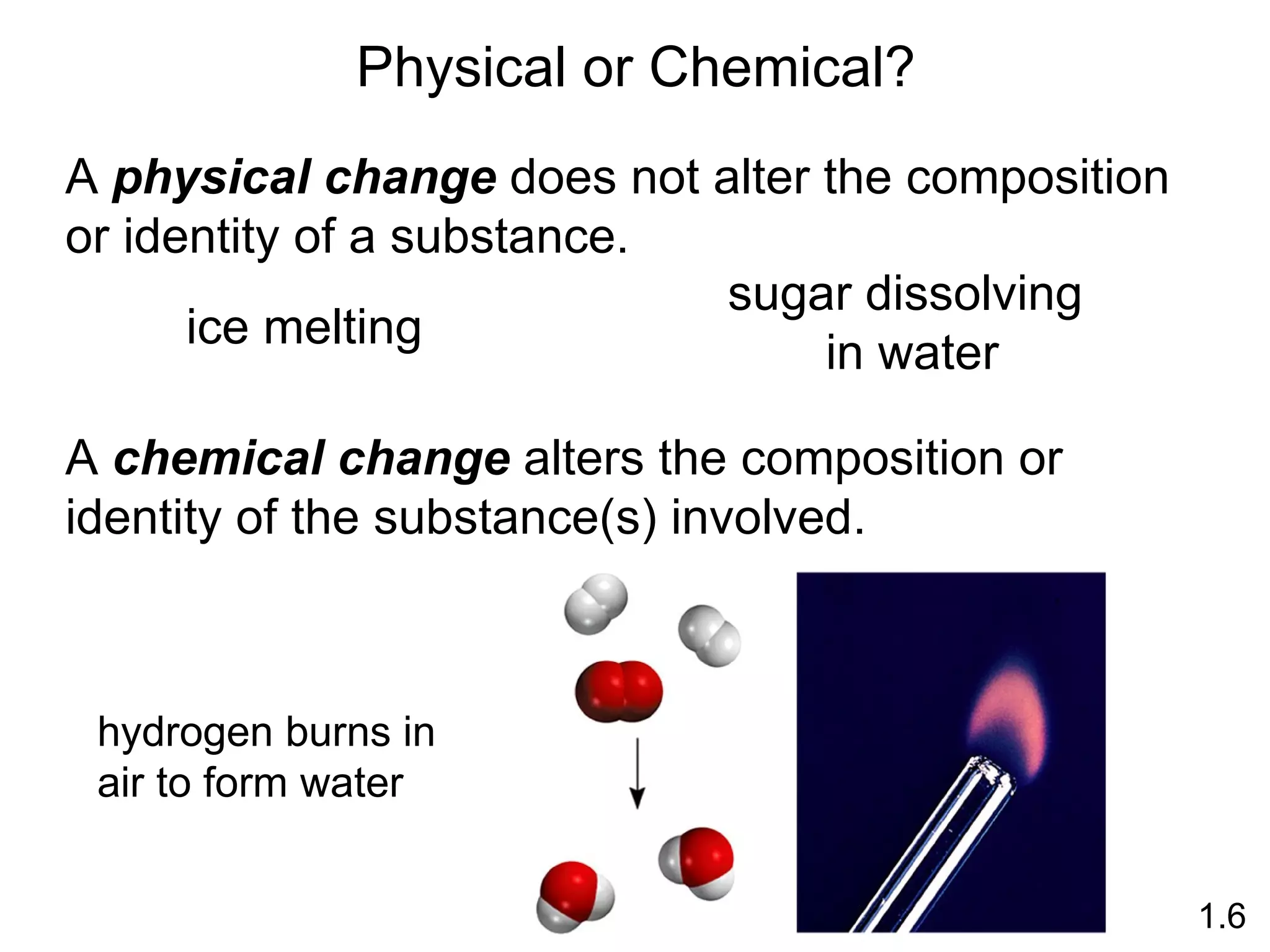
Physical or Chemical? A  physical change  does not alter the composition or identity of a substance. A  chemical change  alters the composition or identity of the substance(s) involved. 1.6 ice melting sugar dissolving  in water hydrogen burns in air to form water
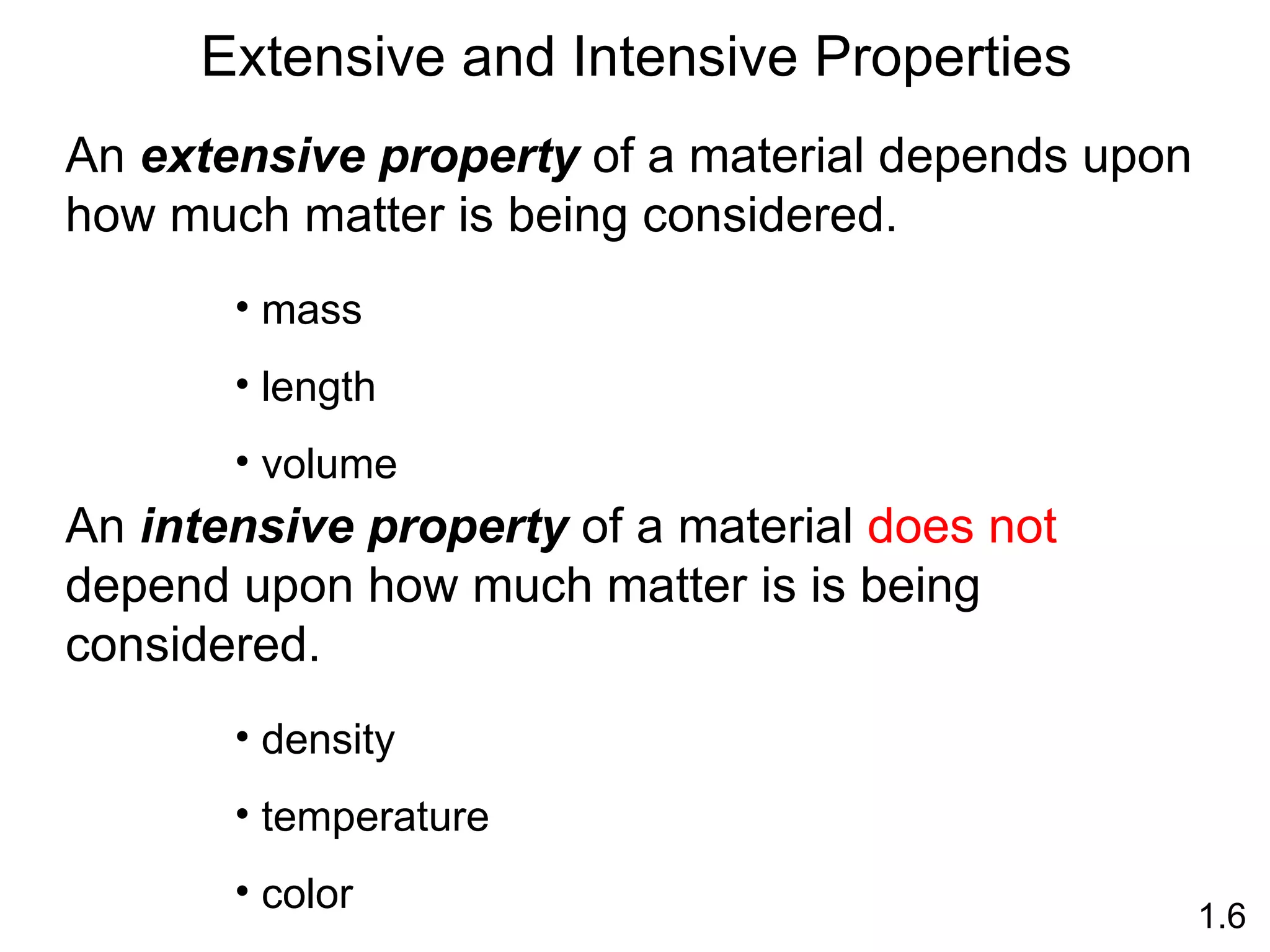
An  extensive property  of a material depends upon how much matter is being considered. An  intensive property  of a material  does not  depend upon how much matter is is being considered. mass length volume density temperature color Extensive and Intensive Properties 1.6
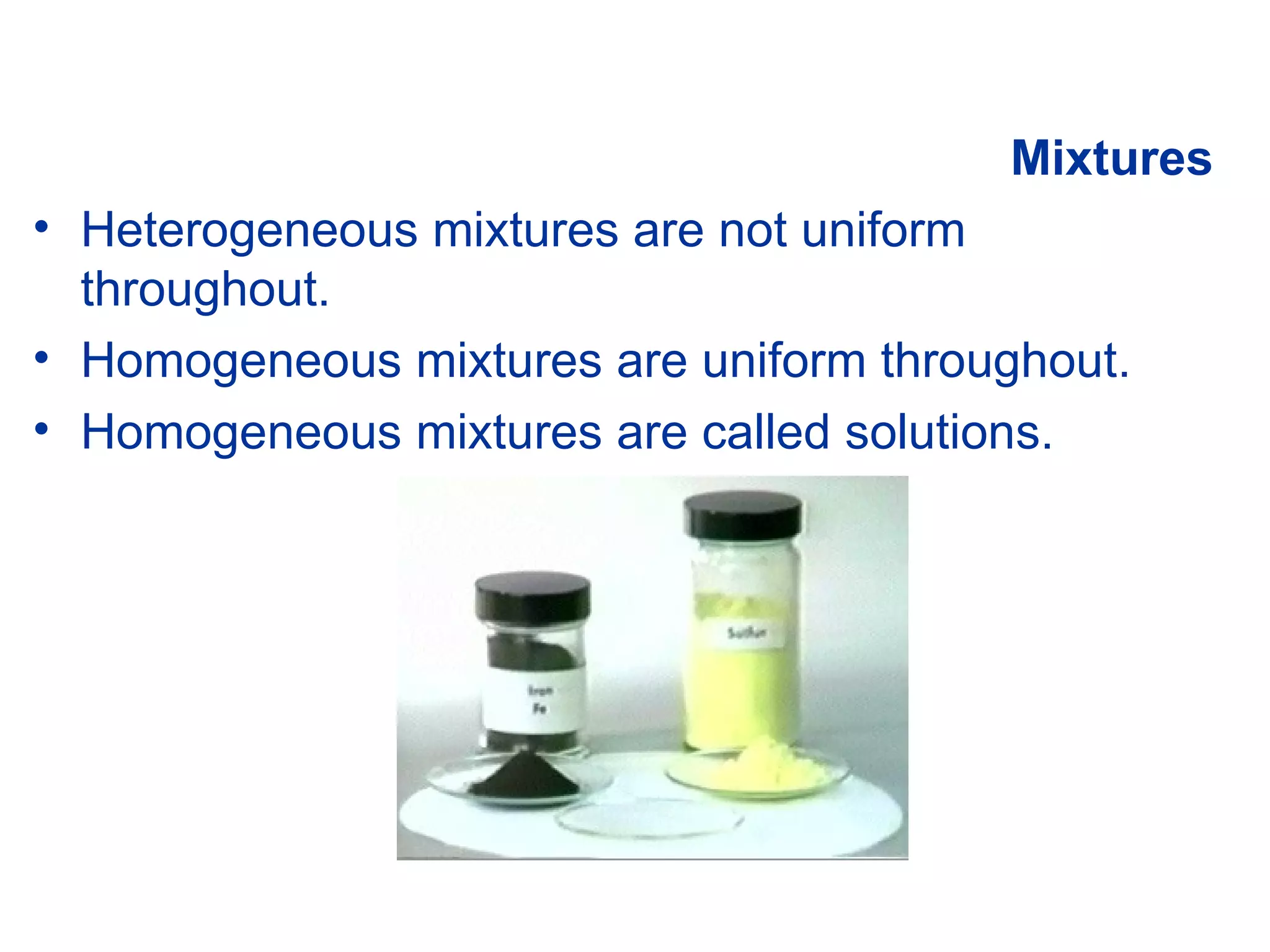
Mixtures Heterogeneous mixtures are not uniform throughout. Homogeneous mixtures are uniform throughout. Homogeneous mixtures are called solutions.
Separation of Mixtures Mixtures can be separated if their physical properties are different. Solids can be separated from liquids by means of  filtration . The solid is collected in filter paper, and the solution, called the filtrate, passes through the filter paper and is collected in a flask. Properties of Matter
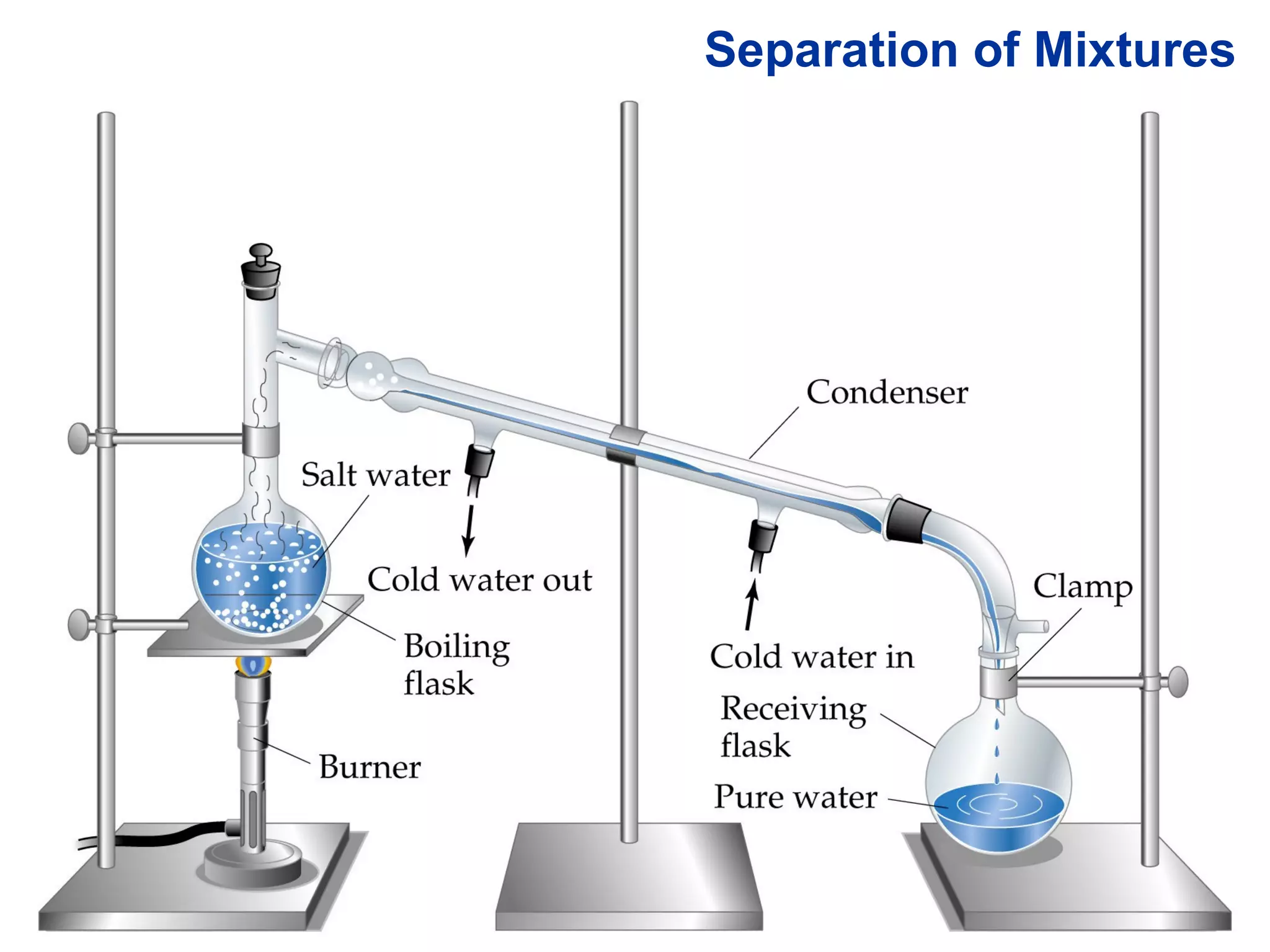
Separation of Mixtures Homogeneous liquid mixtures can be separated by  distillation . Distillation requires the different liquids to have different boiling points. In essence, each component of the mixture is boiled and collected. The lowest boiling fraction is collected first. Properties of Matter
Separation of Mixtures
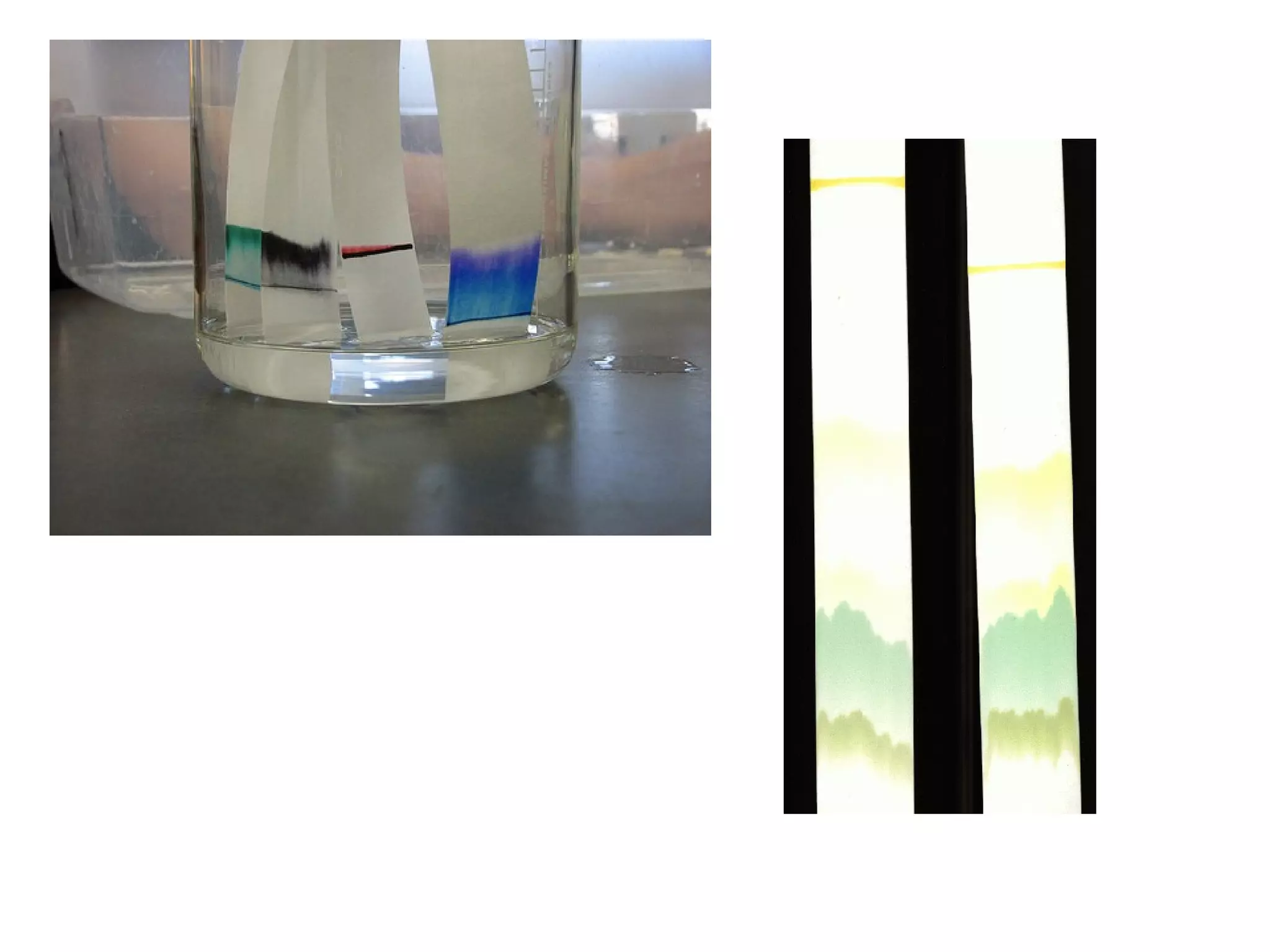
Separation of Mixtures Chromatography  can be used to separate mixtures that have different abilities to adhere to solid surfaces. The greater the affinity the component has for the surface (paper) the slower it moves. The greater affinity the component has for the liquid, the faster it moves. Chromatography can be used to separate the different colors of inks in a pen. Properties of Matter
 
CHEMISTRY is… C –come on! H – hahahaha… E – energy and electrons? M – matter and molecules? I –  international system of units  and ionic bond?  S – scientific method and  significant figures ? T- they are just R – relaxing topics!!! Y – yahooo…     Dioneda, Ingua, de Mesa
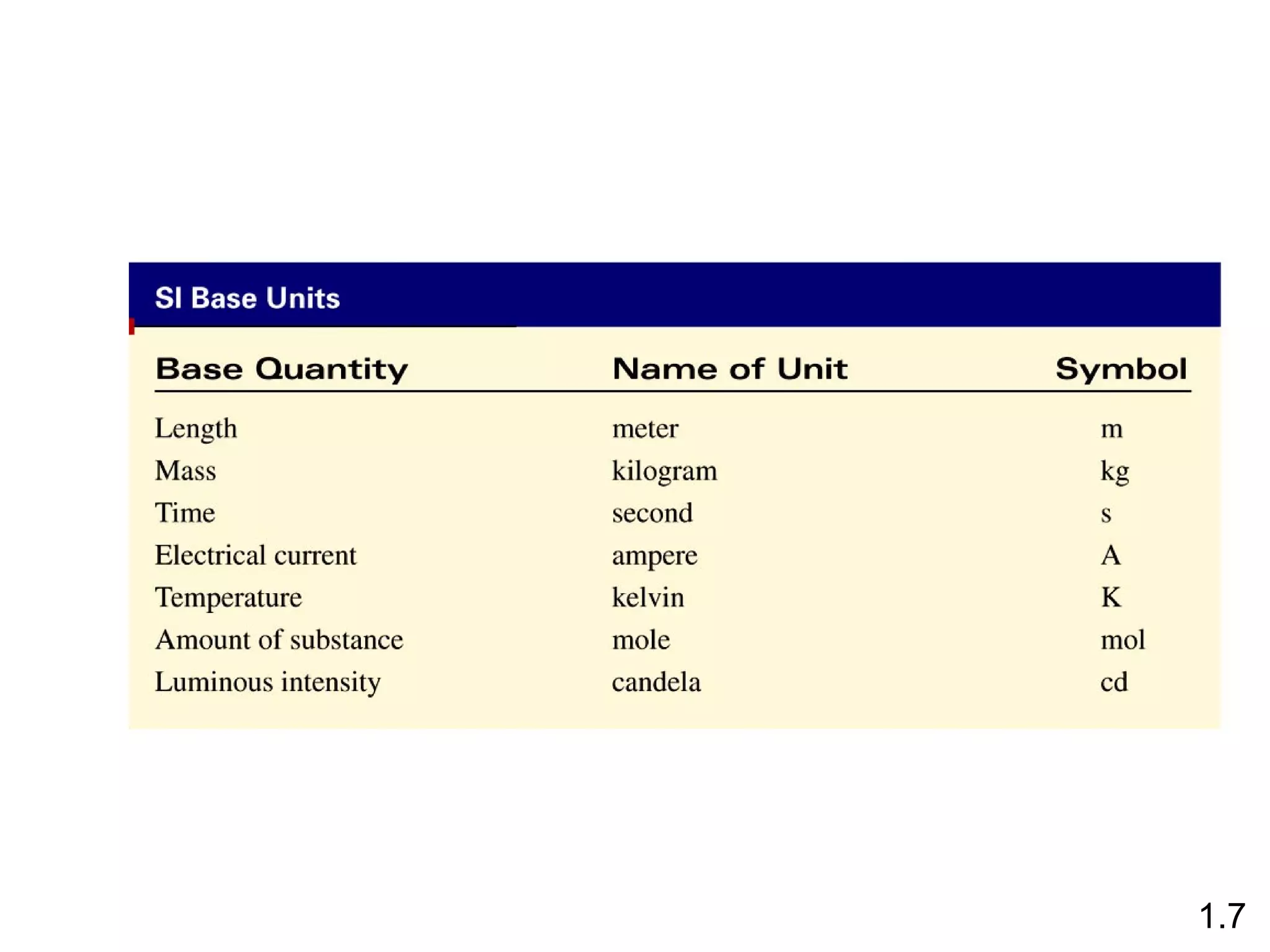
SI Units There are two types of units: fundamental (or base) units; derived units. There are 7 base units in the SI system. Units of Measurement
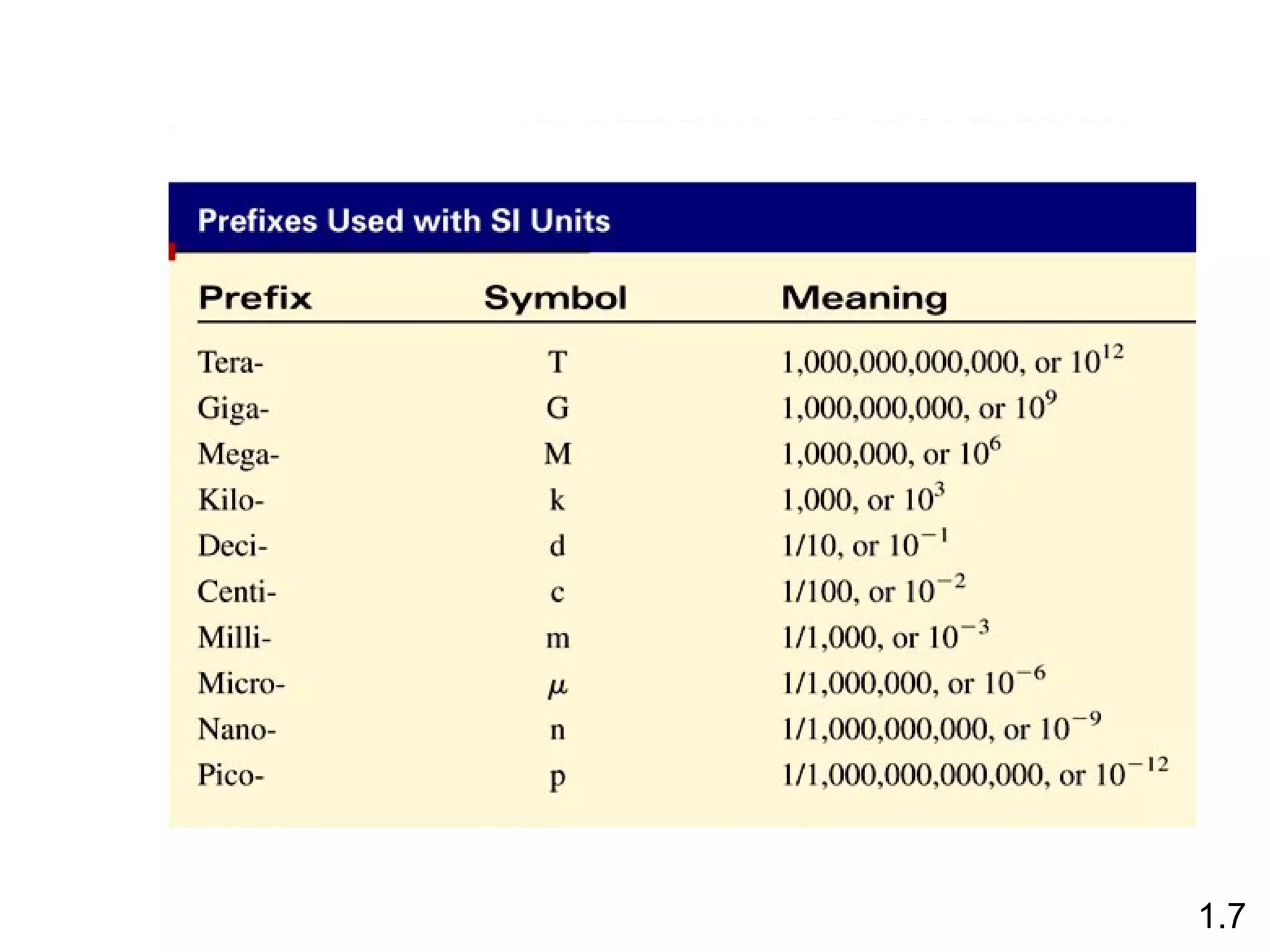
1.7
1.7
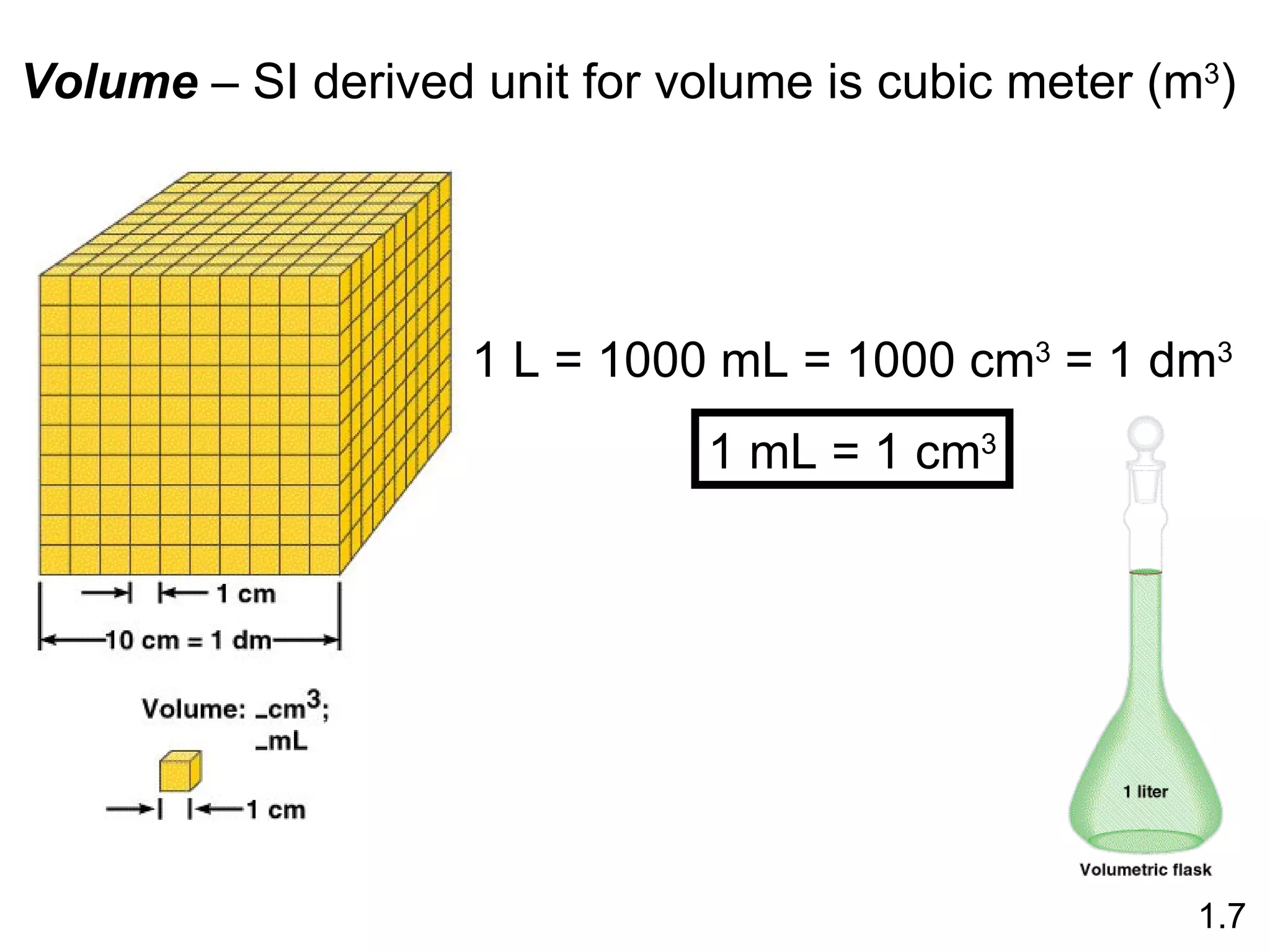
Volume  – SI derived unit for volume is cubic meter (m 3 ) 1 L = 1000 mL = 1000 cm 3  = 1 dm 3 1 mL = 1 cm 3 1.7
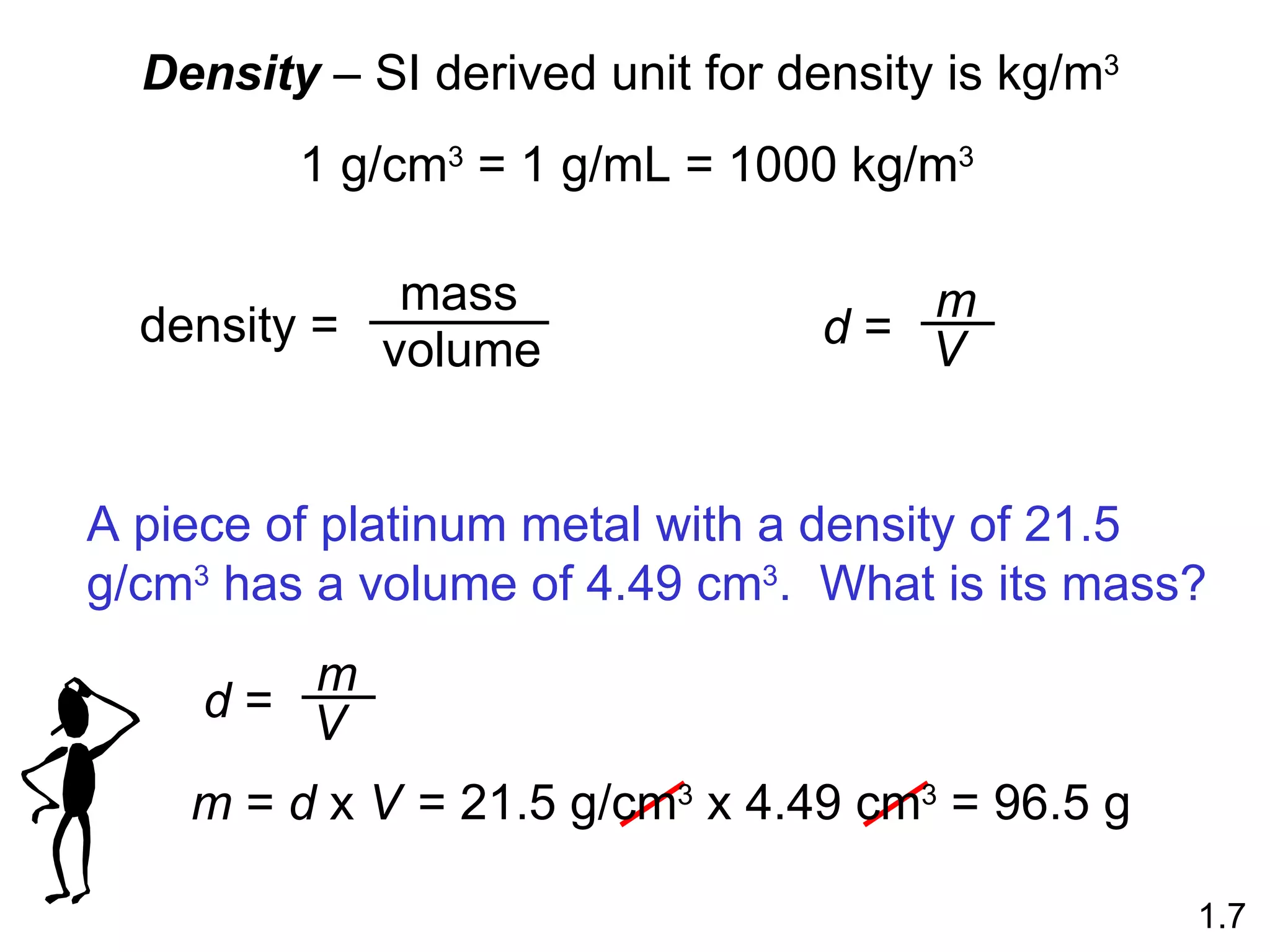
Density  – SI derived unit for density is kg/m 3   1 g/cm 3  = 1 g/mL = 1000 kg/m 3 1.7 m  =  d  x  V = 21.5 g/cm 3  x 4.49 cm 3  = 96.5 g density =  mass volume d  = m V A piece of platinum metal with a density of 21.5 g/cm 3  has a volume of 4.49 cm 3 .  What is its mass? d  = m V
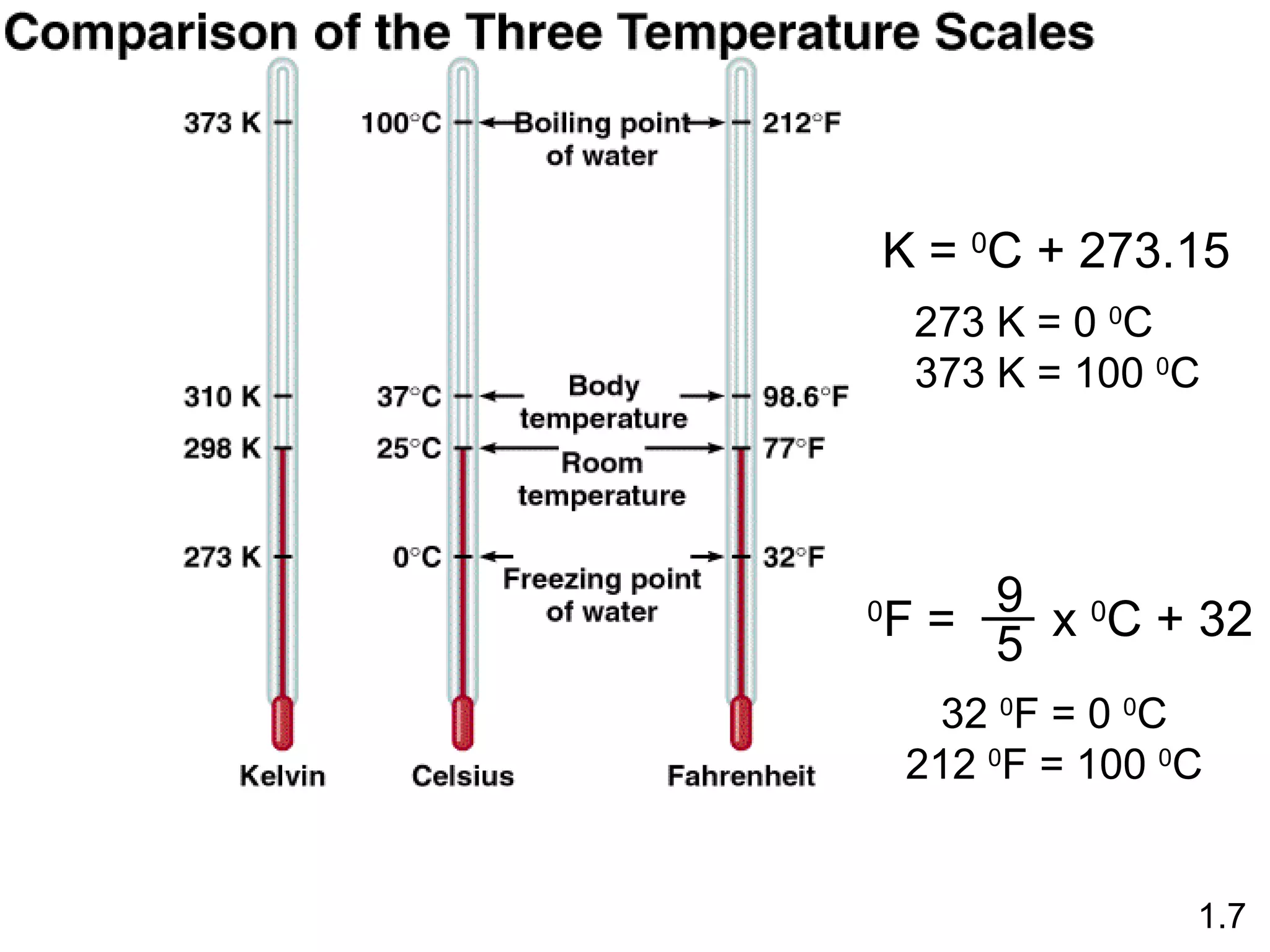
K =  0 C + 273.15 1.7 273 K = 0  0 C  373 K = 100  0 C 32  0 F = 0  0 C  212  0 F = 100  0 C  0 F =  x  0 C + 32 9 5
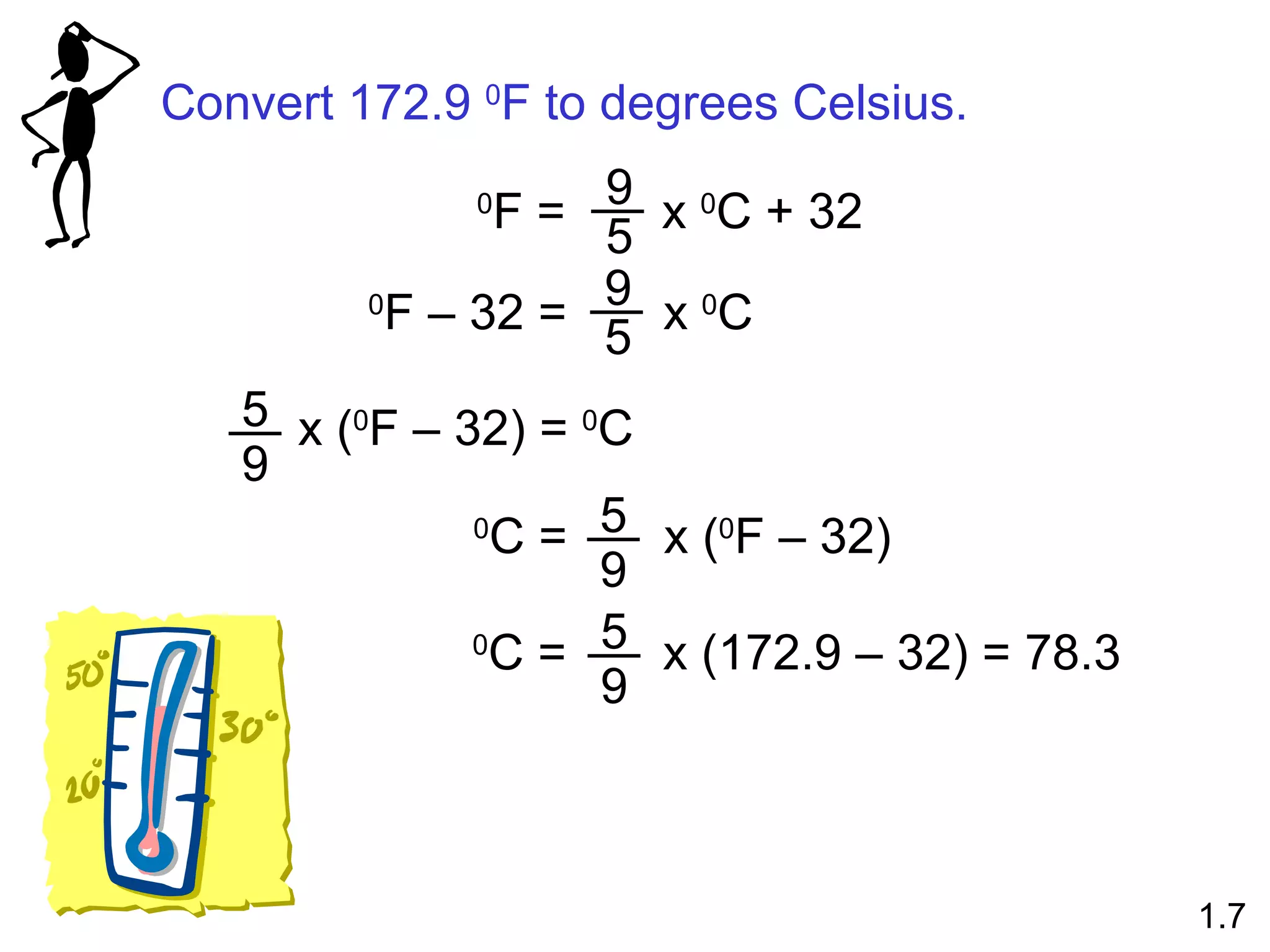
Convert 172.9  0 F to degrees Celsius. 1.7 0 F =  x  0 C + 32 9 5 0 F – 32 =  x  0 C 9 5 x ( 0 F – 32) =  0 C 9 5 0 C =  x ( 0 F – 32) 9 5 0 C =  x (172.9 – 32) = 78.3 9 5
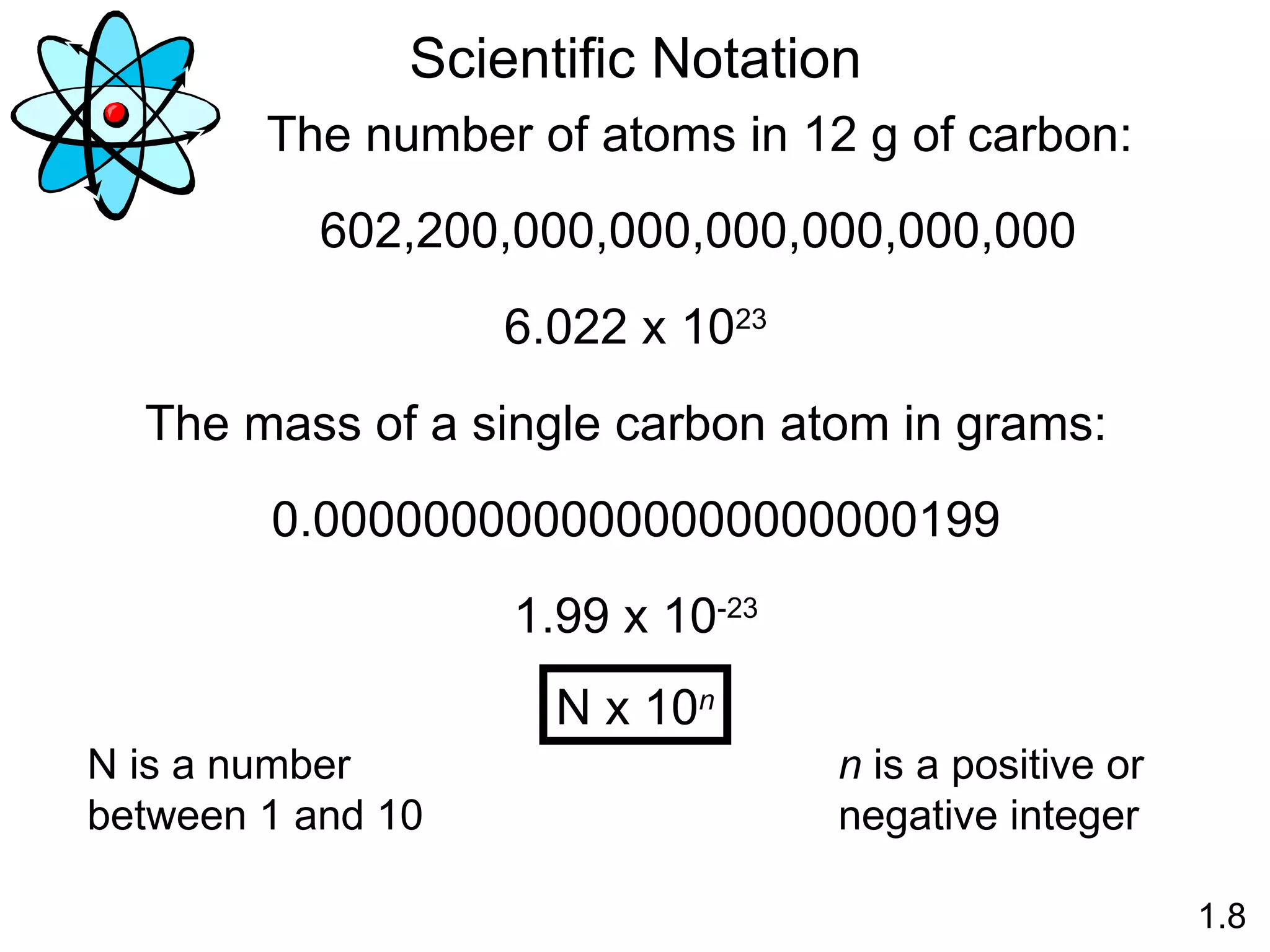
1.8 Scientific Notation 6.022 x 10 23 1.99 x 10 -23 N x 10 n N is a number  between 1 and 10 n  is a positive or  negative integer The number of atoms in 12 g of carbon: 602,200,000,000,000,000,000,000 The mass of a single carbon atom in grams: 0.0000000000000000000000199
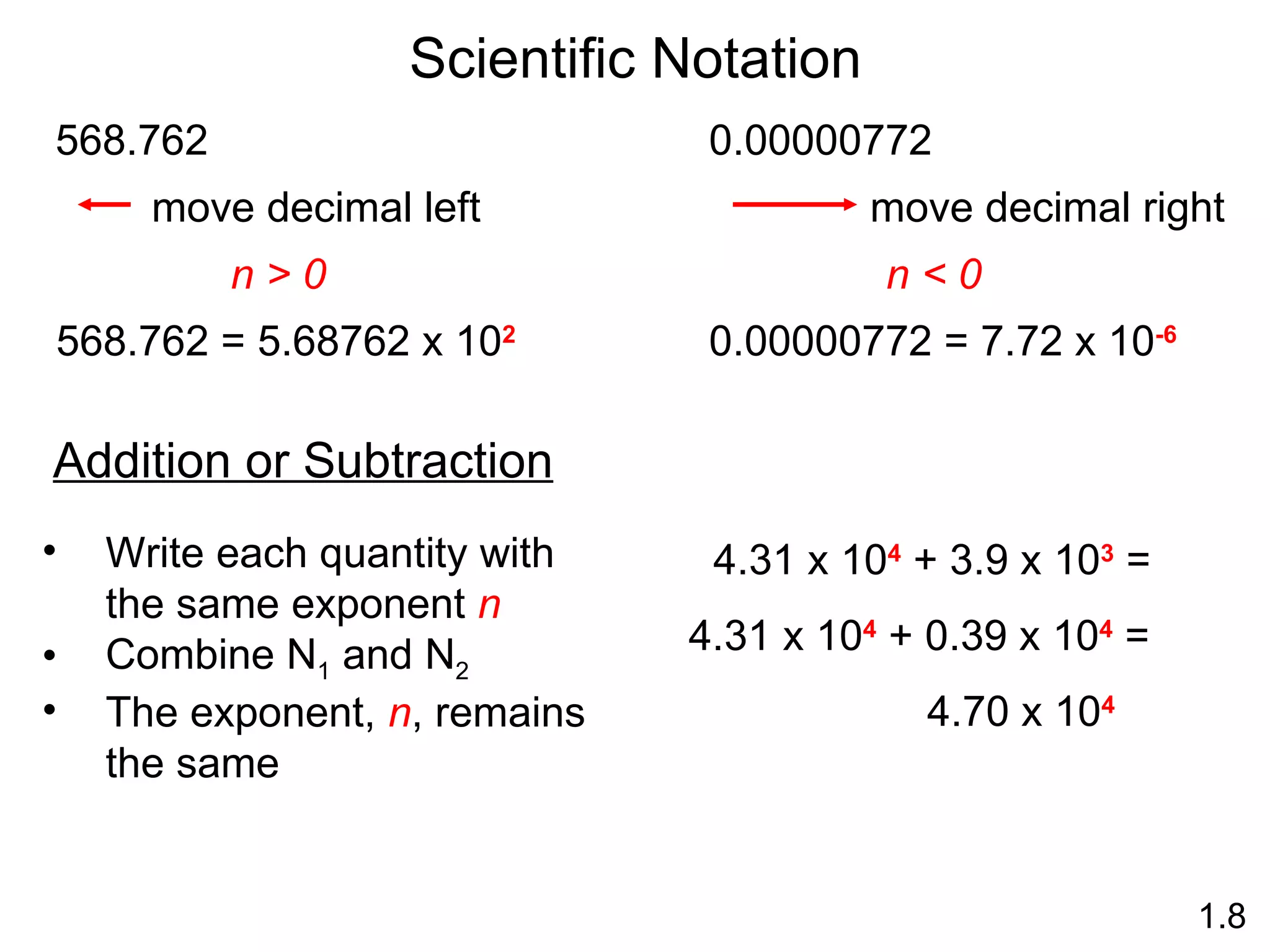
Scientific Notation 1.8 568.762 n > 0 568.762 = 5.68762 x 10 2 0.00000772 n < 0 0.00000772 = 7.72 x 10 -6 Addition or Subtraction Write each quantity with the same exponent  n Combine N 1  and N 2   The exponent,  n , remains the same 4.31 x 10 4  + 3.9 x 10 3  = 4.31 x 10 4  + 0.39 x 10 4  = 4.70 x 10 4 move decimal left move decimal right
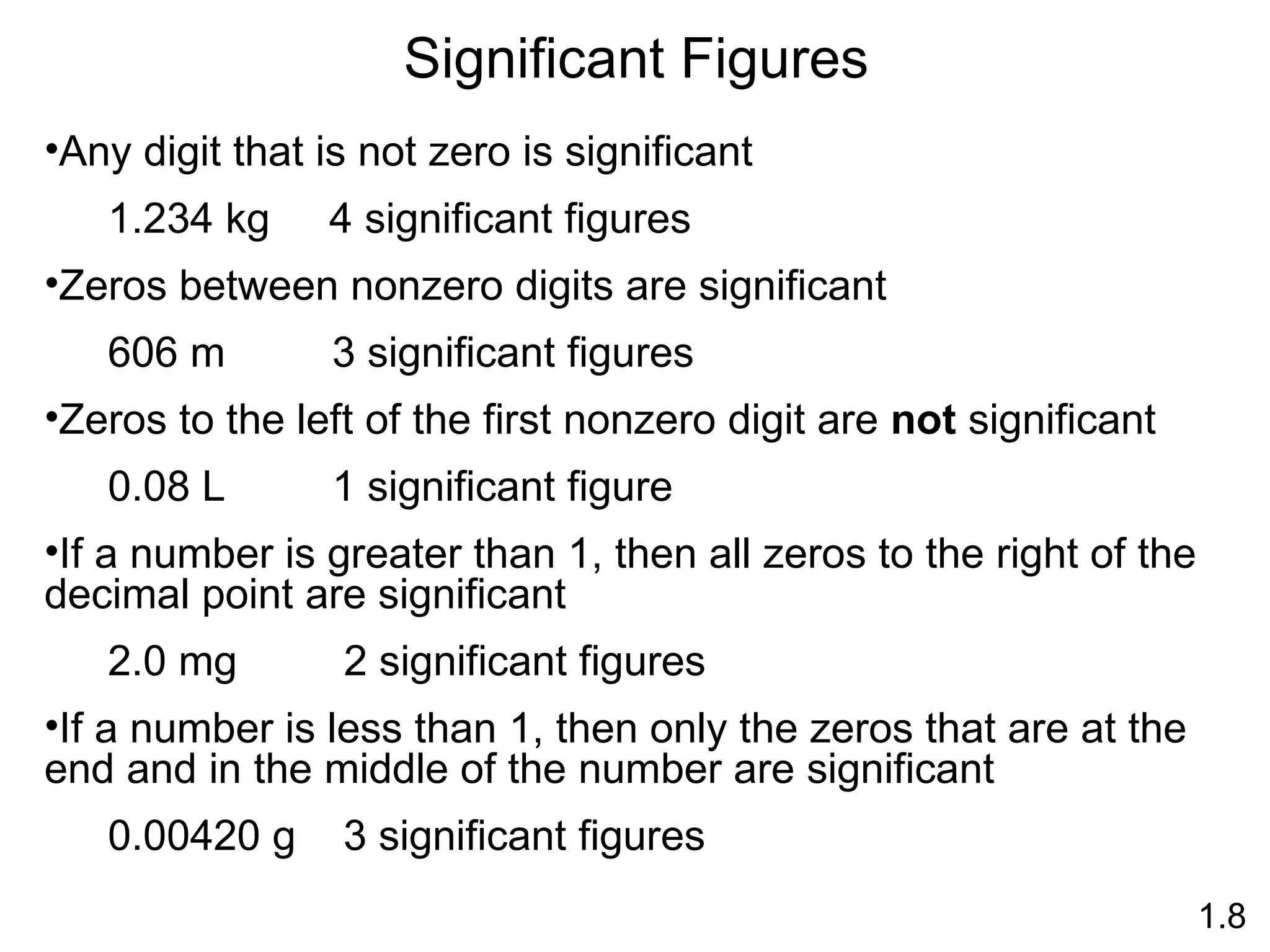
Significant Figures 1.8 Any digit that is not zero is significant 1.234 kg  4 significant figures Zeros between nonzero digits are significant 606 m  3 significant figures Zeros to the left of the first nonzero digit are  not  significant 0.08 L  1 significant figure If a number is greater than 1, then all zeros to the right of the decimal point are significant 2.0 mg  2 significant figures If a number is less than 1, then only the zeros that are at the end and in the middle of the number are significant 0.00420 g  3 significant figures
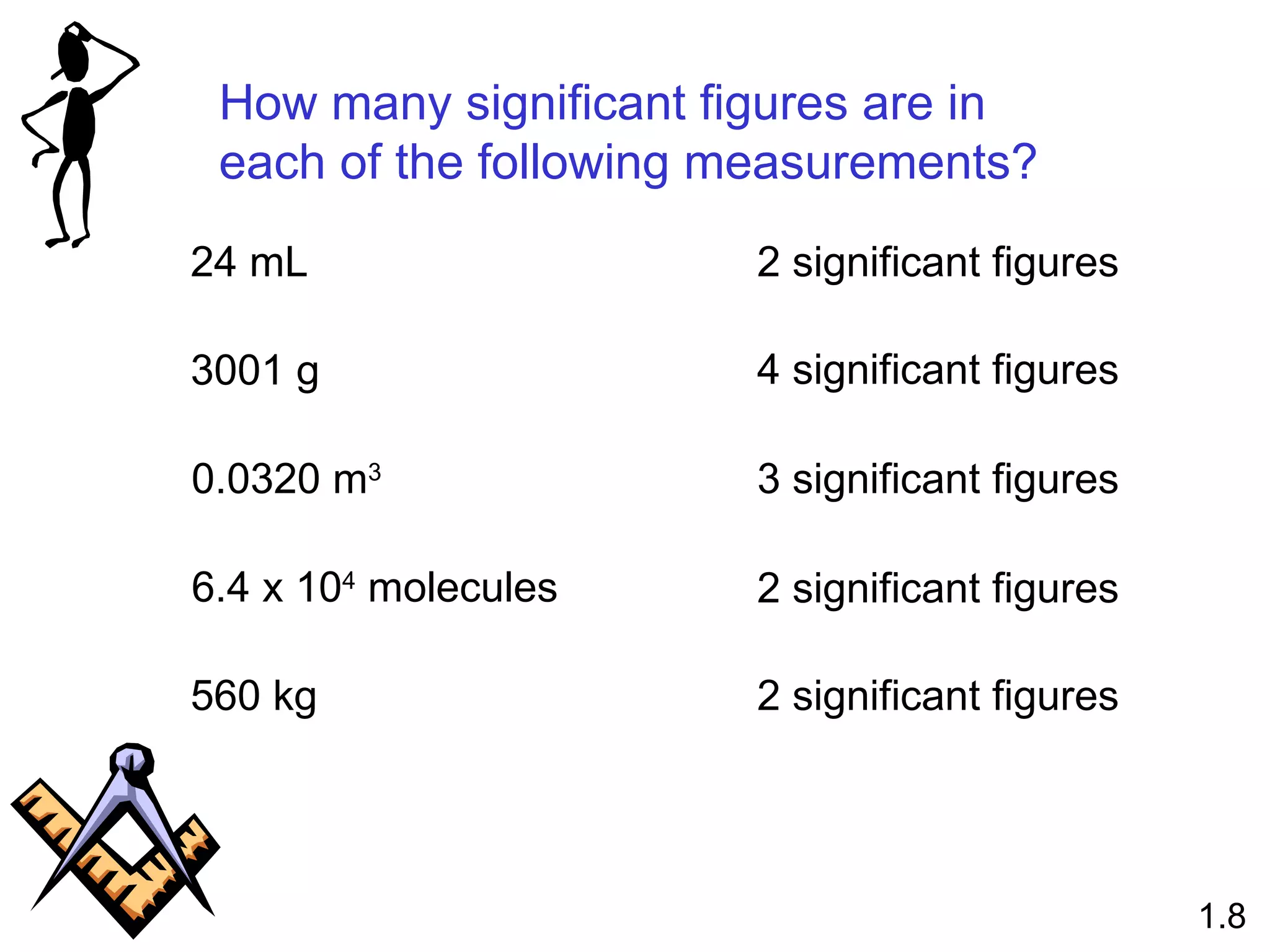
How many significant figures are in each of the following measurements? 24 mL 2 significant figures 3001 g 4 significant figures 0.0320 m 3 3 significant figures 6.4 x 10 4  molecules 2 significant figures 560 kg 2 significant figures 1.8
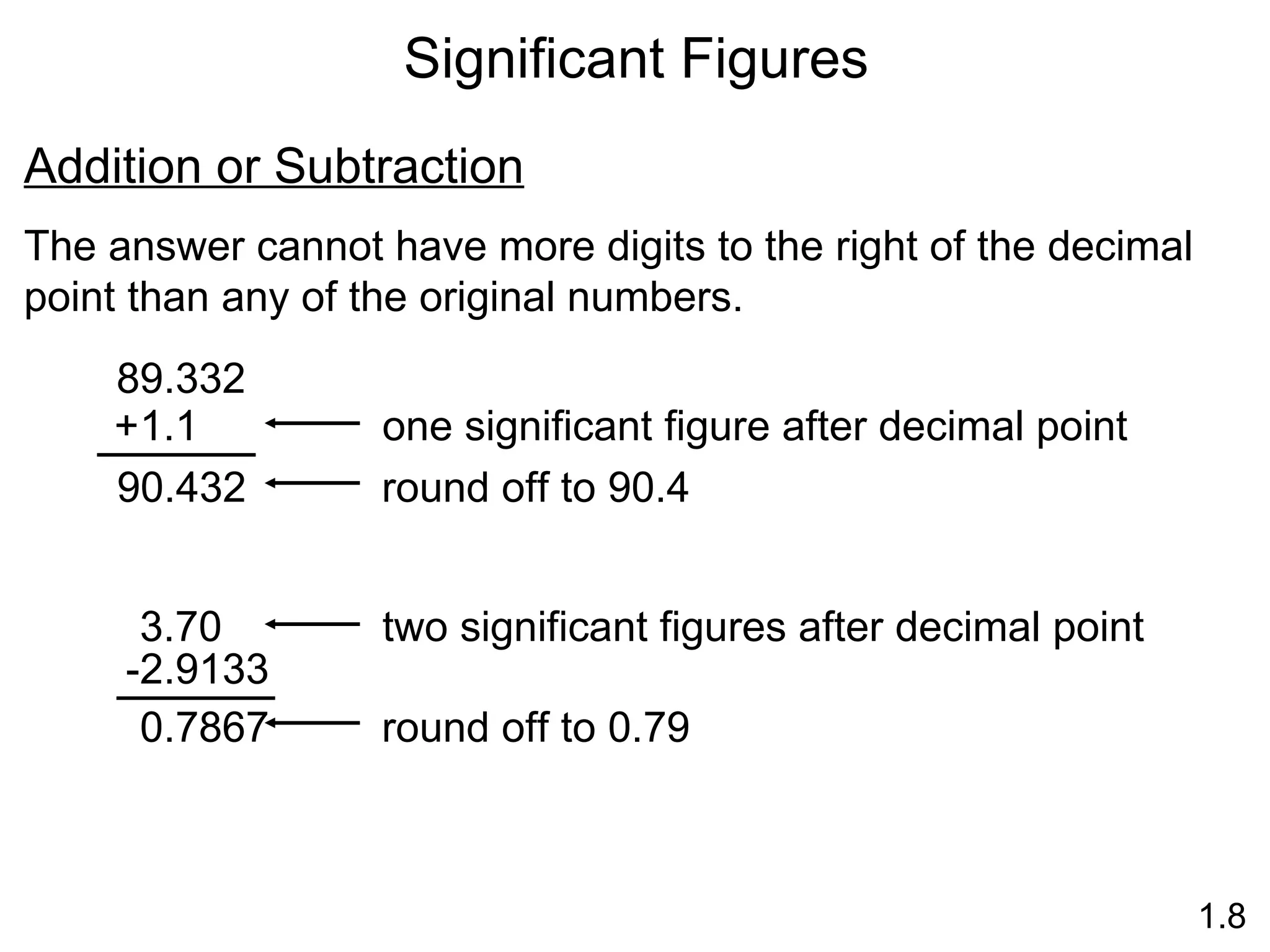
Significant Figures 1.8 Addition or Subtraction The answer cannot have more digits to the right of the decimal point than any of the original numbers. 89.332 1.1 + 90.432 round off to 90.4 one significant figure after decimal point 3.70 -2.9133 0.7867 two significant figures after decimal point round off to 0.79
Significant Figures 1.8 Multiplication or Division The number of significant figures in the result is set by the original number that has the  smallest  number of significant figures 4.51 x 3.6666 = 16.536366 = 16.5 6.8  ÷ 112.04 = 0.0606926  = 0.061 3 sig figs round to 3 sig figs 2 sig figs round to 2 sig figs
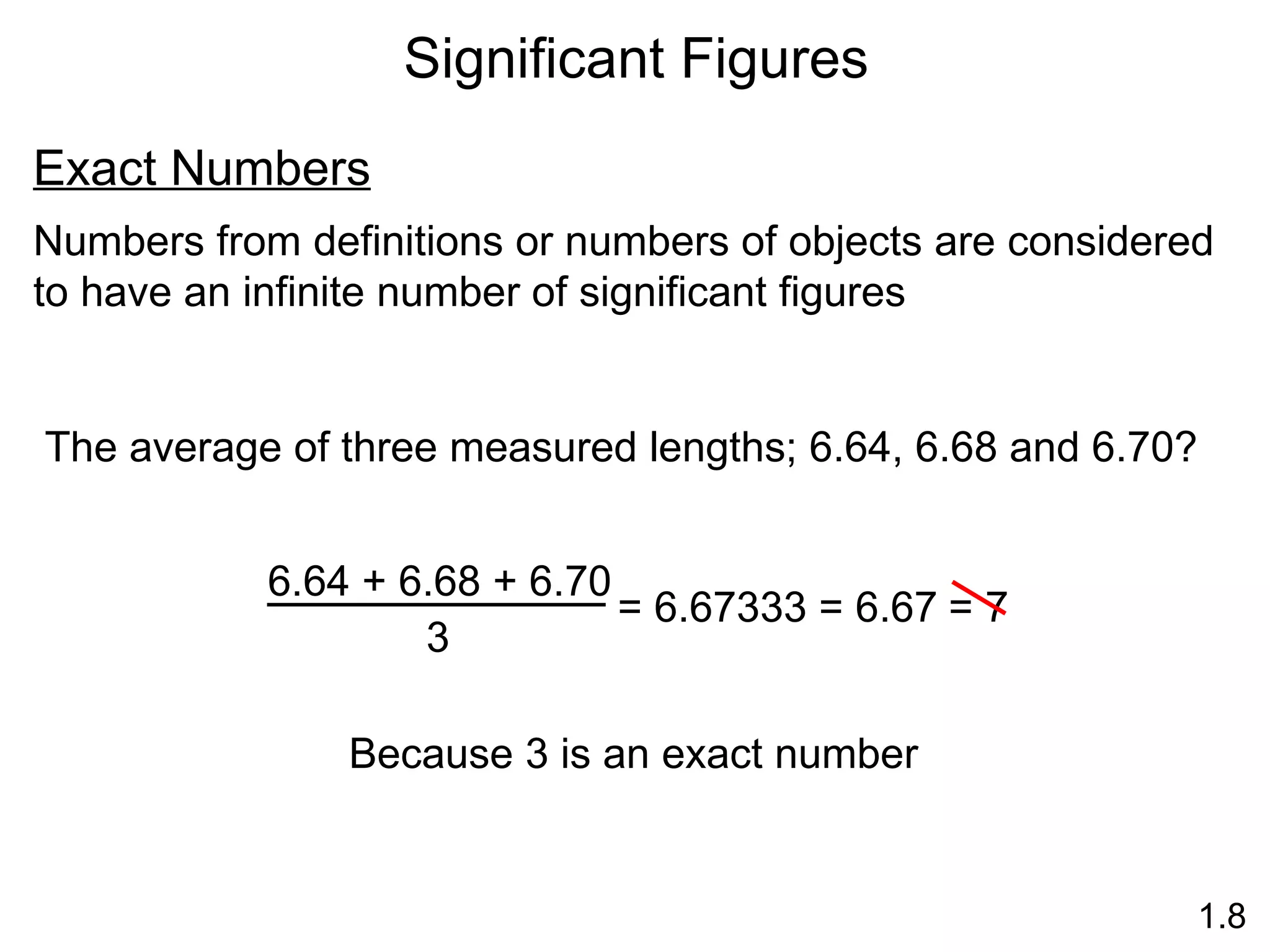
Significant Figures 1.8 Exact Numbers Numbers from definitions or numbers of objects are considered to have an infinite number of significant figures The average of three measured lengths; 6.64, 6.68 and 6.70? Because 3 is an exact number 6.64 + 6.68 + 6.70 3 = 6.67333 = 6.67  = 7
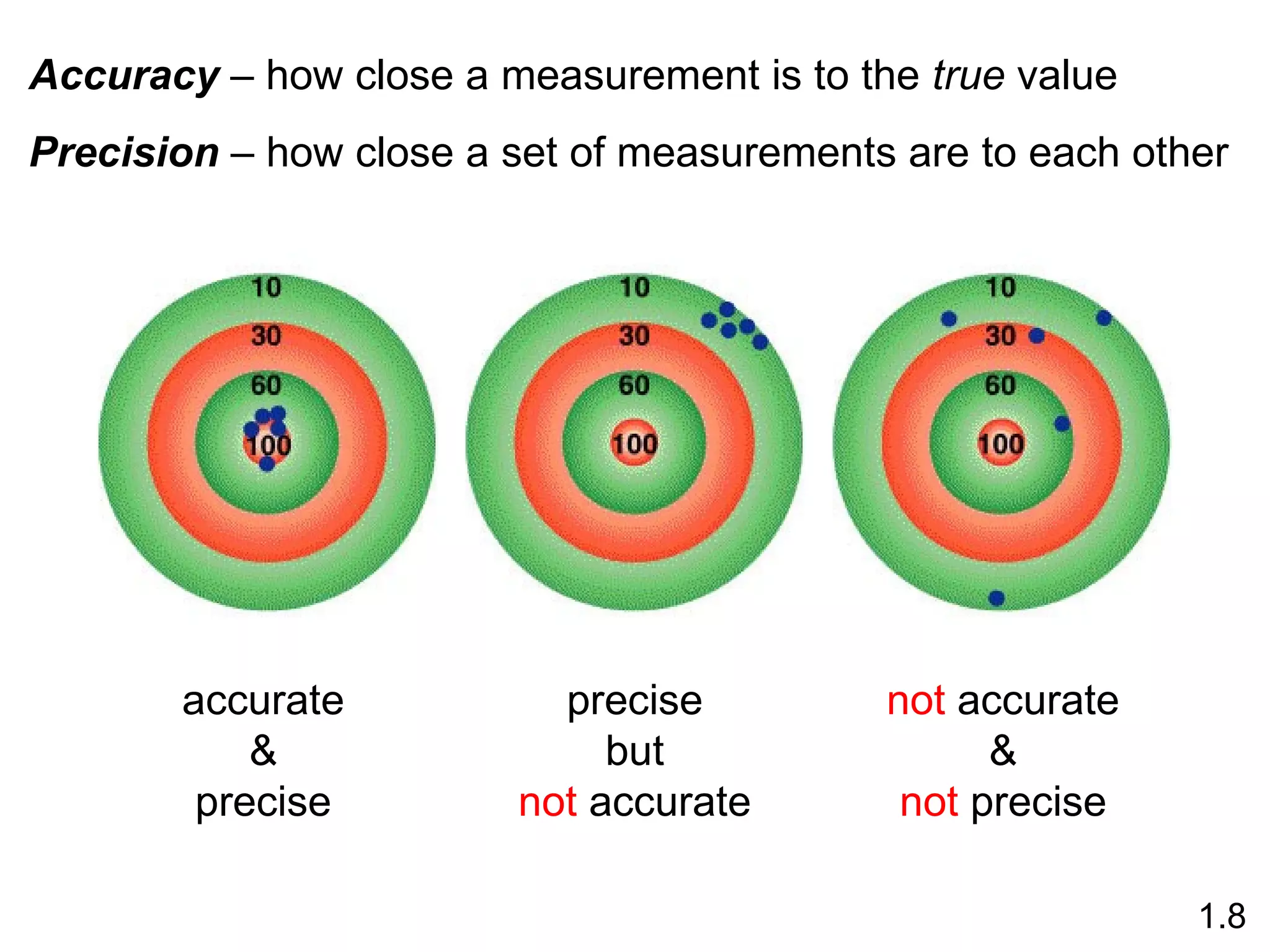
Accuracy  – how close a measurement is to the  true  value Precision  – how close a set of measurements are to each other accurate & precise precise but not  accurate not  accurate & not  precise 1.8
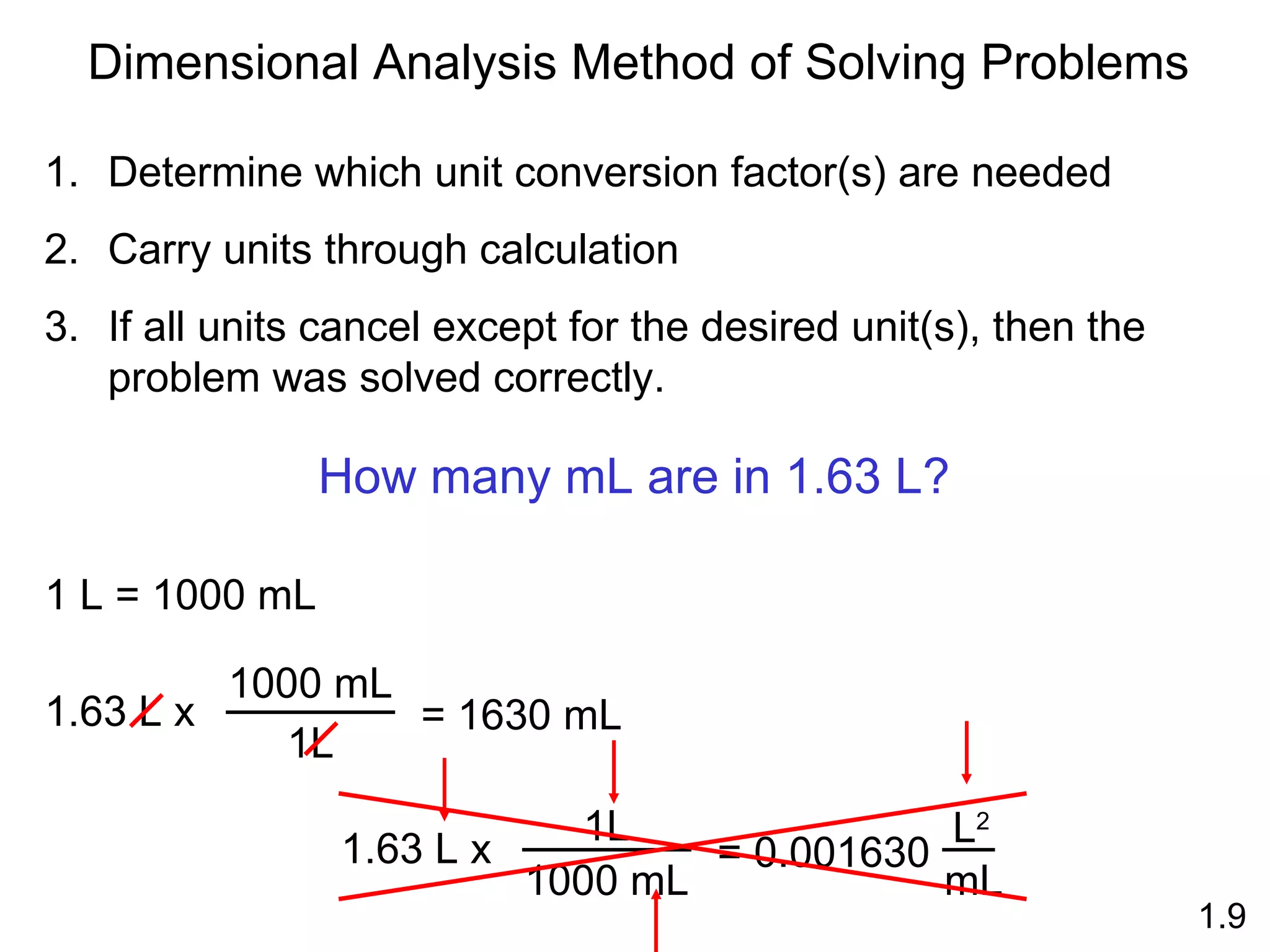
1.9 Dimensional Analysis Method of Solving Problems Determine which unit conversion factor(s) are needed Carry units through calculation If all units cancel except for the desired unit(s), then the problem was solved correctly. 1 L = 1000 mL How many mL are in 1.63 L? 1L 1000 mL 1.63 L x = 1630 mL 1L 1000 mL 1.63 L x = 0.001630 L 2 mL
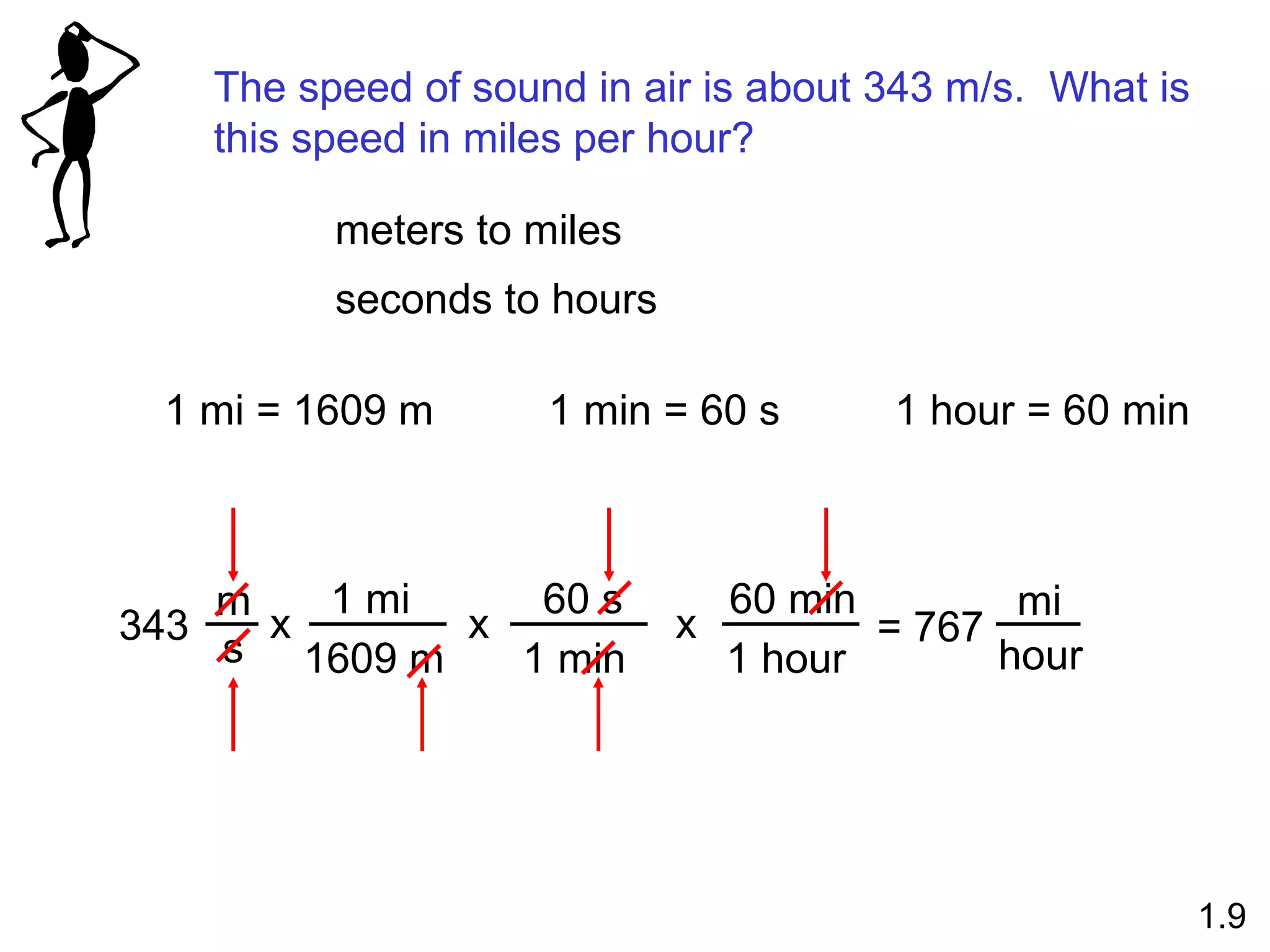
The speed of sound in air is about 343 m/s.  What is this speed in miles per hour? 1 mi = 1609 m 1 min = 60 s 1 hour = 60 min meters to miles seconds to hours 1.9 343 m s x 1 mi 1609 m 60 s 1 min x 60 min 1 hour x = 767 mi hour
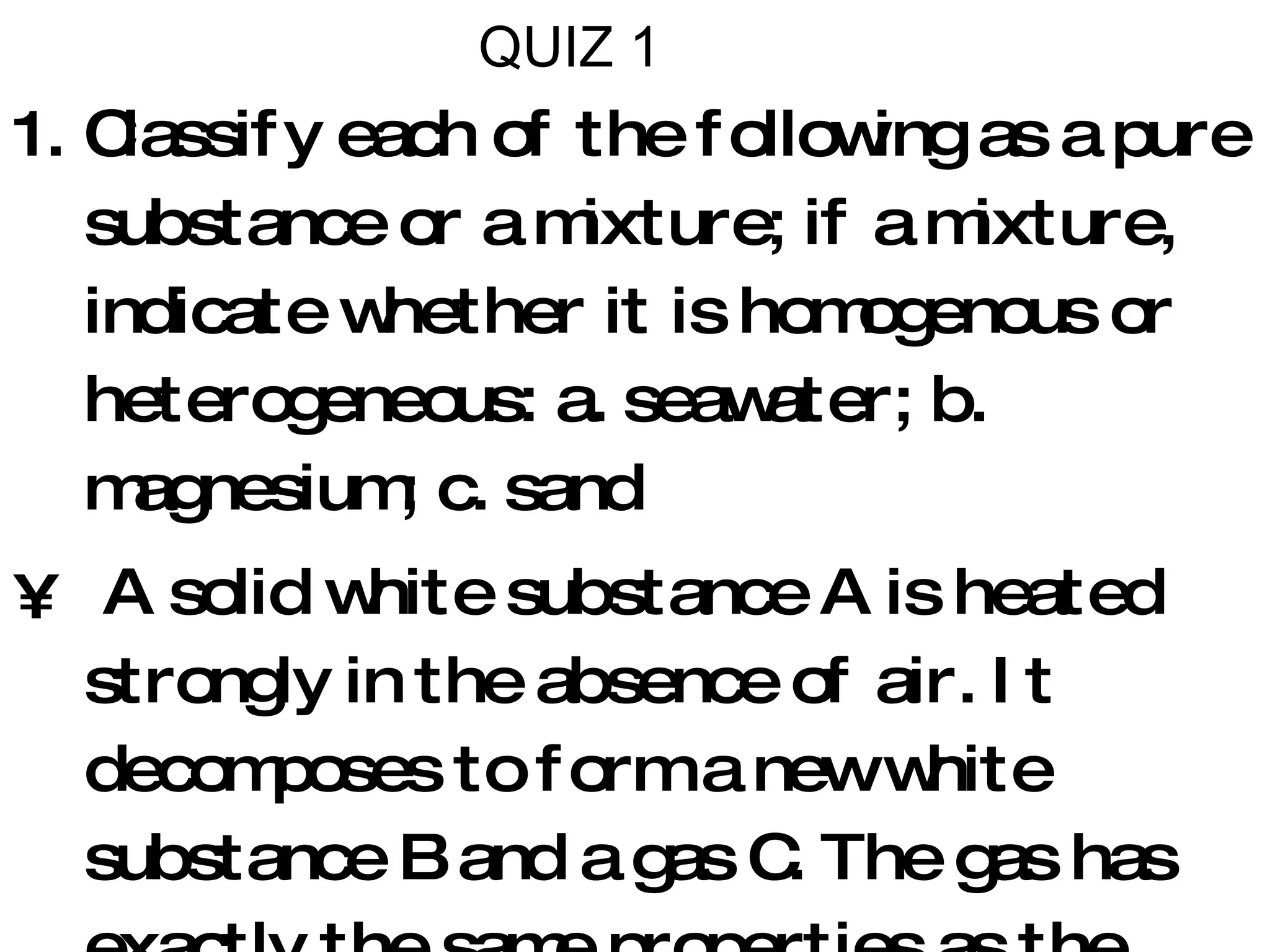
QUIZ 1 Classify each of the following as a pure substance or a mixture; if a mixture, indicate whether it is homogenous or heterogeneous: a. seawater; b. magnesium; c. sand A solid white substance A is heated strongly in the absence of air. It decomposes to form a new white substance B and a gas C. The gas has exactly the same properties as the product obtained when carbon is burned in oxygen. What can we say about whether solids A and B and the gas C are elements or compounds? Carry out the following operations: a. 1.24056 + 75.80; b. 123.1 x 1.01; c. 6.600 x 10 2  /3.3 x 10 4

Measurements

  • 1.
  • 2.
    Physical or Chemical?A physical change does not alter the composition or identity of a substance. A chemical change alters the composition or identity of the substance(s) involved. 1.6 ice melting sugar dissolving in water hydrogen burns in air to form water
  • 3.
    An extensiveproperty of a material depends upon how much matter is being considered. An intensive property of a material does not depend upon how much matter is is being considered. mass length volume density temperature color Extensive and Intensive Properties 1.6
  • 4.
    Mixtures Heterogeneous mixturesare not uniform throughout. Homogeneous mixtures are uniform throughout. Homogeneous mixtures are called solutions.
  • 5.
    Separation of MixturesMixtures can be separated if their physical properties are different. Solids can be separated from liquids by means of filtration . The solid is collected in filter paper, and the solution, called the filtrate, passes through the filter paper and is collected in a flask. Properties of Matter
  • 6.
    Separation of MixturesHomogeneous liquid mixtures can be separated by distillation . Distillation requires the different liquids to have different boiling points. In essence, each component of the mixture is boiled and collected. The lowest boiling fraction is collected first. Properties of Matter
  • 7.
  • 8.
    Separation of MixturesChromatography can be used to separate mixtures that have different abilities to adhere to solid surfaces. The greater the affinity the component has for the surface (paper) the slower it moves. The greater affinity the component has for the liquid, the faster it moves. Chromatography can be used to separate the different colors of inks in a pen. Properties of Matter
  • 9.
  • 10.
    CHEMISTRY is… C–come on! H – hahahaha… E – energy and electrons? M – matter and molecules? I – international system of units and ionic bond? S – scientific method and significant figures ? T- they are just R – relaxing topics!!! Y – yahooo…  Dioneda, Ingua, de Mesa
  • 11.
    SI Units Thereare two types of units: fundamental (or base) units; derived units. There are 7 base units in the SI system. Units of Measurement
  • 12.
  • 13.
  • 14.
    Volume –SI derived unit for volume is cubic meter (m 3 ) 1 L = 1000 mL = 1000 cm 3 = 1 dm 3 1 mL = 1 cm 3 1.7
  • 15.
    Density –SI derived unit for density is kg/m 3 1 g/cm 3 = 1 g/mL = 1000 kg/m 3 1.7 m = d x V = 21.5 g/cm 3 x 4.49 cm 3 = 96.5 g density = mass volume d = m V A piece of platinum metal with a density of 21.5 g/cm 3 has a volume of 4.49 cm 3 . What is its mass? d = m V
  • 16.
    K = 0 C + 273.15 1.7 273 K = 0 0 C 373 K = 100 0 C 32 0 F = 0 0 C 212 0 F = 100 0 C 0 F = x 0 C + 32 9 5
  • 17.
    Convert 172.9 0 F to degrees Celsius. 1.7 0 F = x 0 C + 32 9 5 0 F – 32 = x 0 C 9 5 x ( 0 F – 32) = 0 C 9 5 0 C = x ( 0 F – 32) 9 5 0 C = x (172.9 – 32) = 78.3 9 5
  • 18.
    1.8 Scientific Notation6.022 x 10 23 1.99 x 10 -23 N x 10 n N is a number between 1 and 10 n is a positive or negative integer The number of atoms in 12 g of carbon: 602,200,000,000,000,000,000,000 The mass of a single carbon atom in grams: 0.0000000000000000000000199
  • 19.
    Scientific Notation 1.8568.762 n > 0 568.762 = 5.68762 x 10 2 0.00000772 n < 0 0.00000772 = 7.72 x 10 -6 Addition or Subtraction Write each quantity with the same exponent n Combine N 1 and N 2 The exponent, n , remains the same 4.31 x 10 4 + 3.9 x 10 3 = 4.31 x 10 4 + 0.39 x 10 4 = 4.70 x 10 4 move decimal left move decimal right
  • 20.
    Significant Figures 1.8Any digit that is not zero is significant 1.234 kg 4 significant figures Zeros between nonzero digits are significant 606 m 3 significant figures Zeros to the left of the first nonzero digit are not significant 0.08 L 1 significant figure If a number is greater than 1, then all zeros to the right of the decimal point are significant 2.0 mg 2 significant figures If a number is less than 1, then only the zeros that are at the end and in the middle of the number are significant 0.00420 g 3 significant figures
  • 21.
    How many significantfigures are in each of the following measurements? 24 mL 2 significant figures 3001 g 4 significant figures 0.0320 m 3 3 significant figures 6.4 x 10 4 molecules 2 significant figures 560 kg 2 significant figures 1.8
  • 22.
    Significant Figures 1.8Addition or Subtraction The answer cannot have more digits to the right of the decimal point than any of the original numbers. 89.332 1.1 + 90.432 round off to 90.4 one significant figure after decimal point 3.70 -2.9133 0.7867 two significant figures after decimal point round off to 0.79
  • 23.
    Significant Figures 1.8Multiplication or Division The number of significant figures in the result is set by the original number that has the smallest number of significant figures 4.51 x 3.6666 = 16.536366 = 16.5 6.8 ÷ 112.04 = 0.0606926 = 0.061 3 sig figs round to 3 sig figs 2 sig figs round to 2 sig figs
  • 24.
    Significant Figures 1.8Exact Numbers Numbers from definitions or numbers of objects are considered to have an infinite number of significant figures The average of three measured lengths; 6.64, 6.68 and 6.70? Because 3 is an exact number 6.64 + 6.68 + 6.70 3 = 6.67333 = 6.67 = 7
  • 25.
    Accuracy –how close a measurement is to the true value Precision – how close a set of measurements are to each other accurate & precise precise but not accurate not accurate & not precise 1.8
  • 26.
    1.9 Dimensional AnalysisMethod of Solving Problems Determine which unit conversion factor(s) are needed Carry units through calculation If all units cancel except for the desired unit(s), then the problem was solved correctly. 1 L = 1000 mL How many mL are in 1.63 L? 1L 1000 mL 1.63 L x = 1630 mL 1L 1000 mL 1.63 L x = 0.001630 L 2 mL
  • 27.
    The speed ofsound in air is about 343 m/s. What is this speed in miles per hour? 1 mi = 1609 m 1 min = 60 s 1 hour = 60 min meters to miles seconds to hours 1.9 343 m s x 1 mi 1609 m 60 s 1 min x 60 min 1 hour x = 767 mi hour
  • 28.
    QUIZ 1 Classifyeach of the following as a pure substance or a mixture; if a mixture, indicate whether it is homogenous or heterogeneous: a. seawater; b. magnesium; c. sand A solid white substance A is heated strongly in the absence of air. It decomposes to form a new white substance B and a gas C. The gas has exactly the same properties as the product obtained when carbon is burned in oxygen. What can we say about whether solids A and B and the gas C are elements or compounds? Carry out the following operations: a. 1.24056 + 75.80; b. 123.1 x 1.01; c. 6.600 x 10 2 /3.3 x 10 4