Measuring MassBy Moira Whitehouse PhD
Another thing scientists measure is mass.  Mass is the amount of matter or “stuff” in something and is very closely tied to its weight.
Another thing scientists measure is mass.  Mass is the amount of matter or “stuff” in something and is very closely tied to its weight.  The mass of the matter that makes up something cannot change, but its weight can.  The reason its weight can change is that weight depends on gravity.
Another thing scientists measure is mass.  Mass is the amount of matter or “stuff” in something and is very closely tied to its weight.  The amount of “stuff” inside of something cannot change but its weight can.  The reason its weight can change is that weight depends on gravity. And the amount of gravity on each moon and  planet is different.
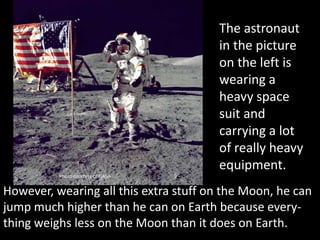
The astronaut in the picture on the left is wearing a heavy space suit and carrying a lot of really heavy equipment.  Photo courtesy of NASAHowever, wearing all this extra stuff on the Moon, he can jump much higher than he can on Earth because every-thing weighs less on the Moon than it does on Earth.
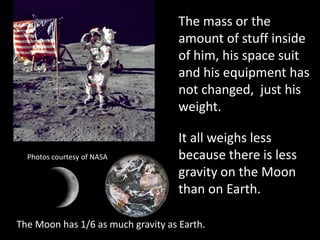
The mass or the amount of stuff inside of him, his space suit and his equipment has not changed,  just his weight.It all weighs less because there is less gravity on the Moon than on Earth.Photos courtesy of NASAThe Moon has 1/6 as much gravity as Earth.
Similarly, astronauts float weightless in outer space and on the shuttle but their mass-- the amount of stuff in them does not change.Photos courtesy of NASA
           The mass of an object is measured:•with a tool called a balance scale
•and  in units called grams (g) and kilograms (kg).500 g200 g100 g5 g20 g50 g10 g2g1g1 kilogram = 1000 grams1kg = 1000 g
How did we get this standard unit for mass?   By using the mass of a cubed centimeter of water.
=
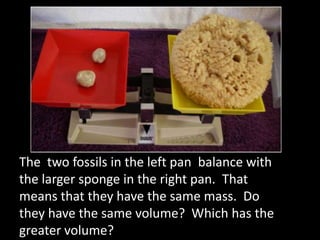
The  two fossils in the left pan  balance with the larger sponge in the right pan.  That means that they have the same mass.  Do they have the same volume?  Which has the greater volume?
The metal balls in the right pan balance with the larger sponge in the left pan.  This means that they have: a.  the same mass            b.  the same volume
These two fossils in the left pan and the steel balls in the right pan balance on the scale.  What can you say about the mass of the two fossils and the steel balls?
Notice that the brass masses that balance both the metal balls and the sponge are exactly the same.On the next page you will see an enlarged picture of these masses.
So all three things—the sponge, the two fossils and the metal balls all have the same mass.Their mass is:10 + 10 + 5 + 2 + 1 = 28 g
In the left pan of the balance scale is a quartz crystal.  In the yellow pan are the masses that balance the mass of the crystal. What is the mass of the quartz crystal?
Yes, it would be100 + 50 + 10 = 160 g
In the left pan of the balance scale is a gourd.  In the yellow pan are the masses that balance the mass of the gourd. What is the mass of the gourd?
Yes, it is 10 + 5 + 2 + 1 = 18 g
In the left pan of the balance scale is a barite crystal.  In the yellow pan are the masses that balance the mass of the crystal. What is the mass of the crystal?1g
1 gYes, it is 200 + 50 + 20 + 10 + 10 + 5 + 2 + 1 = 298 g
Is this scale balanced?Which side is down—the left or the right?
The right side is down.This means that the mass of the geode ismore than 400 gb. less than 400 g
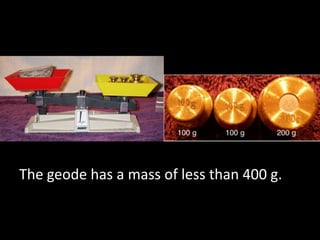
The geode has a mass of less than 400 g.
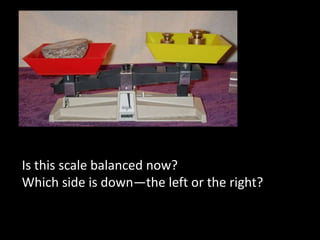
Is this scale balanced now?Which side is down—the left or the right?
This time the left side is down. This means that the mass of the geode ismore than 300 gless than 300 g
The geode has a mass of more than 300 g.
Now the scale balances.  What is the mass of the geode?
The geode has a mass of  356 g.
Now suppose you see at setup like the one on the left with an ammonite and 50 g in the left pan and a series of masses in the right pan.The total of the masses in the right pan is: 100 + 50 + 10 + 10 + 5 + 2=  177g
177 g177 gRemember if the scale balances, the total mass of all the items in the left and right pan must equal 177 g.  If this is true, then how might you figure out the mass of the ammonite in the left pan?
177 g177 gYour number sentence would look like this: 50 g +     the mass of the ammonite        = 177 g							OR177 g – 50 g =    the mass of the ammonite
So the mass of the ammonite would be176 – 50 = 126 g
So how about this one.How would you find the mass of the piece of coal in the left pan?What would you do first?
Yes, the first thing you would do would be to figure the total mass in the right pan.The total mass  in the right  pan is100 + 100 + 10 + 10 + 10 + 10 + 5 + 2 =Now, what would you do?
Yes, you would subtract 10 g from the total of 247 g .  This will give you the mass of the piece of coal.247 – 10 = 237 gThe piece of coal has a mass of 237 g
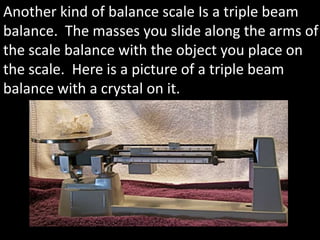
Another kind of balance scale Is a triple beam balance.  The masses you slide along the arms of the scale balance with the object you place on the scale.  Here is a picture of a triple beam balance with a crystal on it.
You read this scale by noticing which number each slider is on and adding those numbers together.  What is the mass of the crystal?
100 + 60 + 1 = 161 gThe crystal has a mass of 161 g.
Study science and when you grow up you may get a chance to go to the moon where:you can leap high and weigh less, but don’t forget, your mass will still be the same.photo courtesy NASA

MASS and procedures for measuring (Teach)

  • 1.
  • 2.
    Another thing scientistsmeasure is mass. Mass is the amount of matter or “stuff” in something and is very closely tied to its weight.
  • 3.
    Another thing scientistsmeasure is mass. Mass is the amount of matter or “stuff” in something and is very closely tied to its weight. The mass of the matter that makes up something cannot change, but its weight can. The reason its weight can change is that weight depends on gravity.
  • 4.
    Another thing scientistsmeasure is mass. Mass is the amount of matter or “stuff” in something and is very closely tied to its weight. The amount of “stuff” inside of something cannot change but its weight can. The reason its weight can change is that weight depends on gravity. And the amount of gravity on each moon and planet is different.
  • 5.
    The astronaut inthe picture on the left is wearing a heavy space suit and carrying a lot of really heavy equipment. Photo courtesy of NASAHowever, wearing all this extra stuff on the Moon, he can jump much higher than he can on Earth because every-thing weighs less on the Moon than it does on Earth.
  • 6.
    The mass orthe amount of stuff inside of him, his space suit and his equipment has not changed, just his weight.It all weighs less because there is less gravity on the Moon than on Earth.Photos courtesy of NASAThe Moon has 1/6 as much gravity as Earth.
  • 7.
    Similarly, astronauts floatweightless in outer space and on the shuttle but their mass-- the amount of stuff in them does not change.Photos courtesy of NASA
  • 8.
    The mass of an object is measured:•with a tool called a balance scale
  • 9.
    •and inunits called grams (g) and kilograms (kg).500 g200 g100 g5 g20 g50 g10 g2g1g1 kilogram = 1000 grams1kg = 1000 g
  • 10.
    How did weget this standard unit for mass? By using the mass of a cubed centimeter of water.
  • 11.
    How did weget this standard unit for mass? By using the mass of a cubed centimeter of water.
  • 12.
  • 13.
    The twofossils in the left pan balance with the larger sponge in the right pan. That means that they have the same mass. Do they have the same volume? Which has the greater volume?
  • 14.
    The metal ballsin the right pan balance with the larger sponge in the left pan. This means that they have: a. the same mass b. the same volume
  • 15.
    These two fossilsin the left pan and the steel balls in the right pan balance on the scale. What can you say about the mass of the two fossils and the steel balls?
  • 16.
    Notice that thebrass masses that balance both the metal balls and the sponge are exactly the same.On the next page you will see an enlarged picture of these masses.
  • 17.
    So all threethings—the sponge, the two fossils and the metal balls all have the same mass.Their mass is:10 + 10 + 5 + 2 + 1 = 28 g
  • 18.
    In the leftpan of the balance scale is a quartz crystal. In the yellow pan are the masses that balance the mass of the crystal. What is the mass of the quartz crystal?
  • 19.
    Yes, it wouldbe100 + 50 + 10 = 160 g
  • 20.
    In the leftpan of the balance scale is a gourd. In the yellow pan are the masses that balance the mass of the gourd. What is the mass of the gourd?
  • 21.
    Yes, it is10 + 5 + 2 + 1 = 18 g
  • 22.
    In the leftpan of the balance scale is a barite crystal. In the yellow pan are the masses that balance the mass of the crystal. What is the mass of the crystal?1g
  • 23.
    1 gYes, itis 200 + 50 + 20 + 10 + 10 + 5 + 2 + 1 = 298 g
  • 24.
    Is this scalebalanced?Which side is down—the left or the right?
  • 25.
    The right sideis down.This means that the mass of the geode ismore than 400 gb. less than 400 g
  • 26.
    The geode hasa mass of less than 400 g.
  • 27.
    Is this scalebalanced now?Which side is down—the left or the right?
  • 28.
    This time theleft side is down. This means that the mass of the geode ismore than 300 gless than 300 g
  • 29.
    The geode hasa mass of more than 300 g.
  • 30.
    Now the scalebalances. What is the mass of the geode?
  • 31.
    The geode hasa mass of 356 g.
  • 32.
    Now suppose yousee at setup like the one on the left with an ammonite and 50 g in the left pan and a series of masses in the right pan.The total of the masses in the right pan is: 100 + 50 + 10 + 10 + 5 + 2= 177g
  • 33.
    177 g177 gRememberif the scale balances, the total mass of all the items in the left and right pan must equal 177 g. If this is true, then how might you figure out the mass of the ammonite in the left pan?
  • 34.
    177 g177 gYournumber sentence would look like this: 50 g + the mass of the ammonite = 177 g OR177 g – 50 g = the mass of the ammonite
  • 35.
    So the massof the ammonite would be176 – 50 = 126 g
  • 36.
    So how aboutthis one.How would you find the mass of the piece of coal in the left pan?What would you do first?
  • 37.
    Yes, the firstthing you would do would be to figure the total mass in the right pan.The total mass in the right pan is100 + 100 + 10 + 10 + 10 + 10 + 5 + 2 =Now, what would you do?
  • 38.
    Yes, you wouldsubtract 10 g from the total of 247 g . This will give you the mass of the piece of coal.247 – 10 = 237 gThe piece of coal has a mass of 237 g
  • 39.
    Another kind ofbalance scale Is a triple beam balance. The masses you slide along the arms of the scale balance with the object you place on the scale. Here is a picture of a triple beam balance with a crystal on it.
  • 40.
    You read thisscale by noticing which number each slider is on and adding those numbers together. What is the mass of the crystal?
  • 41.
    100 + 60+ 1 = 161 gThe crystal has a mass of 161 g.
  • 42.
    Study science andwhen you grow up you may get a chance to go to the moon where:you can leap high and weigh less, but don’t forget, your mass will still be the same.photo courtesy NASA