Common Endocrine Disorders Sherry L. Knowles, RN, CCRN, CRNI Orlando Regional Medical Center 2008
Common Endocrine Disorders Adrenal Insufficiency Myxedema Thyroid Storm Acute Hypoglycemia HHNK DKA DI SIADH
The Endocrine System The endocrine system is a network of glands and hormones that regulate and control both long and short term biological functions. Pineal, Hypothalamus, Pituitary, Thyroid, Parathyroid, Thymus, Adrenal, Pancreas, Gonads  The PITUITARY is known as the “ master gland " due to its role in controlling and regulating the other glands of the body.
The Endocrine System Maintains Homeostasis Controls Metabolism Regulates Fluid Balance Controls Growth Controls Reproduction Mobilizes Stress Response
Acute Hypoglycemia What is Acute Hypoglycemia? An Acute Drop In Blood Sugar Serum Glucose < 50 What causes Acute Hypoglycemia?
Causes of   Acute Hypoglycemia Insufficient Nutritional Intake Excessive Insulin Dosing Inadequate Production Of Glucose Renal or Hepatic Insufficiency Medications
Cardiovascular Signs Palpitations Tachycardia Anxiety Irritability Diaphoresis Pale, cool skin Tachypnea Signs & Symptoms of   Acute Hypoglycemia Neurological Signs Agitation Confusion Slurred Speech Staggering Gait Paraplegia Seizures Coma
Treatment of   Acute Hypoglycemia Give Glucose Watch Glucose Levels Carefully
Diabetes Insipitus What is Diabetes Insipitus? A Condition Resulting From Too Little ADH Why is it called Diabetes Insipitus? The Term Diabetes Refers To Polyuria What causes Diabetes Insipitus?
Causes of  Diabetes Insipitus Decreased ADH Neurological Surgery Head Trauma
Signs & Symptoms  of   Diabetes Insipitus Polyuria Hypovolemia Dehydration Shock Polyuria Severe Hypovolemia Severe Dehydration Elevated Serum Osmolality Elevated Serum Sodium Shock
Treatment of  Diabetes Insipitus Fluid Resuscitation ADH Replacement   (Vasopressin, Pitressin, DDAVP) Treat The Cause
SIADH What is SIADH? Syndrome of Inappropriate ADH Too Much ADH Secretion What causes too much ADH?
Causes of  SIADH Head Trauma Oat Cell Carcinoma Other Cancers Viral Pneumonia Medications Stress Mechanical Ventilation
ADH ADH Means Water Retention Water is retained when ADH is secreted Increased Plasma Concentration stimulates ADH Secretion  Excessive ADH levels may cause water intoxication and cerebral edema
Signs & Symptoms of   SIADH Hyponatremia Low Serum Sodium Serum NA < 135 Low Serum Osmolality   High Urine Osmolality Elevated Specific Gravity Urine specific gravity > 1.030 Elevated Urine Osmolality   Elevated ADH Level Weight Gain Without Edema Elevated CVP, PAP, PAWP Hypertension Concentrated And    UOP Headache Altered LOC Seizures
Treatment of   SIADH Monitor Fluid Balance, Monitor I & O Restrict Fluids Replace Na+ loss when necessary  May Give 3% (Hypertonic) Saline May Give Dilantin or Lithium May require Swan Ganz For Monitoring May Give Diuretics
SIADH vs Diabetes Insipitus SIADH Too Much ADH Water Intoxication Low Serum Sodium Low Serum Osmolality High Urine Osmolality Diabetes Insipitus Too Little ADH Dehydration High Serum Sodium High Serum Osmolality Low Urine Osmolality
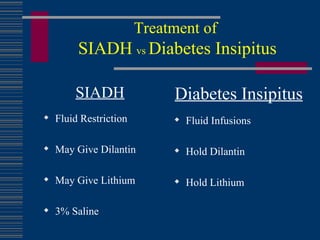
Treatment of  SIADH   vs  Diabetes Insipitus SIADH Fluid Restriction May Give Dilantin May Give Lithium 3% Saline Diabetes Insipitus Fluid Infusions Hold Dilantin Hold Lithium
Diabetic Ketoacidosis What is DKA? Diabetic Ketoacidosis A Life-Threatening Complication  Seen With Diabetes Mellitus Type 1   What causes Diabetic Ketoacidosis?
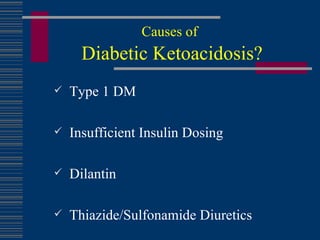
Causes of   Diabetic Ketoacidosis? Type 1 DM Insufficient Insulin Dosing Dilantin Thiazide/Sulfonamide Diuretics
Signs & Symptoms of   DKA Serum Glucose  300-800 Ketoacidosis Present Large Serum And Urine Ketones Fruity Breath Kussmaul Respirations Serum pH < 7.3
Treatment of  DKA Reverse Dehydration NS, then ½ NS Restore Glucose Levels D 5  ½ NS When Glu 250 Restore Electrolytes
HHNK What is HHNK? Hyperglycemic Hyperosmolar Nonketonic Coma A life threatening complication seen with Diabetes Mellitus Type 2 What causes HHNK?
Signs & Symptoms of   HHNK Serum Glucose  600-2000 Ketoacidosis Not Present Absent Or Slight Serum And Urine Ketones Normal Breath Shallow Respirations Serum pH Normal
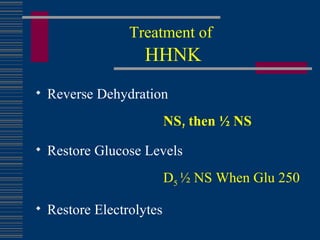
Treatment of   HHNK Reverse Dehydration NS, then ½ NS Restore Glucose Levels D 5  ½ NS When Glu 250 Restore Electrolytes
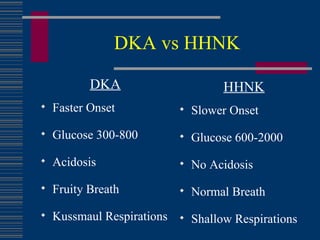
DKA vs HHNK DKA Faster Onset Glucose 300-800 Acidosis Fruity Breath Kussmaul Respirations HHNK Slower Onset Glucose 600-2000 No Acidosis Normal Breath Shallow Respirations
Treatment of   DKA  vs  HHNK Reverse Dehydration NS, then ½ NS Restore Glucose Levels D 5  ½ NS When Glu 250 Restore Electrolytes
Thyroid Storm What is Thyroid Storm? Critical Hyperthyroidism What causes Thyroid Storm? Too Much Thyroid Medication Glandular Dysfunction Thyroid Tumors Medication
Signs & Symptoms of   Thyroid Storm Tachycardia Palpitations Murmurs PAC’s/PVC’s Hypertension CHF Nervousness Confusion Psychosis Convulsions Weakness Heat Intolerance Tremors Diaphoresis Nausea Weight Loss Pruritus Alopecia
Treatment of   Thyroid Storm Treat Symptoms Give Medication PTU (Anti-Thyroid) Glucocorticoids Iodides Calcium Channel Blockers
Myxedema What is Myxedema? Hypothyroidism What causes Myxedema?
Causes of   Myxedema Usually Precipitated By An Illness Infection, Trauma, Exposure To Cold Abrupt Withdrawal of Thyroid Hormones Usually Seen In The Elderly Has A High Mortality Rate
Signs & Symptoms of   Myxedema Altered mental Status Defective Thermoregulation Slowed Body Systems Decreased LOC Decreased respirations Decreased Heart Rate Hypotension Hypothermia
Treatment of  Myxedema Treat The Symptoms Warm Patient Give Fluids As Needed Give Levothyroxine (Thyroid Supplement)
Adrenal Insufficiency What is Adrenal Insufficiency? Life-Threatening Steroid Deficiency What causes Adrenal Insufficiency? Steroid Withdrawal  Acute Exacerbation of Chronic Insufficiency
Adrenal Insufficiency Hypoadrenalism  (Addison’s Disease) hypotension, anorexia, weakness, hyperpyrexia Hyperadrenalism  (Cushing’s Syndrome) hypertension, round face, hunchback, DM, psychosis
Signs & Symptoms of  Adrenal Insufficiency Decreased Appetite  Weight Loss Progressive Fatigue  Weakness Nausea and Vomiting Abdominal Pain Dizziness Personality Changes Irritability Restlessness Diarrhea or Constipation Increased Skin Pigmentation
Treatment of  Adrenal Insufficiency Lifelong hormone replacement  Corticosteroids
Diabetes Mellitus Type I - IDDM (5% - onset 15 yo) Type II - NIDDM (95% - onset 40+) •  25-30% will require insulin eventually Gestational - GDM   Other types resulting from: •  pancreatic disease •  hormonal disease •  drug therapy •  obesity (NIDDM)
Signs & Symptoms of  Diabetes Mellitus Primary Presentation polydipsia polyuria polyphagia weight loss loss of strength
Signs & Symptoms of  Diabetes Mellitus Additional Findings altered vision infections irritability drowsiness malaise nocturia vulvular pruritis paresthesias impotence postural hypotension
Basic Insulin Therapies Insulin (onset / peak / duration) Short acting regular, semi-lente (15 min / 4-6 hrs / 6-8 hrs) Intermediate NPH, lente (3 hrs / 8-12 hrs / 18-24 hrs) Long acting PZI, ultralente (3-4 hrs / 14-20 hrs / 24-36 hrs)
Newer Insulin Therapies Humalog / Novolog Rapid  onset  of  action  and  clearance Allows  for  better  matching  to carbohydrate intake May  give  immediately  after  meals  in  small children Lantus 24 hr  basal  insulin  delivery No “ peak”  effect Alternative  basal-bolus  therapy  to  the  pump
The Endocrine System

Common Endocrine Disorders

  • 1.
    Common Endocrine DisordersSherry L. Knowles, RN, CCRN, CRNI Orlando Regional Medical Center 2008
  • 2.
    Common Endocrine DisordersAdrenal Insufficiency Myxedema Thyroid Storm Acute Hypoglycemia HHNK DKA DI SIADH
  • 3.
    The Endocrine SystemThe endocrine system is a network of glands and hormones that regulate and control both long and short term biological functions. Pineal, Hypothalamus, Pituitary, Thyroid, Parathyroid, Thymus, Adrenal, Pancreas, Gonads The PITUITARY is known as the “ master gland &quot; due to its role in controlling and regulating the other glands of the body.
  • 4.
    The Endocrine SystemMaintains Homeostasis Controls Metabolism Regulates Fluid Balance Controls Growth Controls Reproduction Mobilizes Stress Response
  • 5.
    Acute Hypoglycemia Whatis Acute Hypoglycemia? An Acute Drop In Blood Sugar Serum Glucose < 50 What causes Acute Hypoglycemia?
  • 6.
    Causes of Acute Hypoglycemia Insufficient Nutritional Intake Excessive Insulin Dosing Inadequate Production Of Glucose Renal or Hepatic Insufficiency Medications
  • 7.
    Cardiovascular Signs PalpitationsTachycardia Anxiety Irritability Diaphoresis Pale, cool skin Tachypnea Signs & Symptoms of Acute Hypoglycemia Neurological Signs Agitation Confusion Slurred Speech Staggering Gait Paraplegia Seizures Coma
  • 8.
    Treatment of Acute Hypoglycemia Give Glucose Watch Glucose Levels Carefully
  • 9.
    Diabetes Insipitus Whatis Diabetes Insipitus? A Condition Resulting From Too Little ADH Why is it called Diabetes Insipitus? The Term Diabetes Refers To Polyuria What causes Diabetes Insipitus?
  • 10.
    Causes of Diabetes Insipitus Decreased ADH Neurological Surgery Head Trauma
  • 11.
    Signs & Symptoms of Diabetes Insipitus Polyuria Hypovolemia Dehydration Shock Polyuria Severe Hypovolemia Severe Dehydration Elevated Serum Osmolality Elevated Serum Sodium Shock
  • 12.
    Treatment of Diabetes Insipitus Fluid Resuscitation ADH Replacement (Vasopressin, Pitressin, DDAVP) Treat The Cause
  • 13.
    SIADH What isSIADH? Syndrome of Inappropriate ADH Too Much ADH Secretion What causes too much ADH?
  • 14.
    Causes of SIADH Head Trauma Oat Cell Carcinoma Other Cancers Viral Pneumonia Medications Stress Mechanical Ventilation
  • 15.
    ADH ADH MeansWater Retention Water is retained when ADH is secreted Increased Plasma Concentration stimulates ADH Secretion Excessive ADH levels may cause water intoxication and cerebral edema
  • 16.
    Signs & Symptomsof SIADH Hyponatremia Low Serum Sodium Serum NA < 135 Low Serum Osmolality High Urine Osmolality Elevated Specific Gravity Urine specific gravity > 1.030 Elevated Urine Osmolality Elevated ADH Level Weight Gain Without Edema Elevated CVP, PAP, PAWP Hypertension Concentrated And  UOP Headache Altered LOC Seizures
  • 17.
    Treatment of SIADH Monitor Fluid Balance, Monitor I & O Restrict Fluids Replace Na+ loss when necessary May Give 3% (Hypertonic) Saline May Give Dilantin or Lithium May require Swan Ganz For Monitoring May Give Diuretics
  • 18.
    SIADH vs DiabetesInsipitus SIADH Too Much ADH Water Intoxication Low Serum Sodium Low Serum Osmolality High Urine Osmolality Diabetes Insipitus Too Little ADH Dehydration High Serum Sodium High Serum Osmolality Low Urine Osmolality
  • 19.
    Treatment of SIADH vs Diabetes Insipitus SIADH Fluid Restriction May Give Dilantin May Give Lithium 3% Saline Diabetes Insipitus Fluid Infusions Hold Dilantin Hold Lithium
  • 20.
    Diabetic Ketoacidosis Whatis DKA? Diabetic Ketoacidosis A Life-Threatening Complication Seen With Diabetes Mellitus Type 1 What causes Diabetic Ketoacidosis?
  • 21.
    Causes of Diabetic Ketoacidosis? Type 1 DM Insufficient Insulin Dosing Dilantin Thiazide/Sulfonamide Diuretics
  • 22.
    Signs & Symptomsof DKA Serum Glucose 300-800 Ketoacidosis Present Large Serum And Urine Ketones Fruity Breath Kussmaul Respirations Serum pH < 7.3
  • 23.
    Treatment of DKA Reverse Dehydration NS, then ½ NS Restore Glucose Levels D 5 ½ NS When Glu 250 Restore Electrolytes
  • 24.
    HHNK What isHHNK? Hyperglycemic Hyperosmolar Nonketonic Coma A life threatening complication seen with Diabetes Mellitus Type 2 What causes HHNK?
  • 25.
    Signs & Symptomsof HHNK Serum Glucose 600-2000 Ketoacidosis Not Present Absent Or Slight Serum And Urine Ketones Normal Breath Shallow Respirations Serum pH Normal
  • 26.
    Treatment of HHNK Reverse Dehydration NS, then ½ NS Restore Glucose Levels D 5 ½ NS When Glu 250 Restore Electrolytes
  • 27.
    DKA vs HHNKDKA Faster Onset Glucose 300-800 Acidosis Fruity Breath Kussmaul Respirations HHNK Slower Onset Glucose 600-2000 No Acidosis Normal Breath Shallow Respirations
  • 28.
    Treatment of DKA vs HHNK Reverse Dehydration NS, then ½ NS Restore Glucose Levels D 5 ½ NS When Glu 250 Restore Electrolytes
  • 29.
    Thyroid Storm Whatis Thyroid Storm? Critical Hyperthyroidism What causes Thyroid Storm? Too Much Thyroid Medication Glandular Dysfunction Thyroid Tumors Medication
  • 30.
    Signs & Symptomsof Thyroid Storm Tachycardia Palpitations Murmurs PAC’s/PVC’s Hypertension CHF Nervousness Confusion Psychosis Convulsions Weakness Heat Intolerance Tremors Diaphoresis Nausea Weight Loss Pruritus Alopecia
  • 31.
    Treatment of Thyroid Storm Treat Symptoms Give Medication PTU (Anti-Thyroid) Glucocorticoids Iodides Calcium Channel Blockers
  • 32.
    Myxedema What isMyxedema? Hypothyroidism What causes Myxedema?
  • 33.
    Causes of Myxedema Usually Precipitated By An Illness Infection, Trauma, Exposure To Cold Abrupt Withdrawal of Thyroid Hormones Usually Seen In The Elderly Has A High Mortality Rate
  • 34.
    Signs & Symptomsof Myxedema Altered mental Status Defective Thermoregulation Slowed Body Systems Decreased LOC Decreased respirations Decreased Heart Rate Hypotension Hypothermia
  • 35.
    Treatment of Myxedema Treat The Symptoms Warm Patient Give Fluids As Needed Give Levothyroxine (Thyroid Supplement)
  • 36.
    Adrenal Insufficiency Whatis Adrenal Insufficiency? Life-Threatening Steroid Deficiency What causes Adrenal Insufficiency? Steroid Withdrawal Acute Exacerbation of Chronic Insufficiency
  • 37.
    Adrenal Insufficiency Hypoadrenalism (Addison’s Disease) hypotension, anorexia, weakness, hyperpyrexia Hyperadrenalism (Cushing’s Syndrome) hypertension, round face, hunchback, DM, psychosis
  • 38.
    Signs & Symptomsof Adrenal Insufficiency Decreased Appetite Weight Loss Progressive Fatigue Weakness Nausea and Vomiting Abdominal Pain Dizziness Personality Changes Irritability Restlessness Diarrhea or Constipation Increased Skin Pigmentation
  • 39.
    Treatment of Adrenal Insufficiency Lifelong hormone replacement Corticosteroids
  • 40.
    Diabetes Mellitus TypeI - IDDM (5% - onset 15 yo) Type II - NIDDM (95% - onset 40+) • 25-30% will require insulin eventually Gestational - GDM Other types resulting from: • pancreatic disease • hormonal disease • drug therapy • obesity (NIDDM)
  • 41.
    Signs & Symptomsof Diabetes Mellitus Primary Presentation polydipsia polyuria polyphagia weight loss loss of strength
  • 42.
    Signs & Symptomsof Diabetes Mellitus Additional Findings altered vision infections irritability drowsiness malaise nocturia vulvular pruritis paresthesias impotence postural hypotension
  • 43.
    Basic Insulin TherapiesInsulin (onset / peak / duration) Short acting regular, semi-lente (15 min / 4-6 hrs / 6-8 hrs) Intermediate NPH, lente (3 hrs / 8-12 hrs / 18-24 hrs) Long acting PZI, ultralente (3-4 hrs / 14-20 hrs / 24-36 hrs)
  • 44.
    Newer Insulin TherapiesHumalog / Novolog Rapid onset of action and clearance Allows for better matching to carbohydrate intake May give immediately after meals in small children Lantus 24 hr basal insulin delivery No “ peak” effect Alternative basal-bolus therapy to the pump
  • 45.