Disorders of
Endocrine Glands
Mr. Mayur Gaikar
Assistant Professor
Department of Pharmacology
College of Pharmacy (For Women), Chincholi, Nashik.
Disorders of the pituitary gland
Hypersecretion of anterior pituitary hormones
Gigantism & acromegaly:
The most common cause is prolonged hypersecretion of
growth hormone (GH), usually by a hormone secreting pituitary
tumour. The conditions are only occasionally due to excess growth
hormone releasing hormone (GHRH) secreted by the hypothalamus.
Hyposecretion of other pituitary hormones of both the
anterior & posterior lobes damage to the optic nerves, causing
visual disturbances.
The effects of excess GH include:
‱Excessive growth of bones.
‱Enlargement of internal organs.
‱Formation of excess connective tissue enlargement of the
heart & raised blood pressure reduced glucose tolerance & a
predisposition to diabetes mellitus.
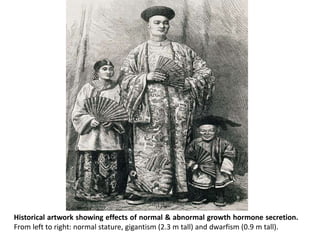
Gigantism
This occurs in children when there is excess GH while
epiphyseal cartilages of long bones are still growing, i.e.
before ossification of bones is complete. It is evident mainly
in the bones of the limbs, & affected individuals may grow to
heights of 2.1 to 2.4 m, although body proportions remain
normal
Historical artwork showing effects of normal & abnormal growth hormone secretion.
From left to right: normal stature, gigantism (2.3 m tall) and dwarfism (0.9 m tall).
Acromegaly
This means ‘large extremities’ and occurs in adults when there
is excess GH after ossification is complete. The bones become
abnormally thick and there is thickening of the soft tissues.
These changes are most noticeable as coarse facial features
(especially excessive growth of the lower jaw), an enlarged
tongue and excessively large hands and feet.
Hyperprolactinaemia
This is caused by a tumour that secretes large amounts
of prolactin. It causes galactorrhoea (inappropriate milk
secretion), amenorrhoea (cessation of menstruation) &
sterility in women and impotence in men.
Disorders of the Posterior Pituitary
Diabetes insipidus
This is a relatively rare condition usually caused by
hyposecretion of ADH due to damage to the hypothalamus by,
for example, trauma, tumour or encephalitis. Occasionally it
occurs when the renal tubules do not respond to ADH. Water
reabsorption by the renal tubules is impaired, leading to
excretion of excessive amounts of dilute urine, often more
than 10 litres daily, causing dehydration, extreme thirst
(polydipsia). Water balance is disturbed unless fluid intake is
greatly increased to compensate for excess losses.
Disorders of
the thyroid
gland
These fall into three main categories:
abnormal secretion of thyroid hormones (T3 and T4)
– hyperthyroidism
– hypothyroidism
goitre – enlargement of the thyroid gland
tumours.
Abnormal thyroid function may arise not only from
thyroid disease but also from disorders of the pituitary or
hypothalamus; in addition, insufficient dietary iodine causes
deficiency in thyroid hormone production.
Hyperthyroidism
This syndrome, also known as thyrotoxicosis, arises
as the body tissues are exposed to excessive levels of T3 &
T4. The main effects are due to increased basal metabolic
rate.
The main causes are:
Graves’ disease
toxic nodular goitre
adenoma
Graves’ disease (Graves’ thyroiditis)
It affects more women than men & may occur at any age,
being most common between the ages of 30 & 50 years. It is an
autoimmune disorder in which an antibody that mimics the effects
of TSH is produced, causing:
increased release of T3 & T4, signs of hyperthyroidism
goitre as the antibody stimulates thyroid growth
exophthalmos in many cases.
Exophthalmos
This is protrusion of the eyeballs that gives the appearance
of staring, which is due to the deposition of excess fat and fibrous
tissue behind the eyes; it is often present in Graves’ disease. In severe
cases the eyelids become retracted & may not completely cover the
eyes during blinking & sleep, leading to drying of the conjunctiva &
predisposing to infection.
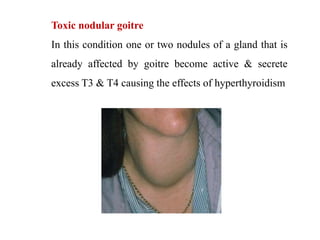
Toxic nodular goitre
In this condition one or two nodules of a gland that is
already affected by goitre become active & secrete
excess T3 & T4 causing the effects of hyperthyroidism
Hypothyroidism
This occurs when there is insufficient T3 & T4
secretion causing:
congenital hypothyroidism in children
myxoedema in adults.
Congenital hypothyroidism
Previously called cretinism, this is a profound deficiency or
absence of thyroid hormones. Unless treatment begins early
in life, mental impairment is permanent and the individual
typically has disproportionately short limbs, a large
protruding tongue, coarse dry skin, poor abdominal muscle
tone and, often, an umbilical hernia.
Myxoedema
Prevalent in the elderly & five times more common in females
than males. Deficiency of T3 & T4 in adults results in an abnormally low
metabolic rate. There may be accumulation of polysaccharide substances
in the subcutaneous tissues, especially of the face.
Autoimmune thyroiditis
The most common cause of acquired hypothyroidism is
Hashimoto’s disease. It is more common in women than men, like Graves’
disease, an organ-specific autoimmune condition. Autoantibodies that
react with thyroglobulin & thyroid gland cells develop & prevent
synthesis and release of thyroid hormones causing hypothyroidism.
Disorders
of the
Parathyroid
Glands
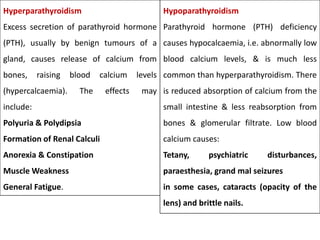
Hyperparathyroidism
Excess secretion of parathyroid hormone
(PTH), usually by benign tumours of a
gland, causes release of calcium from
bones, raising blood calcium levels
(hypercalcaemia). The effects may
include:
Polyuria & Polydipsia
Formation of Renal Calculi
Anorexia & Constipation
Muscle Weakness
General Fatigue.
Hypoparathyroidism
Parathyroid hormone (PTH) deficiency
causes hypocalcaemia, i.e. abnormally low
blood calcium levels, & is much less
common than hyperparathyroidism. There
is reduced absorption of calcium from the
small intestine & less reabsorption from
bones & glomerular filtrate. Low blood
calcium causes:
Tetany, psychiatric disturbances,
paraesthesia, grand mal seizures
in some cases, cataracts (opacity of the
lens) and brittle nails.
Disorders of
the adrenal
cortex
Hypersecretion of glucocorticoids (Cushing’s syndrome)
Cortisol is the main glucocorticoid hormone secreted by the adrenal cortex.
Causes of hypersecretion include:
‱Hormone-secreting adrenal tumours that may be benign or malignant
‱Hypersecretion of adrenocorticotrophic hormone (ACTH) by the anterior
pituitary.
‱Abnormal secretion of ACTH by a non-pituitary tumour, e.g. Bronchial or
pancreatic tumour.
‱Prolonged therapeutic use of ACTH or glucocorticoids, e.g. Prednisolone,
in high doses.
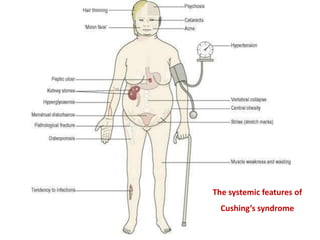
The systemic features of
Cushing’s syndrome
Hyposecretion of glucocorticoids
Inadequate secretion of cortisol causes
diminished gluconeogenesis, low blood glucose levels,
muscle weakness & pallor. It may be primary, i.e. due
to disease of the adrenal cortex, or secondary due to
deficiency of ACTH from the anterior pituitary.
Hypersecretion of mineralocorticoids
Excess aldosterone affects kidney function, with
consequences elsewhere: excessive reabsorption of NaCl & H2O,
causing increased blood volume & Hypertension excessive excretion
of potassium, causing hypokalaemia, which leads to cardiac
arrhythmias, alkalosis, syncope & muscle weakness.
Primary hyperaldosteronism (Conn’s syndrome)
This is due to an excessive secretion of mineralocorticoids,
independent of the renin–angiotensin–aldosterone system. It is
usually caused by a tumour affecting only one adrenal gland.
Secondary hyperaldosteronism
This is caused by overstimulation of
normal glands by the excessively high blood
levels of renin & angiotensin that result from
low renal perfusion or low blood sodium.
Hyposecretion of mineralocorticoids
Hypoaldosteronism results in failure of the kidneys
to regulate sodium, potassium and water excretion, leading
to:
blood sodium deficiency (hyponatraemia) & potassium
excess (hyperkalaemia) dehydration, low blood volume
& low blood pressure.
Chronic adrenocortical insufficiency (Addison’s disease)
This is due to hyposecretion of glucocorticoid &
mineralocorticoid hormones. The most common causes are
development of autoantibodies to cortical cells, metastatic
tumours & infections.
The most important effects are:
Muscle weakness & wasting.
Gastrointestinal disturbances, e.g. Vomiting, diarrhoea, anorexia.
Increased pigmentation of the skin, especially of exposed areas,
due to excess ACTH & the related.
Melanin-stimulating hormone secreted by the anterior pituitary.
Listlessness & tiredness.
Hypoglycaemia
Mental confusion
Menstrual disturbances and loss of body hair in women
Electrolyte imbalance, including hyponatraemia, low blood
chloride levels & hyperkalaemia
Chronic dehydration, low blood volume & hypotension.
Disorders of
the Adrenal
Medulla
Tumours
Hormone-secreting tumours are the main abnormality. The effects
of excess adrenaline (epinephrine) & noradrenaline
(norepinephrine) include:
Hypertension, often associated with arteriosclerosis &
cerebral haemorrhage
Weight loss, Nervousness, Headache
Excessive sweating & alternate flushing & blanching of
the skin
Hyperglycaemia & glycosuria.
Phaeochromocytoma:
This is usually a benign tumour, occurring in one or both glands.
The secretion of hormones may be constantly elevated or in intermittent
bursts, often precipitated by raised intra-abdominal pressure,
e.g. coughing or defaecation.
Neuroblastoma:
This is a rare & malignant tumour, occurring in infants &
children under 15 years of age. Tumours that develop early tend to be
highly malignant but in this condition there may be spontaneous
regression.
Disorders
of the
Pancreatic
Islets
Diabetes mellitus (DM)
This is the most common endocrine disorder
& usually occurs when there is deficiency or
absence of insulin or, rarely, impairment of insulin
activity (insulin resistance).
Type I diabetes mellitus/ Insulin-dependent diabetes mellitus
(IDDM)
This occurs mainly in children & young adults; the onset is
usually sudden & can be life threatening. There is severe
deficiency or absence of insulin secretion due to destruction of ÎČ-
islet cells of the pancreas. Treatment with injections of insulin is
required. The exact cause remains unknown, although, in most
people, there is evidence of an autoimmune mechanism involving
autoantibodies that destroy the ÎČ-islet cells. Genetic predisposition
& environmental factors, including viral infections, are also
implicated.
Type II diabetes mellitus
Previously known as non-insulin-dependent diabetes
mellitus (NIDDM), this is the most common form of diabetes,
accounting for about 90% of cases. The causes are multifactorial
& predisposing factors include:
Obesity
Sedentary lifestyle
Increasing age: affecting middle-aged and older people
Genetic factors.

Endocrine System Disorders

  • 1.
    Disorders of Endocrine Glands Mr.Mayur Gaikar Assistant Professor Department of Pharmacology College of Pharmacy (For Women), Chincholi, Nashik.
  • 2.
    Disorders of thepituitary gland Hypersecretion of anterior pituitary hormones Gigantism & acromegaly: The most common cause is prolonged hypersecretion of growth hormone (GH), usually by a hormone secreting pituitary tumour. The conditions are only occasionally due to excess growth hormone releasing hormone (GHRH) secreted by the hypothalamus.
  • 3.
    Hyposecretion of otherpituitary hormones of both the anterior & posterior lobes damage to the optic nerves, causing visual disturbances. The effects of excess GH include: ‱Excessive growth of bones. ‱Enlargement of internal organs. ‱Formation of excess connective tissue enlargement of the heart & raised blood pressure reduced glucose tolerance & a predisposition to diabetes mellitus.
  • 4.
    Gigantism This occurs inchildren when there is excess GH while epiphyseal cartilages of long bones are still growing, i.e. before ossification of bones is complete. It is evident mainly in the bones of the limbs, & affected individuals may grow to heights of 2.1 to 2.4 m, although body proportions remain normal
  • 5.
    Historical artwork showingeffects of normal & abnormal growth hormone secretion. From left to right: normal stature, gigantism (2.3 m tall) and dwarfism (0.9 m tall).
  • 6.
    Acromegaly This means ‘largeextremities’ and occurs in adults when there is excess GH after ossification is complete. The bones become abnormally thick and there is thickening of the soft tissues. These changes are most noticeable as coarse facial features (especially excessive growth of the lower jaw), an enlarged tongue and excessively large hands and feet.
  • 7.
    Hyperprolactinaemia This is causedby a tumour that secretes large amounts of prolactin. It causes galactorrhoea (inappropriate milk secretion), amenorrhoea (cessation of menstruation) & sterility in women and impotence in men.
  • 8.
    Disorders of thePosterior Pituitary Diabetes insipidus This is a relatively rare condition usually caused by hyposecretion of ADH due to damage to the hypothalamus by, for example, trauma, tumour or encephalitis. Occasionally it occurs when the renal tubules do not respond to ADH. Water reabsorption by the renal tubules is impaired, leading to excretion of excessive amounts of dilute urine, often more than 10 litres daily, causing dehydration, extreme thirst (polydipsia). Water balance is disturbed unless fluid intake is greatly increased to compensate for excess losses.
  • 9.
  • 10.
    These fall intothree main categories: abnormal secretion of thyroid hormones (T3 and T4) – hyperthyroidism – hypothyroidism goitre – enlargement of the thyroid gland tumours. Abnormal thyroid function may arise not only from thyroid disease but also from disorders of the pituitary or hypothalamus; in addition, insufficient dietary iodine causes deficiency in thyroid hormone production.
  • 11.
    Hyperthyroidism This syndrome, alsoknown as thyrotoxicosis, arises as the body tissues are exposed to excessive levels of T3 & T4. The main effects are due to increased basal metabolic rate. The main causes are: Graves’ disease toxic nodular goitre adenoma
  • 12.
    Graves’ disease (Graves’thyroiditis) It affects more women than men & may occur at any age, being most common between the ages of 30 & 50 years. It is an autoimmune disorder in which an antibody that mimics the effects of TSH is produced, causing: increased release of T3 & T4, signs of hyperthyroidism goitre as the antibody stimulates thyroid growth exophthalmos in many cases.
  • 13.
    Exophthalmos This is protrusionof the eyeballs that gives the appearance of staring, which is due to the deposition of excess fat and fibrous tissue behind the eyes; it is often present in Graves’ disease. In severe cases the eyelids become retracted & may not completely cover the eyes during blinking & sleep, leading to drying of the conjunctiva & predisposing to infection.
  • 14.
    Toxic nodular goitre Inthis condition one or two nodules of a gland that is already affected by goitre become active & secrete excess T3 & T4 causing the effects of hyperthyroidism
  • 15.
    Hypothyroidism This occurs whenthere is insufficient T3 & T4 secretion causing: congenital hypothyroidism in children myxoedema in adults. Congenital hypothyroidism Previously called cretinism, this is a profound deficiency or absence of thyroid hormones. Unless treatment begins early in life, mental impairment is permanent and the individual typically has disproportionately short limbs, a large protruding tongue, coarse dry skin, poor abdominal muscle tone and, often, an umbilical hernia.
  • 16.
    Myxoedema Prevalent in theelderly & five times more common in females than males. Deficiency of T3 & T4 in adults results in an abnormally low metabolic rate. There may be accumulation of polysaccharide substances in the subcutaneous tissues, especially of the face. Autoimmune thyroiditis The most common cause of acquired hypothyroidism is Hashimoto’s disease. It is more common in women than men, like Graves’ disease, an organ-specific autoimmune condition. Autoantibodies that react with thyroglobulin & thyroid gland cells develop & prevent synthesis and release of thyroid hormones causing hypothyroidism.
  • 17.
  • 18.
    Hyperparathyroidism Excess secretion ofparathyroid hormone (PTH), usually by benign tumours of a gland, causes release of calcium from bones, raising blood calcium levels (hypercalcaemia). The effects may include: Polyuria & Polydipsia Formation of Renal Calculi Anorexia & Constipation Muscle Weakness General Fatigue. Hypoparathyroidism Parathyroid hormone (PTH) deficiency causes hypocalcaemia, i.e. abnormally low blood calcium levels, & is much less common than hyperparathyroidism. There is reduced absorption of calcium from the small intestine & less reabsorption from bones & glomerular filtrate. Low blood calcium causes: Tetany, psychiatric disturbances, paraesthesia, grand mal seizures in some cases, cataracts (opacity of the lens) and brittle nails.
  • 19.
  • 20.
    Hypersecretion of glucocorticoids(Cushing’s syndrome) Cortisol is the main glucocorticoid hormone secreted by the adrenal cortex. Causes of hypersecretion include: ‱Hormone-secreting adrenal tumours that may be benign or malignant ‱Hypersecretion of adrenocorticotrophic hormone (ACTH) by the anterior pituitary. ‱Abnormal secretion of ACTH by a non-pituitary tumour, e.g. Bronchial or pancreatic tumour. ‱Prolonged therapeutic use of ACTH or glucocorticoids, e.g. Prednisolone, in high doses.
  • 21.
    The systemic featuresof Cushing’s syndrome
  • 22.
    Hyposecretion of glucocorticoids Inadequatesecretion of cortisol causes diminished gluconeogenesis, low blood glucose levels, muscle weakness & pallor. It may be primary, i.e. due to disease of the adrenal cortex, or secondary due to deficiency of ACTH from the anterior pituitary.
  • 23.
    Hypersecretion of mineralocorticoids Excessaldosterone affects kidney function, with consequences elsewhere: excessive reabsorption of NaCl & H2O, causing increased blood volume & Hypertension excessive excretion of potassium, causing hypokalaemia, which leads to cardiac arrhythmias, alkalosis, syncope & muscle weakness. Primary hyperaldosteronism (Conn’s syndrome) This is due to an excessive secretion of mineralocorticoids, independent of the renin–angiotensin–aldosterone system. It is usually caused by a tumour affecting only one adrenal gland.
  • 24.
    Secondary hyperaldosteronism This iscaused by overstimulation of normal glands by the excessively high blood levels of renin & angiotensin that result from low renal perfusion or low blood sodium.
  • 25.
    Hyposecretion of mineralocorticoids Hypoaldosteronismresults in failure of the kidneys to regulate sodium, potassium and water excretion, leading to: blood sodium deficiency (hyponatraemia) & potassium excess (hyperkalaemia) dehydration, low blood volume & low blood pressure.
  • 26.
    Chronic adrenocortical insufficiency(Addison’s disease) This is due to hyposecretion of glucocorticoid & mineralocorticoid hormones. The most common causes are development of autoantibodies to cortical cells, metastatic tumours & infections.
  • 27.
    The most importanteffects are: Muscle weakness & wasting. Gastrointestinal disturbances, e.g. Vomiting, diarrhoea, anorexia. Increased pigmentation of the skin, especially of exposed areas, due to excess ACTH & the related. Melanin-stimulating hormone secreted by the anterior pituitary. Listlessness & tiredness. Hypoglycaemia Mental confusion Menstrual disturbances and loss of body hair in women Electrolyte imbalance, including hyponatraemia, low blood chloride levels & hyperkalaemia Chronic dehydration, low blood volume & hypotension.
  • 28.
  • 29.
    Tumours Hormone-secreting tumours arethe main abnormality. The effects of excess adrenaline (epinephrine) & noradrenaline (norepinephrine) include: Hypertension, often associated with arteriosclerosis & cerebral haemorrhage Weight loss, Nervousness, Headache Excessive sweating & alternate flushing & blanching of the skin Hyperglycaemia & glycosuria.
  • 30.
    Phaeochromocytoma: This is usuallya benign tumour, occurring in one or both glands. The secretion of hormones may be constantly elevated or in intermittent bursts, often precipitated by raised intra-abdominal pressure, e.g. coughing or defaecation. Neuroblastoma: This is a rare & malignant tumour, occurring in infants & children under 15 years of age. Tumours that develop early tend to be highly malignant but in this condition there may be spontaneous regression.
  • 31.
  • 32.
    Diabetes mellitus (DM) Thisis the most common endocrine disorder & usually occurs when there is deficiency or absence of insulin or, rarely, impairment of insulin activity (insulin resistance).
  • 33.
    Type I diabetesmellitus/ Insulin-dependent diabetes mellitus (IDDM) This occurs mainly in children & young adults; the onset is usually sudden & can be life threatening. There is severe deficiency or absence of insulin secretion due to destruction of ÎČ- islet cells of the pancreas. Treatment with injections of insulin is required. The exact cause remains unknown, although, in most people, there is evidence of an autoimmune mechanism involving autoantibodies that destroy the ÎČ-islet cells. Genetic predisposition & environmental factors, including viral infections, are also implicated.
  • 34.
    Type II diabetesmellitus Previously known as non-insulin-dependent diabetes mellitus (NIDDM), this is the most common form of diabetes, accounting for about 90% of cases. The causes are multifactorial & predisposing factors include: Obesity Sedentary lifestyle Increasing age: affecting middle-aged and older people Genetic factors.