+
Common Core State
Standards
Candice McQueen, Ph.D.
Lipscomb University
Senior Vice President & Dean, College of Education
+
Thoughts to consider . . .
Today’s kindergarten students will graduate high
school in 2026 and college in 2030.
 What do you think will be different about the
workplace?
 What skills do you think will be more important for
student success?
+
What are the
Common Core State
Standards?
 A set of clear standards for
Math and English
Language Arts
 Expectations for what
students should know and
be able to do
 Adopted by Tennessee and
43 other states, four
territories, and the District of
Columbia
+
What is the goal of the
CCSS?
 “The CCSS will strengthen
teaching and learning with
standards that are focused,
coherent, clear, and rigorous.”
(www.tncore.org)
 “To ensure all students are ready
for success after high school, the
Common Core State Standards
establish clear, consistent
guidelines for what every
student should know and be able
to do in math and English
Language Arts from Kindergarten
through 12th grade.”
(www.corestandards.org)
+
What are the goals of
the CCSS in Math?
 “The CCSS provides the foundation
for the development of more focused
and coherent instructional materials
and assessments that measure
students’ understanding of
mathematical concepts and
acquisition of fundamental
reasoning habits, in addition to
their fluency with skills. Most
importantly, the CCSS will enable
teachers and education leaders to
focus on improving teaching and
learning, which is critical to ensuring
that all students have access to a
high-quality mathematics program
and the support that they need to be
successful.”
--A joint public statement of the National Council of
Teachers of Mathematics, the National Council of
Supervisors of Mathematics, the Association of State
Supervisors of Mathematics, and the Association of
Mathematics Teacher Educators
+
What does the Math
CCSS emphasize?
Mathematical thinking
Skills-based learning
Concept-driven tasks
Real-world problem-
solving
Organization across
grades
+What are the goals of
the CCSS in English
Language Arts?
 “The Common Core asks students to read stories and
literature, as well as more complex texts that provide
facts and background knowledge in areas such as
science and social studies. Students will be challenged
and asked questions that push them to refer back to
what they’ve read. This stresses critical-thinking,
problem-solving, and analytical skills that are
required for success in college, career, and life.”
(www.corestandards.org)
 “Teachers who immerse their students in rich
textual environments, require increasing
amounts of reading, and help students choose
ever more challenging texts will address rigor as
it is defined by the CCSS. This means keeping
students at the center, motivating them to
continually develop as writers and readers, and
engaging them in literacy projects that are
relevant to their lives. When students feel
personal connections, they are much more
willing to wrestle with complex
topics/texts/questions.”
--Sarah Brown Wessling, high school English teacher and
2010 National Teacher of the Year (excerpt from
Supporting Students in a Time of Core Standards, NCTE)
+
What does the CCSS
ELA emphasize?
 Reading, writing, language,
speaking/listening, and
research skills
 Text-based questioning and
evidence
 Reading to learn
 Literature and content-rich
nonfiction
 Problem-solving and analytical
practice
 Organization across grades
+
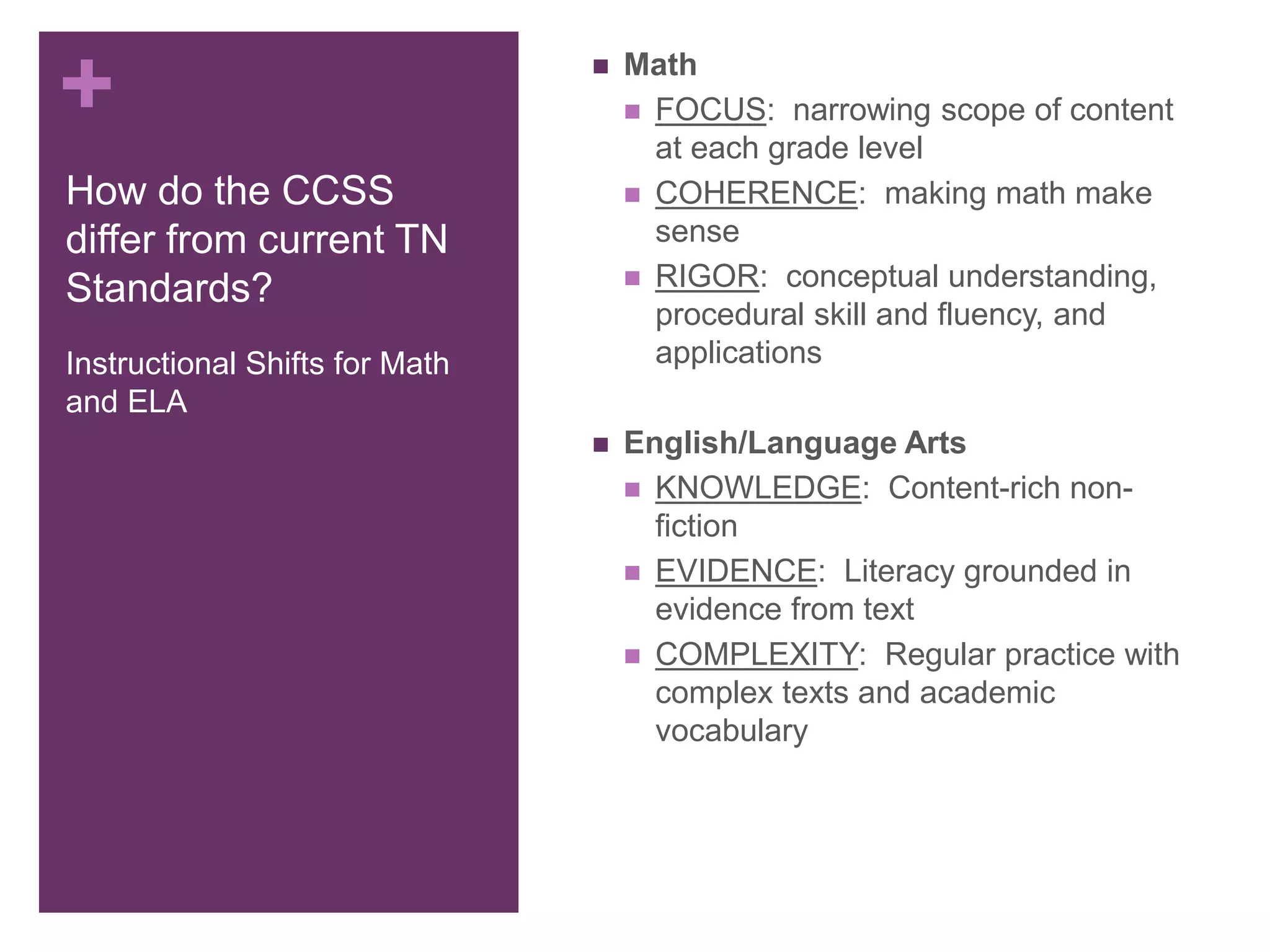
How do the CCSS
differ from current TN
Standards?
 Math
 FOCUS: narrowing scope of content
at each grade level
 COHERENCE: making math make
sense
 RIGOR: conceptual understanding,
procedural skill and fluency, and
applications
 English/Language Arts
 KNOWLEDGE: Content-rich non-
fiction
 EVIDENCE: Literacy grounded in
evidence from text
 COMPLEXITY: Regular practice with
complex texts and academic
vocabulary
Instructional Shifts for Math
and ELA
+
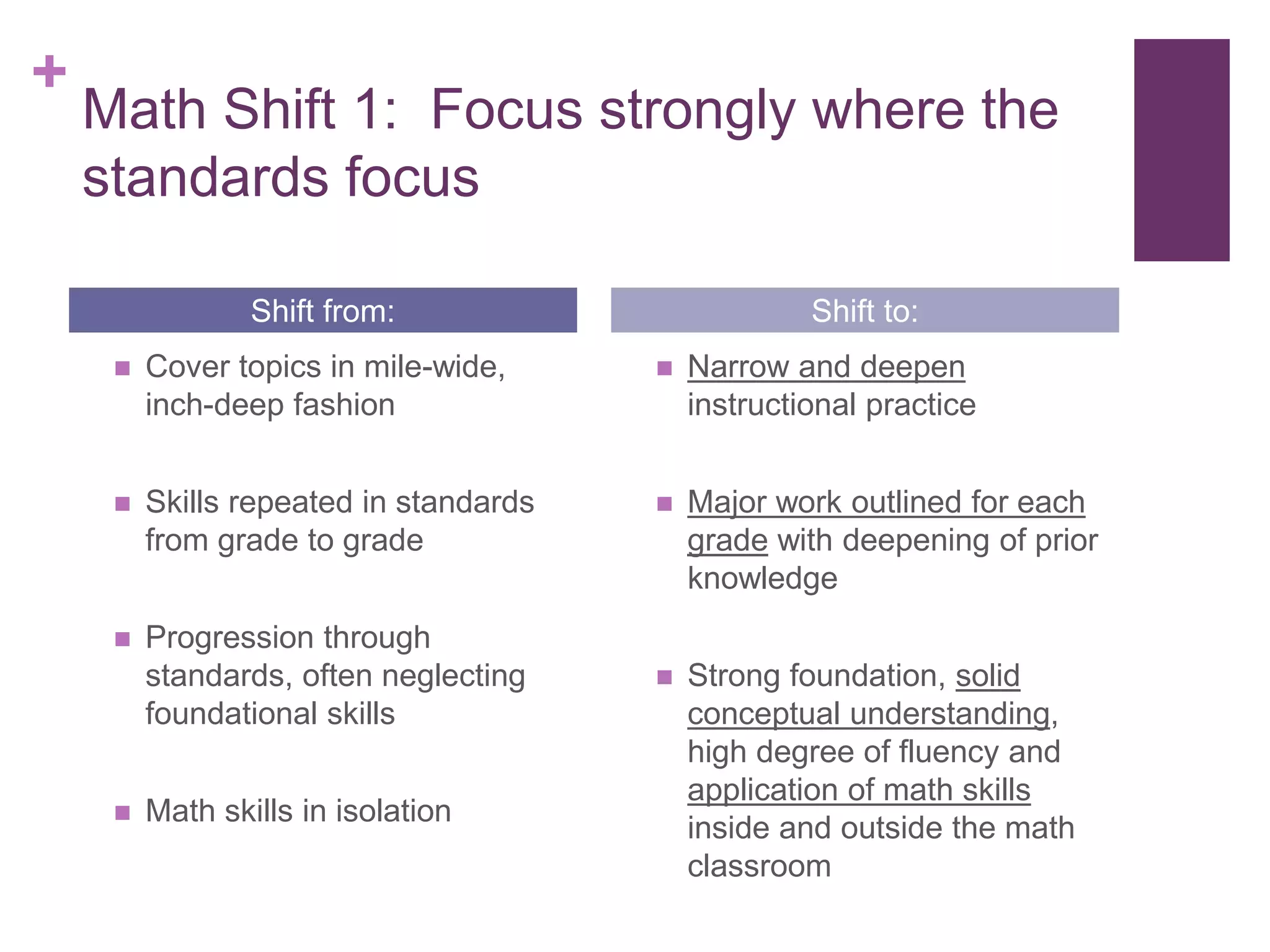
Math Shift 1: Focus strongly where the
standards focus
 Cover topics in mile-wide,
inch-deep fashion
 Skills repeated in standards
from grade to grade
 Progression through
standards, often neglecting
foundational skills
 Math skills in isolation
 Narrow and deepen
instructional practice
 Major work outlined for each
grade with deepening of prior
knowledge
 Strong foundation, solid
conceptual understanding,
high degree of fluency and
application of math skills
inside and outside the math
classroom
Shift from: Shift to:
+
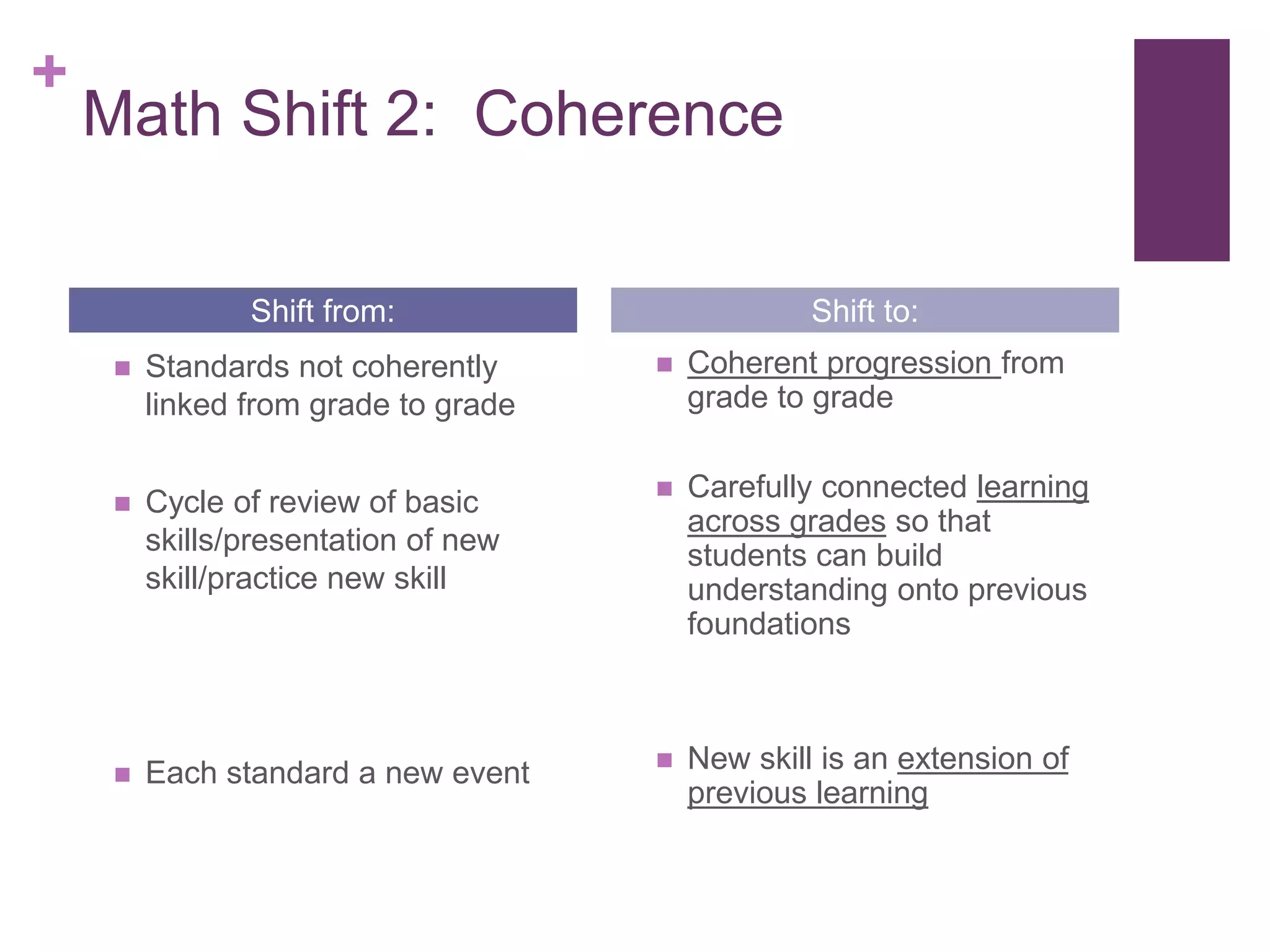
Math Shift 2: Coherence
 Standards not coherently
linked from grade to grade
 Cycle of review of basic
skills/presentation of new
skill/practice new skill
 Each standard a new event
 Coherent progression from
grade to grade
 Carefully connected learning
across grades so that
students can build
understanding onto previous
foundations
 New skill is an extension of
previous learning
Shift from: Shift to:
+
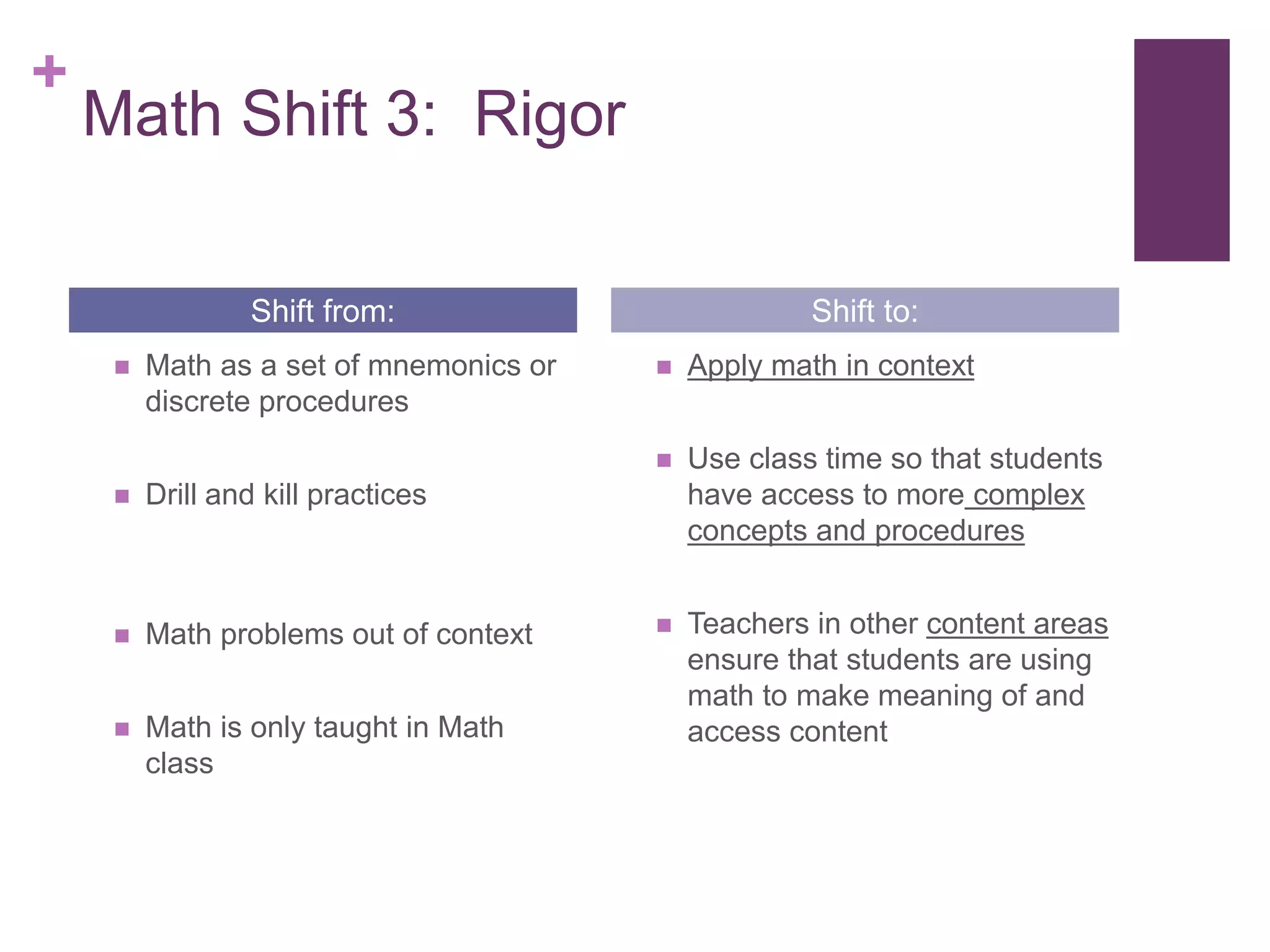
Math Shift 3: Rigor
 Math as a set of mnemonics or
discrete procedures
 Drill and kill practices
 Math problems out of context
 Math is only taught in Math
class
 Apply math in context
 Use class time so that students
have access to more complex
concepts and procedures
 Teachers in other content areas
ensure that students are using
math to make meaning of and
access content
Shift from: Shift to:
+
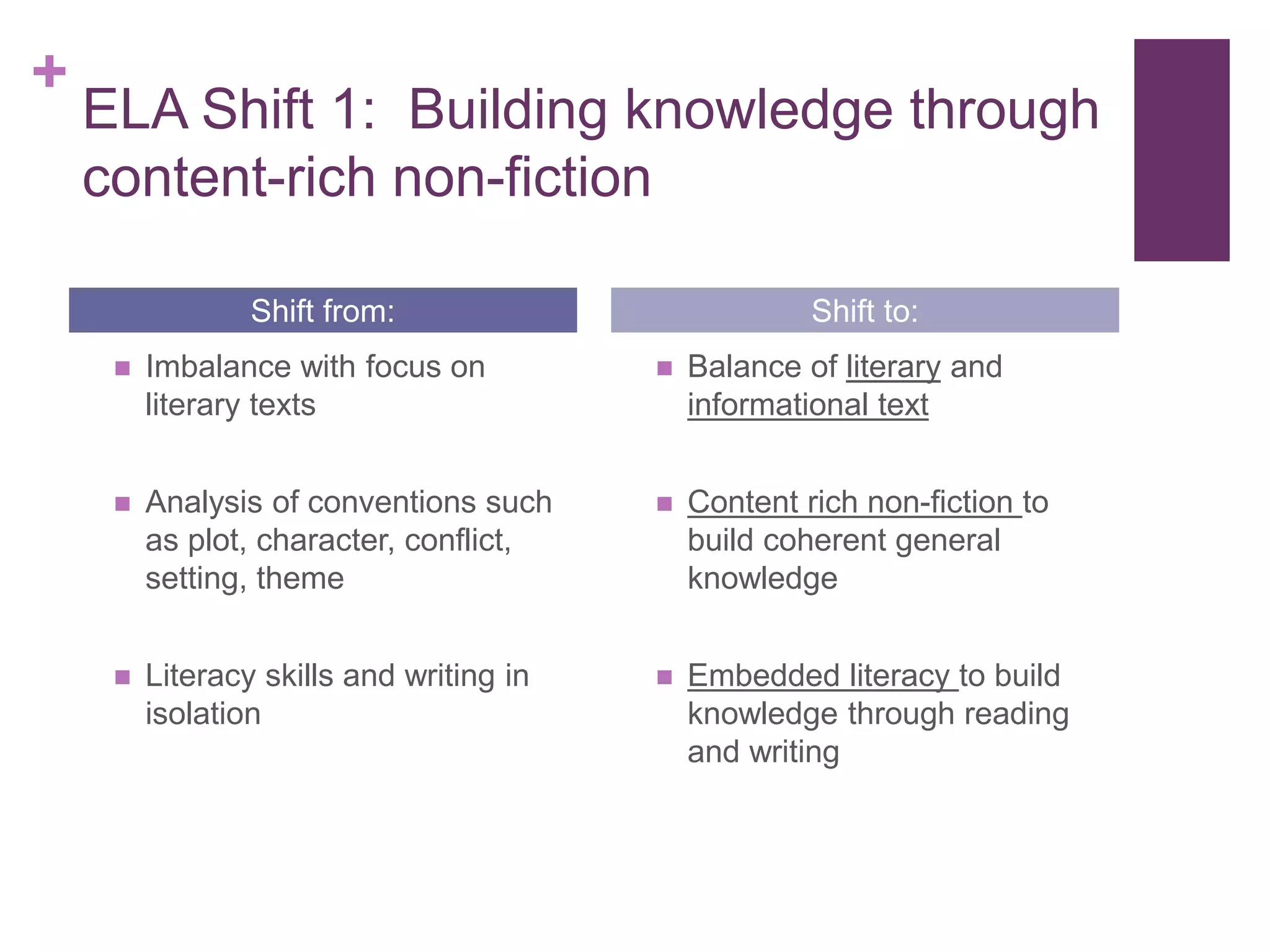
ELA Shift 1: Building knowledge through
content-rich non-fiction
 Imbalance with focus on
literary texts
 Analysis of conventions such
as plot, character, conflict,
setting, theme
 Literacy skills and writing in
isolation
 Balance of literary and
informational text
 Content rich non-fiction to
build coherent general
knowledge
 Embedded literacy to build
knowledge through reading
and writing
Shift from: Shift to:
+
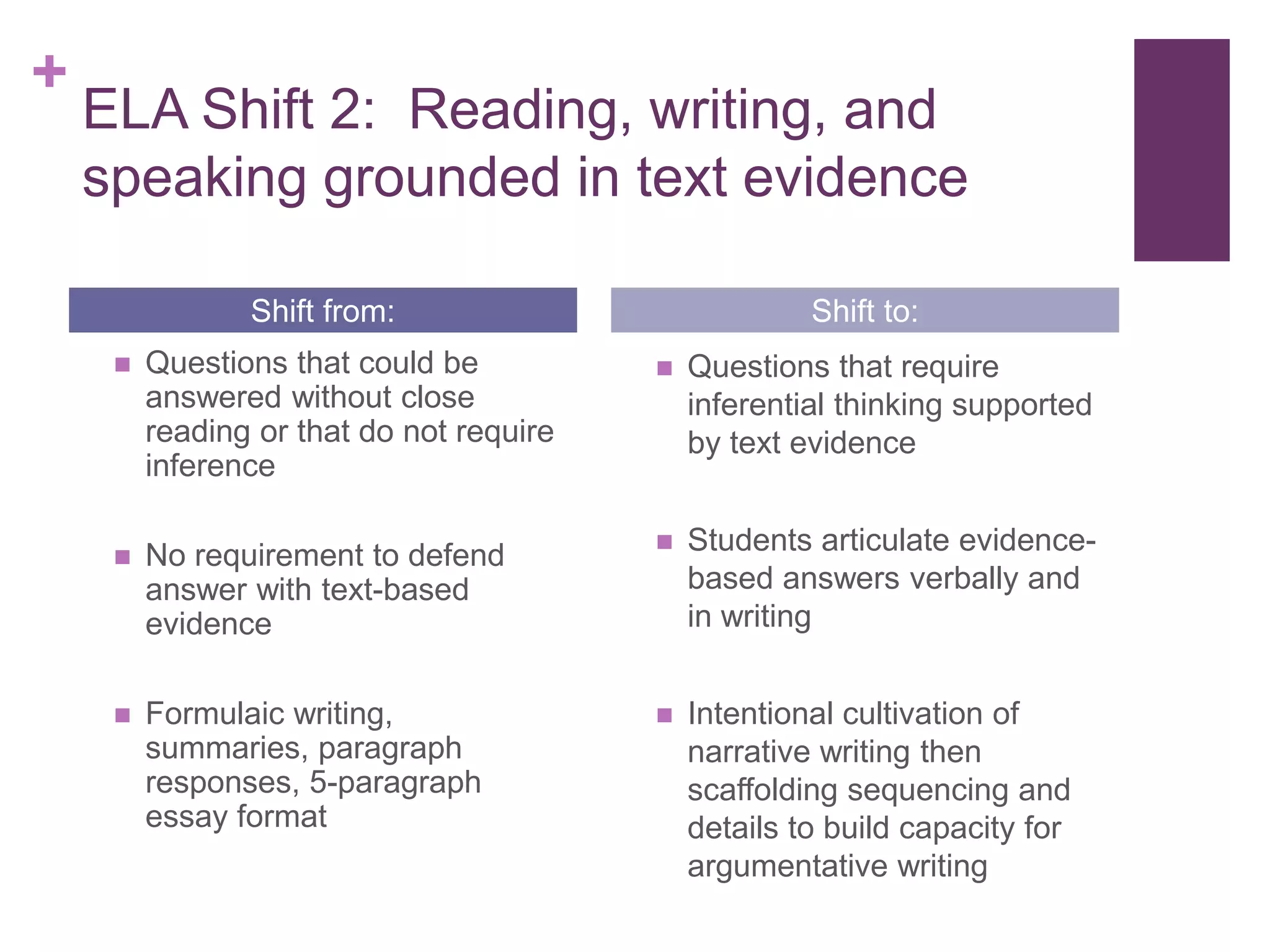
ELA Shift 2: Reading, writing, and
speaking grounded in text evidence
 Questions that could be
answered without close
reading or that do not require
inference
 No requirement to defend
answer with text-based
evidence
 Formulaic writing,
summaries, paragraph
responses, 5-paragraph
essay format
 Questions that require
inferential thinking supported
by text evidence
 Students articulate evidence-
based answers verbally and
in writing
 Intentional cultivation of
narrative writing then
scaffolding sequencing and
details to build capacity for
argumentative writing
Shift from: Shift to:
+
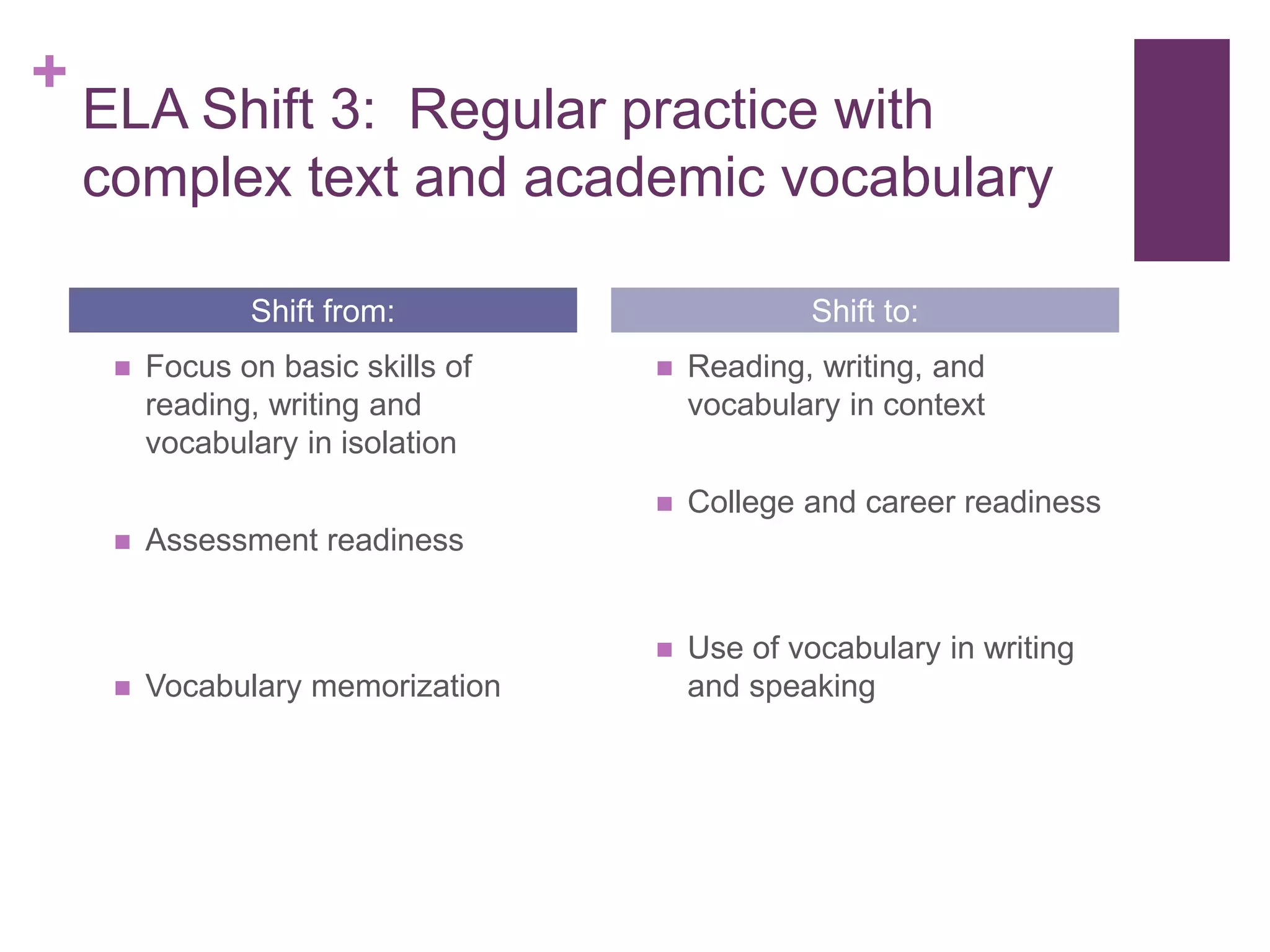
ELA Shift 3: Regular practice with
complex text and academic vocabulary
 Focus on basic skills of
reading, writing and
vocabulary in isolation
 Assessment readiness
 Vocabulary memorization
 Reading, writing, and
vocabulary in context
 College and career readiness
 Use of vocabulary in writing
and speaking
Shift from: Shift to:
+
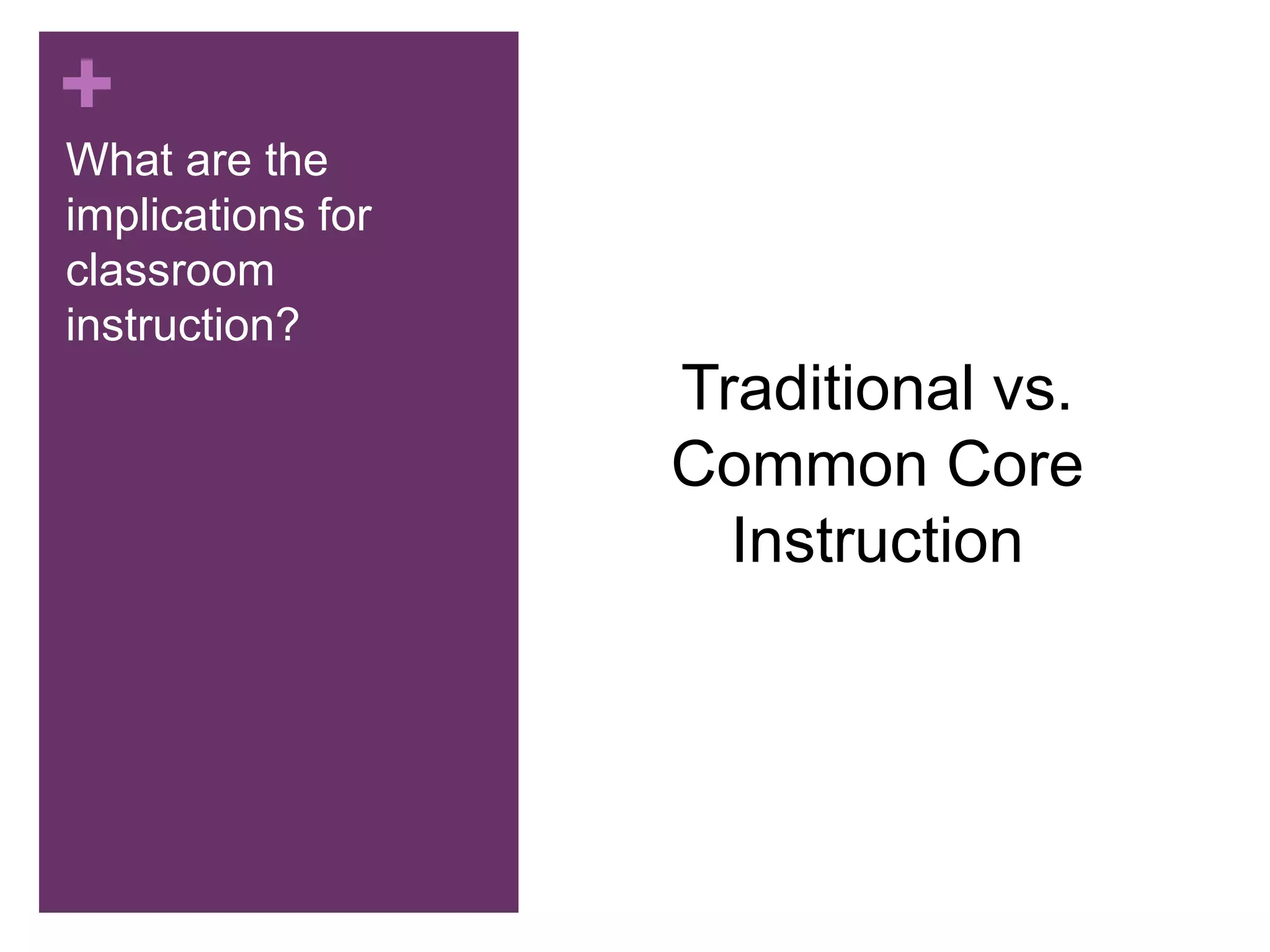
What are the
implications for
classroom
instruction?
Traditional vs.
Common Core
Instruction
+
What are the
implications for
classroom
instruction? Focus on student
learning
 Phillip Eller, 5th Grade Math
+
What are the
implications for
classroom
instruction?
Accountable talk
 Katie Preston, 3rd Grade Social Studies
+
What are the
implications for
classroom
instruction?
Text selection
 Bridget Baron, 10th Grade English
+
What are the
implications for
classroom
instruction?
Authentic tasks
 Cicely Woodard, Algebra 1
+
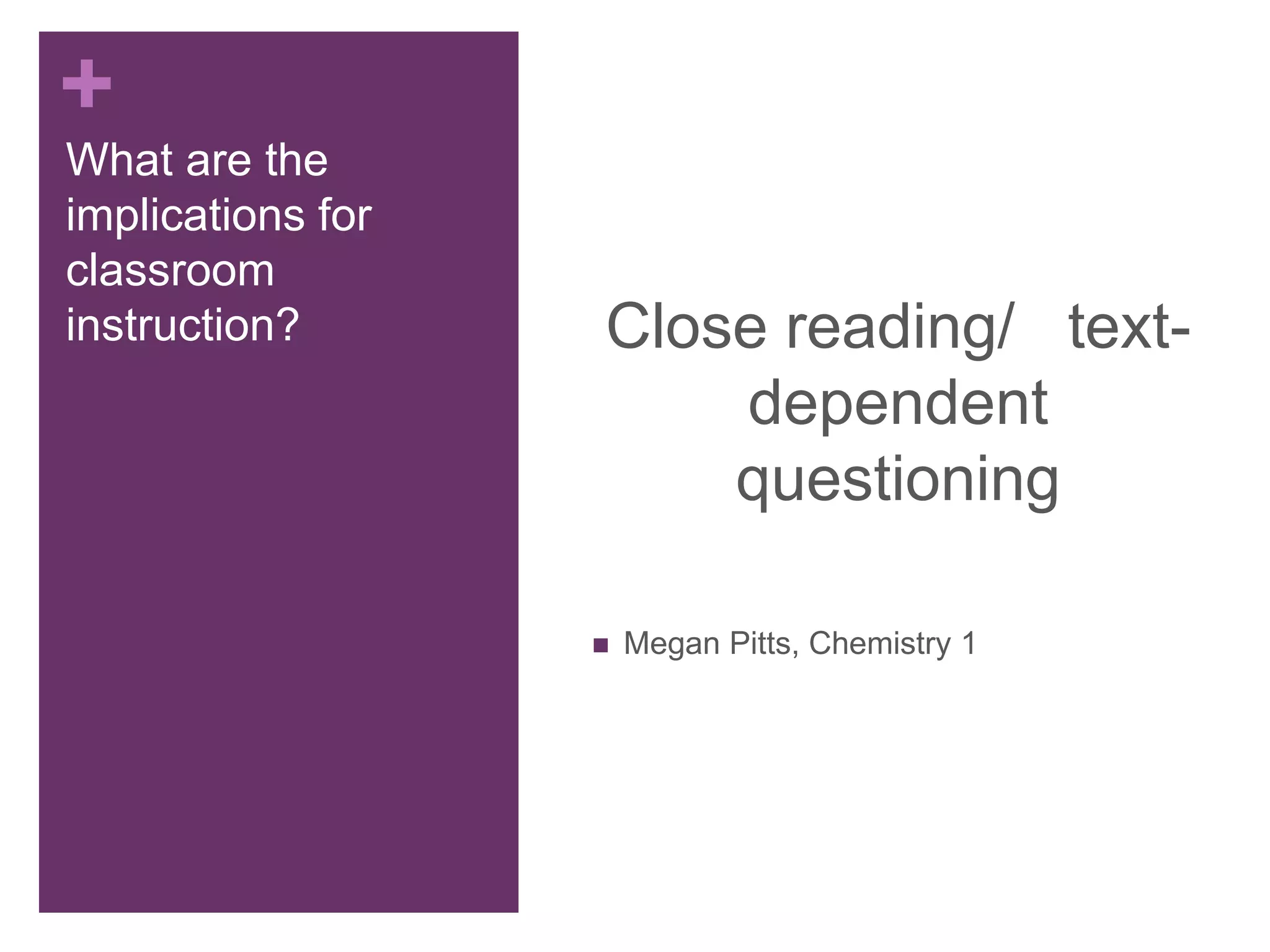
What are the
implications for
classroom
instruction? Close reading/ text-
dependent
questioning
 Megan Pitts, Chemistry 1
+
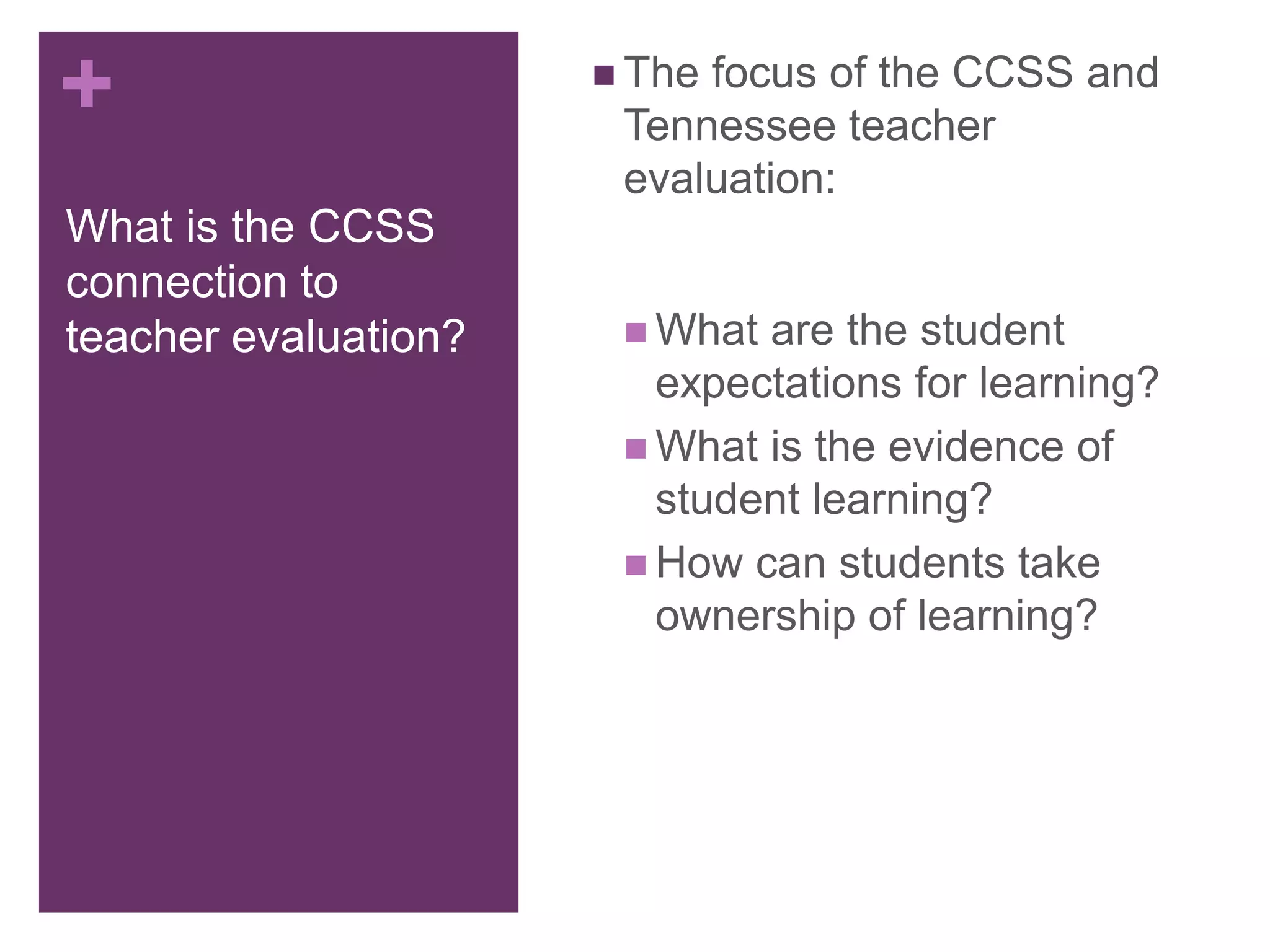
What is the CCSS
connection to
teacher evaluation?
 The focus of the CCSS and
Tennessee teacher
evaluation:
 What are the student
expectations for learning?
 What is the evidence of
student learning?
 How can students take
ownership of learning?
+
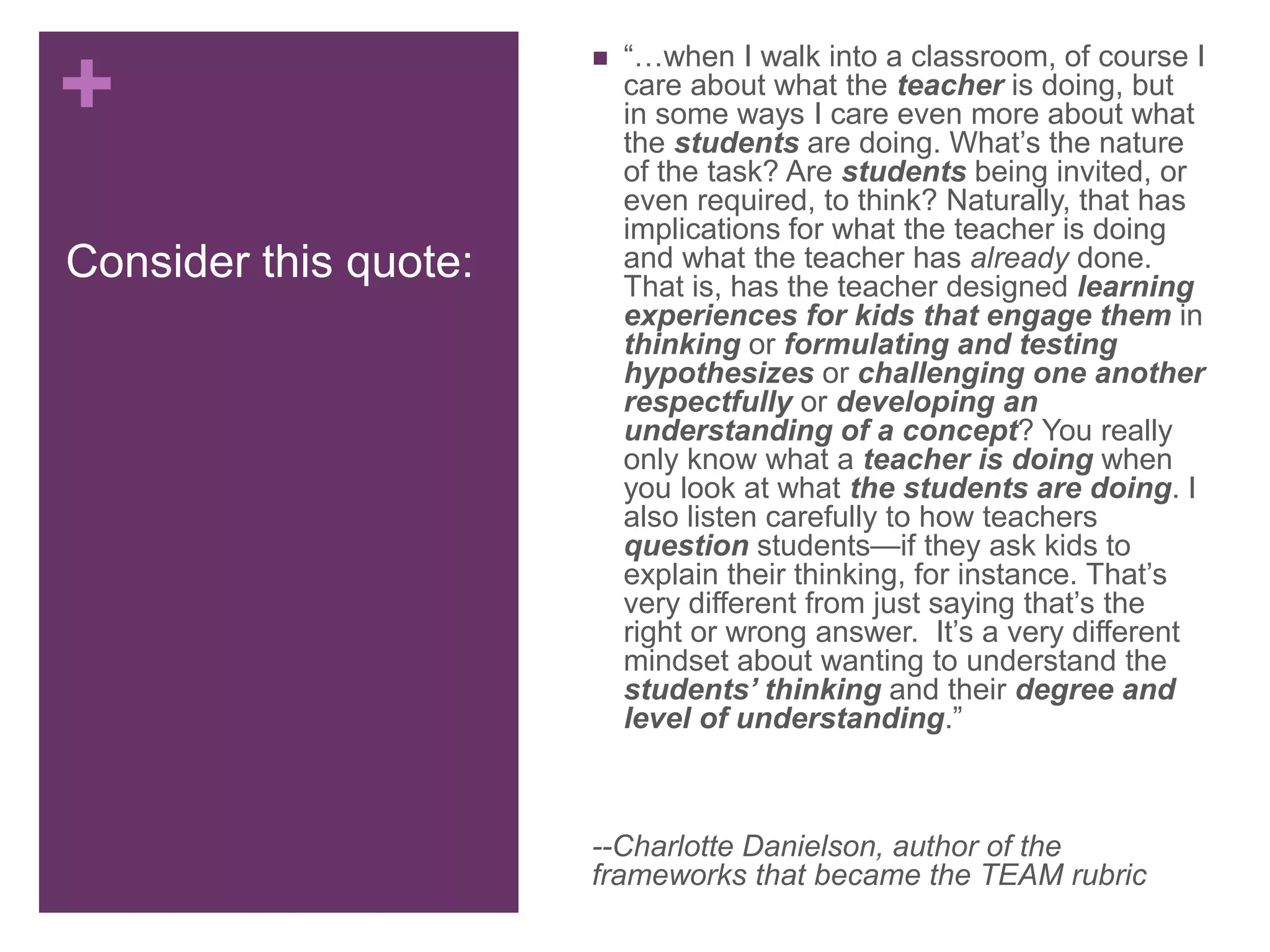
Consider this quote:
 “…when I walk into a classroom, of course I
care about what the teacher is doing, but
in some ways I care even more about what
the students are doing. What’s the nature
of the task? Are students being invited, or
even required, to think? Naturally, that has
implications for what the teacher is doing
and what the teacher has already done.
That is, has the teacher designed learning
experiences for kids that engage them in
thinking or formulating and testing
hypothesizes or challenging one another
respectfully or developing an
understanding of a concept? You really
only know what a teacher is doing when
you look at what the students are doing. I
also listen carefully to how teachers
question students—if they ask kids to
explain their thinking, for instance. That’s
very different from just saying that’s the
right or wrong answer. It’s a very different
mindset about wanting to understand the
students’ thinking and their degree and
level of understanding.”
--Charlotte Danielson, author of the
frameworks that became the TEAM rubric
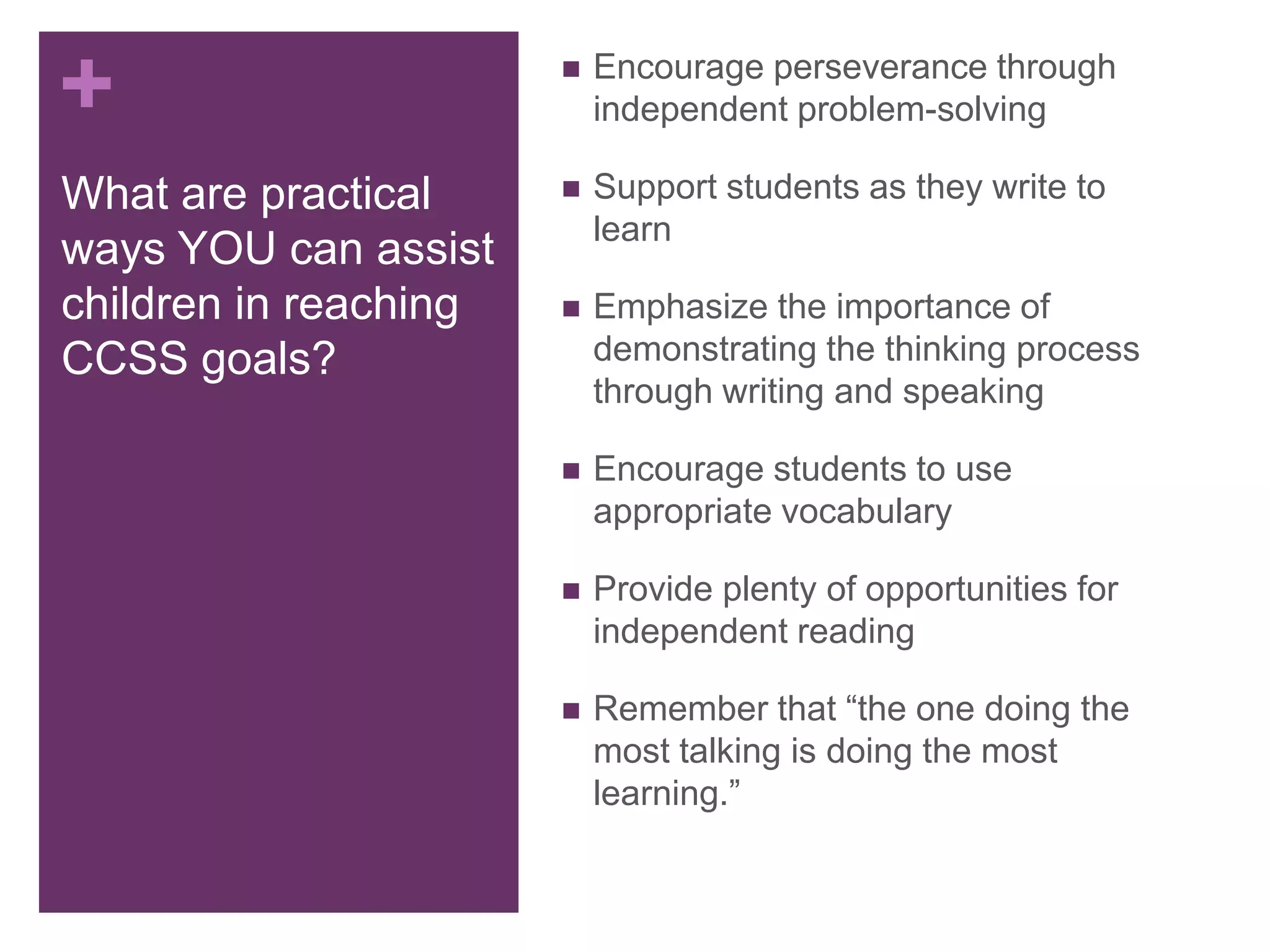
+  Encourage perseverance through
independent problem-solving
 Support students as they write to
learn
 Emphasize the importance of
demonstrating the thinking process
through writing and speaking
 Encourage students to use
appropriate vocabulary
 Provide plenty of opportunities for
independent reading
 Remember that “the one doing the
most talking is doing the most
learning.”
What are practical
ways YOU can assist
children in reaching
CCSS goals?
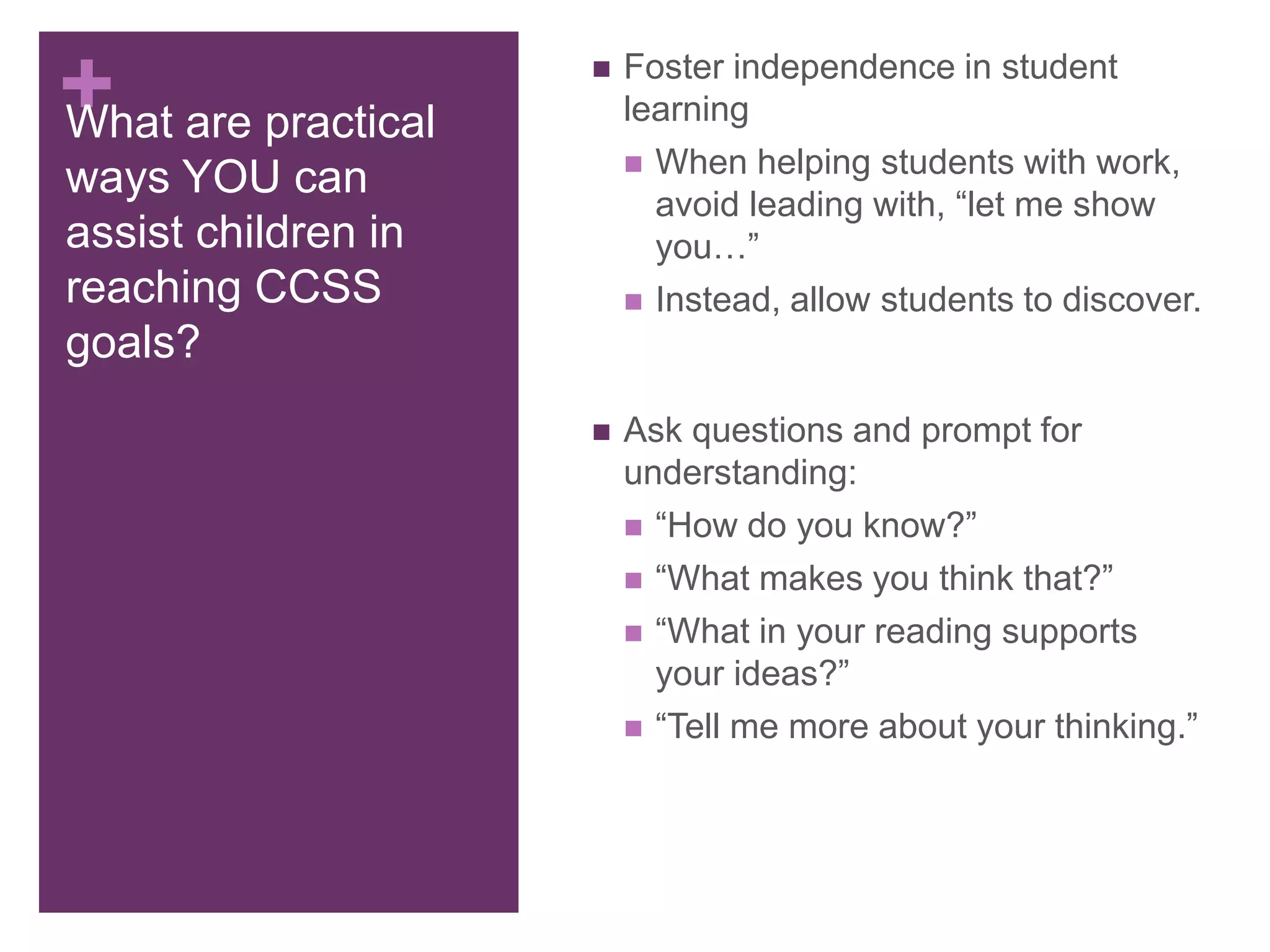
+  Foster independence in student
learning
 When helping students with work,
avoid leading with, “let me show
you…”
 Instead, allow students to discover.
 Ask questions and prompt for
understanding:
 “How do you know?”
 “What makes you think that?”
 “What in your reading supports
your ideas?”
 “Tell me more about your thinking.”
What are practical
ways YOU can
assist children in
reaching CCSS
goals?
+
Video Resources
www.lipscomb.edu/ayers/INVEST

Common Core State Standards

  • 1.
    + Common Core State Standards CandiceMcQueen, Ph.D. Lipscomb University Senior Vice President & Dean, College of Education
  • 2.
    + Thoughts to consider. . . Today’s kindergarten students will graduate high school in 2026 and college in 2030.  What do you think will be different about the workplace?  What skills do you think will be more important for student success?
  • 3.
    + What are the CommonCore State Standards?  A set of clear standards for Math and English Language Arts  Expectations for what students should know and be able to do  Adopted by Tennessee and 43 other states, four territories, and the District of Columbia
  • 4.
    + What is thegoal of the CCSS?  “The CCSS will strengthen teaching and learning with standards that are focused, coherent, clear, and rigorous.” (www.tncore.org)  “To ensure all students are ready for success after high school, the Common Core State Standards establish clear, consistent guidelines for what every student should know and be able to do in math and English Language Arts from Kindergarten through 12th grade.” (www.corestandards.org)
  • 5.
    + What are thegoals of the CCSS in Math?  “The CCSS provides the foundation for the development of more focused and coherent instructional materials and assessments that measure students’ understanding of mathematical concepts and acquisition of fundamental reasoning habits, in addition to their fluency with skills. Most importantly, the CCSS will enable teachers and education leaders to focus on improving teaching and learning, which is critical to ensuring that all students have access to a high-quality mathematics program and the support that they need to be successful.” --A joint public statement of the National Council of Teachers of Mathematics, the National Council of Supervisors of Mathematics, the Association of State Supervisors of Mathematics, and the Association of Mathematics Teacher Educators
  • 6.
    + What does theMath CCSS emphasize? Mathematical thinking Skills-based learning Concept-driven tasks Real-world problem- solving Organization across grades
  • 7.
    +What are thegoals of the CCSS in English Language Arts?  “The Common Core asks students to read stories and literature, as well as more complex texts that provide facts and background knowledge in areas such as science and social studies. Students will be challenged and asked questions that push them to refer back to what they’ve read. This stresses critical-thinking, problem-solving, and analytical skills that are required for success in college, career, and life.” (www.corestandards.org)  “Teachers who immerse their students in rich textual environments, require increasing amounts of reading, and help students choose ever more challenging texts will address rigor as it is defined by the CCSS. This means keeping students at the center, motivating them to continually develop as writers and readers, and engaging them in literacy projects that are relevant to their lives. When students feel personal connections, they are much more willing to wrestle with complex topics/texts/questions.” --Sarah Brown Wessling, high school English teacher and 2010 National Teacher of the Year (excerpt from Supporting Students in a Time of Core Standards, NCTE)
  • 8.
    + What does theCCSS ELA emphasize?  Reading, writing, language, speaking/listening, and research skills  Text-based questioning and evidence  Reading to learn  Literature and content-rich nonfiction  Problem-solving and analytical practice  Organization across grades
  • 9.
    + How do theCCSS differ from current TN Standards?  Math  FOCUS: narrowing scope of content at each grade level  COHERENCE: making math make sense  RIGOR: conceptual understanding, procedural skill and fluency, and applications  English/Language Arts  KNOWLEDGE: Content-rich non- fiction  EVIDENCE: Literacy grounded in evidence from text  COMPLEXITY: Regular practice with complex texts and academic vocabulary Instructional Shifts for Math and ELA
  • 10.
    + Math Shift 1:Focus strongly where the standards focus  Cover topics in mile-wide, inch-deep fashion  Skills repeated in standards from grade to grade  Progression through standards, often neglecting foundational skills  Math skills in isolation  Narrow and deepen instructional practice  Major work outlined for each grade with deepening of prior knowledge  Strong foundation, solid conceptual understanding, high degree of fluency and application of math skills inside and outside the math classroom Shift from: Shift to:
  • 11.
    + Math Shift 2:Coherence  Standards not coherently linked from grade to grade  Cycle of review of basic skills/presentation of new skill/practice new skill  Each standard a new event  Coherent progression from grade to grade  Carefully connected learning across grades so that students can build understanding onto previous foundations  New skill is an extension of previous learning Shift from: Shift to:
  • 12.
    + Math Shift 3:Rigor  Math as a set of mnemonics or discrete procedures  Drill and kill practices  Math problems out of context  Math is only taught in Math class  Apply math in context  Use class time so that students have access to more complex concepts and procedures  Teachers in other content areas ensure that students are using math to make meaning of and access content Shift from: Shift to:
  • 13.
    + ELA Shift 1:Building knowledge through content-rich non-fiction  Imbalance with focus on literary texts  Analysis of conventions such as plot, character, conflict, setting, theme  Literacy skills and writing in isolation  Balance of literary and informational text  Content rich non-fiction to build coherent general knowledge  Embedded literacy to build knowledge through reading and writing Shift from: Shift to:
  • 14.
    + ELA Shift 2:Reading, writing, and speaking grounded in text evidence  Questions that could be answered without close reading or that do not require inference  No requirement to defend answer with text-based evidence  Formulaic writing, summaries, paragraph responses, 5-paragraph essay format  Questions that require inferential thinking supported by text evidence  Students articulate evidence- based answers verbally and in writing  Intentional cultivation of narrative writing then scaffolding sequencing and details to build capacity for argumentative writing Shift from: Shift to:
  • 15.
    + ELA Shift 3:Regular practice with complex text and academic vocabulary  Focus on basic skills of reading, writing and vocabulary in isolation  Assessment readiness  Vocabulary memorization  Reading, writing, and vocabulary in context  College and career readiness  Use of vocabulary in writing and speaking Shift from: Shift to:
  • 16.
    + What are the implicationsfor classroom instruction? Traditional vs. Common Core Instruction
  • 17.
    + What are the implicationsfor classroom instruction? Focus on student learning  Phillip Eller, 5th Grade Math
  • 18.
    + What are the implicationsfor classroom instruction? Accountable talk  Katie Preston, 3rd Grade Social Studies
  • 19.
    + What are the implicationsfor classroom instruction? Text selection  Bridget Baron, 10th Grade English
  • 20.
    + What are the implicationsfor classroom instruction? Authentic tasks  Cicely Woodard, Algebra 1
  • 21.
    + What are the implicationsfor classroom instruction? Close reading/ text- dependent questioning  Megan Pitts, Chemistry 1
  • 22.
    + What is theCCSS connection to teacher evaluation?  The focus of the CCSS and Tennessee teacher evaluation:  What are the student expectations for learning?  What is the evidence of student learning?  How can students take ownership of learning?
  • 23.
    + Consider this quote: “…when I walk into a classroom, of course I care about what the teacher is doing, but in some ways I care even more about what the students are doing. What’s the nature of the task? Are students being invited, or even required, to think? Naturally, that has implications for what the teacher is doing and what the teacher has already done. That is, has the teacher designed learning experiences for kids that engage them in thinking or formulating and testing hypothesizes or challenging one another respectfully or developing an understanding of a concept? You really only know what a teacher is doing when you look at what the students are doing. I also listen carefully to how teachers question students—if they ask kids to explain their thinking, for instance. That’s very different from just saying that’s the right or wrong answer. It’s a very different mindset about wanting to understand the students’ thinking and their degree and level of understanding.” --Charlotte Danielson, author of the frameworks that became the TEAM rubric
  • 24.
    +  Encourageperseverance through independent problem-solving  Support students as they write to learn  Emphasize the importance of demonstrating the thinking process through writing and speaking  Encourage students to use appropriate vocabulary  Provide plenty of opportunities for independent reading  Remember that “the one doing the most talking is doing the most learning.” What are practical ways YOU can assist children in reaching CCSS goals?
  • 25.
    +  Fosterindependence in student learning  When helping students with work, avoid leading with, “let me show you…”  Instead, allow students to discover.  Ask questions and prompt for understanding:  “How do you know?”  “What makes you think that?”  “What in your reading supports your ideas?”  “Tell me more about your thinking.” What are practical ways YOU can assist children in reaching CCSS goals?
  • 26.