The Gettysburg Address
Tim Trent, Ben Wagoner, Jaebong
        Lee, Carina Cho
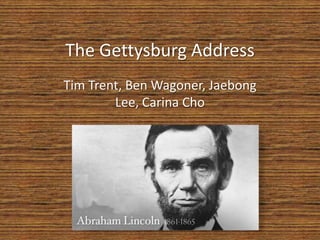
Abraham Lincoln
• Sixteenth president of the
  United States
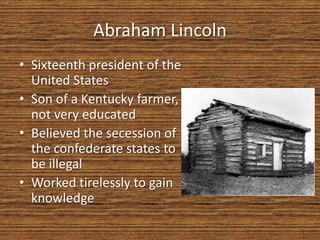
• Son of a Kentucky farmer,
  not very educated
• Believed the secession of
  the confederate states to
  be illegal
• Worked tirelessly to gain
  knowledge
Subject
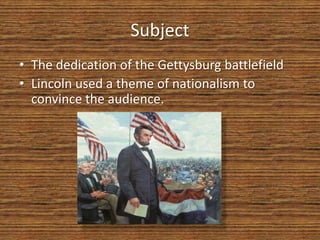
• The dedication of the Gettysburg battlefield
• Lincoln used a theme of nationalism to
  convince the audience.
Info on Gettysburg
• Did not win the war or have major aim
  for the north or the south, but did serve
  as a major battle in the war.
• More than 51,000 confederate and union
  soldiers were wounded, missing or dead.
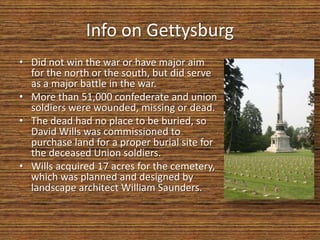
• The dead had no place to be buried, so
  David Wills was commissioned to
  purchase land for a proper burial site for
  the deceased Union soldiers.
• Wills acquired 17 acres for the cemetery,
  which was planned and designed by
  landscape architect William Saunders.
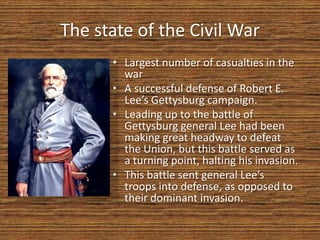
The state of the Civil War
      • Largest number of casualties in the
        war
      • A successful defense of Robert E.
        Lee’s Gettysburg campaign.
      • Leading up to the battle of
        Gettysburg general Lee had been
        making great headway to defeat
        the Union, but this battle served as
        a turning point, halting his invasion.
      • This battle sent general Lee’s
        troops into defense, as opposed to
        their dominant invasion.
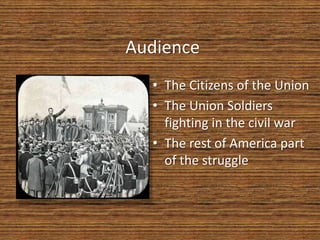
Audience
  • The Citizens of the Union
  • The Union Soldiers
    fighting in the civil war
  • The rest of America part
    of the struggle
Purpose
• Abraham Lincoln was worried about the upcoming election so he
  wanted to unify his party under his leadership. He wanted to gain
  support by appealing to as many different people as possible.
• Lincoln was trying to motivate and honor the soldiers of the
  northern states to continue through the Civil War. He focused on
  the noble ambitions and ideals of the war and the reasons for
  fighting.
• The consecration of the Gettysburg cemetery in Pennsylvania was a
  state event and Lincoln recognized the importance of it.
• The ideals that Lincoln put forth in the Gettysburg Address were
  ideals that all Americans, no matter their political thoughts, could
  accept and rally behind.
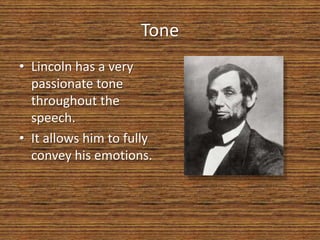
Tone
• Lincoln has a very
  passionate tone
  throughout the
  speech.
• It allows him to fully
  convey his emotions.
Rhetorical Strategies
• Pathos Appeals:
  – “The brave men, living and dead, who struggled here,
    have consecrated it, far above our poor power to add
    or detract.”
  – “… that we here highly resolve that these dead shall
    not have died in vain…”
• Repetition:
  – “We can not dedicate – we cannot consecrate – we
    cannot hallow – this ground.”
  – “…that government of the people, by the people, and
    for the people…”
Effectiveness of Speech
• Effective due to it’s timing
  – Occurred very soon after a huge war with
    numerous injuries and losses
• Effective due to it’s powerful statements
  – “…that cause for which they gave the last full
    measure of devotion…”
  – Incredibly inspirational, and effectively converted
    the graveness of the battle into passion for the
    war.
Text Works Cited
• http://www.whitehouse.gov/about/presidents
  /abrahamlincoln/
• http://www.ourdocuments.gov/doc.php?flash
  =true&doc=36
• http://showcase.netins.net/web/creative/linc
  oln/sites/gettysburg.htm
• Rhetorical Strategies Handbook
• American Lit Textbook
Picture Citations (In order of
                Appearance)
• http://www.whitehouse.gov/about/presidents/abrahamlin
  coln/
• http://lincoln.lib.niu.edu/gal/ichi11483.jpg
• http://loyalkng.com/wp-
  content/uploads/2010/11/Abraham-Lincolns-Gettysburg-
  Address-Revisited-by-Adam-Gault-Read-by-Mitch-
  Rapoport.jpg
• http://en.wikipedia.org/wiki/Battle_of_Gettysburg
• http://a4cgr.files.wordpress.com/2010/01/robert-e-lee.jpg
• http://4.bp.blogspot.com/_8dLGp7jLbio/SwYZrcu6JqI/AAA
  AAAAACE4/cK6ryfLqS3U/s400/getty.jpg
• http://4.bp.blogspot.com/_n0kOLTsDBsw/SOts1brxCjI/AAA
  AAAAAAdc/yi4Bg9ewh4w/s400/angry+abe.jpg

Gettysburg address

  • 1.
    The Gettysburg Address TimTrent, Ben Wagoner, Jaebong Lee, Carina Cho
  • 2.
    Abraham Lincoln • Sixteenthpresident of the United States • Son of a Kentucky farmer, not very educated • Believed the secession of the confederate states to be illegal • Worked tirelessly to gain knowledge
  • 3.
    Subject • The dedicationof the Gettysburg battlefield • Lincoln used a theme of nationalism to convince the audience.
  • 4.
    Info on Gettysburg •Did not win the war or have major aim for the north or the south, but did serve as a major battle in the war. • More than 51,000 confederate and union soldiers were wounded, missing or dead. • The dead had no place to be buried, so David Wills was commissioned to purchase land for a proper burial site for the deceased Union soldiers. • Wills acquired 17 acres for the cemetery, which was planned and designed by landscape architect William Saunders.
  • 5.
    The state ofthe Civil War • Largest number of casualties in the war • A successful defense of Robert E. Lee’s Gettysburg campaign. • Leading up to the battle of Gettysburg general Lee had been making great headway to defeat the Union, but this battle served as a turning point, halting his invasion. • This battle sent general Lee’s troops into defense, as opposed to their dominant invasion.
  • 6.
    Audience •The Citizens of the Union • The Union Soldiers fighting in the civil war • The rest of America part of the struggle
  • 7.
    Purpose • Abraham Lincolnwas worried about the upcoming election so he wanted to unify his party under his leadership. He wanted to gain support by appealing to as many different people as possible. • Lincoln was trying to motivate and honor the soldiers of the northern states to continue through the Civil War. He focused on the noble ambitions and ideals of the war and the reasons for fighting. • The consecration of the Gettysburg cemetery in Pennsylvania was a state event and Lincoln recognized the importance of it. • The ideals that Lincoln put forth in the Gettysburg Address were ideals that all Americans, no matter their political thoughts, could accept and rally behind.
  • 8.
    Tone • Lincoln hasa very passionate tone throughout the speech. • It allows him to fully convey his emotions.
  • 9.
    Rhetorical Strategies • PathosAppeals: – “The brave men, living and dead, who struggled here, have consecrated it, far above our poor power to add or detract.” – “… that we here highly resolve that these dead shall not have died in vain…” • Repetition: – “We can not dedicate – we cannot consecrate – we cannot hallow – this ground.” – “…that government of the people, by the people, and for the people…”
  • 10.
    Effectiveness of Speech •Effective due to it’s timing – Occurred very soon after a huge war with numerous injuries and losses • Effective due to it’s powerful statements – “…that cause for which they gave the last full measure of devotion…” – Incredibly inspirational, and effectively converted the graveness of the battle into passion for the war.
  • 11.
    Text Works Cited •http://www.whitehouse.gov/about/presidents /abrahamlincoln/ • http://www.ourdocuments.gov/doc.php?flash =true&doc=36 • http://showcase.netins.net/web/creative/linc oln/sites/gettysburg.htm • Rhetorical Strategies Handbook • American Lit Textbook
  • 12.
    Picture Citations (Inorder of Appearance) • http://www.whitehouse.gov/about/presidents/abrahamlin coln/ • http://lincoln.lib.niu.edu/gal/ichi11483.jpg • http://loyalkng.com/wp- content/uploads/2010/11/Abraham-Lincolns-Gettysburg- Address-Revisited-by-Adam-Gault-Read-by-Mitch- Rapoport.jpg • http://en.wikipedia.org/wiki/Battle_of_Gettysburg • http://a4cgr.files.wordpress.com/2010/01/robert-e-lee.jpg • http://4.bp.blogspot.com/_8dLGp7jLbio/SwYZrcu6JqI/AAA AAAAACE4/cK6ryfLqS3U/s400/getty.jpg • http://4.bp.blogspot.com/_n0kOLTsDBsw/SOts1brxCjI/AAA AAAAAAdc/yi4Bg9ewh4w/s400/angry+abe.jpg