Aspiration Respect Endeavour
Helping your child make the best
start to their GCSE courses
Year 10
September 2015
The Reality
• Tense time
• Pressure
• Students
• Parents
• Identify ways in which parents can support their children
• Identify what parents should do if there are concerns about the
progress of their children
• Look at the structure of GCSE grades and what they mean
• Analyse some simple techniques to improve the chances of
examination success
• Look at what options are open to students ‘post 16’
Start of GCSE courses
New Curriculum
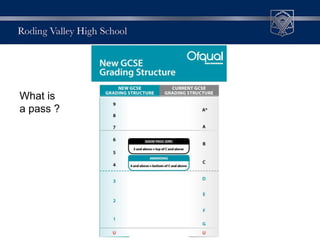
• Grades 9 – 1 GCSE no more A* - G
• Maths and English Language and Literature
• Reformed GCSE’s – increased challenge, no coursework,
SPAG focus
• Reformed A levels - harder, no coursework, SPAG
New style GCSE’s
• English
• Pre 20th Century texts, closed book
assessments, SPAG focus… no coursework,
higher grade boundaries
• Maths
• AS level Maths in Higher, Higher topics in
Foundation, problem solving
(application)…no coursework, higher grade
boundaries
What is
a pass ?
•Prior Attainment Predictions
•Fischer Family Trust data (Band D)
•3 and 4 Levels of Progress (Core Subjects)
•Teacher Assessment
•Progress 8
How do we know what your child is
capable of?
What is Progress 8 ?
• Schools performance is now judged by the progress made of every
child across the curriculum
• Students still needs a ‘pass’ in English and Maths
• Every grade counts at every level
• We have always supported every child and will continue to do so
• 2015 outcome +0.15....
RAP (Raising Attainment of Pupils) – monitor student
progress
All teachers and support staff are fully aware of the changes
All assessments and teaching will have regard for the
changes
All reports to parents are underpinned by regular calendared
assessments
Intervention tutors in English, Maths and Science
Forensic approach to student tracking
We are prepared for the changes ahead
What can GCSE Grades allow my child to
access?
Current benchmark - at least 5A*-C, with some providers asking for 7A*-C as a
minimum
Progress 8 – Good passes in 8 subjects including Maths & English
The study of Maths & English must continue until 18 if passes not secured in
Year 11
Sixth Form Entry - A Level requires at least a B at GCSE level in the subject
being studied.
In Maths and Physics an A grade minimum is required
Roding Valley High School
• An Academic Sixth Form
– Competitive entry level requirements
• 120 applicants for 60 places……….
– Taught by teachers that know you.
– Consistency and continuity of education.
Other options
• BTEC Diploma (Level 2 and Level 1)
• Level 2 and Level 1 study is usually for those
students who do not achieve 5 A*-C grades
• Level 2 study will require students to achieve
around 4 GCSEs
These will not be running at Roding Valley
Other Options continued
• Level One and Entry Level study
• This allows students who have found achieving GCSEs
challenging; the opportunity to continue to study and train.
• Some BTEC qualifications are available at Level 1
www.eppingforestlearners.co.uk/
AQA English Language and
English Literature
Major changes
100% Exam
There is a spoken language
endorsement, but this does not
contribute to the final grade at all.
One tier of entry
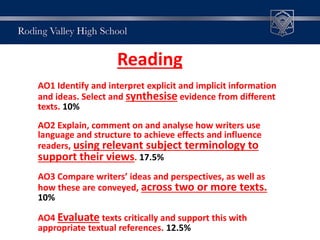
AO1 Identify and interpret explicit and implicit information
and ideas. Select and synthesise evidence from different
texts. 10%
AO2 Explain, comment on and analyse how writers use
language and structure to achieve effects and influence
readers, using relevant subject terminology to
support their views. 17.5%
AO3 Compare writers’ ideas and perspectives, as well as
how these are conveyed, across two or more texts.
10%
AO4 Evaluate texts critically and support this with
appropriate textual references. 12.5%
Reading
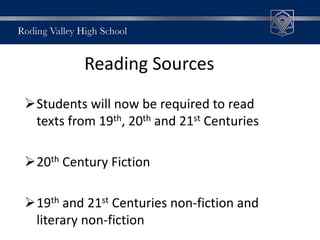
Reading Sources
Students will now be required to read
texts from 19th, 20th and 21st Centuries
20th Century Fiction
19th and 21st Centuries non-fiction and
literary non-fiction
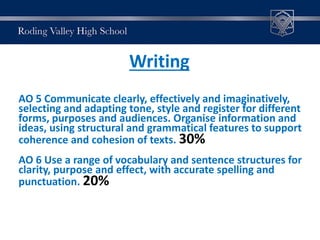
AO 5 Communicate clearly, effectively and imaginatively,
selecting and adapting tone, style and register for different
forms, purposes and audiences. Organise information and
ideas, using structural and grammatical features to support
coherence and cohesion of texts. 30%
AO 6 Use a range of vocabulary and sentence structures for
clarity, purpose and effect, with accurate spelling and
punctuation. 20%
Writing
Paper 1 Section A: Sample question 4
Focus this part of your answer on the second half of the source, from line 18 to
the end.
A student, having read this section of the text said: “The writer brings the very
different characters to life for the reader. It is as if you are inside the coach with
them.”
To what extent do you agree?
In your response, you could:
• write about your own impressions of the characters
• evaluate how the writer has created these impressions
• support your opinions with quotations from the text.
[20 marks] Copyright © AQA and its licensors. All rights reserved.
Paper 1 Section B: Sample question 5
You are going to enter a creative writing competition. Your entry will be judged by a
panel of people of your own age.
Either: Write a description suggested by this picture:
Or: Write the opening part of a story about a place that is severely affected by the
weather.
[24 marks for content and organisation
16 marks for technical accuracy]
[40 marks]
Copyright © AQA and its licensors. All rights reserved.
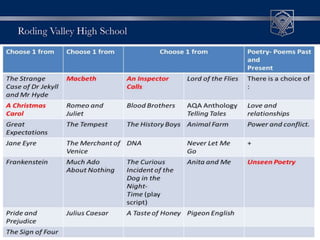
Literature
Closed book
Challenging texts
Whole text exams
Demanding poetry paper
How can students achieve their grade?
READ! READ! READ!
New GCSE Mathematics
Changes to Grades and Tiers
• Maths will continue to be tiered, though the
split will be different
• The same profile of students will not be
entered for Higher and Foundation
• The Foundation Tier - Grades 1-5
• The Higher Tier – Grades 4-9.
Assessment Objectives
• AO1 - Recall and use knowledge
• AO2 - Select and apply mathematical
methods in a range of contexts
• AO3 - Interpret and analyse problems
and generate strategies to solve them
Changes to the Assessment
Objectives
• Weighted differently; ‘Knowledge’ only
accounts for 40% of the marks.
‘Application and Problem Solving’
accounts for 60%
• Greater emphasis on students’
problem-solving skills and increased
literacy focus
Changes to the Provision of Formulae
• Some formulae previously given
in the front of the exam paper will
no longer be listed.
• Students will need to memorise
them.
Changes to the Course Content
• The new syllabus is greatly expanded with
completely new topics making an
appearance at both tiers.
• Substantial new challenges for Higher Tier
candidates
• Greatest shake-up is a vast shift of content
from the Higher to the Foundation Tier.
• To secure a Grade 5, concepts will have to
be mastered which today’s students
targeting A and B grades find challenging.
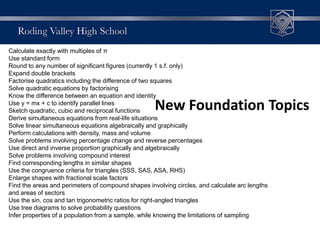
New Foundation Topics
Calculate exactly with multiples of π
Use standard form
Round to any number of significant figures (currently 1 s.f. only)
Expand double brackets
Factorise quadratics including the difference of two squares
Solve quadratic equations by factorising
Know the difference between an equation and identity
Use y = mx + c to identify parallel lines
Sketch quadratic, cubic and reciprocal functions
Derive simultaneous equations from real-life situations
Solve linear simultaneous equations algebraically and graphically
Perform calculations with density, mass and volume
Solve problems involving percentage change and reverse percentages
Use direct and inverse proportion graphically and algebraically
Solve problems involving compound interest
Find corresponding lengths in similar shapes
Use the congruence criteria for triangles (SSS, SAS, ASA, RHS)
Enlarge shapes with fractional scale factors
Find the areas and perimeters of compound shapes involving circles, and calculate arc lengths
and areas of sectors
Use the sin, cos and tan trigonometric ratios for right-angled triangles
Use tree diagrams to solve probability questions
Infer properties of a population from a sample, while knowing the limitations of sampling
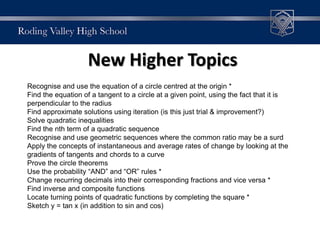
New Higher Topics
Recognise and use the equation of a circle centred at the origin *
Find the equation of a tangent to a circle at a given point, using the fact that it is
perpendicular to the radius
Find approximate solutions using iteration (is this just trial & improvement?)
Solve quadratic inequalities
Find the nth term of a quadratic sequence
Recognise and use geometric sequences where the common ratio may be a surd
Apply the concepts of instantaneous and average rates of change by looking at the
gradients of tangents and chords to a curve
Prove the circle theorems
Use the probability “AND” and “OR” rules *
Change recurring decimals into their corresponding fractions and vice versa *
Find inverse and composite functions
Locate turning points of quadratic functions by completing the square *
Sketch y = tan x (in addition to sin and cos)
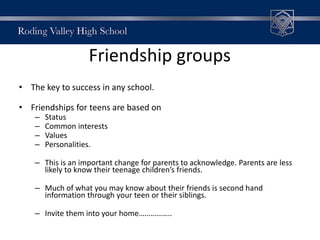
Friendship groups
• The key to success in any school.
• Friendships for teens are based on
– Status
– Common interests
– Values
– Personalities.
– This is an important change for parents to acknowledge. Parents are less
likely to know their teenage children’s friends.
– Much of what you may know about their friends is second hand
information through your teen or their siblings.
– Invite them into your home……………..
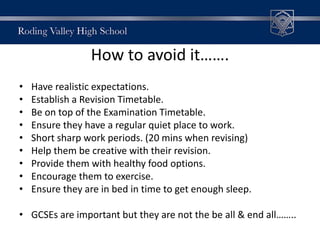
How to avoid it…….
• Have realistic expectations.
• Establish a Revision Timetable.
• Be on top of the Examination Timetable.
• Ensure they have a regular quiet place to work.
• Short sharp work periods. (20 mins when revising)
• Help them be creative with their revision.
• Provide them with healthy food options.
• Encourage them to exercise.
• Ensure they are in bed in time to get enough sleep.
• GCSEs are important but they are not the be all & end all……..
Who should parents contact?
• Individual subject problem
• Subject Teacher/Head of Faculty
• 2 or more subjects – Form Tutor
• General issues – Miss Allinson (Head of Year)
• Careers/Further Education – Mrs Mason
• Attendance concerns – Mrs Low
• Stress – Miss Dyer
• Do not underestimate the power of parental influence,
particularly when this is in partnership with the school
• Believe in your child’s potential, encourage them and
make sure they are as prepared as they can be.
• ‘It’s funny, but the more I practise, the luckier I get.’
End word
• Ask your son or daughter what they are doing
in their subjects.
• Don’t accept the usual response.

Year 10 parent info evening presentation

  • 1.
  • 2.
    Helping your childmake the best start to their GCSE courses Year 10 September 2015
  • 3.
    The Reality • Tensetime • Pressure • Students • Parents
  • 4.
    • Identify waysin which parents can support their children • Identify what parents should do if there are concerns about the progress of their children • Look at the structure of GCSE grades and what they mean • Analyse some simple techniques to improve the chances of examination success • Look at what options are open to students ‘post 16’ Start of GCSE courses
  • 5.
    New Curriculum • Grades9 – 1 GCSE no more A* - G • Maths and English Language and Literature • Reformed GCSE’s – increased challenge, no coursework, SPAG focus • Reformed A levels - harder, no coursework, SPAG
  • 6.
    New style GCSE’s •English • Pre 20th Century texts, closed book assessments, SPAG focus… no coursework, higher grade boundaries • Maths • AS level Maths in Higher, Higher topics in Foundation, problem solving (application)…no coursework, higher grade boundaries
  • 7.
  • 10.
    •Prior Attainment Predictions •FischerFamily Trust data (Band D) •3 and 4 Levels of Progress (Core Subjects) •Teacher Assessment •Progress 8 How do we know what your child is capable of?
  • 11.
    What is Progress8 ? • Schools performance is now judged by the progress made of every child across the curriculum • Students still needs a ‘pass’ in English and Maths • Every grade counts at every level • We have always supported every child and will continue to do so • 2015 outcome +0.15....
  • 12.
    RAP (Raising Attainmentof Pupils) – monitor student progress All teachers and support staff are fully aware of the changes All assessments and teaching will have regard for the changes All reports to parents are underpinned by regular calendared assessments Intervention tutors in English, Maths and Science Forensic approach to student tracking We are prepared for the changes ahead
  • 13.
    What can GCSEGrades allow my child to access? Current benchmark - at least 5A*-C, with some providers asking for 7A*-C as a minimum Progress 8 – Good passes in 8 subjects including Maths & English The study of Maths & English must continue until 18 if passes not secured in Year 11 Sixth Form Entry - A Level requires at least a B at GCSE level in the subject being studied. In Maths and Physics an A grade minimum is required
  • 14.
    Roding Valley HighSchool • An Academic Sixth Form – Competitive entry level requirements • 120 applicants for 60 places………. – Taught by teachers that know you. – Consistency and continuity of education.
  • 15.
    Other options • BTECDiploma (Level 2 and Level 1) • Level 2 and Level 1 study is usually for those students who do not achieve 5 A*-C grades • Level 2 study will require students to achieve around 4 GCSEs These will not be running at Roding Valley
  • 16.
    Other Options continued •Level One and Entry Level study • This allows students who have found achieving GCSEs challenging; the opportunity to continue to study and train. • Some BTEC qualifications are available at Level 1 www.eppingforestlearners.co.uk/
  • 17.
    AQA English Languageand English Literature
  • 18.
    Major changes 100% Exam Thereis a spoken language endorsement, but this does not contribute to the final grade at all. One tier of entry
  • 19.
    AO1 Identify andinterpret explicit and implicit information and ideas. Select and synthesise evidence from different texts. 10% AO2 Explain, comment on and analyse how writers use language and structure to achieve effects and influence readers, using relevant subject terminology to support their views. 17.5% AO3 Compare writers’ ideas and perspectives, as well as how these are conveyed, across two or more texts. 10% AO4 Evaluate texts critically and support this with appropriate textual references. 12.5% Reading
  • 20.
    Reading Sources Students willnow be required to read texts from 19th, 20th and 21st Centuries 20th Century Fiction 19th and 21st Centuries non-fiction and literary non-fiction
  • 21.
    AO 5 Communicateclearly, effectively and imaginatively, selecting and adapting tone, style and register for different forms, purposes and audiences. Organise information and ideas, using structural and grammatical features to support coherence and cohesion of texts. 30% AO 6 Use a range of vocabulary and sentence structures for clarity, purpose and effect, with accurate spelling and punctuation. 20% Writing
  • 22.
    Paper 1 SectionA: Sample question 4 Focus this part of your answer on the second half of the source, from line 18 to the end. A student, having read this section of the text said: “The writer brings the very different characters to life for the reader. It is as if you are inside the coach with them.” To what extent do you agree? In your response, you could: • write about your own impressions of the characters • evaluate how the writer has created these impressions • support your opinions with quotations from the text. [20 marks] Copyright © AQA and its licensors. All rights reserved.
  • 23.
    Paper 1 SectionB: Sample question 5 You are going to enter a creative writing competition. Your entry will be judged by a panel of people of your own age. Either: Write a description suggested by this picture: Or: Write the opening part of a story about a place that is severely affected by the weather. [24 marks for content and organisation 16 marks for technical accuracy] [40 marks] Copyright © AQA and its licensors. All rights reserved.
  • 24.
    Literature Closed book Challenging texts Wholetext exams Demanding poetry paper
  • 26.
    How can studentsachieve their grade? READ! READ! READ!
  • 27.
  • 28.
    Changes to Gradesand Tiers • Maths will continue to be tiered, though the split will be different • The same profile of students will not be entered for Higher and Foundation • The Foundation Tier - Grades 1-5 • The Higher Tier – Grades 4-9.
  • 29.
    Assessment Objectives • AO1- Recall and use knowledge • AO2 - Select and apply mathematical methods in a range of contexts • AO3 - Interpret and analyse problems and generate strategies to solve them
  • 30.
    Changes to theAssessment Objectives • Weighted differently; ‘Knowledge’ only accounts for 40% of the marks. ‘Application and Problem Solving’ accounts for 60% • Greater emphasis on students’ problem-solving skills and increased literacy focus
  • 31.
    Changes to theProvision of Formulae • Some formulae previously given in the front of the exam paper will no longer be listed. • Students will need to memorise them.
  • 32.
    Changes to theCourse Content • The new syllabus is greatly expanded with completely new topics making an appearance at both tiers. • Substantial new challenges for Higher Tier candidates • Greatest shake-up is a vast shift of content from the Higher to the Foundation Tier. • To secure a Grade 5, concepts will have to be mastered which today’s students targeting A and B grades find challenging.
  • 33.
    New Foundation Topics Calculateexactly with multiples of π Use standard form Round to any number of significant figures (currently 1 s.f. only) Expand double brackets Factorise quadratics including the difference of two squares Solve quadratic equations by factorising Know the difference between an equation and identity Use y = mx + c to identify parallel lines Sketch quadratic, cubic and reciprocal functions Derive simultaneous equations from real-life situations Solve linear simultaneous equations algebraically and graphically Perform calculations with density, mass and volume Solve problems involving percentage change and reverse percentages Use direct and inverse proportion graphically and algebraically Solve problems involving compound interest Find corresponding lengths in similar shapes Use the congruence criteria for triangles (SSS, SAS, ASA, RHS) Enlarge shapes with fractional scale factors Find the areas and perimeters of compound shapes involving circles, and calculate arc lengths and areas of sectors Use the sin, cos and tan trigonometric ratios for right-angled triangles Use tree diagrams to solve probability questions Infer properties of a population from a sample, while knowing the limitations of sampling
  • 34.
    New Higher Topics Recogniseand use the equation of a circle centred at the origin * Find the equation of a tangent to a circle at a given point, using the fact that it is perpendicular to the radius Find approximate solutions using iteration (is this just trial & improvement?) Solve quadratic inequalities Find the nth term of a quadratic sequence Recognise and use geometric sequences where the common ratio may be a surd Apply the concepts of instantaneous and average rates of change by looking at the gradients of tangents and chords to a curve Prove the circle theorems Use the probability “AND” and “OR” rules * Change recurring decimals into their corresponding fractions and vice versa * Find inverse and composite functions Locate turning points of quadratic functions by completing the square * Sketch y = tan x (in addition to sin and cos)
  • 38.
    Friendship groups • Thekey to success in any school. • Friendships for teens are based on – Status – Common interests – Values – Personalities. – This is an important change for parents to acknowledge. Parents are less likely to know their teenage children’s friends. – Much of what you may know about their friends is second hand information through your teen or their siblings. – Invite them into your home……………..
  • 41.
    How to avoidit……. • Have realistic expectations. • Establish a Revision Timetable. • Be on top of the Examination Timetable. • Ensure they have a regular quiet place to work. • Short sharp work periods. (20 mins when revising) • Help them be creative with their revision. • Provide them with healthy food options. • Encourage them to exercise. • Ensure they are in bed in time to get enough sleep. • GCSEs are important but they are not the be all & end all……..
  • 42.
    Who should parentscontact? • Individual subject problem • Subject Teacher/Head of Faculty • 2 or more subjects – Form Tutor • General issues – Miss Allinson (Head of Year) • Careers/Further Education – Mrs Mason • Attendance concerns – Mrs Low • Stress – Miss Dyer
  • 43.
    • Do notunderestimate the power of parental influence, particularly when this is in partnership with the school • Believe in your child’s potential, encourage them and make sure they are as prepared as they can be. • ‘It’s funny, but the more I practise, the luckier I get.’
  • 44.
    End word • Askyour son or daughter what they are doing in their subjects. • Don’t accept the usual response.