BEHAVIORAL PROBLEMS
IN
PAEDIATRICS
-- Pritha Biswas
M. Sc Nursing
1st
year
Introduction
Behaviour is anything that is observable and measurable. Behaviour is
learned over time through the environment. All kids misbehave sometimes.
And some may have temporary behaviour problem due to stress.
For example-birth of a sibling, a divorce or a death in family may cause child
to act out. The child may become very stubborn, does not listen to parents
command, very demanding and aggressive. Behavior problems are more
serious .It is important to identify these problems in initial stages as they can
be managed optimally to help the child grow normally and have balanced
mental health.
Definition of Behavioral Problem
Behaviour problems are defined as manifestation of behaviour that is
noticeably different from community. Hereditary, environment, learning
conditioning and positive reinforcement are the common factors those
affect behaviour in child that expected in school or community.
 Etiology of Behavioural problem in children
◦ Maladjustment of children with parents
i)Discipline
ii)Overindulgence
iii)Unrealistic parental expectation
iv)Unwanted child
v)Unfavourable comparison
◦ Influence of social relationship and mass media
◦ Disturbed relationship with neighbours, school, friends and effect of
television, internet, etc.
◦ Mentally and physically handicapped children.
◦ Children with physical sickness and disability like cerebral palsy,
MR
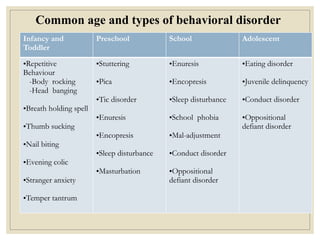
Common age and types of behavioral disorder
Infancy and
Toddler
Preschool School Adolescent
•Repetitive
Behaviour
-Body rocking
-Head banging
•Breath holding spell
•Thumb sucking
•Nail biting
•Evening colic
•Stranger anxiety
•Temper tantrum
•Stuttering
•Pica
•Tic disorder
•Enuresis
•Encopresis
•Sleep disturbance
•Masturbation
•Enuresis
•Encopresis
•Sleep disturbance
•School phobia
•Mal-adjustment
•Conduct disorder
•Oppositional
defiant disorder
•Eating disorder
•Juvenile delinquency
•Conduct disorder
•Oppositional
defiant disorder
BEHAVIORAL DISORDERS
Repetitive behavior
◦ Head banging: This involves rhythmic hitting of the head against a solid
surface often the crib mattress. This is common at bedtime before going to
sleep or after a child wakes during night or in the morning. It can cause callus
formation, abrasions and contusions but no intracranial injury.
◦ Body rocking: It is characterized by rhythmic forward and backward
swaying of the trunk most frequently in sitting position
Management of head banging & body rocking:
Assurance to the parents
Teach parents to ignore as concern and punishment can reinforce it
Padding of bed rails to prevent injury
It is the forcible grinding, clicking or clenching of teeth mostly occurring
during sleep. It can occur due to malocclusion, emotional stress or
disturbing dream.
Management of bruxism:
Counselling of the child for stress.
Instruct the child to clinch the teeth tightly for 5 seconds. relax and repeat
several times for 2 weeks to relieve tension.
Watching or reading horror stories at bed time should be avoided.
● Bruxism:
Habit problem
◦ BREATH HOLDING SPELLS:
Breath holding spell is an involuntary pause in breathing, sometimes
accompanied by loss of consciousness.
Types :
i) Blue spells (cyanotic breath holding) are the most common. A fright or
pain often precipitates a spell. The child cries out or screams, then turns
red in the face before going blue, usually around the lips. The child becomes
floppy and unconscious.
ii) Pale spells (pallid breath holding) are less common. They can occur
very early in life, often followed by a minor injury when the child is upset.
The child opens their mouth as if to cry but no sound comes out, before the
child faints, looking pale.
Phases of Breath Holding Spells
i)Provocation: Consists of some strong physical or emotional stimulus: A fall,
anger, frustration, or pain; lasting 15 seconds or less.
ii)Expiratory apnea and cyanosis: Consists of sustained, forced expiration,
followed by progressive cyanosis in major cases.
iii)Opisthotonic rigidity (backward arching): The patient becomes restless
and then opisthotonic, with strongly extended back, arms, and legs.
iv) Stupor: The apnoeic stage of the attack ends with a gasp or the resumption
of quiet breathing. The normal skin colour promptly returns, and the patient
lies motionless. Child typically remains stuporous or drowsy for minutes to
hours after an attack.
Management of breath holding spell
 Atropine sulphate may be tried in children with frequent pallid
spells.
 Iron therapy in breath holding spells(as these children usually have
iron deficiency anemia).
Most children don’t need treatment for breath-holding spells
To protect the child during a spell, lay the child on the floor and keep
his/her arms, legs, and head from hitting anything hard or sharp.
 Plenty of rest.
Try to help the child feel secure.
Breath-holding spells can be frustrating for parents. Find in which
situation child is getting angry.
During the episode, lie them on their side and watch them, đo not put
anything in their mouth or splash with water.
• THUMB SUCKING
Thumb sucking is common in oral stage (0-l year) as the babies have a natural
urge to suck. This usually decreases after the age of 6 months. Many babies
continue to suck their thumb to soothe themselves. Most children stop thumb
sucking between 3 and 6 years of age.
Causes of Thumb Sucking
Parental causes--Over protection by parents , Neglect by parents, Strictness of
parents , Disharmony between parents , Separation from parents
Due to teachers--excessive strictness, Excessive punitive attitude of teachers
Due to siblings and friends--Excessive competition , Separation from close
friend or sibling
Other causes : Loneliness and boredom, tiredness, frustration , anxiety
Management of Thumb sucking
Usually thumb sucking can be managed at home and includes parents setting rules
and providing distractions. Many experts recommend ignoring thumb sucking in
children as most children stop it on their own.
Do’s
Divert the child's attention.
Engage him in play activities.
The hands and fingers of the child should be kept busy in some interesting activity
like drawing.
Offer praise and rewards to the child for not sucking thumb.
Distract the child when he feels bored.
Put gloves on child's hands or wrap the thumb with a cloth or bandage.
A nontoxic bitter tasting substance can be applied on child's thumb so that he may
not suck it.
Take help of elder children for explanation to younger siblings.
Encourage the child to socialize.
If the child is sucking thumb due to anxiety or distress, address the cause of
discomfort. Talk to the child and reassure him.
Don'ts
Do not scold the child or punish him or forcefully remove thumb from the
mouth.
 Do not tie the child's thumb and fingers.
Do not nag, scold or beat the child.
Do not leave the child repeatedly cold, wet or hungry
◦ NAIL BITING:
Onychophagia or nail biting is a common oral compulsive habit in children
and adults. It is just a way of coping with stress or comforting self nail.
Causes of nailbiting:
Out of curiosity or boredom
To relieve stress or anxiety
Because of habit
Because of nervousness
Lack of confidence Feeling shy
Cont.
Fear or jitteriness due to horror scenes or family environment
Feeling of insecurity
Tiredness
Constant nagging
Management of nail-biting:
 The most common treatment is application of a clear and bitter-tasting
nail polish to the nails. The bitter flavour discourages nail biting.
 Address the child's anxieties. Make the child speak about his/her worries.
 Do not nag or punish the child.
 Keep the fingernails of child neatly trimmed, to cut down on the
temptation to bite.
Cont.
Keep the child's hands clean to cut down on ingestion of germs.
Do not pressurize the children to stop biting nails, as this adds to their stress.
Reassure the child with love and affection.
Discuss with the child about unacceptable habits and how to break them.
Help the child become aware of this bad habit.
In case all these simpler measures fail then behaviour therapy is beneficial.
Habit reversal training, which seeks to unlearn habit of nail biting and
possibly replace it with more constructive habit.
● EVENING COLIC
Colic is characterized by intermittent episodes of abdominal pain or severe
crying in young infants who are otherwise well. Colic usually starts with in few
weeks after birth, reach a peak by 4-6 weeks and subside by 3-4months of age.
Clinical features:
Sudden loud cry in the late afternoon or evening,
Face is red and legs are drawn to the abdomen.
Stops when completely exhausted.
◦ The diagnosis is confirmed when the infant cries for >3 hours per day for >3
days per week for >3 weeks.
Management:
Usually no treatment required.
Hold the baby close against mother’s body and make the baby calm and breath
slow
Warm bath to the baby can help.
Pat or rub the baby’s back placing the baby on his/her belly.
● TIC DISORDER
Tic disorders are characterized by persistent presence of tics, which are
abrupt, repetitive, involuntary movements, and sounds that are purposeless.
Ties are sudden non rhythmic behaviors that are either motor (related to
movements) or vocal, for example, knee bends, lip smacking, tongue
thrusting grimacing, eye blinking, and so on, Tics are seen in transient tic
disorder vocal or motor tic disorder and Tourette's disorder.
Types of Tics :
1.Simple: Using only a few muscles or simple words.
(a)Simple motor tics: These are simple brief meaningless movements such
as eye blinking, facial grimacing, head jerks or shoulder shrugs. They
usually last less than one l second.
(b)Simple phonic tics: These are meaningless sounds or noises such as
throat clearing, coughing, sniffing, barking or hissing.
2. Complex: Using many muscle groups or full words and sentences.
(a)Complex motor tics: These tics involve slower, longer, and more
purposeful movements such as sustained looks, facial gestures, biting,
banging, whirling or twisting around or obscene gestures.
(b)Complex phonic tics: These tics include syllables, words, phrases, and
statements such as "shut up" or "yes, you have done it" The child's speech
may be abnormal with unusual rhythms, tones, and accent.
Management of Tic disorder: A multidisciplinary team should work
together with the affected child's parents and teachers.
Treatment should include the following:
Completion of necessary diagnostic tests including self reports by child and
parents.
Comprehensive assessment including the child's cognitive abilities,
perception, motor kills, behaviour and adaptive functioning.
Cont.
Cognitive behavior therapy: The patient is asked to deliberately perform tíc
movement for specified period of time interspersed with brief periods of rest
Contingency management is another behavioral treatment. It is based on
positive reinforcement, usually administered by parents. Children are praised
and rewarded for not performing tics and for replacing them with alternative
behaviors.
Habit reversal is most commonly used technique, which when combined with
relaxation exercises, awareness training, and contingency management shows
64-100% Success rate.
Medications: Medicines are the main treatment for motor and vocal tics.
Medicatíons prescribed include Typical neuroleptics (antipsychotícs) such as
haloperidol, pimozíde, and tetrabenazine.
● ENURESIS
According to the DSM-IV-TR, enuresis is defined as the repeated voiding of
urine in the bed or clothes at least twice per week for at least three
consecutive months by a child who is at least 5 years of age. It is considered
normal until at least age 6.
Enuresis occurs in 40% in the age of 3-year olds, 10% of 6 years olds, and
3% of 12 year olds. Primary enuresis is twice as common as secondary
enuresis.
Types
Primary enuresis: It refers to the condition in which children have never
been successfully trained to control urination. There may be delay in
maturation of sphincter control.
Secondary enuresis: It refers to the condition in which children have been
successfully trained, but revert to bed wetting in response to some stress. It
may be due to parent-child maladjustment.
Cont.
Nocturnal enuresis : Enuresis that occurs during sleep.
Daytime wetting : Urinary incontinence that occurs while the child is awake.
Mixed enuresis: It includes both nocturnal and diurnal enuresis.
Etiology of Enuresis
Biological/Organic: urinary incontinence (1-3%): Diabetes, urinary tract
infections, deficiencies in night time, anti-diuretic hormone, decreased
functional bladder capacity, inability to hold urine at night, sleep disorders such
as narcolepsy and obstructive sleep apnoea or anatomical delay of urinary tract.
Genetic: Increased incidence of enuresis in children if one or both parents have
a history of enuresis.
Developmental status: Mentally disabled children, delay in central nervous
system maturation and in the development of language and motor skills.
Cont.
Psychological factors: Not common with primary nocturnal enuresis but
more common with secondary enuresis. It is considered as a regressive
symptom in response to stress or trauma (e.g., parental divorce, sexual
abuse, trauma at school, hospitalization, neglect, a new sibling).
Medications: Lithium, theophylline, valproic acid, and clozapine have
also been reported to cause secondary enuresis.
Diagnosis: Complete history and physical examination, urinalysis, urine
culture, ultrasonography.
Management of Enuresis:
Medical Management:
Desmopressin: It is synthetic ADH and is used to decrease night time
urination.
Imipramine: Imipramine is a tricyclic antidepressant which is proved to
be effective in the treatment of enuresis although its mechanism is
unknown.
Cont.
Nurse’s responsibility in enuresis: The nurse should teach the
parents about---
No punishment should be given to the child. If there is any other co-
morbid conditions that can lead to enuresis, they must be treated first.
Motivational therapy: Reassurance, emotional support, eliminating
guilt.
Behavioral modifications:
-Awaken the child to void at times usually associated with bed-
wetting.
-Positive reinforcement for desired behavior (e.g., star or sticker
charts for rewarding periods of continence).
-Make the toilet easy access for the child.
-Let the child help in clean-up after a bed-wetting event. This
encourages sense of responsibility
Cont.
-Bladder training: Reduce fluids before bedtime.
-Dry-bed training : Awakening children at specified intervals until they learn
to awaken on their own when necessary
Enuresis alarms : When abed-wetting alarm senses urine, it goes off ,so the
child can wake up and finish voiding. The child eventually becomes
conditioned to the signal of a full bladder and spontaneously wakes up before
he wait the bed.
●ENCOPRESIS
Encopresis is defined as repeated passage of feces at inappropriate places
(e.g., clothing or floor) at least once a month for a period of at least 3 months
after chronological or developmental age of at least 4 years. The estimated
prevalence of encopresis in 5-year-olds is ~1-3% and 1-2% in children
younger than 10 years.
Cont.
Factors causing Encopresis:
Eating diets high in fat and sugar (junk food) and low in fiber.
Not drinking enough water.
History of constipation or painful experience during toilet training.
Avoidance of school bathrooms.
Cognitive delays such as autism or mental retardation.
Learning disabilities.
Attention deficit disorders or difficulty focusing.
Poor ability to identify physical sensations or symptoms.
Neurological impairment such as spina bifida or paralysis.
Conduct or oppositional disorders.
Abuse and/or neglect.
Cont.
Management of encopresis:
Medical Management:
Bowel cleansing: Using an effective laxative such as polyethylene
glycol (Miralax) on a daily basis may be sufficient to clean out the
bowel. Osmotic laxatives such as lactulose or magnesium hydroxide
(milk of magnesia) may also be added.
Nutritional changes: Include fiber to the diet at a predictable time each
day.
Nursing Management: The nurse should teach the parents about—
Bowel training: Make the child sit for 10 minutes in the toilet 20
minutes after breakfast and again 20 minutes after dinner. Encourage
drinking enough water to elicit urination every two hours. When
urinating, the child should interrupt the stream two to three times before
the bladder is empty. This exercise strengthens pelvic muscles and
sphincter control.
Cont.
Behavior management: Use developmentally appropriate strategies, such as
pictures, puppets and stories. Help them to maintain regular bathroom
routines.
Family support: Family members should keep patience while treating the child
and continue their love and support toward them. School age children may
require cooperation by their teachers to allow the child to use the bathroom
frequently whenever required.
Personality disorder
◦ STRANGER ANXIETY
By about 6-7 months, the infant can differentiate between the primary care
giver and others. Thus at this age develop fear of unfamiliar people or
strangers. When approached by some stranger, the child turns away, even cry
or runs toward the primary caregiver. It may lead to separation anxiety
disorder in older children.
Cont.
Management of stranger anxiety
Teach relaxation technique such as gradually exposing them to stranger
initially from a distance and asking them to greet and slowly advance.
Reassure the parents.
TEMPER TANTRUM
It is a sudden outburst or violent display of frustration and anger as
physical aggression or resistance. Biting, throwing objects, crying, rolling on
floor or banging limbs are common activities during temper tantrum.
In 18 months to 3 years of age, due to development of sense of autonomy
child displays defiance, negativism.
Cont.
Precipitating Factors of temper tantrum
Hunger.
Fatigue.
Lack of sleep.
Innate personality of child.
lneffective parental skills.
Over pampering
Dysfunctional family or family violence.
Management of temper tantrum
ln general-- parents are advised to:
Set a good example to child.
Pay attention to child.
Spend quality time with the child.
Have open communication with child.
Have consistency in behavior.
Cont.
During temper tantrum:
Parents should ignore the child during the episode and once child is calm, tell
child that such behavior is not acceptable,
Verbal reprimand should not be abusive.
Never beat or threaten child.
Impose ‘time Out’(fixed number of minutes o isolation), if temper tantrum is
disruptive, out of control and occurring in public place.
◦ SCHOOL PHOBIA
School phobia is a complex syndrome that can be influenced by the child's
temperament, the school environment and the family problem. Current
thinking defines school phobia or school refusal as an anxiety disorder related
to separation anxiety. Children refuse to attend school because of
uncomfortable feelings, stress, anxiety, or panic.
Cont.
Manifestations of school phobia:
 Physical symptoms: Dizziness, headaches, stomach-ache, diarrhoea, nausea,
vomiting, body shaking or trembling, increased heart rate, chest pains, and back
or joint pains.
These symptoms usually improve once the child is allowed to stay home.
 Behavioral symptoms: Temper tantrums, crying, angry outbursts, and threats to
hurt themselves.
Risk Factors of school phobia:
Individual factor: Fear of failure, Low self-efficacy, Physical illness , learning
difficulties. Separation anxiety
Family factors: Separation and divorce. Parent mental health problem ,
Overprotective parenting , loss or bereavement , high levels of family stress.
 School factors: Bullying , Fear of getting punished , Examination, Peer or staff
mal adjustment.
Cont.
Management of school phobia:
Identify the factor responsible.
Increase parent child interaction.
Help the child to express his/her problem.
Individual behavioral counselling.
Increase the parental separation time gradually.
Positive reinforcement for attending school regularly.
Address peer problem.
Relaxation therapy, cognitive therapy to improve social competence.
Parents are taught to set routines for their children and punish and reward
them appropriately.
Structure school activities student friendly as much as possible.
Increase teacher student interaction
Cont.
JUVENILE DELINQUENCY
Juvenile delinquency is an antisocial behavior, in which a child or adolescent
purposefully and repeatedly does illegal activities. The Children Act, 1960 in India
defines a delinquent as "a child who has committed an offence such as theft,
sexual assault, murder, burglary or inflicting injuries, running away from home,
etc“
Presentation of Antisocial Problems in Children : The common forms of
presentation of juvenile delinquency are---
Constant disobedience
Lying
Stealing
Fire setting
Destructiveness
Cruelty
Truancy from school
Cont.
Running away from home
Sexual problems
Drug and alcohol intake with dependence
Gambling
Management of juvenile deliquency:
The therapy for delinquency should be of three types:
1. Preventive therapy
2. Corrective therapy
3. Drug therapy
Preventive therapy: Prevention of delinquency is often a very difficult problem and
can best be described as under:
o Primary prevention, which extends to the removal of all factors which directly or
indirectly cause delinquency.
o Secondary prevention, which aims at prompt diagnosis and treatment of delinquency.
o Tertiary prevention, which aims at rehabilitation of delinquents.
Cont.
Corrective therapies
oProtective therapy, which not only extends to custodial care, but also to
probation or parole.
oPunitive therapy, with an idea to serve as a deterrent.
oReformative therapy, to bring about certain changes in the personality and
behavior of the delinquent.
oRehabilitative therapy, which is very essential to assist the delinquent in his
progress and give him a new way of living.
Drug Therapy : The use of drug therapy for delinquents is beneficial only in
case of aggressive behavior. Tranquilizers in adequate dose need to be given.
Chlorpromazine, haloperidol can be given orally.
Cont.
Disruptive behaviour disorder
◦ OPPOSITIONAL DEFIANT DISORDER: It is a pattern of negativistic,
hostile and defiant behaviour.The DSM states that ODD has at least four
of the following diagnostic criteria which lasts for at least six months
and is manifested during non-sibling interaction.
Angry/ Irrited mood-Losing one’s temper
- Getting easily annoyed
- Feels resentful or angry
Argumentive / Defiant Behaviour- Arguing with others
- Defying rules or requests
- Annoying others deliberately
- Blaming others for one’s mistake
Cont.
CONDUCT DISORDER
According to the DSM 5,CD is a “repetitive and persistent pattern of behavior
in which the basic rights of others or major age-appropriate societal norms
rules violated.” . More symptoms are related to physical violence and remains
for at least 12 months which includes--
Frequent refusal to obey parents or other authority figures
Repeated truancy
Tendency to use drugs, including cigarettes and alcohol, at a very early age
Lack of empathy for others
Being aggressive to animals and other people of showing sadistic behaviours
including bullying and physical or sexual abuse
Keenness to start physical fights
Using weapons in physical fights
Frequent lying
Cont.
Criminal behaviour such as stealing, deliberately lighting fires, breaking into
houses and vandalism
A tendency to run away from home
Suicidal tendencies - although these are more rare.
● ATTENTION DEFICIT HYPERACTIVITY DISORDER
Around two to five per cent of children are thought to have attention deficit
hyperactivity disorder (ADHD), with boys outnumbering girls by three to one.
The characteristics of ADHD can include:
Inattention – Difficulty concentrating, forgetting instructions, moving from one
task to another without completing anything.
Impulsivity - Talking over the top of others, having a 'short fuse', being accident-
prone.
Overactivity -Constant restlessness and fidgeting.
Cont.
Risk factors: The causes of ODD, CD and ADHD are unknown but some of
the risk factors include:
Gender - Boys are much more likely than girls to suffer from behavioural
disorders
Gestation and birth -Difficult pregnancies, premature birth and low birth weight
may contribute in some Cases to the child's problem behaviour later in life.
Temperament - Children who are difficult to manage, temperamental or
aggressive from an early age are more likely to develop behavioural disorders
later in life.
Family life - For example, a child is at increased risk in families where
domestic violence, Poverty, poor parenting skills or substance abuse are a
problem.
Learning difficulties - Problems with reading and Writing are often associated
with behaviour problems.
Intellectual disabilities -Children with intellectual disabilities are twice as likely
to have behavioural disorders.
Cont.
Management of disruptive behavior:
Treatment is usually multifaceted and depends on the particular disorder and
factors contributing to it, but may include:
Parental education -For example, teaching parents how to communicate with and
manage their children. .
Family therapy- The entire family is helped to improve communication and
problem-solving skills.
Cognitive behavioural therapy - To help the child to control their thoughts and
behaviour.
Social training-The child is taught important social skills, such as how to have a
conversation or play cooperatively with others.
Anger management -The child is taught how to recognise the signs of their
growing frustration and given a range of coping skills designed to defuse their
anger and aggressive behaviour. Relaxation techniques and stress management
skills are also taught.
Support for associated problems For example, a child with a learning difficulty
will benefit from professional support.
Cont.
Encouragement -Many children with behavioural disorders experience repeated
failures at school and in their interactions with others. Encouraging the child to excel
in their particular talents (such as sport) can help to build self-esteem.
Medication -To help control impulsive behaviours.

Speech disorder
●STUTTERING / STAMMERING
Clinical Features
Problems in starting a word or phrase
Hesitation before certain sound has to be uttered
Repetition of a sound, word or syllable
Speech may come out in spurts
Trembling lips and jaws (when trying to talk)
Interjections like "uhm" used more frequently before attempting to utter certain
sounds
Cont.
Causes of Stammering/Stuttering: The following factors may cause or trigger
stuttering--
Developmental factors: If the child has cleft lip, cleft palate or tongue tie, the speech is
affected. There may be central nervous system impairment which may affect the speech
Neurogenic stuttering: A stroke or brain injury may affect the signals between brain,
speech nerves, and muscles, thereby leading to stuttering.
Psychological factor: Factors such as stress and embarrassment may make stuttering worse
in people who stutter.
Management of stammering:
Teach the child skills, strategies, and behaviors that help in oral communication. This may
include fluency shaping therapy and stuttering-modification therapy
Parents should not put undue pressure on the child, regarding fluency of speech during
preschool age.
Give the child sufficient time to express himself.
Never criticize the child for his/her speech.
Encourage the child to speak clearly by teaching him/ her songs and nursery rhymes.

Eating disorders
● PICA
It is a habit disorder characterized by repeated or chronic ingestion of
non-nutritive substances. Examples: mud, paint, clay, plaster, charcoal,
soil, etc. and the habit must persist for more than l month, at an age
when eating such objects is considered developmentally inappropriate.
Types: The subtypes of pica are characterized by the substance eaten,
for example:

Amylophagia: Consumption of starch

Coprophagy: Consumption of animal feces

Geophagy: Consumption of soil, clay or chalk

Hyalophagia: Consumption of glass

Pagophagia: Pathological consumption of ice

Trichophagia: Consumption of hair or wool
Cont.
Predisposing Factors of pica:
Parental neglect
Inadequate supervision
Mental retardation
Lack of affection
Psychological neglect , orphans
Family disorganization
Lower socioeconomic class
Management of pica:
Screening should be done for iron deficiency anaemia , worm infestations,
lead poisoning , other nutritional deficiencies.
Treat cause accordingly.
Discrimination training between edible and non-edible items.
 Make meal time pleasant.
Cont.
Meet the emotional needs of the child.
Do not leave the child alone.
Keep the child busy , as boredom may give time for eating non-edible
substance.
●ANOREXIA NERVOSA
According to DSM 5 criteria, anorexia nervosa is characterized by restriction
of energy intake relative to requirements, intense fear of gaining weight or
becoming fat and disturbance in the way in which one's body weight or shape
is experienced.
In anorexia nervosa, weight is maintained at least 15% below that expected
Symptoms of anorexia nervosa:
Refusal to eat enough food, despite extreme hunger
An intense fear of becoming 'fat' and of losing control.
Cont.
A disturbance of perception of body image in that people may regard themselves as
fat, overestimating body size.
A tendency to exercise obsessively.
A preoccupation with determining “good” and "bad' foods and with the preparation
of food. Absence of menstrual periods.
Adverse Effects of anorexia nervosa:
Thinning of the bones (osteopenia or osteoporosis).
Brittle hair and nail
Dry and yellowish skin
 Growth of fine hair all over the body (lanugo)
Mild anemia and muscle wasting and weakness
Severe constipation
Low blood pressure, slowed breathing and pulse
Damage to the structure and function of the heart
Brain damage
Cont.
Multiorgan failure
Drop In internal body temperature, causing a pesron to feel cold all the time
Lethargy, sluggishness or feeling tired all the time
Infertility
Inability to concentrate and think rationally
Causes of anorexia nervosa:
Genetic
Biochemical or hormonal imbalances
Personal: Changes in life circumstances, such as the onset of adolescence,
breakdown of relationships, childbirth or death of a loved one; perfectionism
and a belief that love from family and friends depends on high achievement
and fear of the responsibilities of adulthood,
 Influence of Social Media, internet etc.
Cont.
Management of anorexia nervosa:
 Restore weight with psychological support.
Nutritional/physical rehabilitation,
Identify/understand dysfunctional attitudes,
Family therapy: Parents should be involved in meal planning, reduce criticism
Psychotherapy: Behavior therapy, group therapy.
Drug: Antidepressants, Tricyclic antidepressants (amitriptyline,
clomípramine), SSRIs (fluoxetine, citalopram), Antihistamines
(cyproheptadine), Antipsychotics (pimozide, sulipride).
◦ BULIMIA NERVOSA
Bulimia nervosa is characterized by frequent episodes of binge eating
followed by recurrent inappropríate compensatory behavior (vomiting,
purging, fasting or exercising or a combination of these) in order to prevent
weight gain. In bulimia nervosa BMI is maintained above 17.5 kg/m in adults
and the equivalent in children and adolescents.
Cont.
Adverse Effects of bulimia nervosa:
Chronically inflamed and sore throat.
Swollen salivary glands in the neck and jaw area.
Worn tooth enamel, increasingly sensitive and decaying teeth as a
result of exposure to stomach acid.
Acid reflux disorder and other gastrointestinal problems.
 Intestinal distress and irritation from laxative abuse.
Severe dehydration from purging of fluids.
 Electrolyte imbalance (loo low or too high levels of sodium, calcium,
potassium and other minerals) which can lead to heart attack
Management of bulimia nervosa:
Cognitive behavioral therapy (CBT) and use of antidepressants.
Encourage eating 3 or more balanced meals a day.
Adopt flexible food rules and body image concerns.
Develop cognitive and behavioral strategies. Binge Eating Disorder
◦ BINGE EATING DISORDER
Binge eating disorder is defined as recurring episodes of eating significantly
more food in a short period of time than most people would eat under similar
circumstances, with episodes marked by feelings of lack of control. Unlike
bulimia nervosa, periods of binge-eating are not followed by purging,
excessive exercise or fasting. Therefore, people with binge-eating disorder
often are overweight or obese. People with binge-eating disorder who are
obese are prone to develop cardiovascular disease and high blood pressure.
Management of bulimia nervosa: Treatment includes psychotherapy and
other antidepressants(fluoxetine)
 Sleep disorders
◦ DYSSOMNIAS (disorders of initiating sleep and maintaining sleep)
◦ PARASOMNIAS (abnormal activities during sleep) : t is defined as episodic nocturnal
behavior involving cognitive disorientation and autonomic and skeletal muscle
disturbance. Partial arousal insomnia includes sleep walking and sleep terror. It is more
prevalent among preschool and school age children. Rhythmic movement disorders like
body rocking and head banging occurs mainly during sleep wake transitions.
◦ HYPERSOMNIAS (excessive sleepiness)
◦ Management sleep disorder:
◦ Establish a bedtime routine
◦ Establish a wake-up time.
◦ Avoid giving stimulants such as sugar or caffeine to the
◦ child near bedtime.
◦ Make the bedroom cozy and inviting
◦ Avoid disturbances in sleep like television.
◦ Maintain silence in and near bedroom.
◦ Be with the child while he falls asleep.
Cont.
Sexual disorders
◦ MASTURBATION: Parents should explain children that masturbation is not a
social activity and it should not be practiced in public.
◦ GENDER LDENTITY DISORDERS: It may develop more prior to 4 years
of age but more common in adolescence, Transsexualism is conviction by a
person biologlcally of one gender that he/she is a member of the other
gender.Transvestism is cross dressing when boys dress up in women’s clothing.
Homosexuality refers to emotional and physical attraction to some one of the
same gender.
Management
Treatment includes psychotherapy
Parenting techniques to teach the gender appropriate behavior.
No punishment or shaming should be done.
Nurses Responsibility in Behavioural disorder in children
◦ Assessment of specific problem of the child by appropriate history and detection
of the responsible factors.
◦ Informing the parents and making them aware about the causes of behavioral
problems of the particular child.
◦ Assisting the parents, teachers and family members for necessary modification
of environment at home school and community.
◦ Counselling of parents to rationalize their expectation of childs achievement
according to the potentiality.
◦ Encouraging the child for behavior modification, as needed.
◦ Creating awareness about psychological disturbences which may lead to
behavioral problem during developmental stage.
◦ Referring the children with behavioural problems for necessary management and
support to better health care facilities, child guidance clinic and support
agencies.
Cont.
◦ Promoting health, emotional development of the child by adequate, physical,
psychological and social support.
◦ Providing counselling services for children and family members to solve the
problems whenever necessary and for tender loving care of the children.
◦ Participating in the management of the problem child as member of health
team along with paediatrician, psychologist and social worker. Organize
guidance clinic.
CONCLUSION: Behavioural disorder in children are very common. They
often under-recognised and under-treated. Untreated children may leads to a
disruptive adult. However treatment for behavioural disorder depends on the
nature of child’s condition and the sensitivity of their symptoms. A positive
and conductive approach is the best way to deal with behavioural problem in
children.

BEHAVIOURAL DISORDERS IN PEDIATRIC pptx. ppt

  • 1.
    BEHAVIORAL PROBLEMS IN PAEDIATRICS -- PrithaBiswas M. Sc Nursing 1st year
  • 2.
    Introduction Behaviour is anythingthat is observable and measurable. Behaviour is learned over time through the environment. All kids misbehave sometimes. And some may have temporary behaviour problem due to stress. For example-birth of a sibling, a divorce or a death in family may cause child to act out. The child may become very stubborn, does not listen to parents command, very demanding and aggressive. Behavior problems are more serious .It is important to identify these problems in initial stages as they can be managed optimally to help the child grow normally and have balanced mental health.
  • 3.
    Definition of BehavioralProblem Behaviour problems are defined as manifestation of behaviour that is noticeably different from community. Hereditary, environment, learning conditioning and positive reinforcement are the common factors those affect behaviour in child that expected in school or community.
  • 4.
     Etiology ofBehavioural problem in children ◦ Maladjustment of children with parents i)Discipline ii)Overindulgence iii)Unrealistic parental expectation iv)Unwanted child v)Unfavourable comparison ◦ Influence of social relationship and mass media ◦ Disturbed relationship with neighbours, school, friends and effect of television, internet, etc. ◦ Mentally and physically handicapped children. ◦ Children with physical sickness and disability like cerebral palsy, MR
  • 5.
    Common age andtypes of behavioral disorder Infancy and Toddler Preschool School Adolescent •Repetitive Behaviour -Body rocking -Head banging •Breath holding spell •Thumb sucking •Nail biting •Evening colic •Stranger anxiety •Temper tantrum •Stuttering •Pica •Tic disorder •Enuresis •Encopresis •Sleep disturbance •Masturbation •Enuresis •Encopresis •Sleep disturbance •School phobia •Mal-adjustment •Conduct disorder •Oppositional defiant disorder •Eating disorder •Juvenile delinquency •Conduct disorder •Oppositional defiant disorder
  • 6.
    BEHAVIORAL DISORDERS Repetitive behavior ◦Head banging: This involves rhythmic hitting of the head against a solid surface often the crib mattress. This is common at bedtime before going to sleep or after a child wakes during night or in the morning. It can cause callus formation, abrasions and contusions but no intracranial injury. ◦ Body rocking: It is characterized by rhythmic forward and backward swaying of the trunk most frequently in sitting position Management of head banging & body rocking: Assurance to the parents Teach parents to ignore as concern and punishment can reinforce it Padding of bed rails to prevent injury
  • 7.
    It is theforcible grinding, clicking or clenching of teeth mostly occurring during sleep. It can occur due to malocclusion, emotional stress or disturbing dream. Management of bruxism: Counselling of the child for stress. Instruct the child to clinch the teeth tightly for 5 seconds. relax and repeat several times for 2 weeks to relieve tension. Watching or reading horror stories at bed time should be avoided. ● Bruxism:
  • 8.
    Habit problem ◦ BREATHHOLDING SPELLS: Breath holding spell is an involuntary pause in breathing, sometimes accompanied by loss of consciousness. Types : i) Blue spells (cyanotic breath holding) are the most common. A fright or pain often precipitates a spell. The child cries out or screams, then turns red in the face before going blue, usually around the lips. The child becomes floppy and unconscious. ii) Pale spells (pallid breath holding) are less common. They can occur very early in life, often followed by a minor injury when the child is upset. The child opens their mouth as if to cry but no sound comes out, before the child faints, looking pale.
  • 9.
    Phases of BreathHolding Spells i)Provocation: Consists of some strong physical or emotional stimulus: A fall, anger, frustration, or pain; lasting 15 seconds or less. ii)Expiratory apnea and cyanosis: Consists of sustained, forced expiration, followed by progressive cyanosis in major cases. iii)Opisthotonic rigidity (backward arching): The patient becomes restless and then opisthotonic, with strongly extended back, arms, and legs. iv) Stupor: The apnoeic stage of the attack ends with a gasp or the resumption of quiet breathing. The normal skin colour promptly returns, and the patient lies motionless. Child typically remains stuporous or drowsy for minutes to hours after an attack.
  • 10.
    Management of breathholding spell  Atropine sulphate may be tried in children with frequent pallid spells.  Iron therapy in breath holding spells(as these children usually have iron deficiency anemia). Most children don’t need treatment for breath-holding spells To protect the child during a spell, lay the child on the floor and keep his/her arms, legs, and head from hitting anything hard or sharp.  Plenty of rest. Try to help the child feel secure. Breath-holding spells can be frustrating for parents. Find in which situation child is getting angry. During the episode, lie them on their side and watch them, đo not put anything in their mouth or splash with water.
  • 11.
    • THUMB SUCKING Thumbsucking is common in oral stage (0-l year) as the babies have a natural urge to suck. This usually decreases after the age of 6 months. Many babies continue to suck their thumb to soothe themselves. Most children stop thumb sucking between 3 and 6 years of age. Causes of Thumb Sucking Parental causes--Over protection by parents , Neglect by parents, Strictness of parents , Disharmony between parents , Separation from parents Due to teachers--excessive strictness, Excessive punitive attitude of teachers Due to siblings and friends--Excessive competition , Separation from close friend or sibling Other causes : Loneliness and boredom, tiredness, frustration , anxiety
  • 12.
    Management of Thumbsucking Usually thumb sucking can be managed at home and includes parents setting rules and providing distractions. Many experts recommend ignoring thumb sucking in children as most children stop it on their own. Do’s Divert the child's attention. Engage him in play activities. The hands and fingers of the child should be kept busy in some interesting activity like drawing. Offer praise and rewards to the child for not sucking thumb. Distract the child when he feels bored. Put gloves on child's hands or wrap the thumb with a cloth or bandage. A nontoxic bitter tasting substance can be applied on child's thumb so that he may not suck it. Take help of elder children for explanation to younger siblings. Encourage the child to socialize. If the child is sucking thumb due to anxiety or distress, address the cause of discomfort. Talk to the child and reassure him.
  • 13.
    Don'ts Do not scoldthe child or punish him or forcefully remove thumb from the mouth.  Do not tie the child's thumb and fingers. Do not nag, scold or beat the child. Do not leave the child repeatedly cold, wet or hungry ◦ NAIL BITING: Onychophagia or nail biting is a common oral compulsive habit in children and adults. It is just a way of coping with stress or comforting self nail. Causes of nailbiting: Out of curiosity or boredom To relieve stress or anxiety Because of habit Because of nervousness Lack of confidence Feeling shy
  • 14.
    Cont. Fear or jitterinessdue to horror scenes or family environment Feeling of insecurity Tiredness Constant nagging Management of nail-biting:  The most common treatment is application of a clear and bitter-tasting nail polish to the nails. The bitter flavour discourages nail biting.  Address the child's anxieties. Make the child speak about his/her worries.  Do not nag or punish the child.  Keep the fingernails of child neatly trimmed, to cut down on the temptation to bite.
  • 15.
    Cont. Keep the child'shands clean to cut down on ingestion of germs. Do not pressurize the children to stop biting nails, as this adds to their stress. Reassure the child with love and affection. Discuss with the child about unacceptable habits and how to break them. Help the child become aware of this bad habit. In case all these simpler measures fail then behaviour therapy is beneficial. Habit reversal training, which seeks to unlearn habit of nail biting and possibly replace it with more constructive habit.
  • 16.
    ● EVENING COLIC Colicis characterized by intermittent episodes of abdominal pain or severe crying in young infants who are otherwise well. Colic usually starts with in few weeks after birth, reach a peak by 4-6 weeks and subside by 3-4months of age. Clinical features: Sudden loud cry in the late afternoon or evening, Face is red and legs are drawn to the abdomen. Stops when completely exhausted. ◦ The diagnosis is confirmed when the infant cries for >3 hours per day for >3 days per week for >3 weeks. Management: Usually no treatment required. Hold the baby close against mother’s body and make the baby calm and breath slow Warm bath to the baby can help. Pat or rub the baby’s back placing the baby on his/her belly.
  • 17.
    ● TIC DISORDER Ticdisorders are characterized by persistent presence of tics, which are abrupt, repetitive, involuntary movements, and sounds that are purposeless. Ties are sudden non rhythmic behaviors that are either motor (related to movements) or vocal, for example, knee bends, lip smacking, tongue thrusting grimacing, eye blinking, and so on, Tics are seen in transient tic disorder vocal or motor tic disorder and Tourette's disorder. Types of Tics : 1.Simple: Using only a few muscles or simple words. (a)Simple motor tics: These are simple brief meaningless movements such as eye blinking, facial grimacing, head jerks or shoulder shrugs. They usually last less than one l second. (b)Simple phonic tics: These are meaningless sounds or noises such as throat clearing, coughing, sniffing, barking or hissing.
  • 18.
    2. Complex: Usingmany muscle groups or full words and sentences. (a)Complex motor tics: These tics involve slower, longer, and more purposeful movements such as sustained looks, facial gestures, biting, banging, whirling or twisting around or obscene gestures. (b)Complex phonic tics: These tics include syllables, words, phrases, and statements such as "shut up" or "yes, you have done it" The child's speech may be abnormal with unusual rhythms, tones, and accent. Management of Tic disorder: A multidisciplinary team should work together with the affected child's parents and teachers. Treatment should include the following: Completion of necessary diagnostic tests including self reports by child and parents. Comprehensive assessment including the child's cognitive abilities, perception, motor kills, behaviour and adaptive functioning.
  • 19.
    Cont. Cognitive behavior therapy:The patient is asked to deliberately perform tíc movement for specified period of time interspersed with brief periods of rest Contingency management is another behavioral treatment. It is based on positive reinforcement, usually administered by parents. Children are praised and rewarded for not performing tics and for replacing them with alternative behaviors. Habit reversal is most commonly used technique, which when combined with relaxation exercises, awareness training, and contingency management shows 64-100% Success rate. Medications: Medicines are the main treatment for motor and vocal tics. Medicatíons prescribed include Typical neuroleptics (antipsychotícs) such as haloperidol, pimozíde, and tetrabenazine.
  • 20.
    ● ENURESIS According tothe DSM-IV-TR, enuresis is defined as the repeated voiding of urine in the bed or clothes at least twice per week for at least three consecutive months by a child who is at least 5 years of age. It is considered normal until at least age 6. Enuresis occurs in 40% in the age of 3-year olds, 10% of 6 years olds, and 3% of 12 year olds. Primary enuresis is twice as common as secondary enuresis. Types Primary enuresis: It refers to the condition in which children have never been successfully trained to control urination. There may be delay in maturation of sphincter control. Secondary enuresis: It refers to the condition in which children have been successfully trained, but revert to bed wetting in response to some stress. It may be due to parent-child maladjustment.
  • 21.
    Cont. Nocturnal enuresis :Enuresis that occurs during sleep. Daytime wetting : Urinary incontinence that occurs while the child is awake. Mixed enuresis: It includes both nocturnal and diurnal enuresis. Etiology of Enuresis Biological/Organic: urinary incontinence (1-3%): Diabetes, urinary tract infections, deficiencies in night time, anti-diuretic hormone, decreased functional bladder capacity, inability to hold urine at night, sleep disorders such as narcolepsy and obstructive sleep apnoea or anatomical delay of urinary tract. Genetic: Increased incidence of enuresis in children if one or both parents have a history of enuresis. Developmental status: Mentally disabled children, delay in central nervous system maturation and in the development of language and motor skills.
  • 22.
    Cont. Psychological factors: Notcommon with primary nocturnal enuresis but more common with secondary enuresis. It is considered as a regressive symptom in response to stress or trauma (e.g., parental divorce, sexual abuse, trauma at school, hospitalization, neglect, a new sibling). Medications: Lithium, theophylline, valproic acid, and clozapine have also been reported to cause secondary enuresis. Diagnosis: Complete history and physical examination, urinalysis, urine culture, ultrasonography. Management of Enuresis: Medical Management: Desmopressin: It is synthetic ADH and is used to decrease night time urination. Imipramine: Imipramine is a tricyclic antidepressant which is proved to be effective in the treatment of enuresis although its mechanism is unknown.
  • 23.
    Cont. Nurse’s responsibility inenuresis: The nurse should teach the parents about--- No punishment should be given to the child. If there is any other co- morbid conditions that can lead to enuresis, they must be treated first. Motivational therapy: Reassurance, emotional support, eliminating guilt. Behavioral modifications: -Awaken the child to void at times usually associated with bed- wetting. -Positive reinforcement for desired behavior (e.g., star or sticker charts for rewarding periods of continence). -Make the toilet easy access for the child. -Let the child help in clean-up after a bed-wetting event. This encourages sense of responsibility
  • 24.
    Cont. -Bladder training: Reducefluids before bedtime. -Dry-bed training : Awakening children at specified intervals until they learn to awaken on their own when necessary Enuresis alarms : When abed-wetting alarm senses urine, it goes off ,so the child can wake up and finish voiding. The child eventually becomes conditioned to the signal of a full bladder and spontaneously wakes up before he wait the bed. ●ENCOPRESIS Encopresis is defined as repeated passage of feces at inappropriate places (e.g., clothing or floor) at least once a month for a period of at least 3 months after chronological or developmental age of at least 4 years. The estimated prevalence of encopresis in 5-year-olds is ~1-3% and 1-2% in children younger than 10 years.
  • 25.
    Cont. Factors causing Encopresis: Eatingdiets high in fat and sugar (junk food) and low in fiber. Not drinking enough water. History of constipation or painful experience during toilet training. Avoidance of school bathrooms. Cognitive delays such as autism or mental retardation. Learning disabilities. Attention deficit disorders or difficulty focusing. Poor ability to identify physical sensations or symptoms. Neurological impairment such as spina bifida or paralysis. Conduct or oppositional disorders. Abuse and/or neglect.
  • 26.
    Cont. Management of encopresis: MedicalManagement: Bowel cleansing: Using an effective laxative such as polyethylene glycol (Miralax) on a daily basis may be sufficient to clean out the bowel. Osmotic laxatives such as lactulose or magnesium hydroxide (milk of magnesia) may also be added. Nutritional changes: Include fiber to the diet at a predictable time each day. Nursing Management: The nurse should teach the parents about— Bowel training: Make the child sit for 10 minutes in the toilet 20 minutes after breakfast and again 20 minutes after dinner. Encourage drinking enough water to elicit urination every two hours. When urinating, the child should interrupt the stream two to three times before the bladder is empty. This exercise strengthens pelvic muscles and sphincter control.
  • 27.
    Cont. Behavior management: Usedevelopmentally appropriate strategies, such as pictures, puppets and stories. Help them to maintain regular bathroom routines. Family support: Family members should keep patience while treating the child and continue their love and support toward them. School age children may require cooperation by their teachers to allow the child to use the bathroom frequently whenever required. Personality disorder ◦ STRANGER ANXIETY By about 6-7 months, the infant can differentiate between the primary care giver and others. Thus at this age develop fear of unfamiliar people or strangers. When approached by some stranger, the child turns away, even cry or runs toward the primary caregiver. It may lead to separation anxiety disorder in older children.
  • 28.
    Cont. Management of strangeranxiety Teach relaxation technique such as gradually exposing them to stranger initially from a distance and asking them to greet and slowly advance. Reassure the parents. TEMPER TANTRUM It is a sudden outburst or violent display of frustration and anger as physical aggression or resistance. Biting, throwing objects, crying, rolling on floor or banging limbs are common activities during temper tantrum. In 18 months to 3 years of age, due to development of sense of autonomy child displays defiance, negativism.
  • 29.
    Cont. Precipitating Factors oftemper tantrum Hunger. Fatigue. Lack of sleep. Innate personality of child. lneffective parental skills. Over pampering Dysfunctional family or family violence. Management of temper tantrum ln general-- parents are advised to: Set a good example to child. Pay attention to child. Spend quality time with the child. Have open communication with child. Have consistency in behavior.
  • 30.
    Cont. During temper tantrum: Parentsshould ignore the child during the episode and once child is calm, tell child that such behavior is not acceptable, Verbal reprimand should not be abusive. Never beat or threaten child. Impose ‘time Out’(fixed number of minutes o isolation), if temper tantrum is disruptive, out of control and occurring in public place. ◦ SCHOOL PHOBIA School phobia is a complex syndrome that can be influenced by the child's temperament, the school environment and the family problem. Current thinking defines school phobia or school refusal as an anxiety disorder related to separation anxiety. Children refuse to attend school because of uncomfortable feelings, stress, anxiety, or panic.
  • 31.
    Cont. Manifestations of schoolphobia:  Physical symptoms: Dizziness, headaches, stomach-ache, diarrhoea, nausea, vomiting, body shaking or trembling, increased heart rate, chest pains, and back or joint pains. These symptoms usually improve once the child is allowed to stay home.  Behavioral symptoms: Temper tantrums, crying, angry outbursts, and threats to hurt themselves. Risk Factors of school phobia: Individual factor: Fear of failure, Low self-efficacy, Physical illness , learning difficulties. Separation anxiety Family factors: Separation and divorce. Parent mental health problem , Overprotective parenting , loss or bereavement , high levels of family stress.  School factors: Bullying , Fear of getting punished , Examination, Peer or staff mal adjustment.
  • 32.
    Cont. Management of schoolphobia: Identify the factor responsible. Increase parent child interaction. Help the child to express his/her problem. Individual behavioral counselling. Increase the parental separation time gradually. Positive reinforcement for attending school regularly. Address peer problem. Relaxation therapy, cognitive therapy to improve social competence. Parents are taught to set routines for their children and punish and reward them appropriately. Structure school activities student friendly as much as possible. Increase teacher student interaction
  • 33.
    Cont. JUVENILE DELINQUENCY Juvenile delinquencyis an antisocial behavior, in which a child or adolescent purposefully and repeatedly does illegal activities. The Children Act, 1960 in India defines a delinquent as "a child who has committed an offence such as theft, sexual assault, murder, burglary or inflicting injuries, running away from home, etc“ Presentation of Antisocial Problems in Children : The common forms of presentation of juvenile delinquency are--- Constant disobedience Lying Stealing Fire setting Destructiveness Cruelty Truancy from school
  • 34.
    Cont. Running away fromhome Sexual problems Drug and alcohol intake with dependence Gambling Management of juvenile deliquency: The therapy for delinquency should be of three types: 1. Preventive therapy 2. Corrective therapy 3. Drug therapy Preventive therapy: Prevention of delinquency is often a very difficult problem and can best be described as under: o Primary prevention, which extends to the removal of all factors which directly or indirectly cause delinquency. o Secondary prevention, which aims at prompt diagnosis and treatment of delinquency. o Tertiary prevention, which aims at rehabilitation of delinquents.
  • 35.
    Cont. Corrective therapies oProtective therapy,which not only extends to custodial care, but also to probation or parole. oPunitive therapy, with an idea to serve as a deterrent. oReformative therapy, to bring about certain changes in the personality and behavior of the delinquent. oRehabilitative therapy, which is very essential to assist the delinquent in his progress and give him a new way of living. Drug Therapy : The use of drug therapy for delinquents is beneficial only in case of aggressive behavior. Tranquilizers in adequate dose need to be given. Chlorpromazine, haloperidol can be given orally.
  • 36.
    Cont. Disruptive behaviour disorder ◦OPPOSITIONAL DEFIANT DISORDER: It is a pattern of negativistic, hostile and defiant behaviour.The DSM states that ODD has at least four of the following diagnostic criteria which lasts for at least six months and is manifested during non-sibling interaction. Angry/ Irrited mood-Losing one’s temper - Getting easily annoyed - Feels resentful or angry Argumentive / Defiant Behaviour- Arguing with others - Defying rules or requests - Annoying others deliberately - Blaming others for one’s mistake
  • 37.
    Cont. CONDUCT DISORDER According tothe DSM 5,CD is a “repetitive and persistent pattern of behavior in which the basic rights of others or major age-appropriate societal norms rules violated.” . More symptoms are related to physical violence and remains for at least 12 months which includes-- Frequent refusal to obey parents or other authority figures Repeated truancy Tendency to use drugs, including cigarettes and alcohol, at a very early age Lack of empathy for others Being aggressive to animals and other people of showing sadistic behaviours including bullying and physical or sexual abuse Keenness to start physical fights Using weapons in physical fights Frequent lying
  • 38.
    Cont. Criminal behaviour suchas stealing, deliberately lighting fires, breaking into houses and vandalism A tendency to run away from home Suicidal tendencies - although these are more rare. ● ATTENTION DEFICIT HYPERACTIVITY DISORDER Around two to five per cent of children are thought to have attention deficit hyperactivity disorder (ADHD), with boys outnumbering girls by three to one. The characteristics of ADHD can include: Inattention – Difficulty concentrating, forgetting instructions, moving from one task to another without completing anything. Impulsivity - Talking over the top of others, having a 'short fuse', being accident- prone. Overactivity -Constant restlessness and fidgeting.
  • 39.
    Cont. Risk factors: Thecauses of ODD, CD and ADHD are unknown but some of the risk factors include: Gender - Boys are much more likely than girls to suffer from behavioural disorders Gestation and birth -Difficult pregnancies, premature birth and low birth weight may contribute in some Cases to the child's problem behaviour later in life. Temperament - Children who are difficult to manage, temperamental or aggressive from an early age are more likely to develop behavioural disorders later in life. Family life - For example, a child is at increased risk in families where domestic violence, Poverty, poor parenting skills or substance abuse are a problem. Learning difficulties - Problems with reading and Writing are often associated with behaviour problems. Intellectual disabilities -Children with intellectual disabilities are twice as likely to have behavioural disorders.
  • 40.
    Cont. Management of disruptivebehavior: Treatment is usually multifaceted and depends on the particular disorder and factors contributing to it, but may include: Parental education -For example, teaching parents how to communicate with and manage their children. . Family therapy- The entire family is helped to improve communication and problem-solving skills. Cognitive behavioural therapy - To help the child to control their thoughts and behaviour. Social training-The child is taught important social skills, such as how to have a conversation or play cooperatively with others. Anger management -The child is taught how to recognise the signs of their growing frustration and given a range of coping skills designed to defuse their anger and aggressive behaviour. Relaxation techniques and stress management skills are also taught. Support for associated problems For example, a child with a learning difficulty will benefit from professional support.
  • 41.
    Cont. Encouragement -Many childrenwith behavioural disorders experience repeated failures at school and in their interactions with others. Encouraging the child to excel in their particular talents (such as sport) can help to build self-esteem. Medication -To help control impulsive behaviours.  Speech disorder ●STUTTERING / STAMMERING Clinical Features Problems in starting a word or phrase Hesitation before certain sound has to be uttered Repetition of a sound, word or syllable Speech may come out in spurts Trembling lips and jaws (when trying to talk) Interjections like "uhm" used more frequently before attempting to utter certain sounds
  • 42.
    Cont. Causes of Stammering/Stuttering:The following factors may cause or trigger stuttering-- Developmental factors: If the child has cleft lip, cleft palate or tongue tie, the speech is affected. There may be central nervous system impairment which may affect the speech Neurogenic stuttering: A stroke or brain injury may affect the signals between brain, speech nerves, and muscles, thereby leading to stuttering. Psychological factor: Factors such as stress and embarrassment may make stuttering worse in people who stutter. Management of stammering: Teach the child skills, strategies, and behaviors that help in oral communication. This may include fluency shaping therapy and stuttering-modification therapy Parents should not put undue pressure on the child, regarding fluency of speech during preschool age. Give the child sufficient time to express himself. Never criticize the child for his/her speech. Encourage the child to speak clearly by teaching him/ her songs and nursery rhymes.
  • 43.
     Eating disorders ● PICA Itis a habit disorder characterized by repeated or chronic ingestion of non-nutritive substances. Examples: mud, paint, clay, plaster, charcoal, soil, etc. and the habit must persist for more than l month, at an age when eating such objects is considered developmentally inappropriate. Types: The subtypes of pica are characterized by the substance eaten, for example:  Amylophagia: Consumption of starch  Coprophagy: Consumption of animal feces  Geophagy: Consumption of soil, clay or chalk  Hyalophagia: Consumption of glass  Pagophagia: Pathological consumption of ice  Trichophagia: Consumption of hair or wool
  • 44.
    Cont. Predisposing Factors ofpica: Parental neglect Inadequate supervision Mental retardation Lack of affection Psychological neglect , orphans Family disorganization Lower socioeconomic class Management of pica: Screening should be done for iron deficiency anaemia , worm infestations, lead poisoning , other nutritional deficiencies. Treat cause accordingly. Discrimination training between edible and non-edible items.  Make meal time pleasant.
  • 45.
    Cont. Meet the emotionalneeds of the child. Do not leave the child alone. Keep the child busy , as boredom may give time for eating non-edible substance. ●ANOREXIA NERVOSA According to DSM 5 criteria, anorexia nervosa is characterized by restriction of energy intake relative to requirements, intense fear of gaining weight or becoming fat and disturbance in the way in which one's body weight or shape is experienced. In anorexia nervosa, weight is maintained at least 15% below that expected Symptoms of anorexia nervosa: Refusal to eat enough food, despite extreme hunger An intense fear of becoming 'fat' and of losing control.
  • 46.
    Cont. A disturbance ofperception of body image in that people may regard themselves as fat, overestimating body size. A tendency to exercise obsessively. A preoccupation with determining “good” and "bad' foods and with the preparation of food. Absence of menstrual periods. Adverse Effects of anorexia nervosa: Thinning of the bones (osteopenia or osteoporosis). Brittle hair and nail Dry and yellowish skin  Growth of fine hair all over the body (lanugo) Mild anemia and muscle wasting and weakness Severe constipation Low blood pressure, slowed breathing and pulse Damage to the structure and function of the heart Brain damage
  • 47.
    Cont. Multiorgan failure Drop Ininternal body temperature, causing a pesron to feel cold all the time Lethargy, sluggishness or feeling tired all the time Infertility Inability to concentrate and think rationally Causes of anorexia nervosa: Genetic Biochemical or hormonal imbalances Personal: Changes in life circumstances, such as the onset of adolescence, breakdown of relationships, childbirth or death of a loved one; perfectionism and a belief that love from family and friends depends on high achievement and fear of the responsibilities of adulthood,  Influence of Social Media, internet etc.
  • 48.
    Cont. Management of anorexianervosa:  Restore weight with psychological support. Nutritional/physical rehabilitation, Identify/understand dysfunctional attitudes, Family therapy: Parents should be involved in meal planning, reduce criticism Psychotherapy: Behavior therapy, group therapy. Drug: Antidepressants, Tricyclic antidepressants (amitriptyline, clomípramine), SSRIs (fluoxetine, citalopram), Antihistamines (cyproheptadine), Antipsychotics (pimozide, sulipride). ◦ BULIMIA NERVOSA Bulimia nervosa is characterized by frequent episodes of binge eating followed by recurrent inappropríate compensatory behavior (vomiting, purging, fasting or exercising or a combination of these) in order to prevent weight gain. In bulimia nervosa BMI is maintained above 17.5 kg/m in adults and the equivalent in children and adolescents.
  • 49.
    Cont. Adverse Effects ofbulimia nervosa: Chronically inflamed and sore throat. Swollen salivary glands in the neck and jaw area. Worn tooth enamel, increasingly sensitive and decaying teeth as a result of exposure to stomach acid. Acid reflux disorder and other gastrointestinal problems.  Intestinal distress and irritation from laxative abuse. Severe dehydration from purging of fluids.  Electrolyte imbalance (loo low or too high levels of sodium, calcium, potassium and other minerals) which can lead to heart attack
  • 50.
    Management of bulimianervosa: Cognitive behavioral therapy (CBT) and use of antidepressants. Encourage eating 3 or more balanced meals a day. Adopt flexible food rules and body image concerns. Develop cognitive and behavioral strategies. Binge Eating Disorder ◦ BINGE EATING DISORDER Binge eating disorder is defined as recurring episodes of eating significantly more food in a short period of time than most people would eat under similar circumstances, with episodes marked by feelings of lack of control. Unlike bulimia nervosa, periods of binge-eating are not followed by purging, excessive exercise or fasting. Therefore, people with binge-eating disorder often are overweight or obese. People with binge-eating disorder who are obese are prone to develop cardiovascular disease and high blood pressure. Management of bulimia nervosa: Treatment includes psychotherapy and other antidepressants(fluoxetine)
  • 51.
     Sleep disorders ◦DYSSOMNIAS (disorders of initiating sleep and maintaining sleep) ◦ PARASOMNIAS (abnormal activities during sleep) : t is defined as episodic nocturnal behavior involving cognitive disorientation and autonomic and skeletal muscle disturbance. Partial arousal insomnia includes sleep walking and sleep terror. It is more prevalent among preschool and school age children. Rhythmic movement disorders like body rocking and head banging occurs mainly during sleep wake transitions. ◦ HYPERSOMNIAS (excessive sleepiness) ◦ Management sleep disorder: ◦ Establish a bedtime routine ◦ Establish a wake-up time. ◦ Avoid giving stimulants such as sugar or caffeine to the ◦ child near bedtime. ◦ Make the bedroom cozy and inviting ◦ Avoid disturbances in sleep like television. ◦ Maintain silence in and near bedroom. ◦ Be with the child while he falls asleep.
  • 52.
    Cont. Sexual disorders ◦ MASTURBATION:Parents should explain children that masturbation is not a social activity and it should not be practiced in public. ◦ GENDER LDENTITY DISORDERS: It may develop more prior to 4 years of age but more common in adolescence, Transsexualism is conviction by a person biologlcally of one gender that he/she is a member of the other gender.Transvestism is cross dressing when boys dress up in women’s clothing. Homosexuality refers to emotional and physical attraction to some one of the same gender. Management Treatment includes psychotherapy Parenting techniques to teach the gender appropriate behavior. No punishment or shaming should be done.
  • 53.
    Nurses Responsibility inBehavioural disorder in children ◦ Assessment of specific problem of the child by appropriate history and detection of the responsible factors. ◦ Informing the parents and making them aware about the causes of behavioral problems of the particular child. ◦ Assisting the parents, teachers and family members for necessary modification of environment at home school and community. ◦ Counselling of parents to rationalize their expectation of childs achievement according to the potentiality. ◦ Encouraging the child for behavior modification, as needed. ◦ Creating awareness about psychological disturbences which may lead to behavioral problem during developmental stage. ◦ Referring the children with behavioural problems for necessary management and support to better health care facilities, child guidance clinic and support agencies.
  • 54.
    Cont. ◦ Promoting health,emotional development of the child by adequate, physical, psychological and social support. ◦ Providing counselling services for children and family members to solve the problems whenever necessary and for tender loving care of the children. ◦ Participating in the management of the problem child as member of health team along with paediatrician, psychologist and social worker. Organize guidance clinic. CONCLUSION: Behavioural disorder in children are very common. They often under-recognised and under-treated. Untreated children may leads to a disruptive adult. However treatment for behavioural disorder depends on the nature of child’s condition and the sensitivity of their symptoms. A positive and conductive approach is the best way to deal with behavioural problem in children.