Common and differential mode noise AC filtering
June 2018
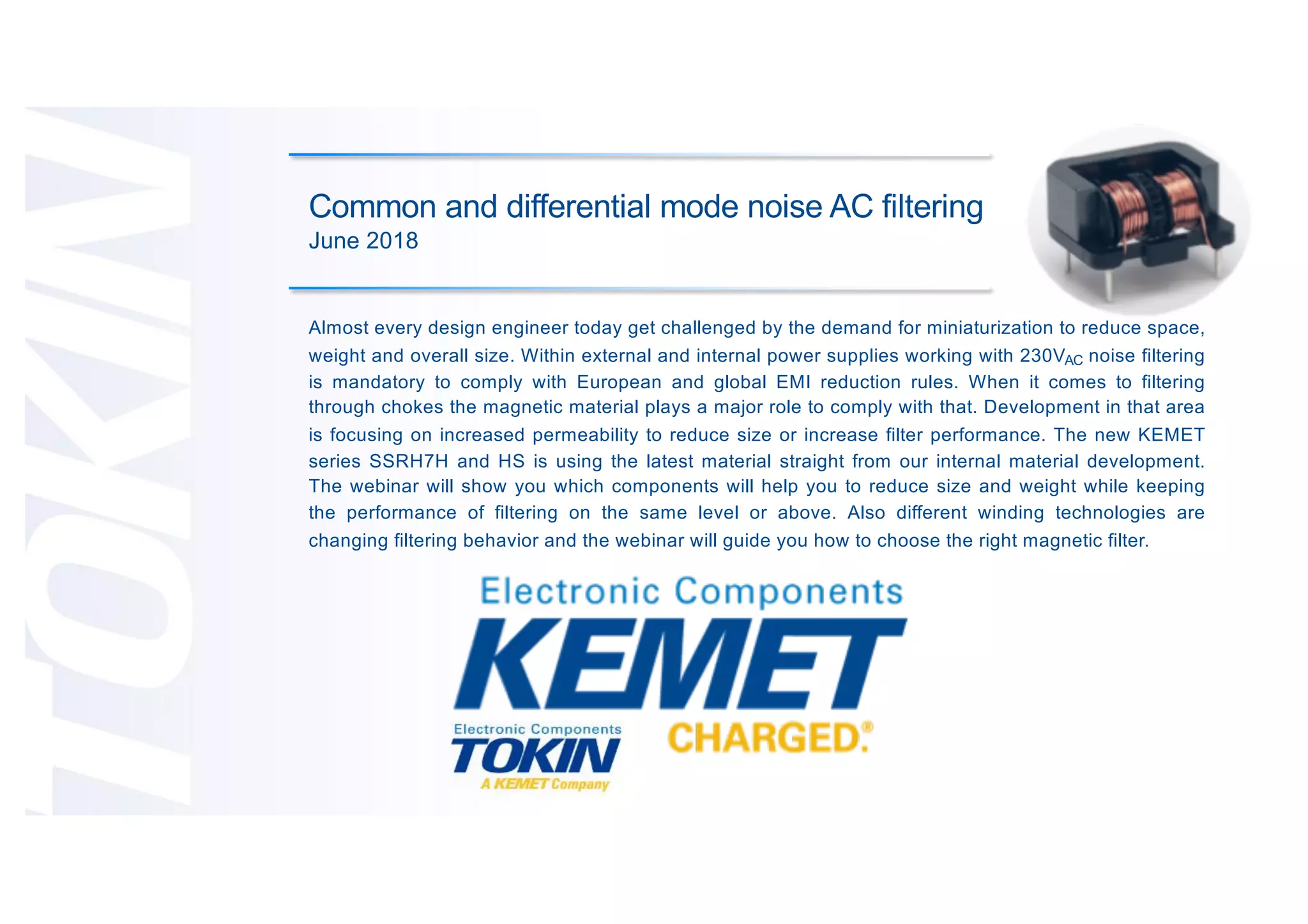
Almost every design engineer today get challenged by the demand for miniaturization to reduce space,
weight and overall size. Within external and internal power supplies working with 230VAC noise filtering
is mandatory to comply with European and global EMI reduction rules. When it comes to filtering
through chokes the magnetic material plays a major role to comply with that. Development in that area
is focusing on increased permeability to reduce size or increase filter performance. The new KEMET
series SSRH7H and HS is using the latest material straight from our internal material development.
The webinar will show you which components will help you to reduce size and weight while keeping
the performance of filtering on the same level or above. Also different winding technologies are
changing filtering behavior and the webinar will guide you how to choose the right magnetic filter.
Noise filtering
• Who is TOKIN, why does KEMET offer magnetic components ?
• EMC/EMI – the basics and general requirements
• How to filter conducted noise
• Common mode vs differential mode chokes
• Inductor basics
• Material and geometrical capabilities and other influence factors
• Component comparison with different permeability
• Application examples
• Safety standards and other material characteristics
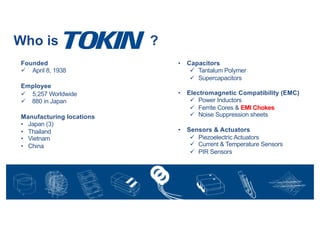
Founded
ü April 8, 1938
Employee
ü 5,257 Worldwide
ü 880 in Japan
Manufacturing locations
• Japan (3)
• Thailand
• Vietnam
• China
• Capacitors
ü Tantalum Polymer
ü Supercapacitors
• Electromagnetic Compatibility (EMC)
ü Power Inductors
ü Ferrite Cores & EMI Chokes
ü Noise Suppression sheets
• Sensors & Actuators
ü Piezoelectric Actuators
ü Current & Temperature Sensors
ü PIR Sensors
Who is ?
PRODUCTS
Capacitors
Inductors
Sensors
Actuators
EMI Suppression
PEOPLE
15,000
REVENUE
$1.1B USD
&
EMC
The Basics
Electro Magnetic Compatibility (EMC):
• The goal of electromagnetic compatibility, or EMC, is to design electronic systems that are
electromagnetically compatible with their environment.
• EMC requirements exist so that electronic systems designers have a set of guidelines that explain
the limits of what is considered electromagnetically compatible
• These standards have been adopted throughout much of Europe and were developed in 1985 by
CISPR ( a French committee)
(International Special Committee on Radio Interference)
EMC
The Basics
• The law makes it illegal to ALL electronic products that have not had their
conducted and radiated emissions measured and verified to be within the limits
set for by the international regulations
• EMC encompasses THREE main areas:
• Emission:
The generation of electromagnetic energy
• Susceptibility:
The tendency of equipment to malfunction due to emissions
• Immunity:
The ability of equipment to function in the presence of emissions
EMC
The Basics
• Different sets of regulations for different types of electronic products
• Devices that are marketed for use in commercial, industrial or business
environments are classified as Class A
• Devices that are marketed for use in residential environments
are classified as Class B
• In general the regulations for Class B devices are more stringent
than those for Class A devices
• Frequency spectrum scans deal with Average limits and Quasi Peak limits
– Average limit is as expected – the average
– Quasi Peak is determined by weighing signals according to their repetition rate
(which is a way of measuring their "annoyance factor." )
EMC
Frequency range & standards
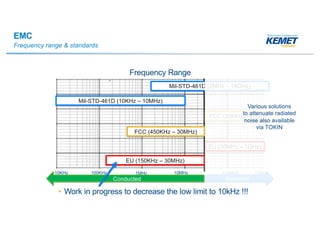
• Work in progress to decrease the low limit to 10kHz !!!
1GHz100MHz10MHz1MHz100KHz10KHz
RadiatedConducted
Mil-STD-461D (2MHz – 18GHz)
Mil-STD-461D (10KHz – 10MHz)
FCC (450KHz – 30MHz)
FCC (30MHz – 40GHz)
EU (150KHz – 30MHz)
EU (30MHz – 1GHz)
Frequency Range
Various solutions
to attenuate radiated
noise also available
via TOKIN
EMC measured
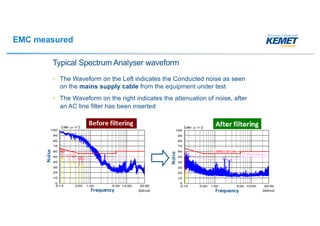
Typical Spectrum Analyser waveform
• The Waveform on the Left indicates the Conducted noise as seen
on the mains supply cable from the equipment under test
• The Waveform on the right indicates the attenuation of noise, after
an AC line filter has been inserted
Solve EMC issues successfully
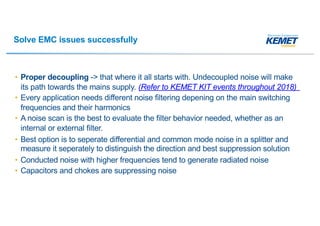
• Proper decoupling -> that where it all starts with. Undecoupled noise will make
its path towards the mains supply. (Refer to KEMET KIT events throughout 2018)
• Every application needs different noise filtering depening on the main switching
frequencies and their harmonics
• A noise scan is the best to evaluate the filter behavior needed, whether as an
internal or external filter.
• Best option is to seperate differential and common mode noise in a splitter and
measure it seperately to distinguish the direction and best suppression solution
• Conducted noise with higher frequencies tend to generate radiated noise
• Capacitors and chokes are suppressing noise
How to filter conducted noise
Required frequency range - 150kHz to 30MHz [EU]
• Noise filters use capacitors and inductors
– For 50/60Hz applications the supply frequency should not
be attenuated, but the high frequency noise should
– Capacitors have a high impedance at low frequencies,
however there is always a leakage current to ground
– Inductors have a low impedance at low frequencies with
no leakage current
• With higher frequencies (= noise)...
– Capacitors impedance reduces which guides noise to
ground
– Inductors impedance increases to block noise from
passing the component and therefore passing the line
Z
Z
Inductor/Choke (MAGNETIC)
Noise to block with High Impedance
Capacitor
Noise current lead to ground with
Low Impedance
Typical schematic, simple noise filter
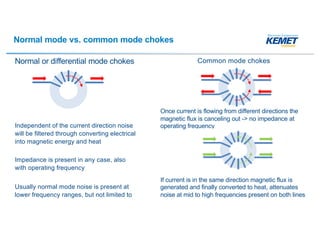
Common mode chokes
Once current is flowing from different directions the
magnetic flux is canceling out -> no impedance at
operating frequency
If current is in the same direction magnetic flux is
generated and finally converted to heat, attenuates
noise at mid to high frequencies present on both lines
Normal mode vs. common mode chokes
Normal or differential mode chokes
Independent of the current direction noise
will be filtered through converting electrical
into magnetic energy and heat
Impedance is present in any case, also
with operating frequency
Usually normal mode noise is present at
lower frequency ranges, but not limited to
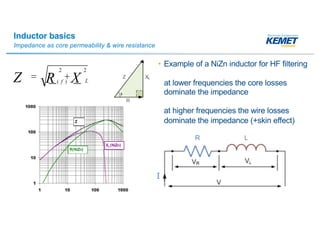
Inductor basics
Impedance as core permeability & wire resistance
• Example of a NiZn inductor for HF filtering
at lower frequencies the core losses
dominate the impedance
at higher frequencies the wire losses
dominate the impedance (+skin effect)
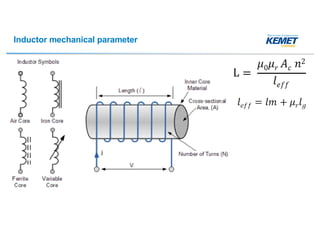
Inductor mechanical parameter
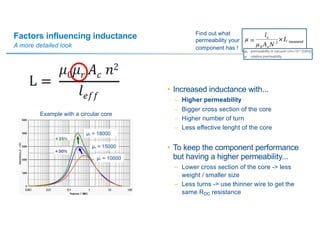
Factors influencing inductance
A more detailed look
• Increased inductance with...
– Higher permeability
– Bigger cross section of the core
– Higher number of turn
– Less effective lenght of the core
• To keep the component performance
but having a higher permeability...
– Lower cross section of the core -> less
weight / smaller size
– Less turns -> use thinner wire to get the
same RDC resistance
Example with a circular core
µr = 18000
µr = 15000
µr = 10000
Find out what
permeability your
component has !
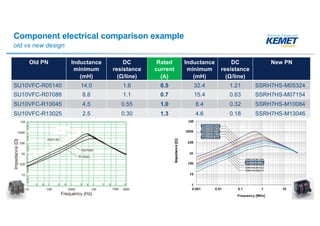
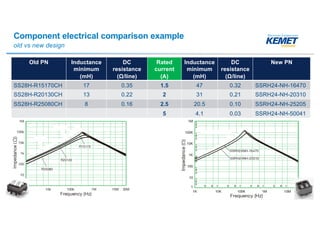
Component electrical comparison example
old vs new design
Old PN Inductance
minimum
(mH)
DC
resistance
(Ω/line)
Rated
current
(A)
Inductance
minimum
(mH)
DC
resistance
(Ω/line)
New PN
SU10VFC-R05140 14.0 1.6 0.5 32.4 1.21 SSRH7HS-M05324
SU10VFC-R07088 8.8 1.1 0.7 15.4 0.63 SSRH7HS-M07154
SU10VFC-R10045 4.5 0.55 1.0 8.4 0.32 SSRH7HS-M10084
SU10VFC-R13025 2.5 0.30 1.3 4.6 0.18 SSRH7HS-M13046
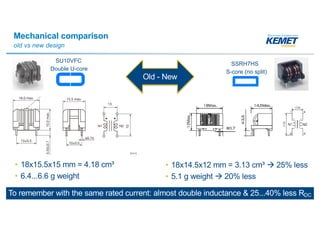
Mechanical comparison
old vs new design
• 18x15.5x15 mm = 4.18 cm³
• 6.4...6.6 g weight
SU10VFC
SSRH7HS
Old - New
• 18x14.5x12 mm = 3.13 cm³ à 25% less
• 5.1 g weight à 20% less
Double U-core
S-core (no split)
To remember with the same rated current: almost double inductance & 25...40% less RDC
Component electrical comparison example
old vs new design
Old PN Inductance
minimum
(mH)
DC
resistance
(Ω/line)
Rated
current
(A)
Inductance
minimum
(mH)
DC
resistance
(Ω/line)
New PN
SS28H-R15170CH 17 0.35 1.5 47 0.32 SSRH24-NH-16470
SS28H-R20130CH 13 0.22 2 31 0.21 SSRH24-NH-20310
SS28H-R25080CH 8 0.16 2.5 20.5 0.10 SSRH24-NH-25205
5 4.1 0.03 SSRH24-NH-50041
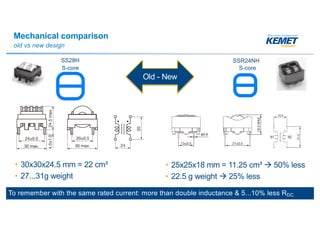
Mechanical comparison
old vs new design
• 30x30x24.5 mm = 22 cm³
• 27...31g weight
SS28H SSR24NH
Old - New
• 25x25x18 mm = 11.25 cm³ à 50% less
• 22.5 g weight à 25% less
S-core S-core
To remember with the same rated current: more than double inductance & 5...10% less RDC
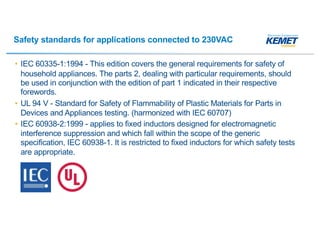
Safety standards for applications connected to 230VAC
• IEC 60335-1:1994 - This edition covers the general requirements for safety of
household appliances. The parts 2, dealing with particular requirements, should
be used in conjunction with the edition of part 1 indicated in their respective
forewords.
• UL 94 V - Standard for Safety of Flammability of Plastic Materials for Parts in
Devices and Appliances testing. (harmonized with IEC 60707)
• IEC 60938-2:1999 - applies to fixed inductors designed for electromagnetic
interference suppression and which fall within the scope of the generic
specification, IEC 60938-1. It is restricted to fixed inductors for which safety tests
are appropriate.
What can we
do together ?
G
et contact

Common and Differential Mode Noise AC Filtering

  • 1.
    Common and differentialmode noise AC filtering June 2018 Almost every design engineer today get challenged by the demand for miniaturization to reduce space, weight and overall size. Within external and internal power supplies working with 230VAC noise filtering is mandatory to comply with European and global EMI reduction rules. When it comes to filtering through chokes the magnetic material plays a major role to comply with that. Development in that area is focusing on increased permeability to reduce size or increase filter performance. The new KEMET series SSRH7H and HS is using the latest material straight from our internal material development. The webinar will show you which components will help you to reduce size and weight while keeping the performance of filtering on the same level or above. Also different winding technologies are changing filtering behavior and the webinar will guide you how to choose the right magnetic filter.
  • 2.
    Noise filtering • Whois TOKIN, why does KEMET offer magnetic components ? • EMC/EMI – the basics and general requirements • How to filter conducted noise • Common mode vs differential mode chokes • Inductor basics • Material and geometrical capabilities and other influence factors • Component comparison with different permeability • Application examples • Safety standards and other material characteristics
  • 3.
    Founded ü April 8,1938 Employee ü 5,257 Worldwide ü 880 in Japan Manufacturing locations • Japan (3) • Thailand • Vietnam • China • Capacitors ü Tantalum Polymer ü Supercapacitors • Electromagnetic Compatibility (EMC) ü Power Inductors ü Ferrite Cores & EMI Chokes ü Noise Suppression sheets • Sensors & Actuators ü Piezoelectric Actuators ü Current & Temperature Sensors ü PIR Sensors Who is ?
  • 4.
  • 5.
    EMC The Basics Electro MagneticCompatibility (EMC): • The goal of electromagnetic compatibility, or EMC, is to design electronic systems that are electromagnetically compatible with their environment. • EMC requirements exist so that electronic systems designers have a set of guidelines that explain the limits of what is considered electromagnetically compatible • These standards have been adopted throughout much of Europe and were developed in 1985 by CISPR ( a French committee) (International Special Committee on Radio Interference)
  • 6.
    EMC The Basics • Thelaw makes it illegal to ALL electronic products that have not had their conducted and radiated emissions measured and verified to be within the limits set for by the international regulations • EMC encompasses THREE main areas: • Emission: The generation of electromagnetic energy • Susceptibility: The tendency of equipment to malfunction due to emissions • Immunity: The ability of equipment to function in the presence of emissions
  • 7.
    EMC The Basics • Differentsets of regulations for different types of electronic products • Devices that are marketed for use in commercial, industrial or business environments are classified as Class A • Devices that are marketed for use in residential environments are classified as Class B • In general the regulations for Class B devices are more stringent than those for Class A devices • Frequency spectrum scans deal with Average limits and Quasi Peak limits – Average limit is as expected – the average – Quasi Peak is determined by weighing signals according to their repetition rate (which is a way of measuring their "annoyance factor." )
  • 8.
    EMC Frequency range &standards • Work in progress to decrease the low limit to 10kHz !!! 1GHz100MHz10MHz1MHz100KHz10KHz RadiatedConducted Mil-STD-461D (2MHz – 18GHz) Mil-STD-461D (10KHz – 10MHz) FCC (450KHz – 30MHz) FCC (30MHz – 40GHz) EU (150KHz – 30MHz) EU (30MHz – 1GHz) Frequency Range Various solutions to attenuate radiated noise also available via TOKIN
  • 9.
    EMC measured Typical SpectrumAnalyser waveform • The Waveform on the Left indicates the Conducted noise as seen on the mains supply cable from the equipment under test • The Waveform on the right indicates the attenuation of noise, after an AC line filter has been inserted
  • 10.
    Solve EMC issuessuccessfully • Proper decoupling -> that where it all starts with. Undecoupled noise will make its path towards the mains supply. (Refer to KEMET KIT events throughout 2018) • Every application needs different noise filtering depening on the main switching frequencies and their harmonics • A noise scan is the best to evaluate the filter behavior needed, whether as an internal or external filter. • Best option is to seperate differential and common mode noise in a splitter and measure it seperately to distinguish the direction and best suppression solution • Conducted noise with higher frequencies tend to generate radiated noise • Capacitors and chokes are suppressing noise
  • 11.
    How to filterconducted noise Required frequency range - 150kHz to 30MHz [EU] • Noise filters use capacitors and inductors – For 50/60Hz applications the supply frequency should not be attenuated, but the high frequency noise should – Capacitors have a high impedance at low frequencies, however there is always a leakage current to ground – Inductors have a low impedance at low frequencies with no leakage current • With higher frequencies (= noise)... – Capacitors impedance reduces which guides noise to ground – Inductors impedance increases to block noise from passing the component and therefore passing the line Z Z Inductor/Choke (MAGNETIC) Noise to block with High Impedance Capacitor Noise current lead to ground with Low Impedance Typical schematic, simple noise filter
  • 12.
    Common mode chokes Oncecurrent is flowing from different directions the magnetic flux is canceling out -> no impedance at operating frequency If current is in the same direction magnetic flux is generated and finally converted to heat, attenuates noise at mid to high frequencies present on both lines Normal mode vs. common mode chokes Normal or differential mode chokes Independent of the current direction noise will be filtered through converting electrical into magnetic energy and heat Impedance is present in any case, also with operating frequency Usually normal mode noise is present at lower frequency ranges, but not limited to
  • 13.
    Inductor basics Impedance ascore permeability & wire resistance • Example of a NiZn inductor for HF filtering at lower frequencies the core losses dominate the impedance at higher frequencies the wire losses dominate the impedance (+skin effect)
  • 14.
  • 15.
    Factors influencing inductance Amore detailed look • Increased inductance with... – Higher permeability – Bigger cross section of the core – Higher number of turn – Less effective lenght of the core • To keep the component performance but having a higher permeability... – Lower cross section of the core -> less weight / smaller size – Less turns -> use thinner wire to get the same RDC resistance Example with a circular core µr = 18000 µr = 15000 µr = 10000 Find out what permeability your component has !
  • 16.
    Component electrical comparisonexample old vs new design Old PN Inductance minimum (mH) DC resistance (Ω/line) Rated current (A) Inductance minimum (mH) DC resistance (Ω/line) New PN SU10VFC-R05140 14.0 1.6 0.5 32.4 1.21 SSRH7HS-M05324 SU10VFC-R07088 8.8 1.1 0.7 15.4 0.63 SSRH7HS-M07154 SU10VFC-R10045 4.5 0.55 1.0 8.4 0.32 SSRH7HS-M10084 SU10VFC-R13025 2.5 0.30 1.3 4.6 0.18 SSRH7HS-M13046
  • 17.
    Mechanical comparison old vsnew design • 18x15.5x15 mm = 4.18 cm³ • 6.4...6.6 g weight SU10VFC SSRH7HS Old - New • 18x14.5x12 mm = 3.13 cm³ à 25% less • 5.1 g weight à 20% less Double U-core S-core (no split) To remember with the same rated current: almost double inductance & 25...40% less RDC
  • 18.
    Component electrical comparisonexample old vs new design Old PN Inductance minimum (mH) DC resistance (Ω/line) Rated current (A) Inductance minimum (mH) DC resistance (Ω/line) New PN SS28H-R15170CH 17 0.35 1.5 47 0.32 SSRH24-NH-16470 SS28H-R20130CH 13 0.22 2 31 0.21 SSRH24-NH-20310 SS28H-R25080CH 8 0.16 2.5 20.5 0.10 SSRH24-NH-25205 5 4.1 0.03 SSRH24-NH-50041
  • 19.
    Mechanical comparison old vsnew design • 30x30x24.5 mm = 22 cm³ • 27...31g weight SS28H SSR24NH Old - New • 25x25x18 mm = 11.25 cm³ à 50% less • 22.5 g weight à 25% less S-core S-core To remember with the same rated current: more than double inductance & 5...10% less RDC
  • 20.
    Safety standards forapplications connected to 230VAC • IEC 60335-1:1994 - This edition covers the general requirements for safety of household appliances. The parts 2, dealing with particular requirements, should be used in conjunction with the edition of part 1 indicated in their respective forewords. • UL 94 V - Standard for Safety of Flammability of Plastic Materials for Parts in Devices and Appliances testing. (harmonized with IEC 60707) • IEC 60938-2:1999 - applies to fixed inductors designed for electromagnetic interference suppression and which fall within the scope of the generic specification, IEC 60938-1. It is restricted to fixed inductors for which safety tests are appropriate.
  • 21.
    What can we dotogether ? G et contact