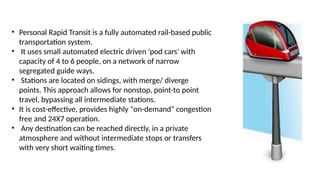
• Personal RapidTransit is a fully automated rail-based public
transportation system.
• It uses small automated electric driven 'pod cars' with
capacity of 4 to 6 people, on a network of narrow
segregated guide ways.
• Stations are located on sidings, with merge/ diverge
points. This approach allows for nonstop, point-to point
travel, bypassing all intermediate stations.
• It is cost-effective, provides highly "on-demand" congestion
free and 24X7 operation.
• Any destination can be reached directly, in a private
atmosphere and without intermediate stops or transfers
with very short waiting times.
3.
NEED OF PRTS!
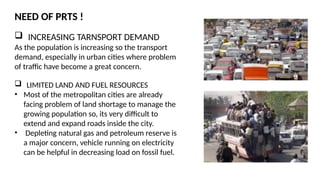
INCREASING TARNSPORT DEMAND
As the population is increasing so the transport
demand, especially in urban cities where problem
of traffic have become a great concern.
LIMITED LAND AND FUEL RESOURCES
• Most of the metropolitan cities are already
facing problem of land shortage to manage the
growing population so, its very difficult to
extend and expand roads inside the city.
• Depleting natural gas and petroleum reserve is
a major concern, vehicle running on electricity
can be helpful in decreasing load on fossil fuel.
4.
DEVELOPMENT OF PRTS!
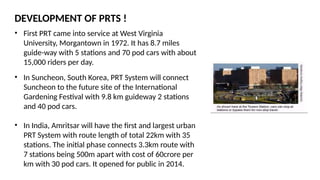
• First PRT came into service at West Virginia
University, Morgantown in 1972. It has 8.7 miles
guide-way with 5 stations and 70 pod cars with about
15,000 riders per day.
• In Suncheon, South Korea, PRT System will connect
Suncheon to the future site of the International
Gardening Festival with 9.8 km guideway 2 stations
and 40 pod cars.
• In India, Amritsar will have the first and largest urban
PRT System with route length of total 22km with 35
stations. The initial phase connects 3.3km route with
7 stations being 500m apart with cost of 60crore per
km with 30 pod cars. It opened for public in 2014.
5.
INFRASTRUCTURE
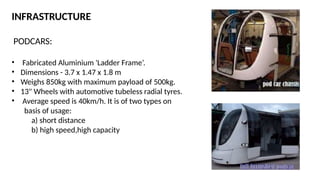
PODCARS:
• Fabricated Aluminium'Ladder Frame’.
• Dimensions - 3.7 x 1.47 x 1.8 m
• Weighs 850kg with maximum payload of 500kg.
• 13" Wheels with automotive tubeless radial tyres.
• Average speed is 40km/h. It is of two types on
basis of usage:
a) short distance
b) high speed,high capacity
6.
GUIDEWAYS
• The guidewaysare usually designed as elevated
systems with concrete and steel beams and columns.
• They are interconnected at " junctions " which allows
pod car to select various paths.
• Guideway density and extent is determined by
maximum walking distance to nearest station and
number of origin and destination point to be served.
• Typical Elevated Guideway Headroom for main road
crossings is 5.7m whereas 2.5m over pedestal crossing.
• Typical column weighs 10 tonnes with dead load
requirement of minimum 2.2kN/m².
• Guideways can be integrated into existing building
without significant strengthening or modifications.
7.
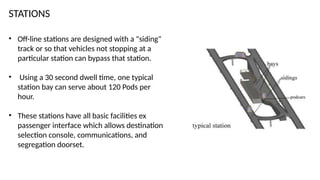
STATIONS
• Off-line stationsare designed with a "siding"
track or so that vehicles not stopping at a
particular station can bypass that station.
• Using a 30 second dwell time, one typical
station bay can serve about 120 Pods per
hour.
• These stations have all basic facilities ex
passenger interface which allows destination
selection console, communications, and
segregation doorset.
8.
SAFTEY AND SECURITY
•No human error so much safer than
vehicles on road.
• Running gear mechanism to prevent
derailment and grade-separated guideways
prevent conflict with pedestrians or
manually controlled vehicles.
• Public transit safety engineering
approaches, such as redundancy and self-
diagnosis of critical systems, are also
included in designs.
• Less crowded so less prone to terrorist
attacks.
APPLICATIONS
• Airport shuttles : connecting parking to
terminals etc.
• Private property developments: ex
educational institutes, private firms and
industry etc.
• Short distance urban connections:
connecting tourists spots etc.
• Faster outer suburban connections:
connecting industrial areas to city center
etc.
9.
CHARACTERISTICS
• PRT issustainable.
• PRT is safe.
• PRT produces zero local emission.
• Infrastructure fit within most urban
fabric.
• PRT offers a 24h, on- demand, direct
origin to destination service.
• PRT has relatively low capital costs.
• PRT is accessible for al
IMPEDIMENTS DEVELOPMENT
• There is very less tested.
• There is a lack of awareness of the concept.
• Would not produce much employment.
• Financial risk as implementing test program
requires substantial finance support.
• PRT may attract vandalism and pods may
be target of crime.
• Not feasible for rural areas.
10.
CASE STUDY PRT
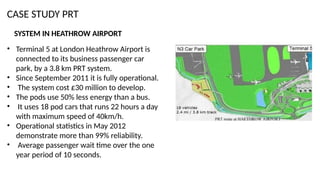
•Terminal 5 at London Heathrow Airport is
connected to its business passenger car
park, by a 3.8 km PRT system.
• Since September 2011 it is fully operational.
• The system cost £30 million to develop.
• The pods use 50% less energy than a bus.
• It uses 18 pod cars that runs 22 hours a day
with maximum speed of 40km/h.
• Operational statistics in May 2012
demonstrate more than 99% reliability.
• Average passenger wait time over the one
year period of 10 seconds.
SYSTEM IN HEATHROW AIRPORT
11.
PRT SYSTEM INAMRITSAR
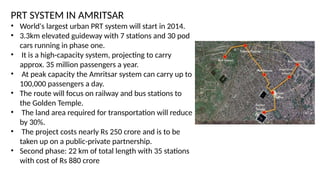
• World's largest urban PRT system will start in 2014.
• 3.3km elevated guideway with 7 stations and 30 pod
cars running in phase one.
• It is a high-capacity system, projecting to carry
approx. 35 million passengers a year.
• At peak capacity the Amritsar system can carry up to
100,000 passengers a day.
• The route will focus on railway and bus stations to
the Golden Temple.
• The land area required for transportation will reduce
by 30%.
• The project costs nearly Rs 250 crore and is to be
taken up on a public-private partnership.
• Second phase: 22 km of total length with 35 stations
with cost of Rs 880 crore
12.
CONCLUSION
• Personal RapidTransit System is an emerging approach to sustainable
transportation. It fulfils almost all the requirements of modern transportation.
• It provides a good solution to the increasing transportation demand.
• It provides solution to limited land resource and helps in decreasing burden on
fossil fuel resource.
• Its cost effectiveness make it accessible to every individual.
• Thus helps in economic development of the society



![Lhr rapid transit[1]](https://cdn.slidesharecdn.com/ss_thumbnails/lhrrapidtransit1-101011132606-phpapp02-thumbnail.jpg?width=640&height=640&fit=bounds)
![Lhr rapid transit[1]](https://cdn.slidesharecdn.com/ss_thumbnails/lhrrapidtransit1-101011133302-phpapp02-thumbnail.jpg?width=640&height=640&fit=bounds)


