CCSE Solar Conference:
Distributed Generation Feasibility
       Presented by Jon Fortune, P.E.


          September 29th, 2009
Overview
    •   Introduction
    •   Terms
    •   Feasibility Studies
    •   Example: Photovoltaics
    •   Site Specifics
    •   Utility Tariffs
    •   Critical Economic Components
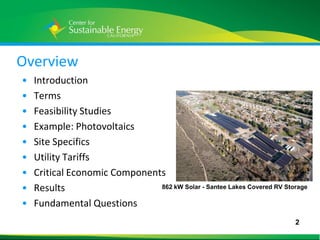
    •   Results                    862 kW Solar - Santee Lakes Covered RV Storage

    •   Fundamental Questions
                                                                             2
2
California Center for Sustainable Energy
Greening Your World!
• An independent voice on energy issues and a trusted,
  unbiased resource for businesses, consumers, public
  agencies and local governments offering balanced,
  objective information throughout the San Diego community
  and California

• The California Center for Sustainable Energy is a nonprofit
  corporation that helps San Diegans and others adopt
  greener practices and save energy and money through
  rebates, technical assistance and education.
                                                                3
3
CCSE’s Energy Advisory Service
        Empowering clients with objective information and sound
                 analysis to green your bottom line

    Service Offerings
    •   IDENTIFYING ENERGY EFFICIENCY OPPORTUNITIES
         •   Determining how much energy you are consuming and evaluating what measures will save you money
    •   DEVELOPING RENEWABLE ENERGY SOLUTIONS
         •   Evaluating and designing integrated, practical alternative energy systems for maximum efficiency and minimum
             costs
    •   QUANTIFYING YOUR CARBON FOOTPRINT
         •   Developing carbon reduction strategies and greenhouse gas accounting that meet regulatory requirements
    •   CREATING INCENTIVE AND OUTREACH PROGRAMS
         •   Identifying potential financial assistance through incentives and rebates and developing training, outreach and
             partnerships
    •   ESTABLISHING MANAGEMENT AND GREEN BUILDING SOLUTIONS
         •   Applying systematic principles and approaches to energy efficiency and environmental considerations in all phases
             of building development                                                                                          4
4
Terms
• kW: kilowatt = Unit of instantaneous power. (speedometer)
• kWh: kilowatt-hour = Unit of energy used over time.
  (odometer)
• Tariff: utility rate schedule.
• DG: Distributed Generation. Name for on-site power usually
  less than 20 MW.
• PV: Photovoltaics. Technological term for direct solar
  electricity. Different than electricity generation from thermal
  generation (aka solar thermal trough, dish, or power tower)
                                                                5
5
Why Feasibility Assessments?
• Most organizations have their core competencies and do not
  have time to become experts
    • Energy costs are just one component of providing the main services your
      organization delivers. New technologies and policy changes can quickly and
      dramatically change the cost-benefit analysis.
• Value of systems is unique per application
    • No “one size fits all” answers
    • Value differs by site, load, tariff, utility provider, etc.
• Same terminology does not mean the same performance/value
    • 100 kW of Wind ≠ 100 kW of PV ≠ 100 kW Fuel Cell
    • kW may be Alternating Current (AC) or Direct Current (DC)
• Feasibility reports direct action by defining constraints and
  objectives                                                                       6
6
Is it worth the added cost?
• Client X desired additional solar power to reduce utility costs and
  prepare for future expansion of water treatment
    • Already had solar installed onsite with positive outcome
    • Prepared an RFP and received bids from reputable developers for desired
      installation of 500-1500kW of new solar
• CCSE was hired during the RFP process, conducted a thorough analysis
  of proposed meters and system sizes
• Results:
    • Determined that switching to a new tariff for one meter would yield ~$16k
      in savings without solar
    • Only 140kW of solar on second meter (with a change in tariff) would yield
      maximum savings
    • Identified true cost of proposed system sizes, maximizing avoided cost and
      minimizing operational cost                                                  7
7
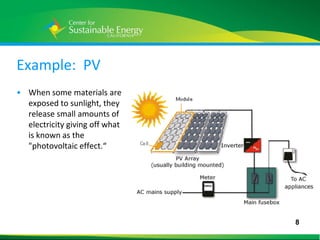
Example: PV
• When some materials are
  exposed to sunlight, they
  release small amounts of
  electricity giving off what
  is known as the
  "photovoltaic effect.“


                                8
8
Is PV a good fit?
    • Advantages
      • Easily deployable and scalable
      • More predictable than wind
      • Produces energy during Peak times (most expensive/most valuable
        times)
      • Minimal required maintenance (cleaning) produces excellent returns

    • Disadvantages
      • May not cover peak times completely
      • Will not reduce site demand translating into no demand cost savings
      • Cost per kWh can appear higher than other technologies such as
        wind and IC engines

                                                                              9
9
Collect Data to Identify Constraints
• How does your site use energy per
  day/month/year?
     • Collect at least 12 months of discrete load data from utility for kW
       and kWh during On, Semi, and Off-Peak periods of each month
     • Net-metering savings work when your load can be met by a PV system
       1MW or smaller

• How will your site use energy in the future?
     • Identify future energy plans, potential for shutdowns, expansion of
       loads

• How much square footage is available for PV?
     • Are there dual benefit opportunities such as covered parking or LEED
       certifications?                                                        10
10
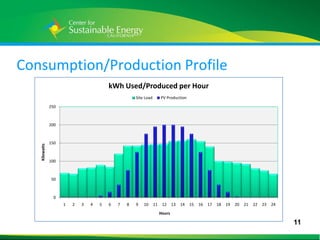
Consumption/Production Profile
                                           kWh Used/Produced per Hour
                                                       Site Load        PV Production

                 250


                 200


                 150
     Kilowatts


                 100


                  50


                   0
                       1   2   3   4   5   6   7   8   9   10      11    12     13   14   15   16   17   18   19   20   21   22   23   24
                                                                        Hours

                                                                                                                                            11
11
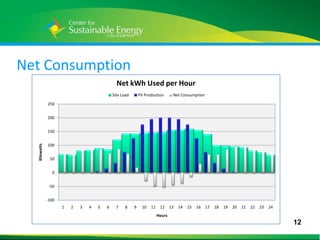
Net Consumption
                                                  Net kWh Used per Hour
                                                Site Load       PV Production       Net Consumption

                 250


                 200


                 150


                 100
     Kilowatts


                  50


                   0


                  -50


                 -100
                        1   2   3   4   5   6     7    8    9    10   11    12     13   14   15   16   17   18   19   20   21   22   23   24
                                                                           Hours
                                                                                                                                               12
12
Tariffs, Tariffs, Tariffs
• Unique opportunities for Water
  Agencies
• Some new – Critical Peak Pricing, limited
  size feed-in tariff
• Some closed – Non-time of use
• Most common – Large Commercial,
  Agricultural
                                              13
13
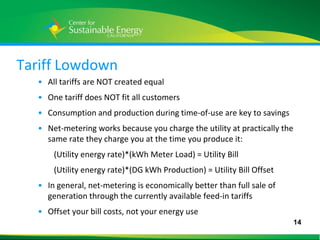
Tariff Lowdown
     • All tariffs are NOT created equal
     • One tariff does NOT fit all customers
     • Consumption and production during time-of-use are key to savings
     • Net-metering works because you charge the utility at practically the
       same rate they charge you at the time you produce it:
         (Utility energy rate)*(kWh Meter Load) = Utility Bill
         (Utility energy rate)*(DG kWh Production) = Utility Bill Offset
     • In general, net-metering is economically better than full sale of
       generation through the currently available feed-in tariffs
     • Offset your bill costs, not your energy use
                                                                              14
14
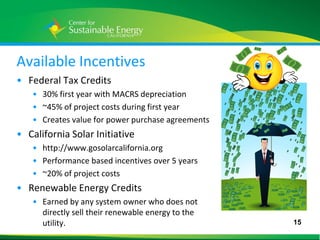
Available Incentives
• Federal Tax Credits
     • 30% first year with MACRS depreciation
     • ~45% of project costs during first year
     • Creates value for power purchase agreements
• California Solar Initiative
     • http://www.gosolarcalifornia.org
     • Performance based incentives over 5 years
     • ~20% of project costs
• Renewable Energy Credits
     • Earned by any system owner who does not
       directly sell their renewable energy to the
       utility.                                      15
15
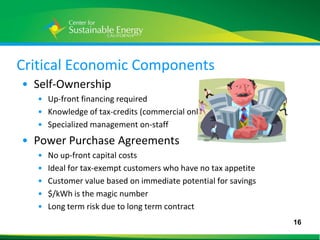
Critical Economic Components
 • Self-Ownership
     • Up-front financing required
     • Knowledge of tax-credits (commercial only)
     • Specialized management on-staff
 • Power Purchase Agreements
     •   No up-front capital costs
     •   Ideal for tax-exempt customers who have no tax appetite
     •   Customer value based on immediate potential for savings
     •   $/kWh is the magic number
     •   Long term risk due to long term contract
                                                                   16
16
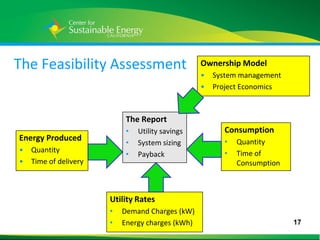
The Feasibility Assessment                         Ownership Model
                                                   •   System management
                                                   •   Project Economics


                             The Report
                             •   Utility savings         Consumption
 Energy Produced                                         •
                             •   System sizing               Quantity
 •   Quantity                                            •
                             •   Payback                     Time of
 •   Time of delivery                                        Consumption


                        Utility Rates
                        •   Demand Charges (kW)
                        •   Energy charges (kWh)                           17
17
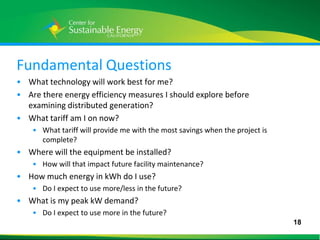
Fundamental Questions
• What technology will work best for me?
• Are there energy efficiency measures I should explore before
  examining distributed generation?
• What tariff am I on now?
     • What tariff will provide me with the most savings when the project is
       complete?
• Where will the equipment be installed?
     • How will that impact future facility maintenance?
• How much energy in kWh do I use?
     • Do I expect to use more/less in the future?
• What is my peak kW demand?
     • Do I expect to use more in the future?
                                                                               18
18
Fundamental Questions
• How will I finance this project?
     • What incentives are available and for how long?
• Can I lease to own?
• What are the maintenance requirements of this equipment?
• What is the life-cycle of this equipment?
     • Will the performance degrade and by how much?


                                                             19
19
Bottom Line
• A independently validated feasibility
  assessment answers the fundamental business
  question about the dollar value of energy
  generated from solar.


                                            20
20
Thank You!  Contact Me:
              Jon Fortune, P.E.
      Manager, Energy Advisory Service
       jon.fortune@energycenter.org
                858-244-1196


                                         21
21

Distributed Generation Feasibility

  • 1.
    CCSE Solar Conference: DistributedGeneration Feasibility Presented by Jon Fortune, P.E. September 29th, 2009
  • 2.
    Overview • Introduction • Terms • Feasibility Studies • Example: Photovoltaics • Site Specifics • Utility Tariffs • Critical Economic Components • Results 862 kW Solar - Santee Lakes Covered RV Storage • Fundamental Questions 2 2
  • 3.
    California Center forSustainable Energy Greening Your World! • An independent voice on energy issues and a trusted, unbiased resource for businesses, consumers, public agencies and local governments offering balanced, objective information throughout the San Diego community and California • The California Center for Sustainable Energy is a nonprofit corporation that helps San Diegans and others adopt greener practices and save energy and money through rebates, technical assistance and education. 3 3
  • 4.
    CCSE’s Energy AdvisoryService Empowering clients with objective information and sound analysis to green your bottom line Service Offerings • IDENTIFYING ENERGY EFFICIENCY OPPORTUNITIES • Determining how much energy you are consuming and evaluating what measures will save you money • DEVELOPING RENEWABLE ENERGY SOLUTIONS • Evaluating and designing integrated, practical alternative energy systems for maximum efficiency and minimum costs • QUANTIFYING YOUR CARBON FOOTPRINT • Developing carbon reduction strategies and greenhouse gas accounting that meet regulatory requirements • CREATING INCENTIVE AND OUTREACH PROGRAMS • Identifying potential financial assistance through incentives and rebates and developing training, outreach and partnerships • ESTABLISHING MANAGEMENT AND GREEN BUILDING SOLUTIONS • Applying systematic principles and approaches to energy efficiency and environmental considerations in all phases of building development 4 4
  • 5.
    Terms • kW: kilowatt= Unit of instantaneous power. (speedometer) • kWh: kilowatt-hour = Unit of energy used over time. (odometer) • Tariff: utility rate schedule. • DG: Distributed Generation. Name for on-site power usually less than 20 MW. • PV: Photovoltaics. Technological term for direct solar electricity. Different than electricity generation from thermal generation (aka solar thermal trough, dish, or power tower) 5 5
  • 6.
    Why Feasibility Assessments? •Most organizations have their core competencies and do not have time to become experts • Energy costs are just one component of providing the main services your organization delivers. New technologies and policy changes can quickly and dramatically change the cost-benefit analysis. • Value of systems is unique per application • No “one size fits all” answers • Value differs by site, load, tariff, utility provider, etc. • Same terminology does not mean the same performance/value • 100 kW of Wind ≠ 100 kW of PV ≠ 100 kW Fuel Cell • kW may be Alternating Current (AC) or Direct Current (DC) • Feasibility reports direct action by defining constraints and objectives 6 6
  • 7.
    Is it worththe added cost? • Client X desired additional solar power to reduce utility costs and prepare for future expansion of water treatment • Already had solar installed onsite with positive outcome • Prepared an RFP and received bids from reputable developers for desired installation of 500-1500kW of new solar • CCSE was hired during the RFP process, conducted a thorough analysis of proposed meters and system sizes • Results: • Determined that switching to a new tariff for one meter would yield ~$16k in savings without solar • Only 140kW of solar on second meter (with a change in tariff) would yield maximum savings • Identified true cost of proposed system sizes, maximizing avoided cost and minimizing operational cost 7 7
  • 8.
    Example: PV • Whensome materials are exposed to sunlight, they release small amounts of electricity giving off what is known as the "photovoltaic effect.“ 8 8
  • 9.
    Is PV agood fit? • Advantages • Easily deployable and scalable • More predictable than wind • Produces energy during Peak times (most expensive/most valuable times) • Minimal required maintenance (cleaning) produces excellent returns • Disadvantages • May not cover peak times completely • Will not reduce site demand translating into no demand cost savings • Cost per kWh can appear higher than other technologies such as wind and IC engines 9 9
  • 10.
    Collect Data toIdentify Constraints • How does your site use energy per day/month/year? • Collect at least 12 months of discrete load data from utility for kW and kWh during On, Semi, and Off-Peak periods of each month • Net-metering savings work when your load can be met by a PV system 1MW or smaller • How will your site use energy in the future? • Identify future energy plans, potential for shutdowns, expansion of loads • How much square footage is available for PV? • Are there dual benefit opportunities such as covered parking or LEED certifications? 10 10
  • 11.
    Consumption/Production Profile kWh Used/Produced per Hour Site Load PV Production 250 200 150 Kilowatts 100 50 0 1 2 3 4 5 6 7 8 9 10 11 12 13 14 15 16 17 18 19 20 21 22 23 24 Hours 11 11
  • 12.
    Net Consumption Net kWh Used per Hour Site Load PV Production Net Consumption 250 200 150 100 Kilowatts 50 0 -50 -100 1 2 3 4 5 6 7 8 9 10 11 12 13 14 15 16 17 18 19 20 21 22 23 24 Hours 12 12
  • 13.
    Tariffs, Tariffs, Tariffs •Unique opportunities for Water Agencies • Some new – Critical Peak Pricing, limited size feed-in tariff • Some closed – Non-time of use • Most common – Large Commercial, Agricultural 13 13
  • 14.
    Tariff Lowdown • All tariffs are NOT created equal • One tariff does NOT fit all customers • Consumption and production during time-of-use are key to savings • Net-metering works because you charge the utility at practically the same rate they charge you at the time you produce it: (Utility energy rate)*(kWh Meter Load) = Utility Bill (Utility energy rate)*(DG kWh Production) = Utility Bill Offset • In general, net-metering is economically better than full sale of generation through the currently available feed-in tariffs • Offset your bill costs, not your energy use 14 14
  • 15.
    Available Incentives • FederalTax Credits • 30% first year with MACRS depreciation • ~45% of project costs during first year • Creates value for power purchase agreements • California Solar Initiative • http://www.gosolarcalifornia.org • Performance based incentives over 5 years • ~20% of project costs • Renewable Energy Credits • Earned by any system owner who does not directly sell their renewable energy to the utility. 15 15
  • 16.
    Critical Economic Components • Self-Ownership • Up-front financing required • Knowledge of tax-credits (commercial only) • Specialized management on-staff • Power Purchase Agreements • No up-front capital costs • Ideal for tax-exempt customers who have no tax appetite • Customer value based on immediate potential for savings • $/kWh is the magic number • Long term risk due to long term contract 16 16
  • 17.
    The Feasibility Assessment Ownership Model • System management • Project Economics The Report • Utility savings Consumption Energy Produced • • System sizing Quantity • Quantity • • Payback Time of • Time of delivery Consumption Utility Rates • Demand Charges (kW) • Energy charges (kWh) 17 17
  • 18.
    Fundamental Questions • Whattechnology will work best for me? • Are there energy efficiency measures I should explore before examining distributed generation? • What tariff am I on now? • What tariff will provide me with the most savings when the project is complete? • Where will the equipment be installed? • How will that impact future facility maintenance? • How much energy in kWh do I use? • Do I expect to use more/less in the future? • What is my peak kW demand? • Do I expect to use more in the future? 18 18
  • 19.
    Fundamental Questions • Howwill I finance this project? • What incentives are available and for how long? • Can I lease to own? • What are the maintenance requirements of this equipment? • What is the life-cycle of this equipment? • Will the performance degrade and by how much? 19 19
  • 20.
    Bottom Line • Aindependently validated feasibility assessment answers the fundamental business question about the dollar value of energy generated from solar. 20 20
  • 21.
    Thank You! Contact Me: Jon Fortune, P.E. Manager, Energy Advisory Service jon.fortune@energycenter.org 858-244-1196 21 21