Are You Cashing in
on the Need for
Green Energy?
By: April Scarlett
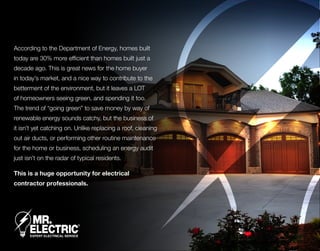
According to the Department of Energy, homes built
today are 30% more efficient than homes built just a
decade ago. This is great news for the home buyer
in today’s market, and a nice way to contribute to the
betterment of the environment, but it leaves a LOT
of homeowners seeing green, and spending it too.
The trend of “going green” to save money by way of
renewable energy sounds catchy, but the business of
it isn’t yet catching on. Unlike replacing a roof, cleaning
out air ducts, or performing other routine maintenance
for the home or business, scheduling an energy audit
just isn’t on the radar of typical residents.
This is a huge opportunity for electrical
contractor professionals.
How many homes in your market
were built before 2006?
If we look at a 32 year housing study by the U.S. Department of Housing and Urban Development, we see a near double
growth rate for housing units from 366,000 units in 1975 to 713,000 units in 2005. Now compare that to a report by the U.S.
Census Bureau in 2015 that shows 743,000 completed homes built for the single month of July. Even if homeowners are
selling their old homes to move into modern, more efficient ones, there is an entire, younger generation moving into older
homes, but with a more modern mindset.
Any home built before 2006, that hasn’t been upgraded to be
energy efficient, is a prospective energy audit customer.
These younger homeowners of older homes may be greenhorns
when it comes to property ownership, but they are green-seekers
when it comes to saving money and protecting the environment.
These are your ideal target market for the residential energy audit
and energy management industry.
What is Energy Management?
Energy management is the process of using reliable and renewable energy to produce the most efficient and
environmentally friendly facilities. An energy audit, or energy assessment, is the means to determine energy management.
The ultimate goal of an audit is to propose solutions to reduce energy consumption and save money.
Characteristics of a Home or Commercial Energy Audit
• Assessing the physical barrier between the conditioned and unconditioned
environment of a structure, or the building envelope, regarding the flow/
resistance to air, water, heat/cool, light and noise.
• Determining wattage for appliances, lighting, HVAC/cooling, and other
use of electronics based on structure, climate, and consumer behavior.
• Proposing scope of work to resolve energy loss/lessen consumption in
a way that is financially, environmentally and physically beneficial to the
consumer.
The Energy Auditing Industry
Thanks to the headlines concerning global warming, climate change is at the forefront of discussions across the globe,
and not just in environmental advocacy circles. Individuals, businesses and governments have been researching possible
methods to significantly reduce the carbon footprint of humans on our planet. It began with the scientific community taking
stock of the damage already done, and reporting it to governments worldwide. In response, incentives were created for
business and industry sectors to find ways to reduce energy consumption, and create cleaner methods of conducting
business.
In addition to helping reverse the trend toward destroying planet earth, private sector corporations began to notice the
benefits long-term to their bottom line, and now lead the way as influencers in the energy conservation market. The RE100
is a collaborative, global initiative of influential businesses committed to 100% renewable electricity, working to massively
increase demand for renewable energy.
As reported by the RE100, the private sector accounts for half of the world’s electricity consumption. The goal
of their initiative is “to accelerate the transformation of the global energy market and aid the transition to a low carbon
economy.”
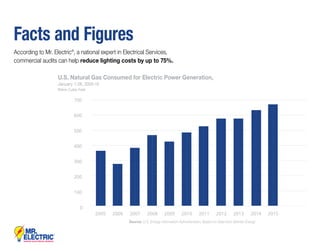
Facts and Figures
According to Mr. Electric®
, a national expert in Electrical Services,
commercial audits can help reduce lighting costs by up to 75%.
Source: U.S. Energy Information Administration, Based on Data from Betnek Energy
U.S. Natural Gas Consumed for Electric Power Generation,
January 1-28, 2005-15
Billion Cubic Feet
700
2005 2006 2007 2008 2009 2010 2011 2012 2013 2014 2015
600
500
400
300
200
100
0
2002 2003 2004 2005 2006 2007 2008 2009 2010 2011 2012
2013 2014
12.5
10.0
7.5
5.0
2.5
0.0
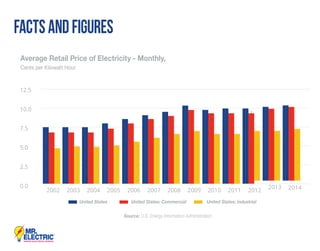
FactsandFigures
Source: U.S. Energy Information Administration
United States United States: Commercial United States: Industrial
Average Retail Price of Electricity - Monthly,
Cents per Kilowatt Hour
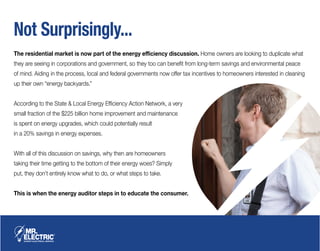
Not Surprisingly...
The residential market is now part of the energy efficiency discussion. Home owners are looking to duplicate what
they are seeing in corporations and government, so they too can benefit from long-term savings and environmental peace
of mind. Aiding in the process, local and federal governments now offer tax incentives to homeowners interested in cleaning
up their own “energy backyards.”
According to the State & Local Energy Efficiency Action Network, a very
small fraction of the $225 billion home improvement and maintenance
is spent on energy upgrades, which could potentially result
in a 20% savings in energy expenses.
With all of this discussion on savings, why then are homeowners
taking their time getting to the bottom of their energy woes? Simply
put, they don’t entirely know what to do, or what steps to take.
This is when the energy auditor steps in to educate the consumer.
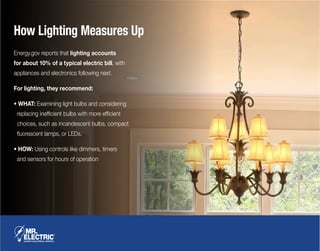
How Lighting Measures Up
Energy.gov reports that lighting accounts
for about 10% of a typical electric bill, with
appliances and electronics following next.
For lighting, they recommend:
• WHAT: Examining light bulbs and considering
replacing inefficient bulbs with more efficient
choices, such as incandescent bulbs, compact
fluorescent lamps, or LEDs.
• HOW: Using controls like dimmers, timers
and sensors for hours of operation
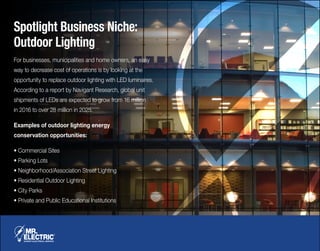
Spotlight Business Niche:
Outdoor Lighting
For businesses, municipalities and home owners, an easy
way to decrease cost of operations is by looking at the
opportunity to replace outdoor lighting with LED luminaires.
According to a report by Navigant Research, global unit
shipments of LEDs are expected to grow from 16 million
in 2016 to over 28 million in 2025.
Examples of outdoor lighting energy
conservation opportunities:
• Commercial Sites
• Parking Lots
• Neighborhood/Association Street Lighting
• Residential Outdoor Lighting
• City Parks
• Private and Public Educational Institutions
Case and Point
Dean Ford owns Mr. Electric®
of Victoria, in British Columbia, Canada. He currently does 18-25 Commercial Energy Audits
per month that range in estimates from $2,500 to $450,000 dollars Canadian. Ford was seeing a slow increase in audit
interest each year, until he hired a Commercial Accounts Manager, and then his auditing business exploded. When Ford
was asked about whether or not his customers were equally as interested in the environmental aspects of an audit, or
mostly the savings, he answered that it is almost always the savings, and for good reason.
“We did one quote recently that was $75,000, had a $38,000 rebate, and the customer was going to pocket $496,000 over
the 12 year life span of the bulbs,” Ford said.
Ford maintains that energy audits and proposed solutions can impact commercial customers in more ways than one.
“With the ever constant restraints put on business owners these days, introducing them to ways of increasing their bottom
line, by not over paying on simple things like utilities, has a dramatic effect on their day-to-day operations,” he said. “Stores
are lit better, stores’ lighting is consistent throughout, maintenance costs go way down, and profits can go up. It’s the
perfect storm.”
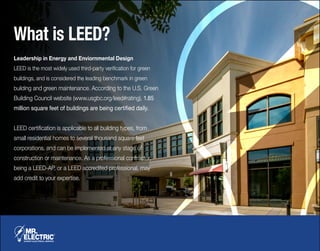
What is LEED?
Leadership in Energy and Enviornmental Design
LEED is the most widely used third-party verification for green
buildings, and is considered the leading benchmark in green
building and green maintenance. According to the U.S. Green
Building Council website (www.usgbc.org/leed#rating), 1.85
million square feet of buildings are being certified daily.
LEED certification is applicable to all building types, from
small residential homes to several thousand square feet
corporations, and can be implemented at any stage of
construction or maintenance. As a professional contractor,
being a LEED-AP, or a LEED accredited professional, may
add credit to your expertise.
It’s Easy Being Green
With so much global economic support for energy conservation
and a healthier environment, it’s downright trendy to be in on
the Green movement. According to the Energy Efficiency
Market Report, energy efficiency is becoming an established
financial market segment as a result of “the availability of a
greater range of financial products, models and intermediaries
to facilitate investment.” These include the implementation of
specialized entities, Clean energy bonds, climate bonds and
green bonds, as well as on-bill financing programs like PACE
(Property Assessed clean Energy).
With giant organizations like the CDP motivating corporations and
cities to disclose their environmental impact, the Paris Talks of 2015
bringing world leaders together on the topic, and week-long events
such as Climate Week in New York City (hosted by the Climate
Group), the need for energy conservation professionals isn’t hard
to fathom.
1010 N. University Parks Dr, Waco, TX 76707
Visit go.dwyr.com/energy to learn how
Mr. Electric®
franchisee’s benefit
from commercial energy audits
or Call today 866-523-2870

FS-MRE-ECM-Whitepaper-1016-REV2

  • 1.
    Are You Cashingin on the Need for Green Energy? By: April Scarlett
  • 2.
    According to theDepartment of Energy, homes built today are 30% more efficient than homes built just a decade ago. This is great news for the home buyer in today’s market, and a nice way to contribute to the betterment of the environment, but it leaves a LOT of homeowners seeing green, and spending it too. The trend of “going green” to save money by way of renewable energy sounds catchy, but the business of it isn’t yet catching on. Unlike replacing a roof, cleaning out air ducts, or performing other routine maintenance for the home or business, scheduling an energy audit just isn’t on the radar of typical residents. This is a huge opportunity for electrical contractor professionals.
  • 3.
    How many homesin your market were built before 2006? If we look at a 32 year housing study by the U.S. Department of Housing and Urban Development, we see a near double growth rate for housing units from 366,000 units in 1975 to 713,000 units in 2005. Now compare that to a report by the U.S. Census Bureau in 2015 that shows 743,000 completed homes built for the single month of July. Even if homeowners are selling their old homes to move into modern, more efficient ones, there is an entire, younger generation moving into older homes, but with a more modern mindset. Any home built before 2006, that hasn’t been upgraded to be energy efficient, is a prospective energy audit customer. These younger homeowners of older homes may be greenhorns when it comes to property ownership, but they are green-seekers when it comes to saving money and protecting the environment. These are your ideal target market for the residential energy audit and energy management industry.
  • 4.
    What is EnergyManagement? Energy management is the process of using reliable and renewable energy to produce the most efficient and environmentally friendly facilities. An energy audit, or energy assessment, is the means to determine energy management. The ultimate goal of an audit is to propose solutions to reduce energy consumption and save money. Characteristics of a Home or Commercial Energy Audit • Assessing the physical barrier between the conditioned and unconditioned environment of a structure, or the building envelope, regarding the flow/ resistance to air, water, heat/cool, light and noise. • Determining wattage for appliances, lighting, HVAC/cooling, and other use of electronics based on structure, climate, and consumer behavior. • Proposing scope of work to resolve energy loss/lessen consumption in a way that is financially, environmentally and physically beneficial to the consumer.
  • 5.
    The Energy AuditingIndustry Thanks to the headlines concerning global warming, climate change is at the forefront of discussions across the globe, and not just in environmental advocacy circles. Individuals, businesses and governments have been researching possible methods to significantly reduce the carbon footprint of humans on our planet. It began with the scientific community taking stock of the damage already done, and reporting it to governments worldwide. In response, incentives were created for business and industry sectors to find ways to reduce energy consumption, and create cleaner methods of conducting business. In addition to helping reverse the trend toward destroying planet earth, private sector corporations began to notice the benefits long-term to their bottom line, and now lead the way as influencers in the energy conservation market. The RE100 is a collaborative, global initiative of influential businesses committed to 100% renewable electricity, working to massively increase demand for renewable energy. As reported by the RE100, the private sector accounts for half of the world’s electricity consumption. The goal of their initiative is “to accelerate the transformation of the global energy market and aid the transition to a low carbon economy.”
  • 6.
    Facts and Figures Accordingto Mr. Electric® , a national expert in Electrical Services, commercial audits can help reduce lighting costs by up to 75%. Source: U.S. Energy Information Administration, Based on Data from Betnek Energy U.S. Natural Gas Consumed for Electric Power Generation, January 1-28, 2005-15 Billion Cubic Feet 700 2005 2006 2007 2008 2009 2010 2011 2012 2013 2014 2015 600 500 400 300 200 100 0
  • 7.
    2002 2003 20042005 2006 2007 2008 2009 2010 2011 2012 2013 2014 12.5 10.0 7.5 5.0 2.5 0.0 FactsandFigures Source: U.S. Energy Information Administration United States United States: Commercial United States: Industrial Average Retail Price of Electricity - Monthly, Cents per Kilowatt Hour
  • 8.
    Not Surprisingly... The residentialmarket is now part of the energy efficiency discussion. Home owners are looking to duplicate what they are seeing in corporations and government, so they too can benefit from long-term savings and environmental peace of mind. Aiding in the process, local and federal governments now offer tax incentives to homeowners interested in cleaning up their own “energy backyards.” According to the State & Local Energy Efficiency Action Network, a very small fraction of the $225 billion home improvement and maintenance is spent on energy upgrades, which could potentially result in a 20% savings in energy expenses. With all of this discussion on savings, why then are homeowners taking their time getting to the bottom of their energy woes? Simply put, they don’t entirely know what to do, or what steps to take. This is when the energy auditor steps in to educate the consumer.
  • 9.
    How Lighting MeasuresUp Energy.gov reports that lighting accounts for about 10% of a typical electric bill, with appliances and electronics following next. For lighting, they recommend: • WHAT: Examining light bulbs and considering replacing inefficient bulbs with more efficient choices, such as incandescent bulbs, compact fluorescent lamps, or LEDs. • HOW: Using controls like dimmers, timers and sensors for hours of operation
  • 10.
    Spotlight Business Niche: OutdoorLighting For businesses, municipalities and home owners, an easy way to decrease cost of operations is by looking at the opportunity to replace outdoor lighting with LED luminaires. According to a report by Navigant Research, global unit shipments of LEDs are expected to grow from 16 million in 2016 to over 28 million in 2025. Examples of outdoor lighting energy conservation opportunities: • Commercial Sites • Parking Lots • Neighborhood/Association Street Lighting • Residential Outdoor Lighting • City Parks • Private and Public Educational Institutions
  • 11.
    Case and Point DeanFord owns Mr. Electric® of Victoria, in British Columbia, Canada. He currently does 18-25 Commercial Energy Audits per month that range in estimates from $2,500 to $450,000 dollars Canadian. Ford was seeing a slow increase in audit interest each year, until he hired a Commercial Accounts Manager, and then his auditing business exploded. When Ford was asked about whether or not his customers were equally as interested in the environmental aspects of an audit, or mostly the savings, he answered that it is almost always the savings, and for good reason. “We did one quote recently that was $75,000, had a $38,000 rebate, and the customer was going to pocket $496,000 over the 12 year life span of the bulbs,” Ford said. Ford maintains that energy audits and proposed solutions can impact commercial customers in more ways than one. “With the ever constant restraints put on business owners these days, introducing them to ways of increasing their bottom line, by not over paying on simple things like utilities, has a dramatic effect on their day-to-day operations,” he said. “Stores are lit better, stores’ lighting is consistent throughout, maintenance costs go way down, and profits can go up. It’s the perfect storm.”
  • 12.
    What is LEED? Leadershipin Energy and Enviornmental Design LEED is the most widely used third-party verification for green buildings, and is considered the leading benchmark in green building and green maintenance. According to the U.S. Green Building Council website (www.usgbc.org/leed#rating), 1.85 million square feet of buildings are being certified daily. LEED certification is applicable to all building types, from small residential homes to several thousand square feet corporations, and can be implemented at any stage of construction or maintenance. As a professional contractor, being a LEED-AP, or a LEED accredited professional, may add credit to your expertise.
  • 13.
    It’s Easy BeingGreen With so much global economic support for energy conservation and a healthier environment, it’s downright trendy to be in on the Green movement. According to the Energy Efficiency Market Report, energy efficiency is becoming an established financial market segment as a result of “the availability of a greater range of financial products, models and intermediaries to facilitate investment.” These include the implementation of specialized entities, Clean energy bonds, climate bonds and green bonds, as well as on-bill financing programs like PACE (Property Assessed clean Energy). With giant organizations like the CDP motivating corporations and cities to disclose their environmental impact, the Paris Talks of 2015 bringing world leaders together on the topic, and week-long events such as Climate Week in New York City (hosted by the Climate Group), the need for energy conservation professionals isn’t hard to fathom.
  • 14.
    1010 N. UniversityParks Dr, Waco, TX 76707 Visit go.dwyr.com/energy to learn how Mr. Electric® franchisee’s benefit from commercial energy audits or Call today 866-523-2870