International Journal of Engineering Science Invention
ISSN (Online): 2319 – 6734, ISSN (Print): 2319 – 6726
www.ijesi.org ||Volume 5 Issue 11|| November 2016 || PP. 24-27
www.ijesi.org 24 | Page
Comments on the Best Design Strategies Using Psychrometric
Chart with Reference to Indore City
Mohit Sheode1
1
Department of Civil and Environmental Engineering, NITTTR Bhopal, India.
Abstract: With the evolution of Climate based technologies, it has proved to be helpful for professionals of
construction field to not only predict the impact of climate but also act accordingly. The present paper is an
attempt to suggest plans, orientation and to provide meaningful cause for incorporation of a particular style of
design. The output of Climate Consultant 6.0 developed by UCLA Energy Design Tools Group has been taken to
predict best design strategies ,in general, for Indore city of Madhya Pradesh State and comments are made
accordingly.
Keywords: Buildings, Climate, Design, Dry bulb temperature, Psychrometric Chart, Thermal Insulation.
I. Introduction
Building science is the complex discipline that deals with the architecture and construction technology that
concerns itself with the detail-design with reference to a optimal design of buildings in response to naturally
occurring physical phenomenon such as the weather (sun, wind, rain, temperature, humidity) or related issues as
per a specific geographical location under the constraints of characteristics of materials, conductivity, radiation,
convection human physiology (comfort, radiance, perception, sweat function, and occupants’ physical
comfort/health).
Various allied literature survey is done and briefing about them is contained in the following section. Jayant
Sathaye et al. [1] wrote with reference to climate change and India concluded that institutions in the
industrialized countries largely dominate research on climate science and policy particularly on climate
modeling. They suggest that mitigation and policy should be made accordingly, institution like Leadership in
Energy and Environmental Design (LEED) – a US Green Building Council organization that uses 69-point
criteria to award a certificate at platinum, gold and other levels to buildings are a better approach and awareness
in such form can be made in India too. Indoor environment quality and alike design process thus becomes
necessary. R.V. Simha [2] presented a paper on thermal comfort in India emphasized on the need for the
evolution of adaptive comfort approach and need to establish comfort labs in India. Besides indicating
compliance with ASHRAE Standard 55-2010, the Comfort Model calculates SETs also simultaneously. This
can help arriving at acceptable comfort temperature as a result of interaction with users. Robina Hetherington et
al. [3] did a study on the integrated building design, information and simulation modeling, suggested the need to
reduce radically the energy used by buildings. Current design and simulation software are used in very different
ways, with energy simulation generally employed to check energy code compliance after the design stages, the
modeling methods used and poor interoperability inhibit iterative design practice, and they elicited early
software requirements for combined simulation and design software. Leena Thomas and George Baird [4] did
post-occupancy evaluation of passive downdraft evaporative cooling at Torrent Research Centre, Ahmadabad,
India. The findings outlined in their paper show that this building, completed over 10 years ago, continues to
satisfy expectations for a contemporary workplace of high quality that is simultaneously energy efficient also.
While the wider implications of the success of climate responsive buildings for the Indian subcontinent where
there is currently a large scale development of glass boxes that can be energy intensive and inappropriate. Even
in those situations where air-conditioning is inevitable, the climate responsive approach via attention to
minimizing façade heat gains and day lighting coupled with a designer’s responsive approach.
II. Modeling Of Case
Definitions for Fundamental Comfort model: Comfort (Using ASHRAE Standard 55) with winter cloth value
of 1.0, summer cloth value of 0.5. Activity level daytime is 1.1. Predicted percent of people satisfied is 90.
Comfort lowest and highest winter temperature is 20.3 and 24.3 degree Celsius respectively. Likewise comfort
highest summer temperature is 26.7 degree Celsius. Maximum humidity is 84.6 %. The PMV model is the basis
for analysis in this case in Climate Consultant Software. Minimum indoor velocity to affect indoor comfort is
0.2 m/s. Maximum comfortable velocity is 1.5 m/s. Maximum perceived temperature reduction is 3 degree
Celsius. Maximum and minimum wet bulb temperatures are 20.0 and 6.6 degree Celsius respectively.
Comments On The Best Design Strategies Using Psychrometric Chart With Reference To Indore City
www.ijesi.org 25 | Page
III. Attainment of Psychrometric Chart
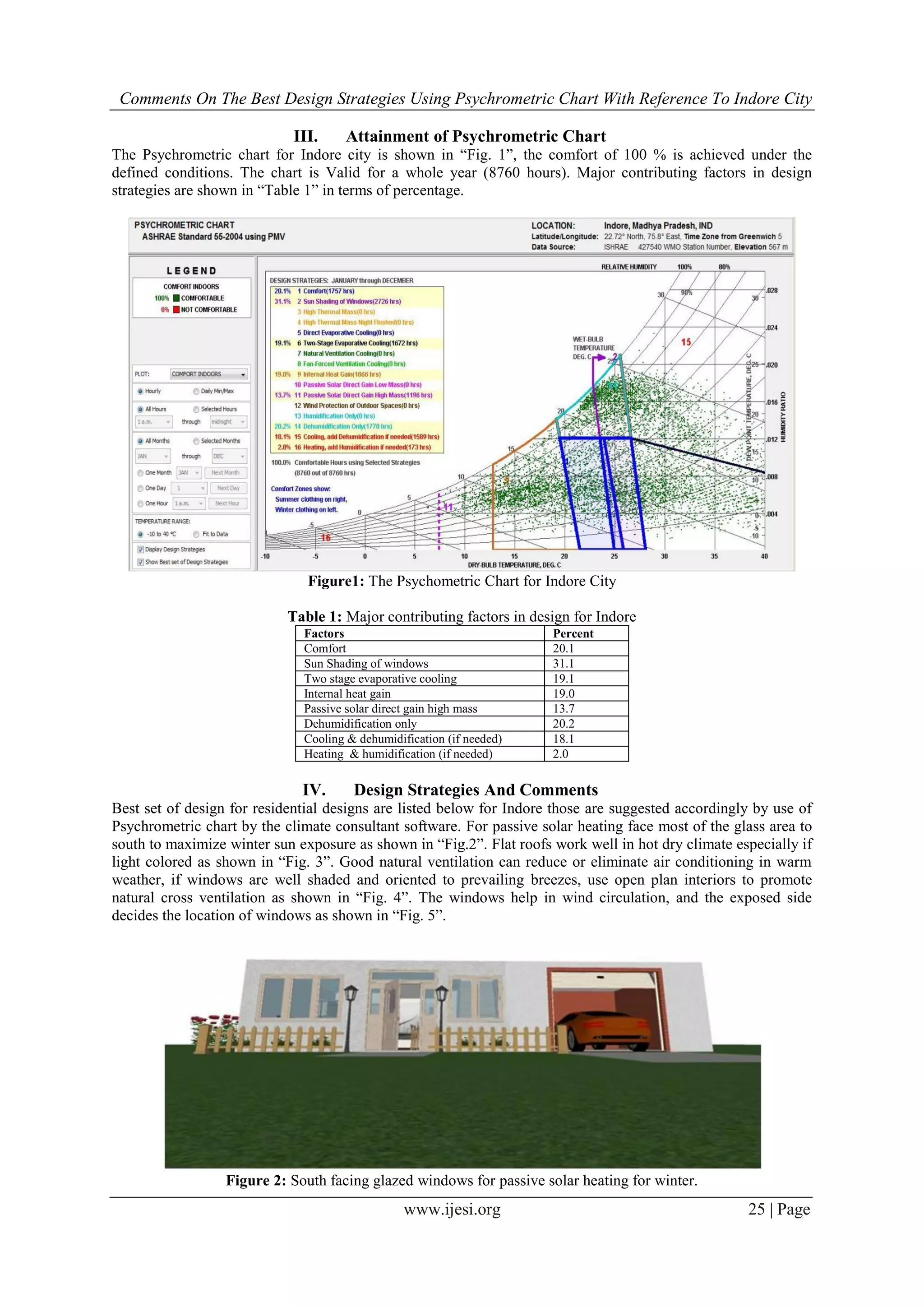
The Psychrometric chart for Indore city is shown in “Fig. 1”, the comfort of 100 % is achieved under the
defined conditions. The chart is Valid for a whole year (8760 hours). Major contributing factors in design
strategies are shown in “Table 1” in terms of percentage.
Figure1: The Psychometric Chart for Indore City
Table 1: Major contributing factors in design for Indore
Factors Percent
Comfort 20.1
Sun Shading of windows 31.1
Two stage evaporative cooling 19.1
Internal heat gain 19.0
Passive solar direct gain high mass 13.7
Dehumidification only 20.2
Cooling & dehumidification (if needed) 18.1
Heating & humidification (if needed) 2.0
IV. Design Strategies And Comments
Best set of design for residential designs are listed below for Indore those are suggested accordingly by use of
Psychrometric chart by the climate consultant software. For passive solar heating face most of the glass area to
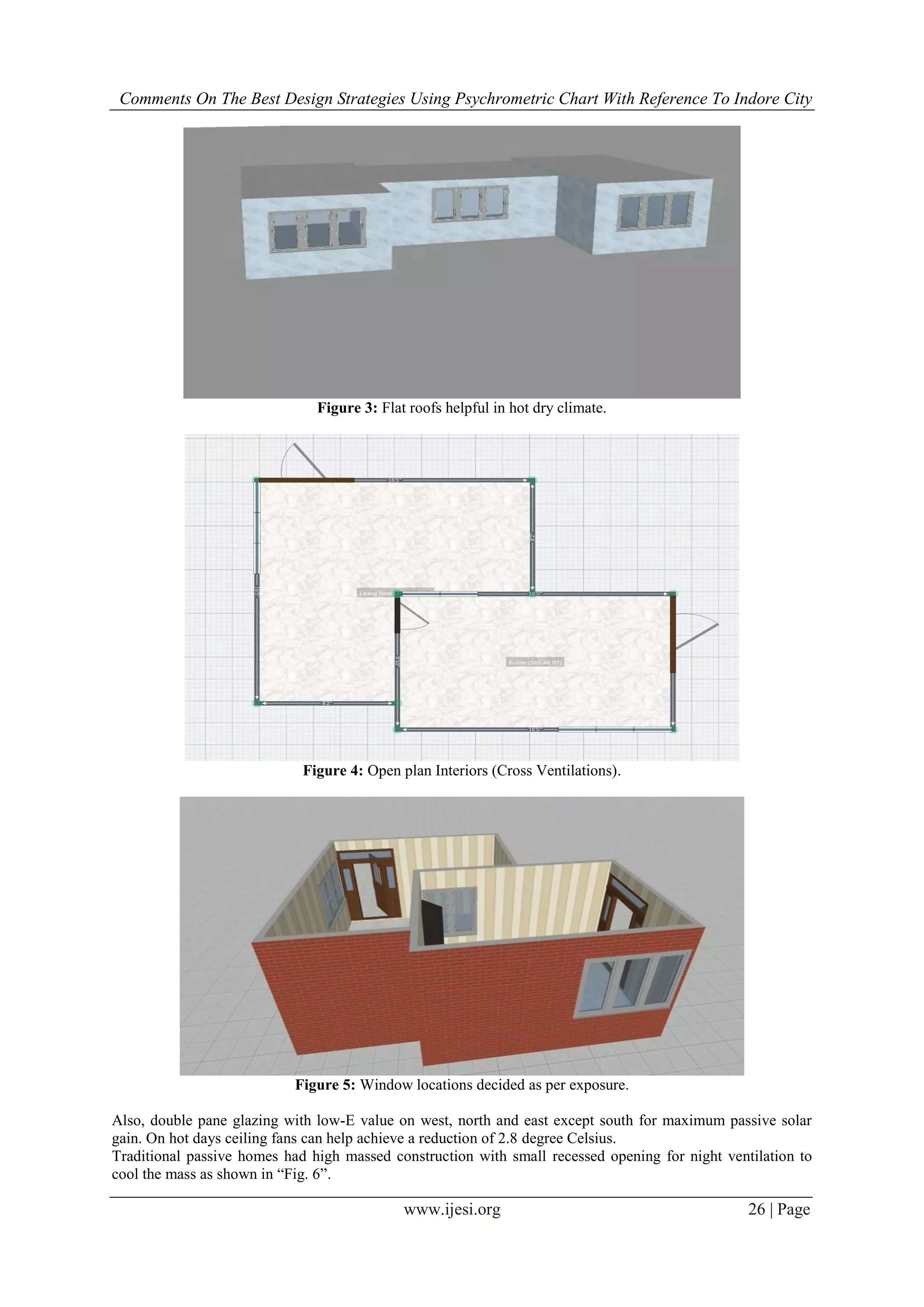
south to maximize winter sun exposure as shown in “Fig.2”. Flat roofs work well in hot dry climate especially if
light colored as shown in “Fig. 3”. Good natural ventilation can reduce or eliminate air conditioning in warm
weather, if windows are well shaded and oriented to prevailing breezes, use open plan interiors to promote
natural cross ventilation as shown in “Fig. 4”. The windows help in wind circulation, and the exposed side
decides the location of windows as shown in “Fig. 5”.
Figure 2: South facing glazed windows for passive solar heating for winter.
Comments On The Best Design Strategies Using Psychrometric Chart With Reference To Indore City
www.ijesi.org 26 | Page
Figure 3: Flat roofs helpful in hot dry climate.
Figure 4: Open plan Interiors (Cross Ventilations).
Figure 5: Window locations decided as per exposure.
Also, double pane glazing with low-E value on west, north and east except south for maximum passive solar
gain. On hot days ceiling fans can help achieve a reduction of 2.8 degree Celsius.
Traditional passive homes had high massed construction with small recessed opening for night ventilation to
cool the mass as shown in “Fig. 6”.
Comments On The Best Design Strategies Using Psychrometric Chart With Reference To Indore City
www.ijesi.org 27 | Page
Figure 6: High massed passive homes
V. Conclusion
The above study is an attempt to promote the use of climate technology based software to enhance the comfort
level of occupant in residential apartments. The choice of a particular design and plan depends on several
factors, climate being one of the major among them. The ancient architects had incorporated several
methodologies which are scientifically sound and proven. The use of software packages like Climate Consultant
can enhance the comfort level in cities like Indore that are on the pathway of urban development and
industrialization. Psychrometric charts can suggest better planning as well as suitable materials are available as
per specifications that can be useful by construction managers. The design strategies suggested that can be used,
are obtained for Indore, but has already being used in one or the other form since ancient times.
References
[1]. Jayant Sathaye , P.R. Shukla, N.H. Ravindranath, Climate change, sustainable development and India: Global and national
concerns, Current Science ,90(3), 2006, 314-325.
[2]. R. V. Simha, Thermal Comfort in India, 3rd Regional Conference & Exhibition, "Innovations in Sustainable Habitats – The GRIHA
Approach”, 2012, 1-61.
[3]. Robina Hetherington ,Robin Laney, Peake, Stephen and Oldham, David, Integrated building design, information and simulation
modelling: the need for a new hierarchy, International Building Performance Simulation Association, Sydney, Australia,2011, 1-10.
[4]. Leena Thomas and George Baird, Post-occupancy evaluation of passive downdraft evaporative cooling and air-conditioned
buildings at Torrent Research Centre, Ahmedabad, India, Proc. 40th Annual Conference of the Architectural Science Association,
University of Adelaide, Australia, 2006, 97-104.

Comments on the Best Design Strategies Using Psychrometric Chart with Reference to Indore City

  • 1.
    International Journal ofEngineering Science Invention ISSN (Online): 2319 – 6734, ISSN (Print): 2319 – 6726 www.ijesi.org ||Volume 5 Issue 11|| November 2016 || PP. 24-27 www.ijesi.org 24 | Page Comments on the Best Design Strategies Using Psychrometric Chart with Reference to Indore City Mohit Sheode1 1 Department of Civil and Environmental Engineering, NITTTR Bhopal, India. Abstract: With the evolution of Climate based technologies, it has proved to be helpful for professionals of construction field to not only predict the impact of climate but also act accordingly. The present paper is an attempt to suggest plans, orientation and to provide meaningful cause for incorporation of a particular style of design. The output of Climate Consultant 6.0 developed by UCLA Energy Design Tools Group has been taken to predict best design strategies ,in general, for Indore city of Madhya Pradesh State and comments are made accordingly. Keywords: Buildings, Climate, Design, Dry bulb temperature, Psychrometric Chart, Thermal Insulation. I. Introduction Building science is the complex discipline that deals with the architecture and construction technology that concerns itself with the detail-design with reference to a optimal design of buildings in response to naturally occurring physical phenomenon such as the weather (sun, wind, rain, temperature, humidity) or related issues as per a specific geographical location under the constraints of characteristics of materials, conductivity, radiation, convection human physiology (comfort, radiance, perception, sweat function, and occupants’ physical comfort/health). Various allied literature survey is done and briefing about them is contained in the following section. Jayant Sathaye et al. [1] wrote with reference to climate change and India concluded that institutions in the industrialized countries largely dominate research on climate science and policy particularly on climate modeling. They suggest that mitigation and policy should be made accordingly, institution like Leadership in Energy and Environmental Design (LEED) – a US Green Building Council organization that uses 69-point criteria to award a certificate at platinum, gold and other levels to buildings are a better approach and awareness in such form can be made in India too. Indoor environment quality and alike design process thus becomes necessary. R.V. Simha [2] presented a paper on thermal comfort in India emphasized on the need for the evolution of adaptive comfort approach and need to establish comfort labs in India. Besides indicating compliance with ASHRAE Standard 55-2010, the Comfort Model calculates SETs also simultaneously. This can help arriving at acceptable comfort temperature as a result of interaction with users. Robina Hetherington et al. [3] did a study on the integrated building design, information and simulation modeling, suggested the need to reduce radically the energy used by buildings. Current design and simulation software are used in very different ways, with energy simulation generally employed to check energy code compliance after the design stages, the modeling methods used and poor interoperability inhibit iterative design practice, and they elicited early software requirements for combined simulation and design software. Leena Thomas and George Baird [4] did post-occupancy evaluation of passive downdraft evaporative cooling at Torrent Research Centre, Ahmadabad, India. The findings outlined in their paper show that this building, completed over 10 years ago, continues to satisfy expectations for a contemporary workplace of high quality that is simultaneously energy efficient also. While the wider implications of the success of climate responsive buildings for the Indian subcontinent where there is currently a large scale development of glass boxes that can be energy intensive and inappropriate. Even in those situations where air-conditioning is inevitable, the climate responsive approach via attention to minimizing façade heat gains and day lighting coupled with a designer’s responsive approach. II. Modeling Of Case Definitions for Fundamental Comfort model: Comfort (Using ASHRAE Standard 55) with winter cloth value of 1.0, summer cloth value of 0.5. Activity level daytime is 1.1. Predicted percent of people satisfied is 90. Comfort lowest and highest winter temperature is 20.3 and 24.3 degree Celsius respectively. Likewise comfort highest summer temperature is 26.7 degree Celsius. Maximum humidity is 84.6 %. The PMV model is the basis for analysis in this case in Climate Consultant Software. Minimum indoor velocity to affect indoor comfort is 0.2 m/s. Maximum comfortable velocity is 1.5 m/s. Maximum perceived temperature reduction is 3 degree Celsius. Maximum and minimum wet bulb temperatures are 20.0 and 6.6 degree Celsius respectively.
  • 2.
    Comments On TheBest Design Strategies Using Psychrometric Chart With Reference To Indore City www.ijesi.org 25 | Page III. Attainment of Psychrometric Chart The Psychrometric chart for Indore city is shown in “Fig. 1”, the comfort of 100 % is achieved under the defined conditions. The chart is Valid for a whole year (8760 hours). Major contributing factors in design strategies are shown in “Table 1” in terms of percentage. Figure1: The Psychometric Chart for Indore City Table 1: Major contributing factors in design for Indore Factors Percent Comfort 20.1 Sun Shading of windows 31.1 Two stage evaporative cooling 19.1 Internal heat gain 19.0 Passive solar direct gain high mass 13.7 Dehumidification only 20.2 Cooling & dehumidification (if needed) 18.1 Heating & humidification (if needed) 2.0 IV. Design Strategies And Comments Best set of design for residential designs are listed below for Indore those are suggested accordingly by use of Psychrometric chart by the climate consultant software. For passive solar heating face most of the glass area to south to maximize winter sun exposure as shown in “Fig.2”. Flat roofs work well in hot dry climate especially if light colored as shown in “Fig. 3”. Good natural ventilation can reduce or eliminate air conditioning in warm weather, if windows are well shaded and oriented to prevailing breezes, use open plan interiors to promote natural cross ventilation as shown in “Fig. 4”. The windows help in wind circulation, and the exposed side decides the location of windows as shown in “Fig. 5”. Figure 2: South facing glazed windows for passive solar heating for winter.
  • 3.
    Comments On TheBest Design Strategies Using Psychrometric Chart With Reference To Indore City www.ijesi.org 26 | Page Figure 3: Flat roofs helpful in hot dry climate. Figure 4: Open plan Interiors (Cross Ventilations). Figure 5: Window locations decided as per exposure. Also, double pane glazing with low-E value on west, north and east except south for maximum passive solar gain. On hot days ceiling fans can help achieve a reduction of 2.8 degree Celsius. Traditional passive homes had high massed construction with small recessed opening for night ventilation to cool the mass as shown in “Fig. 6”.
  • 4.
    Comments On TheBest Design Strategies Using Psychrometric Chart With Reference To Indore City www.ijesi.org 27 | Page Figure 6: High massed passive homes V. Conclusion The above study is an attempt to promote the use of climate technology based software to enhance the comfort level of occupant in residential apartments. The choice of a particular design and plan depends on several factors, climate being one of the major among them. The ancient architects had incorporated several methodologies which are scientifically sound and proven. The use of software packages like Climate Consultant can enhance the comfort level in cities like Indore that are on the pathway of urban development and industrialization. Psychrometric charts can suggest better planning as well as suitable materials are available as per specifications that can be useful by construction managers. The design strategies suggested that can be used, are obtained for Indore, but has already being used in one or the other form since ancient times. References [1]. Jayant Sathaye , P.R. Shukla, N.H. Ravindranath, Climate change, sustainable development and India: Global and national concerns, Current Science ,90(3), 2006, 314-325. [2]. R. V. Simha, Thermal Comfort in India, 3rd Regional Conference & Exhibition, "Innovations in Sustainable Habitats – The GRIHA Approach”, 2012, 1-61. [3]. Robina Hetherington ,Robin Laney, Peake, Stephen and Oldham, David, Integrated building design, information and simulation modelling: the need for a new hierarchy, International Building Performance Simulation Association, Sydney, Australia,2011, 1-10. [4]. Leena Thomas and George Baird, Post-occupancy evaluation of passive downdraft evaporative cooling and air-conditioned buildings at Torrent Research Centre, Ahmedabad, India, Proc. 40th Annual Conference of the Architectural Science Association, University of Adelaide, Australia, 2006, 97-104.