Protection against Hazards
Hazard: A hazard poses the threat that an unwanted event, possibly
a catastrophe, may occur.
Risk: Risk is the probability that the event will occur.
All buildings are subject to hazards such as hurricanes, earthquakes,
flood, fire, and lightning strikes, both during and after construction.
Assessment of risk of a hazard and selection of cost-effective way of
avoiding the hazard and protection against it required to be done.
▪ Wind Protection
▪ Protection against Earthquakes
▪ Protection against Water
▪ Protection against Fire
▪ Lightning Protection
▪ Protection against Intruders
2
3.
Protection against Fire
Thereare two distinct aspects of fire protection: life safety and
property protection.
A program that provides for prompt notification and evacuation of
occupants meets the objectives for life safety, but provides
no protection for property.
Conversely, it is possible that adequate property protection might
not be sufficient for protection of life.
Absolute safety from fire is not attainable. It is not possible to
eliminate all combustible materials or all potential ignition sources.
Thus, in most cases, an adequate fire protection plan must assume
that unwanted fires will occur despite the best efforts to prevent
them.
3
4.
Fire Protection Concepts:
Someof the reasons for causing Fire in the Buildings- are human
error, arson, faulty electrical equipment, poor maintenance
of heating equipment, and natural causes, such as lightning.
Consequently, buildings should be designed to minimize the
probability of a fire and to protect life and limit property damage if a
fire should occur.
Following steps should be taken for Fire Prevention:
Fire prevention steps.pdf
4
5.
Extinguishment of Fires:
▪Design of all buildings should include provisions for prompt
extinguishment of fires.
▪ Such apparatus may range from small, hand-held extinguishers
for small fires to hoses attached to a large, pressurized water
supply and automatic fire sprinklers.
▪ Also desirable are fire and smoke detectors and a protective
signaling system that sounds an alarm to alert building occupants
and calls fire fighters.
5
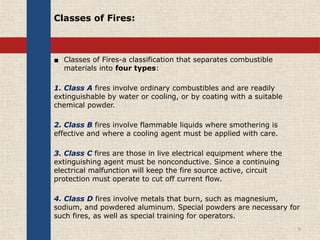
Classes of Fires:
▪Classes of Fires-a classification that separates combustible
materials into four types:
1. Class A fires involve ordinary combustibles and are readily
extinguishable by water or cooling, or by coating with a suitable
chemical powder.
2. Class B fires involve flammable liquids where smothering is
effective and where a cooling agent must be applied with care.
3. Class C fires are those in live electrical equipment where the
extinguishing agent must be nonconductive. Since a continuing
electrical malfunction will keep the fire source active, circuit
protection must operate to cut off current flow.
4. Class D fires involve metals that burn, such as magnesium,
sodium, and powdered aluminum. Special powders are necessary for
such fires, as well as special training for operators.
9
10.
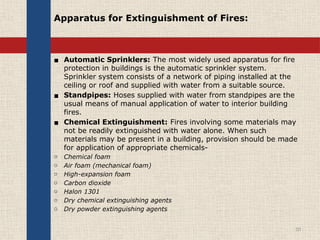
Apparatus for Extinguishmentof Fires:
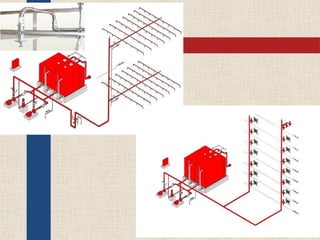
▪ Automatic Sprinklers: The most widely used apparatus for fire
protection in buildings is the automatic sprinkler system.
Sprinkler system consists of a network of piping installed at the
ceiling or roof and supplied with water from a suitable source.
▪ Standpipes: Hoses supplied with water from standpipes are the
usual means of manual application of water to interior building
fires.
▪ Chemical Extinguishment: Fires involving some materials may
not be readily extinguished with water alone. When such
materials may be present in a building, provision should be made
for application of appropriate chemicals-
o Chemical foam
o Air foam (mechanical foam)
o High-expansion foam
o Carbon dioxide
o Halon 1301
o Dry chemical extinguishing agents
o Dry powder extinguishing agents
10
There are twotypes of fire control
A. Active control
B. Passive control
Types of fire control
13.
A. Active control
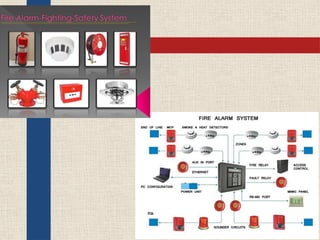
1.FireDetection / Fire alarm System :
Fire alarm System can be either manual or automatic.
2.Fire extinguishing systems
It is obligatory to make provision of fire detection and/or fire
extinguishing systems. These systems are described below –
Types of fire control
14.
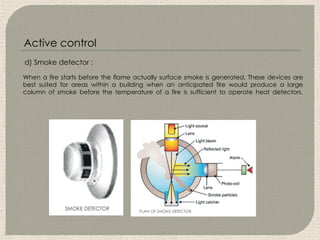
These are simplestand most reliable fire
detection and are commonly used in building.
They are also known as temperature detectors.
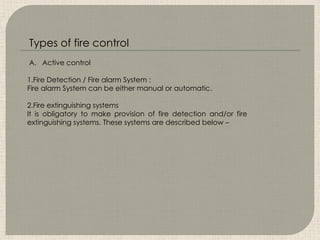
This consists of a hand bell or similar sounding
devise emitting distinctive sound when struck.
Such devices are installed near all the main exit
and passages.
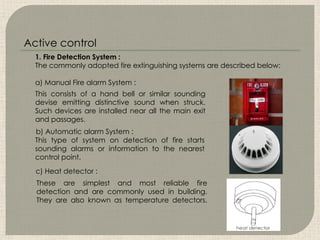
This type of system on detection of fire starts
sounding alarms or information to the nearest
control point.
1. Fire Detection System :
The commonly adopted fire extinguishing systems are described below:
a) Manual Fire alarm System :
b) Automatic alarm System :
c) Heat detector :
Active control
15.
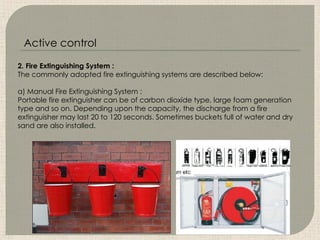
When a firestarts before the flame actually surface smoke is generated. These devices are
best suited for areas within a building when an anticipated fire would produce a large
column of smoke before the temperature of a fire is sufficient to operate heat detectors.
d) Smoke detector :
Active control
16.
2. Fire ExtinguishingSystem :
The commonly adopted fire extinguishing systems are described below:
a) Manual Fire Extinguishing System :
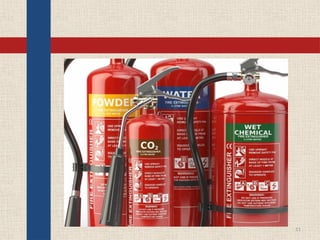
Portable fire extinguisher can be of carbon dioxide type, large foam generation
type and so on. Depending upon the capacity, the discharge from a fire
extinguisher may last 20 to 120 seconds. Sometimes buckets full of water and dry
sand are also installed.
Active control
17.
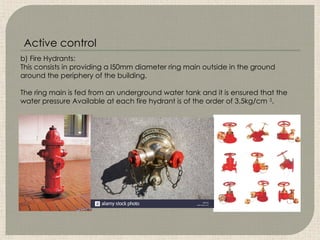
b) Fire Hydrants:
Thisconsists in providing a l50mm diameter ring main outside in the ground
around the periphery of the building.
The ring main is fed from an underground water tank and it is ensured that the
water pressure Available at each fire hydrant is of the order of 3.5kg/cm 2
.
Active control
18.
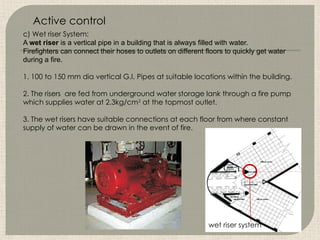
c) Wet riserSystem:
A wet riser is a vertical pipe in a building that is always filled with water.
Firefighters can connect their hoses to outlets on different floors to quickly get water
during a fire.
1. 100 to 150 mm dia vertical G.I. Pipes at suitable locations within the building.
2. The risers are fed from underground water storage lank through a fire pump
which supplies water at 2.3kg/cm2
at the topmost outlet.
3. The wet risers have suitable connections at each floor from where constant
supply of water can be drawn in the event of fire.
wet riser system
Active control
19.
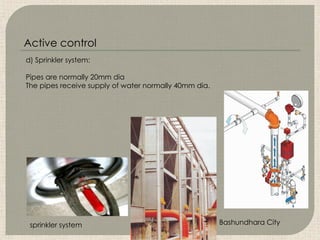
sprinkler system BashundharaCity
d) Sprinkler system:
Pipes are normally 20mm dia
The pipes receive supply of water normally 40mm dia.
Active control
20.
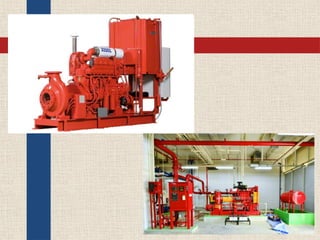
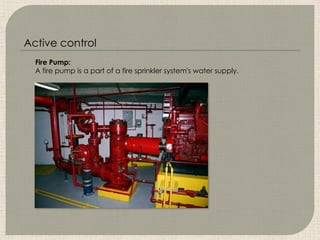
Fire Pump:
A firepump is a part of a fire sprinkler system's water supply.
Active control
21.
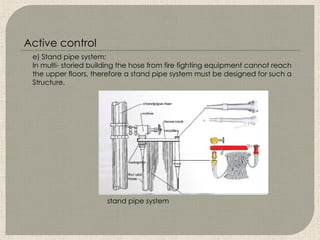
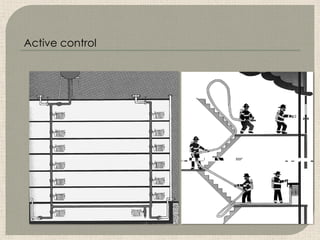
e) Stand pipesystem:
In multi- storied building the hose from fire fighting equipment cannot reach
the upper floors, therefore a stand pipe system must be designed for such a
Structure.
stand pipe system
Active control
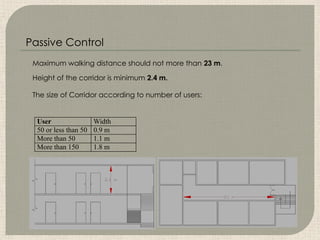
Height of thecorridor is minimum 2.4 m.
The size of Corridor according to number of users:
Maximum walking distance should not more than 23 m.
User Width
50 or less than 50 0.9 m
More than 50 1.1 m
More than 150 1.8 m
Passive Control
26.
Types of Exits
Buildingcodes generally indicate what types of facilities may
qualify as exits. These usually include:
Exit Passageway
Exit Doors
Stairs
Ramps
Refuge floors
Passive Control
27.
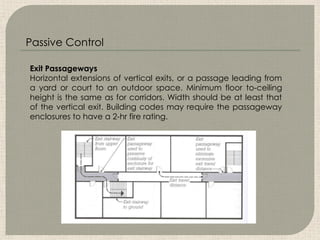
Exit Passageways
Horizontal extensionsof vertical exits, or a passage leading from
a yard or court to an outdoor space. Minimum floor
to-ceiling
height is the same as for corridors. Width should be at least that
of the vertical exit. Building codes may require the passageway
en
closures to have a 2-hr fire rating.
Passive Control
28.
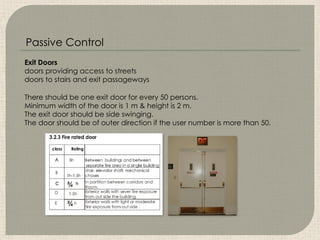
Exit Doors
doors providingaccess to streets
doors to stairs and exit passageways
There should be one exit door for every 50 persons.
Minimum width of the door is 1 m & height is 2 m.
The exit door should be side swinging.
The door should be of outer direction if the user number is more than 50.
Passive Control
29.
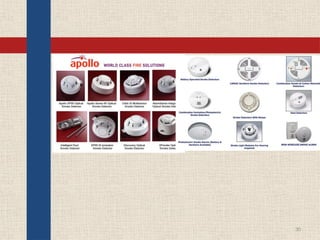
Detection of Fires:
Everyfire-extinguishing activity must start with detection. To assist
in this, many types of automatic detectors are available, with a wide
range of sensitivity.
There are five general types of detectors, each employing a different
physical means of operation. The types are designated –
• fixed-temperature detectors,
• rate-of-rise detectors,
• Photoelectric detectors,
• combustion-products detectors, and
• ultraviolet or infrared detectors.
• Detectors.pdf
29
In addition toproviding means for early detection of fire, preventing its
spread, and extinguishing it speedily, building designers should also provide
the appropriate number, sizes, and arrangements of exits to permit quick
evacuation of occupants if fire or other conditions dangerous to life occur.
Building codes generally contain requirements for safe, emergency egress
from buildings.
Egress Components
‘‘Life Safety Code’’ defines a means of egress composed of three
Parts-
Exit access—that portion that leads to an entrance to an exit
Exit—the portion that is separated from all other building spaces by
construction or equipment required to provide a protected path to the exit
discharge
Exit discharge—the portion that connects the termination of an exit to a
public way
31
Emergency Egress:
32.
Means of egressmay be provided by exterior and interior doors and
enclosed horizontal and vertical passageways, including stairs and
escalators.
Types of Exits:
Building codes generally recognize the following as acceptable
exits when they meet the codes’ safety requirements:
• Corridors
• Exit passageways
• Exit doors
• Horizontal exit
• Interior stairs
• Exterior stairs
• Smokeproof tower
• Escalators
• Moving walks
32
Emergency Egress:
33.
Refuge Areas:
A refugearea is a space protected against fire and smoke. When
located within a building, the refuge should be at about the same level as the
areas served and separated from them by construction with at least a 2-hr fire
rating.
Access to the refuge areas should be protected by fire doors with a fire rating
of 1.5 hr or more.
Location of Exits:
Building codes usually require a building to have at least two
means of egress from every floor. Exits should be remote from each other, to
reduce the chance that both will be blocked in an emergency.
All exit access facilities and exits should be located so as to be clearly visible to
building occupants or signs should be installed to indicate the direction of
travel to the exits.
Signs marking the locations of exits should be illuminated with at least 5 ft-c of
light. Floors of means of egress should be illuminated with at least 1 ft-c of
artificial light whenever the building is occupied.
33
Emergency Egress:
34.
Required Exit Capacity:
Minimumwidth of a passageway for normal use is 36 in. This is large
enough to accommodate one-way travel for persons on crutches or in
wheelchairs.
For two way travel, a 60-in width is necessary. Building codes,
however, may require greater widths to permit rapid passage of the
anticipated number of evacuees in emergencies.
This number depends on a factor called the occupant load, but the
minimum width should be ample for safe, easy passage of
handicapped persons. (Occupant load of a building space is the
maximum number of persons that may be in the space at any time)
Emergency Egress.pdf
34
Emergency Egress: