


COMBAT
AIR POLLUTION
Bioremediation Techniques
A sustainable approach….!!!
A Presentation
By
Alok Mishra
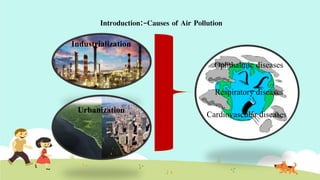
Introduction:-Causes of Air Pollution
Industrialization
Urbanization
Ophthalmic diseases
Respiratory diseases
Cardiovascular diseases
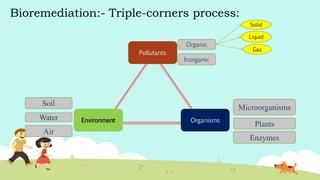
Bioremediation:- Triple-corners process:
Organisms
Pollutants
Environment
Microorganisms
Plants
Enzymes
Soil
Water
Air
Organic
Inorganic
Solid
Liquid
Gas
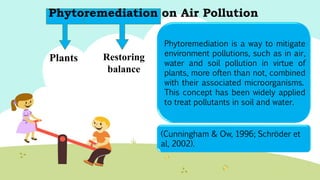
Phytoremediation on Air Pollution
Phytoremediation is a way to mitigate
environment pollutions, such as in air,
water and soil pollution in virtue of
plants, more often than not, combined
with their associated microorganisms.
This concept has been widely applied
to treat pollutants in soil and water.
(Cunningham & Ow, 1996; Schröder et
al, 2002).
Plants Restoring
balance
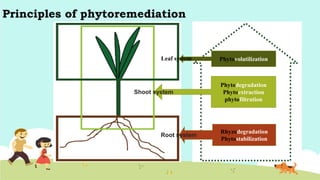
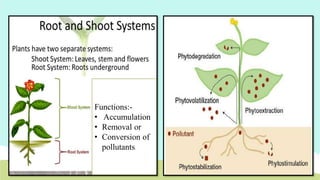
Principles of phytoremediation
Phytovolatilization
Phytodegradation
Phytoextraction
phytofiltration
Rhyzodegradation
Phytostabilization
Shoot system
Root system
Leaf system
Functions:-
• Accumulation
• Removal or
• Conversion of
pollutants.
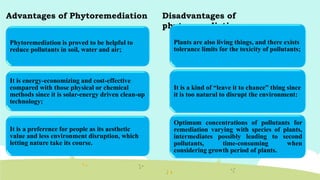
Disadvantages of
phytoremediation
Plants are also living things, and there exists
tolerance limits for the toxicity of pollutants;
It is a kind of “leave it to chance” thing since
it is too natural to disrupt the environment:
Optimum concentrations of pollutants for
remediation varying with species of plants,
intermediates possibly leading to second
pollutants, time-consuming when
considering growth period of plants.
Phytoremediation is proved to be helpful to
reduce pollutants in soil, water and air;
It is energy-economizing and cost-effective
compared with those physical or chemical
methods since it is solar-energy driven clean-up
technology;
It is a preference for people as its aesthetic
value and less environment disruption, which
letting nature take its course.
Advantages of Phytoremediation
Examples of
phytoremediation
of air pollutants
Particulate matters
Vegetation has been used to shield dust in many countries,
and the process is called phytofiltration.
A 8-m wide green belt may reduce 2 to 3 times of dust fall
For phytofiltration, morphological characteristics, such as
orientation of leaf on the main axis, size and shape,
surface nature, the presence or absence of trichrome and
wax deposition, are factors to trap or capture dust from
ambient air.
Inorganic pollutants:-
SO2
Nearly 70% SO2 in the atmosphere originates
from fossil fuel combustion.
SO2 enters into plants mainly through stoma,
and can be utilized in a reductive sulphur
cycle in plants.
They are changed into SO42- or SO32- in
cell walls. Phosphosulphate, carrier protein,
carrier protein with bound sulphide are the
intermediates in the reduction pathway.
The final products are cysteine or other
organic compounds.
NOX are air pollutants, and they are one of precursors of
photochemical reaction.
They can reach plant system through wet/dry deposition to
foliar or roots.
Plant species, plant age, NOX concentration and other
environmental conditions are factors which influence the leaf
penetration of NOX.
After NO2 enter into the plant, most of them are metabolized to
organic compounds, e.g. amino acid, through nitrate
assimilation pathway.
The enzymes in plants, such as nitrate reductase, nitrite
reductase or glutamine synthetize may play an important role in
this process.
Genetic engineering could turn plants into magic sink for NOx
by making the enzymes overexpressed.
Inorganic pollutants:- NOX
Organic pollutants :-
Formaldehyde
Formaldehyde, a ubiquitous air pollutant, is so
harmful that it is classified as a mutagen and
carcinogen.
In the 1980’s, an NASA's research in the USA
revealed that low level of formaldehyde in air
could be removed by plant leaves alone, while
higher concentrations of the toxic chemical can be
filtered by activated carbon firstly and the plant
roots and associated microorganisms degrade and
assimilate remained chemicals (Wolverton,1988).
It appears that formaldehyde can be oxidized and
then degraded in C1 metabolism in
phytodegradation.
Benzene and toluene have been reported to be
removed from air and be assimilated by plants
(Porter, 1994; Ugrekhelidze, 1997).
Porter (1994) suggested at the lower toluene
exposure, a fairly modest amount light change was
credited with significant increase or decrease of
removal rate and the plant, the only photoresponsive
organisms in the system, may be responsible for the
phenomenon.
Furthermore, hydroxylation is considered to be the
first step of the aromatic ring cleavage of benzene
and toluene in higher plants.
Benzene and toluene
Removal of Indoor Air Pollution by
Ornamental Plants.
Plants-Screening experiments:-This experiment aimed to acquire
plants which are capable of effective-removing binary mixture of
benzene (0.26 mg· m-3) and toluene (0.3 mg· m-3). Allowing for
vast amounts of species of plants, only one individual for every
species of plants was fumigated in the initial screening
experiment.
Fumigating-experiments at gradient concentrations:- The gradient
concentrations (Table 1.) were set up to investigate optimum
concentrations of benzene and toluene for phytoremediation
application. The plants were chosen from those plants with
relatively high removal efficiency from plants-screening
experiment.
Evaluating-experiments for new lines of Chrysanthemum
morifolium:- It is one object in the experiments to evaluate
removal performance of new lines of Chrysanthemum morifolium
at the optimum concentrations of benzene and toluene acquired
in the experiments mentioned above.
Experiment Steps
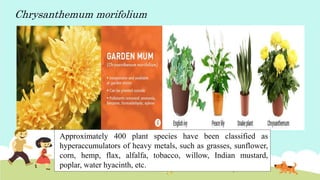
Chrysanthemum morifolium
Approximately 400 plant species have been classified as
hyperaccumulators of heavy metals, such as grasses, sunflower,
corn, hemp, flax, alfalfa, tobacco, willow, Indian mustard,
poplar, water hyacinth, etc.
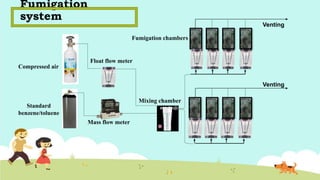
Fumigation
system
Standard
benzene/toluene
Compressed air
Mass flow meter
Float flow meter
Fumigation chambers
Mixing chamber
Venting
Venting
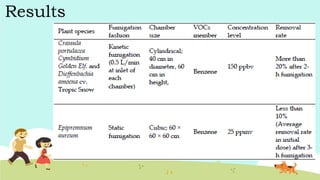
Results
Futureperspective
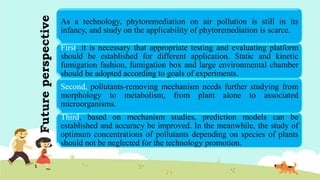
As a technology, phytoremediation on air pollution is still in its
infancy, and study on the applicability of phytoremediation is scarce.
First, it is necessary that appropriate testing and evaluating platform
should be established for different application. Static and kinetic
fumigation fashion, fumigation box and large environmental chamber
should be adopted according to goals of experiments.
Second, pollutants-removing mechanism needs further studying from
morphology to metabolism, from plant alone to associated
microorganisms.
Third, based on mechanism studies, prediction models can be
established and accuracy be improved. In the meanwhile, the study of
optimum concentrations of pollutants depending on species of plants
should not be neglected for the technology promotion.
Conclusion
s
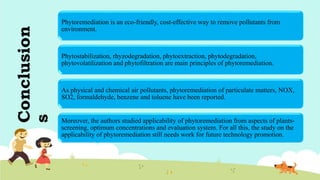
Phytoremediation is an eco-friendly, cost-effective way to remove pollutants from
environment.
Phytostabilization, rhyzodegradation, phytoextraction, phytodegradation,
phytovolatilization and phytofiltration are main principles of phytoremediation.
As physical and chemical air pollutants, phytoremediation of particulate matters, NOX,
SO2, formaldehyde, benzene and toluene have been reported.
Moreover, the authors studied applicability of phytoremediation from aspects of plants-
screening, optimum concentrations and evaluation system. For all this, the study on the
applicability of phytoremediation still needs work for future technology promotion.
Combat air pollution

Combat air pollution

  • 1.
    COMBAT AIR POLLUTION Bioremediation Techniques Asustainable approach….!!! A Presentation By Alok Mishra
  • 2.
    Introduction:-Causes of AirPollution Industrialization Urbanization Ophthalmic diseases Respiratory diseases Cardiovascular diseases
  • 3.
  • 4.
    Phytoremediation on AirPollution Phytoremediation is a way to mitigate environment pollutions, such as in air, water and soil pollution in virtue of plants, more often than not, combined with their associated microorganisms. This concept has been widely applied to treat pollutants in soil and water. (Cunningham & Ow, 1996; Schröder et al, 2002). Plants Restoring balance
  • 5.
  • 6.
    Functions:- • Accumulation • Removalor • Conversion of pollutants.
  • 7.
    Disadvantages of phytoremediation Plants arealso living things, and there exists tolerance limits for the toxicity of pollutants; It is a kind of “leave it to chance” thing since it is too natural to disrupt the environment: Optimum concentrations of pollutants for remediation varying with species of plants, intermediates possibly leading to second pollutants, time-consuming when considering growth period of plants. Phytoremediation is proved to be helpful to reduce pollutants in soil, water and air; It is energy-economizing and cost-effective compared with those physical or chemical methods since it is solar-energy driven clean-up technology; It is a preference for people as its aesthetic value and less environment disruption, which letting nature take its course. Advantages of Phytoremediation
  • 8.
  • 9.
    Particulate matters Vegetation hasbeen used to shield dust in many countries, and the process is called phytofiltration. A 8-m wide green belt may reduce 2 to 3 times of dust fall For phytofiltration, morphological characteristics, such as orientation of leaf on the main axis, size and shape, surface nature, the presence or absence of trichrome and wax deposition, are factors to trap or capture dust from ambient air.
  • 10.
    Inorganic pollutants:- SO2 Nearly 70%SO2 in the atmosphere originates from fossil fuel combustion. SO2 enters into plants mainly through stoma, and can be utilized in a reductive sulphur cycle in plants. They are changed into SO42- or SO32- in cell walls. Phosphosulphate, carrier protein, carrier protein with bound sulphide are the intermediates in the reduction pathway. The final products are cysteine or other organic compounds. NOX are air pollutants, and they are one of precursors of photochemical reaction. They can reach plant system through wet/dry deposition to foliar or roots. Plant species, plant age, NOX concentration and other environmental conditions are factors which influence the leaf penetration of NOX. After NO2 enter into the plant, most of them are metabolized to organic compounds, e.g. amino acid, through nitrate assimilation pathway. The enzymes in plants, such as nitrate reductase, nitrite reductase or glutamine synthetize may play an important role in this process. Genetic engineering could turn plants into magic sink for NOx by making the enzymes overexpressed. Inorganic pollutants:- NOX
  • 11.
    Organic pollutants :- Formaldehyde Formaldehyde,a ubiquitous air pollutant, is so harmful that it is classified as a mutagen and carcinogen. In the 1980’s, an NASA's research in the USA revealed that low level of formaldehyde in air could be removed by plant leaves alone, while higher concentrations of the toxic chemical can be filtered by activated carbon firstly and the plant roots and associated microorganisms degrade and assimilate remained chemicals (Wolverton,1988). It appears that formaldehyde can be oxidized and then degraded in C1 metabolism in phytodegradation. Benzene and toluene have been reported to be removed from air and be assimilated by plants (Porter, 1994; Ugrekhelidze, 1997). Porter (1994) suggested at the lower toluene exposure, a fairly modest amount light change was credited with significant increase or decrease of removal rate and the plant, the only photoresponsive organisms in the system, may be responsible for the phenomenon. Furthermore, hydroxylation is considered to be the first step of the aromatic ring cleavage of benzene and toluene in higher plants. Benzene and toluene
  • 12.
    Removal of IndoorAir Pollution by Ornamental Plants.
  • 13.
    Plants-Screening experiments:-This experimentaimed to acquire plants which are capable of effective-removing binary mixture of benzene (0.26 mg· m-3) and toluene (0.3 mg· m-3). Allowing for vast amounts of species of plants, only one individual for every species of plants was fumigated in the initial screening experiment. Fumigating-experiments at gradient concentrations:- The gradient concentrations (Table 1.) were set up to investigate optimum concentrations of benzene and toluene for phytoremediation application. The plants were chosen from those plants with relatively high removal efficiency from plants-screening experiment. Evaluating-experiments for new lines of Chrysanthemum morifolium:- It is one object in the experiments to evaluate removal performance of new lines of Chrysanthemum morifolium at the optimum concentrations of benzene and toluene acquired in the experiments mentioned above. Experiment Steps
  • 14.
    Chrysanthemum morifolium Approximately 400plant species have been classified as hyperaccumulators of heavy metals, such as grasses, sunflower, corn, hemp, flax, alfalfa, tobacco, willow, Indian mustard, poplar, water hyacinth, etc.
  • 15.
    Fumigation system Standard benzene/toluene Compressed air Mass flowmeter Float flow meter Fumigation chambers Mixing chamber Venting Venting
  • 16.
  • 17.
    Futureperspective As a technology,phytoremediation on air pollution is still in its infancy, and study on the applicability of phytoremediation is scarce. First, it is necessary that appropriate testing and evaluating platform should be established for different application. Static and kinetic fumigation fashion, fumigation box and large environmental chamber should be adopted according to goals of experiments. Second, pollutants-removing mechanism needs further studying from morphology to metabolism, from plant alone to associated microorganisms. Third, based on mechanism studies, prediction models can be established and accuracy be improved. In the meanwhile, the study of optimum concentrations of pollutants depending on species of plants should not be neglected for the technology promotion.
  • 18.
    Conclusion s Phytoremediation is aneco-friendly, cost-effective way to remove pollutants from environment. Phytostabilization, rhyzodegradation, phytoextraction, phytodegradation, phytovolatilization and phytofiltration are main principles of phytoremediation. As physical and chemical air pollutants, phytoremediation of particulate matters, NOX, SO2, formaldehyde, benzene and toluene have been reported. Moreover, the authors studied applicability of phytoremediation from aspects of plants- screening, optimum concentrations and evaluation system. For all this, the study on the applicability of phytoremediation still needs work for future technology promotion.