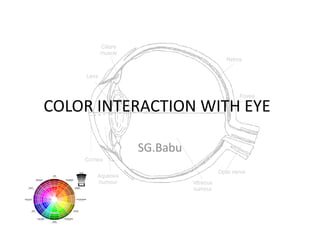
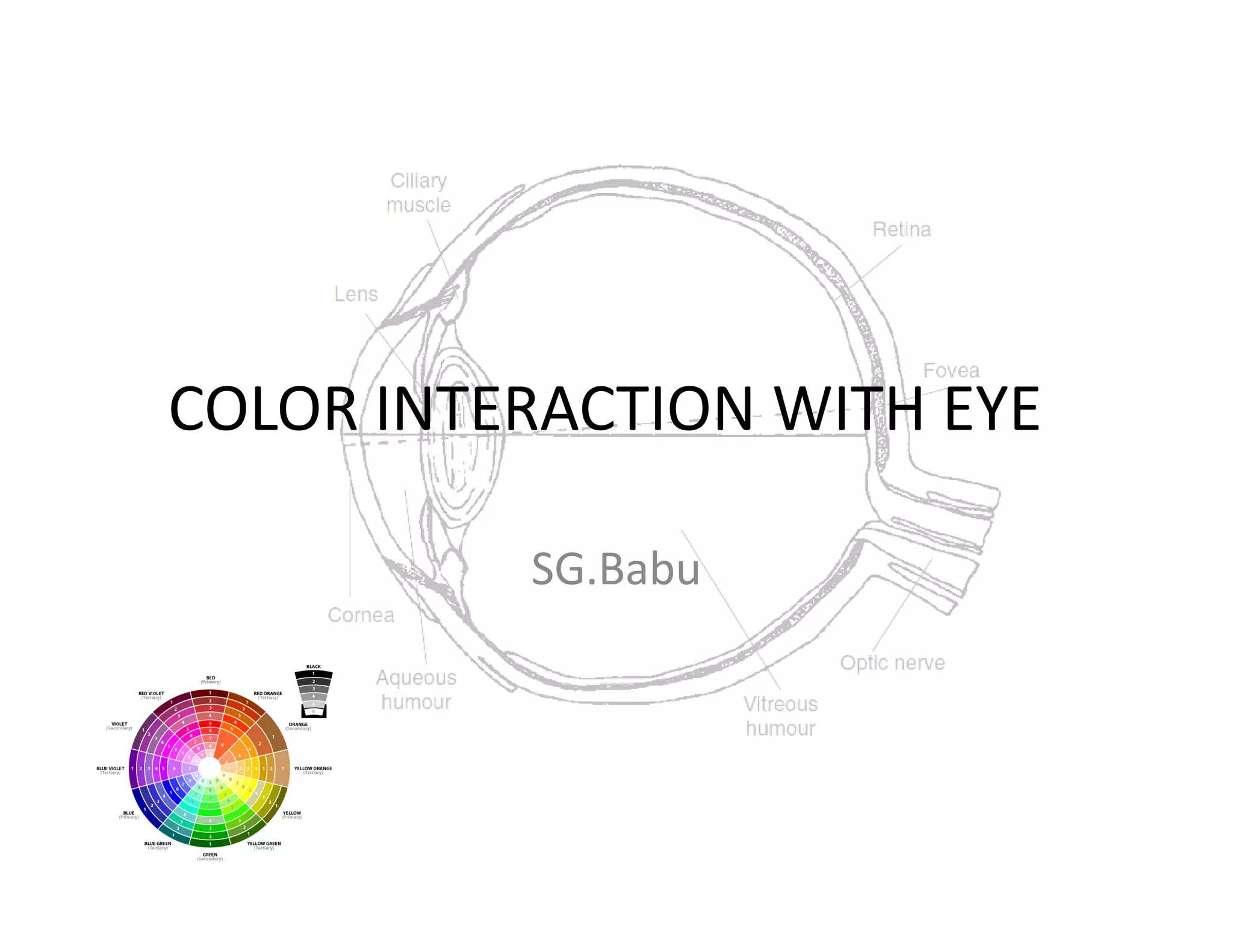
COLOR INTERACTION WITH EYE
SG.Babu
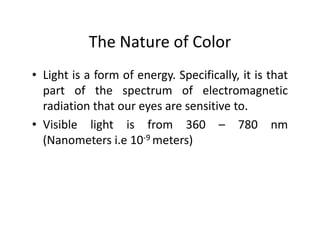
COLOR
• Colour exists only in the mind; it is a
perceptual response to light that enters the
eye either directly from self-luminous light
sources or, indirectly, from light reflected bysources or, indirectly, from light reflected by
illuminated objects.
The Nature of Color
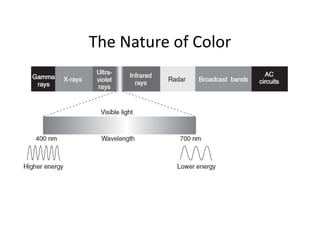
• Light is a form of energy. Specifically, it is that
part of the spectrum of electromagnetic
radiation that our eyes are sensitive to.
• Visible light is from 360 – 780 nm• Visible light is from 360 – 780 nm
(Nanometers i.e 10-9 meters)
The Nature of Color
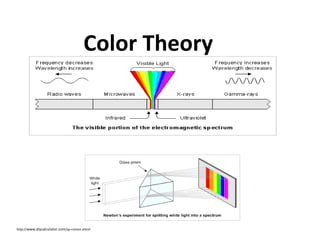
Color Theory
http://www.diycalculator.com/sp-cvision.shtml
The Physical Basis of Color
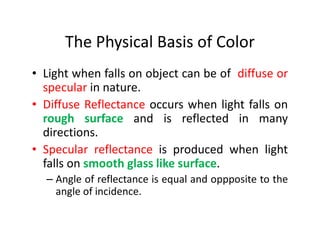
• Light when falls on object can be of diffuse or
specular in nature.
• Diffuse Reflectance occurs when light falls on
rough surface and is reflected in manyrough surface and is reflected in many
directions.
• Specular reflectance is produced when light
falls on smooth glass like surface.
– Angle of reflectance is equal and oppposite to the
angle of incidence.
The Physical Basis of Color
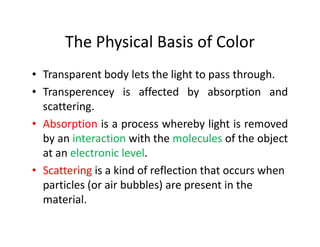
• Transparent body lets the light to pass through.
• Transperencey is affected by absorption and
scattering.
• Absorption is a process whereby light is removed• Absorption is a process whereby light is removed
by an interaction with the molecules of the object
at an electronic level.
• Scattering is a kind of reflection that occurs when
particles (or air bubbles) are present in the
material.
The Human Color Vision System
• The light that is reflected by objects or
emitted by light sources enters the eye, where
it may be absorbed by visual pigments in the
photoreceptors, or cones, contained withinphotoreceptors, or cones, contained within
the retina.
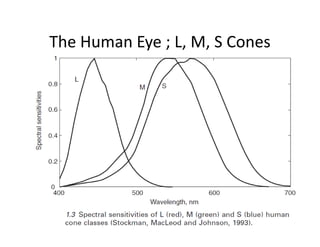
• There are three classes of Cones as L (Long),
M(Medium) and S(Short) Cones
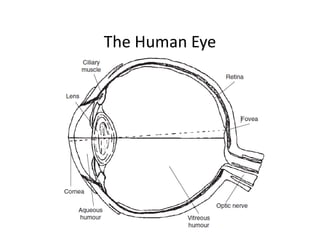
The Human Eye
The Human Eye
• Light is focused onto the retina which includes
specialised cells, known as rods and cones, that
contain photopigments that undergo a chemical
transformation when light of an appropriate
wavelength is absorbed.wavelength is absorbed.
• Normal conditions (Photopic Vision) is by cones
• Low Illuminanave (Scotopic Vision – Dark
conditions) is by Rods
• Generally the Color during Scotopic vision is
Monochromatic and is Grey
The Human Eye
• The three classes of cone are referred to as
being short-, medium- and long-wavelength
sensitive in relation to the wavelength of the
peak sensitivity of the photopigments.peak sensitivity of the photopigments.
• The abbreviated terms L-, M-, and S-cone
classes are often used.
The Human Eye ; L, M, S Cones
The Human Eye
• Additive colour mixing and trichromacy lead to
the view that there should be three colour
primaries, psychologically it has been long known
that there are four colour primaries, red, green,
yellow and blue.yellow and blue.
• The retinal signals leave the retina and pass along
the optic nerve away from the eye into the brain.
The fibres from the two eyes meet and cross
over at an anatomical structure known as the
chiasma.
The Human Eye
• The signals from the left-hand part of the visual
field from both eyes project to the right
hemisphere of the brain and those from the
right-hand part of the visual field are processed in
the left hemisphere. The retinal ganglion fibres
terminate at the lateral geniculate nuclei or LGN
the left hemisphere. The retinal ganglion fibres
terminate at the lateral geniculate nuclei or LGN
• At LGN a certain amount of further processing
takes place, before long fibres knownas optic
radiations take the signals to an area in the lower
rear (occipital) part of the cerebral cortex which is
called the visual cortex.
The Spatial Vision
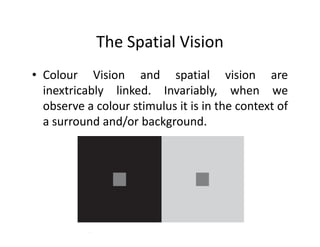
• Colour Vision and spatial vision are
inextricably linked. Invariably, when we
observe a colour stimulus it is in the context of
a surround and/or background.a surround and/or background.
The Spatial Vision
• The Spatial Processing that takes place in the
human visual system therefore impacts upon
how colour perception operates.
• Ganglion Cells are Spectrally opponent and• Ganglion Cells are Spectrally opponent and
some are also spatially opponent.
The Spatial Vision
• Visual system encodes multiple
representations of an image for different
colour directions (e.g. luminance, red–green,
blue–yellow), spatial frequencies andblue–yellow), spatial frequencies and
temporal frequencies.
• The spatial-frequency response of the visual
system as a whole can be quantified by the
contrast-sensitivity function (CSF)
The Color Perception
• Colour perception for humans is three-dimensional, a
fact that almost certainly stems from the existence in
the retina of three different classes of light-receptive
cells.
• Three terms, or numbers, are necessary and sufficient
to define a colour stimulus for the visual system underto define a colour stimulus for the visual system under
standard conditions.
• The three-dimensional nature of colour may be
explained by trichromacy and the existence of the L-,
M-, and S-cone types but the notion of spatial colour
contrast is essential to a modern understanding of
colour perception.
The Color Contrast
• The three-dimensional nature of colour may
be explained by trichromacy and the existence
of the L-, M-, and S-cone types but the notion
of spatial colour contrast is essential to aof spatial colour contrast is essential to a
modern understanding of colour perception.
• Eg: A yellow patch viewed on a green
background will appear more reddish than the
same physical yellow patch on a red
background.
The Color Consultancy and
Appearence
• Next Class

Color interaction with eye

  • 1.
  • 2.
    COLOR • Colour existsonly in the mind; it is a perceptual response to light that enters the eye either directly from self-luminous light sources or, indirectly, from light reflected bysources or, indirectly, from light reflected by illuminated objects.
  • 3.
    The Nature ofColor • Light is a form of energy. Specifically, it is that part of the spectrum of electromagnetic radiation that our eyes are sensitive to. • Visible light is from 360 – 780 nm• Visible light is from 360 – 780 nm (Nanometers i.e 10-9 meters)
  • 4.
  • 5.
  • 6.
    The Physical Basisof Color • Light when falls on object can be of diffuse or specular in nature. • Diffuse Reflectance occurs when light falls on rough surface and is reflected in manyrough surface and is reflected in many directions. • Specular reflectance is produced when light falls on smooth glass like surface. – Angle of reflectance is equal and oppposite to the angle of incidence.
  • 7.
    The Physical Basisof Color • Transparent body lets the light to pass through. • Transperencey is affected by absorption and scattering. • Absorption is a process whereby light is removed• Absorption is a process whereby light is removed by an interaction with the molecules of the object at an electronic level. • Scattering is a kind of reflection that occurs when particles (or air bubbles) are present in the material.
  • 8.
    The Human ColorVision System • The light that is reflected by objects or emitted by light sources enters the eye, where it may be absorbed by visual pigments in the photoreceptors, or cones, contained withinphotoreceptors, or cones, contained within the retina. • There are three classes of Cones as L (Long), M(Medium) and S(Short) Cones
  • 9.
  • 10.
    The Human Eye •Light is focused onto the retina which includes specialised cells, known as rods and cones, that contain photopigments that undergo a chemical transformation when light of an appropriate wavelength is absorbed.wavelength is absorbed. • Normal conditions (Photopic Vision) is by cones • Low Illuminanave (Scotopic Vision – Dark conditions) is by Rods • Generally the Color during Scotopic vision is Monochromatic and is Grey
  • 11.
    The Human Eye •The three classes of cone are referred to as being short-, medium- and long-wavelength sensitive in relation to the wavelength of the peak sensitivity of the photopigments.peak sensitivity of the photopigments. • The abbreviated terms L-, M-, and S-cone classes are often used.
  • 12.
    The Human Eye; L, M, S Cones
  • 13.
    The Human Eye •Additive colour mixing and trichromacy lead to the view that there should be three colour primaries, psychologically it has been long known that there are four colour primaries, red, green, yellow and blue.yellow and blue. • The retinal signals leave the retina and pass along the optic nerve away from the eye into the brain. The fibres from the two eyes meet and cross over at an anatomical structure known as the chiasma.
  • 14.
    The Human Eye •The signals from the left-hand part of the visual field from both eyes project to the right hemisphere of the brain and those from the right-hand part of the visual field are processed in the left hemisphere. The retinal ganglion fibres terminate at the lateral geniculate nuclei or LGN the left hemisphere. The retinal ganglion fibres terminate at the lateral geniculate nuclei or LGN • At LGN a certain amount of further processing takes place, before long fibres knownas optic radiations take the signals to an area in the lower rear (occipital) part of the cerebral cortex which is called the visual cortex.
  • 18.
    The Spatial Vision •Colour Vision and spatial vision are inextricably linked. Invariably, when we observe a colour stimulus it is in the context of a surround and/or background.a surround and/or background.
  • 19.
    The Spatial Vision •The Spatial Processing that takes place in the human visual system therefore impacts upon how colour perception operates. • Ganglion Cells are Spectrally opponent and• Ganglion Cells are Spectrally opponent and some are also spatially opponent.
  • 20.
    The Spatial Vision •Visual system encodes multiple representations of an image for different colour directions (e.g. luminance, red–green, blue–yellow), spatial frequencies andblue–yellow), spatial frequencies and temporal frequencies. • The spatial-frequency response of the visual system as a whole can be quantified by the contrast-sensitivity function (CSF)
  • 21.
    The Color Perception •Colour perception for humans is three-dimensional, a fact that almost certainly stems from the existence in the retina of three different classes of light-receptive cells. • Three terms, or numbers, are necessary and sufficient to define a colour stimulus for the visual system underto define a colour stimulus for the visual system under standard conditions. • The three-dimensional nature of colour may be explained by trichromacy and the existence of the L-, M-, and S-cone types but the notion of spatial colour contrast is essential to a modern understanding of colour perception.
  • 22.
    The Color Contrast •The three-dimensional nature of colour may be explained by trichromacy and the existence of the L-, M-, and S-cone types but the notion of spatial colour contrast is essential to aof spatial colour contrast is essential to a modern understanding of colour perception. • Eg: A yellow patch viewed on a green background will appear more reddish than the same physical yellow patch on a red background.
  • 23.
    The Color Consultancyand Appearence • Next Class