Glare
ILP Professional Lighting Summit - June 2019
Nic Winter - Road Lighting Sales Manager
TRT Lighting Ltd
Contents
• What determines glare?
• Disability & Discomfort glare
• T.I. & G Classes
• Tunnels
• T.I. deconstructed
• T.I. & age
• Sports/outdoor work environment Lighting
• GR and area lighting – example junction
• L.E.D.s source size – D classes
• Office Lighting – UGR – source size
What Determines Glare?
• How “bright” the light source is – how much
light is coming from the source, in the
direction of the viewer?
• How dark the surroundings are?
• Is the light source in the line of sight?
• How big is the light source?
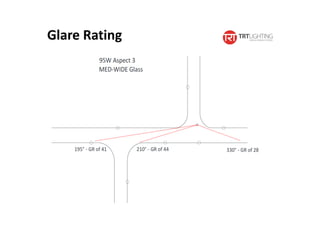
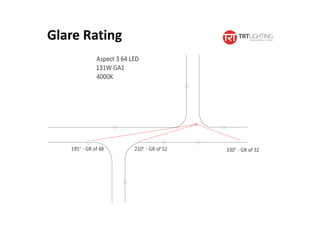
• How “bright” the light source is – the photometry of the fitting
determines what % of the output of the fitting is directed
towards the viewer and what power/flux the output is obviously
also affects brightness. Photometry & Power.
• How dark the surroundings are - ambience - the Luminance of
the known surfaces.
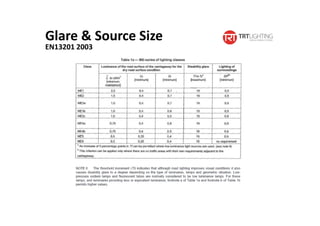
• How directly the light source is in the line of sight, affects the
intensity of the illuminance on the eye. Relative position.
• How big the light source is – source size.
• How old the observer is -Glare, like all lighting, is the interaction
of light & a person.
What Determines Glare?
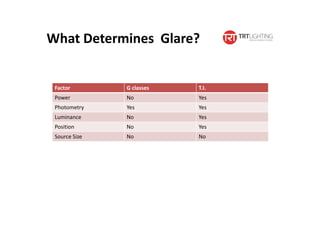
Factor G classes T.I.
Power No Yes
Photometry Yes Yes
Luminance No Yes
Position No Yes
Source Size No No
What Determines Glare?
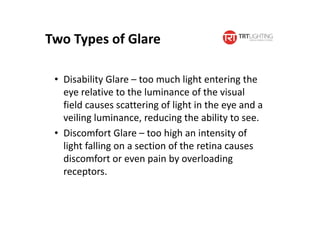
Two Types of Glare
• Disability Glare – too much light entering the
eye relative to the luminance of the visual
field causes scattering of light in the eye and a
veiling luminance, reducing the ability to see.
• Discomfort Glare – too high an intensity of
light falling on a section of the retina causes
discomfort or even pain by overloading
receptors.
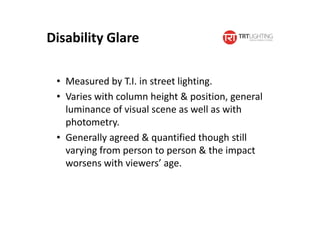
Disability Glare
• Measured by T.I. in street lighting.
• Varies with column height & position, general
luminance of visual scene as well as with
photometry.
• Generally agreed & quantified though still
varying from person to person & the impact
worsens with viewers’ age.
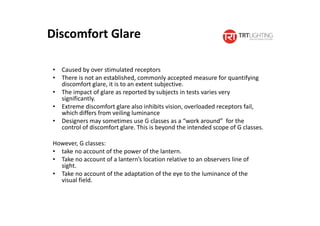
Discomfort Glare
• Caused by over stimulated receptors
• There is not an established, commonly accepted measure for quantifying
discomfort glare, it is to an extent subjective.
• The impact of glare as reported by subjects in tests varies very
significantly.
• Extreme discomfort glare also inhibits vision, overloaded receptors fail,
which differs from veiling luminance
• Designers may sometimes use G classes as a “work around” for the
control of discomfort glare. This is beyond the intended scope of G classes.
However, G classes:
• take no account of the power of the lantern.
• Take no account of a lantern’s location relative to an observers line of
sight.
• Take no account of the adaptation of the eye to the luminance of the
visual field.
G Class restrictions do not
necessarily limit disability glare
As measured by T.I.
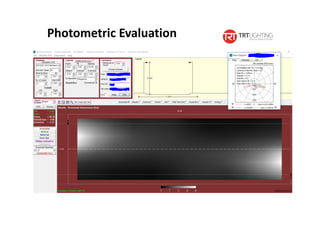
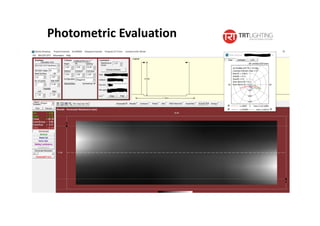
Photometric Evaluation
Glare control in tunnels is measured by T.I.
relating to disability glare – a key difference to
road lighting being that the luminance of the walls and
ceiling are known as well as the roadway. Discomfort
glare is not separately accounted for. The road surface
can be made brighter (reducing T.I.) by closely spaced
luminaires with a distribution that does not overly
illuminate the eye (which causes veiling luminance).
This could partly explain why there are some reports of
discomfort glare in tunnels lit with L.E.D.s despite T.I.
limits being met.
Tunnel Lighting
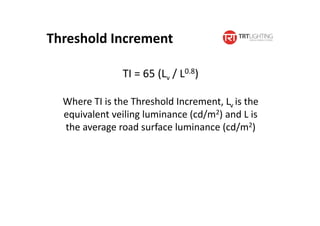
Threshold Increment
TI = 65 (Lv / L0.8)
Where TI is the Threshold Increment, Lv is the
equivalent veiling luminance (cd/m2) and L is
the average road surface luminance (cd/m2)
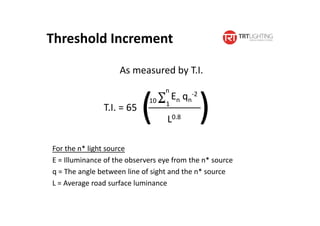
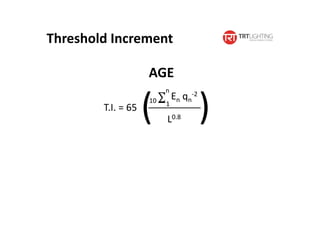
T.I. = 65
Threshold Increment
As measured by T.I.
En qn
-2n
1
( )L0.8
For the n* light source
E = Illuminance of the observers eye from the n* source
q = The angle between line of sight and the n* source
L = Average road surface luminance
10
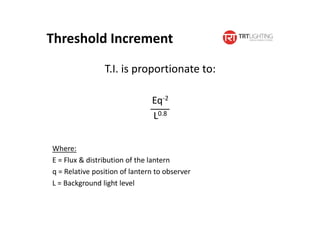
T.I. is proportionate to:
Eq-2
L0.8
Threshold Increment
Where:
E = Flux & distribution of the lantern
q = Relative position of lantern to observer
L = Background light level
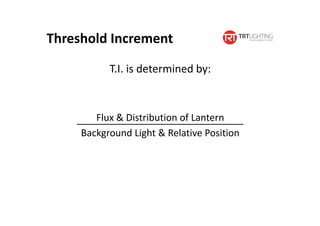
T.I. is determined by:
Flux & Distribution of Lantern
Background Light & Relative Position
Threshold Increment
Glare & older drivers
As measured by T.I.
T.I. = 65
Threshold Increment
AGE
En qn
-2n
1
( )L0.8
10
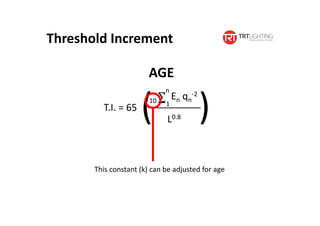
T.I. = 65
Threshold Increment
AGE
En qn
-2n
1
( )L0.8
10
This constant (k) can be adjusted for age
K = 9.05
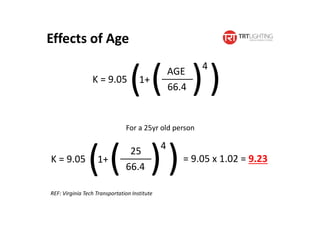
Effects of Age
( )1+
(AGE
66.4
4
)
K = 9.05
( )1+
( 25
66.4
4
)
For a 25yr old person
= 9.05 x 1.02 = 9.23
REF: Virginia Tech Transportation Institute
K = 9.05
Effects of Age
( )1+
(AGE
66.4
4
)
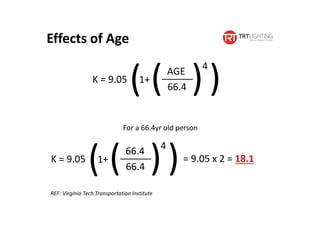
K = 9.05
( )1+
(66.4
66.4
4
)
For a 66.4yr old person
= 9.05 x 2 = 18.1
REF: Virginia Tech Transportation Institute
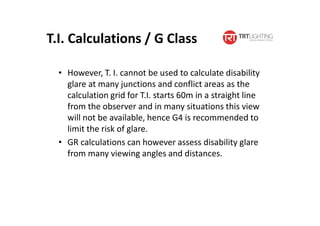
• However, T. I. cannot be used to calculate disability
glare at many junctions and conflict areas as the
calculation grid for T.I. starts 60m in a straight line
from the observer and in many situations this view
will not be available, hence G4 is recommended to
limit the risk of glare.
• GR calculations can however assess disability glare
from many viewing angles and distances.
T.I. Calculations / G Class
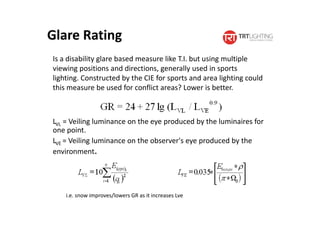
Glare Rating
LVL = Veiling luminance on the eye produced by the luminaires for
one point.
LVE = Veiling luminance on the observer's eye produced by the
environment.
Is a disability glare based measure like T.I. but using multiple
viewing positions and directions, generally used in sports
lighting. Constructed by the CIE for sports and area lighting could
this measure be used for conflict areas? Lower is better.
i.e. snow improves/lowers GR as it increases Lve
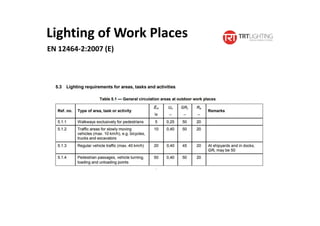
Lighting of Work Places
EN 12464-2:2007 (E)
Glare Rating
i.e. snow improves/lowers GR as it increases Lve
Glare Rating
i.e. snow improves/lowers GR as it increases Lve
What’s Changed…? - LEDs.
• Do our existing measures of glare show any difference
between LEDs and lamp based lanterns?
• If not, does this mean that LEDs are not actually “more glary”
or that our current measures of glare are insufficient?
• Previous BS (2003) took account of source size
Glare & Source Size
EN13201 2003
Source size
• Lumens per mm2 of emitter or Candelas per
steradian ?
• What is the emitter – the LED chip, the lens, the
cover ?
• Is far field single point photometry now failing?
• At 20m distance from a lantern on a 10m column
the eye can delineate as finely as an 8mm separation
between 8mm wide lines.
Source size UGR
• Used in interior lighting to quantify discomfort glare despite being a
luminance based measure.
• UGR accounts for the contrast in Luminance of a lantern to the
surrounding luminance.
• It takes account of the source size and the relative position of the observer
as part of the calculation of the luminance of the lantern.
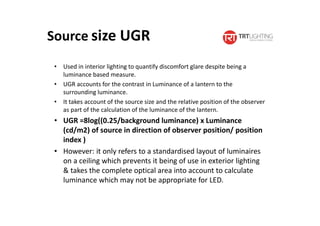
• UGR =8log((0.25/background luminance) x Luminance
(cd/m2) of source in direction of observer position/ position
index )
• However: it only refers to a standardised layout of luminaires
on a ceiling which prevents it being of use in exterior lighting
& takes the complete optical area into account to calculate
luminance which may not be appropriate for LED.
What to Do?
• Consider the T.I. of illuminance based designs when the road
layout is broadly appropriate but balance this with the need for
vertical illuminance.
• There is not an established measure of discomfort glare in
street lighting.
• G classes can be misleading
• T.I. is an increasing concern with increasing driver age
• For conflict areas G4 as per the B.S. guidance is playing safe but
potentially unnecessarily restrictive in some situations.
• Consider using GR in conflict areas.
• Research on the effect of source size is needed.

PLS 2019: Glare

  • 1.
    Glare ILP Professional LightingSummit - June 2019 Nic Winter - Road Lighting Sales Manager TRT Lighting Ltd
  • 2.
    Contents • What determinesglare? • Disability & Discomfort glare • T.I. & G Classes • Tunnels • T.I. deconstructed • T.I. & age • Sports/outdoor work environment Lighting • GR and area lighting – example junction • L.E.D.s source size – D classes • Office Lighting – UGR – source size
  • 3.
    What Determines Glare? •How “bright” the light source is – how much light is coming from the source, in the direction of the viewer? • How dark the surroundings are? • Is the light source in the line of sight? • How big is the light source?
  • 4.
    • How “bright”the light source is – the photometry of the fitting determines what % of the output of the fitting is directed towards the viewer and what power/flux the output is obviously also affects brightness. Photometry & Power. • How dark the surroundings are - ambience - the Luminance of the known surfaces. • How directly the light source is in the line of sight, affects the intensity of the illuminance on the eye. Relative position. • How big the light source is – source size. • How old the observer is -Glare, like all lighting, is the interaction of light & a person. What Determines Glare?
  • 5.
    Factor G classesT.I. Power No Yes Photometry Yes Yes Luminance No Yes Position No Yes Source Size No No What Determines Glare?
  • 6.
    Two Types ofGlare • Disability Glare – too much light entering the eye relative to the luminance of the visual field causes scattering of light in the eye and a veiling luminance, reducing the ability to see. • Discomfort Glare – too high an intensity of light falling on a section of the retina causes discomfort or even pain by overloading receptors.
  • 7.
    Disability Glare • Measuredby T.I. in street lighting. • Varies with column height & position, general luminance of visual scene as well as with photometry. • Generally agreed & quantified though still varying from person to person & the impact worsens with viewers’ age.
  • 8.
    Discomfort Glare • Causedby over stimulated receptors • There is not an established, commonly accepted measure for quantifying discomfort glare, it is to an extent subjective. • The impact of glare as reported by subjects in tests varies very significantly. • Extreme discomfort glare also inhibits vision, overloaded receptors fail, which differs from veiling luminance • Designers may sometimes use G classes as a “work around” for the control of discomfort glare. This is beyond the intended scope of G classes. However, G classes: • take no account of the power of the lantern. • Take no account of a lantern’s location relative to an observers line of sight. • Take no account of the adaptation of the eye to the luminance of the visual field.
  • 9.
    G Class restrictionsdo not necessarily limit disability glare As measured by T.I.
  • 10.
  • 11.
  • 12.
    Glare control intunnels is measured by T.I. relating to disability glare – a key difference to road lighting being that the luminance of the walls and ceiling are known as well as the roadway. Discomfort glare is not separately accounted for. The road surface can be made brighter (reducing T.I.) by closely spaced luminaires with a distribution that does not overly illuminate the eye (which causes veiling luminance). This could partly explain why there are some reports of discomfort glare in tunnels lit with L.E.D.s despite T.I. limits being met. Tunnel Lighting
  • 13.
    Threshold Increment TI =65 (Lv / L0.8) Where TI is the Threshold Increment, Lv is the equivalent veiling luminance (cd/m2) and L is the average road surface luminance (cd/m2)
  • 14.
    T.I. = 65 ThresholdIncrement As measured by T.I. En qn -2n 1 ( )L0.8 For the n* light source E = Illuminance of the observers eye from the n* source q = The angle between line of sight and the n* source L = Average road surface luminance 10
  • 15.
    T.I. is proportionateto: Eq-2 L0.8 Threshold Increment Where: E = Flux & distribution of the lantern q = Relative position of lantern to observer L = Background light level
  • 16.
    T.I. is determinedby: Flux & Distribution of Lantern Background Light & Relative Position Threshold Increment
  • 17.
    Glare & olderdrivers As measured by T.I.
  • 18.
    T.I. = 65 ThresholdIncrement AGE En qn -2n 1 ( )L0.8 10
  • 19.
    T.I. = 65 ThresholdIncrement AGE En qn -2n 1 ( )L0.8 10 This constant (k) can be adjusted for age
  • 20.
    K = 9.05 Effectsof Age ( )1+ (AGE 66.4 4 ) K = 9.05 ( )1+ ( 25 66.4 4 ) For a 25yr old person = 9.05 x 1.02 = 9.23 REF: Virginia Tech Transportation Institute
  • 21.
    K = 9.05 Effectsof Age ( )1+ (AGE 66.4 4 ) K = 9.05 ( )1+ (66.4 66.4 4 ) For a 66.4yr old person = 9.05 x 2 = 18.1 REF: Virginia Tech Transportation Institute
  • 22.
    • However, T.I. cannot be used to calculate disability glare at many junctions and conflict areas as the calculation grid for T.I. starts 60m in a straight line from the observer and in many situations this view will not be available, hence G4 is recommended to limit the risk of glare. • GR calculations can however assess disability glare from many viewing angles and distances. T.I. Calculations / G Class
  • 23.
    Glare Rating LVL =Veiling luminance on the eye produced by the luminaires for one point. LVE = Veiling luminance on the observer's eye produced by the environment. Is a disability glare based measure like T.I. but using multiple viewing positions and directions, generally used in sports lighting. Constructed by the CIE for sports and area lighting could this measure be used for conflict areas? Lower is better. i.e. snow improves/lowers GR as it increases Lve
  • 24.
    Lighting of WorkPlaces EN 12464-2:2007 (E)
  • 25.
    Glare Rating i.e. snowimproves/lowers GR as it increases Lve
  • 26.
    Glare Rating i.e. snowimproves/lowers GR as it increases Lve
  • 27.
    What’s Changed…? -LEDs. • Do our existing measures of glare show any difference between LEDs and lamp based lanterns? • If not, does this mean that LEDs are not actually “more glary” or that our current measures of glare are insufficient? • Previous BS (2003) took account of source size
  • 28.
    Glare & SourceSize EN13201 2003
  • 29.
    Source size • Lumensper mm2 of emitter or Candelas per steradian ? • What is the emitter – the LED chip, the lens, the cover ? • Is far field single point photometry now failing? • At 20m distance from a lantern on a 10m column the eye can delineate as finely as an 8mm separation between 8mm wide lines.
  • 30.
    Source size UGR •Used in interior lighting to quantify discomfort glare despite being a luminance based measure. • UGR accounts for the contrast in Luminance of a lantern to the surrounding luminance. • It takes account of the source size and the relative position of the observer as part of the calculation of the luminance of the lantern. • UGR =8log((0.25/background luminance) x Luminance (cd/m2) of source in direction of observer position/ position index ) • However: it only refers to a standardised layout of luminaires on a ceiling which prevents it being of use in exterior lighting & takes the complete optical area into account to calculate luminance which may not be appropriate for LED.
  • 31.
    What to Do? •Consider the T.I. of illuminance based designs when the road layout is broadly appropriate but balance this with the need for vertical illuminance. • There is not an established measure of discomfort glare in street lighting. • G classes can be misleading • T.I. is an increasing concern with increasing driver age • For conflict areas G4 as per the B.S. guidance is playing safe but potentially unnecessarily restrictive in some situations. • Consider using GR in conflict areas. • Research on the effect of source size is needed.